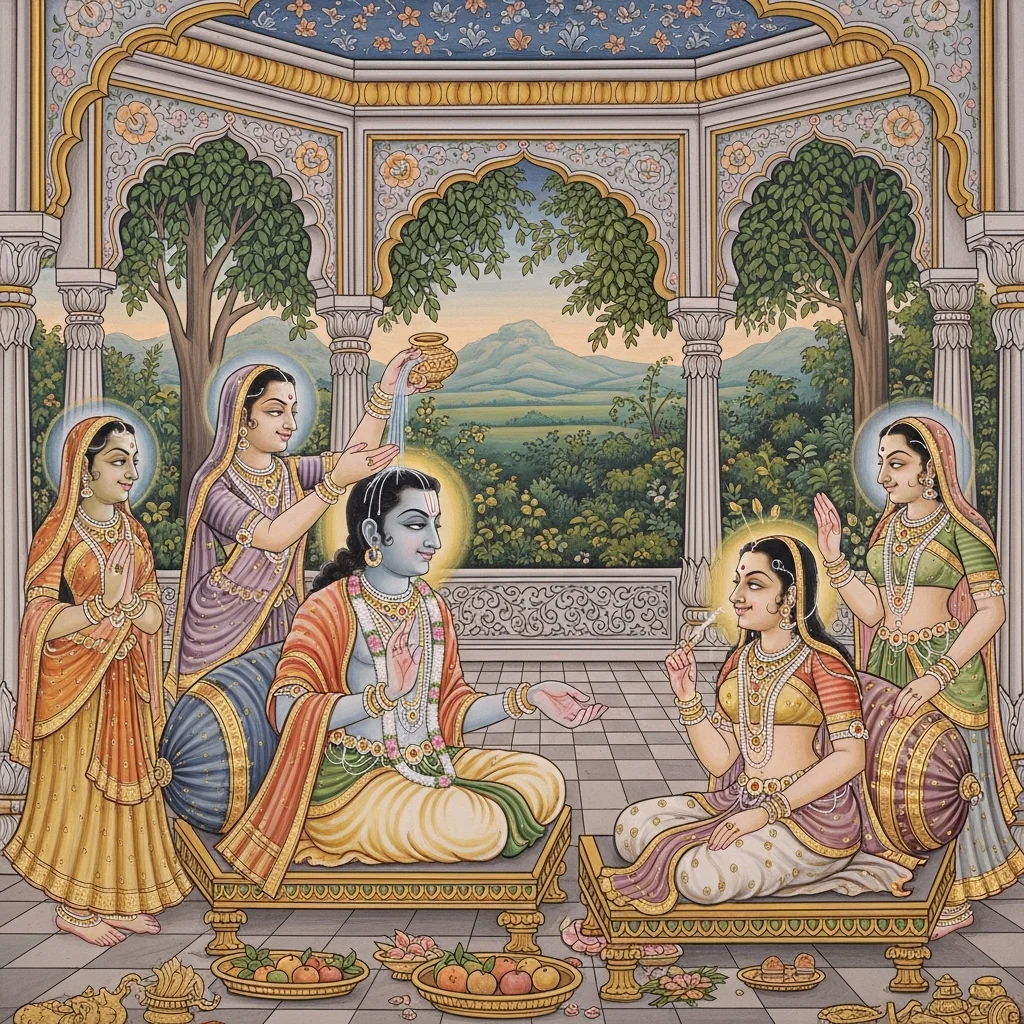
Adhyaya 6
Chapter 6 begins with Īśvara setting out a westward pilgrimage sequence from Maṅgala: darśan of Siddheśvara as the bestower of accomplishments, Cakratīrtha—explicitly said to grant the fruit of “crores of tīrthas”—and Lokeśvara as a svayambhū liṅga. The route continues to Yakṣavana, where Yakṣeśvarī is praised as a wish-fulfilling goddess, and then returns to Vastrāpatha with an extension to Mount Raivataka, portrayed as holding innumerable tīrthas (including Mṛgīkūṇḍa and other named sites) and many divine presences such as Ambikā, Pradyumna, Sāmba, and further Śaiva markers. The dialogue then shifts as Pārvatī recalls the great sacred rivers and liberation-giving cities already heard, and asks why Vastrāpatha is deemed especially significant and how Śiva is established there as svayambhū. Īśvara introduces the promised explanation through an etiological tale: in Kānyakubja, King Bhoja captures a mysterious deer-faced woman from among a herd; she remains mute until priests direct him to the ascetic Sārasvata. Through ritual consecration (abhiṣeka) and mantra-framed procedures, her speech and memory return, and she recounts an extended karmic history across births—kingship, widowhood, animal rebirths, and violent death motifs—culminating in a convergence at Raivataka/Vastrāpatha, presenting the kṣetra as the key to purification and release.
Shlokas
Verse 1
ईश्वर उवाच । अधुना संप्रवक्ष्यामि मंगलात्पश्चिमे व्रजेत् । तत्र सिद्धेश्वरं पश्येत्सर्वसिद्धिप्रदायकम्
Īśvara said: Now I shall declare the route. From Maṅgala one should go westward; there one should behold Siddheśvara, the bestower of every attainment.
Verse 2
तत्रैव चक्रतीर्थं तु तीर्थकोटिफलप्रदम् । लोकेश्वरं स्वयंभूतं पूर्वमिंद्रेश्वरेति च
There itself is Cakratīrtha, granting the fruit of crores of tīrthas. There is Lokeśvara, self-manifest; and formerly it was also known as Indreśvara.
Verse 3
दृष्ट्वा तं विधिवद्देवि ततो यक्षवनं व्रजेत् । मंगलात्पश्चिमे भागे यत्र देवी स्वयं स्थिता
Having beheld him properly, O Goddess, then one should go to Yakṣavana, in the western region from Maṅgala, where the Devī herself abides.
Verse 4
यक्षेश्वरी महाभागा वांछितार्थप्रदायिनी । तां संपूज्य विधानेन ततो वस्त्रापथं पुनः
Yakṣeśvarī, the greatly fortunate one, bestows the desired aims. Having worshipped her according to the proper procedure, then (one should return) again to Vastrāpatha.
Verse 5
गिरिं रैवतकं गत्वा कुर्याद्यात्राविधानतः । मृगीकुंडादितीर्थानि संति तत्रैव कोटिशः
Having gone to Mount Raivataka, one should perform the pilgrimage according to the prescribed observance. There indeed are countless tīrthas there—such as Mṛgīkuṇḍa and others—by the crores.
Verse 6
यद्भुक्तिशिखरे देवि सीमालिंगं हि तत्स्मृतम् । दशकोटिस्तु तीर्थानि तत्र संति वरान ने
O Goddess, on the peak called Bhuktiśikhara, the Sīmāliṅga is indeed remembered. There are ten crores of tīrthas there, O best of women.
Verse 7
यत्र वै यादवाः सिद्धाः कलौ ये बुद्धिरूपिणः । शतसहस्रार्बुदं च लिंगं तत्रैव तिष्ठति
Where the Yādavas—accomplished siddhas—abide, appearing in the Kali age as awakened discernment itself, there too stands the liṅga called Śatasahasrārbuda.
Verse 8
गजेंद्रस्य पदं तत्र तत्रैव रसकूपिकाः । सप्त कुण्डानि तत्रैव रैवते पर्वतोत्तमे
There too is the footprint of Gajendra, and there itself are wells of sacred essence. There also are seven holy ponds upon Raivata, the most excellent of mountains.
Verse 9
अंबिका च स्थिता देवी प्रद्युम्नः सांब एव च । लिंगाकारे पर्वते तु तत्र तीर्थानि कोटिशः
There abides the Goddess Ambikā; and Pradyumna, and Sāmba as well. On that mountain, shaped like a liṅga, there are tīrthas by the crores.
Verse 10
मृगीकुंडं च तत्रैव कालमेघस्तथैव च । क्षेत्रपालस्वरूपेण महोदधि स्वयं स्थितः । दामोदरश्च तत्रैव भवो ब्रह्माडनायकः
There also are Mṛgī-kuṇḍa and likewise Kāla-megha. The great ocean itself stands there in the form of Kṣetrapāla, guardian of the sacred field. There too are Dāmodara and Bhava, the lord of the Brahmāṇḍa (the universe).
Verse 11
पार्वत्युवाच । श्रुतानि तव तीर्थानि देवेश वदतस्तव । गंगा सरस्वती पुण्या यमुना च महानदी
Pārvatī said: O Lord of the gods, I have heard of your tīrthas as you have been describing them—such as the Gaṅgā, the Sarasvatī the pure, the holy Yamunā, and the great rivers (and others).
Verse 12
गोदावरी गोमती च नदी तापी च नर्मदा । सरयूः स्वर्णरेखा च तमसा पापनाशिनी
The Godāvarī and the Gomatī; the river Tāpī and the Narmadā; the Sarayū and the Svarṇarekhā; and the Tamasā, the destroyer of sins.
Verse 13
नद्यः समुद्रसंयोगाः सर्वाः पुण्याः श्रुता मया । मोक्षारण्यानि दिव्यानि ।दिव्यक्षेत्राणि यानि च
I have heard that all rivers—especially where they meet the ocean—are holy. And I have heard of the divine forests that grant liberation, and of the sacred kṣetras that are celebrated as divine.
Verse 14
नगर्यो मुक्तिदायिन्यस्ताः श्रुतास्त्वत्प्रसादतः । ब्रह्मविष्णुशिवादीनां सूर्येंदुवरुणस्य च
And through your grace I have heard of those cities that bestow liberation; and of the sacred abodes associated with Brahmā, Viṣṇu, Śiva, and others, and also of Sūrya, the Moon, and Varuṇa.
Verse 15
देवताना मृषीणां च संति स्थानान्यनेकशः । परं देव त्वया पुण्यं प्रभासं कथितं मम
There are many abodes of the gods and of the ṛṣis. Yet, O Lord, you have told me of holy Prabhāsa as something supreme.
Verse 16
तस्माद्यच्चाधिकं प्रोक्तं क्षेत्रं वस्त्रापथं त्वया । शृण्वंत्या च मया पूर्वं न पृष्टं कारणं तदा
Therefore, since you have declared Vastrāpatha to be an even more excellent kṣetra, I—though I had heard it earlier—did not then ask the reason.
Verse 17
इदानीं च श्रुतं सर्वं स्वस्थाहं कारणं वद । प्रभावं प्रथमं ब्रूहि क्षेत्रस्य च भवस्य च
Now I have heard everything and am composed; tell me the reason. First, explain the glory—both of this kṣetra and of Bhava (Śiva) as well.
Verse 18
कस्मिन्देशे च तत्तीर्थं शिवः केनात्र संस्थितः । स्वयंभूर्भगवान्रुद्रः कथं तत्र स्थितः स्वयम् । प्रभो मे महदाश्चर्यं वर्तते तद्वदाधुना
In what land is that tīrtha? By whom was Śiva established there? How did the self-born, blessed Rudra come to abide there by himself? O Lord, this is a great wonder to me—tell me of it now.
Verse 19
ईश्वर उवाच । वस्त्रापथस्य क्षेत्रस्य प्रभावं प्रथमं शृणु । पश्चाद्भवस्य माहात्म्यं शृणु त्वं च वरानने
Īśvara said: “First, hear the power and excellence of the kṣetra of Vastrāpatha; thereafter, O fair-faced one, hear also the greatness of Bhava (Śiva) there.”
Verse 20
कान्यकुब्जे महाक्षेत्रे राजा भोजेति विश्रुतः । पुरा पुण्ययुगे धर्म्यः प्रजा धर्मेण शासति
In the great sacred region of Kānyakubja there was a king famed as Bhoja. In former times, in that auspicious age, that righteous ruler governed his subjects according to dharma.
Verse 21
विशालाक्षो दीर्घबाहुर्विद्वान्वाग्ग्मी प्रियंवदः । सर्वलक्षणसंपूर्णो बह्वाश्चर्यविलोककः
He was large-eyed and long-armed—learned, eloquent, and sweet-spoken; endowed with every noble mark, and keen in observing many wonders.
Verse 22
वनात्कदाचिदभ्येत्य वनपालोब्रवीदिदम् । आश्चर्यं भ्रमता देव वने दृष्टं मयाधुना
Once, returning from the forest, the forest-guard said: “O King, while roaming in the woods I have just seen a marvel.”
Verse 23
गिरौ विषमभूभागे वहुवृक्षसमाकुले । मृगयूथगता नारी मया दृष्टा मृगानना
On a mountain, in uneven terrain thick with many trees, I saw a woman moving among a herd of deer—her face like that of a doe.
Verse 24
मृगवत्प्लवते बाला सदा तत्रैव दृश्यते । इति श्रुत्वा वचो राजा तुष्टस्तस्मै धनं ददौ
“That young girl leaps like a deer and is always seen there.” Hearing these words, the king—pleased—gave him a reward of wealth.
Verse 25
चतुरं तुरगं दिव्यं वाससी स्वर्णभूषणम् । इदानीमेव यास्यामि सेनाध्यक्ष त्वया सह
“Bring a fine, swift divine horse, garments, and golden ornaments. I shall go at once—commander of the army—together with you.”
Verse 26
अश्वानां दशसाहस्रं वागुराणां त्वनेकधा । पत्तयो यांतु सर्वत्र वेष्टयंतु गिरिंवरम्
Let ten thousand horsemen—together with nets of many kinds—go forth in every direction; and let the foot-soldiers encircle the excellent mountain.
Verse 27
न हंतव्यो मृगः कश्चिद्रक्षणीया हि सा मृगी । स्त्रीवेषधारिणी नारी मृगी भवति भूतले
No deer should be slain at all; that doe must indeed be protected. A woman bearing a woman’s guise becomes a doe upon the earth.
Verse 28
क्व यास्यति वराकी सा मद्बलैः परिपीडिता । शस्त्रास्त्रवर्जितं सैन्यं वनपालपदानुगम्
Where can that poor woman go, when she is being hard-pressed by my forces? This troop bears no weapons or missiles, and moves under the guidance of the forest-guard.
Verse 29
अहोरात्रेण संप्राप्तं बहुव्याधजनाग्रतः । अश्वाधिरूढो बलवान्भोजराजो ययौ स्वयम्
Within a single day and night, with many hunters at the front, the mighty Bhoja king himself rode forth on horseback.
Verse 30
निःशब्दपदसञ्चारः संज्ञासंकेतभाषकः । गिरिं संवेष्टयामास वागुराभिः स्वयं नृपः
Moving with noiseless steps and speaking only through signs and signals, the king himself surrounded the mountain with nets.
Verse 31
वनपालेन सहितो मृगयूथं ददर्श सः । सा मृगी मृगमध्यस्था नारीदेहा मुखे मृगी । मृगवच्चेष्टते बाला धावते च मृगैः सह
Accompanied by the forest-guard, he beheld a herd of deer. In their midst was a doe—human in body, yet with the face of a deer. The young maiden moved like a deer and ran along with the herd.
Verse 32
अश्वगंधान्समाघ्राय सन्त्रस्ता मृगयूथपाः । क्षुब्धा भ्रान्ताः क्षणे तस्मिन्सर्वे यांति दिशो दश
Catching the scent of horses, the leaders of the deer-herds were struck with fear. Agitated and bewildered, in that very moment they all fled into the ten directions.
Verse 33
मृगवक्त्रा तु या नारी मृगैः कतिपयैः सह । प्लवमाना निपतिता वागुरायां विचेतना
But the deer-faced woman, along with a few deer, leapt and fell into the net, and there she lost consciousness.
Verse 34
बलाध्यक्षेण विधृता मृगैः सह शनैर्नृपः । ददर्श महदाश्चर्यं भोजराजो जनैर्वृतः
Restrained by the commander of the forces, and with the deer secured, the king—Bhojarāja, surrounded by his people—slowly beheld a great wonder.
Verse 35
ततः कोलाहलो जातः परमानंदिनिस्वनः । मृगैः सह समानिन्ये कान्यकुब्जं मृगीं नृपः
Then a loud uproar arose, filled with cries of delight. Along with the deer, the king brought that “doe” to Kānyakubja.
Verse 36
दिव्यवस्त्रसमाच्छन्ना दिव्याभरणभूषिता । नरयानस्थिता नारी प्रविवेश मृगैर्वृता
Clad in divine garments and adorned with heavenly ornaments, the woman, seated upon a human conveyance, entered—surrounded by deer.
Verse 37
वादित्रैर्ब्रह्मघोषैश्च नीयते नृपमंदिरम् । जनैर्जानपदैर्मार्गे दृश्यते नृपमन्दिरे
With music and Vedic acclamations, she was led to the king’s palace. Along the road the townspeople beheld her, and likewise within the royal residence.
Verse 38
नीयमाना नागरैश्च महदाश्चर्यभाषकैः । पुण्ये मुहूर्त्ते संप्राप्ते सा मृगी नृपमन्दिरम्
Escorted by townspeople speaking in great amazement, that doe-maiden was brought—when the auspicious moment arrived—into the king’s palace.
Verse 39
प्रतीहारेण राजेन्द्र वचसा वारितो जनः । गतः सेनापतिः सैन्यं गृहीत्वा स्वनिकेतनम्
O best of kings, the crowd was held back by the chamberlain’s command; and the commander, having gathered the troops, departed to his own quarters.
Verse 40
राजापि स्वगृहं प्राप्य स्नात्वा संपूज्य देवताः । तां मृगीं स्नापयामास दिव्यगन्धानुलेपनाम्
The king too, having returned to his residence, bathed and duly worshipped the deities; then he had that doe-maiden bathed and anointed with heavenly fragrances.
Verse 41
कुङ्कुमेन विलिप्तांगीं दिव्यवस्त्रावगुंठिताम् । यथोचितं यथास्थानं दिव्याभरणभूषिताम्
Her limbs were anointed with kunkuma (saffron), veiled in divine garments; and, as was fitting, in each proper place, she was adorned with heavenly ornaments.
Verse 42
एकांते निर्जने राजा बभाषे चारुलोचनाम् । का त्वं कस्य सुता केन कारणेन मृगैः सह
In a secluded, lonely place the king spoke to the fair-eyed one: “Who are you—whose daughter are you—and for what reason are you here among the deer?”
Verse 43
स्त्रीणां शरीरं ते कस्मान्मृगीणां वदनं कुतः । इति सर्वं समाचक्ष्व परं कौतूहलं हि मे
“Why do you have the body of a woman, yet the face of a doe? Tell me all of this—for my curiosity is great.”
Verse 44
एवं सा प्रोच्यमानापि न बभाषे कथंचन । मूकवन्न विजानाति न च भुंक्ते सुलोचना
Though questioned in this way, she did not speak at all. Like one mute, she seemed unaware—and the lovely-eyed one did not even eat.
Verse 45
न भुंक्ते पृथिवीपालो न राज्यं बहु मन्यते । न दारैर्विद्यते कार्यं नाश्वैर्न च गजै रथैः
The protector of the earth would not eat, nor did he value his kingdom. He found no purpose in wives, nor in horses, elephants, or chariots.
Verse 46
तदेव राज्यं ते दारास्ते गजास्तद्धनं बहु । प्रमदामदसंरक्तं यत्र संक्रीडते मनः
For him, that alone is “kingdom”—that alone is “wife,” that alone “elephants” and abundant “wealth”—where the mind, intoxicated by passion for a woman, sports and revels.
Verse 47
आहूयाह प्रतीहारं तया संमोहितो नृपः । पुरोधसं गुरुं विप्रानाचार्याञ्छीघ्रमानय
Deluded and shaken by her, the king summoned the chamberlain and said: “Quickly bring the royal priest, the preceptor, and the brāhmaṇa teachers.”
Verse 48
दैवज्ञानथ मन्त्रज्ञान्भिषजस्तांत्रिकांस्तथा । इति सन्नोदितो राज्ञा प्रतीहारो ययौ स्वयम्
Thus urged by the king, the chamberlain himself went forth to summon those skilled in divine omens, mantra-lore, healing, and tantric rites.
Verse 49
आजगाम स वेगेन समानीय द्विजोत्तमान् । राज्ञे विज्ञापयामास देव विप्राः समागताः
He returned swiftly, having brought the best of the twice-born, and reported to the king: “O Lord, the brāhmaṇas have arrived.”
Verse 50
प्रवेशय गुरुं द्वाःस्थं संप्राप्तान्मद्धिते रतान् । इति सन्नोदितो राज्ञा तथा चक्रे स बुद्धिमान्
“Admit them, O doorkeeper—those who have come, intent on my welfare.” Thus instructed by the king, the wise attendant did exactly so.
Verse 51
अभ्युत्थाय नृपः पूर्वं नमस्कृत्य प्रपूज्य च । आसनेषूपविष्टांस्तान्बभाषे कार्यतत्परः
Rising first, the king bowed in reverence and duly honored them; and when they were seated upon their seats, he addressed them, intent upon the matter at hand.
Verse 52
इदमाश्चर्यमेवैकं कथं शक्यं निवेदितुम् । जानीत हि स्वयं सर्वे लोकतः शास्त्रतोऽपि वा
“This is a single wonder indeed—how can it be properly explained? You all surely know of it yourselves, whether from common report or from the scriptures.”
Verse 53
कथमेषा समुत्पन्ना कस्येदं कर्मणः फलम् । अस्यां केन प्रकारेण वचनं मानुषं भवेत्
“How did she arise, and whose deed bears this fruit? And by what means could human speech ever manifest in her?”
Verse 54
स्वयं मनुष्यवदना कथमेषा भविष्यति । सावधानैर्द्विजैर्भूयः सर्वं संचिन्त्य चोच्यताम्
“How could she, of herself, come to have a human face? Let the attentive brāhmaṇas reflect on everything again and then declare it.”
Verse 55
विप्रा ऊचुः । देव सारस्वतो नाम कुरुक्षेत्रे द्विजोत्तमः । ऊर्द्ध्वरेताः सरस्वत्यां तपस्तेपे जितेन्द्रियः
The brāhmaṇas said: “O King, there is a foremost brāhmaṇa named Deva Sārasvata in Kurukṣetra—celibate, self-restrained—who performed austerities on the Sarasvatī.”}]}}}json to=verse_translations code={
Verse 56
कथयिष्यति सर्वं ते तेनादिष्टा मृगी स्वयम् । इति श्रुत्वा वचो राजा ययौ सारस्वतं द्विजम्
“He will recount everything to you; the doe herself has been directed by him.” Hearing these words, the king went to the brāhmaṇa Sārasvata.
Verse 57
सरस्वतीजले स्नातं प्रभासे ध्यानतत्परम् । दृष्ट्वा प्रदक्षिणीकृत्य साष्टांगं तं प्रणम्य च । उपविष्टो नृपो भूमौ प्रांजलिः सञ्जितेन्द्रियः
Seeing him—bathed in the waters of the Sarasvatī at Prabhāsa and wholly intent on meditation—the king circumambulated him, bowed with the eight-limbed prostration, and then sat upon the ground with folded hands, his senses restrained.
Verse 58
मनुष्यपदसंचारं श्रुत्वा ज्ञात्वा च कारणम् । सारस्वतो बभाषेऽथ तं नृपं भक्तितत्परम्
Having heard the sound of human footsteps and understood its cause, Sārasvata then addressed that king, who was wholly devoted in devotion.
Verse 59
सारस्वत उवाच । भोजराज शुभं तेस्तु ज्ञातं तत्कारणं मया । मृगानना त्वया नारी समानीता वनात्किल
Sārasvata said: “O Bhojarāja, may auspiciousness be yours. I have understood the reason for this. Indeed, a doe-faced woman has been brought by you from the forest.”
Verse 60
महदाश्चर्यमेवैतत्तव चेतसि वर्त्तते । आदिष्टा तु मया बाला सर्वं ते कथयिष्यति
“This very matter appears as a great wonder in your mind. But the young woman has been instructed by me—she will tell you everything.”
Verse 61
जानाम्यहं महाराज चरित्रं जन्म यादृशम् । आश्चर्यं संभवेल्लोके कथ्यमानं तया स्वयम्
O great king, I know the tale—what her birth was like. When she herself recounts it, it will indeed become a wonder to the world.
Verse 62
इत्यादिश्य गतो वेगाद्रथेनादित्यवर्चसा । अहोरात्रद्वयेनैव संप्राप्तो नृप मन्दिरम्
Having thus instructed them, he departed swiftly in a chariot radiant like the sun; and in merely two days and nights he arrived at the king’s palace.
Verse 63
प्रविश्य च मृगीं दृष्ट्वा यत्रास्ते मृगलोचना । तया सारस्वतो ज्ञातो धर्मज्ञः सर्वविद्द्विजः
Entering within and seeing the doe-eyed woman where she was staying, she recognized Sārasvata as a Brahmin who knew dharma and was all-knowing.
Verse 64
मृग्युवाच । एष सर्वं हि जानाति कारणं यच्च यादृशम् । वर्त्तमानं भविष्यं च भूतं यद्भुवनत्रये
The doe-woman said: “He indeed knows everything—the cause and its nature—what is present, what is to come, and what has been, across the three worlds.”
Verse 65
एतेन मरणं ज्ञातं मदीयं पूर्वजन्मनि । वस्त्रापथे महाक्षेत्रे तपस्तप्तं भवालये
“Through him my death in a former birth has been known—when, in the great sacred field of Vastrāpatha, in the abode of Bhava (Śiva), austerity was performed.”
Verse 66
विधूय कलुषं सर्वं ज्ञानमुत्पाद्य यत्नतः । जरामरणनिर्मुक्तः प्रत्यक्षं दृष्टवान्भवम्
Shaking off all impurity and, with earnest effort, bringing forth true knowledge, one is freed from old age and death and beholds Bhava (Śiva) directly.
Verse 67
अस्य तुष्टो भवो देवो ज्ञातं तीर्थस्य कारणम् । आदिष्टया मया वाच्यं भवेज्जन्मनि कारणम्
Bhava, the Lord, pleased with him, made known the cause of this tīrtha. And as I was instructed, I must speak of the cause of this birth.
Verse 68
इति चिन्तापरा यावत्तावद्विप्रः समागतः । तस्मै प्रणामपरमा मूर्च्छिता निपपात सा
While she remained absorbed in anxious thought, a brāhmaṇa arrived. Striving to bow to him with utmost reverence, she collapsed to the ground, fainting.
Verse 69
अथ सारस्वतो ज्ञानाज्ज्ञातवान्कारणं च तत् । आनयन्तु द्विजा वेगात्कलशं तोयसंभृतम्
Then, through Sarasvatī-born insight, the brāhmaṇa understood its cause. He said, “O twice-born ones, quickly bring a water-filled pot (kalaśa).”
Verse 70
सवौंषधीः पल्लवांश्च दूर्वाः पुष्पाणि चाक्षतान् । धूपं च चंदनं चैव गोमयं मधुसर्पिषी
“Bring all medicinal herbs, fresh sprouts, dūrvā grass, flowers and akṣata (unbroken grains); also incense (dhūpa) and sandalwood, cow-dung, honey, and ghee.”
Verse 71
इत्यादिष्टैर्द्विजैर्वेगात्समानीतं नृपाज्ञया । उपलिप्य च भूभागं स्वस्तिकं संनिवेश्य च
Thus instructed, the twice-born swiftly brought everything by the king’s command. They plastered the ground and set upon it the auspicious svastika mark.
Verse 72
तत्राग्निकार्यं कृत्वाऽथ वेदान्कुंभे निधाय सः । इन्द्रं तस्मिंश्च विन्यस्य दिक्पालांश्च यथाक्रमम् । हुत्वाग्निं स चरुं कृत्वा ग्रहपूजामकारयत्
There he performed the fire-ritual; then, placing the Vedas within the pot, he installed Indra there and, in due order, the guardians of the directions. Having offered oblations into the fire and prepared the caru offering, he had the worship of the planets performed.
Verse 73
तोयं सुवर्णपात्रस्थं कृत्वा कुंभान्स्वयं गुरुः । अभिषेकं ततश्चक्रे मुहूर्ते सार्वकामिके
Placing the water in a golden vessel and arranging the pots himself, the guru then performed the consecratory sprinkling (abhiṣeka) at an auspicious, wish-fulfilling moment.
Verse 74
अभिषिक्ता तु सा तेन पूता स्नानार्थवारिणा । जाता सचेतना बाला सर्वं पश्यति चक्षुषा
When she was sprinkled by him with that purified water meant for bathing, the girl was cleansed and regained consciousness; with her eyes she could see everything clearly.
Verse 75
शृणोति सर्वं जानाति चरित्रं पूर्वजन्मनः । बदरीफलमात्रं तु पुरोडाशं ददौ गुरुः
She could hear everything and understood the account of her former birth. Then the guru gave her a puroḍāśa offering, only as much as a single badarī (jujube) fruit.
Verse 76
तयोपभुक्तं यत्नेन ततश्चक्रे स मार्ज्जनम् । मानुषे वचने कर्णे ददौ ज्ञानं गुरुस्ततः
After she had partaken of it with care, he performed a rite of purification. Thereafter the guru bestowed understanding, speaking human words into her ear.
Verse 77
गुरवे दक्षिणां दत्त्वा ततः सा च मृगानना । भोजराजाय सर्व च चरित्रं पूर्वजन्मनः
Having given the guru his dakṣiṇā (due offering), she—gentle-featured, deer-faced—then related to King Bhoja the entire account of her former birth.
Verse 78
वक्तुं प्रचक्रमे बाल्याद्यद्वृत्तं पूर्वजन्मनि । नमस्कृत्य गुरुं पूर्वं ब्राह्मणान्क्षत्रियांस्तथा
He then began to recount the events of his former birth, starting from childhood; first he bowed to his teacher, and likewise to the brāhmaṇas and the kṣatriyas.
Verse 79
मृग्युवाच । न विषादस्त्वया कार्यो राजञ्च्छ्रुत्वा मयोदितम् । इतस्त्वं सप्तमे स्थाने कलिंगाधिपतेः सुतः
Mṛgyu said: “O King, do not grieve after hearing what I have spoken. From here, in the seventh birth, you will be born as the son of the ruler of Kaliṅga.”
Verse 80
मृते पितरि बालस्त्वं स्वभिषिक्तः स्वमंत्रिभिः । अहं हि वंगराजस्य संजाता दुहिता किल
“When your father died, you were still a boy, yet your own ministers anointed you as king. And I, indeed, was born as the daughter of the king of Vaṅga.”
Verse 81
परिणीता त्वया देव पित्रा दत्ता स्वयं नृप । त्वयाऽहं पट्टमहिषी कृता योषिद्वरा यतः
O lord, O king—my father himself gave me to you, and you married me. You made me your crowned queen, the foremost among women.
Verse 82
युवा जातः क्रमेणैव हिंस्रः क्रूरो बभूव ह । न वेदशास्त्रकुशलो दयाधर्मविवर्जितः
As he gradually came of age, he became violent and cruel. He was not skilled in the Vedas and śāstras, and he was devoid of compassion and dharma.
Verse 83
लुब्धो मानी महाक्रोधी सत्याचार बहिष्कृतः । न देवं न गुरुं विप्रान्नो जानाति दुराशयः
Greedy, arrogant, and possessed of great anger, he was cast out from truthful conduct. With wicked intentions, he acknowledged neither God, nor his teacher, nor the brāhmaṇa sages.
Verse 84
विरक्ता हि प्रजास्तस्य ब्राह्मणोच्छेदकारकः । समासन्नैर्नृपैस्तस्य देशः सर्वो विलुंपितः । सैन्यं सर्वं समादाय युद्धायोपजगाम सः
His subjects turned away from him, for he was a destroyer of brāhmaṇas. Neighboring kings plundered his entire realm. Then he gathered all his forces and advanced to war.
Verse 85
सहैवाहं गता देव युद्धं जातं नृपैः सह । हारितं सैनिकैस्तस्य गता नष्टा दिशो दश
I went along with him, O lord. A battle arose with those kings. His troops were routed, and I fled—lost in all ten directions.
Verse 86
त्यक्त्वा धर्मं निजं राजा पलायनपरोऽभवत् । गच्छमानस्तु नृपतिः शत्रुभिः परिपीडितः
Abandoning his own dharma, the king became intent only on fleeing. As he went, the ruler was harried and tormented by enemies.
Verse 87
तवास्मिवादी दुष्टात्मा हतो लोकविरोधकः । देहं तस्य गृहीत्वाग्नौ प्रविष्टाहं नृपोत्तम
That wicked soul—ever proclaiming ‘I am yours’—was slain, an enemy of the people. Taking up his body, I entered the fire, O best of kings.
Verse 88
मृतस्यैवं गतिर्नास्ति नरके स विपच्यते । मृतं कांतं समादाय भार्याग्नौ प्रविशेद्यदि
For such a man there is no auspicious passage after death; he is cooked in hell. But if a wife, taking up her deceased beloved, enters the wife’s funeral fire, then a different destiny is spoken of.
Verse 89
सा तारयति पापिष्ठं यावदाभूतसंप्लवम् । इह पापक्षयं कृत्वा पश्चात्स्वर्गे महीयते
She delivers even the most sinful man, up to the cosmic dissolution. Having caused the exhaustion of sin here, afterward she is honored in heaven.
Verse 90
अतस्त्वं ब्राह्मणो जातो देशे मालवके नृप । तस्यैव तत्र भार्याहं संभूता ब्राह्मणी नृप
Therefore, O king, you were born as a brāhmaṇa in the Mālava country. And there, O king, I was born as his very wife—indeed as a brāhmaṇī.
Verse 91
धनधान्यसमृद्धोऽभूत्तथा जीवधनाधिकः । मृतः पिता मृता माता स च भ्रातृविवर्जितः
He became prosperous in wealth and grain, and abounded in “living wealth” (dependents and servants). His father died, his mother died, and he was without brothers.
Verse 92
धनधान्यसमृद्धोऽपि लुब्धो भ्रमति भूतले । अतीव कोपनो विप्रो वेदपाठविवर्जितः
Though prosperous in wealth and grain, he wandered the earth driven by greed. That brāhmaṇa was exceedingly irascible and devoid of Vedic study.
Verse 93
स्नानसंध्यादिहीनश्च मायावी याचते जनम् । भक्तिं करोमि परमां स च क्रुध्यति मां प्रति
Devoid of bathing, sandhyā rites, and the like, and given to deceit, he begged from people. Though I offered him the highest devotion, he grew angry toward me.
Verse 94
संतानं तस्य वै नास्ति धनरक्षापरो हि सः । न ददाति न चाश्नाति न जुहोति स रक्षति
He had no offspring, for he was intent only on guarding wealth. He neither gives in charity, nor truly enjoys what he has, nor performs offerings; he only hoards and protects.
Verse 95
न तर्पणं तिलैर्विप्रो विदधात्यतिलो भतः । कार्त्तिकेऽपि च संप्राप्ते विष्णुपूजाविवर्जितः
That brāhmaṇa, out of excessive greed, did not perform tarpaṇa with sesame. Even when Kārttika arrived, he remained devoid of worship of Viṣṇu.
Verse 96
दीपं ददाति नो विप्रो मासमेकं निरन्तरम् । न भुंक्ते शाकपत्रं स एकाहारो निरंतरम्
That brāhmaṇa did not offer a lamp continuously even for a single month. He ate no leafy greens, keeping unbroken the vow of one meal a day.
Verse 97
मासे नभस्ये संप्राप्ते प्राप्ते कृष्णे नृपोत्तम । न करोति गृहे श्राद्धं स्नानतर्पणवर्जितः
O best of kings, when the month of Nabhasya arrived and the dark fortnight came, he performed no śrāddha in his house, being without bathing and tarpaṇa (water-offerings).
Verse 98
न जानाति दिनं पित्र्यं पक्षमेकं निरन्तरम् । अन्यत्र भुंक्ते विप्रोऽसौ क्षयाहेऽपि समागते
That brāhmaṇa does not observe even the ancestral day, nor the continuous fortnight appointed for the Pitṛs. Even when kṣayāha—the omitted lunar day—arrives, he eats elsewhere, showing no reverence for the rites due to the forefathers.
Verse 99
मकरस्थेऽपि संक्रांतौ कृशरान्नं ददाति न । तिलान्सुवर्णं तारं वा वस्त्रं वा फलमेव च । शाकपत्रं स पुष्पं वा न ददाति तथेंधनम्
Even at Saṅkrānti, when the Sun enters Capricorn, he gives no kṛśara, the ritual food. He gives neither sesame, nor gold, nor silver, nor cloth, nor even fruit; neither leafy greens nor flowers—nor even firewood.
Verse 100
गवां गवाह्निकं नैव कथं मुक्तिर्भविष्यति । न याति विष्णुशरणं संप्राप्ते दक्षिणायने
If he does not perform the daily duty owed to the cows, how could liberation (mukti) ever arise? When dakṣiṇāyana—the Sun’s southern course—has come, he does not take refuge in Viṣṇu.
Verse 101
धेनुं ददाति नो विप्रो ग्रहणे चंद्रसूर्ययोः
That brāhmaṇa does not bestow a milch-cow in charity at the eclipses of the Moon and the Sun.
Verse 102
एकापि दत्ता सुपयस्विनी सा सवस्त्रघंटाभरणोपपन्ना । वत्सेन युक्ता हि ददाति दात्रे मुक्तिं कुलस्यास्य करोति वृद्धिम्
Even a single cow, rich in milk, given in charity with cloth, a bell, and ornaments, and accompanied by her calf—such a gift grants the donor liberation and brings prosperity and increase to his lineage.
Verse 103
यावंति रोमाणि भवंति तस्यास्तावंति वर्षाणि महीयते सः । ब्रह्मालये सिद्ध गणैर्वृतोऽसौ संतिष्ठते सूर्यसमानतेजाः
For as many hairs as are upon that cow, for that many years is the donor honored. Surrounded by hosts of Siddhas, he abides in Brahmā’s world, radiant with splendor equal to the Sun.
Verse 104
देवालयं नो विदधाति वापीं कूपं तडागं न करोति कुण्डम् । पुण्यं विवाहं सुजनोपकारं नासौ सतां वा द्विजमंदिरं च
He builds neither a temple, nor a stepwell, nor a well; he makes neither a pond nor a water-tank. He performs no meritorious marriage, no help to good people, nor does he establish a dwelling for the virtuous or a house for brāhmaṇas.
Verse 105
धनं सदा भूमिगतं करोति धर्मं न जानाति कुलस्य चासौ । अहं हि तस्यानुगता भवामि कथं हि कांतं परिवं चयामि
He always buries his wealth in the earth and does not understand the dharma that upholds the family line. Yet I remain devoted to him—so how can I abandon my beloved husband and go elsewhere?
Verse 106
एवं हि वर्त्तमानः स कालधर्ममुपेयिवान् । धनलोभान्मया देव मरणं परिवर्जितम्
Living in this manner, he came under the law of Time—death. O Lord, through greed for wealth, I averted death for him.
Verse 107
पश्यन्त्या गोत्रिभिः सर्वं गृहीतं धनसंचयम् । कालेन महता देव मृताऽहं द्विजमंदिरे
While my kinsmen looked on, the entire hoard of wealth was seized. After a long time, O Lord, I died in the house of a brāhmaṇa.
Verse 108
श्वेतसर्पः समभवद्देशे तस्मिन्नरोत्तम । तत्रैवाहं ब्राह्मणस्य संजाता तनया नृप
O best of men, in that very region there appeared a white serpent. And there itself, O king, I was born as the daughter of a brāhmaṇa.
Verse 109
वर्षेष्टमे तु संप्राप्ते परिणीता द्विजन्मना । तस्मिन्नेव गृहे सर्पो मदीये वसते नृप
When the eighth year had arrived, I was married to a twice-born man. In that very house, O king, the serpent lived—indeed, in my own dwelling.
Verse 110
भार्या ममेति संदष्टो रात्रौ भर्त्ता महा हिना । मृतोऽपि ब्राह्मणैः सर्पो लगुडैर्विनिपातितः
At night the great serpent bit my husband, thinking, “She is my wife.” And though already dead, the serpent too was struck down by brāhmaṇas with clubs.
Verse 111
वैधव्यं मम दत्त्वा तु द्विजसर्पौ मृतावुभौ । पित्रा मात्रा महाशोकं कृत्वा मे मुण्डितं शिरः
Thus, having cast upon me the state of widowhood, both the brāhmaṇa—my husband—and the serpent died. Then my father and mother, overwhelmed by great sorrow, had my head shaved.
Verse 112
वसाना श्वेतवस्त्रं च विष्णुभक्तिपरायणा । मासोपवासनिरता यानि तीर्थान्यनेकशः
Clad in white garments and wholly devoted to Viṣṇu-bhakti, intent on monthly fasts, I again and again undertook pilgrimages to many tīrthas, the sacred fords.
Verse 113
सर्पस्तु मकरो जातो गोदावर्यां शिवालये । देवं भीमेश्वरं द्रष्टुं गताऽहं स्वजनैः सह
That serpent, however, was reborn as a makara in the Godāvarī, near a shrine of Śiva. And I went with my kinsfolk to behold the Lord Bhīmeśvara.
Verse 114
यावत्स्नातुं प्रविष्टाऽहं वृता सर्वजनैर्नृप । मकरेण तदा दृष्टा भार्येयं मम वल्लभा । गृहीता मकरेणाहं नेतुमंतर्जले नृप
When I entered the water to bathe—O king—surrounded by many people, the makara saw me and thought, “This is my beloved wife.” It seized me and began to drag me down into the depths, O king.
Verse 115
हाहाकारः समभवज्जनः क्षुब्धः समंततः । कुंताघातेन केनासौ मकरस्तु निपातितः
A great cry of distress arose, and the people were thrown into turmoil on every side. Then that makara was struck down by someone with a spear-thrust.
Verse 116
झषवक्त्रः स्थिता चाहं मृता कृष्टा जनैर्बहिः । अग्निं दत्त्वा जले क्षिप्त्वा भस्म लोका गृहान्गताः
With my face disfigured like that of a fish, I lay there—dead—and the people dragged me out. Having offered the fire rites to Agni and cast the ashes into the water, they returned to their homes.
Verse 117
स्त्रीवधाल्लुब्ध्वको जातो झषस्तीर्थप्रभावतः । मानुषीं योनिमापन्नस्तस्मिन्नेव महावने
Because of the killing of a woman, he was born as a hunter; yet by the power of that fish-tīrtha he attained human birth again, in that very great forest.
Verse 118
अग्नेर्जलाच्च सर्पाच्च गजात्सिंहादवृषादपि । झषाद्विस्फोटकान्मृत्युर्येषां ते नरके गताः
Those who meet death through fire, water, a serpent, an elephant, a lion, a bull, a fish, or by eruptive disease—such persons are said to have gone to hell.
Verse 119
आत्महा भ्रूणहा स्त्रीहा ब्रह्मघ्नः कूटसाक्ष्यदः । कन्याविक्रयकर्ता च मिथ्या ब्रतधरस्तु यः
A suicide, a slayer of an embryo, a killer of a woman, a slayer of a brāhmaṇa, one who bears false witness, one who sells a maiden, and one who deceitfully wears the marks of a vow—such a person is counted among grievous sinners.
Verse 120
विक्रीणाति क्रतुं यस्तु मद्यपः स्याद्द्विजस्तु यः । राजद्रोही स्वर्णचौरो ब्रह्मवृत्तिविलोपकः
One who sells a sacrifice, a twice-born who drinks liquor, a traitor to the king, a thief of gold, and one who destroys the livelihood ordained for brāhmaṇas—these are declared great offenders.
Verse 121
गोघ्नस्तु निक्षेपहरो ग्रामसीमाहरस्तु यः । सर्वे ते नरकं यांति या च स्त्री पतिवंचका
A slayer of a cow, a thief of entrusted deposits, and one who steals the boundary-land of a village—all such persons go to hell; and so too does the woman who deceives her husband.
Verse 122
झषमृत्युप्रभावेन जाता क्रौंची वने नृप । गोदावरीवने व्याधो भ्रमते मृगमार्गकः
By the force of a death brought about by a fish, O king, I was born in the forest as a female krauñcī-bird. In the woodland of the Godāvarī a hunter wandered, tracking the paths of deer.
Verse 123
वने क्रौंचः सकामो मां मुदा कामयितुमुद्यतः । दृष्टाहं भ्रमता तेन व्याधेनाकृष्य कार्मुकम्
In the forest a male krauñca, filled with desire, eagerly sought to mate with me in delight. Then that roaming hunter saw me and drew his bow.
Verse 124
हतः क्रौंचो मृतो राज न्नष्टा स्थानादहं ततः । गोदावरीवने तस्मिन्नेवंरूपं ददर्श तम्
The krauñca was struck down and died, O king, and then I vanished from that place. In that very Godāvarī forest he beheld it in such a form.
Verse 125
ऋषिर्व्याधं शशापाथ दृष्ट्वा कर्म विगर्हितम् । कामधर्ममकुर्वाणं प्रिया संभाषतत्परम् । क्रौंचं त्वमवधीर्यस्मात्तस्मात्सिंहो भविष्यसि
Then a sage, seeing the hunter’s blameworthy deed—killing the bird while it was engaged in love’s natural dharma and intent on conversing with its mate—cursed him: “Since you have slain the krauñca, therefore you shall become a lion.”
Verse 126
ऋषिस्तेन विनीतेन स्थित्वा सन्तोषितो नृप । ऋषिर्वदति तस्याग्रे न मे मिथ्या वचो भवेत्
When that humbled one stood before him, the sage was pleased, O king. The sage said in his presence: “My words shall not prove false.”
Verse 127
सिंहस्थस्य प्रसादं ते करिष्ये मुक्तिहेतवे । सुराष्ट्रदेशे भविता सिंहो रैवतके गिरौ
“When you are established as a lion, I shall grant you favor for the sake of liberation. In the land of Surāṣṭra you will become a lion upon Mount Raivataka.”
Verse 128
वस्त्रापथे महा क्षेत्रे मुक्तिस्ते विहिता ध्रुवा । इत्युक्त्वा स ऋषिर्देव गतो भीमेश्वरं प्रति । दुर्वचःश्रवणाद्व्याधः क्रमात्पंचत्वमाययौ
“In the great sacred field of Vastrāpatha, your liberation is firmly assured.” Having spoken thus, the divine sage departed toward Bhīmeśvara. But the hunter, through hearing harsh and sinful words, in due course met his end.
Verse 129
क्रौंची क्रौंचवियोगेन गता सा च वनांतरे । मृता दैववशाज्जाता मृगी रैवतके गिरौ
Separated from her krauñca-mate, the krauñcī wandered into the forest. Dying by the force of fate, she was reborn as a doe upon Mount Raivataka.
Verse 130
मृगयूथगता नित्यं मोदते मदविह्वला । व्याधः सिंहः समभवद्गिरेस्तस्य महावने
Living always among a herd of deer, she delighted—restless with youthful rapture. And the hunter, in that mountain’s great forest, became a lion.
Verse 131
कामार्ता भ्रमता दृष्टा मृगी सिंहेन यत्नतः । तत्र संभ्रमते नित्यं सिंहश्चापि मृगी वने
As she wandered, the love-stricken doe was carefully noticed by the lion. Thereafter, in that forest, the lion roamed continually, his mind fixed upon the doe.
Verse 132
सिंहोऽपि दैवयोगेन ममेयमिति मन्यते । परं हिंस्रस्वभावेन तामादातुं प्रचक्रमे
By a fated conjunction, even the lion thought, “She is mine.” Yet, by his violent nature, he set about to seize her.
Verse 133
चलत्वं मृगजातीनां विहितं वेधसा स्वयम् । पुनर्गता मृगी यूथं क्रीडते चारुलोचना
Restlessness is indeed ordained by the Creator for the tribes of deer. And so the doe, lovely-eyed, returned again to her herd and played about.
Verse 134
भवस्य पश्चिमे भागे तत्र रैवतके गिरौ । अनुयातः शनैः सोऽथ मृगेन्द्रो मृगयूथपः । उत्पपात ततः सिंहो संघस्य मूर्द्धनि
On the western side of Bhava’s domain—there, on Mount Raivataka—the lord of beasts, leader of the deer-herd, followed her slowly. Then the lion sprang upon the very head of the herd.
Verse 135
सिंहस्य न मृगैः कार्यं हरिणीं प्रति पश्यतः । यत्र सा हरिणी याति ययौ सिंहस्तथैव ताम्
For the lion, there was no concern for the other deer as he watched only the doe. Wherever that doe went, the lion went after her in the same way.
Verse 136
यदा वेगं मृगी चक्रे सिंहः कुद्धस्तदा वने । सिंहोऽपि वेगवाञ्जातो मृगीवेगाधिकोऽभवत्
When the doe burst into speed in the forest, the lion grew enraged. The lion too became swift, and his speed surpassed the doe’s.
Verse 137
यदा सिंहेन संक्रांता ददौ झम्पां मृगी तु सा । भवस्याग्रे नदीतोये पतिता जलमूर्द्धनि
When the lion leapt upon her, that doe made a sudden bound. She fell into the river’s water before Bhava, plunging into the surface of the stream.
Verse 138
लंबते तु शरीरं मे वेणौ प्रोतं शिरो मम । सिंहः सहैव पतितो मृतः पयसि मध्यतः
My body is hanging, while my head is stuck fast in the bamboo. The lion too fell down together with me and died in the middle of the water.
Verse 139
स्वर्णरेषाजले देव विशीर्णं मम तद्वपुः । न तु वक्त्रं निपतितं त्वक्सारशिरसि स्थितम्
O King, in the waters of Svarṇareṣā my body was torn apart; yet my face did not fall into the water—it remained lodged upon that head of bamboo-splinter.
Verse 140
एतच्चरित्रं यत्सर्वं दृष्टं सारस्वतेन वै । तत्तीर्थस्य प्रभावेन सिंहस्त्वं समजायथाः
This entire episode was indeed witnessed by Sārasvata. And by the power of that holy ford (tīrtha), you were born as a lion.
Verse 141
इदं हि सप्तमं जन्म सर्वपापक्षयोदयम् । कान्यकुब्जे महादेशे राजा भोजेतिविश्रुतः
Truly, this is the seventh birth, wherein arises the destruction of all sins. In the great land of Kānyakubja there is a king renowned by the name Bhoja.
Verse 142
अहं हि हरिणीगर्भे जाता मानुषरूपिणी । जातं वक्त्रं मृगीणां मे यस्मान्न पतितं जले
Indeed, I was born in the womb of a doe, yet I bore a human form. And I received the face of a doe, because it did not fall into the water.