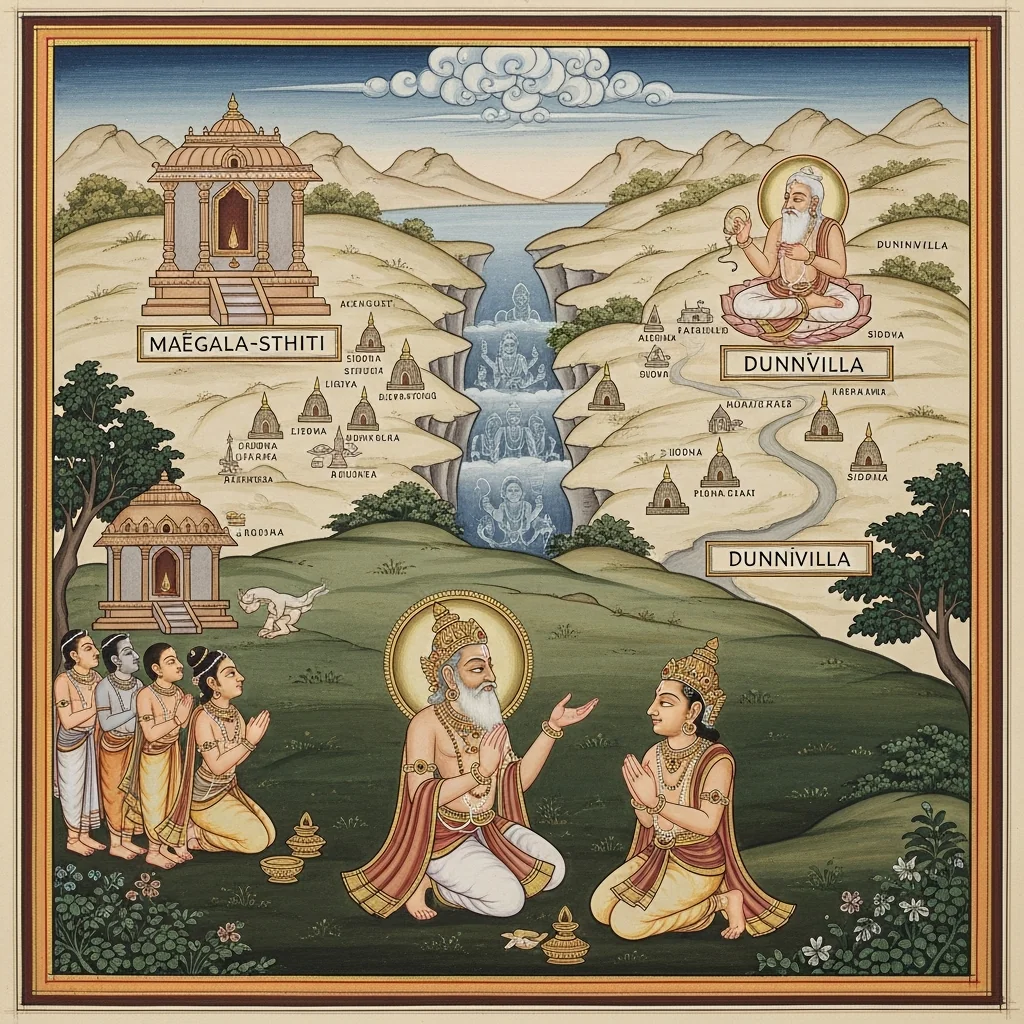
Adhyaya 4
Chapter 4 is framed as Īśvara’s instruction to Devī, outlining a short pilgrimage to Dunnāvilla, one yojana west of Maṅgala-sthiti. The teaching situates the place within a layered sacred memory and folds it into the kṣetra’s map. It recalls an episode involving Bhīma and the name “Dunnaka,” said to have been formerly consumed and then abandoned, as an etiological sign for the site’s renown. It then speaks of a “divine opening” (divya-vivara), a major route to pātāla, bringing cosmological geography into the sacred landscape. The pātāla account is cited as having been taught earlier in a prior compilation (pātāla-uttara-saṅgraha), indicating continuity of tradition. Dunnāvilla is further praised for its many liṅgas and sixteen siddha-sthānas, forming a concentrated Śaiva holy cluster. Finally, the place is remembered as once a gold mine, and people are directed to go there seeking “bhūti” (prosperity/attainment), acknowledging worldly aims while placing them within a sanctified itinerary.
Shlokas
Verse 1
ईश्वर उवाच । ततो गच्छेन्महादेवि दुन्नाविल्लेति विश्रुतम् । योजनस्यांतरे देवि पश्चिमे मंगलस्थितेः
Īśvara said: Then, O Great Goddess, one should go to the place renowned as Dunnāville, lying one yojana away, to the west of Maṅgalasthitī.
Verse 2
दुन्नको यत्र भीमेन भुक्त्वा त्यक्तः पुरा प्रिये । तत्रैव विवरं दिव्यं महा पातालमार्गदम्
O beloved, it is the place where Dunnaka was once eaten and cast aside by Bhīma. There itself is a divine opening that grants a passage to the great Pātāla, the netherworld.
Verse 3
तस्य कल्पः पुरा प्रोक्तः पातालोत्तरसंग्रहे । तत्र लिंगान्यनेकानि सिद्धस्थानानि षोडश
Its sacred account was formerly taught in the Pātālottara-saṃgraha. There are many liṅgas there, and sixteen seats of the Siddhas.
Verse 4
सुवर्णस्याकरः पूर्वं तत्स्थानमभवत्प्रिये । तस्मिन्स्थाने नरैर्देवि गन्तव्यं भूतिलिप्सया
O beloved, that place was formerly a mine of gold. O Goddess, people should go to that spot with the desire for prosperity.