Adhyaya 3
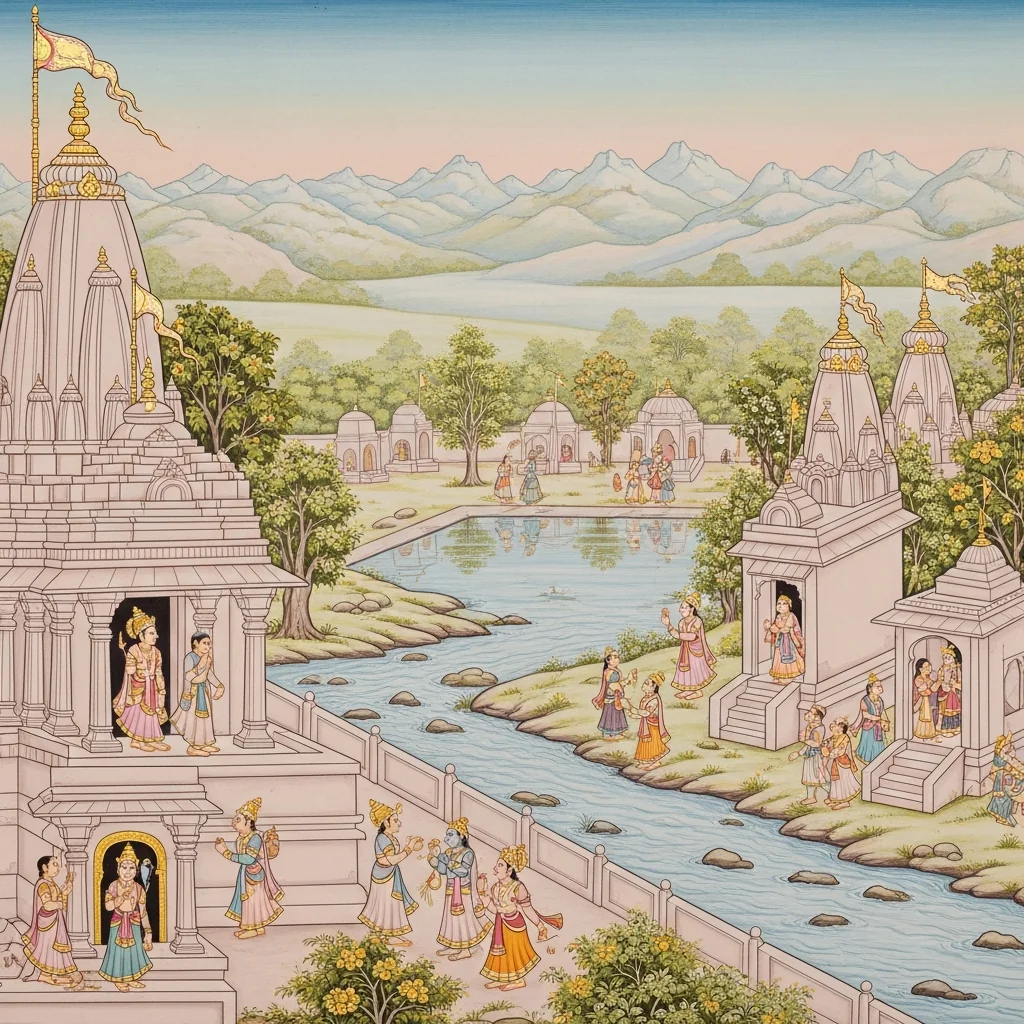
This adhyāya is a concise yet authoritative catalogue spoken in Īśvara’s own voice. It opens by acknowledging that Vastrāpatha contains tīrthas in overwhelming multitude (“koṭiśaḥ”), and then sets a guiding method: only the “sāra” (essence) will be stated, as a distilled map of the most important sacred sites. It names the Dāmodarā river, also remembered as Suvarṇarekhā, and places Brahmakuṇḍa beside the Brahmeśvara shrine. The chapter then lists further Śaiva loci—Kālamēgha, Bhava/Dāmodara, Kālikā (two gavyūtis away), Indreśvara, the mountains Raivata and Ujjayanta—followed by Kumbhīśvara and Bhīmeśvara. The kṣetra’s extent is measured as five gavyūtis, and Mṛgīkuṇḍa is singled out for its power to destroy sin. The closing verse frames the whole as a deliberate summary and notes the region’s association with mineral and ratna (gem) deposits, joining sacred topography with resource-topography in an archival register.
Shlokas
Verse 1
ईश्वर उवाच । अथ वस्त्रापथे क्षेत्रे संति तीर्थानि कोटिशः । तथापि सारं ते वच्मि सर्वतीर्थमहोदयम्
Īśvara said: Now, in the kṣetra of Vastrāpatha there are crores of tīrthas; yet I shall tell you the very essence—the great source of auspiciousness of all tīrthas.
Verse 2
दामोदरे नदी प्रोक्ता स्वर्णरेषेति या स्मृता । ब्रह्मकुण्डं च तत्रैव तथा ब्रह्मेश्वरः स्मृतः
It is said that there is a river called Dāmodarā, also remembered as “Svarṇareṣā.” There too is Brahma-kuṇḍa, and Brahmeśvara is likewise renowned in that very place.
Verse 3
कालमेघश्च संप्रोक्तो भवो दामोदरः स्मृतः । गव्यूतिद्वितयेनैव कालिका तत्र कीर्तिता
He is also proclaimed as Kālamegha; and there Bhava is remembered as Dāmodara. And at a distance of two gavyūtis, Kālikā is celebrated in that region.
Verse 4
इन्द्रेश्वरश्च तत्रैव रैवतः पर्वतस्तथा । उज्जयंतश्च तत्रैव देवः कुम्भीश्वरः स्मृतः
There itself are the holy shrines of Indreśvara; likewise the mountain Raivata; and there too is Ujjayanta. In that very place the deity is remembered as Kumbhīśvara.
Verse 5
भीमेश्वरश्च तत्रैव ततः क्षेत्रं महाप्रभम् । तैलसारणिकंनाम त्रेतायां हैममारकम्
There too is Bhīmeśvara; and then one comes to a greatly radiant sacred region called Tailasāraṇika—known in the Tretā age as Haimamāraka.
Verse 6
पंचगव्यूतिमात्रं तु तत्क्षेत्रं संप्रकीर्तितम् । मृगीकुण्डं च तत्रैव सर्वपातकनाशनम्
That sacred region is proclaimed to extend for five gavyūtis. There too is Mṛgīkuṇḍa, the pool that destroys all sins.
Verse 7
एतद्वस्त्रापथं क्षेत्रं रत्नधात्वोस्तथाऽकरम् । कथितं तव देवेशि पुनः संक्षेपतो मया
Thus, O Goddess, I have again described to you in brief this sacred region of Vastrāpatha, also famed as a mine of jewels and metals.