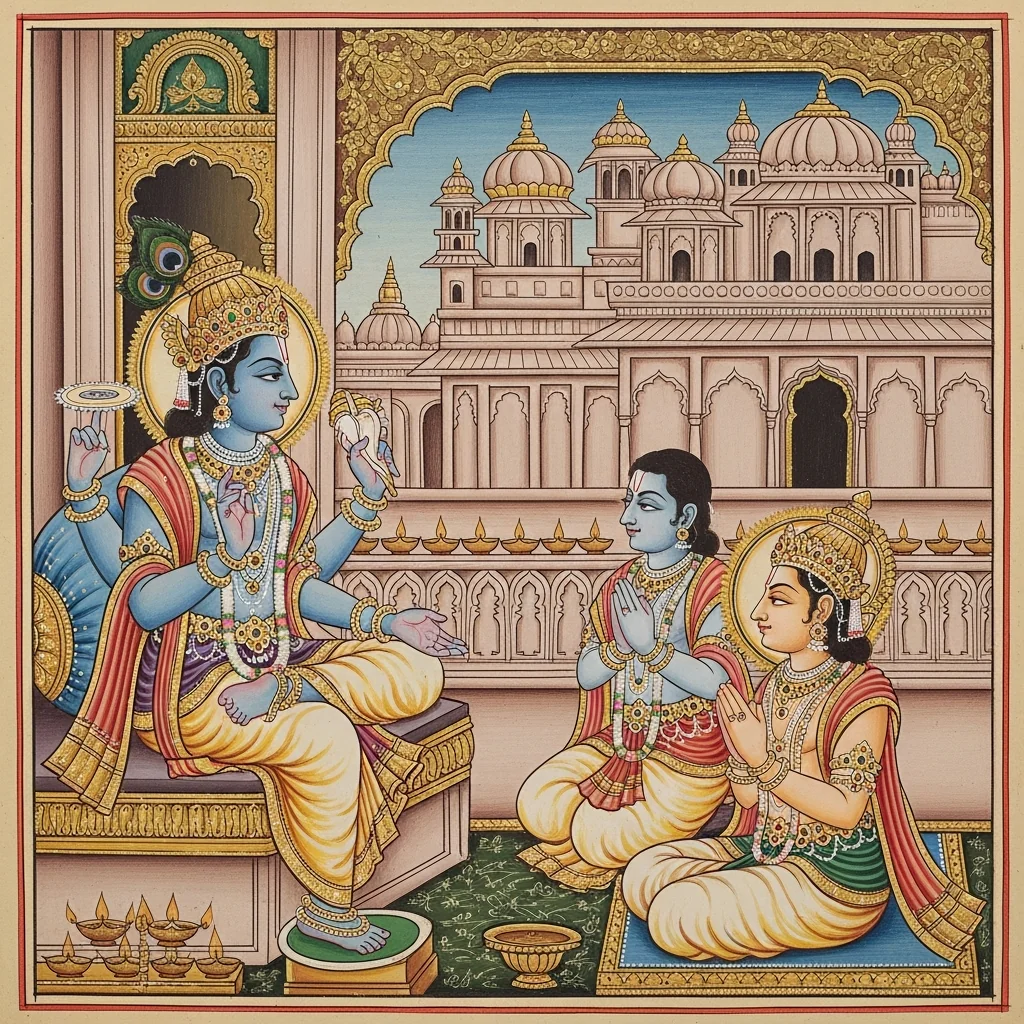
Adhyaya 19
Adhyāya 19 unfolds as a theological dialogue. Prompted by a royal question, Sarasvata recounts how Hari as Vāmana/Trivikrama completes the yajña: when the sacrifice ends, Bali is reminded of a remaining “debt” (ṛṇa) in the third step—an ethical demand to fulfill the gift he pledged. Bali’s son Bāṇa challenges the propriety of taking a third step in a cosmic form after requesting land as a dwarf, raising concerns about truthful exchange and the conduct expected of sādhus. Janārdana answers with measured reasoning: the request was made within a stated measure and was accepted; the act ultimately benefits Bali, granting him residence in Sutala/Mahātala and future eminence, even an Indra-role in a coming manvantara. Trivikrama then instructs Bali to dwell in Sutala, while promising abiding presence in Bali’s heart and renewed closeness. The chapter also projects an auspicious lamp-festival (dīpa) and communal worship, linking devotional celebration to Bali’s name and to social well-being. The closing phalaśruti declares that remembering, hearing, and reciting this account diminishes sin and steadies devotion to Śiva and Kṛṣṇa; it urges proper patronage to the reciter (dāna) and warns against sharing the “secret” with the irreverent, marking the ethical boundary of Purāṇic transmission.
Shlokas
Verse 1
राजोवाच । गृहीत्वा दक्षिणां दैत्यान्महाविष्णुर्जनार्दनः । चकार किं ममाचक्ष्व परं कौतूहलं हि मे
The King said: “Having accepted the dānavas (daityas) as the dakṣiṇā, the sacrificial fee, what did Mahāviṣṇu—Janārdana—do? Tell me; my curiosity is very great.”
Verse 2
सारस्वत उवाच । एवं स्तुतः सुरैर्देवो गृहीत्वा मेदिनीं हरिः । बलिं निर्वासयामास संपूर्णे यज्ञकर्मणि । यज्ञांते दक्षिणां लब्ध्वा संपूर्णोऽभूदथाध्वरः
Sārasvata said: Thus praised by the gods, Hari took possession of the earth and, when the sacrificial rite had been brought to completion, he drove Bali out. And when, at the end of the sacrifice, the dakṣiṇā was received, the sacrifice itself became fully consummated.
Verse 3
भगवानप्यसंपूर्णे तृतीये तु क्रमे विभुः । समभ्येत्य बलिं प्राह ईषत्प्रस्फुरिताधरः
Though the third stride was still unfulfilled, the all-powerful Lord approached Bali and spoke—his lips quivering slightly.
Verse 4
ऋणे भवति दैत्येन्द्र बंधनं घोरदर्शनम् । त्वं पूरय पदं तन्मे नोचेद्बन्धं प्रतीच्छ भोः
‘When a debt remains, O lord of the Daityas, a dreadful bondage follows. Fulfill that step for me; otherwise, accept the fetter, O sir.’
Verse 5
तन्मुरारिवचः श्रुत्वा पुरो भूत्वा बलेः सुतः । बाणो वामनमाचष्टे तदा तं विश्वरूपिणम्
Hearing the words of Murāri, Bāṇa, son of Bali, stepped forward and addressed Vāmana, who at that time stood revealed in the Universal Form.
Verse 6
कृत्वा महीमल्पतरां वपुः कृत्वा तु वामनम् । पदत्रयं याचयित्वा विश्वरूपमगाः कथम्
“After making the earth seem ‘small’ and assuming the body of a dwarf as Vāmana, you begged for three steps—how then did you become the Universal Form?”
Verse 7
यदि तृतीयं क्रमणं याचसे जगदीश्वर । पुनर्वामनतां याहि बलिर्दास्यति तत्पदम्
“If you ask for the third stride, O Lord of the world, then return again to the dwarf-form; Bali will grant that step to that very Vāmana.”
Verse 8
यादृग्विधाय बलिना वामनायोदकं कृतम् । तत्तादृशाय दातव्यमथ किं विश्वरूपिणे
“The libation-water that Bali offered was performed for Vāmana as such; it should be given to one of that same kind—what right is there to give it to one in the Universal Form?”
Verse 9
भवत्कृतमिदं विश्वं विश्वस्मिन्वर्तते बलिः । छद्मना नैव गृह्णन्ति साधवो ये महेश्वर
“This universe is your own making, and Bali abides within this universe. The truly virtuous, O Great Lord, do not accept anything by deception.”
Verse 10
जगदेतज्जगन्नाथ तावकं यदि मन्यसे । ज्ञात्वा बलिममर्यादं भवद्भक्तिपराङ्मुखम्
“If you deem this entire world to be yours, O Lord of the world—then, knowing Bali to be one who transgresses all bounds and has turned away from devotion to you…”
Verse 11
कंठपाशेन निष्कास्य केन वै वार्यते भवान् । गोपालमन्यं कुरुते रक्षणाय च गोपतिः । सुतृणं चारयन्पूर्वो गोपः किं कुरुते तदा
“If you drive him out with a noose about his neck, who indeed could restrain you? When the lord of the cattle appoints another cowherd for protection, what then does the former cowherd do—when he is merely letting them graze upon the good grass?”
Verse 12
इत्येवमुक्ते तेनाथ वचने बलिसूनुना । प्रोवाच भगवान्वाक्यमादिकर्ता जनार्दनः
When Bali’s son had spoken thus, Janārdana—the Blessed Lord, the primal Creator—then replied with these words.
Verse 13
यान्युक्तानि वचांसीत्थं त्वया बालेन सांप्रतम् । तेषां त्वं हेतुसंयुक्तं शृणु प्रत्युत्तरं मम
“O child, to the words you have just spoken in this manner, now listen to my reply—reasoned and firmly grounded.”
Verse 14
पूर्वमुक्तस्तव पिता मया बाण पदत्रयम् । देहि मह्यं प्रमाणेन तदेतत्समनुष्ठितम्
“Earlier, O Bāṇa, I asked your father for ‘three steps’ of land. Show me, by proper proof, that this was indeed duly carried out.”
Verse 15
किं न वेत्ति प्रमाणं मे बलिस्तव पिता सुत । बलेरपि हितार्थाय कृतमेतत्पदत्रयम्
O son, does Bali—your father—not know my true measure? This act of the “three steps” was done even for Bali’s own welfare.
Verse 16
तस्माद्यन्मम बालेय त्वत्पित्रांऽबु करे महत् । दत्तं तेनास्य सुतले कल्पं यावद्वसिष्यति
Therefore, dear child, because your father placed a great gift into my hands with the water-offering, he shall dwell in Sutala for as long as a kalpa.
Verse 17
गते मन्वन्तरे बाण श्राद्धदेवस्य साम्प्रतम् । सावर्णिके त्वागते च बलिरिन्द्रो भविष्यति
When the present Manvantara of Śrāddhadeva has passed, O Bāṇa, and the Sāvarṇika Manvantara arrives, Bali shall become Indra.
Verse 18
इति प्रोक्त्वा बलिसुतं बाणं देवस्त्रिविक्रमः । प्रोवाच बलिमभ्येत्य वचनं मधुराक्षरम्
Having thus spoken to Bāṇa, Bali’s son, the god Trivikrama approached Bali and addressed him in words gentle and sweet.
Verse 19
श्रीभगवानुवाच । अपूर्णदक्षिणे यागे गच्छ राजन्महातलम् । सुतलंनाम पातालं वस तत्र निरामयः
The Blessed Lord said: “Since the sacrifice was left with its priestly fee (dakṣiṇā) incomplete, go, O king, to Mahātala. In the netherworld called Sutala, dwell there free from affliction.”
Verse 20
बलिरुवाच । सुतलस्थस्य मे नाथ कथं चरणयोस्तव । दर्शनं पूजनं भोगो निवसामि यथासुखम्
Bali said: “O Lord, if I must remain in Sutala, how shall I behold Your sacred feet, worship You, and delight in Your presence, so that I may dwell in peace?”
Verse 21
श्रीभगवानुवाच । दैत्येन्द्र हदये नित्यं तावके निवसाम्यहम् । अतस्ते दर्शनं प्राप्तः पुनः स्थास्ये तवान्तिकम्
The Blessed Lord said: “O lord of the Daityas, I dwell ever within your heart. Therefore you have attained My darśana; and again I shall remain near you.”
Verse 22
तथान्यमुत्सवं पुण्यं वृत्ते शक्रमहोत्सवे । दीपप्रतिपन्नामाऽसौ तत्र भावी महोत्सवः
When the great festival of Śakra (Indra) has passed, there too another holy celebration will arise—a grand festival known by the name Dīpa-pratipannā.
Verse 23
तत्र त्वां नरशार्दूला हृष्टाः पुष्टाः स्वलंकृताः । पुष्पदीपप्रदानेन अर्चयिष्यंति यत्नतः
There, O tiger among men, people—joyful, thriving, and well-adorned—will worship you with careful devotion, offering flowers and lamps.
Verse 24
तत्रोत्सवः पुण्यतमो भविष्यति धरातले । तव नामांकितो दैत्य तेन त्वं वत्सरं सुखी
That festival there will become the most meritorious upon the earth. Marked with your name, O Daitya, by it you will remain happy for a full year.
Verse 25
भविष्यसि नरा ये तु दृढभक्तिसहा न्विताः । त्वामर्चयन्ति विधिवत्तेऽपि स्युः सुखभागिनः
And those people who, endowed with steadfast devotion, worship you according to the proper rite— they too shall become sharers in happiness.
Verse 26
यथैव राज्यं भवतस्तु सांप्रतं तथैव सा भाव्यथ कौमुदीति । इत्येवमुक्त्वा मधुमदितीश्वरं निवासयित्वा सुतलं सभार्यकम्
“Just as your kingship stands at present, so too shall the festival called Kaumudī come to be.” Having spoken thus, the Lord, slayer of Madhu, settled him in Sutala together with his wife.
Verse 27
उर्वी समादाय जगाम तूर्णं स शक्रसद्मामरसंघजुष्टम् । दत्त्वा मघोने मधुजित्त्रिविष्टपं कृत्वा तु देवान्मखभागभोगिनः
Taking up the charge of the earth, he swiftly went to Śakra’s abode, thronged by hosts of immortals. He then granted to Maghavan (Indra) the heaven won by the slayer of Madhu, and ensured that the gods partook of their rightful shares in sacrifice.
Verse 28
अन्तर्दधे विश्वपतिर्महेशः संपश्यतां वै वसुधाधिपानाम्
Maheśa, the Lord of the universe, vanished from sight even as the kings of the earth looked on.
Verse 29
गृहीत्वेति बले राज्यं मनुपुत्रे नियोजितम् । द्वीपांतरे च ते दैत्याः प्रेषिताश्चाज्ञया स्वयम्
Thus, having taken back the kingship from Bali, it was entrusted to the son of Manu. And those Daityas were themselves dispatched, by direct command, to another island-continent.
Verse 30
पातालनिलया ये तु ते तत्रैव निवेशिताः । देवानां परमो हर्षः संजातो बलिनिग्रहे
Those who dwelt in Pātāla were settled there itself. Supreme joy arose among the gods at the subduing of Bali.
Verse 31
निवासाय पुनश्चक्रे वामनो वामनो मनः । तत्र क्षेत्रे स्वनगरे वामनः स न्युवास ह
Then Vāmana again turned his mind toward dwelling there. In that sacred kṣetra, as if in his own city, Vāmana indeed resided.
Verse 32
सारस्वत उवाच । प्रादुर्भावस्ते कथितो नरेन्द्र पुण्यः शुचिर्वामनस्याघहारी । स्मृते यस्मिन्संश्रुते कीर्तिते च पापं यायात्संक्षयं पुण्यमेति
Sārasvata said: O king, I have narrated to you the sacred, purifying manifestation of Vāmana, the remover of sin. When this account is remembered, heard, or recited, sin is diminished and merit is gained.
Verse 33
ईश्वर उवाच । इति सारस्वतवचः श्रुत्वा भोजः स भूपतिः । नमस्कृत्य मुनिश्रेष्ठं पूजयामास भक्तितः
Īśvara said: Having thus heard Sārasvata’s words, that king Bhoja bowed to the best of sages and worshipped him with devotion.
Verse 34
ततो यथोक्तविधिना स भोजो नृपसत्तमः । वस्त्रापथक्षेत्र यात्रां परिवारजनैः सह । कृत्वा कृतार्थतां प्राप्तो जगामान्ते परं पदम्
Then that excellent king Bhoja, following the prescribed rites, undertook the pilgrimage to Vastrāpathakṣetra together with his attendants. Having thus fulfilled his purpose, he ultimately went to the supreme state.
Verse 35
एतन्मया पुण्यतमं प्रभासक्षेत्रे च वस्रापथमीरितं ते । श्रुत्वा पठित्वा परया समेतो भक्त्या तु विष्णोः पदमभ्युपैति
This most meritorious account of Vastrāpatha in the sacred region of Prabhāsa has been declared by me to you. Whoever hears it and recites it with supreme devotion truly attains the abode of Viṣṇu.
Verse 36
यथा पापानि धूयंते गंगावारिविगाहनात् । तथा पुराणश्रवणाद्दुरितानां विना शनम्
Just as sins are washed away by bathing in the waters of the Gaṅgā, so too, by hearing the Purāṇa, wicked deeds are destroyed little by little.
Verse 37
इदं रहस्यं परमं तवोक्तं न वाच्यमेतद्धरिभक्तिवर्जिते । द्विजस्य निन्दानिरतेऽतिपापे गुरावभक्ते कृतपापबुद्धौ
This supreme secret has been spoken by you; it should not be told to one who is devoid of devotion to Hari—nor to one greatly sinful, who delights in reviling brāhmaṇas, who is faithless toward the guru, and whose mind is set on wrongdoing.
Verse 38
इदं पठेद्यो नियतं मनुष्यः कृतभावनः । तस्य भक्तिः शिवे कृष्णे निश्चला जायते धुवम्
Whoever, disciplined and intent, regularly recites this with contemplative feeling—unwavering devotion surely arises in that person toward Śiva and Kṛṣṇa.
Verse 39
तद्भक्त्या सकलानर्थान्प्राप्नोति पुरुषोत्तमः । पुराणवाचिने दद्याद्गोभूस्वर्णविभूषणम्
Through that devotion, a person attains every desired good. One should give to the reciter of the Purāṇa gifts such as cows, land, gold, and ornaments.
Verse 40
वित्तशाठ्यं न कर्तव्यं कुर्वन्दारिद्र्यमाप्नुयात् । त्रिःकृत्वा प्रपठञ्छृण्वंन्सर्वान्कामानवाप्नुयात्
One should not practice miserliness with wealth; whoever does so falls into poverty. But by reciting and hearing this three times, one may attain all desired aims.