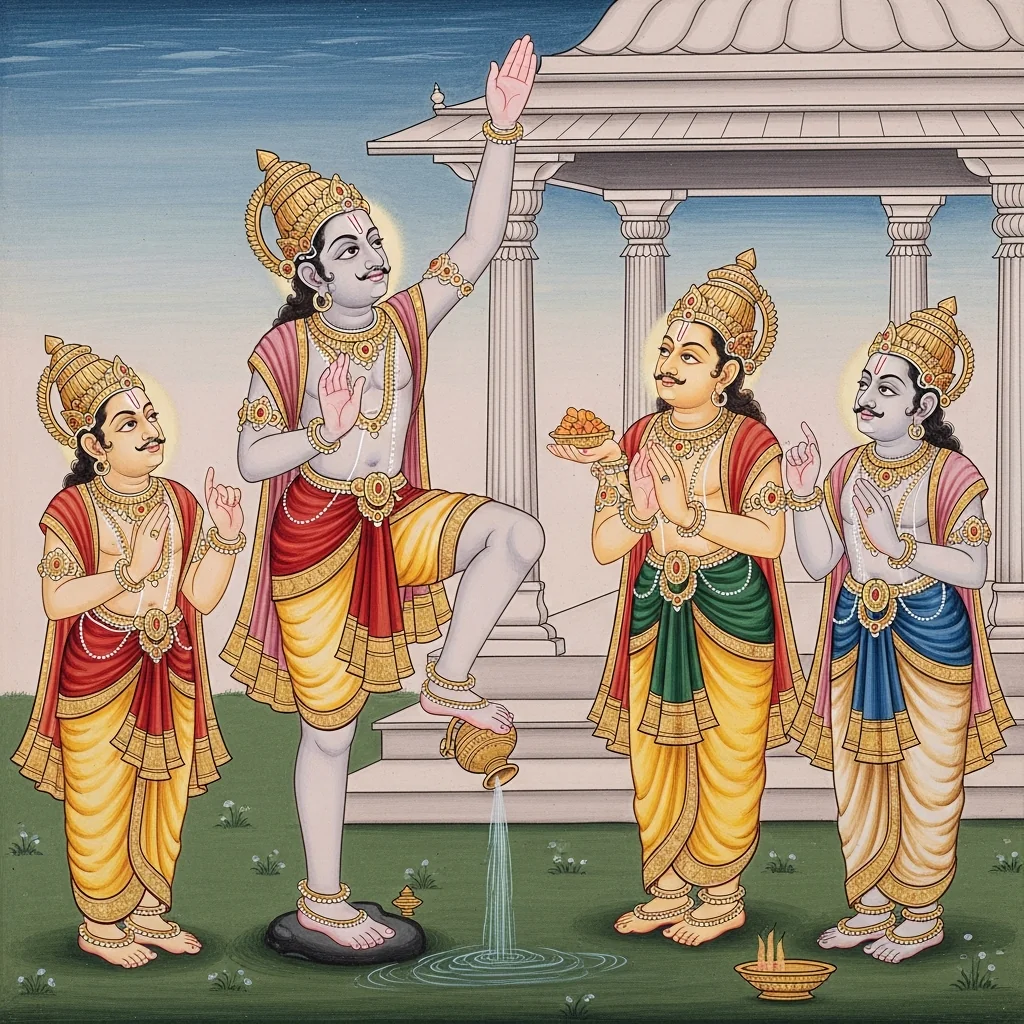
Adhyaya 18
Chapter 18 begins with a king’s question about what Vāmana did upon reaching the great sacred field of Vastrāpatha. Sārasvata describes Vāmana’s disciplined observance: bathing in the Svarṇarekhā, worshiping Bhava (Śiva), and settling into seated yoga—padmāsana, restraint of the senses, silence, and regulated breath. The chapter then defines prāṇāyāma in its classic terms—pūraka, recaka, kumbhaka—and teaches that yogic knowledge purifies the faults accumulated over time. A direct theological instruction follows: Īśvara sets forth a Sāṅkhya-like ordering of tattvas, culminating in the 25th principle, puruṣa, while pointing toward realization of the supreme Self beyond all enumeration. With Nārada’s arrival, the narrative expands into cosmology and the sequence of avatāras (from Matsya through Narasiṃha and beyond), highlighting the Prahlāda–Hiraṇyakaśipu episode as a model of unwavering bhakti and metaphysical vision. The chapter then turns to Bali’s yajña: his vow of generosity, Śukra’s warning, Vāmana’s request for three steps, and the manifestation of Trivikrama. It concludes with sacred-water imagery—Gaṅgā as the water from Viṣṇu’s foot—and a final emphasis on purification, worship, and liberation through knowledge and disciplined practice.
Shlokas
Verse 1
राजोवाच । वस्त्रापथे महाक्षेत्रे सम्प्राप्तो वामनो यदा । तदाप्रभृति किं चक्रे तन्मे विस्तरतो वद
The King said: “When Vāmana arrived at the great sacred field of Vastrāpatha, what did he do from that time onward? Tell me that in detail.”
Verse 2
सारस्वत उवाच । वामनो वसतिं चक्रे भवस्याग्रे नृपोत्तम । स्वर्णरेखाजले स्नात्वा भवं सम्पूज्य भावतः
Sārasvata said: “O best of kings, Vāmana made his dwelling in the presence of Bhava (Śiva). Bathing in the waters of Svarṇarekhā, he worshipped Bhava with heartfelt devotion.”
Verse 3
एकांते निर्मले स्थाने कण्टकास्थिविवर्जिते । कृष्णाजिनपरिच्छन्न उपविष्टो वरा सने
In a secluded, pure spot—free from thorns and bones—he sat upon an excellent seat, covered with a black antelope-skin.
Verse 4
कृत्वा पद्मासनं धीरो निश्चलोऽभूद्द्विजोत्तमः । विधाय कन्धराबंधमृजुनासावलोककः
Assuming the lotus posture, the steadfast best of the twice-born became motionless; setting the neck and shoulders in proper alignment, he fixed his gaze gently along the straight line of the nose.
Verse 5
गृहक्षेत्रकलत्राणां चिंतां मुक्त्वा धनस्य च । मायां च वैष्णवीं त्यक्त्वा कृतमौनो जितेन्द्रियः
Casting off concern for house, land, and family—and for wealth as well—he set aside even the Vaiṣṇava power of illusion, observed silence, and mastered his senses.
Verse 6
निराहारो जितक्रोधो मुक्तसंसारबंधनः । भुजौ पद्मासने कृत्वा किञ्चिन्मीलितलो चनः । मनोतिचंचलं ज्ञात्वा स्थिरं चक्रे हृदि द्विजः
Fasting, having conquered anger, and freed from the bonds of worldly existence, he placed his arms in the lotus posture and kept his eyes slightly closed. Knowing the mind to be exceedingly restless, the twice-born made it steady within the heart.
Verse 8
एवं तं हृदये कृत्वा गृहीत्वा सर्वसन्धिषु । आनीय ब्रह्मणः स्थाने दृढं ब्रह्मण्ययोजयत्
Thus, placing That within the heart and holding it firmly at all the inner junctions (of the body), he brought it to the station of Brahman and yoked it there with unshakable steadiness.
Verse 9
गृहीत्वा पवनं बाह्यं यदा पूर यते तनुम् । तदा स पूरको ज्ञेयो रेचकं तु वदाम्यहम्
When one draws in the external breath and thereby fills the body, that is to be known as inhalation (pūraka). Now I shall explain exhalation (recaka).
Verse 10
यदा चाभ्यन्तरो वायुर्बाह्ये याति क्रमान्नृप । तदा स रेचको ज्ञेयः स्तम्भनात्कुम्भको भवेत्
O King, when the inner vital wind gradually moves outward, that is to be understood as exhalation (recaka). When it is checked and held still, it becomes breath-retention (kumbhaka).
Verse 11
पञ्चविंशतितत्त्वानि यदा जानंति योगिनः । मुच्यन्ते पातकैः सर्वैः सप्तजन्मकृतैरपि
When yogins come to know the twenty-five principles (tattvas), they are released from all sins—even those accumulated across seven births.
Verse 12
राजोवाच । कानि तत्त्वानि को देही किं ज्ञेयं योगिनां वद । उत्पन्नज्ञानसद्भावो योगयुक्तः कथं भवेत्
The King said: “Which are the principles (tattvas)? Who is the embodied one (dehī)? Tell me what a yogin should know. And how does one become established in yoga, with genuine knowledge arisen within?”
Verse 13
ईश्वर उवाच । प्रकृतिश्च ततो बुद्धिरहंकारस्ततोऽभवत् । तन्मात्रपंचकं तस्मादेषा प्रकृतिरष्टधा
Īśvara said: “First is Prakṛti; from it arises buddhi (intellect), and from buddhi arises ahaṃkāra (egoity). From that come forth the five tanmātras (subtle elements). Thus Prakṛti is declared to be eightfold.”
Verse 14
बुद्धीन्द्रियाणि पञ्चैव पञ्च कर्मेंद्रियाणि च । एकादशं मनो विद्धि महा भूतानि पंच च
Know the five organs of perception and the five organs of action; know the mind (manas) as the eleventh; and there are also the five great elements (mahābhūtas).
Verse 15
गणः षोडशकः सांख्ये विस्तरेण प्रकीर्तितः । चतुर्विंशतितत्त्वानि पुरुषः पंचविंशकः
In Sāṃkhya, the group of sixteen is expounded in detail. The principles (tattvas) are twenty-four; the Puruṣa is the twenty-fifth.
Verse 16
देहीति प्रोच्यते देहे स चात्मानं च पश्यति । विंदन्ति परमात्मानं षष्ठं तं विंशतेः परम्
Dwelling in the body, he is called the “dehī” (the embodied one), and he beholds the Ātman. The wise realize the Supreme Self, Paramātman, beyond the “twenty,” counting Him as the “sixth” beyond them.
Verse 17
आसनादिप्रकारा ये ते ज्ञेयाः प्रथमं सदा । यदा दीपशिखाप्रायं ज्योतिः पश्यंति ते हृदि
The various disciplines beginning with āsana (posture) should always be learned first. When they behold within the heart a light like the flame of a lamp,
Verse 18
उत्पन्नज्ञानसद्भावा भण्यास्ते योगिनो बुधैः । पूर्वं जरां जरयति रोगा नश्यति दूरतः
The wise call yogins those in whom true knowledge has arisen. First they wear away old age, and disease perishes far from them.
Verse 19
सर्वपापचये क्षीणे पश्चान्मृत्युं स विंदति । मृतो लोके नरो नास्ति योगी जानाति चेत्स्वयम्
When the accumulation of all sins is exhausted, then he encounters death. Yet in this world there is no ‘dead man’—if the yogin truly knows for himself.
Verse 20
तदा द्वाराणि संरुद्ध्य दश प्राणान्स मुञ्चति । पुण्य पापक्षयं कृत्वा प्राणा गच्छंति योगिनाम् । अणिमादिगुणैश्वर्यं प्राप्नुवंति शिवालये
Then, having sealed the bodily ‘gates’ (the sense-openings), he releases the ten vital currents. After bringing merit and sin to exhaustion, the yogin’s life-breaths depart and reach Śiva’s abode—where they attain the lordly yogic perfections beginning with aṇimā (minuteness).
Verse 21
अनेन ध्यानयोगेन भवं पश्यति मानवः । मनसा चिंतितं सर्वं सम्प्राप्तं भवदर्शनात्
By this yoga of meditation, a person beholds Bhava (Śiva). Through the vision of Bhava, all that was contemplated in the mind becomes fulfilled and attained.
Verse 22
एवमास्ते यदा विप्रो वामनो भवसन्निधौ । गगनादवतीर्णं तं तदा पश्यति नारदम्
While the brāhmaṇa Vāmana sat thus, in the presence of Bhava (Śiva), he then beheld Nārada descending from the sky.
Verse 23
वामन उवाच । महर्षे कुशलं तेऽद्य कस्मादागम्यते त्वया । प्रणमामि महर्षे त्वां ब्रह्मैव त्वं जगत्त्रये
Vāmana said: “O great sage, are you well today? From where have you come? I bow to you, O seer—for in the three worlds you are truly Brahman itself.”
Verse 24
नारद उवाच । स्वर्ग लोकादहं प्राप्तः कुशलं किं ब्रवीमि ते
Nārada said: “I have come from Svarga-loka. What tidings of well-being should I tell you?”
Verse 25
यातायातैर्दिनेशस्य पूर्य्यते ब्रह्मणो दिनम् । दिनांते जायते रात्री रात्रौ नश्यंति देवताः
By the comings and goings of the Sun, a “day of Brahmā” is filled up. At the end of that day, night arises—and in that night the gods disappear (are withdrawn).
Verse 26
का कथा मृत्युलोकस्य ये म्रियंते दिनेदिने । नभो धूमाकुलं जातं देवा बलिगृहे गताः
What then to speak of the mortal world, where people die day after day? The sky has become filled with smoke, and the gods have gone to Bali’s house (palace).
Verse 27
सप्तर्षयो गतास्तत्र ब्रह्मणा ब्रह्मचारिणः । हाहाहूहूस्तुंबरुश्च गतौ नारदपर्वतौ
There the Seven Ṛṣis—celibate students of Brahmā—have gone as well. Hāhā and Hūhū, and Tuṃbaru too, have gone; and Nārada and Parvata (also) have gone.
Verse 28
अप्सरोगणगन्धर्वाः संप्राप्ता बलिमंदिरे । उत्पातशांतिको यज्ञः क्रियते बलिना स्वयम्
Hosts of Apsarases and Gandharvas have arrived at Bali’s palace. Bali himself is performing a yajña to pacify ominous disturbances.
Verse 29
तत्रैव गन्तुमिच्छामि द्रष्टुं यज्ञं बलेर्गृहे । सहस्रमेकं यज्ञानामेकोनं विदधे बलिः
I too wish to go there, to behold the yajña in Bali’s house. Bali has performed one less than a thousand sacrifices—nine hundred and ninety-nine.
Verse 30
दैत्यानां भुवनं सर्वं संपूर्णेऽस्मिन्भविष्यति । असावतिशयः कोऽपि प्रारब्धो यज्ञकर्मणि । द्विजातिभ्यो मया देयं येन यद्याच्यते स्वयम्
“If this yajña is brought to completion, the entire realm of the Daityas will be firmly established. Some extraordinary undertaking has begun in this sacrificial rite. Therefore, whatever a twice-born (dvija) asks of me in person—whoever it may be—I must give of my own accord.”
Verse 31
वारितेनापि मे देयं सत्यमस्तु वचो मम । आत्मानमपि दारांश्च राज्यं पुत्रान्प्रियान्मम
“Even if I am restrained, I must still give—let my word be true. I would give even my own self, my wife, my kingdom, and my beloved sons.”
Verse 32
प्रार्थितश्चेन्न दास्यामि व्यर्थो भवतु मेऽध्वरः । अनेन वचसा जाता महती मे शिरो व्यथा । प्रतिज्ञाय कथं यज्ञः संपूर्णोऽयं भविष्यति
“If, when requested, I do not give, then let my sacrifice become futile. By these words a great pain has arisen in my head. Having made the pledge, how will this yajña ever be completed?”
Verse 33
भंगोपायं न पश्यामि भ्रमामि भुवनत्रये । विध्वंसकारिणं ज्ञात्वा भवंतं पर्युपस्थितः
I see no way out of this impasse; I wander through the three worlds. Knowing you to be able to bring destruction—or a decisive resolution—I have come and stand before you, seeking refuge.
Verse 34
यथा न पूर्यते यज्ञस्तथेदानीं विधीयताम्
Let it be arranged now so that the sacrifice (yajña) is not left incomplete.
Verse 35
वामन उवाच । महर्षे शृणु मे वाक्यं का शक्तिर्मम विद्यते । कोऽहं कस्मात्करिष्यामि यज्ञे देवाः समागताः
Vāmana said: “Great sage, hear my words. What power do I possess? Who am I, and what could I possibly do—when the gods themselves have assembled at this sacrifice (yajña)?”
Verse 36
ऋषयो ब्राह्मणाः सर्वे कथं व्यर्थो भविष्यति । अपरं शृणु मे वाक्यं ब्रह्मर्षे ब्रह्मणस्पते
All the sages and brāhmaṇas are present—how could this sacrifice become fruitless? Now hear yet another word of mine, O brahmarṣi, lord of sacred speech (Brahmaṇaspati).
Verse 37
न कलत्रं न ते पुत्राः कस्मात्प्रकृतिरीदृशी । युद्धं विना न ते सौख्यं न सौख्यं कलहं विना
You have neither wife nor sons—why is your nature like this? Without battle you find no happiness, and without conflict you find no happiness.
Verse 39
नारदः कुरुते चान्यदन्यत्कुर्वंति ब्राह्मणाः । ममापि कौतुकं जातं महर्षे वद सत्वरम्
“Nārada does one thing, while the brāhmaṇas do another. Curiosity has arisen in me as well—O great sage, tell me quickly.”
Verse 40
नारद उवाच । पाद्मकल्पे व्यतिक्रांते रात्र्यंते शृणु वामन । ब्रह्माण्डं वारिणा व्याप्तमन्यत्किं चिन्न विद्यते
Nārada said: “Listen, O Vāmana. When the Padma-kalpa had passed, at the end of the night, the entire cosmic egg (universe) was pervaded by water; nothing else whatsoever existed.”
Verse 41
अप्सु शेते देवदेवः स च नारायणः स्मृतः । स ब्रह्मा स शिवो नास्ति भेदस्तेषां परस्परम्
The God of gods rests upon the cosmic waters; he is remembered as Nārāyaṇa. He is Brahmā; he is Śiva—between them there is no mutual difference.
Verse 42
यदा भवंति ते भिन्ना स्तदा देवत्रयं च ते । कर्त्तुं वाराहकल्पं तु भिन्ना जातास्त्रयस्तदा
But when they appear as distinct, then they are spoken of as the triad of gods. For the purpose of carrying out the Varāha-kalpa, they then became three in differentiated form.
Verse 43
ब्रह्मविष्णुहरा देवा रजःसत्त्वतमोमयाः । सृष्टिं ब्रह्मा करोत्येवं तां च पालयते हरिः
The gods—Brahmā, Viṣṇu, and Hara—are constituted of rajas, sattva, and tamas. Thus Brahmā brings forth creation, and Hari preserves it.
Verse 44
हरः संहरते सर्वं त्रैलोक्यं सचराचरम् । एवं प्रवर्त्य देवेश उपविष्टा वरासने । कैलासशिखरे रम्ये मंत्रयंति परस्परम्
Hara withdraws all— the three worlds, with all that moves and does not move. Thus, having set the cosmic functions in motion, the lords of the gods, seated upon an excellent throne on the lovely peak of Kailāsa, consult with one another.
Verse 45
त्रयाणां को वरो देवः को ज्येष्ठः को गुणाधिकः । चतुर्थो नास्ति यो वेत्ति सहसा ते त्रयः स्थिताः
Among the three, who is the superior deity? Who is the eldest? Who excels in qualities? There was no fourth to decide—thus those three stood at once in uncertainty.
Verse 46
तेभ्यः समुत्थितं ज्योतिरेकीभूतं तदंबरे । कालमानेन युक्तं तद्भ्राम्ते रविमंडलम्
From them arose a radiance, unified into a single blaze in the sky. Joined to the measure of time, it revolves as the orb of the Sun.
Verse 47
अहं ज्येष्ठो ह्यहं ज्येष्ठो वादोऽभूद्धरब्रह्मणोः । द्वयोर्विवदतोः क्रोधात्संजातोऽहं मुखात्प्रभो
“I am the eldest—indeed, I am the eldest!” Thus arose a dispute between Hara and Brahmā. From the anger of those two as they argued, O lord, I was born from the mouth.
Verse 48
कथं देव न जानासि यदुक्तं ब्रह्मणा तदा । दशावतारास्ते रंतुं मत्स्यकूर्मादयः पुरा
“O god, how do you not know what Brahmā said at that time—that your ten avatāras, beginning with Matsya and Kūrma, formerly manifested for divine play (līlā)?”
Verse 49
रुद्रेण वारिता गत्वा कलहो वो न युज्यते । तथैव कृतवान्विष्णुरवतारान्दशैव तान्
Restrained by Rudra, desist: this quarrel does not befit you. Even so, Viṣṇu indeed undertook those very ten avatāras.
Verse 50
कल्पादौ ब्रह्मणो वक्त्रात्संजातोऽहं द्विजोत्तम । कलहाजन्म मे यस्मात्तस्मान्मे कलहः प्रियः
At the beginning of the kalpa, I was born from the mouth of Brahmā, O best of twice-born. Since my birth is from quarrel, therefore quarrel is dear to me.
Verse 51
कल्पादौ सृजता पूर्वं चिन्वितं ब्रह्मणा स्वयम् । वेदान्तिना कथं सृष्टिः कर्त्तव्याऽहो हरे मया
At the very beginning of the aeon, Brahmā himself pondered before commencing creation: “O Hari, I who am grounded in the Vedas and their final purport—how indeed am I to carry out this act of creation?”
Verse 52
नष्टान्वेदान्न जानामि क्व वेदास्ते गता इति । पृथ्वीमपि न जानामि किं स्थाने किमधो गता
I do not know where the lost Vedas have gone. I do not even know where the Earth is—what place she is in, or into what depths she has fallen.
Verse 54
जले जलेचरो मत्स्यो महानद्यां भविष्यसि । आदाय वेदान्वेगेन मम त्वं दातुमर्हसि
In the waters you shall become a fish, moving through the waters in the great river. Taking up the Vedas swiftly, you must deliver them to me.
Verse 55
तथा च कृतवान्देवो मत्स्यरूपं जले महत् । वेदान्समानयामास ददौ च ब्रह्मणे पुरा । कूर्मरूपं पुनः कृत्वा मंदरं धारयिष्यसि
Thus the Lord assumed the great Fish-form in the vast waters; he recovered the Vedas and in former times bestowed them upon Brahmā. Then, taking the Tortoise-form once more, you shall uphold Mount Mandara.
Verse 56
इत्युक्तो ब्रह्मणा विष्णुर्लक्ष्मीस्त्वां वरयिष्यति । पुरा चित्रं चरित्रं ते मथने दृष्टवानहम्
Thus Brahmā addressed Viṣṇu: “Lakṣmī will choose you. Long ago, at the churning of the ocean, I beheld your wondrous deeds.”
Verse 57
यदा रसातलं प्राप्ता पृथिवी नैव दृश्यते । ब्रह्मांडार्थे स्थानकृते तत्र सा नैव दृश्यते
When the Earth had sunk to Rasātala, she could not be seen at all; even in the place arranged for the purpose of the Brahmāṇḍa—the cosmic egg of the universe—she was not seen there.
Verse 58
वाराहं क्रियतां रूपं ब्रह्मणा प्रेरितः स्वयम् । महावराहरूपं स कृत्वा भूमेरधो गतः
“Assume the Boar-form (Varāha),” urged Brahmā himself. So he took on the form of the Great Boar and went down beneath the Earth.
Verse 59
उद्धृत्य च तदा विष्णुर्दंष्ट्राग्रेण वसुंधराम् । स निनाय यथास्थानं मुस्तां व धरणीतलात्
Then Viṣṇu lifted up the Earth upon the tip of his tusk and bore her back to her proper place—like raising a clump of mustā-grass from the ground.
Verse 60
अवतारं तृतीयं वै हरस्यापि मनोहरम् । येन सा पृथिवी पृथ्वी पर्वतैः सहिता धृता
This was indeed the third, enchanting descent of Hari—by which the Earth, together with her mountains, was upheld and set firm.
Verse 61
चतुर्थं नरसिंहं वै कथयामि सुदारुणम् । आदित्या अदितेः पुत्रा दितेः पुत्रौ महावलौ
Now I shall tell of the fourth descent, Narasiṃha, exceedingly fierce. The Ādityas are the sons of Aditi, while the two sons of Diti are of great might.
Verse 62
हिरण्यकशिपुर्दैत्यो हिरण्याक्षो महाबलः । स्वर्गे देवाः स्थिताः सर्वे पाताले दैत्यदानवाः
Hiraṇyakaśipu the Daitya, and Hiraṇyākṣa of great might—while all the Devas remained in heaven, the Daityas and Dānavas held their station in the netherworld.
Verse 63
हिरण्यकशिपुश्चक्रे दैत्यो राज्यं रसातले । मनुपुत्रा धरापृष्ठे स्थापिता देवदानवैः
Hiraṇyakaśipu, the Daitya, established his dominion in Rasātala; and the sons of Manu were set upon the surface of the earth by the Devas and Dānavas.
Verse 64
क्रमेणाभ्यासयोगेन भिन्नांश्चक्रे स चैकतः । प्राणापानव्यानोदानसमानाख्यांश्च मारुतान्
In due order, by the discipline of repeated practice, he made the divided forces become one; and he brought under mastery the vital airs called prāṇa, apāna, vyāna, udāna, and samāna.
Verse 65
सप्तद्वीपवतीं पृथ्वीं गृहीत्वा साऽमरावतीम् । ग्रहीतुकामो बुभुजे पुत्रपौत्रैः कृतादरः
Having seized the earth with its seven continents, he then longed to seize Amarāvatī as well; and, showing favor, he took his pleasure with sons and grandsons.
Verse 66
प्रह्लादप्रमुखान्पुत्रान्स पीडयति मंदधीः । पुत्रेषु पाठ्यमानेषु प्रह्लादोऽपि पपाठ तत्
That dull-witted one tormented his sons, with Prahlāda foremost among them. As the lessons were being drilled into the sons, Prahlāda too recited that teaching.
Verse 67
येन वै पठ्यमानेन जायते तस्य वेदना । भुवनद्वयराज्येन दैत्यो देवान्न मन्यते
That lesson, when recited, brought him pain. With sovereignty over the two worlds, the Daitya no longer held the Devas in any regard.
Verse 68
तपसा तोषितो ब्रह्मा ददौ तस्मै वरं प्रभुः । अमरत्वं स देवेभ्यो मनुष्येभ्यः सुरोत्तम
Brahmā, the Lord, pleased by his austerity, granted him a boon: immortality—safety from the Devas and from human beings, O best of gods.
Verse 69
कस्मादपि न मे भूयान्मरणं यदि चेद्भवेत् । किंचित्सिंहो नरः किंचिद्यो भवेद्धरणीधरः
May death not come to me from anything whatsoever; and if death must occur, let it be by one who is in part lion and in part man, a being who bears up the earth.
Verse 70
तस्मात्कररुहैभिन्नो मरिष्ये न धरातले । एवं भविष्यतीत्युक्त्वा गतो ब्रह्मा च विस्मयम्
Therefore I shall not die upon the earth’s surface; I shall die only when torn by nails. Saying, “So shall it be,” Brahmā departed—astonished.
Verse 71
कालेन गच्छता तस्य संजातो विग्रहो महान् । देवाः किं मे करिष्यंति विष्णुना किं प्रयोजनम्
As time passed, his prideful might grew immense. “What can the Devas do to me? What need have I of Viṣṇu?”
Verse 72
यष्टव्योऽहं सदा यज्ञै रुद्रः किं मे करिष्यति । एवं हि वर्त्तमानस्य प्रह्लादः स्तौति तं हरिम्
“I am ever to be worshipped through sacrifices—what can Rudra do to me?” Thus, while matters stood so, Prahlāda continued to praise that Lord Hari.
Verse 73
येनास्य जायते मृत्युस्तमेव स्मरते हरिम् । यदासौ वार्यमाणोऽपि विरौति च हरिं हरिम्
He remembers only Hari—He by whom death itself comes to beings; and even when restrained, he still cries out, “Hari! Hari!”
Verse 74
चतुर्भुजं शंखगदासिधारिणं पीतांबरं कौस्तुभ लाञ्छितं सदा । स्मरामि विष्णुं जगदेकनायकं ददाति मुक्तिं स्मृतमात्र एव यः
I remember Viṣṇu—the four-armed Lord bearing conch, mace, and sword; clad in yellow garments and ever marked with the Kaustubha jewel—the sole ruler of the universe, who grants liberation by mere remembrance.
Verse 75
अनेन वचसा क्षुब्धो दैत्यो देत्यान्दि देश ह । मारयध्वं तु तं दुष्टं गज सर्पजलाग्नितः
Stirred into rage by these words, the Daitya commanded the Dānavas: “Kill that wicked one—by elephant, by serpent, by water, or by fire!”
Verse 76
प्रह्लाद उवाच । गजेपि विष्णुर्भुजगेऽपि विष्णुर्जलेऽपि विष्णुर्ज्वलनेऽपि विष्णुः । त्वयि स्थितो दैत्य मयि स्थितश्च विष्णुं विना दैत्यगणाऽपि नास्ति
Prahlāda said: “In the elephant too is Viṣṇu; in the serpent too is Viṣṇu; in water too is Viṣṇu; in fire too is Viṣṇu. He abides in you, O Daitya, and He abides in me as well—without Viṣṇu, even the hosts of demons cannot exist.”
Verse 77
यदा स मार्यमाणोऽपि मृत्युं प्राप्नोति न क्वचित् । हिरण्यकशिपोर्वक्षो दह्यते क्रोधवह्निना । तदा शिक्षयितुं पुत्रं मुखाग्रे संनिवेश्य च
When, though repeatedly attacked, he did not meet death in any way, Hiraṇyakaśipu’s chest burned with the fire of wrath. Then, wishing to ‘discipline’ his son, he seated him before his face.
Verse 78
वचोभिः कठिनैः पुत्रं स्वयं हन्तुं समुद्यतः । धिक्त्वा नारायणं स्तौषि ममारिं स्तौषि चेत्पुनः
With harsh words, he rose to kill his son himself: “Fie! You praise Nārāyaṇa! If you again praise my enemy…!”
Verse 79
पुष्पलावं लविष्यामि शिरस्तेऽहं वरासिना । अहं विष्णुरहं ब्रह्मा रुद्र इन्द्रो वरं वद
“I shall cut your head with this excellent sword as one slices a mass of flowers. I am Viṣṇu, I am Brahmā, (I am) Rudra, (I am) Indra—speak, ask a boon!”
Verse 80
आत्मीयं पितरं मुक्त्वा कमन्यं स्तौषि बालक
Forsaking your own father, child—whom else do you praise?
Verse 81
यदा न पठते बालः स्तौति नो पितरं स्वकम् । दण्डेनाहत्य गुरुणा प्रह्लादः प्रेरितः पुनः । वदैकं वचनं शिष्य देहि मे गुरुदक्षिणाम्
When the boy would neither recite nor praise his own father, the teacher struck him with a staff and again pressed Prahlāda: “Speak but one statement, disciple—give me my guru-dakṣiṇā, the teacher’s due.”
Verse 82
यथा मे तुष्यते स्वामी ददाति विपुलं धनम्
“So that my lord may be pleased with me and grant abundant wealth.”
Verse 83
प्रह्लाद उवाच । प्रहरस्व प्रथमं मां करिष्ये वचनं गुरो । स्तौमि विष्णुमहं येन त्रैलोक्यं सचराचरम्
Prahlāda said: “Strike me first; I shall carry out your command, O Guru. I praise Viṣṇu—He by whom the three worlds, with all that moves and does not move, are sustained.”
Verse 84
कृतं संवर्द्धितं शांतं स मे विष्णुः प्रसीदतु । ब्रह्मा विष्णुर्हरो विष्णु रिन्द्रो वायुर्यमोऽनलः
“May that Viṣṇu be gracious to me—He who creates, nurtures, and brings peace. Brahmā is Viṣṇu; Hara is Viṣṇu; Indra, Vāyu, Yama, and Agni are also Viṣṇu.”
Verse 85
प्रकृत्यादीनि तत्त्वानि पुरुषं पंचविंशकम् । पितृदेहे गुरोर्देहे मम देहेऽपि संस्थितः
The principles beginning with Prakṛti, and the Puruṣa as the twenty-fifth—He abides in the father’s body, in the Guru’s body, and in my body as well.
Verse 86
एवं जानन्कथं स्तौमि म्रियमाणं नराधमम्
Knowing thus, how could I praise a dying wretch of a man?
Verse 87
गुरुरुवाच । नरेषु कोऽधमः शिष्य जन्मादिमरणेऽधम । कथं न पितरं स्तौषि म्रियमाणो हरिं हरिम्
The Guru said: “Among men, who is ‘low’, O disciple—when birth and death themselves are lowly? How is it that, while dying, you do not praise the Father—Hari, Hari?”
Verse 89
भये राजकुले युद्धे व्याधौ स्त्रीसंगमे वने । अशक्तौ वाऽथ संन्यासे मरणे भूमिसंस्थिताः । स्मरंति मातरं मूर्खाः पितरं च नराधमाः
In fear, in a royal court, in battle, in illness, in the company of women, in the forest; in weakness, or even in renunciation; and at death, fallen upon the ground—fools remember their mother, and the lowest among men remember their father.
Verse 90
माता नास्ति पिता नास्ति नास्ति मे स्वजनो जनः । हरिं विना न कोऽप्यस्ति यद्युक्तं तद्विधीयताम्
There is no mother, no father; no kin of mine at all. Without Hari, none truly exists for me. Whatever is proper—let that be done.
Verse 91
इत्यादिवचनैः क्रुद्धो हन्तुं दैत्यः समुत्थितः । तदा माता समागत्य पुत्रस्य पुरतः स्थिता
Angered by such words, the asura rose up to kill. Then the mother came forward and stood before her son.
Verse 92
भ्रातरः स्वजनो भगिनी भाषते मा हरिं वद । अहं माता स्वसा चेयं भ्रातरः स्वजनो जनः । यथा संमिलितैर्वत्स स्थीयते वहुवासरम्
“Brothers, kinsfolk, sister,” she said, “do not utter ‘Hari.’ I am the mother; this is the sister; these are the brothers—your own people. Dear child, stay together with all of us for many days.”
Verse 93
गंतुं न विद्यते शक्तिर्जलमध्ये ममाधुना । अवतारैस्त्वया कार्यं दशभिः सृष्टिरक्षण म्
Now, in the midst of these waters, I have no power to move forward. Therefore you must safeguard creation by means of ten descents (avatāras).
Verse 94
यस्याः पीतं मया मूत्रं पुरीषमुदरे बहु । सा माता नरकोऽस्माकमग्रे वक्तुं न शक्यते
She whose urine I drank, and in whose womb I bore much filth—she is my mother. Yet the hell that comes from speaking ill of her cannot truly be described.
Verse 95
निर्मितो न द्वितीयस्तु निर्मितो विश्वकर्मणा । त्वादृशस्तु पुमान्कश्चिद्यस्य नो हदये हरिः
Though fashioned by Viśvakarman, there is no second like you. Yet what sort of man are you, in whose heart Hari does not dwell?
Verse 96
दशमासं ध्रुवं मन्ये मूत्रं पास्यति तर्पितः । भ्रातरो भ्रातरः सत्यं गर्भेऽपि स्युः कथं यदि
I am certain that for ten months the embryo, sustained within the womb, drinks urine. If it is said, “brothers are truly brothers,” how could they be so—even while in the womb?
Verse 97
युध्यतस्तान्कथं माता वराकी वारयिष्यति । स्वजनो दृश्यते वृद्धः परेषु पण्डितायते
When they are fighting, how can that poor mother restrain them? One seems “the elder” only among his own people, but among others he plays the scholar.
Verse 98
कुटुंबं भण्यते कस्माद्यश्च नायाति याति च । बंधनं च कुटुम्बस्य जायते नरकाय नः
Why is it called “family” (kuṭumba)—that which neither truly comes nor truly goes? Indeed, attachment to family becomes a bondage, leading us toward hellish suffering.
Verse 99
माता मे विद्यते चान्या पितान्यो भ्रातरश्च ये । स्वसा स्वजनसम्वन्धं ज्ञात्वा मुक्तिमवाप्नुयात्
I have another mother, another father, and other brothers as well. Knowing the true relationship of “sister” and “one’s own people,” one may attain liberation (mokṣa).
Verse 100
माता प्रकृतिरस्माकं स्वसा बुद्धिर्निगद्यते । अहंकारस्ततो जातो योऽहमित्यनुमीयते
Prakṛti is said to be our mother, and Buddhi is called our sister. From that arises Ahaṃkāra—the ego by which one concludes, “I am”.
Verse 101
तन्मात्राः सोदराः पञ्च ये गच्छन्ति सहैव मे । एषा प्रकृतिरस्माकं विकारः स्वजनो मम
The five tanmātras are my own brothers, who go forth together with me. This is our Prakṛti; and its modification is what I call “my own people.”
Verse 102
एतेषां वाहको यस्तु पुरुषः पञ्च विंशकः । स मे पिता शरीरेऽस्मिन्परमात्मा हरिः स्थितः
He who bears and directs all these—the twenty-fifth, the Puruṣa—he is my Father. In this very body, Hari abides as the Supreme Self, the Paramātman.
Verse 103
यद्यसौ चित्यन्ते चित्ते दृश्यते हृदये हरिः । अणिमादिगुणैश्वर्यं पदं तस्यैव जायते
If Hari is contemplated and beheld within the mind and in the heart, then for that very person arises the state of lordly power, endowed with qualities such as aṇimā (subtlety) and the like.
Verse 104
भवता सम्मतं राज्यं तन्मे नित्यं तृणैः समम् । यत्र नो पूज्यते विष्णुर्ब्रह्मा रुद्रोऽनिलोऽनलः
The kingdom you approve of is, to me, always equal to mere grass—where Viṣṇu is not worshipped, nor Brahmā, nor Rudra, nor Vāyu, nor Agni.
Verse 105
प्रत्यक्षो दृश्यते यस्तु निरालम्बो भ्रमत्यसौ । स एव भगवान्विष्णुर्य एते गगने स्थिताः
That which is directly seen moving about, unsupported—indeed, that is Bhagavān Viṣṇu: the very one by whom these (bodies) stand established in the sky.
Verse 106
ध्रुवे बद्धा ग्रहाः सर्वे य एतेऽप्युडवः स्थिताः । ते सर्वे विष्णुवचसा न पतंति धरातले
All the planets, and even these fixed stars, are bound to Dhruva; by Viṣṇu’s command they do not fall down to the earth.
Verse 107
काले विनाशः सर्वेषां तेनैव विहितः स्वयम् । इति संचिंत्य मे नास्ति भवद्भ्यो मरणाद्भयम्
In due time, the destruction of all is ordained by Him alone. Reflecting thus, I have no fear of death because of you.
Verse 108
इति तद्वचनस्यांते पदा हत्वा पिताऽब्रवीत् । कुत्राऽसौ हन्मि तत्पूर्वं पश्चात्त्वां हरिभाषिणम्
When those words ended, the father struck him with his foot and said: “Where is He? I shall kill Him first—then you, who speak of Hari.”
Verse 109
प्रह्लाद उवाच । पृथिव्यादीनि भूतानि तान्येव भगवान्हरिः । स्थले जले किं बहुना सर्वं विष्णुमयं जगत्
Prahlāda said: “Earth and the other elements—those very things are Bhagavān Hari. On land, in water—what more need be said? The entire world is pervaded by Viṣṇu.”
Verse 110
तृणे काष्ठे गृहे क्षेत्रे द्रव्ये देहे स्थितो हरिः । ज्ञायते ज्ञानयोगेन दृश्यते किं नु चक्षुषा
Hari abides in grass, in wood, in houses, in fields, in possessions, and in the body. He is known through the yoga of true knowledge—how could He be seen merely with the eyes?
Verse 111
ब्रह्मालये याति रसातले वा धरातलेऽसौ भ्रमति क्षणेन । आघ्राति गन्धं विदधाति सर्वं शृणोति जानाति स चात्र विष्णुः
He goes to Brahmā’s abode, or to Rasātala, or he roams upon the earth in an instant. He smells fragrances, arranges and accomplishes all, hears and knows—indeed, that here is Viṣṇu.
Verse 112
इत्युक्तः सहजां मायां त्यक्त्वा सिंहासनोत्थितः । दृढं परिकरं बद्ध्वा खङ्गं चाकृष्य चोज्ज्वलम्
Thus addressed, he cast off his innate delusion, rose from the throne, tightly fastened his belt and drew forth a shining sword.
Verse 113
हत्वा तं फलकाग्रेण बभाषे दुस्सहं वचः । इदानीं स्मर रे विष्णुं नो चेज्जवलितकु ण्डलम् । पतिष्यति शिरो भूमौ फलं पक्वं यथा नगात्
Having struck him with the tip of a sword, he spoke unbearable words: “Now, you wretch, remember Viṣṇu! Otherwise your head—adorned with blazing earrings—will fall to the earth like a ripe fruit dropping from a tree.”
Verse 114
नो चेद्दर्शय तं विष्णुमस्मात्स्तंभाद्विनिर्गतम् । प्रह्लादस्तु भयं त्यक्त्वा चक्रे पद्मासनं भुवि
“Otherwise, show that Viṣṇu—emerging from this very pillar!” But Prahlāda, casting away fear, formed the lotus-posture upon the ground.
Verse 115
विधाय कंधरां नेतुमुच्चैः श्वासं निरुध्य च । हृदि ध्यात्वा हरिं देवं मरणायोन्मुखः स्थितः
Fixing his neck as if to be led to execution, and restraining his breath, he meditated within his heart on Hari, the Divine—standing ready even for death.
Verse 116
प्रभो मया तदा दृष्टमाश्चर्यं गगनाद्भुवि । पुष्पमाला स्थिता कण्ठे प्रह्लादस्य स्वयं गता
O Lord, then I beheld a marvel: from the sky to the earth a garland of flowers came of its own accord and rested upon Prahlāda’s neck.
Verse 117
गगनं व्याप्यमानं च किंकिमेवं कृतं जनैः । झटिति त्रुट्यति स्तम्भाच्छब्देन क्षुभितो जनः
The sky seemed filled with clanging sounds as people cried, “What is this?” Suddenly the pillar cracked—its thunderous noise throwing the crowd into agitation.
Verse 118
धरणी याति पातालं द्यौर्वा भूमिं समेष्यति । पतिष्यति शिरो भूमौ खड्गघाताहतं नु किम्
“Is the earth sinking to the netherworld, or is the sky collapsing onto the ground? Will someone’s head fall to the earth, struck down by a sword-blow—what is happening?”
Verse 119
तावत्स्तंभाद्विनिष्क्रान्तः सिंहनादो भयंकरः । भूमौ निपतिताः सर्वे दैत्याः शब्देन मूर्च्छिताः
Just then, from the pillar burst forth a terrifying lion-roar; all the Dānavas fell to the ground, fainting from that sound.
Verse 120
हिरण्यकशिपोर्हस्तात्खड्गचर्म पपात च । न स जानाति किं किमेतदिति पुनःपुनः
From Hiraṇyakaśipu’s hand his sword and shield dropped; again and again he could not comprehend, asking, “What is this—what is this?”
Verse 121
उत्थितो वीक्षते यावत्तावत्पश्यति तं हरिम् । अधो नरं स्थितं सिंहमुपरिष्टाद्विभी षणम्
Rising and looking about, he then beheld Hari: below, a man; above, a lion—terrifying in form.
Verse 122
दंष्ट्रा करालवदनं लेलिहानमिवांबरम् । जाज्वल्यमानवपुषं पुच्छाच्छोटितमस्तकम्
With fearsome fangs and a gaping, dreadful mouth, licking as though the very sky; with a blazing body, his head lashed by the sweep of his tail.
Verse 123
महाकण्ठकृतारावं सशब्द मिव तोयदम् । समुच्छ्वसितकेशांतं दुर्निरीक्ष्यं सुरासुरैः
With a thunderous roar from His mighty throat—like a cloud rumbling aloud—His mane bristling as He breathed, He became unbearable to behold even for gods and demons.
Verse 124
नरसिंहमथो दृष्ट्वा निपपात पुनः क्षितौ । विगृह्य केशपाशे तं भ्रामयामास चांबरम्
Then, on seeing Narasiṃha, he fell again to the ground. Seizing him by the lock of hair, Narasiṃha whirled him around in the sky.
Verse 125
भ्रामयित्वा शतगुणं पृथिव्यां समपोथयत् । न ममार स दैत्येन्द्रो ब्रह्मणो वरकारणात्
After whirling him a hundredfold, He dashed him down upon the earth. Yet that lord of demons did not die—because of a boon granted by Brahmā.
Verse 126
गगनस्थैस्तदा देवै रुच्चैः संस्मारितो हरिः । दैत्यं जानुनि चानीय वक्षो हृष्टो निरीक्ष्य च
Then Hari, reminded aloud by the gods stationed in the sky, drew the demon onto His knee; and, gazing upon his chest with fierce delight, He prepared to end him.
Verse 127
जयजयेति यक्षानां सुराणां सोऽवधारयत् । शब्दं कर्णे भुजौ सज्जौ कृत्वा तौ पद्मलांछितौ
He heeded the cry of “Victory! Victory!” raised by the Yakṣas and the gods. Then, with His lotus-marked arms made ready, He fixed His attention upon the sound.
Verse 128
बिभेद वक्षो दैत्यस्य वज्रघातकिणांकितम् । नखैः कुन्दसुमप्रख्यैरस्थिसंघातकर्शितम्
With nails bright as jasmine blossoms, He tore open the demon’s chest—scarred as though struck by a thunderbolt, and worn down to the bone.
Verse 129
भिन्ने वक्षसि दैत्येन्द्रो ममारच पपात च । तदा सहर्षमभवत्त्रैलोक्यं सचराचरम्
When his chest was split, the king of demons died and fell. Then all the three worlds—moving and unmoving—became filled with joy.
Verse 130
ममापि तृप्तिः सञ्जाता प्रसादात्तव केशव । यदा पुरत्रये दग्धे प्रसादाच्छंकरस्य च
Even I became satisfied by your grace, O Keśava—just as (I was) when the three cities were burned, by the grace of Śaṅkara.
Verse 131
हिण्याक्षे पुनर्जाता सा काले विनिपातिते । इदानीं नास्ति मे तृप्तिः कुत्र यामि करोमि किम्
That same satisfaction arose again when Hiṇyākṣa was struck down. But now I have no satisfaction—where shall I go, what shall I do?
Verse 132
पृथिव्यां क्षत्रियाः सन्ति न युध्यंते परस्परम् । देवानां दानवैः सार्द्धं नास्ति युद्धं कथं प्रभो
On earth there are Kṣatriyas, yet they do not fight one another. And there is no war between the gods and the Dānavas—how is this so, O Lord?
Verse 133
इदानीं बलिना व्याप्तं त्रैलोक्यं सचराचरम् । पञ्चमो योऽवतारस्ते न जाने किं करिष्यति । वलिनिग्रहकालोऽयं तद्दर्शय जनार्दन
Now Bali has pervaded the three worlds—everything moving and unmoving. Your fifth descent (avatāra) is at hand; I do not know what he will accomplish. This is the time to restrain Bali—show me that divine plan, O Janārdana.
Verse 134
सारस्वत उवाच । तदेतत्सकलं श्रुत्वा बभाषे वामनो मुनिम्
Sārasvata said: Having heard all of this, Vāmana spoke to the sage.
Verse 135
वामन उवाच । शृणु नारद यद्वृत्तं हिण्यकशिपौ हते । दैत्यराजः कृतो राजा प्रह्लादोऽतीव वैष्णवः
Vāmana said: Hear, O Nārada, what happened after Hiraṇyakaśipu was slain. Prahlāda—exceedingly devoted to Viṣṇu—was made the king of the Daityas.
Verse 136
तेन राज्यं धरापृष्ठे कृतं संवत्सरान्बहून् । तस्यापि कुर्वतो राज्यं विग्रहो हि सुरैः समम्
Thus he ruled upon the face of the earth for many years; yet even as he governed, conflict arose with the Devas as well.
Verse 137
नो पश्याम्यपि दैत्यानां पूर्ववैरमनुस्मरन् । उत्पाद्य पुत्रान्सबहून्राज्यं चक्रे स पुष्कलम्
Though he recalled the former enmity, he did not even look upon the Daityas. Having begotten many sons, he established a kingdom prosperous and abundant.
Verse 138
विरोचनाद्बलिर्जातो बाल एव यदाऽभवत् । एकान्ते स हरिं ज्ञात्वा तदा योगेन केनचित्
From Virocana was born Bali; and while he was still but a child, in solitude he came to know Hari through a certain yogic discipline.
Verse 139
मुक्त्वा राज्यं प्रियान्पुत्रान्गतोऽसौ गिरिसानुषु । कल्पान्तस्थायिनं देहं तस्य चक्रे जनार्द्दनः
Abandoning his kingdom and beloved sons, he went to the mountain slopes. Janārdana granted him a body enduring until the end of a kalpa.
Verse 140
दैत्यानां दानवानां च बहूनां राज्यकारणे । विवादोतीव संजातः को नो राजा भवेदिति
Among the many Daityas and Dānavas, over the matter of kingship, a great dispute arose: “Who among us shall become king?”
Verse 141
नारद उवाच । हिण्याक्षस्य ये पुत्राः पौत्राश्च बलवत्तराः । विरोचनप्रभृतयः सन्ति ये बलवत्तराः
Nārada said: The sons and grandsons of Hiraṇyākṣa are exceedingly powerful—those beginning with Virocana are truly mighty.
Verse 142
वृषपर्वापि बलवान्राज्यार्थे समुपस्थितः । इन्द्रवित्तेशवरुणा वायुः सूर्योनलो यमः
Vṛṣaparvan too, being powerful, came forth for the sake of kingship. (Opposite him stood) Indra, Kubera the Lord of Wealth, Varuṇa, Vāyu, Sūrya, Agni, and Yama.
Verse 143
दैत्येन सदृशा न स्युर्बलरूपक्षमादिभिः । औदार्यादिगुणैः कृत्वा सन्तत्या चासुराधिकः
In strength, beauty, patience, and the like, none are equal to that Daitya. By virtues such as generosity, and by his lineage as well, he is even superior among the Asuras.
Verse 144
शुक्रेणा चार्यमाणास्ते युद्ध्यंते च परस्परम् । अमृताहरणे दौष्ट्यं यदा दैत्याः स्मरन्ति तत्
Urged on by Śukra, they fight among themselves. For when the Daityas recall the treachery connected with the carrying off of the amṛta, their hostility flares up.
Verse 145
पीतावशेषममृतं कस्माद्यच्छंति देवताः । नास्माकमिति संनह्य युध्यन्ते च परस्परम्
“Why do the gods give only the leftover amṛta after drinking?”—thus, with the thought “It is not for us,” they arm themselves and fight one another.
Verse 146
कदाचिदपि नो युद्धं विश्रांतिमुपगच्छति । एककार्योद्यता यस्माद्बहवो दैत्यदानवाः
Our warfare never finds rest at any time, for many Daityas and Dānavas are ever mobilized toward a single aim.
Verse 147
पीत्वाऽमृतं सुरा जाता अमरास्ते जयन्ति च । देवदानवदैत्यानां गन्धर्वोरगरक्षसाम् । विष्णुर्बलाधिको युद्धे तदेतत्कारणं वद
“Having drunk the amṛta, the gods became deathless and thus they triumph. Yet in battle Viṣṇu is mightier than Devas, Dānavas, Daityas, Gandharvas, Nāgas, and Rākṣasas—tell me the reason for this.”
Verse 148
वामन उवाच । अनादिनिधनः कर्त्ता पाता हर्त्ता जनार्दनः । एकोऽयं स शिवो देवः स चायं ब्रह्मसंज्ञितः । एकस्य तु यदा कार्यं जायते भुवने नृप
Vāmana said: “Janārdana is without beginning or end—creator, protector, and withdrawer. He alone is that God who is called Śiva, and he is also known as Brahmā. But when, O king, a particular task arises in the world…”
Verse 149
तस्य देहं समाश्रित्य मृत्युकार्यं कुर्वंति ते । ब्रह्मांडं सकलं विष्णोः करदं वरदो यतः । तस्माद्बलाधिको विष्णुर्न तथान्योऽस्ति कश्चन
Taking refuge in his very body, they perform the work of death. For the entire cosmos is tributary to Viṣṇu, the giver of boons; therefore Viṣṇu is supreme in power—there is none other like him.
Verse 150
पालनायोद्यतो विष्णुः किमन्यैश्चर्मचक्षुभिः । इन्द्राद्याश्च सुराः सर्वे विष्णोर्व्यापारकारिणः
Viṣṇu is intent on protection—what need is there of others who see only with fleshly eyes? All the gods beginning with Indra are merely agents carrying out Viṣṇu’s work.
Verse 151
सृष्टिं कृत्वा ततो ब्रह्मा कैलासे संस्थितो हरः । न शक्यते सुरैर्विष्णुर्भ्राम्यन्ते भुवनत्रये
Having created, Brahmā then withdraws; and Hara abides upon Kailāsa. But Viṣṇu cannot be encompassed by the gods—he pervades and moves through the three worlds.
Verse 152
जगत्यस्मिन्यदा कश्चिद्वैपरीत्येन वर्तते । तस्योच्छेदं समागत्य करोत्येव जनार्दनः
Whenever, in this world, someone acts perversely—turned against dharma—Janārdana surely comes forth and brings about his removal.
Verse 153
त्वमेजय महाबाहो न मनो नारदाऽदयम् । सर्वपापहरां दिव्यां तां कथां कथयाम्यहम्
O mighty-armed King Janamejaya, steady your mind—together with Nārada and the rest—upon this. I shall relate that divine account which destroys all sins.
Verse 154
पुरा विवदतां तेषां दैत्यानां राज्यहेतवे । प्रह्लादेन समागत्य व्यवस्था विहिता स्वयम्
Formerly, when those Daityas were disputing over kingship, Prahlāda himself came forward and, by his own authority, established a settlement.
Verse 155
सर्वलक्षणसं पन्नो दीर्घायुर्बलवत्तरः । यज्ञशीलः सदानंदो बहुपुत्रोतिदुर्जयः
Endowed with every auspicious mark, long-lived and exceedingly strong—devoted to sacrifice, ever joyful, blessed with many sons, and very hard to conquer.
Verse 156
न युध्यते सुरैः साकं विष्णुं यो वेत्ति दुर्जयम् । संग्रामे मरणं नास्ति यस्य यः सर्वदक्षिणः
He who knows Viṣṇu to be unconquerable does not wage war alongside the gods. For such a one there is no death in battle, and he is ever generous in gifts and honor.
Verse 157
आत्मनो वचनं व्यर्थं न करोति कथंचन । सर्वेषां पुत्रपौत्राणां मध्ये यो राजते श्रिया
He never makes his own word futile in any way; among all sons and grandsons, he is the one who shines with prosperity and splendor.
Verse 158
अभिषिक्तस्तु शुक्रेण स वो राजा भवेदिति । गुरुप्रमाणमित्युक्त्वा ययौ यत्रागतः पुनः
“He who is anointed by Śukra shall be your king.” Saying, “The guru’s word is the authority,” they departed again to the place from which they had come.
Verse 159
तथा च कृतवंतस्ते सहिता दैत्यदानवाः । विरोचनप्रभृतयः पुत्राः पौत्राः स्वयंगताः
And so they did: the assembled Daityas and Dānavas—Virocana and the rest—sons and grandsons, came of their own accord.
Verse 160
प्रत्येकं वीक्षिताः सर्वे गुरुणा ज्ञानपूर्वकम् । प्रह्लादेन गुणाः प्रोक्ता न ते संति विरोचने
Each of them was examined individually by the guru with discerning knowledge. Prahlāda declared the virtues—yet those virtues were not found in Virocana.
Verse 161
अन्येषामपि दैत्यानां वृषपर्वापि नेदृशः । यथा निरीक्षिताः पुत्रा बलिप्रभृतयो मुने । सर्वान्संवीक्ष्य शुक्रेण बलौ दृष्टा गुणास्तथा
Even among the other Daityas, Vṛṣaparvan too was not of such stature. Thus, O sage, the sons—beginning with Bali—were examined; and when Śukra had carefully reviewed them all, those very virtues were seen in Bali.
Verse 162
बलिदेहेऽधिकान्दृष्ट्वा दैत्येभ्यो विनिवेदिताः । बलिर्गुणाधिको दैत्याः कथं कार्यं भवेन्मया
Seeing superior excellences in Bali’s person, he reported to the Daityas: “Bali surpasses in virtues. O Daityas, what should be done by me now?”
Verse 163
केनापि दैवयोगेन बलिरिंद्रो भविष्यति । यादृशस्तु पिता लोके तादृशस्तु सुतो भवेत्
By some providential conjunction of fate, Bali will become Indra, the lord of sovereignty. For in this world, as a father is, so indeed does the son tend to become.
Verse 164
पौत्रश्च निश्चितं तादृग्भवतीति न चेत्सुतः । प्रह्लादस्तु महायोगी वैष्णवो विष्णुवल्लभः
And if the son is not so, then certainly the grandson becomes of that very nature. But Prahlāda is a great yogin—devoted to Viṣṇu, beloved of Viṣṇu.
Verse 165
तस्माद्विरोचने केचिद्धिरण्यकशिपोर्गुणाः । ज्येष्ठो विरोचनो राज्ये यदि चेत्क्रियतेऽसुराः । नरसिंहः समागत्य निश्चितं मारयिष्यति
Therefore, in Virocana there are indeed some traits of Hiraṇyakaśipu. O Asuras, if the elder Virocana is installed in the kingdom, Narasiṃha will surely come and kill him.
Verse 166
मुक्तं विरोचनेनापि राज्यं मरणभीरुणा । प्रह्लादस्य गुणाः सर्वे बलिदेहे व्यवस्थिताः
Even Virocana, fearing death, relinquished the kingdom. All the virtues of Prahlāda were established in the very person of Bali.
Verse 167
एवं ते समयं कृत्वा बलिं राज्येऽभ्यषिंचय न् । यः प्रह्लादः स वै विष्णुर्यो विष्णुः स बलिः स्वयम्
Thus, having made an agreement, they consecrated Bali to the kingship. He who is Prahlāda is indeed Viṣṇu; and he who is Viṣṇu is Bali himself.
Verse 168
अतो मित्रीकृतो देवैर्विग्रहैस्तु विवर्जितः । एकीभावं कृतं सर्वं बलिराज्ये सुरासुरैः
Therefore he was made a friend by the gods, and was free from hostilities. Under Bali’s rule, gods and asuras together brought everything into unity.
Verse 169
तस्यापि भाषितं श्रुत्वा देवेंद्रो मम मंदिरे । समागता वालखिल्याः शप्तोहं वामनः कृतः
Hearing even his words, Devendra came to my temple. The Vālakhilya sages arrived there; I was cursed and made to become Vāmana.
Verse 170
प्रसाद्य ते मया प्रोक्ताः शापमुक्तिप्रदा मम । भविष्यतीति तैरुक्तं बलिनिग्रहणादनु
Having propitiated them, I spoke of the means that would grant release from my curse. They said it would come to pass after the restraining of Bali.
Verse 171
तवापि कौतुकं युद्धे बलिर्यज्ञं करोति च । देवानां निग्रहो नास्ति सर्वे यज्ञे समागताः
Even your eagerness for battle is out of place, for Bali is performing a yajña. There is no oppression of the gods—indeed, all have assembled at the sacrifice.
Verse 172
स मां यजति यज्ञेन वधं तस्य करोतु कः । अहं च वामनो जातो नारदः कौतुकान्वितः
He worships me through sacrifice—who then could bring himself to slay him? And I was born as Vāmana; and Nārada too, filled with wonder at this unfolding.
Verse 173
विपरीतमिदं सर्वं वर्त्तते मम चेतसि । तथाऽपि क्रमयोगेन सर्वं भव्यं करोम्यहम्
All this moves contrary within my mind; yet, by the disciplined order of right method, I shall still bring everything to an auspicious fulfillment.
Verse 174
नारद उवाच । प्रसादं कुरु देवेश युद्धार्थं कौतुकं मम । एकेन ब्राह्मणेनाजौ हन्यंते क्षत्रिया यदा । पित्रा प्रोक्तं च मे पूर्वं तदा युद्धं भविष्यति
Nārada said: “Show me your favor, O Lord of the gods. I have a keen wonder regarding war: when, in battle, kṣatriyas are slain by a single brāhmaṇa—just as my father foretold to me long ago—then that war shall indeed come to pass.”
Verse 175
ब्राह्मणोसि भवाञ्जातः कदा युद्धं करिष्यसि । विहस्य वामनो ब्रूते सत्यं तव भविष्यति
“You are born a brāhmaṇa—when will you wage war?” Thus, smiling, Vāmana replied: “What you speak shall come to be true.”
Verse 176
जमदग्निसुतो भूत्वा गुरुं कृत्वा महेश्वरम् । कार्त्तवीर्यं वधिष्यामि बहुभिः क्षत्रियैः सह
Becoming the son of Jamadagni, and taking Maheśvara as my guru, I shall slay Kārttavīrya—together with many kṣatriyas.
Verse 177
समंतपंचके पंच करिष्ये रुधिरह्रदान् । तत्राहं तर्पयिष्यामि पितॄनथ पितामहान्
At Samantapañcaka I shall make five lakes of blood; there I will offer libations to satisfy the Fathers and the Grandfathers.
Verse 178
पुण्यक्षेत्रं करिष्यामि भवांस्तत्रागमिष्य ति । परं च कौतुकं युद्धे भविष्यति तव प्रियम्
I shall establish it as a holy field of merit; and you will come there. In that war, a supreme wonder—dear to you—shall also take place.
Verse 179
ब्राह्मणेभ्यो ग्रहीष्यंति यदा कुं क्षत्रियाः पुनः । तदैव तान्हनिष्यामि पुनर्दा स्यामि मेदिनीम्
When the kṣatriyas again seize wealth from the brāhmaṇas, then at once I shall slay them; and again I shall give away the earth.
Verse 180
त्रिसप्तवारं दास्यामि जित्वा जित्वा वसुंधराम् । शस्त्रन्यासं करिष्यामि निर्विण्णो युद्धकर्मणि । विहरिष्यामि रम्येषु वनेषु गिरिसानुषु
Twenty-one times I shall conquer the earth and then give it away. Wearied of the work of war, I shall lay down my weapons, and I shall wander in lovely forests and upon mountain-slopes.
Verse 181
लंकायां रावणो राज्यं करिष्यति महाबलः । त्रैलोक्यकंटकं नाम यदासौ धारयिष्यति
In Laṅkā, mighty Rāvaṇa shall rule; and when he bears the name “Thorn to the Three Worlds,” then the destined course shall unfold.
Verse 182
तदा दाशरथी रामः कौसल्यानंदवर्द्धनः । भविष्ये भ्रातृभिः सार्द्धं गमिष्ये यज्ञमंडपे
Then Rāma, son of Daśaratha—who increases Kauśalyā’s joy—shall arise; and together with his brothers he shall go to the sacrificial pavilion.
Verse 183
ताडकां ताडयित्वाहं सुबाहुं यज्ञमंदिरे । नीत्वा यज्ञाद्गमिष्यामि सीतायास्तु स्वयंवरे
Having struck down Tāḍakā and, within the sacrificial enclosure, subdued Subāhu, I shall depart from that rite and go to Sītā’s svayaṃvara.
Verse 184
परिणेष्याभि तां सीतां भंक्त्वा माहेश्वरं धनुः । त्यक्त्वा राज्यं गमिष्यामि वने वर्षांश्चतुर्दश
I shall wed Sītā by breaking the great bow of Maheśvara; then, renouncing the kingdom, I shall go to the forest for fourteen years.
Verse 185
सीताहरणजं दुःखं प्रथमं मे भविष्यति । नासाकर्णविहीनां तां करिष्ये राक्षसीं वने
The first great sorrow that will befall me shall arise from Sītā’s abduction; and in the forest I shall make that rākṣasī bereft of nose and ears.
Verse 186
चतुर्द्दशसहस्राणि त्रिशिरःखरदूषणान् । धत्वा हनिष्ये मारीचं राक्षसं मृगरूपिणम्
“Having slain the fourteen thousand—Triśiras, Khara, and Dūṣaṇa—I shall then kill Mārīca, the rākṣasa who takes the form of a deer.”
Verse 187
हृतदारो गमिष्यामि दग्ध्वा गृध्रं जटायुषम् । सुग्रीवेण समं मैत्रीं कृत्वा हत्वाऽथ वालिनम्
“Bereft of my wife, I shall go on; having cremated the vulture Jaṭāyus, I shall forge friendship with Sugrīva, and then slay Vālin.”
Verse 188
समुद्रं बंधयिष्यामि नलप्रमुखवानरैः । लंकां संवेष्टयिष्यामि मारयिष्यामि राक्षसान्
“I shall bind the ocean with the vānaras led by Nala; I shall besiege Laṅkā and destroy the rākṣasas.”
Verse 189
कुम्भकर्णं निहत्याजौ मेघनादं ततो रणे । निहत्य रावणं रक्षः पश्यतां सर्वरक्षसाम्
“Having slain Kumbhakarṇa in battle, and then Megha-nāda in the fight, I shall kill Rāvaṇa—the rākṣasa—before the very eyes of all the rākṣasas.”
Verse 190
विभीषणाय दास्यामि लंकां देवविनिर्मिताम् । अयोध्यां पुनरागत्य कृत्वा राज्यमकंटकम्
“I shall give Laṅkā—built by the gods—to Vibhīṣaṇa; then, returning to Ayodhyā, I shall establish a kingdom free from thorns (free from affliction and obstruction).”
Verse 191
कालदुर्वाससोश्चित्रचरित्रेणामरावतीम् । यास्येहं भ्रातृभिः सार्द्धं राज्यं पुत्रे निवेद्य च
And then, through the wondrous course of events involving Time and Durvāsas, I shall go to Amarāvatī together with my brothers, after entrusting the kingdom to my son.
Verse 192
द्वापरे समनुप्राप्ते क्षत्रियैर्बहुभिर्मही । भाराक्रांता न शक्नोति पातालं गंतुमुद्यता
When the Dvāpara age arrives, the earth—overrun by many kṣatriyas—will be crushed by the burden; though striving, she will not be able to descend to Pātāla.
Verse 193
मथुरायां तदा कर्त्ता कंसो राज्यं महासुरः । शिशुपालजरासंधौ कालनेमिर्महासुरः
In Mathurā at that time, the mighty demon Kaṃsa was the ruler over the kingdom; and among Śiśupāla and Jarāsandha, the great demon Kālanemi (also) stood prominent.
Verse 194
पौंड्रको वासुदेवश्च बाणो राजा महासुरः । गजवाजितुरंगाढ्या वध्यंते मे तदा मुने
Pauṇḍraka Vāsudeva and King Bāṇa—great demons—together with forces rich in elephants, horses, and chariots, will then be slain by me, O sage.
Verse 195
कलौ स्वल्पोदका मेघा अल्पदुग्धाश्च धेनवः । दुग्धे घृतं न चैवास्ति नास्ति सत्यं जनेषु च
In Kali-yuga the clouds will yield little water, and the cows will give little milk; even within milk there will be no ghee, and among people truth will no longer remain.
Verse 196
चोरैरुपहता लोका व्याधिभिः परिपीडिताः । त्रातारं नाभि गच्छंति युद्धावस्थां गता अपि
People will be struck by thieves and tormented by diseases; even when they fall into war and peril, they will not go to a protector for refuge.
Verse 197
क्षुद्राः पश्चिमवाहिन्यो नद्यः शुष्यंति कार्त्तिके । एकादशीव्रतं नास्ति कृष्णा या च चतुर्द्दशी
The rivers will become petty and flow westward, drying up in Kārttika; the observance of Ekādaśī will vanish, and the Kṛṣṇa-pakṣa Caturdaśī holy day will likewise be neglected.
Verse 198
न जानाति जनः कश्चिद्विक्रांतमपि स्वे गृहे । दरिद्रोपहतं सर्वं संध्यास्नानविवर्जितम् । भविष्यति कलौ सर्वं न तत्पूर्वयुगत्रये
No one will recognize excellence, even within one’s own home. Everything will be battered by poverty and bereft of twilight bathing (sandhyā-snāna). All this will come to pass in Kali; it was not found in the three earlier yugas.
Verse 199
पितरं मातरं पुत्रस्त्यक्त्वा भार्यां निषेवते । न गुरुः स्वजनः कश्चित्कोऽपि कं नानुसेवते
A son will abandon father and mother and cling to his wife; there will be no revered guru and no true kinsman—no one will faithfully follow or serve anyone.
Verse 200
यथायथा कलिर्व्याप्तिं करोति धरणीतले । तथातथा जनः सर्व एकाकारो भविष्यति
As Kali spreads ever more across the face of the earth, so too will all people increasingly become of one uniform type, losing distinct virtues and disciplines.
Verse 201
म्लेच्छैरुपहतं सर्वं संध्यास्नानविवर्जितम् । कल्किरित्यभिविख्यातो भविष्ये ब्राह्मणो ह्यहम्
When all is oppressed by the Mlecchas and the twilight bath at sandhyā is forsaken, in the future I shall be born as a brāhmaṇa, renowned by the name Kalki.
Verse 202
म्लेच्छानां छेदनं कृत्वा याज्ञवल्यपुरोहितः । बहुस्वर्णेन यज्ञेन यक्ष्ये निष्कृतिकारणात्
After cutting down the Mlecchas, with Yājñavalkya as my priest, I shall perform a sacrifice rich in gold, for the sake of expiation and restoration.
Verse 203
भविष्यंत्यवतारा मे युद्धं तेषु भविष्यति । इदानीं बलिना युद्धं करिष्यंति न देवताः
“My descents (avatāras) will indeed take place in the future, and in them there will be battle. But for now, the gods will not wage war against Bali.”
Verse 204
स मां यजति दैत्येन्द्रो न मे वध्यो बलिर्भवेत् । सर्वस्वदाननियमं करोति स महाध्वरे
“That lord of the Daityas worships Me; therefore Bali is not to be slain by Me. In that great sacrifice, he undertakes the vow of giving away everything in charity.”