Adhyaya 17
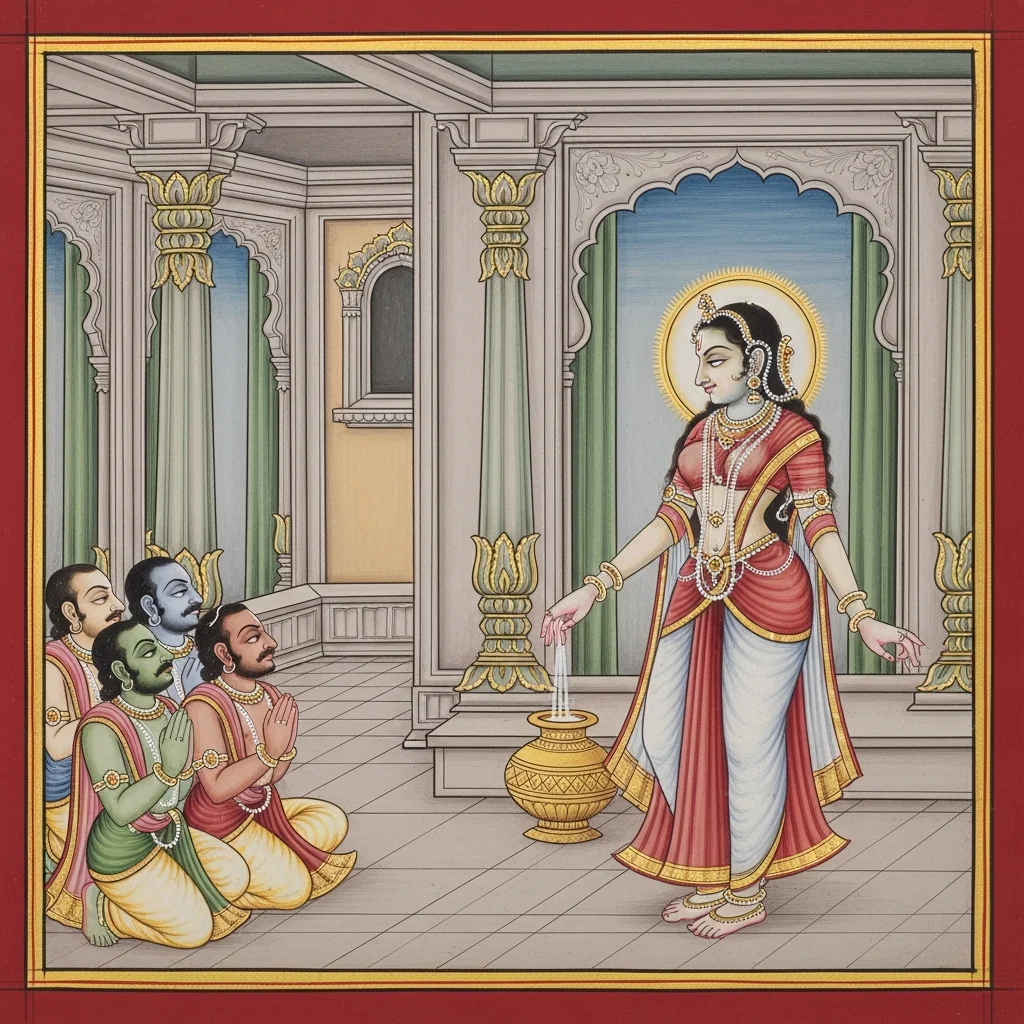
This chapter begins with a king’s query and a sage’s narration, leading to Nārada’s deliberate journey to Bali’s court in view of the impending Vāmana avatāra and the ethical problem of engaging in conflict without violating reverence for one’s guru. Bali is shown among daitya nobles who question the cosmic allotment of amṛta, jewels, and heavenly privileges; the Mohinī episode is recalled to display divine strategy and social restraint, including the protocol of self-choice and warnings against transgression. Nārada then counsels Bali on honoring brāhmaṇas, on kingship through a catalogue of royal virtues, and on turning attention to the sacred landscape of Raivataka. The narrative proceeds with the origin legend of Raivataka/Revati-kuṇḍa and the reordering of the Revati star, culminating in the institution of the place-based vow, the Viṣṇuvallabha vrata. It prescribes fasting on the bright-fortnight Ekādaśī of Phālguna, bathing, flower-worship, night vigil with kathā-listening, circumambulation with fruits, lamp-offering, and regulated food. Finally, it returns to political consequence: the daitya–deva conflict, ominous signs in Bali’s realm after Vāmana’s advent, and the injunction of an expiatory “all-giving” sacrifice to pacify disturbances—binding ritual observance, righteous rule, and cosmological change into a single instructive arc.
Shlokas
Verse 1
राजोवाच । विचित्रमिदमाख्यानं त्वत्प्रसादाच्छ्रुतं मया । दृष्ट्वा नारायणं शक्रं नारदो मंदरे गिरौ
The King said: “Wondrous is this narrative that I have heard by your grace. After seeing Nārāyaṇa and Śakra, what did Nārada do upon Mount Mandara?”
Verse 2
किं चकार मुनींद्रोऽथ तन्मे विस्तरतो मुने । वद संसारसरणोद्भूतमायाप्रपीडितम् । कथामृतजलौघेन वितृषं कुरु मां प्रभो
“Then what did that lord of sages do? Tell me in detail, O sage. I am oppressed by delusion born of the pathways of saṃsāra—by the flood of nectar-like sacred discourse, make me free from thirst, O revered one.”
Verse 3
सारस्वत उवाच । अथासौ नारदो देवं ज्ञात्वा शप्तं द्विजन्मना । भृगुणा च तथा पूर्वं नान्यथैतद्भविष्यति
Sārasvata said: “Then Nārada, knowing that the god had been cursed by a twice-born (brāhmaṇa)—and that earlier too by Bhṛgu—understood that this would not turn out otherwise.”
Verse 4
भविष्यं यद्भवं देव वर्तमानं विचिंत्यताम् । अयं च वामनो भूत्वा विष्णुर्यास्यति तां पुरीम्
“Let what is to come, and what is now, be considered, O god. For this Viṣṇu, becoming Vāmana, will go to that city.”
Verse 5
निग्रहं स बलेः पश्चात्करिष्यति मम प्रियम् । युद्धं विना कथं स्थेयं वर्तमानं महोल्बणम्
“Afterwards he will restrain Bali, fulfilling what is dear to me. Yet how can this present, exceedingly fierce situation be endured without battle?”
Verse 6
देवदानवयुद्धानि दैत्यगन्धर्व रक्षसाम् । निवारितानि सर्वाणि सरीसृपपतत्रिणाम्
“All wars—of gods and dānavas, of daityas, gandharvas, and rākṣasas—indeed all conflicts even among reptiles and birds—have been checked and prevented.”
Verse 7
सापत्नजः कलिर्नास्ति मम भाग्यपरिक्षये । देवेन्द्रो गुरुणा पूर्वं वारितः किं करोम्यहम्
“As my fortune wanes, no strife born of rivalry remains for me. Even Indra, lord of the gods, was once restrained by his guru—what then am I to do?”
Verse 8
माननीयो गुरुर्मेऽयमतस्तं न शपाम्यहम् । युद्धार्थं तु ततो यत्नो न सिध्यति करोमि किम्
“This guru of mine is worthy of honor; therefore I do not curse him. Yet my effort toward battle does not succeed—what am I to do?”
Verse 9
केनापि दैवयोगेन पुरुषार्थो न सिध्यति । तथापि यत्नः कर्तव्यः पुरुषार्थे विपश्चिता । दैवं पुरुषकारेण विनापि फलति क्वचित्
“By destiny alone, human aims are not fulfilled. Yet the wise must still exert themselves in proper puruṣārtha, righteous human endeavor. For fate, even without personal striving, bears fruit only at times.”
Verse 10
यदुक्तं तद्वचो व्यर्थं यतः सिद्धिः प्रयत्नतः । बलिं गत्वा भणिष्यामि यथा युद्धं करिष्यति
“Those words that were spoken are futile, for success comes from exertion. I shall go to Bali and tell him how he should wage the battle.”
Verse 11
न श्रोष्यति स चेद्वाक्यं निश्चितं तं शपाम्यहम् । इत्युक्त्वा स ययौ वेगान्नारदो बलिमंदिरे । निमेषांतरमात्रेण शिष्याभ्यां गगने स्थितः
“If he will not heed my words, I shall surely curse him!” So saying, Nārada swiftly went to Bali’s palace; in the space of a mere blink, he stood in the sky together with his two disciples.
Verse 12
प्रासादे शैलसंकाशे सप्तभौमे महोज्ज्वले । तस्योपरि सभा दिव्या निर्मिता विश्वकर्मणा
In a palace like a mountain—seven-storied and brilliantly radiant—there stood above it a divine assembly-hall fashioned by Viśvakarman.
Verse 13
तस्यां सिंहासनं दिव्यं तत्रासीनो बलिर्नृप । दैत्यैः परिवृतः सर्वैः प्रौढिहास्यकथापरैः
There, upon a divine throne, sat King Bali—surrounded by all the Dāityas, engrossed in bold jests and boastful talk.
Verse 14
ऋषिभिर्ब्राह्मणैः शांतैस्त थैवोशनसा स्वयम् । पुत्रमित्रकलत्रैश्च संवृतो दिव्यमन्दिरे
In that divine palace he was attended by peaceful sages and brāhmaṇas, and by Uśanas himself, and was surrounded as well by sons, friends, and wives.
Verse 15
देवांगनाकरग्राहगृहीतैर्दिव्यचामरैः । संवीज्यमानो दैत्येन्द्रः स्तूयमानः स चारणैः
The lord of the Dāityas was fanned with divine chowries held in the hands of celestial maidens, and he was praised by the Cāraṇas.
Verse 16
यावदास्ते मदोन्मत्ता मन्त्रयंति परस्परम् । दैत्यदानवमुख्या ये ते सर्वे युद्धकांक्षिणः
As he sat there, intoxicated with pride, they conferred among themselves—those chief Dāityas and Dānavas, all longing for war.
Verse 17
उत्थायोत्थाय भाषंते प्रगल्भंते सुरैः सह । अस्मदीयमिदं सर्वं त्रैलोक्यं सांप्रतं गतम्
Rising again and again, they spoke with arrogance and grew ever bolder before the gods: “All this threefold world has now come under our power.”
Verse 18
शुक्रबुद्ध्या विना युद्धं प्राप्स्यते किं महोदयः । दैत्येन्द्रो देवराजेन स्नेहं च कुरुतो यदि
Without Śukra’s counsel, how could this great undertaking of war be achieved—especially if the lord of the Dāityas is forming friendship with the king of the gods?
Verse 19
ऐरावणं सदा मत्तं कथं नो याचते बलिः । चतुरं तुरगं कस्मान्नार्पयति दिवाकरः
“How is it that Bali does not demand from us Airāvaṇa, ever in rut? And why does the Sun not offer to him his swift and clever horse?”
Verse 20
यावन्नाक्रम्यते लुब्धो धनाध्यक्षो रणाजिरे । तावन्नार्पयते वित्तं यदा तत्संचितं सुरैः
“So long as the greedy lord of wealth is not assailed on the battlefield, he does not yield his riches—though those very treasures were amassed by the gods.”
Verse 21
न दर्शयति रत्नानि जलराशी रसातलात् । यावन्न मन्दरं क्षिप्त्वा विमथ्नीमो वयं च तम्
“The oceanic mass does not reveal its jewels from the depths of Rasātala—until we cast in Mandara and churn it.”
Verse 22
यथामृतकलाश्चन्द्राद्भुज्यन्ते क्रमशः सुरैः । एवं भागं बलेः कस्मान्न ददाति जलात्मकः
Just as the gods, in due succession, partake of the portions of nectar from the Moon—so why does the one of watery nature not grant Bali his rightful share?
Verse 23
स्वर्धुनी शीतलो वातः पद्मर्किजल्कवासितः । स्वर्गे वाति शनैर्यद्वत्तथा न बलिमंदिरे
The cool breeze of the celestial Gaṅgā (Svadhunī), fragrant with lotus-filaments warmed by the sun, blows gently in heaven—yet such a breeze seems not to blow in Bali’s abode.
Verse 24
इन्द्रचापोद्यता मेघा जलं मुंचंति भूतले । बलिखङ्गोद्धुताः स्वर्गं पुनस्ते यांति भूतलात्
Clouds, with Indra’s bow (the rainbow) raised, pour down water upon the earth; but when driven upward by Bali’s sword, they return again from the earth to heaven.
Verse 25
अस्मदीये धरापृष्ठे यमो मारयते जनम् । नैवं स्वर्गे न पाताले पश्याहो कार्यकारणम्
On this surface of earth that is ours, Yama strikes down people; not so in heaven, nor in Pātāla—behold this strange chain of cause and effect!
Verse 26
आयुर्वृत्तिं सुतान्सौख्यमस्माकं लिखति स्वयम् । ललाटे चित्रगुप्तोऽसौ न देवानां तु तत्समम्
Our lifespan, livelihood, children, and happiness—Citragupta himself writes them upon the forehead; but among the gods there is nothing comparable to this.
Verse 27
वर्षाशीतातपाः काला वर्तंते भुवि सांप्रतम् । न स्वर्गे नैव पाताले भीता भूमौ भ्रमंति हि
Now upon the earth the seasons of rain, cold, and heat prevail; not in heaven, nor in Pātāla—frightened, they indeed wander upon the earth.
Verse 28
एकवीर्योद्भवा यूयं स्वस्रीया देवदानवाः । भूमौ स्थिता वयं कस्माद्देवाः केनोपरिकृताः
You—Devas and Dānavas—are born from the same heroic source and are kin through sisters; why then are we stationed on earth, and by whom are the gods set above us?
Verse 29
समुद्रे मथ्यमाने तु दैत्येन्द्रो वंचितः सुरैः । एकतः सर्वदेवाश्च बलिश्चैवैकतः स्थितः
When the Ocean was being churned, Bali, lord of the Dānavas, was deceived by the Devas. On one side stood all the gods together, and on the other side stood Bali alone.
Verse 30
उत्पन्नेषु च रत्नेषु भाग्यं वै यस्य यादृशम् । गजाश्वकल्पवृक्षाद्याश्चंद्रगोगणदंतिनः
And when the treasures arose, each received a share according to the measure of one’s fortune—elephants, horses, the Kalpavṛkṣa (wish-fulfilling tree), and other wondrous beings and riches.
Verse 31
गृहीत्वा ह्यमृतं देवैर्वयं पाने नियोजिताः । एतया चूर्णिता यूयं न जानीथातिगर्विताः
“After the Devas seized the amṛta, we were appointed only to drink. You, swollen with pride, do not realize that you have been crushed by her—by deception.”
Verse 32
पीतावशेषं पीयूषं सत्यलोके धृतं सुरैः । अहोतिकुटिला देवाः कस्माच्छेषं न दीयते
The nectar left over after drinking has been kept by the Devas in Satyaloka. Alas—how exceedingly crafty the Devas are! Why is the remainder not given to us?
Verse 33
सुरामृतमिति ज्ञात्वा पीयूषाद्वंचिता वयम् । तिलतैलमेवमिष्टं यैर्न दृष्टं घृतं क्वचित्
Taking it to be “the Devas’ nectar,” we were cheated out of the true ambrosia. Like those who prefer sesame oil because they have never seen ghee, we were deluded.
Verse 34
विष्णोर्वक्रचरित्राणां संख्या कर्तु न शक्यते । तथापि कथ्यते तुष्टैर्हृष्टैस्तैर्यदनुष्ठितम्
The number of Vishnu’s wondrous, crafty exploits cannot be counted. Even so, what was carried out by those delighted and exhilarated beings is being recounted.
Verse 35
गौरांगी सुन्दरी सुभ्रूः पीनोन्नतपयोधरा । सुकेशा चंद्रवदना कर्णासक्तविलोचना
Fair-limbed, beautiful, with lovely brows; with full and uplifted breasts; with splendid hair, a moonlike face, and eyes stretching gracefully toward her ears—
Verse 36
वलित्रयांकिता मध्ये बाला मुष्ट्यापि गृह्यते । स्थलारविंदचरणा लतेव भुजभूषिता
Her waist, marked with three graceful folds, was so slender it could be grasped even in a fist; her feet were like lotuses on firm ground, and her arms were adorned like a tender creeper.
Verse 37
सा सर्वाभरणोपेता सर्वलक्षणसंयुता । त्रैलोक्यमोहिनी देवी संजाताऽमृतमन्थने
Adorned with every ornament and endowed with every auspicious mark, that goddess—enchantress of the three worlds—arose during the churning for amṛta, the nectar of immortality.
Verse 38
अमृतादुत्थिता पूर्वं यस्य सा तस्य तद्ध्रुवम् । त्रैलोक्यं वशगं तस्य यस्य सा चारुलोचना
Whomever she first rose toward from the amṛta, surely she belonged to him. And the three worlds come under the sway of the one to whom that lovely-eyed goddess belongs.
Verse 39
तया संमोहिताः सर्वे देवदानवराक्षसाः । विमुच्य मन्थनं सर्वे तां ग्रहीतुं समुद्यताः
Enchanted by her, all the devas, dānavas, and rākṣasas—abandoning the churning itself—rushed forward, eager to seize her.
Verse 40
एका स्त्री बहवो देवा दानवादैत्यराक्षसाः । विवादः सुमहाञ्जातः कथमत्र भविष्यति
One woman—and so many: gods, dānavas, daityas, and rākṣasas. A great dispute has arisen; how will this be resolved here?
Verse 41
आगत्य विष्णुना सर्वे भुजे धृत्वा निवारिताः । अस्यार्थे किमहो वादः क्रियते भोः परस्परम्
Then Viṣṇu came and restrained them all, holding them back with his arms, saying: “Why, for this matter, do you raise quarrel against one another?”
Verse 42
अमृतार्थे समारम्भो महिलार्थे विनश्यति । संकेतं प्रथमं कृत्वा विष्णुना चुंबिता पुनः
“An undertaking begun for amṛta is ruined when turned toward a woman.” Having first made an agreement, she was again kissed by Viṣṇu.
Verse 43
दिव्यरूपधरः स्रग्वी वनमालाविभूषितः । कौस्तुभोद्द्योतिततनुः शंखचक्रगदाधरः
Assuming a divine form, garlanded and adorned with the forest-wreath (vanamālā), his body shone with the Kaustubha jewel; he bore the conch, discus, and mace.
Verse 44
तस्या हस्ते शुभां मालां दत्त्वा विष्णुः पुरः स्थितः । उद्धृत्य बाहुं सर्वेषां बभाषे वचनं हरिः
Placing an auspicious garland into her hand, Viṣṇu stood before them. Then Hari raised up the arms of all and addressed them with these words.
Verse 45
कुर्वंतु कुण्डलं सर्वे तिष्ठन्तु स्वयमासने । विलोक्य स्वेच्छया लक्ष्मीर्वरमालां प्रयच्छतु
“Let all of you form a circle and remain each upon your own seat. Let Lakṣmī, after looking, freely bestow the bridal garland (varamālā) upon the one she chooses.”
Verse 46
स्वयंवरविभेदं यः करिष्यत्यतिलंपटः । स वध्यः सहितैः सर्वैः परस्त्रीलुब्धको यथा
“Whoever, overcome by greed, tries to disrupt this svayaṃvara should be slain by all together, like a man who lusts after another’s wife.”
Verse 47
परदारकृतं पापं स्त्रीवध्या तस्य जायताम् । अन्योऽपि यः करोत्येवमेवमस्तु तदुच्यताम्
Let the sin born of violating another’s marriage fall upon the one who deserves punishment for harming women. And if any other acts in the same way, let the same be declared for him as well.
Verse 48
साधारणं हरिं ज्ञात्वा तथेत्युक्त्वा तथा कृतम् । देवदानवदैत्यानां गंधर्वोरगरक्षसाम् । मध्ये योऽभिमतो भर्ता स ते सत्यं भवेदिति
Recognizing Hari as the impartial arbiter, they replied, “So be it,” and acted accordingly. “Among the devas, dānavas, daityas, gandharvas, nāgas, and rākṣasas, the one whom you desire as husband—may he truly become yours.”
Verse 49
तेनासौ मोहिता पूर्वं दृष्टिदानेन कर्षिता । आद्यं संमोहनं स्त्रीणां चक्रे दृष्टिनिरीक्षणम्
By him she had already been bewildered earlier, drawn in by the “gift of his glance.” Thus, as the first act of enchanting women, he employed the power of looking—captivating through mere sight.
Verse 50
एवमेवेति तत्कर्णे हस्तं दत्त्वा यदुच्यते । दधाति हृदि यं नारी कामबाणप्रपीडिता
Whatever is whispered into her ear with the hand placed as a cover, accompanied by “so it is, so it is”—that very message a woman, afflicted by Kāma’s arrows, holds fast within her heart.
Verse 51
तमेव वरयेदत्र कश्चिन्नास्त्येव संशयः । संजाते कलहे पूर्वं हरिणा तं निवर्तितुम्
Here she would choose him alone—there is no doubt of it. But when a quarrel had arisen earlier, Hari acted to restrain it and turn the situation back, averting the conflict.
Verse 52
यदा गृहीता सर्वैः सा हरिं नैव विमुंचति । त्वमेव भर्ता साऽचष्टे मुंच मां व्रज दूरतः
Even when seized by all of them, she would not release Hari at all. “You alone are my husband,” she declared—“let me go; depart far away.”
Verse 53
मुक्त्वा दूरं ततो विष्णुः प्रविष्टः सुरमण्डले । तदा सर्वे च मामुक्त्वा यथास्थानं स्वयं गताः
Then Viṣṇu, having freed himself and gone far away, entered the assembly of the gods. Thereupon all of them, releasing me as well, returned of their own accord to their respective places.
Verse 54
आचष्ट विजया पूर्वं सर्वान्देवान्यथाक्रमम् । सा च निरीक्षते पश्चात्तं विचार्य विमुञ्चति
Vijayā first pointed out all the gods in due order. Then she looked upon him afterward—and, having considered, she released him.
Verse 55
उदासीनः शिवः शांतो गौरीकांतस्त्रिलोचनः । नान्यां निरीक्षते नित्यं ध्यानासक्तस्त्रिलोचनः
Śiva—tranquil, detached, the beloved of Gaurī, the Three-eyed—never looks upon another; ever absorbed in meditation, the Three-eyed remains inwardly fixed.
Verse 56
पितामहोयमित्युक्तं यदा सख्या तदा तया । नमस्कृत्य गतं दूरे कृत्वा मौनं न पश्यति
When her companion said, “This is Pitāmaha (Brahmā),” then she bowed to him; and when he had gone far away, maintaining silence, she did not look after him.
Verse 57
आदित्यं पद्मकं मुञ्च दहनं दहनात्मकम् । वाति वातो गता दूरे वरुणो मे पिता यतः
“Release Āditya (the Sun), Padmaka, and Dahana whose very nature is fire. The wind blows and has gone far away—for Varuṇa is my father.”
Verse 58
पौलोमीवदनासक्तो देवेन्द्रो मे न रोचते
Indra, the lord of the gods, does not please me—his mind being attached to Paulomī’s face.
Verse 59
वधबंधकृतच्छेदभेददण्डविकर्ष णम् । कुर्वन्न कुरुते सौम्यं रूपं वैवस्वतो यमः
Even while carrying out slaying, binding, cutting, splitting, punishment, and dragging away, Vaivasvata Yama does not assume a gentle form, O good one.
Verse 60
देवदानवगंधर्वदैत्यपन्नगराक्षसान्
The gods, Dānavas, Gandharvas, Daityas, Nāgas, and Rākṣasas—
Verse 61
दृष्ट्वात्युग्रांस्ततो याति दृष्टोऽसौ पुरुषो त्तमः । कर्णांतलोचनभ्रांतवक्त्रं दृष्ट्यावलोक्य तम्
Seeing those exceedingly terrifying ones, that Supreme Person departs; and when they look upon Him, their faces become distorted—eyes rolling to the edges of their ears—at that very sight.
Verse 62
सौभाग्यातिशयाक्रांतं रम्यं काममनोहरम् । संजातपुलकोद्भेदस्वेदवारिकणांकितम्
He was suffused with extraordinary blessed fortune—lovely, delightful, and enchanting to the mind; his body marked by hairs standing on end and by droplets of sweat and water that had arisen.
Verse 63
देवदानवदैत्येन्द्रक्रोधदृष्टिनिरीक्षितम् । रम्यं रामा वरं चक्रे ददौ मालां ततः स्वयम्
Watched by the wrathful glances of the lords of Devas, Dānavas, and Daityas, the lovely Rāmā chose him as her bridegroom and then personally placed a garland upon him.
Verse 64
दैत्याः परस्परं प्रोचुः प्रेक्ष्य तत्सुरचेष्टितम् । विभागं पश्य देवानां स्वर्गे सर्वे स्वयं गताः
The Daityas said to one another, seeing that deed of the gods: “Behold the gods’ arrangement—each has gone of his own accord to heaven!”
Verse 65
पातालस्य तले यूयं मानवा धरणीतले । देवास्त्रिभुवने यांतु न वयं स्वर्गगामिनः
“You belong to the depths of Pātāla; humans belong upon the earth’s surface. Let the gods move through the three worlds—yet we are not destined to go to heaven.”
Verse 66
मानवाः क्षत्रिया राज्यं कुर्वंतु पृथिवीतले । पातालं तु परित्यज्य धात्री यदि तु रक्ष्यते
“Let human Kṣatriyas rule the kingdom upon the earth. But if, abandoning Pātāla, the Earth-Mother is to be protected—”
Verse 67
दैत्यदानवजैः कैश्चिद्राक्षसैस्तन्न शोभनम् । अथ किं बहुनोक्तेन राजा त्रिभुवने बलिः
But it is not fitting that the earth be guarded by certain Daityas, Dānavas, and Rākṣasas. What need of many words? Bali is the king of the three worlds.
Verse 68
संविभज्याथ रत्नानि समं राज्यं विधीयताम् । यावदेवं प्रगल्भंते तावत्पश्यंति नारदम्
So let the jewels be apportioned, and let the kingdom be set in equal order. As they spoke so boldly, they then beheld Nārada.
Verse 69
गगनात्समुपायांतं द्वितीयमिव भास्करम् । ब्रह्मदंडकरासक्तयुद्धपुस्तकधारिणम्
Descending from the sky, he shone like a second sun—bearing in his hands the Brahmin’s staff and the emblems of sacred discipline: a book of knowledge and the readiness to contend for dharma.
Verse 70
कृष्णाजिनधरं शांतं छत्रवीणाकमण्डलून् । मौंजीगुणत्रयासक्तग्रंथिप्रवरमेखलम्
Peaceful and clad in black antelope-skin, he bore an umbrella, a vīṇā, and a kamandalu water-pot; about his waist was a fine girdle of muñja-grass cord, knotted and bound with its threefold strands.
Verse 71
ब्रह्मरूपधरं शांतं दिव्यरुद्राक्षभूषितम् । गत कल्पकृतग्रंथिसूत्रमालावलंबितम्
Assuming a Brahmā-like form, serene and adorned with divine rudrākṣa beads, he wore garlands of sacred threads whose knots were fashioned long ago, enduring across the ages.
Verse 72
विरंचिहरसंवादो जन्माहंकारगर्वितः । संक्रुद्धैः क्रियते कोऽद्य चिंतातत्परमानसम्
“The dispute between Virañci (Brahmā) and Hara (Śiva), swollen with pride of birth and ego—who today is stirring it again in anger, with a mind wholly intent on anxiety?”
Verse 73
आयातं नारदं दृष्ट्वा विस्मिताः समुपस्थिताः । प्रभो प्रसादः क्रियतामागंतव्यं गृहे मम
Seeing Nārada arrive, they stood up in amazement and said: “O Lord, be gracious—please come to my house.”
Verse 74
धन्योऽहं कृतपुण्योऽहं यस्य मे त्वं गृहागतः । इत्युक्तो बलिना विप्रो विवेशासुरमंदिरे । आसनं पाद्यमर्घ्यं च दत्त्वा संपूजितो द्विजः
“Blessed am I, truly meritorious am I, for you have come to my home!”—thus spoken by Bali, the Brahmin entered the asura palace. Having been offered a seat, water for the feet, and arghya, the twice-born was duly honored.
Verse 75
प्रविश्य सहिताः सर्वे संविष्टा दैत्यदानवाः । शुक्रेण सहितो दैत्यो बभाषे नारदं बलिः
After entering together, all the daityas and dānavas took their seats. Then Bali, the daitya king, accompanied by Śukra, spoke to Nārada.
Verse 76
इदं राज्यमिमे दारा इमे पुत्रा अहं बलिः । ब्रूहि येनात्र ते कार्यं दानं मे प्रथमं व्रतम्
“This is my kingdom; these are my wives; these are my sons—I am Bali. Tell me what you require here; for giving (dāna) is my foremost vow.”
Verse 77
नारद उवाच । भक्त्या तुष्यंति ये विप्रास्ते विप्रा भूमिदेवताः । न तु ये पूजिताः शक्त्या पुनर्याचंति तेऽधमाः
Nārada said: “Those Brahmins who are satisfied by devotion are truly ‘gods upon the earth.’ But those who, even after being honored according to one’s capacity, ask again—such men are base.”
Verse 78
त्वयाऽहं पूजितो हृष्टो न वित्तैर्मे प्रयोजनम् । हृष्टोऽहं तव राज्येन यज्ञैर्दानैर्व्रतैस्तथा
“You have honored me, and I am pleased; I have no need of wealth. I rejoice in your righteous rule, and in your sacrifices, charities, and vows as well.”
Verse 79
देवैः कृतं विप्रियं ते किंचित्पश्याम्यहं बले । त्वया संपूज्यमानोऽपि देवराजो न तुष्यति
O Bali, I perceive that the gods have done something displeasing to you. Even though you duly honor him, the king of the gods is not satisfied.
Verse 80
न क्षमंति सुराः सर्वे तव राज्यं धरातले । स्वर्गे मे तापको जातो देवानां तव विग्रहे
All the gods cannot tolerate your sovereignty upon the earth. Because of the gods’ hostility toward you, a burning anxiety has arisen for me even in heaven.
Verse 81
संनह्य प्रथमं याति यः सैन्यं शत्रुभूमिषु । स क्षत्रियो विजयते तस्य राज्यं च वर्धते
That kṣatriya who first arms himself and leads his army into the enemy’s lands attains victory, and his kingdom increases.
Verse 82
उच्छेदस्तव राज्यस्य भविष्यति श्रुतं मया । एवं ज्ञात्वा यथायुक्तं तच्छीघ्रं तु विधीयताम्
I have heard that the destruction of your kingdom will come to pass. Knowing this, arrange at once what is proper, without delay.
Verse 83
बलिरुवाच । यैर्गुणैः कुरुते राज्यं राजा तान्वद मे विभो । दानं पात्रे प्रदातव्यं मया त्वमपि तं वद
Bali said: O mighty one, tell me the qualities by which a king truly governs a kingdom. Tell me also to whom I should give charity—what makes one a worthy recipient.
Verse 84
नारद उवाच । षड्विंशद्गुणसंपन्नो राजा राज्यं करोति च । स राज्यफलमाप्नोति शृणु तत्कथयाम्यहम्
Nārada said: A king endowed with twenty-six qualities truly sustains kingship. He attains the fruits of righteous rule. Listen—those qualities I shall now describe.
Verse 85
चरेद्धर्मानकटुको मुंचेत्स्नेहमनास्तिके । अनृशंसश्चरेदर्थं चरेत्काममनुद्धतः
Let him practice dharma without harshness; let him abandon attachment to the faithless. Let him pursue wealth without cruelty, and enjoy rightful pleasures without arrogance.
Verse 86
प्रियं ब्रूयादकृपणः शूरः स्यादविकत्थनः । दाता चाऽयामवर्जः स्यात्प्रगल्भः स्यादनिष्ठुरः
Let him speak what is pleasing; let him be free from miserliness. Let him be brave yet not boastful; a giver, not one who shirks effort. Let him be confident, yet never cruel.
Verse 87
संदधीत न चानार्यान्विगृह्णीयान्न बंधुभिः । नानाप्तैश्चारयेच्चारान्कुर्यात्कार्यमपीडयन्
Let him form alliances, yet not with ignoble men; let him not quarrel with his own kinsmen. Let him employ spies through trustworthy agents, and accomplish affairs without oppressing others.
Verse 88
अर्थान्ब्रूयान्न चापत्सु गुणान्ब्रूयान्न चात्मनः । आदद्यान्न च साधुभ्यो नासत्पुरुषमाश्रयेत्
Let him speak of resources and policy, but not in times of crisis; let him speak of virtues, but not his own. Let him not take from the good, and let him never seek refuge in the wicked.
Verse 89
नापरीक्ष्य नयेद्दण्डं न च मंत्रं प्रकाशयेत् । विसृजेन्न च लुब्धेभ्यो विश्वसेन्नापकारिषु
One should not impose punishment without proper examination, nor reveal confidential counsel. One should not entrust matters to the greedy, and should not place trust in those who have done harm.
Verse 90
आप्तैः सुगुप्तदारः स्याद्रक्ष्यश्चान्यो घृणी नृपः । स्त्रियं सेवेत नात्यर्थं मृष्टं भुंजीत नाऽहितम्
Let a king keep his household well-guarded by trusted people, and let him protect others with compassion. Let him not be excessively given to sensual indulgence; let him eat what is wholesome and refined, and not what is harmful.
Verse 91
अस्तेयः पूजयेन्मान्यान्गुरुं सेवेदमायया । अर्च्यो देवो न दम्भेन श्रियमिच्छेदकुत्सिताम्
Let him be free from theft; let him honor the worthy and serve the guru without deceit. Let him worship the deity without hypocrisy, seeking prosperity that is not ignoble.
Verse 92
सेवेत प्रणयं कृत्वा दक्षः स्यादथ कालवित् । सांत्ववाक्यं सदा वाच्यमनुगृह्णन्न चाक्षिपेत्
Having established goodwill, let him act with skill and know the proper time. Let him always speak conciliating words, granting favor, and never utter harshness or insult.
Verse 93
प्रहरेन्न च विप्राय हत्वा शत्रून्न शेषयेत् । क्रोधं कुर्यान्न चाकस्मान्मृदुः स्यान्नापकारिषु
Let him not strike a brāhmaṇa; and having subdued enemies, let him not leave them to rise again. Let him not grow angry without cause, yet let him not be soft toward those who do harm.
Verse 94
एवं राज्ये चिरं स्थेयं यदि श्रेय इहेच्छसि । तपःस्वाध्यायदानानि तीर्थयात्राऽश्रमाणि च
If you desire welfare in this very life, then remain steadfast in sovereignty in this manner. Practice austerity, scriptural study, and charity—and undertake pilgrimages to sacred tīrthas and visits to hermitages as well.
Verse 95
योगेनात्मप्रबोधस्य कलां नार्हंति षोडशीम् । त्वया संसारवैराग्यं कर्त्तव्यं विप्रपूजनम्
Through yoga they do not attain even a sixteenth part of true awakening of the Self. Therefore you should cultivate dispassion toward saṃsāra and perform worship and honoring of brāhmaṇas.
Verse 96
यष्टव्यं विविधैर्यज्ञैर्ध्येयो नारायणो हरिः । प्रसंगेन समायातो यास्ये रैवतके गिरौ
Sacrifices of various kinds should be performed, and Nārāyaṇa Hari should be meditated upon. Having come here by fortunate circumstance, I shall go to Mount Raivataka.
Verse 97
तत्रास्ते भगवान्विष्णुर्नदी त्रैलोक्यपावनी । तत्रास्ते च शिवावृक्षो बहुपुष्पफलान्वितः । तत्र गत्वा करिष्यामि व्रतं तद्विष्णुवल्लभम्
There dwells Lord Viṣṇu, and there is a river that purifies the three worlds. There too stands the Śivā-tree, abundant with flowers and fruits. Going there, I shall undertake that vow which is dear to Viṣṇu.
Verse 98
बलिरुवाच । कोऽयं रैवतकोनाम व्रतं किं विष्णुवल्लभम् । शिवावृक्षास्तु के प्रोक्तास्तत्कथं कथयस्व मे
Bali said: “What is this place called Raivataka? What is the vow that is dear to Viṣṇu? And what are the trees called Śivāvṛkṣas? Explain to me how this is so.”
Verse 99
नारद उवाच । पुरा युगादौ दैत्येन्द्र सपक्षाः पर्वताः कृताः । संचिंत्य ब्रह्मणा पश्चादचलास्ते कृताः पुनः
Nārada said: In ancient times, at the beginning of the age, the mountains were created with wings, O lord of the Daityas. Later, after reflecting, Brahmā made those very mountains again wingless and immovable.
Verse 100
उत्पतंति महाकाया निपतंति यदृच्छया । मेरुमंदरकैलासा वचसा संस्थिताः स्थिराः
Those huge-bodied mountains would fly up and then fall down at random. But Meru, Mandara, and Kailāsa were made steady and firmly established by divine command.
Verse 101
वारिता न स्थिता ये तु त इंद्रेण स्थिरीकृताः । मेरोर्दक्षिण शृंगे तु कुमुदेति स पर्वतः
Those mountains which, even when restrained, would not stay in place—Indra made them firm. Upon Meru’s southern peak there is that mountain called Kumuda.
Verse 102
दिव्यः सपक्षः सौवर्णो दिव्यवृक्षैः समावृतः । तस्योपरि पुरी दिव्या वैष्णवी विष्णुना कृता
It is celestial, winged, and golden, encircled by divine trees. Upon it stands a heavenly city—Vaiṣṇavī—fashioned by Viṣṇu.
Verse 103
तस्या मध्ये गृहं दिव्यं यस्मिल्लंक्ष्मीः सदा स्थिता । मेरोः शृंगे पुरी रम्या गृहं तत्र मनोरमम्
In the midst of that city is a divine mansion wherein Lakṣmī ever abides. On Meru’s summit is a delightful city, and there a most enchanting residence.
Verse 104
तत्रास्ते स भवो देवो भवानी यत्र संस्थिता । सभा माहेश्वरी रम्या सौवर्णी रत्नमंडिता
There dwells the god Bhava (Śiva), where Bhavānī is established. (There is) a lovely Māheśvarī assembly-hall, golden and adorned with jewels.
Verse 105
तत्रास्ते भगवान्विष्णुर्देवैर्ब्रह्मादिभिर्वृतः । तस्यां विष्णुः सदा याति देवं द्रष्टुं महेश्वरम्
There too dwells Lord Viṣṇu, surrounded by the gods headed by Brahmā. In that place, Viṣṇu ever goes to behold the god Maheśvara (Śiva).
Verse 106
सौवर्णैः कुमुदैर्यस्मादसौ सर्वत्र मंडितः । कुमुदेति कृतं नाम देवैस्तत्र समागतैः
Because it is everywhere adorned with golden kumuda-lotuses, the gods who assembled there gave it the name ‘Kumuda’.
Verse 107
एकदा भगवान्रुद्रो गिरौ तस्मिन्समागतः । द्रष्टुं तच्छिखरे रम्ये तां पुरीं विष्णुपालिताम्
Once, the Blessed Rudra came to that mountain, to behold upon its lovely summit that city protected by Viṣṇu.
Verse 108
गृहागतं हरं दृष्ट्वा हरिणा स तु पूजितः । लक्ष्म्या संपूजिता गौरी हर्षिता तत्र संस्थिता
Seeing Hara (Śiva) arrive at his dwelling, Hari (Viṣṇu) worshipped him. Gaurī (Pārvatī), duly honored by Lakṣmī, remained there, delighted.
Verse 109
एकासनोपविष्टौ तौ मंत्रयंतौ परस्परम् । हरेण कारणं ज्ञात्वा तत्सर्वं कथितं हरेः
Seated together on a single seat, the two of them consulted with one another. Having understood the reason through Hara (Śiva), Hari (Viṣṇu) then related that entire matter to Hara.
Verse 110
त्वयेयं नगरी कार्या मंदरे पर्वतोत्तमे । प्रष्टव्यः कारणं नाहमवश्यं तद्भविष्यति
“This city is to be established by you, O excellent mountain, Mandara. As for the cause, it is not for me to be questioned—surely it will come to pass.”
Verse 111
हर एव विजानाति कारणं कतमोऽपि न । एवं तथेति तौ प्रोक्त्वा संस्थितौ पर्वतोऽपि सः
“Hara alone knows the reason; no one else at all does.” Having spoken thus—“So be it”—the two remained, and that mountain too stood firm.
Verse 112
तं दृष्ट्वा संगतं रुद्रं कुमुदः स्वयमाययौ । धन्योऽहं कृतपुण्योऽहं यस्य मे गृहमागतौ
Seeing Rudra arrive in company, Kumuda himself came forward and said, “Blessed am I; rich in merit am I, since you two have come to my house.”
Verse 113
द्वाभ्यामुक्तो गिरिवरो ददाव किं वरं तव । इत्युक्तः पर्वतस्ताभ्यां वरं वव्रे स मूढधीः
Addressed by the two, the excellent mountain said, “What boon shall I grant you?” Thus spoken to by them, the mountain—of deluded understanding—chose a boon.
Verse 114
भविष्यत्कार्यहेतुत्वाद्भविष्यति न तद्वृथा । यत्राहं तत्र वस्तव्यं भवद्भ्यामस्तु मे वरः
“Because it is a cause for a future purpose, it will not be in vain. Wherever I am, there you two should dwell—let this be my boon.”
Verse 116
मत्सन्निधौ समागत्य स्थातव्यं ब्रह्मवासरम् । तथेत्युक्त्वा सपत्नीकौ गतौ हरिहरावुभौ
“Come into my presence and remain for a full ‘day of Brahmā’.” Saying, “So be it,” both Hari and Hara departed, each together with his consort.
Verse 117
ऋषिरासीन्महाभाग ऋतवागिति विश्रुतः । तस्यापुत्रस्य पुत्रोऽभूद्रेवत्यन्ते महात्मनः
There was a most fortunate sage, renowned by the name Ṛtavāk. Though he was without a son, at the end of the nakṣatra Revatī a son was born to that great-souled one.
Verse 118
स तस्य विधिवच्चक्रे जातकर्मादिकाः क्रियाः । तथोपनयनाद्याश्च स चाशीलोऽभवन्नृप
He duly performed for him the rites beginning with the jātakarma (birth-ceremony), and likewise those beginning with the upanayana (initiation). Yet that boy became ill-conducted, O king.
Verse 119
यतः प्रभृति जातोऽसौ ततः प्रभृत्यसावृषिः । दीर्घरोगपरामर्शमवापातीव दुर्द्धरम्
From the very time that boy was born, from that moment onward the sage seemed as though afflicted by the hard-to-bear touch of a prolonged disease.
Verse 120
माता चास्य परामार्तिं कुष्ठरोगाभिपीडिता । जगाम चिन्तां स ऋषिः किमेतदिति दुःखितः
And his mother too, grievously afflicted and tormented by leprosy (kuṣṭha), fell into extreme suffering. Seeing this, the sage became distressed and sank into anxious thought: “What is this—why has this happened?”
Verse 121
मूर्खस्तु मंदधीः पुत्रो दुःखं जनयते पितुः । अमार्गगो विशेषेण दुःखाद्दुःखतरं हि तत्
A foolish son, dull of understanding, brings sorrow to his father. And when he walks the path of adharma, that sorrow becomes truly worse than sorrow itself.
Verse 122
अपुत्रता मनुष्याणां श्रेयसे न कुपुत्रता । सुहृदां नोपकाराय पितॄणां नापि तृप्तये
For human beings, childlessness is better for one’s welfare than having a wicked son—who is of no help to friends and brings no satisfaction even to the ancestors.
Verse 123
सुपुत्रो हृदयेऽभ्येति मातापित्रोर्दिनेदिने । पित्रोर्दुःखाय धिग्जन्म तस्य दुष्कृतकर्मणः
A good son enters ever more deeply into the hearts of his mother and father, day by day. But—shame upon the birth of that evil-doer whose life becomes only a cause of pain to his parents.
Verse 124
धन्यास्ते तनया ये स्युः सवर्लोकाभिसंमताः । परोपकारिणः शांताः साधुकर्मण्यनुव्रताः
Blessed are those sons who are honored by all the worlds—who work for the good of others, who are peaceful, and who remain devoted to righteous deeds.
Verse 125
अनिर्वृतं निरानंदं दुःखशोकपरिप्लुतम् । नरकाय न स्वर्गाय कुपुत्रत्वं हि जन्मिनः
Joyless and without peace, flooded with grief and sorrow—having a wicked son leads a person toward hell, not toward heaven.
Verse 126
करोति सुहृदां दैन्यमहितानां तथा मुदम् । अकाले तु जरां पित्रोः कुपुत्रः कुरुते किल
A wicked son brings misery to well-wishers and, likewise, delight to enemies. Indeed, he makes his parents grow old before their time.
Verse 127
नारद उवाच । एवं सोऽत्यन्तदुष्टस्य पुत्रस्य चरितैर्मुनिः । दह्यमानमनोवृत्तिर्वृद्धगर्गमपृच्छत
Nārada said: Thus, tormented inwardly by the deeds of his utterly wicked son, the sage—his mind burning with anguish—questioned the aged Garga.
Verse 128
ऋतवागुवाच । सुव्रतेन पुरा वेदा अधीता विधिना मया । समाप्य विद्या विधवत्कृतो दारपरिग्रहः
Ṛtavāk said: Formerly, with steadfast vows, I studied the Vedas according to the prescribed rule. Having duly completed my learning, I then properly entered the householder’s life by taking a wife.
Verse 129
सदारेण हि याः कार्याः श्रौतस्मार्त्तादिकाः क्रियाः । ताः कृताश्च विधानेन कामं समनुरुध्य च
Indeed, the rites to be performed together with one’s wife—Vedic (śrauta), traditional (smārta), and the like—I carried out according to proper procedure, thereby fulfilling the rightful aims of life as well.
Verse 130
पुत्रार्थं जनितश्चायं पुंनाम्नो विच्युतौ मुने । सोऽयं किमात्मदोषेण मातुर्दोषेण किं मम । अस्मद्दुःखावहो जातो दौःशील्याद्वद कोविद
“O sage, this child was begotten for the sake of a son and for deliverance from the hell called Puṃ-nāma. Why then has he become—by what fault of mine, or what fault of his mother—one who brings sorrow upon our house? Tell me, O wise one: from where has this ill-conduct arisen?”
Verse 131
गर्ग उवाच । रेवत्यन्ते मुनिश्रेष्ठ जातोऽयं तनयस्तव । तेन दुःखाय ते दुष्टे काले यस्मादजायत
Garga said: “O best of sages, this son of yours was born at the ending junction of Revatī. Therefore, since he was born at an inauspicious time, he has become a cause of sorrow to you.”
Verse 132
तवापचारो नैवास्य मातुर्नापि कुलस्य च । अन्यद्दौःशील्यहेतुत्वं रेवत्यंत उपागतम्
“This is not due to any wrongdoing on your part, nor on the mother’s, nor of the family-line. Rather, the very cause of this ill-conduct has come from the Revatī-ending junction (of time).”
Verse 133
रेवती अश्विनोर्मध्यमाश्लेषामघयोस्तथा । ज्येष्ठामूलर्क्षयोः प्रोक्तं गंडांतं तु भयावहम्
The junction called Gaṇḍānta—declared to be fearsome—lies at the end of Revatī and the beginning of Aśvinī; likewise between Āśleṣā and Maghā, and between Jyeṣṭhā and Mūla.
Verse 134
गंडत्रये तु ये जाता नरनारीतुरंगमाः । तिष्ठंति न चिरं गेहे तिष्ठन्तोऽपि भयंकराः । एवमुक्तोऽथ गर्गेण चुक्रोधातीव कोपनः
But those—men, women, and even horses—who are born in these three Gaṇḍāntas do not remain long within the household; and even while they remain, they are a source of fear. When Garga spoke thus, the hot-tempered one became exceedingly angry.
Verse 135
ऋतवागुवाच । यस्मान्ममैक पुत्रस्य रेवत्यन्ते समुद्भवः
Ṛtavāgu said: “Since my only son has been born at the ending junction of Revatī…”
Verse 136
रेवती किं न जानाति मां विप्रः शापयिष्यति । जाज्वल्यमाना गगनात्तस्मात्पततु रेवती
“Does Revatī not know that a brāhmaṇa will curse me? Therefore let Revatī—blazing—fall down from the sky!”
Verse 137
नारद उवाच । तेनैवं व्याहृते वाक्ये रेवत्यृक्षं पपात ह पश्यतः सर्वलोकस्य विस्मयाविष्टचेतसः
Nārada said: “When those words were thus uttered, the star of Revatī indeed fell, while all the worlds looked on—minds seized with astonishment.”
Verse 138
ईश्वरेच्छाप्रभावेन पतिता गिरिमूर्द्धनि । रेवत्यृक्षं निपतितं कुमुदाद्रौ समन्ततः
By the power of the Lord’s will it fell upon a mountain summit; the asterism Revatī descended all around upon Mount Kumuda.
Verse 139
सुराष्ट्रदेशे स प्राप्तः पतितो भूतले शुभे । हिमाचलस्य पुत्रो य उज्जयंतो गिरिर्महान्
It reached the land of Surāṣṭra and fell upon the auspicious earth—upon that great mountain Ujjayanta, said to be a son of Himācala.
Verse 140
कुमुदेन समं मैत्री कृता पूर्वं परस्परम् । यत्र त्वं स्थास्यसे स्थाता तत्राहमपि निश्चितम्
Formerly, Kumuda and I had established mutual friendship. Wherever you, the steadfast one, shall remain established, there I too am firmly resolved to stay.
Verse 141
इति कृत्वा गृहीत्वाथ गंगावारि सयामुनम् । सारस्वतं तथा पुण्यं सिंचितुं तं समागतः
Having done so, he then took the waters of the Gaṅgā together with the Yamunā, and likewise the holy Sarasvatī water, and came there in order to sprinkle (consecrate) him with that sacred water.
Verse 142
आहूतसंप्लवं यावत्संस्थितौ तौ परस्परम् । कुमुदाद्रिश्च तत्पातात्ख्यातो रैवतकोऽभवत्
Until the summoned flood subsided, the two remained there together. And from that descent, Mount Kumuda became renowned by the name “Raivataka.”
Verse 143
अतीव रम्यः सर्वस्यां पृथिव्यां पृथिवीपते । कुमुदाद्रिश्च सौवर्णो रेवतीच्यवनात्पुनः
O lord of the earth, Mount Kumuda was exceedingly delightful throughout the whole world; and again, by the descent and flowing of Revatī, it shone with golden splendor.
Verse 144
पंकजाभः स बाह्येन जातो वर्णेन भूपते । मेरुवर्णः स मध्ये तु सौवर्णः पर्वतोत्तमः
O king, outwardly that foremost mountain assumed a lotus-like hue; yet in its midst it bore the color of Meru—truly golden, the best of mountains.
Verse 145
ततः सञ्जनयामास कन्यां रैवतको गिरिः । रेवतीकांति संभूतां रेवतीसदृशाननाम्
Then Raivataka Mountain brought forth a maiden—born of Revatī’s radiance, her face resembling Revatī herself.
Verse 146
प्रमुचो नाम राजर्षिस्तेन दृष्टा वरांगना । पितृवद्रेवतीनाम कृतं तस्या नृपोत्तम
A royal sage named Pramuca beheld that excellent maiden; and like a father, O best of kings, he bestowed upon her the name “Revatī.”
Verse 147
रेवतीति च विख्याता सा सर्वत्र वरांगना । सर्वतेजोमयं स्थानं सर्वतीर्थजलाश्रयम्
She became renowned everywhere as “Revatī,” that excellent maiden. (That region is) a place formed of universal splendor, a reservoir that holds the waters of all tīrthas.
Verse 148
गंगाजलप्रवाहैश्च संयुक्तं यामुनैस्तथा । स्थितं सारस्वतं तोयं तत्र गर्तेषु तत्त्रयम्
There the waters of Sarasvatī remained, united with the flowing currents of Gaṅgā and likewise with those of Yamunā. In the hollows there, that triad of sacred waters stood together.
Verse 149
विख्यातं रेवतीकुंडं यत्र जाता च रेवती । स्मरणाद्दर्शनात्स्नानात्सर्वपापक्षयो भवेत्
Famed is the Revatī Kuṇḍa, where Revatī was born. By remembering it, by beholding it, and by bathing in it, the destruction of all sins comes to pass.
Verse 150
सा बाला वर्द्धिता तेन प्रमुंचेन महात्मना । यौवनं तु तया प्राप्तं तस्मिन्रैवतके गिरौ
That young girl was brought up by the great-souled sage Pramuñca; and on that Raivataka mountain she attained her youth.
Verse 151
तां तु यौवनसंपन्नां दृष्ट्वाऽथ प्रमुचो मुनि । एकांते चिन्तयामास कोऽस्या भर्ता भविष्यति
Seeing her now endowed with youth, the sage Pramuñca reflected in private: “Who will become her husband?”
Verse 152
हूत्वाहूत्वा स पप्रच्छ गुरुं वह्निं द्विजोत्तमः । प्रसादं कुरु मे ब्रूहि कोऽस्या भर्ता भविष्यति
Calling again and again, that best of brāhmaṇas asked his guru—Fire: “Be gracious to me; tell me, who will be her husband?”
Verse 153
अन्योऽस्याः सदृशः कोऽपि वंशे नास्ति करोमि किम् । वह्निकुण्डात्समुत्थाय प्रोक्तवान्हव्यवाहनः
“In her lineage there is none comparable to her—what am I to do?” Thus spoke Havyavāhana (Agni), rising up from the fire-pit.
Verse 154
शृणु मे वचनं विप्र योऽस्या भर्ता भविष्यति । प्रियव्रतान्वयभवो महाबलपराक्रमः
“Hear my words, O brāhmaṇa: her husband-to-be will be born in the lineage of Priyavrata, endowed with great strength and valor.”
Verse 155
पुत्रो विक्रमशीलस्य कालिंदीजठरोद्भवः । दुर्दमो नाम भविता भर्ता ह्यस्या महीपतिः
“He will be the son of Vikramaśīla, born from the womb of Kāliṃdī; named Durdama, he will indeed become her husband—a lord of the earth.”
Verse 156
अत्रांतरे समायातो दुर्दमः स महीपतिः । गिरौ मृगवधाकांक्षी मुनिं गेहे न पश्यति । प्रियेऽयि तातः क्व गत एहि सत्यं ब्रवीहि मे
Meanwhile, King Durdama arrived there, wishing to hunt on the mountain. Not seeing the sage in the house, he said: “Dear one—where has your father gone? Come, tell me the truth.”
Verse 157
नारद उवाच । अग्निशालास्थितेनैव तच्छ्रुतं वचनं प्रियम् । प्रियेत्यामन्त्रणं कोऽयं करोति मम वेश्मनि
Nārada said: While he was staying in the fire-hall, he heard those affectionate words. “Who is it,” he wondered, “that addresses ‘Dear one’ in my dwelling?”
Verse 158
स ददर्श महात्मानं राजानं दुर्दमं मुनिः । जहर्ष दुर्दमं दृष्ट्वा मुनिः प्राह स गौतमम्
The sage beheld the great-souled king Durdama. Seeing Durdama, he rejoiced and addressed him with reverence: “O Gautama.”
Verse 159
शिष्यं विनयसम्पन्नमर्घ्यं पाद्यं समानय । एकं तावदयं भूपश्चिरकालादुपागतः
“Bring my well-disciplined disciple, along with the arghya offering and water for washing the feet. For this king has come here after a long time.”
Verse 160
जामाता सांप्रतं राजा योग्यास्य च सुता मम । ततः स चिंतयामास राजा जामातृ कारणम्
“At present, the king is to be my son-in-law, and my daughter is worthy of him.” Therefore the king began to reflect upon the reason and manner of becoming a son-in-law.
Verse 161
मौनेन विधिना राजा जगृहेऽर्घ्यं द्विजाज्ञया । तमासनगतं विप्रो गृहीतार्घ्यं महामुनिः
“Following the rite of silence, the king accepted the arghya as directed by the brāhmaṇa. The great sage, the brāhmaṇa, having received the arghya, remained seated upon his seat.”
Verse 162
प्रस्तुतं प्राह राजेन्द्रं नृपते कुशलं पुरे । कोशे बले च मित्रे च भृत्यामात्य प्रजासु च । तथात्मनि महाबाहो यत्र सर्वं प्रतिष्ठितम्
Then, speaking fittingly, he addressed the lord of kings: “O ruler, is all well in your city—your treasury, your army, your allies, your servants and ministers, and your subjects? And are you yourself well, O mighty-armed one, upon whom everything depends?”
Verse 163
पत्नी च ते कुशलिनी याऽत्र स्थाने हि तिष्ठति । अन्यासां कुशलं ब्रूहि याः संति तव मंदिरे
And is your wife—who dwells here in this very place—well and at peace? Tell me too of the welfare of the other ladies who are in your palace.
Verse 164
राजोवाच । त्वत्प्रसादादकुशलं नास्ति राज्ये क्वचिन्मम । जातकौतूहलोऽस्म्यस्मि मम भार्याऽत्र का मुने
The King said: By your grace, nowhere in my realm is there any misfortune. Yet I am filled with curiosity—O sage—who is my wife here in this place?
Verse 165
प्रमुच उवाच । रेवती ते वरा भार्या किं न वेत्सि नृपोत्तम । त्रैलोक्यसुन्दरी या तु कथं सा विस्मृता तव
Pramuca said: Revatī is your most excellent wife—why do you not know this, O best of kings? She who is the beauty of the three worlds—how could you have forgotten her?
Verse 166
राजोवाच । सुभद्रां शांतपापां च कावेरीतनयां तथा । सूरात्मजानुजातां च कदंबां च वरप्रजाम्
The King said: (I remember) Subhadrā, and Śāntapāpā, and also Kāverītanayā; and Sūrātmajānujātā; and Kadambā too—blessed with excellent offspring.
Verse 168
ऋषिरुवाच । प्रियेति सांप्रतं प्रोक्ता रेवती सा प्रिया तव । तदन्यथा न भविता वचनं नृपसत्तम
The sage said: Just now she was spoken of as “beloved”; that Revatī is indeed your beloved. This word shall not be otherwise, O best among kings.
Verse 169
राजोवाच । नास्ति भावकृतो दोषः क्षम्यतां तद्वचो मम । विनिर्गतं वचोवक्त्रान्नाहं जाने द्विजोत्तम
The King said: “There is no fault truly born of deliberate intent—please forgive my words. Once speech has left the mouth, I do not fully know it or master it, O best of brāhmaṇas.”
Verse 170
ऋषिरुवाच । नास्ति भावकृतो दोषः परिवेद्मि कुरुष्व तत् । वह्निना कथितस्त्वं मे जामाताद्य भविष्यसि
The sage said: “There is no fault born of deliberate intent—I understand. Do what is proper. For Fire (Agni) has spoken of you to me; today you shall become my son-in-law.”
Verse 171
इत्यादिवचनै राजा भार्या मेने स रेवतीम् । ऋषिस्तथोद्यतः कर्तुं विवाहं विधि पूर्वकम् । उवाच कन्या पितरं किञ्चिन्मे श्रूयतां पितः
With such words, the king accepted Revatī as his wife. The sage then prepared to solemnize the marriage according to the proper rites. But the maiden said to her father, “Father, please hear something I wish to say.”
Verse 172
यदि मे पतिना तात विवाहं कर्तुमिच्छसि । रेवत्यृक्षं विवाहं मे तत्करोतु प्रसादतः
“Father, if you wish to arrange my marriage with this husband, then by your gracious favor let my wedding be performed under the Revatī nakṣatra.”
Verse 173
ऋषिरुवाच । रेवत्यृक्षश्च न वै भद्रे चन्द्रयोगे दिवि स्थितम् । ऋक्षाण्यन्यान्यपि संति सुभ्रूर्वैवाहकानि च
The sage said: “O gentle one, the Revatī nakṣatra is not presently stationed in the heavens in conjunction with the Moon. Yet there are other constellations too, O fair-browed girl, that are suitable for marriage.”
Verse 174
कन्योवाच । तात तेन विना कालो विकलः प्रतिभाति मे । विवाहो विकले तात मद्विधायाः कथं भवेत्
The maiden said: “Father, without that (Revatī timing), time itself appears deficient to me. Father, when the time is incomplete, how can a marriage for one such as I be rightly accomplished?”
Verse 175
प्रमुञ्च उवाच । ऋतवागिति विख्यातस्तपस्वी रेवतीं प्रति । चकार कोपं क्रुद्धेन तेनर्क्षं तन्निपातितम्
Pramuñca said: “A renowned ascetic named Ṛtavāk, in connection with Revatī, became angry; and in his wrath he caused that constellation to fall.”
Verse 176
मया चास्मै प्रतिज्ञाता भार्येति विदितं तव । न चेच्छसि विवाहं त्वं संकटं नः समागतम्
“And I have promised you to him as a wife—you know this well. If you do not consent to the marriage, then a great difficulty has come upon us.”
Verse 177
कन्योवाच । ऋतवागेव स मुनिः किमेतत्तप्तवान्स्वयम् । न त्वया मम तातेन ब्रह्मबन्धोः सुताऽस्मि किम्
The maiden said: “Is that sage truly Ṛtavāk—has he himself performed such austerity? Or is it, father, that because of you I am treated as the daughter of a mere ‘brahma-bandhu’, a Brahmin in name alone?”
Verse 178
ऋषिरुवाच । ब्रह्मबन्धोः सुता न त्वं तपस्वी नास्ति मेऽधिकः । सुता त्वं च मया देया नान्यत्कर्तुं समुत्सहे
The sage said: “You are not the daughter of a brahma-bandhu. There is no ascetic superior to me. And you must be given by me (in marriage); I do not have the resolve to do otherwise.”
Verse 179
कन्योवाच । तपस्वी यदि मे तातस्तत्किमृक्षमिदं दिवि । समारोप्य विवाहो मे कस्मान्न क्रियते पुनः
The maiden said: “Father, if he is truly an ascetic, then what is this constellation in the sky? Now that it has been raised and set back in place, why is my marriage not performed again at the proper time?”
Verse 180
ऋषिरुवाच एवं भवतु भद्रं ते भद्रे प्रीतिमती भव । आरोपयामीन्दुमार्गे रेवत्यृक्षं कृते तव
The sage said: “So be it; may auspiciousness be yours, O gentle one—be filled with joy. For your sake, I shall set the Revatī constellation upon the Moon’s path.”
Verse 181
ततस्तपःप्रभावेन रेवत्यृक्षं महामुनिः । यथा पूर्वं तथा चक्रे सोमयोगि द्विजोत्तमः । विवाहं दुहितुः कृत्वा जामातरमुवाच ह
Then, by the power of his austerities, that great sage—the foremost twice-born, established in Soma-yoga—restored Revatī’s lunar mansion to its former state. Having performed his daughter’s marriage, he then addressed his son-in-law.
Verse 182
औद्वाहिकं ते भूपाल कथ्यतां किं ददाम्यहम् । दुष्प्रापमपि दास्यामि विद्यते मे महत्तपः
“O king, tell me what wedding-gift you desire—what shall I give you? Even what is hard to obtain, I will grant, for great austerity is mine.”
Verse 183
राजोवाच । मनोः स्वायंभुवस्याहमुत्पन्नः संततौ मुने । मन्वंतराधिपं पुत्रं त्वत्प्रसादाद्वृणोम्यहम्
The king said: “O sage, I am born in the lineage of Svāyambhuva Manu. By your gracious favor, I choose as my boon a son who will become a lord of a Manvantara.”
Verse 184
ऋषिरुवाच । भविष्यति महीपालो महाबलपराक्रमः । रेवती रेवतीकुण्डे स्नात्वा पुत्रं जनिष्यति
The sage said: “Truly a king of the earth, mighty in strength and valor, shall be born. Revati, having bathed in Revati-kuṇḍa, will give birth to a son.”
Verse 185
एवं कृत्वा गतो राजा सा च पुत्रमजीजनत् । रैवतेति कृतं नाम बभूव स मनुर्नृपः
Thus it was done; the king departed, and she bore a son. That kingly Manu was given the name “Raivata”.
Verse 186
अमुना च तदा प्रोक्तमस्मिन्रैवतके गिरौ । स्त्रियः स्नानं करिष्यंति तासां पुत्रा महाबलाः । दीर्घायुषो भविष्यंति दुःखदारिद्र्यवर्जिताः
And then he declared on this Raivataka mountain: “Women who bathe here shall have sons of great strength; they shall be long-lived, free from sorrow and from poverty.”
Verse 187
नारद उवाच । इत्युक्ते पर्वतो राजन्दीर्घो भूत्वा पपात सः । एतौ तौ संस्मृतौ देवौ सभार्यौ हरिशंकरौ
Nārada said: “When this was spoken, O king, the mountain became elongated and then fell. Thereupon those two deities—Hari and Śaṅkara, together with their consorts—were remembered and invoked.”
Verse 188
स्मृतमात्रौ तदाऽयातौ तेन बद्धौ पुरा यतः । यत्राहं तत्र स्थातव्यं भवद्भ्यामिति निश्चितम्
The moment they were remembered, they came at once, for in former times they had been bound by him. It had been firmly resolved: “Where I am, there you two must remain.”
Verse 189
अतो विष्णुहरौ देवौ स्थितौ तौ पर्वतोत्तमे । गिरौ रैवतके रम्ये स्वर्णरेखानदीजले । आराधयद्धरिं देवं रेवती तां च सोब्रवीत्
Therefore the two deities—Viṣṇu and Hara—remained upon that best of mountains, the lovely Raivataka, by the waters of the river Svarṇarekhā. There Revatī worshiped Lord Hari, and he spoke to her.
Verse 190
भवताच्चंद्रयोगस्ते गगने ब्राह्मणाज्ञया । अन्यद्वृणीष्व तुष्टोऽहं वरं मनसि यत्स्थितम्
“And by the command of the brāhmaṇa, your union with the Moon has taken place in the heavens. Now choose another boon—I am pleased; ask for whatever rests in your heart.”
Verse 191
रेवत्युवाच । गिरौ रैवतके देव स्थातव्यं भवता सदा । मया स्नानं कृतं यत्र तत्र स्नास्यंति ये जनाः
Revatī said: “O Lord, you should always abide on Mount Raivataka. Wherever I have performed sacred bathing, in that very place people too shall bathe.”
Verse 192
तेषां विष्णुपुरे वासो भवत्विति वृतं मया । एवमस्तु तदा प्रोच्य गिरौ रैवतके स्थितः । दामोदरश्चतुर्बाहुः स्वयं रुद्रोपि संस्थितः
“For those people, let there be residence in Viṣṇu’s city”—thus was my vow. Saying, “So be it,” Dāmodara, the four-armed Lord, remained established on Mount Raivataka; and Rudra himself also took his station there.
Verse 193
गंगाद्याः सरितः सर्वाः संस्थिता विष्णुना सह । क्षीरोदे मथ्यमाने तु यदा वृक्षः समुत्थितः
All rivers, beginning with the Gaṅgā, became present there together with Viṣṇu, when—during the churning of the Milk Ocean—the sacred tree arose.
Verse 194
आमर्द्दे देवदैत्यानां तेन सामर्दकी स्मृता । अस्मिन्वृक्षे स्थिता लक्ष्मीः सदा पितृगृहे नृप
Because it arose amid the crushing struggle between the gods and the asuras, it is remembered as Sāmardakī. In this tree Lakṣmī ever abides, O King, as though in the ancestral home.
Verse 195
शिवालक्ष्मीः स्मृतो वृक्षः सेव्यते सुरसत्तमैः । देवैर्ब्रह्मादिभिः सर्वैर्वृक्षोऽसौ वैष्णवः स्मृतः
That tree is remembered as Śivālakṣmī and is worshipfully served by the best of the gods. By all the deities, beginning with Brahmā, that tree is indeed proclaimed to be Vaiṣṇava in nature.
Verse 196
सर्वैः संचिंत्य मुक्तोऽसौ गिरौ रैवतके पुरा । अस्य वृक्षस्य यात्रां ये करिष्यंति हरेर्दिने
After due deliberation by all, that (tree/sacred presence) was formerly established on Mount Raivataka. Those who will undertake pilgrimage to this tree on Hari’s day (Viṣṇu’s sacred day)…
Verse 197
फाल्गुने च सिते पक्ष एकादश्यां नृपोत्तम । तेषां पुत्राश्च पौत्राश्च भविष्यंति गुणाधिकाः । प्रांते विष्णुपुरे वासो जायतेनात्र संशयः
In Phālguna, in the bright fortnight, on Ekādaśī, O best of kings—sons and grandsons of those devotees will become rich in virtues; and in the end, residence in Viṣṇu’s city is attained—of this there is no doubt.
Verse 198
बलिरुवाच । कथमेतद्व्रतं कार्यं वैष्णवं विष्णुवल्लभम् । रात्रौ जागरणं कार्यं विधिना केन तद्वद
Bali said: “How is this Vaiṣṇava vow, beloved of Viṣṇu, to be performed? And by what rule should the night-vigil be observed? Tell me that.”
Verse 199
नारद उवाच । फाल्गुनस्य सिते पक्ष एकादश्यामुपोषितः । स्नात्वा नद्यां तडागे वा वाप्यां कूपे गृहेऽपि वा
Nārada said: “On Ekādaśī in the bright fortnight of Phālguna, one should fast and then bathe—whether in a river, a pond, a tank, a well, or even at home.”
Verse 200
गत्वा गिरौ वने वाऽपि यत्र सा प्राप्यते शिवा । पूज्या पुष्पैः शुभै रात्रौ कार्यं जागरणं नरैः
Having gone to a mountain—or even to a forest—where that auspicious Śivā, the sacred presence, is found, she should be worshipped with blessed flowers; and through the night people should keep vigil.
Verse 201
अष्टाधिकशतैः कार्या फलैस्तस्याः प्रदक्षिणा । प्रदक्षिणीकृत्य नगं भोक्तव्यं तु फलं नरैः
Her circumambulation (pradakṣiṇā) should be performed with one hundred and eight fruits. Having thus circumambulated the sacred tree, people should then partake of the fruit.
Verse 202
करकं जलपूर्णं तु कर्त्तव्यं पात्रसंयुतम् । हविष्यान्नं तु कर्त्तव्यं दीपः कार्यो विधानतः
One should arrange a water-pot filled with water, set together with a proper vessel. One should also prepare haviṣya food, and offer a lamp according to rule.