Adhyaya 13
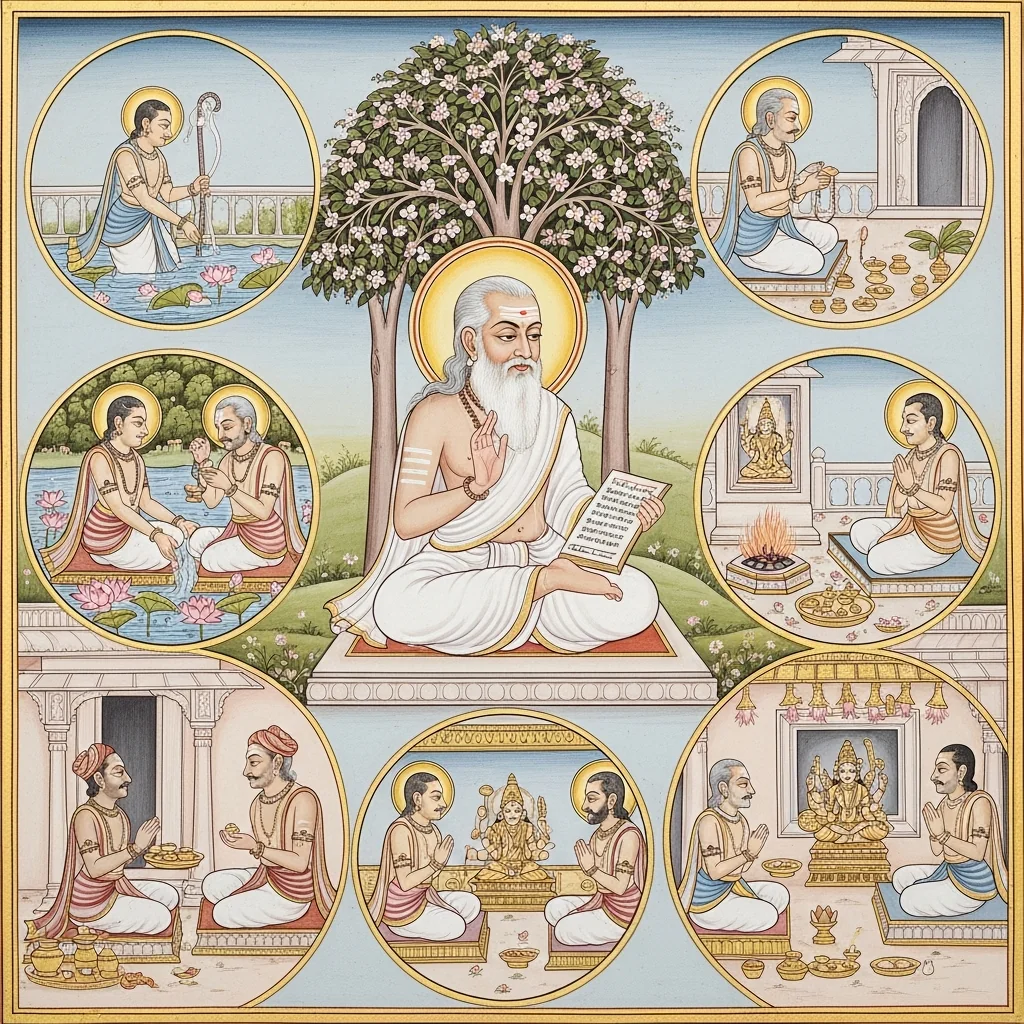
Chapter 13 presents a prescriptive discourse by Sārasvata, laying out a practical discipline for householders (gṛhasthas) who seek purification and auspicious advancement. It opens by stressing that one cannot easily rise beyond the mixed workings of wholesome and unwholesome karma (śubha/aśubha) without sustained virtuous conduct. It then lists daily and periodic duties: repeated bathing, worship of Hari–Hara, truthful and beneficial speech, and charity according to one’s means; avoidance of slander and sexual misconduct; and restraint from intoxicants, gambling, quarrels, and violence. Rites performed correctly—snāna, dāna, japa, homa, deva-pūjā, and dvija-arcana—are said to yield “imperishable” results. A major section catalogs types of gifts—cow, bull, horse, elephant, house, gold, silver, perfumes, foods, ritual materials, utensils, clothing, travel assistance, and continual food-giving—each linked to a phala pattern: release from sin, heavenly conveyances, and protection on the path of Yama (Yama-path). The chapter also codifies śrāddha etiquette regarding worthy invitees, the necessity of śraddhā (faith), and honoring ascetics and guests, and it closes by turning toward the forthcoming “yātrā-vidhi” (pilgrimage procedure).
Shlokas
Verse 1
सारस्वत उवाच । छित्त्वा शुभाशुभं कर्म मुक्तिमिच्छेच्छिवां ततः । इदं न शक्यते कर्त्तुं शुभं कार्यं तदा नरैः
Sārasvata said: Having cut off both meritorious and demeritorious action, one should then desire Śiva’s auspicious liberation. Yet this lofty state is not easily accomplished by men; therefore one must undertake truly virtuous deeds.
Verse 2
उत्थायोत्थाय स्नातव्यं पूज्यौ हरिहरौ स्वयम् । सत्यं वाच्यं हितं कार्यं दानं देयं स्वशक्तितः
Rising early again and again, one should bathe; Hari and Hara themselves are to be worshipped. One should speak truth, do what is beneficial, and give charity according to one’s capacity.
Verse 3
परापवादभीरुत्वं परदारान्विवर्जयेत् । सुवर्णभूमिहरणब्रह्मदेवस्ववर्जनम्
Let one fear bringing blame upon others and shun another’s spouse. One should refrain from stealing gold or land, and from taking what belongs to Brahmins or to the gods.
Verse 4
ब्राह्मणस्त्रीनरेंद्राणां बालवृद्धतपस्विनाम् । पितृमातृगुरूणां च नाप्रियं मनसा वदेत्
Concerning Brahmins, women, kings, children, the aged, and ascetics—and also one’s father, mother, and teachers—one should not utter anything harsh or displeasing, even within the mind.
Verse 5
देशकालपरिज्ञानं पात्रापात्रविवेचनम् । छाया नृणां न वक्तव्या तक्राग्नींधनकांजिकम्
Know well the place and the time, and discern the worthy recipient from the unworthy. Do not speak of another’s “shadow,” indulging in disparagement, nor speak improperly of buttermilk, firewood, fire, and sour gruel—petty matters that breed quarrel.
Verse 6
औषधं शाकमर्थिभ्यो दातव्यं गृह मेधिभिः । एकादशीपंचदशीचतुर्दश्यष्टमीषु च
Householders should give medicines and vegetables to those in need—especially on the eleventh, fifteenth, fourteenth, and eighth lunar days.
Verse 7
अमावास्याव्यतीपातसंक्रांतिग्रहणेषु च । वैधृते पितृमात्रोश्च क्षयाहदिवसेषु च
Likewise, on the new-moon day (Amāvasyā), on Vyatīpāta, at the solar transitions (Saṅkrānti), during eclipses, on Vaidhṛti, and on the death-anniversary days of one’s father and mother—such dharmic gifts and observances should be performed.
Verse 8
युगादिमन्वादिदिने गृहे कार्यो महोत्सवः । तीर्थे वा गमनं कार्यं गृहाच्छतगुणं यतः
On Yugādi and Manvādi days, one should hold a great festival at home—or go to a tīrtha; for the merit gained at the holy ford is a hundredfold compared to that gained at home.
Verse 9
इद्रियाणां जयः कार्यो मद्यं द्यूतं विवर्जयेत् । विवादं गमनं युद्धं गृही यत्नेन वर्जयेत्
One should strive to conquer the senses and avoid intoxicants and gambling. A householder should carefully shun quarrels, reckless roaming, and fighting.
Verse 10
स्नानं दानं जपो होमो देवपूजा द्विजार्चनम् । अक्षयं जायते सर्वं विधिवच्चेद्भवेत्कृतम्
Bathing (at the sacred place), charity, mantra-recitation, fire-offerings, worship of the gods, and honoring of Brāhmaṇas—when performed according to proper rule, all of these become inexhaustible in their merit.
Verse 11
एकापि गौः प्रदातव्या वस्त्रालंकारभूषणा । दोग्ध्री सवत्सा तरुणी द्विजमुख्याय कल्पिता
Even a single cow should be given—adorned with cloth and ornaments—one that yields milk, is young, and is given along with her calf, duly offered to an eminent Brāhmaṇa.
Verse 12
संप्राप्य भारतं खंडं मानुषं जन्म चोत्तमम् । धन्यो ददाति यो धेनुं स नरः सूर्यमण्डलम् । भित्त्वा याति विमानेन गम्यमानो गवादिभिः
Having attained Bhārata-varṣa and the excellent human birth, blessed indeed is the one who gives a milk-cow. That man, breaking through to the solar sphere, goes by a celestial car, escorted by cows and the like.
Verse 13
सप्त जन्मानि पापानि कृत्वा पापीह चाधमः । एको ददाति यो धेनुं मुच्यते सर्वपातकैः
Even if a man, base and sinful in this world, has committed sins through seven births—by giving even a single milk-cow, he is released from all grievous downfalls.
Verse 14
यदा स नीयते बद्धो यममार्गेण किंकरैः । तदा नंदा समागत्य स्वं पुत्रमिव पश्यति
When he is led away bound on Yama’s road by the servants of death, then Nandā arrives and beholds him as though he were her own son.
Verse 15
विजित्य हुंकृतेनैव तान्दूतान्दूरतः स्थितान् । गोप्रदं तं समादाय प्रयाति शिवमन्दिरम्
Conquering those messengers standing at a distance merely by her bellowing, she takes that giver of cows and proceeds to Śiva’s temple.
Verse 16
वृषो धर्म हति प्रोक्तो येन मुक्तः स मुच्यते । गोषु मध्ये पितॄन्सर्वान्हरमुद्दिश्य वा हरिम्
The bull is declared to be the “slayer of unrighteousness”; by whomsoever one is released, he is indeed freed. In the midst of cows, one should honor all the ancestors—dedicating the act to Hara (Śiva), or else to Hari (Viṣṇu).
Verse 17
सूर्यब्रह्मपुरे वासो जायते ब्रह्मवासरे । दृढं ककुद्मिनं संतं युवानं भारसाधनम्
A dwelling arises in Sūrya-Brahmapura on the day of Brahmā. (One should give) a firm, humped bull—strong, youthful, and fit for bearing loads.
Verse 18
हलक्षमं बलीवर्दं दत्त्वा विप्राय पर्वसु । तमारुह्य नरो याति गोलोकं शिवसंनिधौ
Having given to a Brāhmaṇa on festival days a draught-ox fit for the plough, mounting it that man goes to Goloka, in the very presence of Śiva.
Verse 19
अश्वं सास्तरणं दत्त्वा खलीनेन च संयुतम् । अश्वराजबलात्स्वर्गे मोदते ब्राह्मवासरम्
Having given a horse together with a saddle-cloth and equipped with bridle and gear, by the power of that ‘king of horses’ he rejoices in heaven for a day of Brahmā.
Verse 20
गजदानाद्गजेंद्रेण नीयते नंदनं वनम् । पृथिव्यां सागरांतायामेष राजा भविष्यति
By gifting an elephant, one is led by the lord of elephants to Nandana grove; and upon this earth, bounded by the oceans, he shall become a king.
Verse 21
गृहं सोपस्करं दत्त्वा विप्राय गृहमेधिने । लभते नंदने दिव्यं विमानं सार्वकामिकम्
Having gifted a house complete with furnishings to a Brahmin householder, one obtains in Nandana a divine aerial chariot that fulfills every desire.
Verse 22
द्रव्यं पृथिव्यां परमं सुवर्णं हृष्यंति देवा यदि दीयते ततः । सूर्योपि तस्मै रुचिरं विमानं ददाति तावद्भ्रमतेऽत्र यावत्
Gold is the supreme wealth upon the earth; when it is given, the gods rejoice. Even Sūrya grants to that giver a splendid celestial car, in which he roams for as long as this merit endures.
Verse 23
रौप्यं पितॄणामतिवल्लभं तद्दत्त्वा नरो निर्मलतामुपैति । सोमस्य लोकं लभते स तावद्भुवे निवद्धा ऋषयो हि यावत्
Silver is exceedingly dear to the Pitṛs; by gifting it, a person attains purity. He gains the world of Soma (Soma-loka) for as long as the sages remain bound to the earth, for a vast ordained span.
Verse 24
श्रीखंडकर्पूरसमाकुलानि तांबूलरत्नादिफलानि दत्त्वा । पुष्पाणि वस्त्राणि सुखेन याति साकं शशांकं दिवि देववृंदैः
Having offered mixtures of sandalwood and camphor, betel (tāmbūla), gems and fruits—together with flowers and garments—one goes happily to heaven, in the company of Śaśāṅka (the Moon), amid hosts of gods.
Verse 25
तक्रोदकतैलघृतदुग्धेक्षुरसमधूनि यो दद्यात् । खर्जूरखंडद्राक्षावातामांजीरकैः साकम्
Whoever gives buttermilk, water, oil, ghee, milk, sugarcane-juice, and honey—together with dates, sugar, raisins, almonds, and figs—earns great merit.
Verse 26
दर्भाक्षतमृद्गोमयदूर्वायज्ञोपवीतानि । तिलचर्मसूर्यपिटकं दत्त्वा ख्यातश्चिरं स्वर्गे
Having given darbha grass, unbroken rice (akṣata), clay, cow-dung, dūrvā grass, and the sacred thread (yajñopavīta)—and also sesame, leather, and a sunshade—one becomes renowned for a long time in heaven.
Verse 27
आत्माहाराच्चतुर्भागं सिद्धान्नाद्यदि दीयते । हन्तकारः स तं दत्त्वा ध्रुवं याति ध्रुवालये
If one gives a fourth portion of one’s own daily food as cooked fare (siddhānna), then that giver—having offered it—surely goes to the steadfast abode of Dhruva.
Verse 28
आत्माहारप्रमाणेन प्रत्यहं गोषु दीयते । गवाह्निकं तासु दत्त्वा नरो याति सुरालयम्
If each day one gives to the cows a portion equal to one’s own food, then by offering them that daily share, a person attains the abode of the gods.
Verse 29
कंडनीपेषणीचुल्लीमार्जनीभिश्च यत्कृतम् । पापं गृही क्षालयति ददद्भिक्षां दिनं प्रति
Whatever sin a householder incurs through grinding, pounding, the cooking-hearth, and sweeping—he washes it away by giving alms each day.
Verse 30
ग्रासमात्रा भवेद्भिक्षा सा नित्यं यत्र दीयते । तद्गृहं गृहमन्यच्च स्मशानमिव दृश्यते
Where alms are given daily only in a single mouthful, that house—and any other like it—appears like a cremation-ground, bereft of true prosperity and auspiciousness.
Verse 31
कुम्भान्सोदकसिद्धान्नांश्छत्रोपानत्कमंडलुम् । अंगुलीयकवासांसि दत्त्वा याति नरो दिवि
By gifting water-pots, cooked food together with water, an umbrella, footwear, and a kamaṇḍalu (water-vessel), as well as rings and garments, a person attains heaven.
Verse 32
श्रांतस्य यानं तृषितस्य पानमन्नं क्षुधार्त्तस्य नरो नरेन्द्र । दत्त्वा विमानेन सुरांगनाभिः संस्तूयमानस्त्रिदिवं स याति
O king among men, one who gives a conveyance to the weary, drink to the thirsty, and food to the hungry ascends to heaven in a celestial chariot, praised by divine maidens.
Verse 33
भोजनं सततं देयं यथाशक्त्या घृत प्लुतम् । तन्मया हि यतः प्राणा अतः पुष्यंति प्राणिनः
Food should be given continually, according to one’s means, enriched with sacred ghee; for by it the lives of beings are sustained—therefore creatures flourish through food.
Verse 34
क्षुत्पीडा महती लोके ह्यन्नं तद्भेषजं स्मृतम् । तेन सा शांतिमायाति ततोन्नं देयमुत्तमम्
Hunger is a great affliction in the world, and food is remembered as its medicine; by it that suffering comes to peace—therefore the gift of food is supreme.
Verse 35
अन्नं वस्त्रं फलं तोयं तक्रं शाकं घृतं मधु । पत्रं पुष्पं तथोपानत्कंथां यष्टिं कमंडलुम्
One should give in charity food, clothing, fruit, water, buttermilk, vegetables, ghee, honey, leaves and flowers; as well as footwear, a patched cloak, a staff, and a water-pot (kamandalu).
Verse 36
छत्रपात्रे व्रतं विद्या अक्षमाला सुरार्चनम् । कन्या कुशोपवीतानि बीजौषधगृहाणि च
Also to be given are umbrellas and vessels, support for sacred vows (vrata), education and learning, rosaries, and worship offered to the gods; as well as kanyā-dāna (the gifting of a maiden in marriage), sacred threads of kuśa-grass, and stores of seeds and medicines.
Verse 37
सस्यं क्षेत्रं यज्ञपात्रं योगपट्टं च पादुके । कृष्णाजिनं बुद्धिदानं धर्मादेशकथानकम्
Gifts may also include grain and farmland, ritual vessels for yajña, a yogic strap and sandals, a black antelope-skin (kṛṣṇājina), the giving of wisdom, and discourses that teach dharma.
Verse 38
अथैतत्संततं देयं तेन श्रेयो महद्भवेत् । सर्वपापक्षयं कृत्वा दाता याति शिवालयम्
Therefore, these gifts should be given unceasingly; thereby great welfare arises. Having brought about the destruction of all sins, the giver goes to Śiva’s abode.
Verse 39
श्राद्धे गृहस्था भोक्तव्याः कुलीना वेदपारगाः । अक्रोधनाः स्नानशीलाः स्वदेशाचारतत्पराः
At a śrāddha, householders should be fed—those of good lineage, well-versed in the Veda, free from anger, devoted to bathing and purity, and committed to the proper customs of their region.
Verse 40
आमंत्र्य पूर्वदिवसे निरीहा अपि ये द्विजाः । अलोलुपा व्याधिहीना न तु ये ग्रामयाजिनः
Even those Brāhmaṇas who are without worldly striving should be invited on the previous day—those who are free from greed and free from disease; but not those who live by conducting village-sacrifices as a profession.
Verse 41
तेषां पुरः प्रदातव्यं पिंडदानं विधानतः । श्राद्धं श्रद्धाविहीनेन कृतमप्यकृतं भवेत्
In their presence, the piṇḍa-offering must be given according to rule. A śrāddha performed without faith, even if done outwardly, becomes as though not done at all.
Verse 42
तस्माच्छ्रद्धान्वितैः श्राद्धं कर्त्तव्यं क्रोधवर्जितैः । वानप्रस्थो ब्रह्मचारी पथिकस्तीर्थसेवकः
Therefore, śrāddha should be performed by those endowed with faith and free from anger. A forest-dweller, a celibate student, a traveler, and one devoted to serving tīrthas—such persons are to be honored.
Verse 43
अतिथिर्वैश्वदेवांते स पूज्यः श्राद्धकर्मणि । सर्वदा यतयः पूज्याः स्वशक्त्या गृहमेधिभिः
At the conclusion of the Vaiśvadeva offering, the guest should be honored in the Śrāddha rite. And ascetics (yatis) are always to be revered by householders, according to their means.
Verse 44
यात्राविधिमथो वक्ष्ये सेतिहासं नृपोत्तम
Now I shall explain the procedure of pilgrimage (yātrā-vidhi), together with its sacred ancient account, O best of kings.