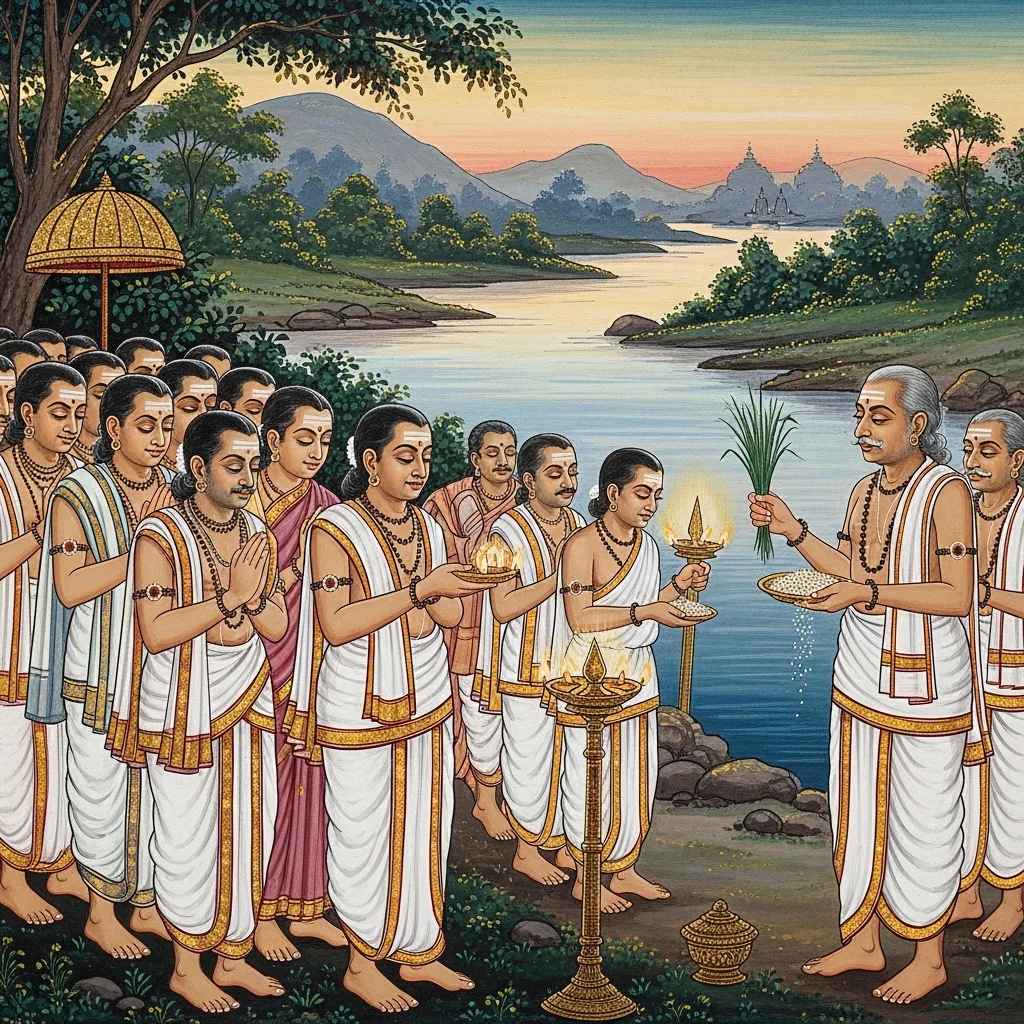
Adhyaya 12
Spoken by Sarasvata, this chapter sets forth a pilgrimage-ritual regimen at Vastrāpatha Tīrtha, insisting that ethical self-restraint is the necessary foundation. It opens by listing auspicious items to carry and offer—Gaṅgā-water, honey, ghee, sandal, aguru, saffron, guggulu, bilva leaves, and flowers—and describes the pilgrim’s discipline of walking and purity. After bathing, one should behold (darśana) and honor Śiva, Viṣṇu, and Brahmā; through proper vision and offerings, bondage is said to be cut and liberation approached. It then portrays communal pilgrimage and the making and installation of a deity image upon a chariot, anointed with fragrant substances, accompanied by music, dance, lamps, and gifts—gold, cows, water, food, cloth, fuel, and pleasing speech. The chapter turns to ritual correctness: receiving brāhmaṇa instruction, performing sandhyā, using darbha and tila with havis-foods, and offering tulasī, the hundred-petaled lotus, camphor, and śrīkhaṇḍa. A calendrical framework is given for the efficacy of saṅkalpa and śrāddha—ayana, viṣuva, saṅkrānti, eclipses, month-end, and kṣaya-days—while strongly emphasizing ancestral rites at rivers and great tīrthas. Śrāddha is linked to the satisfaction of the pitṛs and to household auspicious increase (vṛddhi-śrāddha). Moral faults to be abandoned—lust, anger, greed, delusion, intoxication, envy, slander, negligence, betrayal, laziness, adultery, theft, and more—are enumerated, for only by forsaking them does the full tīrtha-fruit arise: snāna, japa, homa, tarpaṇa, śrāddha, and pūjā become effective. The chapter concludes with a broad catalogue of tīrthas and an inclusive promise: even non-human beings dying there gain heavenly enjoyments and later liberation; mere remembrance of such places destroys sin, so one must not miss the chance for worship and darśana.
Shlokas
Verse 1
सारस्वत उवाच । गंगोदकं मधुघृते कुंकुमागुरुचंद नम् । गुग्गुलं बिल्वपत्राणि बकपुष्पं च यो वहेत्
Sārasvata said: “Whoever carries Ganges-water, honey and ghee, saffron, agaru, sandalwood, guggulu resin, bilva leaves, and bakula flowers (for worship)…”
Verse 2
पदचारी शुचितनुर्भारं स्कन्धे निधाय च । तीर्थे स्नात्वा शिवं विष्णुं ब्रह्माणं शंकरं प्रियम्
Walking on foot, with a purified body, and placing the load upon one’s shoulder; having bathed at the tīrtha, one should worship Śiva, Viṣṇu, and Brahmā—dear Śaṅkara.
Verse 3
दृष्ट्वा निवेदयेद्यस्तु स मुक्तः सर्वबन्धनैः । स नरो गणतां याति यावदाभूतसंप्लवम्
But whoever, after beholding (the deity), makes an offering (nivedana)—he is freed from all bonds. That man attains the status of a Gaṇa (Śiva’s attendant) until the dissolution of beings.
Verse 4
कलत्रमित्रपुत्रैर्वा भ्रातृभिः स्वजनैर्नरैः । सहितो वा नरैर्याति तीर्थे देवं विचिंत्य च
Whether accompanied by wife, friends, sons, brothers, and one’s own kin—or even by other men—he goes to the tīrtha, keeping the Deity ever in mind.
Verse 5
देवमूर्तिं शुभां कृत्वा रथस्थां सुप्रतिष्ठिताम् । चन्दनागुरुकर्पूरैरर्चितां कुंकुमेन च
Having fashioned an auspicious image of the Deity, well installed and set upon a chariot, one should worship it with sandalwood, agaru, camphor, and also with kunkuma (saffron).
Verse 6
पूजयन्विविधैः पुष्पैर्धूपदीपादिकैर्नृप । गीतनृत्यैः सवादित्रैर्हास्यलास्यैरनेकधा
O King, there one should worship with many kinds of flowers, with incense, lamps, and the like; and also with singing and dancing, accompanied by musical instruments, with joyous mirth and graceful performance in many ways.
Verse 7
धरित्रीं कांचनं गाश्च जलान्नवसनानि च । तृणेन्धने प्रियां वाणीं यच्छन्याति नरो यदि
If a man departs from this world while giving in charity land, gold, cows, water, food, garments—even grass and fuel—and also sweet, pleasing speech, then that giving becomes his dharmic wealth, praised in the tīrtha’s greatness.
Verse 8
देवांगनाकरग्राहगृहीतो नन्दनं वनम् । प्राप्य भुंक्ते शुभान्भोगान्यावदाचन्द्रतारकम्
Seized by the hands of celestial maidens, he attains Nandana Grove and enjoys auspicious delights, enduring as long as the moon and stars remain.
Verse 9
तीर्थे संचरितः पुरुषो रोगैः प्राणान्विमुञ्चति । अदृष्ट्वा दैवतं तीर्थे दृष्टतीर्थफलं लभेत्
A man who moves about in a tīrtha may even lose his life through illness; yet, even without beholding the deity there, he still gains the fruit that comes from having ‘seen’—that is, visited—the holy place.
Verse 10
संसारदोषान्विविधान्विचिन्त्य स्त्रीपुत्रमित्रेष्वपि बंधमुक्तः । विज्ञाय बद्धं पुरुषं प्रधानैः स सर्वतीर्थानि करोति देहम्
Reflecting on the many faults of saṃsāra, becoming free from attachment even to wife, children, and friends—and learning from the wise how a person is bound—he makes his very body a ‘confluence of all tīrthas’, a vessel of sacredness.
Verse 11
आजन्मजन्मांन्तरसंचितानि दग्ध्वा स पापानि नरो नरेन्द्र । तेजोमयं सर्वगतं पुराणं भवोद्भवं पश्यति मुच्यते सः
O lord of men, having burned away sins accumulated from birth after birth, that person beholds the Ancient One—luminous, all-pervading, the source of existence—and is released.
Verse 12
तीर्थे विप्रवचो ग्राह्यं स्नात्वा संध्यार्चनादिकम् । दर्भास्तिला हविष्यान्नं प्रयोगाः श्रद्धया कृताः
At the tīrtha, one should accept the counsel of brāhmaṇas; having bathed, one should perform sandhyā worship and the related rites—using darbha grass and sesame, and offering haviṣya food—carrying out the prescribed acts with faith.
Verse 13
अगस्त्यं भृङ्गराजं च पुष्पं शतदलं शुभम् । कर्पूरागुरुश्रीखंडं कुंकुमं तुलसीदलम्
Agastya flowers and bhṛṅgarāja, the auspicious hundred-petalled blossom; camphor, aguru, fragrant sandal paste, kuṅkuma (saffron), and tulasī leaves—these are praised as sacred offerings for worship at the tīrtha.
Verse 14
बिल्वप्रमाणपिंडेषु दीपोद्द्योतितभूमिषु । तांबूल फलनैवेद्यं तिलदर्भोदकेन च
With offerings shaped into balls the size of bilva fruits, upon ground illumined by lamps, one should offer tāmbūla (betel), fruits, and naivedya (sacred food), together with water sanctified by sesame and darbha grass.
Verse 15
तीर्थे संकल्पितं मर्त्यैस्तदनंतं प्रजायते । अयने विषुवे चैव संक्रांतौ ग्रहणेषु च
Whatever saṅkalpa (sacred resolve) mortals form at a tīrtha becomes inexhaustible in its fruit—especially at the solstices, the equinoxes, the saṅkrānti (solar ingresses), and during eclipses.
Verse 16
मासांतेऽपर पक्षे तु क्षयाहे पितृमातृके । गजच्छायां त्रयोदश्यां द्रव्ये प्राप्तौ द्विजोत्तमः
At the month’s end, in the dark fortnight—on the kṣaya day sacred to the ancestral fathers and mothers—on the thirteenth day at Gajacchāyā, that excellent Brāhmaṇa came into the possession of wealth.
Verse 17
गृहे श्राद्धं प्रकुर्वीत पितॄणामृणमुक्तये । गृहाच्छतगुणं नद्यां या नदी याति सागरम्
One should perform śrāddha at home to be freed from the debt owed to the ancestors. Yet when it is done at a river—at that river which flows onward to the ocean—the fruit becomes a hundredfold compared to what is gained at home.
Verse 18
प्रभासे पुष्करे राजन्गंगायां पिंडतारके । प्रयागे नृपगोमत्यां भवदामोदराग्रतः
O King—whether at Prabhāsa, at Puṣkara, on the Gaṅgā at Piṇḍatāraka, at Prayāga, or on the Gomati—before Bhava and Dāmodara (the Lord), these sacred places are proclaimed for ancestral offerings and for the merit of tīrthas.
Verse 19
नर्मदादिषु तीर्थेषु कुर्याच्छ्राद्धं नरो यदि । सर्वपापविनिर्मुक्तः पितरो यांति सद्गतिम्
If a person performs śrāddha at sacred fords such as the Narmadā, he is freed from all sins, and the ancestors attain sadgati, the blessed course.
Verse 20
संतानमुत्तमं लब्ध्वा भुक्त्वा भोगाननुत्तमान् । दिव्यं विमानमारुह्य प्रान्ते याति सुरालयम्
Having obtained excellent progeny and enjoyed unsurpassed delights, in the end he ascends a divine celestial car and goes to the abode of the gods.
Verse 21
जातकर्मादियज्ञेषु विवाहे यज्ञकर्मणि । देवप्रतिष्ठाप्रारंभे वृद्धिश्राद्धं प्रकल्पयेत्
At rites such as the birth-sacraments (jātakarma and others), at marriage, during sacrificial acts, and at the commencement of installing a deity, one should arrange the vṛddhi-śrāddha, the śrāddha for increase and auspicious growth.
Verse 22
तृप्यन्ति देवताः सर्वा स्तृप्यंति पितरो नृणाम् । वृद्धिश्राद्धकृतो गेहे जायते सर्वमंगलम्
All the deities are satisfied, and the ancestors of men are satisfied as well. In a home where vṛddhi-śrāddha is performed, every auspicious blessing arises.
Verse 23
कामः क्रोधश्च लोभश्च मोहो मद्यमदादयः । माया मात्सर्यपैशुन्यमविवेको विचारणा
Desire, anger, greed, delusion, intoxication from liquor and the like; deceit, envy, slander, lack of discernment, and perverse reasoning—these are the faults that obstruct dharma and diminish the fruit of sacred acts.
Verse 24
अहंकारो यदृच्छा च चापल्यं लौल्यता नृप । अत्यायासोप्यनायासः प्रमादो द्रोहसाहसम्
O King, egoism, aimless caprice, fickleness, and restless craving; excessive strain as well as indolent ease, negligence, treachery, and reckless audacity—these too are destructive dispositions that spoil the path of dharma.
Verse 25
आलस्यं दीर्घसूत्रत्वं परदारोपसेवनम् । अल्पाहारो निराहारः शोकश्चौर्यं नृपोत्तम
O best of kings, sloth, procrastination, consorting with another’s wife; ill-regulated eating—whether too little or none at all—grief, and theft: these too are censured as dharma-destroying faults.
Verse 26
एतान्दोषान्गृहे नित्यं वर्जयन्यदि वर्तते । स नरो मण्डनं भूमेर्देशस्य नगरस्य च
If a man lives in his household while constantly avoiding these faults, he becomes an ornament to the earth—an adornment to his land and to his city as well.
Verse 27
श्रीमान्विद्वान्कुलीनोऽसौ स एव पुरुषोत्तमः । सर्वतीर्थाभिषेकश्च नित्यं तस्य प्रजायते
Such a person becomes prosperous, learned, and of noble character—indeed, he is best among men. For him, the merit of bathing as if consecrated in all sacred tīrthas arises every day.
Verse 28
तदा तीर्थफलं सम्यक्त्यक्तदोषस्य जायते । स्नानं सन्ध्या जपो होमः पितृदेवर्षितर्पणम् । श्राद्धं देवस्य पूजा च त्यक्तदोषस्य जायते
Then, for one who has abandoned faults, the full fruit of pilgrimage truly arises. Bathing, the sandhyā rites, japa, homa, offerings (tarpana) to ancestors, gods, and seers, śrāddha, and worship of the deity—all these bear fruit for the one who has given up faults.
Verse 29
प्रयागे वा कुरुक्षेत्रे सरस्वत्यां च सागरे । गयायां वा रुद्रपदे नरनारायणाश्रमे
Whether at Prayāga, at Kurukṣetra, at the Sarasvatī and the ocean, at Gayā, at Rudrapada, or at the hermitage of Nara and Nārāyaṇa—
Verse 30
प्रभासे पुष्करे कृष्णे गोमत्यां पिंडतारके । वस्त्रापथे गिरौ पुण्ये तथा दामोदरे नृप
At Prabhāsa, at Puṣkara, at the Kṛṣṇa (river/tīrtha), at the Gomatī, at Piṇḍatāraka, at Vastrāpatha upon the holy mountain, and likewise at Dāmodara, O king—
Verse 31
भीमेश्वरे नर्मदायां स्कांदे रामेश्वरादिषु । उज्जयिन्यां महाकाले वाराणस्यां च भूर्भुवः
At Bhīmeśvara on the Narmadā, at the Skānda-tīrthas, at Rāmeśvara and other such places; at Ujjayinī at Mahākāla; and at Vārāṇasī, the realm of earth and heaven—
Verse 32
कालिंद्यां मथुरायां च सकृद्याति नरो यदि । सदोषो मुच्यते दोषैर्ब्रह्महत्यादिभिः कृतैः
If a man goes even once to the Kāliṇdī (Yamunā) and to Mathurā, then—even if burdened with faults—he is freed from sins, including grave ones such as brahmahatyā.
Verse 33
अपि कीटः पतंगो वा पक्षी वा सूकरोऽपि वा । खरोष्ट्रकुंजरा वाजिमृगसिंहसरीसृपाः
Even a worm or an insect, a bird or even a boar—donkeys, camels, elephants, horses, deer, lions, and reptiles—
Verse 34
ज्ञानतोऽज्ञानतो राजंस्तेषु स्था नेषु ये मृताः । सर्वे ते पुण्यकर्माणः स्वर्गं भुक्त्वा सुखं बहु
O king, whether knowingly or unknowingly, those who die in those places—all of them become doers of merit; having enjoyed heaven, they experience abundant happiness.
Verse 35
चतुर्वर्णेषु सर्वे ते जायंते कर्मबंधनात् । कर्मबंधं विहायाशु मुक्तिं यांति नराः पुनः
All of them are reborn among the four social orders due to the bondage of karma; then, casting off that karmic bondage swiftly, those persons again attain liberation.
Verse 36
मोदंते तीर्थमरणात्स्वर्गभोगावसानतः । संप्राप्य भारते खंडे कर्मभूमिं महोदयम्
Having departed at a sacred ford (tīrtha), they rejoice; and when the enjoyment of heaven comes to an end, they attain the Bhārata region—this exalted field of action (karma-bhūmi)—for a renewed rise in spiritual fortune.
Verse 37
अनेकाश्चर्यसंयुक्तं बहुपर्वतमंडितम् । गंगायाः सरितः सर्वाः समुद्रैः सह संगताः
This region is filled with many wonders and adorned with numerous mountains; and all the rivers—foremost among them the Gaṅgā—are said to meet the oceans.
Verse 38
पदेपदे निधानानि संति तीर्थान्यनेकशः । येषां स्मरणमात्रेण सर्वपापक्षयो भवेत्
At every step there are treasures—countless sacred fords—whose mere remembrance brings about the destruction of all sins.
Verse 39
पातालमार्गा बहवः स्वर्गमार्गश्च दृश्यते । गगने दृश्यते सूर्यो हृदये दृश्यते हरः
Many are the paths to the netherworlds (Pātāla), and the path to heaven is also seen. In the sky the Sun is seen; in the heart, Hara (Śiva) is seen.
Verse 40
ध्यानेन ज्ञानयोगेन तपसा वचसा गुरोः । सत्येन साहसेनैव दृश्यते भुवनत्रयम्
By meditation, by the yoga of knowledge, by austerity, by the word of the Guru, and indeed by truth and courageous resolve—the three worlds become knowable and manifest.
Verse 41
वेदस्मृतिपुराणैश्च ये न पश्यंति भूतलम् । पातालं स्वर्गलोकं च वंचितास्ते नरा इह
Those who, through the Vedas, Smṛtis, and Purāṇas, do not discern the true nature of the earthly plane—and of the nether realms and the heavenly world—are, here itself, deceived and deprived.
Verse 42
ये विरज्यंति न स्त्रीषु कामासक्ता विचेतसः । देहोन्यथा वरस्त्रीणामन्यथा तैश्च चिंतितम्
Those who do not grow dispassionate toward women—whose minds are unsettled and bound by desire—find that the reality of the body is one thing, while what they imagine about “excellent women” is quite another.
Verse 43
जन्मभूमिषु ते रक्ता जन्यंते जंतवः पुनः । मुक्तिमार्गात्पुनर्भ्रष्टा जायंते पशुयोनिषु
Attached to their birthplaces, such beings are born again and again; having fallen once more from the path of liberation (mukti), they are reborn in animal wombs.
Verse 44
धनानि संप्राप्य वराटिकां ये द्विजातिमुख्याय विधाय पूजाम् । यच्छंति नो निर्मलचेतना ये नराधमा दैवहता मृतास्ते
Those base men who, even after gaining wealth, do not give even a single coin, nor offer reverent worship to a foremost twice-born (brāhmaṇa), their intention lacking purity—are struck down by fate and die.
Verse 45
देहं सुपुष्टं विजरं च यौवनं लब्ध्वा न गंगादिषु यांति ये नराः । माता पिता नो न सुतो न बांधवो भार्या स्वसा नो दुहिता न विद्यते
Those who, having obtained a well-nourished body and the vigor of youth, do not go to the Gaṅgā and other sacred waters—are, as it were, without mother, without father, without son, without kin; for them no wife, no sister, no daughter exists.
Verse 46
एकस्तु यो याति कथं न क्लिश्यते मूर्खो न जानाति भवं महेश्वरम् । स्नात्वा न पश्यंति हरं महेश्वरं दैवेन ते वै मुषिता नराधमाः
How can one who goes alone not be afflicted? The fool does not recognize Bhava, the Great Lord Maheśvara. Even after bathing at the tīrtha, they do not behold Hara, Maheśvara—by fate indeed those lowest of men are deluded and robbed of right understanding.