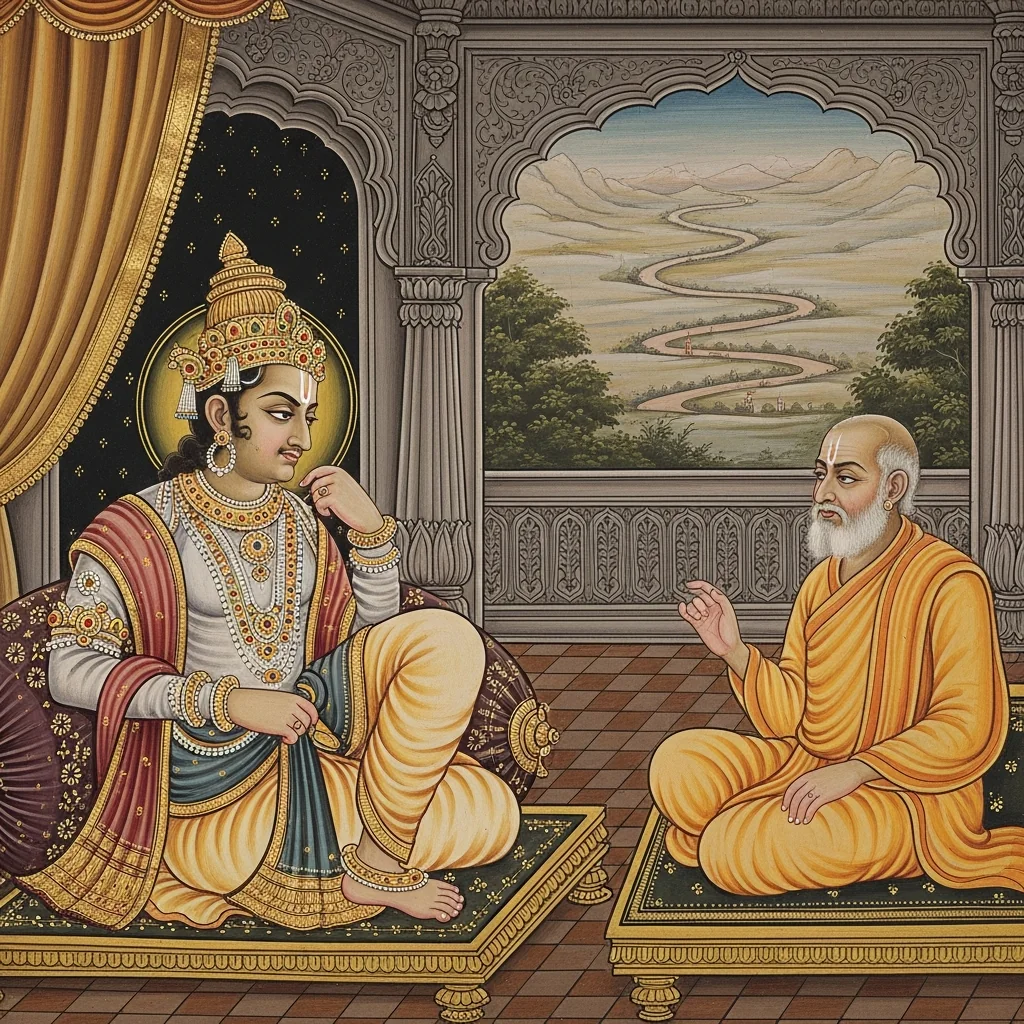
Adhyaya 10
Adhyāya 10 unfolds as a theological dialogue shaped by inquiry. Pārvatī first marvels at the māhātmya of the tīrtha, Mount Raivataka, Bhava (Śiva), and Vastrāpatha, establishing that sacred geography is confirmed by divine speech. She then asks what the earthly king—Bhojarāja/Janeśvara—does after obtaining a deer and meeting the sage Sārasvata, shifting the focus from place-glory to moral narrative. Īśvara replies with normative teaching on social and relational ethics: the ideal woman is virtuous and auspicious, and kinship roles are duties that uphold stability for both women and men. The king, delighted at gaining such a wife, praises Sārasvata as one endowed with ascetic power and revelatory knowledge. The king then recounts the fame of Saurāṣṭra, Raivataka, and Vastrāpatha, recalling divine assemblies on Ujjayanta and motifs involving Vāmana and Bali. He declares his wish to renounce kingship and undertake pilgrimage through higher worlds up to Śiva’s abode, but the sage restrains him, teaching that divine presence and requisite rites can be honored within the household as well, and that the urge for far travel must be governed by right counsel and steady dharma.
Shlokas
Verse 1
पार्वत्युवाच । अहो तीर्थस्य माहात्म्यं गिरे रैवतकस्य च । भवस्य देवदेवस्य तथा वस्त्रापथस्य च
Pārvatī said: “Ah! Great indeed is the glory of this tīrtha, and of Mount Raivataka, of Bhava—the God of gods—and likewise of Vastrāpatha.”
Verse 2
गंगा सरस्वती चैव गोमती नर्मदा नदी । स्वर्णरेखाजले सर्वास्तथा ब्रह्मा सवासवः
The Gaṅgā, Sarasvatī, Gomati, and the river Narmadā—all of them are present in the waters of the Svarṇarekhā; and so too are Brahmā along with Indra.
Verse 3
ब्रह्मेन्द्र विष्णुमुख्यानां देवानां शंकरस्य च । वासो विरचितस्तत्र यावद्ब्रह्मदिनं भवेत्
There, garments were fashioned for Brahmā, Indra, Viṣṇu and the other chief gods—and for Śaṅkara as well—enduring for as long as a day of Brahmā (a cosmic age).
Verse 4
क्षेत्रतीर्थप्रभावं च प्रसादात्तव शंकर । श्रुतं सविस्तरं सर्वमिदं त्वदुदितं मया
O Śaṅkara, by your grace I have heard in full detail the power of this sacred field and its tīrthas—everything that was spoken by you.
Verse 5
महेश्वर प्रभो ब्रूहि किं चकार जनेश्वरः । भोजराजो मृगीं प्राप्य स च सारस्वतो मुनिः
O Maheśvara, O Lord, tell me: what did that ruler of men do—King Bhoja—after obtaining the doe? And what did the sage Sārasvata do?
Verse 6
ईश्वर उवाच । तासु सर्वासु नारीषु रूपौदार्यगुणाधिका । नित्यं प्रमुदिता शांता नित्यं मंगलकारिका
Īśvara said: Among all those women, she excelled in beauty, generosity, and virtue—ever joyful, serene, and ever a bringer of auspiciousness.
Verse 7
माता स्वसा सखी पुत्री स्त्रीषु संबन्धवर्धनी । पिता भ्राता गुरुः पुत्रः पुरुषेषु तथा कृतः
Among women she became one who strengthened bonds—as a mother, a sister, a friend, a daughter; and among men she was likewise regarded—as a father, a brother, a teacher, and a son.
Verse 8
एवं गुणवतीं भार्यां प्राप्य हृष्टो जनेश्वरः । सारस्वतं मुनिं स्तुत्वा राजा वचनमब्रवीत्
Thus, having obtained such a virtuous wife, the king—delighted—praised the sage Sārasvata and then spoke these words.
Verse 9
राजोवाच । ब्रह्मा विष्णुर्हरः सूर्य इन्द्रोऽग्निर्मरुतां गणः । ब्रह्मचर्येण तपसा त्वया सन्तोषिताः प्रभो
The King said: Brahmā, Viṣṇu, Hara, the Sun, Indra, Agni, and the hosts of the Maruts have been pleased by your celibate discipline and austerity, O lord.
Verse 10
दैवतं परमं मे त्वं पिता माता गुरुः प्रभुः । येन जन्मांतरं सर्वं प्रत्यक्षं कथितं मम
You are my supreme deity—my father, mother, teacher, and lord—by whom my entire former birth has been described to me as though seen directly.
Verse 11
सुराष्ट्रदेशो विख्यातो गिरी रैवतको महान् । भवः स्वयंभूर्भगवान्क्षेत्रे वस्त्रापथे श्रुतः
The land of Surāṣṭra is renowned, and the great mountain Raivataka is famed. In the sacred kṣetra of Vastrāpatha, the Blessed Lord Bhava (Śiva) is spoken of as Svayaṃbhū—self-manifest.
Verse 12
उज्जयंतगिरेर्मूर्ध्नि गौरीस्कन्दगणेश्वराः । भावयंतो भवं सर्वे संस्थिता ब्रह्मवासरम्
Upon the summit of Mount Ujjayaṃta, Gaurī, Skanda, and Gaṇeśa—together with all their attendants—abided for a full day of Brahmā, contemplating and worshipping Bhava (Śiva).
Verse 13
वामनो नगरं स्थाप्य शिवं सिद्धेश्वरं प्रति । जित्वा दैत्यं बलिं बद्ध्वा स्वयं रैवतके स्थितः
Having founded a city, Vāmana turned toward Śiva as Siddheśvara. Having conquered the demon Bali and bound him, he himself came to dwell on Mount Raivataka.
Verse 14
इत्येतत्सर्वमाश्चर्यं जीवद्भिर्यदि दृश्यते । तीर्थयात्राविधानेन भवो वस्त्रापथे हरिः
Thus, if living beings behold all these wondrous signs, it is by the proper observance of pilgrimage. At Vastrāpatha, Bhava (Śiva) is indeed Hari (Viṣṇu).
Verse 15
त्यक्त्वा राज्यं प्रियान्पुत्रान्पत्त्यश्वरथकुञ्जरान् । पुत्रं राज्ये प्रतिष्ठाप्य गन्तव्यं निश्चितं मया
Renouncing my kingdom—my beloved sons, infantry, horses, chariots, and elephants—having installed my son upon the throne, I have firmly resolved to depart.
Verse 16
त्वत्प्रसादाच्छ्रुतं सर्वं गम्यते यदि दृश्यते । तीर्थयात्राविधानेन भवो वस्त्रापथे हरिः
By your grace I have heard all; and if it may truly be reached and beheld, then by the proper discipline of pilgrimage—at Vastrāpatha, Bhava (Śiva) is Hari (Viṣṇu).
Verse 17
सूर्यलोकं सोमलोकमिंद्रलोकं हरेः पुरम् । ब्रह्मलोकमतिक्रम्य यास्येऽहं शिवमंदिरम्
Passing beyond the worlds of Sūrya, Soma, Indra, and even Hari’s city—surpassing Brahmā’s world as well—I shall go to the temple-abode of Śiva.
Verse 18
श्रुत्वा हि वाक्यं विविधं नरेन्द्रात्प्रहृष्टरोमा स मुनिर्बभूव । जिज्ञासमानो हि नृपस्य सर्वं निवारयामास मुनिर्नरेन्द्रम्
Hearing the king’s varied words, the sage was filled with rapture, his hair standing on end. Yet, wishing to understand fully the king’s intent, the sage sought to restrain the monarch.
Verse 19
सारस्वत उवाच । गृहेऽपि देवा हरविष्णुमुख्या जलानि दर्भा नृपते तिलाश्च । अनेकदेशांतरदर्शनार्थं मनो निवार्यं नृपते त्वयेति
Sārasvata said: Even at home, O King, the gods are present—chiefly Hara (Śiva) and Viṣṇu—together with water, darbha-grass, and sesame. Therefore, O King, restrain the mind that runs outward merely to behold many lands.