Adhyaya 96
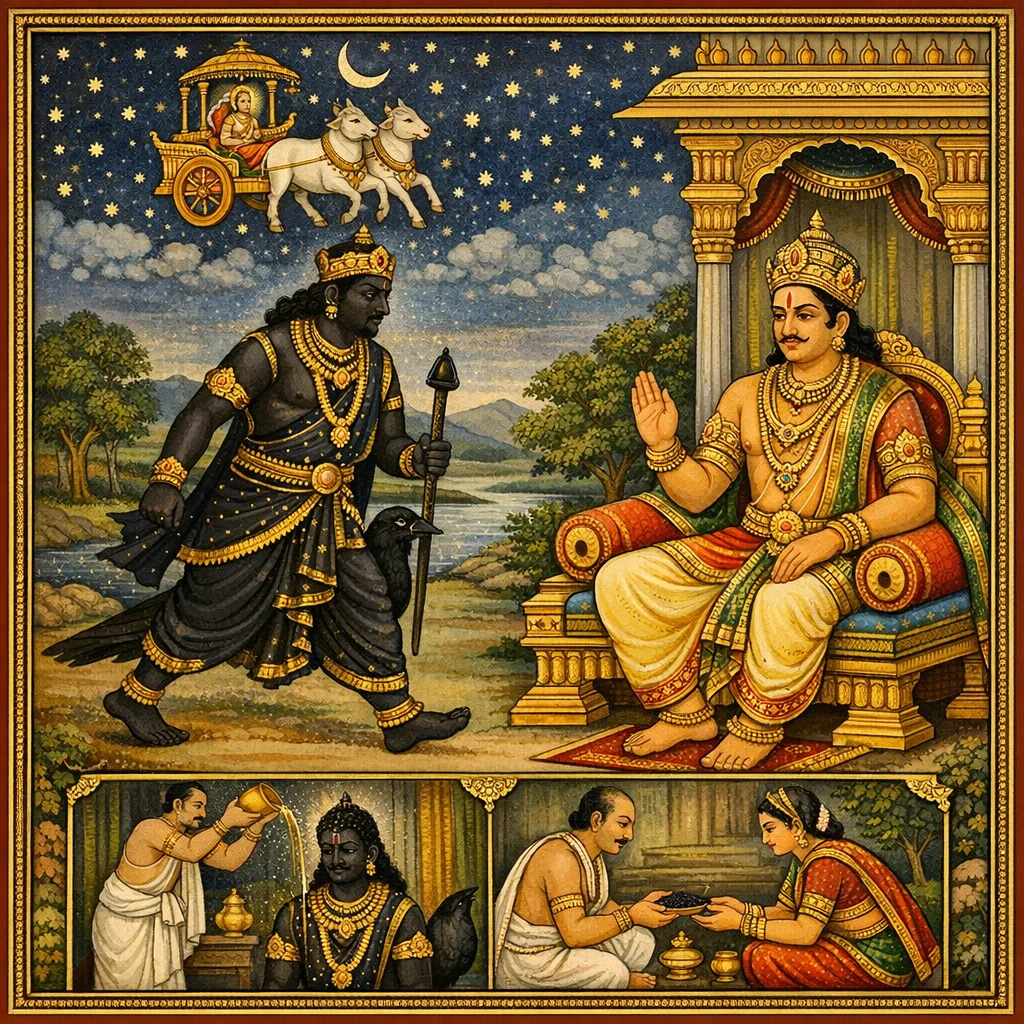
Chapter 96, narrated by Sūta to the ṛṣis, weaves together royal lineage, the founding of a sacred locale, and a cosmological-ethical episode. After King Ajapāla descends to Rasātala, his son becomes king and is praised for extraordinary nearness to the divine and for securing the world’s stability, with the motif that he has “conquered” Śanaiścara. In the local satkṣetra, Viṣṇu/Nārāyaṇa is said to be pleased; a splendid edifice is established and the renowned pond/well called Rājavāpī is constructed. A specific merit is proclaimed: performing śrāddha at Rājavāpī on the fifth lunar day—especially during pretapakṣa—brings social honor and spiritual benefit. The ṛṣis then ask how Śanaiścara was restrained from “breaking” Rohiṇī’s cart, a celestial sign astrologers warn would cause twelve years of severe drought and famine, social collapse, and disruption of Vedic sacrificial cycles. King Daśaratha of the solar dynasty, son of Aja, confronts Śanaiścara with a mantra-empowered divine arrow and commands him to abandon the Rohiṇī path for the sake of public welfare and dharma. Śanaiścara, astonished, acknowledges the unprecedented act, explains the motif of his dangerous gaze, and grants a boon. Daśaratha requests protections: those who anoint with oil on Śanaiścara’s day, and those who donate sesame and iron according to capacity, should be spared affliction; likewise, those who perform pacificatory rites with sesame homa, fuel-sticks, and rice-grains on that weekday should receive extended protection. The chapter ends with a phalaśruti: regular reading or hearing brings an end to torments caused by Śanaiścara.
Shlokas
Verse 1
सूत उवाच । एवं तस्मिन्गते भूपे ह्यजापाले रसातलम् । तत्पुत्रश्चाभवद्राजा मंत्रिभिस्तु पुरस्कृतः
Sūta said: Thus, when King Ajāpāla went down to Rasātala, his son became king, attended and upheld by his ministers.
Verse 2
यो नित्यमगमत्स्वर्गे वासवं रमते सदा । शनैश्चरो जितो येन रोहिणीं परिभेदयन्
He would ever ascend to heaven and continually delight Vāsava (Indra). By him Śanaiścara (Saturn) was subdued, even while he afflicted Rohiṇī.
Verse 3
गृहे यस्य स्वयं विष्णुर्भूत्वा चैव चतुर्विधः । रावणस्य विनाशार्थं जन्म चक्रे प्रहर्षितः
In his house Viṣṇu himself—manifest in a fourfold way—joyfully took birth for the destruction of Rāvaṇa.
Verse 4
तेनागत्यात्र सत्क्षेत्रे तोषितो मधुसूदनः । प्रासादं शोभनं कृत्वा ततश्चैव प्रतिष्ठितः
When he came to this holy kṣetra, Madhusūdana (Viṣṇu) was pleased with him; and after a splendid temple was built, the Lord was duly installed there.
Verse 5
तस्यापि विश्रुता वापी स्वयं तेन विनिर्मिता । राजवापीति लोकेऽस्मिन्विख्यातिं परमां गता
He himself constructed a renowned vāpī, a stepwell or pond; in this world it attained the highest fame by the name “Rājavāpī”.
Verse 6
तस्यां यः कुरुते श्राद्धं संप्राप्ते पञ्चमीदिने । प्रेतपक्षे विशेषेण स नरः स्यात्सतां प्रियः
Whoever performs śrāddha there on the fifth lunar day—especially during the Preta-pakṣa, the fortnight for the departed—becomes dear to the virtuous and the good.
Verse 7
ऋषय ऊचुः । कथं तेन जितः सौरी रोहिणीशकटं च यत् । भिंदानस्तोषितस्तेन कथं नारायणो वद
The sages said: How did he conquer Śaurī (Śanaiścara), and how was the “Rohiṇī-cart” (Rohiṇīśakaṭa) broken? And in what manner did he please Nārāyaṇa? Tell us.
Verse 8
।सूत उवाच । तस्मिञ्छासति धर्मज्ञे स्वधर्मेण वसुन्धराम् । अतिसौख्यान्वितो लोकः सर्वदैव व्यजायत
Sūta said: When that knower of dharma ruled the earth in accordance with his own righteous duty, the people continually flourished, endowed with great happiness.
Verse 9
बहुक्षीरप्रदा गावः सस्यानि गुणवंति च । कामवर्षी च पर्जन्यो यथर्त्तुफलिता द्रुमाः
Cows yielded abundant milk; crops were rich in quality; the rains fell as desired; and trees bore fruit in due season.
Verse 10
कस्यचित्त्वथ कालस्य दैवज्ञैस्तस्य भूपतेः । कथितं रोहिणीभेदं रविपुत्रः करिष्यति
Then, at a certain time, astrologers informed that king: the son of Ravi (Śanaiścara) would bring about a “breach” in Rohiṇī—the ominous Rohiṇī-bheda.
Verse 11
तस्यानंतरमेवाशु दुर्भिक्षं संभविष्यति । अनावृष्टिश्च भविता रौद्रा द्वादश वार्षिकी । यया संपत्स्यते सर्वं भूतलं गतमानवम्
Immediately after that, a terrible famine would arise; there would be a fierce drought lasting twelve years, by which the whole earth would be afflicted—its people brought to ruin.
Verse 12
तेषां तद्वचनं श्रुत्वा स राजा कुपितोऽभ्यगात् । शनैश्चरं समुद्दिश्य विमानमधिरुह्य च
Hearing their words, the king grew wrathful and set forth; fixing his mind upon Śanaiścara, he also mounted the celestial chariot, the vimāna.
Verse 13
तस्य तुष्टेन संदत्तं विमानं कामगं पुरा । शक्रेण तत्र संतिष्ठञ्छनैश्चरमुपाद्रवत्
Formerly, Indra (Śakra), being pleased, had granted him a wish-moving vimāna; standing upon it, he charged at Śanaiścara.
Verse 14
ततः सूर्यपथं मुक्त्वा ततश्चंद्रस्य पार्थिवः । नक्षत्रसरणिं प्राप्य सज्यं कृत्वा महद्धनुः
Then the king, leaving the path of the Sun and then that of the Moon, reached the course of the constellations; and having strung his great bow, he stood ready.
Verse 15
तत्र बाणं समारोप्य शनैश्चरमुपाद्रवत् । प्रोवाच पुरतः स्थित्वा सूर्यपुत्रमधोमुखम्
There he set an arrow to his bow and rushed toward Śanaiścara; standing before him, he addressed the Sun’s son, whose face was turned downward.
Verse 16
त्यजैनं रोहिणीमार्गं सांप्रतं त्वं शनैश्चर । मद्वाक्यादन्यथाऽहं त्वां नयिष्यामि यमक्षयम्
“Abandon this path of Rohiṇī at once, O Śanaiścara. If you act against my command, I shall send you to Yama’s abode.”
Verse 17
एतेन निशिताग्रेग शरेणा नतपर्वणा । दिव्यास्त्रमंत्रयुक्तेन सत्यमेतद्ब्रवीम्यहम्
By this arrow—sharp-pointed and well-jointed—empowered with the mantras of a divine weapon, I declare this to be true.
Verse 18
तस्य तद्वचनं श्रुत्वा तादृग्रौद्रतमं महत् । मन्दो विस्मयमापन्नस्ततश्चेदमभाषत
Hearing those words—so exceedingly fierce and formidable—Manda (Śanaiścara) was struck with astonishment, and then spoke as follows.
Verse 19
कस्त्वं ब्रूहि महाभाग मम मार्गं रुणत्सि यः । अगम्यं केनचिल्लोके सर्वैरपि सुरासुरैः
“Who are you? Tell me, O fortunate one—you who obstruct my course, which in this world is inaccessible to anyone, even to all gods and demons.”
Verse 20
राजोवाच । अहं दशरथो नाम सूर्यवंशोद्भवो नृपः । अजस्य तनयः प्राप्तः कामं वारयितुं क्रुधा
The King said: “I am Daśaratha by name, a ruler born in the Solar dynasty, the son of Aja. I have come in wrath to restrain your intent.”
Verse 21
मंद उवाच । न त्वया सह संबंधः कश्चिदस्ति महीपते । मम यत्त्वं प्रकोपाढ्यो मन्मार्गं हंतुमिच्छसि
Manda said: “O king, I have no connection with you whatsoever—why then, filled with anger, do you wish to strike down my path?”
Verse 22
राजोवाच । रोहिणीसंभवं त्वं हि शकटं भेदयिष्यसि । सांप्रतं मम दैवज्ञैर्वाक्यमेतदुदाहृतम्
The King said: “Truly, you will shatter the cart born of Rohiṇī. This is the very pronouncement my astrologers have just declared to me.”
Verse 23
तस्मिन्मन्द त्वया भिन्ने न वर्षति शतक्रतुः । एतद्वदति दैवज्ञा ज्योतिःशास्त्रविचक्षणाः
“If that cart is broken by you, O Manda, then Śatakratu (Indra) will not send rain. Thus declare the astrologers, skilled in the science of the heavens and omens.”
Verse 24
जाते वृष्टिनिरोधेऽथ जायंतेऽन्नानि न क्षितौ । अन्नाभावात्क्षयं यांति ततो भूभितले जनाः
When the rains are checked, no grain is produced upon the earth. From the lack of food, the people upon the world’s surface then waste away and perish.
Verse 25
जनोच्छेदे ततो जाते अग्निष्टोमादिकाः क्रियाः । न भवंति धरा पृष्ठे ततः स्यादेव संक्षयः
When the people are cut off and perish, rites such as the Agniṣṭoma and the rest no longer take place upon the earth. From that, indeed, there arises further ruin.
Verse 26
एतस्मात्कारणाद्रुद्धो मार्गस्ते सूर्यसंभव । रोहिणीं गंतुकामस्य सत्यमेतन्मयोदितम्
For this very reason, O one born of the Sun, your path is blocked as you desire to go to Rohiṇī. This is the truth that I have spoken.
Verse 27
शनिरुवाच । गच्छ पुत्र निजं गेहं ममापि त्वं च रोचसे । तुष्टोऽहं तव वीर्येण न त्वन्येन महीपते
Śani said: “Go, my son, to your own home. You are pleasing even to me. O king, I am satisfied by your valor—by nothing else.”
Verse 28
न केनचित्कृतं कर्म यदेतद्भवता कृतम् । न करिष्यति चैवान्यो देवो वा मानवोऽथ वा
No one has performed a deed like this which you have done; and no other—whether god or man—will ever do it.
Verse 29
नाहं पश्यामि भूपाल कथंचिदपि तूर्ध्वतः । यतो दृष्टिविनिर्दग्धं भस्मसाज्जायतेऽखिलम्
O king, I do not look upward at all, for everything that is scorched by my gaze becomes wholly reduced to ash.
Verse 30
जातमात्रेण बालेन मया पादौ निरीक्षितौ । तातस्य सहसा दग्धौ ततोऽहं वारितोंऽबया
When I was only newly born as a child, I looked upon my father’s feet; at once they were burned. Then I was restrained by my mother.
Verse 31
न त्वया पुत्र द्रष्टव्यं किंचिदेव कथंचन । प्रमाणं यदि ते धर्मो मातृवाक्यसमुद्भवः
“You must not look at anything at all, my son, in any manner—if, for you, dharma is an authority arising from your mother’s word.”
Verse 32
तस्मात्त्वया महत्कर्म कृतमीदृक्सुदुष्करम् । प्रजानां पार्थिवश्रेष्ठ त्यक्त्वा दूराद्भयं मम
Therefore you have accomplished a great deed, exceedingly hard to perform, O best of kings; for the sake of your subjects you have cast far away the fear of me.
Verse 33
तस्मा त्तव कृते नाहं भेदयिष्यामि रोहिणीम् । कथंचिदपि भूपाल युगांतररशतेष्वपि
Therefore, for your sake, O king, I shall not afflict Rohiṇī—never in any way, even across hundreds of thousands of ages.
Verse 34
वरं वरय चास्माकं तस्मादद्य भविष्यति । हृतत्स्थितं दुर्लभं भूप सर्वेषामिह देहिनाम्
“Choose a boon from me; therefore, today it shall be granted. O king, for embodied beings in this world, it is exceedingly rare to keep one’s heart steady and unshaken.”
Verse 35
राजोवाच । तव यो वासरे प्राप्ते तैलाभ्यंगं करोति वै । तस्याऽन्यदिवसं यावत्पीडा कार्या न च त्वया
The king said: “Whoever, when your day arrives, truly performs an oil-anointing (abhyanga), to him you should not cause affliction—at least until the following day.”
Verse 36
तिलदानं करोत्येवं लोहदानं च यस्तव । करोति दिवसे शक्त्या यावद्वर्षं त्वया हि सः
“Likewise, whoever on your day, according to his capacity, gives sesame in charity and also donates iron, continuing so for a full year—he should indeed be protected by you.”
Verse 37
रक्षणीयः सुकृच्छ्रेषु संकटेषु सदैव हि । त्वयि गोचरपीडायां संस्थिते चार्कसंभव
He should ever be protected in grievous hardships and in times of peril—especially when you stand in a painful gocara-transit (affliction), O son of the Sun.
Verse 38
यः कुर्याच्छांतिकं सम्यक्तिलहोमं च भक्तितः । वासरे तव संप्राप्ते समिद्भिश्च तथाऽक्षतैः
Whoever, when your day arrives, duly performs the rite of pacification (śāntika)—offering with devotion a sesame-homa (tilahoma), with sacred fuel-sticks and also unbroken rice (akṣata)—
Verse 39
तस्य सार्धानि वर्षाणि सप्त कार्या प्रयत्नतः । त्वया रक्षा महाभाग वरं चेन्मम यच्छसि
For that person, you must diligently grant protection for seven and a half years, O noble one—if you are truly bestowing this boon upon me.
Verse 40
सूत उवाच । एवमित्येव संप्रोच्य विरराम ततः परम् । शनैश्चरो महीपालवचनाद्द्विजसत्तमाः
Sūta said: “Having spoken only, ‘So be it,’ he then fell silent. O best of the twice-born, Śanaiścara acted in accordance with the king’s words.”
Verse 41
एतद्वः सर्वमाख्यातं यत्पृष्टोऽहं सुविस्तरात् । भवद्भिः सूर्यपुत्रस्य राज्ञा दशरथेन हि । संवादं रोहिणीभेदे सञ्जातं समुपस्थिते
Thus have I told you, in full and at length, all that you asked of me: the dialogue between the Sun’s son, Śanaiścara, and King Daśaratha, which arose during the episode of Rohiṇī-bheda when it came to pass.
Verse 42
यश्चैतत्पठते नित्यं शृणुयाद्यो विशेषतः । शनैश्चरकृता पीडा तस्य नाशं प्रगच्छति
Whoever recites this daily—or, most especially, whoever listens to it—his affliction wrought by Śanaiścara goes to destruction.