Adhyaya 94
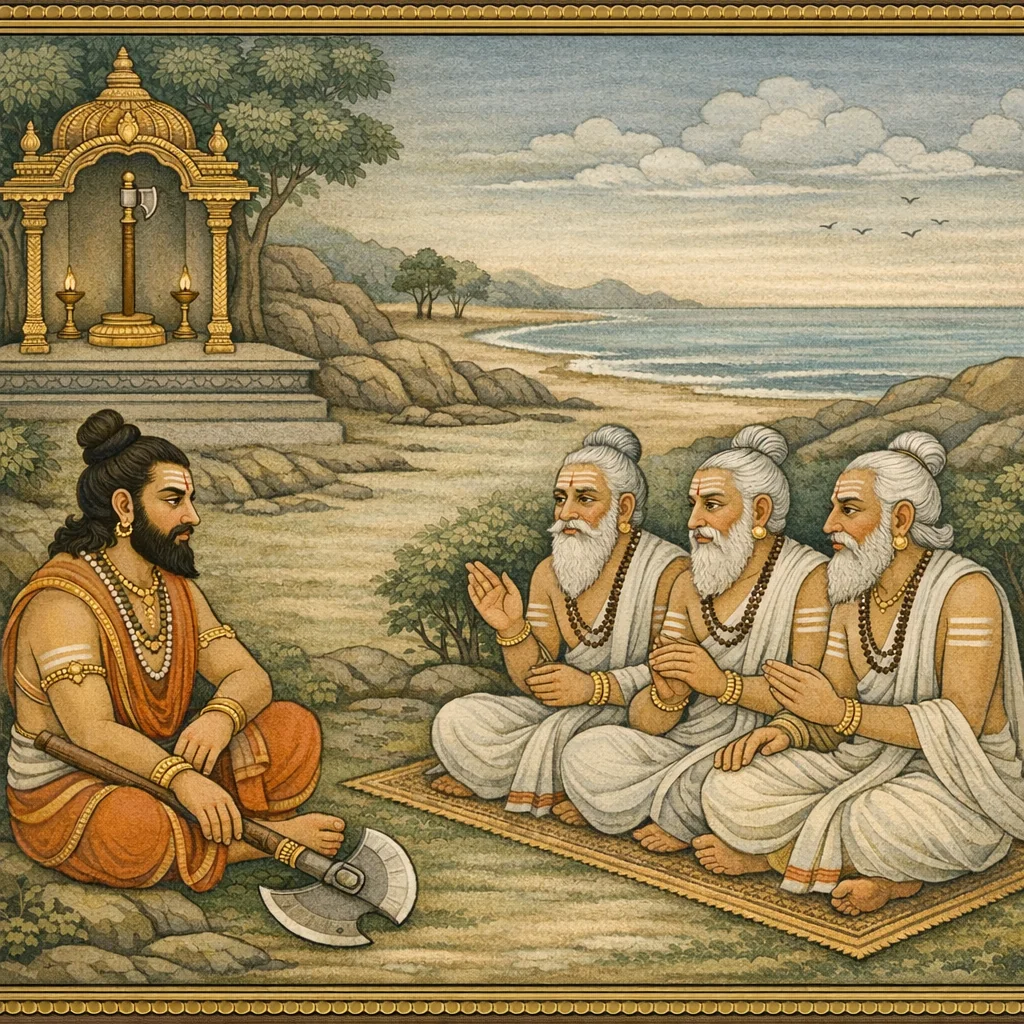
This chapter is Sūta’s reply to the sages’ question about a brilliantly radiant iron staff (lohayaṣṭi) seen in the sacred kṣetra. Sūta relates that Paraśurāma (Rāma Bhārgava), after performing rites such as honoring the ancestors and proceeding toward the sea for a purificatory bath, is urged by the resident sages and brāhmaṇas to relinquish his axe (kuṭhāra). Their counsel is ethical and inward: so long as a weapon remains in one’s hand, the seed of anger may still arise, which is unfit for one who has fulfilled his vow. Paraśurāma voices a concern about the governance of violence: if he abandons the axe, another might seize it and misuse it, becoming liable to destruction, since Paraśurāma cannot endure offense or abuse. A settlement is reached: at the brāhmaṇas’ request he breaks the axe and fashions from it an iron staff, entrusting it to them for protection and custodianship. The brāhmaṇas promise to preserve and worship it and proclaim the phalāśruti—fallen kings may regain sovereignty; students and brāhmaṇas attain higher knowledge, even omniscience; the childless obtain offspring; and special merit comes from worship with fasting, especially on the fourteenth day of the dark fortnight of Āśvina. Paraśurāma departs; the brāhmaṇas build a shrine and establish regular worship, through which desires are swiftly fulfilled. The closing note adds that the original axe was forged by Viśvakarman from imperishable iron infused with Rudra’s fiery power.
Shlokas
Verse 1
सूत उवाच । तथान्या लोहयष्टिस्तु तस्मिन्क्षेत्रेऽतिशोभना । मुक्ता परशुरामेण भंक्त्वा निजकुठारकम्
Sūta said: Likewise, in that sacred region there is another exceedingly splendid “Iron Staff” (Lohayaṣṭi), established by Paraśurāma after he had broken his own axe.
Verse 2
तां दृष्ट्वा मानवः सम्यगुपवासपरायणः । मुच्यते हि स्वकात्पापात्तत्क्षणाद्विजसत्तमाः
O best of the twice-born, one who beholds that sacred presence with sincere devotion to upavāsa (holy fasting) is freed from his own sins at that very instant.
Verse 3
ऋषय ऊचुः । कुतः परशुरामेण भंक्त्वा निजकुठारकम् । निर्मिता लोहयष्टिः सा तत्रोत्सृष्टा च सा कुतः
The sages said: For what cause did Paraśurāma, after breaking his own axe, fashion that iron staff? And for what reason was it cast away there?
Verse 4
सूत उवाच । यदा रामो ह्रदं कृत्वा तर्पयित्वा निजान्पितॄन् । गतामर्षो द्विजेन्द्राणां दत्त्वा यज्ञे वसुन्धराम्
Sūta said: When Rāma (Paraśurāma), having made a sacred pond and offered tarpaṇa (libations) to his own forefathers, and having laid aside his anger toward the foremost brāhmaṇas, gave the earth as a sacrificial gift in a yajña—
Verse 5
ततः संप्रस्थितो हृष्टो धृत्वा मनसि सागरम् । स्नानार्थं तं समादाय कुठारं भास्करप्रभम्
Then, delighted, he set out—holding the ocean in his mind as his destination. For the sake of ritual bathing, he took up that axe, radiant like the sun.
Verse 6
तदा स मुनिभिः प्रोक्तः सर्वैस्तत्क्षेत्रवासिभिः । वांछद्भिस्तु हितं तस्य सदा शमपरायणैः
At that time he was addressed by all the sages dwelling in that sacred region—ever devoted to tranquility—who desired his welfare.
Verse 7
रामराम महाभाग यद्धारयसि पाणिना । शस्त्रं पूर्णे प्रतिज्ञोऽपि तन्न युक्तं भवेत्तव
“Rāma, Rāma, O fortunate one—what you hold in your hand is a weapon. Though your vow has been fulfilled, it is not fitting for you to keep a weapon in your hand.”
Verse 9
अनेन करसंस्थेन तव कोपः कथंचन । न यास्यति शरीरस्थस्तस्मादेनं परित्यज
“So long as this remains in your hand, your anger will not depart in any way while it abides within your body. Therefore, abandon it.”
Verse 12
यदि चैनं मया मुक्तं कुठारं च द्विजोत्तमाः । ग्रहीष्यति परः कश्चिन्मम वध्यो भविष्यति
(Paraśurāma said:) “O best of brāhmaṇas, if I were to release and abandon this axe, some other person might seize it—and then he would become one whom I must slay.”
Verse 13
नापराधमिमं शक्तः सोढ़ुं चाहं कथंचन । अपि ब्राह्मणमुख्यस्य जनस्यान्यस्य का कथा
(Paraśurāma said:) “I cannot, in any way, endure such an offense—especially if it is committed against a foremost brāhmaṇa; what then need be said of others?”
Verse 14
तथापि नास्ति ते शांतिर्मुक्तेऽप्यस्मिन्द्विजोत्तमाः । गृहीतेऽपि च युष्माभिस्तस्माद्रक्ष्यः प्रयत्नतः
(Paraśurāma said:) “Even so, O best of brāhmaṇas, you will not have peace even if this is released; and even if it is taken up by you, therefore it must be guarded with effort.”
Verse 15
ब्राह्मणा ऊचुः । यद्येवं त्वं महाभाग रक्षार्थं संप्रयच्छसि । अस्माकं तत्र भंक्त्वाशु पिंडं कृत्वा समर्पय
The brāhmaṇas said: “If this is so, O greatly fortunate one, and you are granting something for our protection, then break it there at once, fashion it into a solid piece, and offer it to us.”
Verse 16
येन रक्षामहे सर्वे परमं यवमाश्रिताः । न च गृह्णाति वा कश्चिद्गते कालांतरेऽपि च
“By means of that we may all be protected—taking refuge in the supreme sanctity—and so that no one may seize it, even as time passes.”
Verse 17
तेषां तद्वचनं श्रुत्वा रामः शस्त्रभृतां वरः । चक्रे लोहमयीं यष्टिं तं भंक्त्वा स कुठारकम्
Hearing their words, Rāma—the foremost among weapon-bearers—broke his axe and fashioned from it an iron staff.
Verse 18
ततः स ब्राह्मणेंद्राणामर्पयामास सादरम् । रक्षार्थं भार्गवश्रेष्ठो विनयावनतः स्थितः
Then the foremost of the Bhārgavas respectfully presented it to the chief brāhmaṇas for safekeeping, standing in humility and reverent deference.
Verse 19
ब्राह्मणा ऊचुः । लोहयष्टिमिमां राम त्वत्कुठारसमुद्भवाम् । वयं संरक्षयिष्यामः पूजयिष्याम एव हि
The brāhmaṇas said: “O Rāma, this iron staff that has arisen from your axe—we shall safeguard it and indeed worship it.”
Verse 20
यथा शक्तिमयी कीर्तिः स्कन्दस्यात्र प्रतिष्ठिता । लोहयष्टिमयी तद्वत्तव राम भविष्यति
“Just as Skanda’s fame, embodied in the Śakti (spear), is established here, so too, O Rāma, shall your fame be established here embodied in the iron staff.”
Verse 21
भ्रष्टराज्यस्तु यो राजा एनामाराधयिष्यति । स्वं राज्यमचिरात्प्राप्य स प्रतापी भविष्यति
“Any king who has fallen from his kingdom, if he worships this (iron staff), will soon regain his own realm and become mighty in splendor.”
Verse 22
विद्याकृते द्विजो वा यः सदैनां पूजयिष्यति । स विद्यां परमां प्राप्य सर्वज्ञत्वं प्रपत्स्यते
“Or, any twice-born who worships this constantly for the sake of learning will obtain supreme knowledge and attain the state of omniscience.”
Verse 23
अपुत्रो वा नरो योऽथ नारी वा पूजयिष्यति । एतां यष्टिं त्वदीयां च पुत्रवान्स भविष्यति
Whether a man without a son or any woman worships this staff that is yours, that person will be blessed with offspring.
Verse 24
उपवासपरो भूत्वा यश्चैनां पूजयिष्यति । आश्विनस्यासिते पक्षे चतुर्दश्यां विशेषतः
And whoever worships this while devoted to fasting (upavāsa)—especially on the fourteenth lunar day (caturdaśī) of the dark fortnight of Āśvina—gains special merit.
Verse 25
एवं श्रुत्वा ततो रामस्तेषामेव द्विजन्मनाम् । प्रणम्य प्रययौ तूर्णं समुद्रसदनं प्रति
Having heard this, Rāma bowed down to those very twice-born brāhmaṇas and swiftly departed toward the abode of the Ocean.
Verse 26
तेऽपि विप्रास्ततस्तस्याश्चक्रुः प्रासादमुत्तमम् । तत्र संस्थाय तां चक्रुस्ततः पूजासमाहिताः
Those brāhmaṇas too then built an excellent temple for her; establishing her there, they performed worship with concentrated devotion.
Verse 27
प्राप्नुवंति च तत्पार्श्वात्कामानेव हृदि स्थितान् । सुस्तोकेनाऽपि कालेन दुर्लभास्त्रिदशैरपि
And from that sacred vicinity, people attain the very desires that dwell in their hearts within a very short time—boons difficult to obtain even for the gods.
Verse 94
कुठारश्चैव विप्रेंद्रा रुद्रतेजोद्भवेन च । लोहेन निर्मितः पूर्वमक्षयो विश्वकर्मणा
O best of brāhmaṇas, there was also a battle-axe—made of iron born from Rudra’s fiery splendor—formerly fashioned by Viśvakarmā, imperishable by nature.