Adhyaya 88
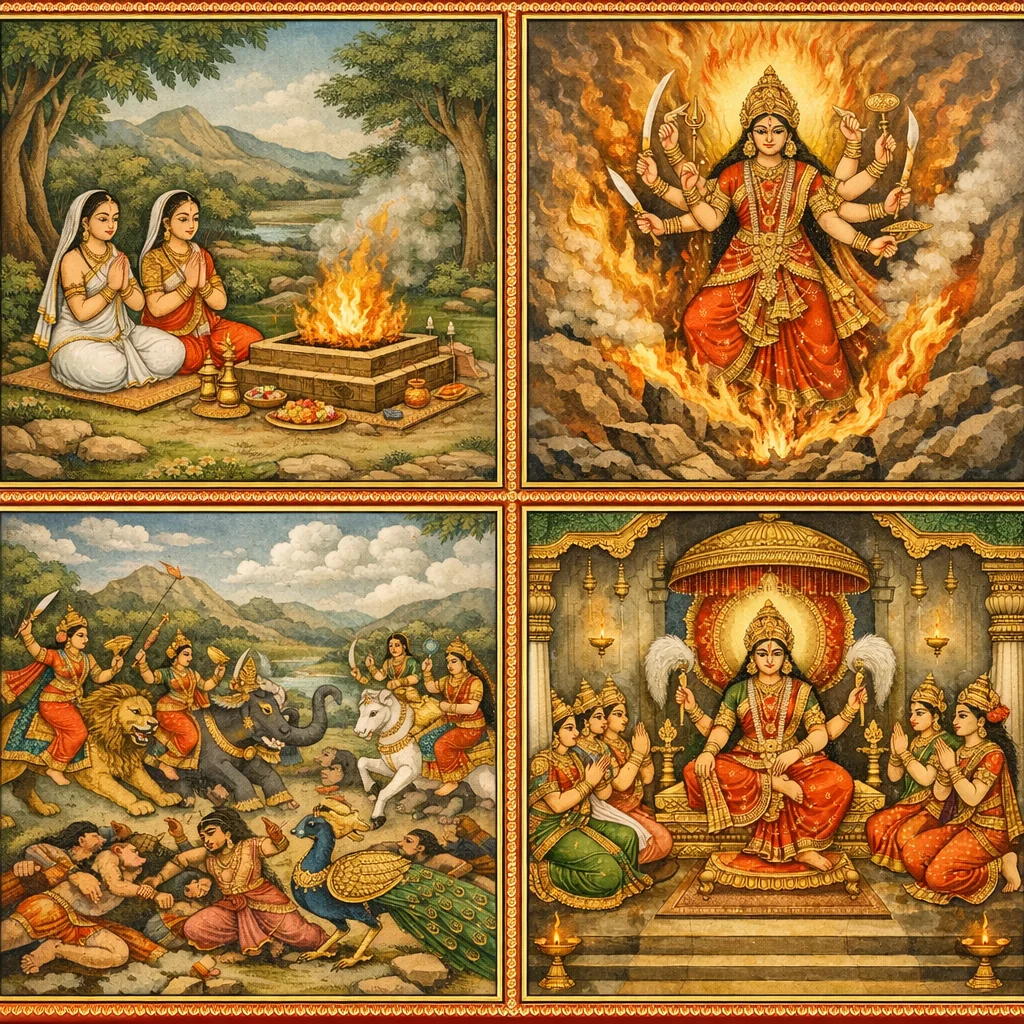
The chapter begins with the Ṛṣis asking Sūta to explain Ambā‑Vṛddhā—named earlier among four local guardian deities—and to tell the origin of her yātrā (pilgrimage observance) and her prabhāva (sacred power). Sūta relates that when King Camatkāra founded the city, four deities were ritually installed for its protection. In the royal line, two women—Ambā and another called Vṛddhā—are married to the king of Kāśī by Vedic rites. When the king is slain in battle against the Kālayavanas, the two widows go to Hāṭakeśvara‑kṣetra and undertake sustained austerity and goddess‑propitiation with a protective aim against their husband’s enemies. Their rite culminates in a fierce epiphany: from the fire‑sacrifice arise mighty female forms, followed by vast hosts of multi‑formed “Mothers,” described in extensive iconographic detail (faces, limbs, mounts, weapons, and behaviors). These hosts rout and consume the hostile forces, devastate their realm, and then return to their station. The hosts ask for sustenance and a dwelling; the two presiding goddesses lay down ethical‑ritual prohibitions and conditions—cast as who becomes “edible”—thereby setting normative boundaries for human conduct. The narrative closes with the king building a grand residence for the goddesses, and with phala statements: beholding their faces at dawn, worshiping at the beginnings and endings of undertakings, and making offerings on specific tithis bestow protection, desired results, and a “thornless” (unobstructed) life.
Shlokas
Verse 1
ऋषय ऊचुः । यास्त्वया देवताः प्रोक्ताश्चतस्रः सूतनंदन । चमत्कारी महित्था च महालक्ष्मीस्तथाऽपरा
The sages said: O son of Sūta, you have spoken of four deities—Camatkārī, Mahitthā, and likewise Mahālakṣmī as another.
Verse 2
अंबावृद्धा चतुर्थी च तासां तिस्रः प्रकीर्तिताः । विस्तरेण चतुर्थी च अंबावृद्धा न कीर्तिता
And (you also mentioned) Ambāvṛddhā and Caturthī as the fourth; yet only three of them were described. Caturthī and Ambāvṛddhā were not spoken of in detail.
Verse 3
एतस्याः सर्वमाचक्ष्व प्रभावं सूतसंभव । केनैषा निर्मिता यात्रा सर्वं विस्तरतो वद
O Sūta, sprung from the sūta-lineage, tell us in full the greatness of this Śakti. By whom was this pilgrimage (yātrā) established? Explain everything in detail.
Verse 4
सूत उवाच । एषा तपोमयी शक्तिरम्बावृद्धा सुरेश्वरी । यथात्र संस्थिता पूर्वं तत्सर्वं श्रूयतां मम
Sūta said: This is the Śakti formed of austerity—Ambāvṛddhā, the sovereign goddess. How she came to be established here in ancient times—hear all of that from me.
Verse 5
चमत्कारमहीपेन पुरमेतद्यदा कृतम् । तदा तद्रक्षणार्थाय निर्मिता भावितात्मना । चतस्रो देवता ह्येताः संमतेन द्विजन्मनाम्
When this city was founded by the wondrous king, then—by that noble-minded ruler—for the protection of it, these four deities were established, with the approval of the twice-born (brāhmaṇas).
Verse 6
अथ तस्य महीपस्य अंबानामाभवत्सुता । तथान्या वृद्धसंज्ञा च रूपौदार्यगुणान्विते
Then that king had a daughter named Ambā, and another known as Vṛddhā—both endowed with beauty, generosity, and noble virtues.
Verse 7
उभे ते काशिराजेन परिणीते द्विजोत्तमाः । गृह्योक्तेन विधानेन देवविप्राग्निसंनिधौ
O best of the twice-born, both were married by the king of Kāśī according to the rites taught in the Gṛhya tradition, in the presence of the gods, the brāhmaṇas, and the sacred fire.
Verse 8
कस्यचित्त्वथ कालस्य काशिराजस्य भूपतेः । तैः कालयवनैः सार्धमभवत्संगरो महान्
After some time, for the king of Kāśī, a great battle arose with those Kāla‑Yavanas.
Verse 9
अथ तैर्निहतः संख्ये सभृत्यबलवाहनः । हरलब्धवरै रौद्रैः काशिराजः प्रतापवान्
Then, in battle, the valiant king of Kāśī—together with his attendants, forces, and mounts—was slain by those fierce ones who had obtained boons from Hara (Śiva).
Verse 10
अथांबा चैव वृद्धा च वैधव्यं प्राप्य दुःखदम् । हाटकेश्वरजं क्षेत्रं गत्वा ते वांछितप्रदम्
Then Ambā and Vṛddhā, having fallen into the sorrow-giving state of widowhood, went to the sacred field of Hāṭakeśvara—the bestower of the desired boon.
Verse 11
देव्या आराधने यत्नं कृतवत्यौ ततः परम् । नाशार्थं पतिशत्रूणां धृतवत्यौ शुभव्रतम्
Thereafter, the two of them strove in the worship of the Goddess; and, for the destruction of their husband’s enemies, they undertook a holy and auspicious vow.
Verse 12
यावद्वर्षशतं साग्रं न च तुष्टा सुरेश्वरी । ततो वैराग्यमासाद्य वांछंत्यौ स्वतनुक्षयम्
Even after a full hundred years, the sovereign Goddess was not yet pleased. Then, attaining dispassion, the two of them desired the wasting away of their own bodies—self-surrender unto death.
Verse 13
मंत्रैराथर्वणैर्विप्राः क्षुरिकासूक्तसंभवैः । छित्त्वाच्छित्त्वा स्वमांसानि मंत्रपूतानि भक्तितः
With Atharvanic mantras born of the Kṣurikā-sūkta, the brāhmaṇas, in devotion, repeatedly cut portions of their own flesh—now sanctified by mantra—and offered them in the rite.
Verse 14
कृतवत्यौ ततो होमं सुसमिद्धे हुताशने । अग्निकुण्डात्ततस्तस्माश्चतुर्हस्ता शुभानना
Then they performed the homa into the well-kindled fire. From that very fire-pit thereupon emerged a four-armed Goddess with an auspicious face.
Verse 15
श्वेतवस्त्रा विनिष्क्रांता नारी बालार्कसव्रिभा । तथान्या च सुनेत्रास्या तप्तहाटकसन्निभा
A woman emerged clad in white garments, radiant like the newly risen sun; and another also appeared—fair-eyed and bright as heated gold.
Verse 16
तस्मात्कुण्डाद्विनिष्क्रांता धृतखड्गा भयावहा । साऽपरापि तथारूपा शक्तिः परमदारुणा
From that kuṇḍa there emerged another, sword in hand, dreadful to behold; and then yet another Śakti of the same form—exceedingly fierce.
Verse 17
प्रोचतुस्ते वरं हृत्स्थं प्रार्थ्यतामिति दुर्लभम्
They said: “Ask for the boon that rests within your heart—though it be hard to obtain.”
Verse 18
ते ऊचतुः । अस्माकं दयितो भर्त्ता काशिराजः प्रतापवान् । निहतः संगरे क्रुद्धैर्यवनैः कालपूर्वकैः
They said: “Our beloved husband, the mighty King of Kāśī, has been slain in battle by enraged Yavanas, whose appointed time had come.”
Verse 19
युष्मदीय प्रसादेन यथा तेषां परिक्षयः । सञ्जायते महादेव्यौ तथा कार्यमसंशयम्
By your grace, O two Great Goddesses, let their utter destruction come to pass—thus must it be done, without doubt.
Verse 20
स्थातव्यं च तथात्रैव उभाभ्यामपि सादरम् । स्वपुरस्य प्ररक्षार्थमेतत्कृत्यं मतं हि नौ
And you both should remain here itself with reverence, for the protection of our own city; this indeed we deem to be the proper duty.
Verse 21
तयोस्तद्वचनं श्रुत्वा उभे ते देवते ततः । संप्रोच्य बाढमित्येवं तस्मिन्कुण्डे व्यवस्थिते
Hearing their words, the two goddesses replied, “So be it,” and thus took their station in that very kuṇḍa.
Verse 22
एतस्मिन्नंतरे तस्मात्कुण्डाच्छतसहस्रशः । निष्क्रांताः संख्यया हीना मातरो नैकरूपिकाः
Meanwhile, from that kuṇḍa, the divine Mothers (mātr̥kās) emerged in hundreds of thousands—beyond counting—of many different forms.
Verse 23
एका गजमुखी तत्र तथान्या तुरगानना । सारमेय मुखाश्चान्याः पक्षिच्छागमुखाः पराः
There, one had the face of an elephant; another bore the face of a horse. Others had the faces of dogs, while still others had the faces of birds and goats.
Verse 24
तिर्यञ्च वपुषश्चान्या वक्त्रैर्मानुषसंभवैः । त्रिशीर्षाः पञ्चशीर्षाश्च दशशीर्षास्तथा पराः
Some had animal bodies yet faces resembling those born as humans. Others were three-headed; some five-headed; and some, indeed, ten-headed.
Verse 25
गुह्य स्थानस्थितैर्वक्त्रैरेकाश्चान्या हृदिस्थितैः । पार्श्वसंस्थैः स्थिताश्चान्या अन्याः पृष्ठिगतैर्मुखैः
Some had their faces set in hidden parts; others had faces placed upon the chest. Some bore faces on their sides, while others had faces positioned upon their backs.
Verse 26
एकहस्ता द्विहस्ताश्च पञ्चहस्तास्तथापराः । अन्या विंशतिहस्ताश्च विहस्ताश्च तथापराः
Some had one hand, some had two hands, and others had five hands. Some had twenty hands, while others were without hands as well.
Verse 27
बहुपादा विपादाश्च एकपादास्तथापराः । तथान्याश्चार्धपादाश्च अधोवक्त्रा विभीषणाः
Some had many feet; some had two; others had but one. Some had only half a foot, and some—terrifying—had their faces turned downward.
Verse 28
एकनेत्रा द्विनेत्राश्च त्रिनेत्राश्च तथापराः । काश्चिद्गजसमारूढा हयारूढास्तथापराः
Some were one-eyed, some two-eyed, and others three-eyed. Some were mounted upon elephants, and others were mounted upon horses.
Verse 29
वृषवानरसिंहाजव्याघ्रसर्पास्थिताः पराः । गोधाश्वरासभारूढास्तथा च विहगाश्रिताः
Others were seated upon bulls, monkeys, lions, goats, tigers, and serpents. Some rode upon lizards, horses, and asses, and some were supported by birds.
Verse 30
कूर्मकुक्कुटसर्पादिसमारूढाः सहस्रशः । प्रकुर्वंत्यो रुदन्त्यश्च गायन्त्यश्च तथा पराः । नृत्यंत्यश्च हसंत्यश्च क्रीडासक्ताः परस्परम्
By the thousands they were mounted upon tortoises, cocks, serpents, and the like—some were acting wildly, some were weeping, and others were singing. Some were dancing and laughing, absorbed in play with one another.
Verse 32
ह्रस्वदन्त्यो विदंत्यश्च दीर्घदन्त्यो विभीषणाः । गजदंत्यस्तथैवान्या लोहदंत्योभयावहाः
Some had short teeth; some were toothless; others had long teeth and were terrifying. Some bore tusks like elephants, and others had iron teeth, bringing dread.
Verse 33
लंबकर्ण्यो विकर्ण्यश्च शूर्पकर्ण्यस्तथा पराः । शंकुकर्ण्यः कुकर्ण्यश्च बहुकर्ण्यः सुकर्णिकाः
Some had drooping ears; some had misshapen ears; others had winnow-like ears. Some had cone-shaped ears, some had bad ears, while others had many ears or beautiful ears.
Verse 34
एकवस्त्रा विवस्त्राश्च बहुवस्त्रास्तथा पराः । चर्मप्रावरणाश्चैव कथाप्रावरणान्विताः
Some wore a single garment, some were unclothed, and others were clothed in many garments. Some were covered with hides, and others were wrapped in coverings of strange and fearsome appearance.
Verse 35
खङ्गहस्ताः शराहस्ताः कुंतहस्ताश्च भीषणाः । पाशहस्तास्तथैवान्याः प्रासचापकराः पराः । शूलमुद्गरहस्ताश्च भुशुंडिकरभूषिताः
Terrifying ones appeared with swords in hand, with arrows in hand, and with spears in hand. Others held nooses; others bore javelins and bows; and others carried tridents and clubs, adorned with weapons in their grasp.
Verse 36
अथ ताभ्यां तथाऽकर्ण्य ताः सर्वा हर्षसंयुताः । प्रस्थितास्तत्र ता यत्र ते कालयवनाः स्थिताः
Then, having heard thus from those two, all of them—filled with joy—set out to the place where those Kāla-Yavanas were stationed.
Verse 37
ततस्ते तत्समालोक्य बलं देवीसमुद्रवम् । रौद्र रूपधरं तीव्रं विकृतं विकृतैर्मुखैः
Then, beholding that host of goddesses surging like an ocean, they saw a fierce and intense power—bearing a wrathful form, terrifying to behold—distorted with grotesque faces.
Verse 38
विषण्णवदनाः सर्वे भयभीता समंततः । धावतो भक्षितास्ताभिर्देवताभिः सुनिर्दयम्
All of them, their faces fallen in despair and fear hemming them in on every side, fled; yet as they ran, those deities mercilessly devoured them.
Verse 39
बालवृद्धसमोपेतं तेषां राष्ट्रं दुरात्मनाम् । स्त्रीभिश्च सहितं ताभिर्देवताभिः प्रभक्षितम्
Their kingdom—of those wicked-souled men—together with children and the aged, and even the women, was wholly consumed by those deities.
Verse 40
एवं निर्वास्य तद्राष्ट्रं सर्वास्ता हर्षसंयुताः । भूय एव निजं स्थानं संप्राप्ता द्विजसत्तमाः
Thus, having driven them out from that kingdom, all those divine ones, filled with joy, returned once more to their own abode, O best of the twice-born.
Verse 42
उद्वासितस्तथा सर्वो देशस्तेषां स वै महान् । सांप्रतं दीयतां कश्चिदाहारस्तृप्तिहेतवे । निवासाय ततः स्थानं किंचिच्चावेद्यतां हि नः
Thus their entire great country has been laid waste and left empty. Now, let some food be given to us for our satisfaction; and then, make known to us also a place where we may dwell.
Verse 43
देव्यावूचतुः । मर्त्यलोकेऽत्र या नार्यो गर्भवत्यः स्वपंति च । संध्याकालप्रकाशे च तासां गर्भोऽस्तु वो द्रुतम्
The two goddesses said: “In this mortal world, those women who are pregnant and asleep at the time of twilight’s light—let their embryos swiftly become yours.”
Verse 44
रुदंत्यो या विनिर्यांति चत्वरेषु त्रिकेषु च । तासां गर्भस्तु युष्माकं संप्रदत्तः प्रभुज्यताम्
“And those women who come out weeping—at crossroads and at tri-junctions—let their embryos be granted to you; consume them as what has been given.”
Verse 45
उच्छिष्टा याः प्रसर्पंति रमन्ते च स्वपंति च । तासां गर्भः समस्तानां युष्माकं भोज नाय वै
Those women who, tainted by leftover food, roam about, sport, and sleep—every embryo borne by all of them is indeed appointed as food for you.
Verse 46
सूतिकाभवने यस्मिन्नुच्छिष्टं चोपजायते । स बालकस्तु युष्माकं भोजनाय प्रकल्पितः
In whatever lying-in chamber impurity and the taint of leftover food arises, the child there is declared to be appointed as food for you.
Verse 47
न षष्ठीजागरो यस्य बालकस्य भविष्यति । स भविष्यति भोज्याय युष्माकं नात्र संशयः
That child for whom the wakeful observance of the sixth night (ṣaṣṭhī-jāgara) is not performed will become food for you—of this there is no doubt.
Verse 48
नाशं यास्यति वा यत्र पावकः सूतिकागृहे । स भविष्यति भोज्याय युष्माकं बालरूपधृक्
Where the sacred fire in the lying-in house is allowed to be extinguished or destroyed, the one there—bearing the form of a child—shall become food for you.
Verse 49
मांगल्यैः संपरित्यक्तं यद्भवेत्सूतिकागृहम् । तस्मिन्यस्तिष्ठते बालः स युष्माकं प्रकल्पितः
If a lying-in house is forsaken, bereft of auspicious rites and protections, then the child who remains there is proclaimed as appointed for you.
Verse 50
संध्यायां बालका ये वा स्वपंत्याकाशदेशगाः । ते सर्वे भोजनार्थाय युष्माकं संनिवेदिताः
Those children who sleep at twilight, lying in open places beneath the sky—every one of them is offered up for your eating.
Verse 51
यस्य जन्मदिने प्राप्ते वर्षांते क्रियते न च । मांगल्यं तस्य यद्गात्रं तद्युष्माकं प्रकल्पितम्
When one’s birthday arrives and yet, at the year’s completion, the auspicious rite is not performed, then whatever ‘auspiciousness’ belongs to that body is declared assigned to you.
Verse 52
तैलाभ्यंगं नरः कृत्वा यश्च स्नानं करोति न । स दत्तो भोजनार्थाय युष्माकं नात्र संशयः
A man who anoints his body with oil and yet does not bathe—he is given over for your eating; of this there is no doubt.
Verse 53
उच्छिष्टो यः पुमांस्तिष्ठेद्यो वा चत्वरमध्यगः । भक्षणीयः स सर्वाभिर्निर्विकल्पेन चेतसा
Any man who remains in the impurity of leftovers, or who stands in the midst of a crossroads—let him be devoured by all of you, with minds free of hesitation.
Verse 54
रजस्वलां व्रजेद्यो वा पुरुषः काममोहितः । नग्नः शेते तथा स्नाति भक्षणीयः स सत्वरम्
Any man who, deluded by lust, approaches a menstruating woman—or who lies naked and bathes in that manner—let him be devoured at once.
Verse 55
दक्षिणाभिमुखो रात्रौ यश्च स्नाति विमूढधीः । शेते च शयने सोऽपि भक्षणीयश्च सत्वरम्
Whoever, with deluded understanding, bathes at night facing south, and likewise lies down to sleep in that improper manner—he too is declared “fit to be eaten”, and swiftly so.
Verse 56
उदङ्मुखश्च यो रात्रौ दिवा वा दक्षिणामुखः । मूत्रोत्सर्गं पुरीष वा प्रकुर्याद्भक्ष्य एव सः
Whoever urinates or passes stool facing north at night, or facing south in the daytime—he is indeed declared “fit to be eaten”, exposed to swift misfortune.
Verse 57
यः कुर्याद्रजनीवक्त्रे दधिसक्तुप्रभक्षणम् । अंत्यजाभिगमं चाथ भक्षणीयो द्रुतं हि सः
Whoever eats curds mixed with roasted barley-flour at the “mouth of night” (nightfall), and likewise engages in forbidden sexual contact—he quickly becomes “fit to be eaten”, falling into grave inauspiciousness.
Verse 58
सूत उवाच । एवं ताभ्यां तदा प्रोक्ता देवतास्ताः समंततः । परिवार्य तदा तस्थुः संप्रहृष्टेन चेतसा
Sūta said: Thus instructed by those two, the deities on every side gathered and stood encircling them, their hearts filled with delight.
Verse 59
एतस्मिन्नंतरे राजा चमत्कारः प्रतापवान् । प्रासादं निर्ममे ताभ्यां कैलासशिखरोपमम्
Meanwhile, the mighty king Camatkāra built for those two a palace resembling the peak of Kailāsa.
Verse 60
ततः प्रभृति ते ख्याते क्षेत्रे तत्र महोदये । अंबावृद्धाभिधाने च पुररक्षापरे सदा
From that time onward, those two became renowned in that greatly auspicious kṣetra, at the place called Ambāvṛddhā, ever intent on protecting the city.
Verse 61
यः पुमान्प्रातरुत्थाय ताभ्यां पश्यति चाननम् । तस्य संवत्सरंयावन्न च च्छिद्रं प्रजायते
A man who rises in the morning and beholds the faces of those two—throughout the year no “breach” (harm, misfortune, vulnerability) arises for him.
Verse 62
वृद्ध्यादौ वाथ चांते वा ताभ्यां पूजां करोति यः । न तस्य जायते च्छिद्रं कथंचिदपि भूतले
Whoever performs worship to those two at the beginning of prosperity—or again at its end—never suffers any “breach” or calamity anywhere on earth.
Verse 63
यात्राकाले पुमान्यश्च ताभ्यां पूजां समाचरेत् । स वांछितफलं प्राप्य शीघ्रं स्वगृहमाप्नुयात्
Whoever, at the time of setting out on a journey, duly performs worship to those two, attains the desired fruit and swiftly returns to his own home.
Verse 64
सदाष्टम्यां चतुर्दश्यां यस्ताभ्यां बलिमाहरेत् । स कामानाप्नुयादिष्टानिह प्रेत्य च सद्गतिम्
Whoever offers bali (a ritual offering) to those two on the eighth and the fourteenth lunar days gains the desired wishes in this world, and after death attains a good destiny.
Verse 65
यो महानवमीसंज्ञे दिवसे श्रद्धयान्वितः । ताभ्यां समाचरेत्पूजां स सदा स्यादकण्टकी
Whoever, endowed with faith, performs worship to those two on the day known as Mahānavamī remains ever free from troubles and obstacles.
Verse 88
इति श्रीस्कांदे महापुराण एकाशीतिसाहस्र्यां संहितायां षष्ठे नागरखण्डे हाटकेश्वरक्षेत्रमाहात्म्येंऽबावृद्धामाहात्म्यवर्णनंनामाष्टाशीतितमोऽध्यायः
Thus ends the eighty-eighth chapter, called “The Description of the Greatness of Ambāvṛddhā,” in the Hāṭakeśvara-kṣetra Māhātmya, within the sixth division, the Nāgara Khaṇḍa, of the Śrī Skanda Mahāpurāṇa, in the collection of eighty-one thousand verses.