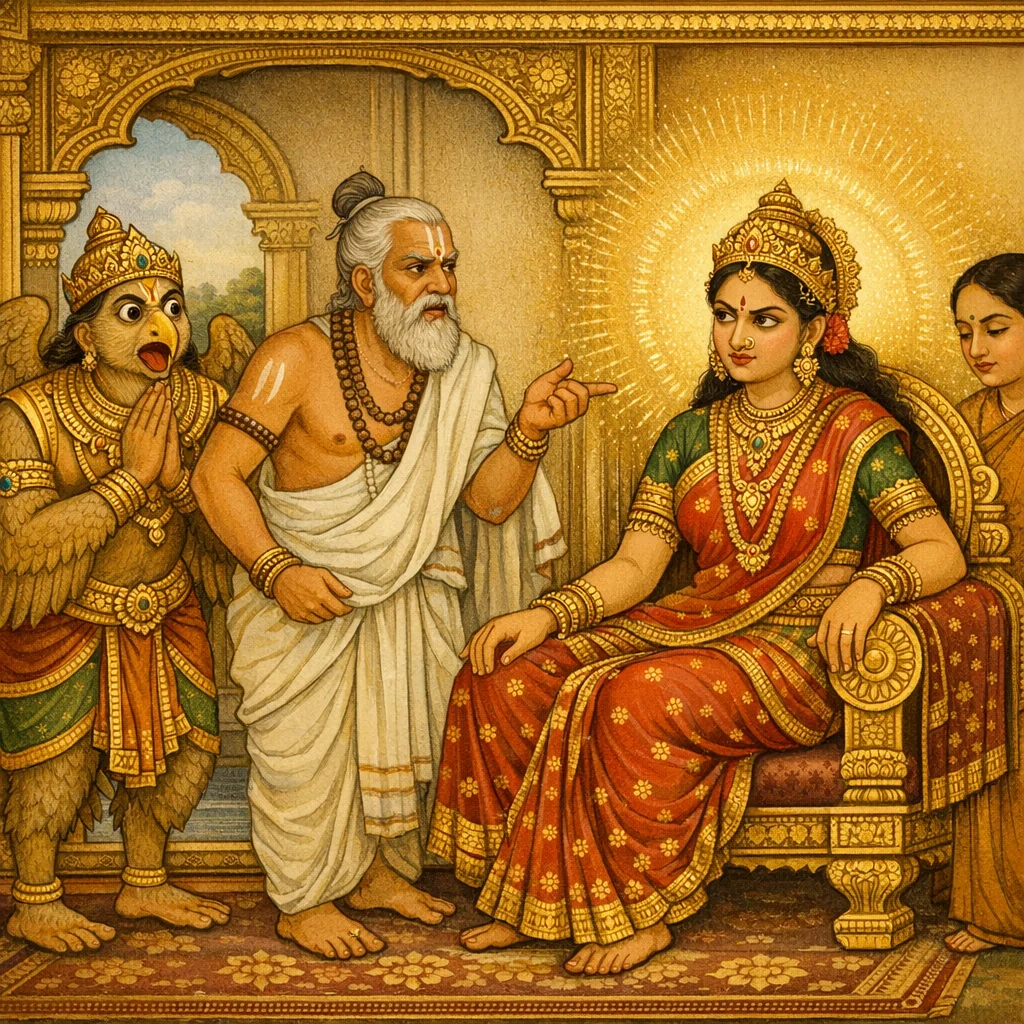
Adhyaya 81
Adhyāya 81 unfolds through layered dialogue. Garuḍa speaks of a brāhmaṇa friend of Bhṛgu lineage and his daughter Mādhavī, for whom no worthy husband can be found; Garuḍa petitions Viṣṇu, declaring Him alone equal in virtue and beauty. Viṣṇu asks that the maiden be brought for His direct sight, mindful of concerns about divine radiance. The narrative turns to domestic and ritual tension: Lakṣmī, taking the maiden’s nearness as rivalry, utters a curse that Mādhavī will become “aśvamukhī” (horse-faced), stirring alarm in the community and indignation among brāhmaṇas. A brāhmaṇa voice then distinguishes mere verbal request from true marital status, reframing the curse’s scope and pointing to bonds that will ripen in future births. The chapter then pivots as Garuḍa notices an extraordinary elderly woman near Viṣṇu; Viṣṇu identifies her as Śāṇḍilī, famed for knowledge and brahmacarya (sacred continence). Garuḍa’s skeptical, biased speech about women and youthful desire brings an immediate consequence—his wings vanish and he is left helpless—an ethical warning about speech, prejudice, and disrespect toward ascetic virtue.
Shlokas
Verse 1
। श्रीगरुड उवाच । ममास्ति दयितं मित्रं ब्राह्मणो भृगुवंशजः । तस्यास्ति माधवीनाम कन्या कमललोचना
Śrī Garuḍa said: “I have a beloved friend, a Brāhmaṇa born in the lineage of Bhṛgu. He has a daughter named Mādhavī, lotus-eyed.”
Verse 2
न तस्याः सदृशः कांतः प्राप्तस्तेन महात्मना । यतस्ततोऽहमादिष्टः कांतमस्यास्त्वमानय । अनुरूपं द्विजश्रेष्ठ यद्यहं संमतस्तव
That great-souled man could not find a husband suitable and equal to her. Therefore I was commanded: “Bring a husband for this maiden—one worthy of her, O best of Brāhmaṇas—if you hold my request in esteem.”
Verse 3
ततो मयाऽखिला भूमिस्तद्वरार्थं विलोकिता । न तदर्थं वरो लब्धः सर्वैः समुचितो गुणैः
Then I surveyed the whole earth in search of such a bridegroom; yet for that purpose I found no man fit—one endowed with all the requisite virtues.
Verse 4
ततस्त्वं पुण्डरीकाक्ष मम चित्ते व्यवस्थितः । अनुरूपः पतिस्तस्याः सर्वैरेव गुणैर्युतः
Therefore, O lotus-eyed Lord, you are firmly established in my heart as the perfectly suitable husband for that maiden—endowed with every noble quality.
Verse 5
तस्मात्पाणिग्रहं तस्याः स्वीकुरुष्व सुरेश्वर । अत्यन्तरूपयुक्ताया मम वाक्यप्रणोदितः
Therefore, O Lord of the gods, accept her hand in marriage—she who is possessed of surpassing beauty—moved by my entreaty.
Verse 6
भगवानुवाच । अत्रानय द्विजश्रेष्ठ तां कन्यां कमलेक्षणाम् । येन दृष्ट्वा स्वयं पश्चात्प्रकरोमि यथोदितम्
The Blessed Lord said: “Bring that lotus-eyed maiden here, O best of the twice-born. After seeing her myself, I shall then do as has been requested.”
Verse 7
गरुड उवाच । तव तेजोभयादेव सा कन्या जनकान्विता । मया दूरे विनिर्मुक्ता तत्कथं तामिहानये
Garuḍa said: “Out of fear of your splendor alone, I released that maiden—together with her father—far away. How then can I bring her here?”
Verse 8
श्रीभगवानुवाच । अत्र तां मम तत्तेजो जनकेन समन्विताम् । न हि धक्ष्यति तस्मात्त्वं शीघ्रं द्विजवराऽनय
The Blessed Lord said: “Bring her here quickly, O excellent twice-born, together with her father. My radiance will not burn her; therefore do not fear.”
Verse 9
एवमुक्तस्ततस्तेन विष्णुना प्रभविष्णुना । तां कन्या मानयामास तं च विप्रभृगूद्वहम्
Thus addressed by Viṣṇu, the mighty Lord, he then honored both that maiden and the foremost Brāhmaṇa—the best of Bhṛgu’s line among the twice-born.
Verse 10
अथासौ प्रणिपत्योच्चैर्ब्राह्मणो मधुसूदनम् । लक्ष्मीवन्न्यविशत्पार्श्वे गरुडस्य समीपतः
Then that Brāhmaṇa bowed deeply to Madhusūdana, and—like Lakṣmī herself—took his place at the side, near Garuḍa.
Verse 11
सापि कन्या वरारोहा बाल्यभावादनिन्दिता । शय्यैकांते समाविष्टा दक्षिणे मुरविद्विषः
That maiden too—fair-limbed and blameless through the innocence of youth—sat at the edge of the couch, on the right side of the foe of Mura (Viṣṇu).
Verse 12
अथ कोपपरीतांगी महिष्याधर्ममाश्रिता । लक्ष्मीः शशाप तां कन्यां सपत्नीति विचिन्त्य च
Then Lakṣmī—her limbs seized by anger, forsaking dharma like a jealous queen—cursed that maiden, thinking, “She is a rival wife.”
Verse 13
यस्मान्मे पुरतः पापे कांतस्य मम हर्षिता । शय्यायां त्वं समाविष्टा लज्जां त्यक्त्वा सुदूरतः । तस्मादश्वमुखी नूनं विकृता त्वं भविष्यसि
“Because, O sinful girl, right before me you—delighting in my beloved—sat upon his couch, casting modesty far away; therefore you shall surely become deformed, with a horse’s face.”
Verse 14
एवं शापे श्रिया दत्ते हाहाकारो महानभूत् । सर्वेषां तत्र संस्थानां कोपश्चापि द्विजन्मनः
When Śrī (Lakṣmī) thus pronounced the curse, a great cry of distress arose. All those assembled there were shaken, and the twice-born (brāhmaṇa) also became wrathful.
Verse 16
यावन्नाग्निद्विजातीनां प्रत्यक्षं गुरुसंनिधौ । ससंकल्पं स्वयं दत्ता गृह्योक्तविधिना जनैः
So long as the sacred fire and the twice-born were present as witnesses, and in the very presence of the guru, the people themselves gave the gift with a formal resolve (saṅkalpa), according to the procedure taught in the Gṛhya rites.
Verse 18
एवमुक्त्वा स विप्रेंद्रस्ततः प्रोवाच केशवम् । आतिथ्यं विहितं ह्येतत्तव पत्न्या यथोचितम् । तस्मात्तत्र प्रयास्यामि यत्र स्यात्तादृशी सुता
Having spoken thus, that foremost brāhmaṇa then addressed Keśava: “This hospitality has indeed been duly offered by your wife, as is fitting. Therefore I shall go to that place where a daughter of such a kind may be found.”
Verse 19
ब्राह्मण उवाच । सहस्रं याच्यते कन्या करोत्येकः करग्रहम् । वाङ्मात्रेण न तस्याः स्यात्पत्नीभावः कथंचन
The brāhmaṇa said: “A thousand may seek the maiden, yet only one performs the taking of the hand (marriage). By words alone, she can never become a wife in any manner.”
Verse 20
तस्मान्नाश्वमुखी ह्येषा जन्मन्यस्मिन्भविष्यति । गृहीत्वेमां गृहं गच्छ प्रयच्छ स्वेप्सिताय च
“Therefore, in this very birth she will not become horse-faced. Take her, go home, and give her in marriage to the one you desire.”
Verse 22
सेयं तव सुता विप्र बंधुस्थानं समाश्रिता । भविष्यति ततो जामिः कनिष्ठा मेऽन्यजन्मनि
“This daughter of yours, O brāhmaṇa, has taken refuge in the station of kinship. Therefore, in another birth, she will become my younger sister—a close blood-relation.”
Verse 23
अवतीर्णस्य भूपृष्ठे देवकार्येण केनचित् । वाजिवक्त्रधरा प्रोक्ता यद्येषा मम कांतया
“When I have descended upon the earth for some divine purpose, if she is described as ‘one bearing a horse-face’ because of my beloved…”
Verse 24
ततोऽहं सुमहत्कृत्वा तपश्चैवानया सह । करिष्यामि शुभास्यां च तथा लक्ष्मीमपि द्विज
“Then I shall undertake very great austerity together with her; and, O brāhmaṇa, I shall also bring about the auspicious-faced one—and Lakṣmī as well.”
Verse 25
एवं स भगवान्विप्रं तं सन्तोष्य तदा गिरा । गरुडेन समं चक्रे कथाश्चित्रा मनोरमाः
Thus the Blessed Lord, having then satisfied that brāhmaṇa with His words, conversed with Garuḍa in wondrous and delightful stories.
Verse 26
अथ तस्मिन्कथांते स गरुडः पुरुषोत्तमम् । प्रोवाच तां स्त्रियं दृष्ट्वा वृद्धां तेजःसमन्विताम्
Then, when that conversation had ended, Garuḍa spoke to Puruṣottama. Having seen that woman—aged, yet endowed with radiance—he addressed the matter concerning her.
Verse 27
अपूर्वेयं सुरश्रेष्ठ स्त्री वृद्धा तव पार्श्वगा । किमर्थं केयमाख्याहि कुतः प्राप्ता जनार्दन
“O best of the gods, this aged woman standing at Your side is most extraordinary. For what reason is she here? Tell me—who is she, and from where has she come, O Janārdana?”
Verse 28
श्रीभगवानुवाच । एषा ख्याता खगश्रेष्ठ लोकेऽस्मिन्वृद्धकन्यका । शांडिलीनाम सर्वज्ञा ब्रह्मचर्यपरायणा
The Blessed Lord said: “O best of birds, she is renowned in this world as the ‘Vṛddhakanyakā’—the aged maiden. Her name is Śāṇḍilī, wise in all matters, wholly devoted to the vow of brahmacarya (sacred celibacy).”
Verse 29
तपोवीर्यसमोपेता सर्वदेवाभिवंदिता । नास्ति वै चेदृशी नारी खगेन्द्रात्र जगत्त्रये
“Endowed with the might born of austerity, and honored by all the gods—O lord of birds—there is truly no woman like her anywhere in the three worlds.”
Verse 30
सूत उवाच । तस्य तद्वचनं श्रुत्वा विहस्य विहगाधिपः । प्रोवाच वासुदेवं च तां विलोक्य चिरं द्विजाः
Sūta said: “Hearing those words, the lord of birds smiled; and after gazing at her for a long while, he spoke to Vāsudeva—O twice-born sages.”
Verse 31
गरुड उवाच । नैतच्चित्रं तपो यच्च क्रियते सुमहत्तरम् । यथा च दीयते दानं यच्च तत्रास्ति चाद्भुतम् । तथा च क्रियते युद्धं संग्रामे युद्धशालिभिः
Garuḍa said: “It is not so surprising that mighty austerities are performed; nor that gifts are given—wondrous though they may be. In the same way, in battle, those skilled in warfare also wage war.”
Verse 32
नाश्चर्यं चित्रमेतच्च ब्रह्मचर्यं तदद्भुतम् । विशेषाद्यौवनावस्थां संप्राप्य पुरुषोत्तम
“This is not the real wonder. Brahmacarya—self-restraint in celibacy—that indeed is the marvel, especially upon attaining youth, O Puruṣottama.”
Verse 33
विशेषेण च नारीभिरत्र न श्रद्दधाम्यहम् । अवश्यं यौवनस्थेन तिर्यग्योनिगतेन च
“And in this matter, I especially find it hard to believe of women. For inevitably, one who is in youth—even one born among the animal realms—is driven by desire.”
Verse 34
विकारः खलु कर्तव्यो नाधि काराय यौवनम् । यदि न प्राप्नुवंत्येताः पुरुषं योषितः क्वचित्
“Indeed, youth tends toward transformation and agitation; it is not naturally fit for restraint. If women do not obtain a man somewhere…”
Verse 35
अन्योन्यं मैथुनं चक्रुः कामबाणप्रपीडिताः । कुष्ठिनं व्याधितं वापि स्थविरं व्यंगमेव च । अप्येताः पुरुषाभावे मन्यंते पंचसायकम्
Tormented by the arrows of Kāma, they even couple with one another; or with a leper, a sick man, an old man, even a cripple. Indeed, when a suitable man is lacking, they still deem the Five-arrowed one (Kāma) irresistible.
Verse 36
नाग्निस्तृप्यति काष्ठानां नापगानां महोदधिः । नांतकः सर्वभूतानां न पुंसां वामलोचना
Fire is never sated with wood; the great ocean is never sated by rivers. Death (Antaka) is never sated with beings—nor is the fair-eyed woman ever sated with men.
Verse 37
न परत्र भयादेता मर्यादां विदधुः स्त्रियः । मुक्त्वा भूपभयं चैकमथवा गुरुजं भयम्
These women do not set bounds of conduct out of fear of the world to come; rather, except for the single fear of the king’s punishment—or perhaps fear arising from elders and teachers—they establish such limits.
Verse 38
सूत उवाच । एवं तस्य वचः श्रुत्वा शांडिली ब्रह्मचारिणी । मौनव्रतधराऽप्येवं हृदि कोपं दधार सा
Sūta said: Hearing those words, Śāṇḍilī—the ascetic devoted to brahmacarya—though observing a vow of silence, still held anger within her heart.
Verse 39
एतस्मिन्नंतरे तस्य पक्षिनाथस्य तत्क्षणात् । उभौ पक्षौ गतौ नाशं रुण्डाकारोऽत्र सोऽभवत्
Just then, in that very moment, the lord of birds lost both his wings; both wings were destroyed, and here he became like a headless trunk—wingless and maimed.
Verse 40
मांसपिंडमयो रौद्रः सर्वरोगविवर्जितः । अशक्तश्च तथा गन्तुं पदमात्रमपि क्वचित्
He appeared fierce, as though a mere lump of flesh, free from every disease—yet he was powerless, unable to go even a single step anywhere.