Adhyaya 54
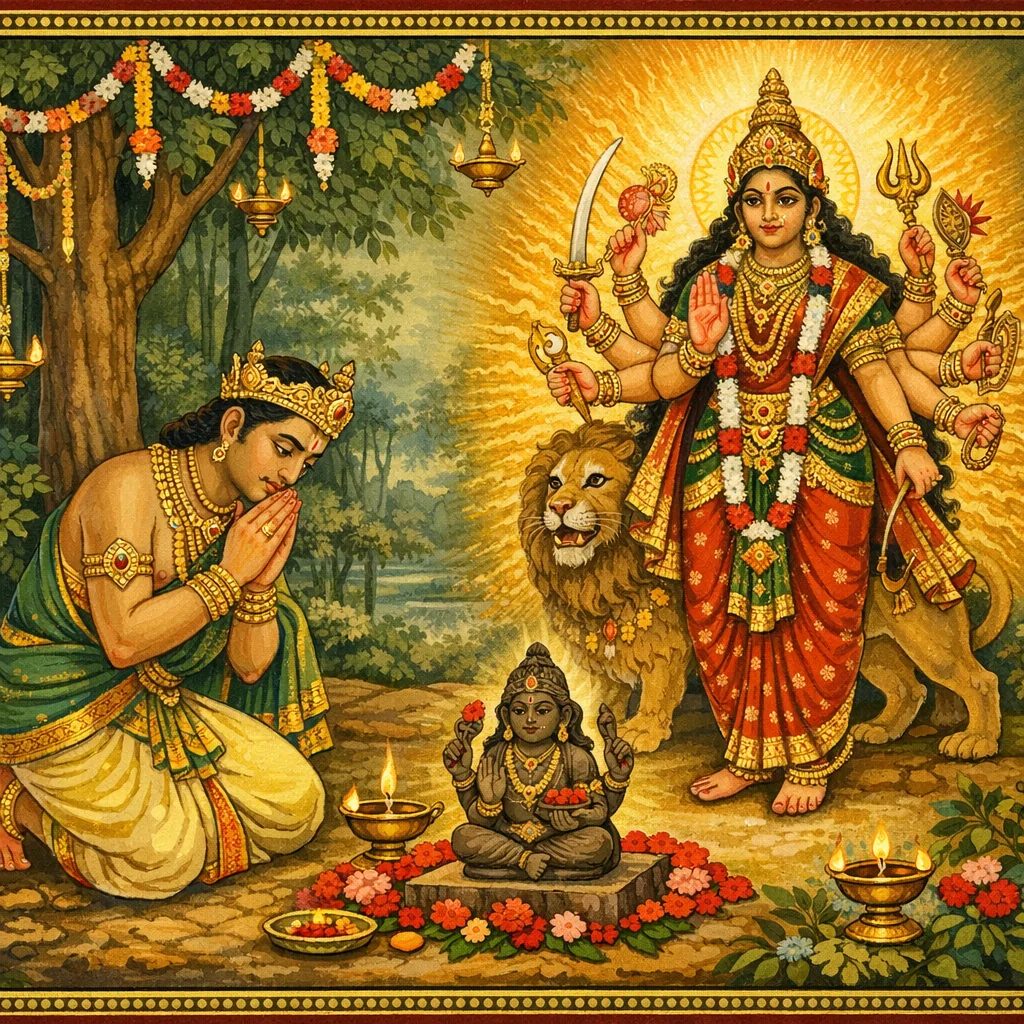
Framed by Sūta’s narration, this chapter describes the goddess Carmamuṇḍā dwelling at a sacred site traditionally said to have been established by the devoted king Nala. It then recounts Nala’s life in brief: his virtues as ruler of Niṣadha, his marriage to Damayantī, and the rise of misfortune through gambling under Kali’s influence. Having lost his kingdom and become separated from his blameless wife in the forest, Nala wanders from wood to wood until he reaches Hāṭakeśvara-kṣetra. On Mahānavamī, a time charged with ritual potency, he fashions a clay image of the goddess for lack of means and worships with fruits and roots, reciting a long hymn of many epithets that proclaims her cosmic pervasiveness and her fierce, protective power. The goddess appears, is pleased, and offers a boon; Nala asks for reunion with his faultless wife. A phala statement follows: whoever praises the goddess with this hymn gains the desired result that very day. The chapter ends with a colophon placing this unit within the Nāgarakhaṇḍa’s Hāṭakeśvara-kṣetra-māhātmya.
Shlokas
Verse 1
। सूत उवाच । चर्ममुंडा तथा देवी तस्मिन्स्थाने व्यवस्थिता । नलेन स्थापिता पूर्वं स्वयमेव महात्मना
Sūta said: In that very place the Goddess Carmamuṇḍā abides—formerly installed there by the great-souled King Nala himself.
Verse 2
अभ्यर्चयति तां भक्त्या यो महानवमी दिने । स कामान्वांछितांल्लब्ध्वा पदं प्राप्नोति शाश्वतम्
Whoever worships Her with devotion on the day of Mahānavamī, having attained the desired wishes, reaches the eternal state.
Verse 3
वीरसेनसुतः पूर्वं नलोनाम महीपतिः । आसीत्सर्वगुणोपेतः सर्व शत्रुक्षयावहः
Formerly there was a king named Nala, the son of Vīrasena—endowed with every virtue, a bringer of the destruction of all enemies.
Verse 4
भार्या तस्याभवत्साध्वी प्राणेभ्योपि गरीयसी । दमयंतीति विख्याता विदर्भाधिपतेः सुता
His wife was a virtuous lady, dearer even than life itself—famed as Damayantī, the daughter of the king of Vidarbha.
Verse 5
अथासौ कलिनाविष्टो द्यूतं चक्रे महीपतिः । पुष्करेण समं विप्रा दायादेन दिवानिशम्
Then that king, seized by Kali, engaged in gambling, O brāhmaṇas, day and night, together with Puṣkara—his kinsman.
Verse 6
ततः स व्यसनासक्तो वार्यमाणोऽपि सज्जनैः । हारयामास सप्तांगं राज्यं मुक्त्वा च तां प्रियाम्
Thereafter, addicted to that ruinous vice, though restrained by the good, he lost his seven-limbed kingdom—and even abandoned his beloved.
Verse 7
अथ तां स समादाय प्रविष्टो गहनं वनम् । निर्जलं लज्जयाविष्टो दुःखव्याकुलितेंद्रियः
Then, taking her with him, he entered a dense forest—waterless—overcome with shame, his senses distressed by sorrow.
Verse 8
ततः स चिंतयामास यद्येषा भीममंदिरे । याति तन्मुच्यते कष्टाद्वनवाससमुद्भवात्
Then he reflected: “If she goes to Bhīma’s palace, she will be freed from the hardships that have arisen from this forest-exile.”
Verse 9
न मया तत्र गंतव्यं कथंचिदपि मानिना । तस्मादेनां परित्यज्य रात्रौ गच्छामि दूरतः
“I—being bound by pride—must not go there by any means. Therefore, abandoning her, I shall depart far away in the night.”
Verse 10
येन त्यक्ता मया साध्वी कुण्डिनं याति तत्पुरम् । स एवं निश्चयं कृत्वा सुखसुप्तां विहाय ताम् । प्रजगाम वनं घोरं वन्यश्वापदसंकुलम्
Thinking, “By my leaving her, the virtuous lady will go to Kuṇḍina, that city,” he made this resolve; and leaving her while she slept peacefully, he went into a dreadful forest crowded with wild beasts and predators.
Verse 11
प्रत्यूषे चापि सोत्थाय यावत्पश्यति भाभिनी । तावत्पश्यतिशून्यं स्वं पार्श्वं यत्र नलः स्थितः
At dawn, when the radiant lady awoke and looked about, she saw that the place beside her—where Nala had been—was empty.
Verse 12
ततो विलप्य दुःखार्ता करुणं तत्र कानने । जगाम मार्गमाश्रित्थ पितुर्हर्म्यं शनैःशनैः
Then, afflicted with grief, she lamented piteously there in the forest; taking to the path, she slowly made her way toward her father’s palace.
Verse 13
नलोऽपि च वने तस्मिन्भ्रममाणो महीपतिः । एकाकी वृक्षकुंजानि सेवयामास सर्वदा
Nala too, wandering in that forest—the king of the earth—lived alone, continually taking shelter among groves and thickets of trees.
Verse 14
ततस्तद्वनमुत्सृज्य जगामान्यन्महावनम् । नानावृक्षगणैर्युक्तं बहुश्वापदसंकुलम्
Then, leaving that forest behind, he went to another great wilderness—filled with many kinds of trees and teeming with numerous wild beasts.
Verse 15
एवं स पृथिवीपालो भ्रममाणोवनाद्वनम् । हाटकेश्वरजं क्षेत्रमाससाद ततः परम्
Thus the protector of the earth, roaming from forest to forest, finally reached the sacred region of Hāṭakeśvara.
Verse 16
एतस्मिन्नंतरे प्राप्तं तन्महानवमीदिनम् । विशेषाद्यत्र भूपालाः पूजयन्ति सुरेश्वरीम्
Meanwhile, the day of Mahānavamī arrived—especially famed as the occasion when kings worship the Goddess, Sureśvarī, Sovereign of the gods.
Verse 17
ततः स मृन्मयीं कृत्वा चर्ममुण्डधरां नृपः । विभवाभावतः पश्चात्फलमूलैरतर्पयत्
Then the king fashioned an earthen image of the Goddess—clad in a hide and wearing a garland of severed heads; and, lacking wealth, he afterward satisfied her with offerings of fruits and roots.
Verse 18
ततस्तस्याः स्तुतिं कृत्वा पुरः स्थित्वा कृतांजलिः । श्रद्धया परया युक्तो निषधाधिपतिः स्वयम्
Then, having offered his hymn of praise to her, the lord of Niṣadha himself stood before the Goddess with folded hands, filled with the highest faith.
Verse 19
जय सर्वगते देवि चर्ममुण्डधरे वरे । जय दैत्यकुलोच्छेददक्षे दक्षात्मजे शुभे
Victory to you, O all-pervading Goddess—supreme one who bears hide and skulls. Victory to you, O auspicious daughter of Dakṣa, skilled in the destruction of the demon clans.
Verse 20
कालरात्रि जयाचिन्त्ये नवम्यष्टमिवल्लभे । त्रिनेत्रे त्र्यंबकाभीष्टे जय देवि सुरार्चिते
Victory to you, O Kālarātri—O inconceivable one, beloved of the sacred Eighth and Ninth lunar days. O three-eyed Goddess, desired of Tryambaka (Śiva)—victory to you whom the gods worship.
Verse 21
भीमरूपे सुरूपे च महाविद्ये महाबले । महोदये महाकाये जयदेवि महाव्रते
Victory to you, O Goddess—terrific in form and yet beautiful; O great Wisdom, O great Power; O of vast rising splendor and mighty body—victory to you, keeper of the great vow.
Verse 22
नित्यरूपे जगद्धात्रि सुरामांसवसाप्रिये । विकरालि महाकालि जय प्रेतजनानुगे
Victory to you, O eternal-formed Mother who sustains the world; O one pleased by offerings of liquor, flesh, and fat. O Vikarālī, O Mahākālī—victory to you who are followed by hosts of spirits.
Verse 23
शवयानरते रम्ये भुजंगाभरणान्विते । पाशहस्ते महाहस्ते रुधिरौघकृतास्पदे
O lovely one who delights in a bier as her vehicle, adorned with serpent-ornaments; O one holding a noose, O mighty-handed one—whose dwelling is made amid torrents of blood.
Verse 24
फेत्कारा रवशोभिष्ठे गीतवाद्यविराजिते । जयानाद्ये जय ध्येये भर्गदेहार्धसंश्रये
O you whose splendor is heightened by the cry ‘pheṭ’, radiant with song and instruments; victory to you, the beginningless one, victory to you, worthy of meditation—who abide as the half-body of Bharga (Śiva).
Verse 25
त्वं रतिस्त्वं धृतिस्तुष्टिस्त्वं गौरी त्वं सुरेश्वरी । त्वं लक्ष्मीस्त्वं च सावित्री गायत्री त्वमसंशयम्
You are Rati; you are steadfastness and contentment. You are Gaurī; you are the Lady of the gods. You are Lakṣmī, and you are Sāvitrī—indeed, you are Gāyatrī without any doubt.
Verse 26
यत्किंचित्त्रिषु लोकेषु स्त्रीरूपं देवि दृश्यते । तत्सर्वं त्वन्मयं नात्र विकल्पोऽस्ति मम क्वचित्
O Goddess, whatever feminine form is seen in the three worlds—know it all to be made of you alone. In this I have no doubt anywhere.
Verse 27
येन सत्येन तेन त्वमत्रावासं द्रुतं कुरु । सान्निध्यं भक्तितस्तुष्टा सुरासुरनमस्कृते
By that truth, therefore, swiftly make your dwelling here. Pleased by devotion, grant your living presence—O you who are saluted by gods and asuras alike.
Verse 28
सूत उवाच । एवं स्तुता च सा देवी नलेन पृथिवीभुजा । प्रोवाच दर्शनं गत्वा तं नृपं भक्तवत्सला
Sūta said: Thus praised by King Nala, ruler of the earth, the Goddess—tender to her devotees—came before him, granted her divine vision, and spoke to that king.
Verse 29
श्रीदेव्युवाच । परितुष्टाऽस्मि ते वत्स स्तोत्रेणानेन सांप्रतम् । तस्माद्गृहाण मत्तस्त्वं वरं मनसि संस्थितम्
The blessed Goddess said: Dear child, I am now fully pleased with you by this hymn. Therefore, receive from me the boon that is settled in your heart.
Verse 30
नल उवाच । दमयन्तीति मे भार्या प्राणेभ्योऽपि गरीयसी । सा मया निर्जने मुक्ता । वने व्यालगणान्विते
Nala said: Damayantī is my wife—dearer to me even than my own life. Yet I abandoned her alone in a solitary forest filled with packs of wild beasts.
Verse 31
अखण्डशीलां निर्दोषां यथाहं त्वत्प्रसादतः । लभे भूयोऽपि तां देवि तथात्र कुरु सत्वरम्
O Goddess, by your grace may I regain her again—she whose virtue is unbroken and who is without blemish. Accomplish this here, O Devi, without delay.
Verse 32
स्तोत्रेणानेन यो देवि स्तुतिं कुर्यात्पुरस्तव । तत्रैव दिवसे तस्मै त्वया देयं मनोगतम्
O Goddess, whoever praises you before your presence with this hymn—on that very day you should grant that person what is desired in the heart.
Verse 33
सूत उवाच । सा तथेति प्रतिज्ञाय जगामादर्शनं ततः । सोऽपि पार्थिवशार्दूलो लेभे सर्वं तयोदितम्
Sūta said: Saying “So be it,” she pledged thus and then vanished from sight. And that tiger among kings also obtained everything that had been spoken by her.
Verse 54
इति श्रीस्कांदे महापुराण एकाशीतिसाहस्र्यां संहितायां षष्ठे नागरखण्डे हाटकेश्वरक्षेत्रमाहात्म्ये नलनिर्मितचर्ममुण्डामाहात्म्यवर्णनंनाम चतुष्पञ्चाशत्तमोऽध्यायः
Thus ends the fifty-fourth chapter, called “The Description of the Greatness of Carmamuṇḍā, established by Nala,” in the Hāṭakeśvara-kṣetra Māhātmya of the sixth Nāgara Khaṇḍa, within the Śrī Skanda Mahāpurāṇa (the Saṃhitā of eighty-one thousand verses).