Adhyaya 33
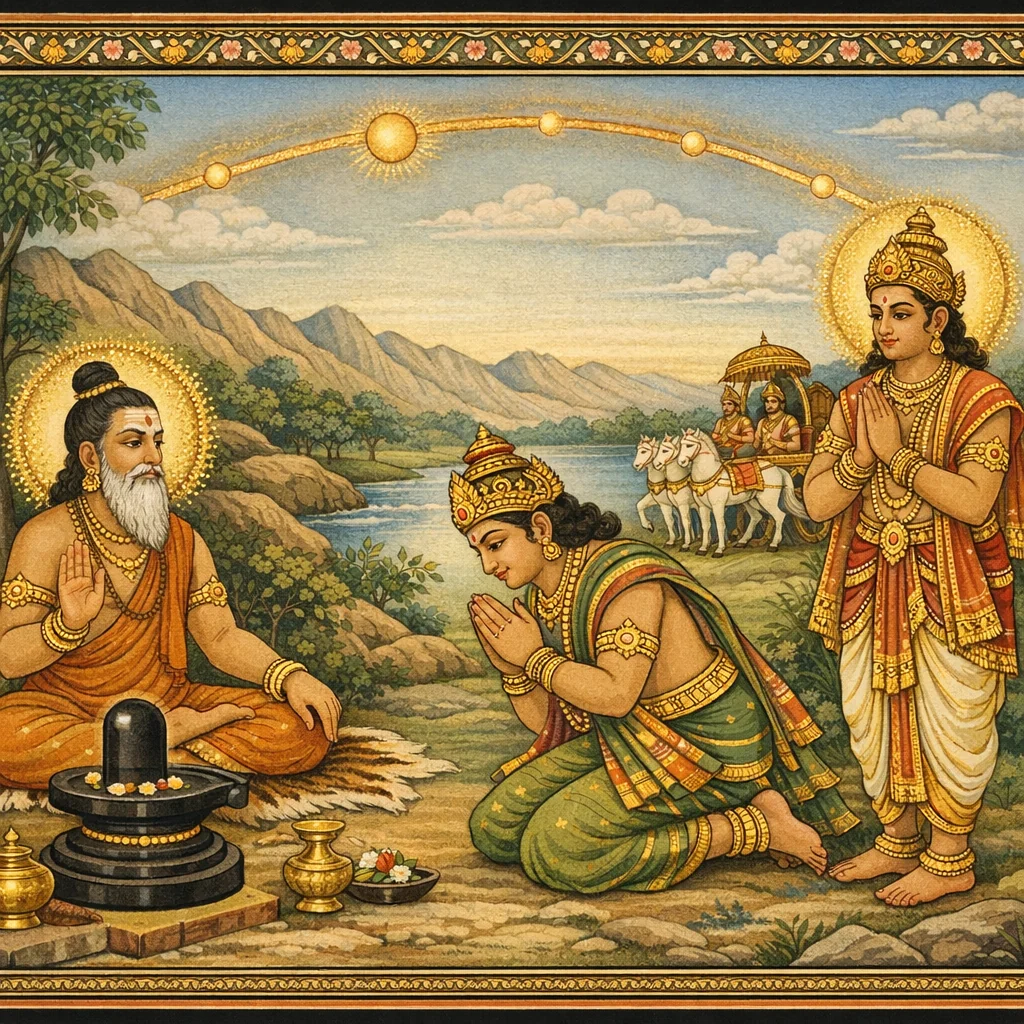
Sūta describes the holy āśrama of Agastya, where Mahādeva (Śiva) is worshipped. On Caitra śukla caturdaśī, Divākara (Sūrya) is said to arrive there and perform worship of Śaṅkara. Those who worship Śaṅkara at that place with bhakti attain divine closeness, and śrāddha performed there with proper śraddhā satisfies the ancestors as effectively as a formal pitṛ rite. When the ṛṣis ask why Sūrya circumambulates Agastya’s āśrama, Sūta recounts the Vindhya episode: out of rivalry with Sumeru, Vindhya blocks the sun’s path, endangering cosmic order—timekeeping, seasons, and ritual cycles. Sūrya, disguised as a brahmin, seeks Agastya’s help; Agastya commands Vindhya to reduce his height and remain so while the sage proceeds south. Agastya then establishes a liṅga and instructs Sūrya to worship it annually on that lunar day, promising that any human who worships the liṅga then will reach Sūrya’s realm and gain liberation-oriented merit. The chapter ends with Sūta affirming Sūrya’s recurring presence at the site and inviting further questions.
Shlokas
Verse 1
। सूत उवाच । अगस्त्यस्याश्रमोऽन्योस्ति तथा तत्र द्विजोत्तमाः । यत्र तिष्ठति विश्वात्मा स्वयं देवो महेश्वरः
Sūta said: O best of the twice-born, there is another hermitage of Agastya, where the Universal Self—Lord Maheśvara himself—abides in person.
Verse 2
शुक्लपक्षे चतुर्दश्यां चैत्रमासे दिवाकरः । स्वयमभ्येत्य देवेशं पूजयत्येव शंकरम्
On the fourteenth lunar day of the bright fortnight in the month of Caitra, the Sun himself comes and worships Śaṅkara, the Lord of gods.
Verse 3
तस्मादन्योऽपि यस्तस्यां भक्त्या चागत्य शंकरम् । तमेव पूजयेद्भक्त्या स याति देवमन्दिरम्
Therefore, whoever else comes there with devotion and worships that very Śaṅkara with bhakti, attains the divine abode.
Verse 4
यस्तत्र कुरुते श्राद्धं सम्यक्छ्रद्धासमन्वितः । पितरस्तस्य तृप्यंते पितृमेधे कृते यथा
Whoever performs Śrāddha there properly, endowed with faith, satisfies his ancestors—just as if a Pitṛmedha rite had been performed.
Verse 5
ऋषय ऊचुः । अगस्त्यस्याश्रमं प्राप्य कस्माद्देवो दिवाकरः । प्रदक्षिणां प्रकुरुते वदैतन्मे सुविस्तरम्
The sages said: “Having reached Agastya’s hermitage, why does the divine Sun, Divākara, perform pradakṣiṇā (circumambulation)? Explain this to us in full detail.”
Verse 6
सूत उवाच । कथयामि कथामेतां शृणुत द्विज सत्तमाः । अस्ति विंध्य इति ख्यातः पर्वतः पृथिवीतले
Sūta said: “I shall narrate this account—listen, O best of the twice-born. On the surface of the earth there is a mountain renowned as Vindhya.”
Verse 7
यस्य वृक्षाग्रशाखायां संलग्नास्तरणेः कराः । पुष्पपूगा इवाधःस्थैर्लक्ष्यंते मुग्धसि द्धकैः
On that mountain, the Sun’s rays seem to cling to the topmost branches of trees; to the innocent siddhas dwelling below, they appear like clusters of flowers hanging down.
Verse 8
अनभिज्ञास्तमिस्रस्य यस्य सानुनिवासिनः । रत्नप्रभाप्रणुन्नस्य कृष्णपक्षनिशास्वपि
The dwellers upon its slopes are unacquainted with darkness, for it is driven away by the radiance of jewels—even on the nights of the dark fortnight.
Verse 9
यस्य सानुषु मुंचंतो भांति पुष्पाणि पादपाः । वायुवेगवशान्नूनं नीरौघ नीरदा इव
On its slopes, the trees—casting down blossoms—appear like rain-clouds pouring streams of water, surely driven by the force of the wind.
Verse 10
यस्मिन्नानामृगा भांति धावमाना इतस्ततः । कलत्रपुत्रपुष्ट्यर्थं लोभार्थं मानवा इव
There, many kinds of deer and other beasts are seen running here and there—like human beings who hurry about out of greed, seeking to support wife and children.
Verse 11
निर्यासच्छद्मना बाष्पं वासिताशेषदिङ्मुखम् । मुञ्चंति तरवो यत्र दन्तिदन्तक्षतत्वचः
There, trees whose bark has been wounded by the tusks of elephants exude ‘tears’ in the guise of resin—perfuming all directions.
Verse 12
चीरिकाविरुतैर्दीर्घै रुदंत इव चापरे । हस्तिहस्तहता वृक्षा मन्यन्ते यस्य सानुषु
And others, hearing the long cries of cīrikā birds, think that the trees upon its slopes—struck down by the hands (trunks) of elephants—are as though weeping.
Verse 13
इतश्चेतश्च गच्छद्भिर्निर्झरांभोभिरावृतः । शुशुभे सितवस्त्राढ्यैः पुमानिव विभूषितः
Covered by waterfall-waters flowing this way and that, the mountain shone—adorned as though it were a man decorated with abundant white garments.
Verse 14
यस्य स्पर्द्धा समुत्पन्ना पूर्वं सह सुमेरुणा । ततः प्राह सहस्रांशुं गत्वा स क्रोधमूर्च्छितः
For that Vindhya, rivalry first arose with Mount Sumeru; then, going to the thousand-rayed Sun, it spoke—overcome by anger.
Verse 15
कस्माद्भास्कर मेरोस्त्वं प्रकरोषि प्रदक्षिणाम् । कुलपर्वतसंज्ञेऽपि न करोषि कथं मयि
Vindhya said: “O Bhāskara (Sun), why do you make a circumambulation of Mount Meru? Though I too am celebrated as a ‘Kulaparvata’ (a primordial mountain), why do you not likewise circumambulate me?”
Verse 16
भास्कर उवाच । न वयं श्रद्धया तस्य गिरेः कुर्मः प्रदक्षिणाम् । एष मे विहितः पन्था येनेदं विहितं जगत्
Bhāskara said: “We do not circumambulate that mountain out of personal reverence. This is the path ordained for me—the very course by which this world has been duly ordered.”
Verse 17
तस्य तुंगानि शृंगाणि व्याप्य खं संश्रितानि च । तेन संजायते तस्य बलादेव प्रद क्षिणा
“Its lofty peaks spread through and rise into the sky; therefore, by that very mountain’s overpowering presence, a circumambulating course comes about.”
Verse 18
एतच्छ्रुत्वा विशेषेण संक्रुद्धो विंध्यपर्वतः । प्रोवाच पश्य भानो त्वं तर्हि तुंगत्वमद्य मे । रुरोधाथ नभोमार्गं येन गच्छति भास्करः
Hearing this, Vindhya Mountain flared with fierce anger and said, “Behold, O Bhānu! Today you shall witness my height.” Then he blocked the pathway of the heavens along which Bhāskara, the Sun, journeys.
Verse 19
अथ रुद्धं समालोक्य मार्गं वासरनायकः । चिन्तयामास चित्ते स्वे सांप्रतं किं करोम्यहम्
Seeing his course obstructed, the lord of the day—the Sun—pondered within himself: “What shall I do now?”
Verse 20
करोमि यद्यहं चास्य पर्वतस्य प्रदक्षिणाम् । तद्भविष्यति कालस्य चलनं भुवनत्रये
“If I were to perform pradakṣiṇā, circumambulating this mountain, then the very course of time would be thrown off throughout the three worlds.”
Verse 21
मासर्तुभुवनानां च तथा भावी विपर्ययः । अग्निष्टोमादिकाः सर्वाः क्रिया यास्यंति संक्षयम् । नष्टयज्ञोत्सवे लोके देवानां स्यान्महाव्यथा
“The months, the seasons, and the worlds would fall into disorder. All rites—beginning with the Agniṣṭoma—would wane and perish. When the festivals of yajña vanish from the world, the gods would be stricken with great anguish.”
Verse 22
एवं संचिन्त्य चित्तेन बहुधा तीक्ष्णदीधितिः । जगाम मनसा भीतः सोऽगस्त्यं मुनिपुंगवम्
Thus pondering in many ways, the sharp-rayed Sun, fear stirring within his heart, turned his mind toward Agastya—the foremost among sages.
Verse 23
नान्योस्ति वारणे शक्तो विंधस्यास्य हि तं विना । अगस्त्यं ब्राह्मणश्रेष्ठं मित्रावरुणसंभवम्
None other can restrain this Vindhya except him—Agastya, the foremost of brāhmaṇas, born of Mitra and Varuṇa.
Verse 24
ततो द्विजमयं रूपं स कृत्वा तीक्ष्णदीधितिः । चमत्कारपुरक्षेत्रे तस्याश्रमपदं ययौ
Then the sharp-rayed Sun assumed the form of a brāhmaṇa and went to Agastya’s hermitage-abode in the sacred region of Cāmatkārapura.
Verse 25
ततस्तु वैश्वदेवांते वेदोच्चारपरायणः । प्रोवाच सोऽतिथिः प्राप्तस्तवाहं मुनिसत्तम
Then, at the conclusion of the Vaiśvadeva rite, that guest—devoted to the recitation of the Veda—addressed him: “O best of sages, I have come to you as your guest.”
Verse 26
ततोऽगस्त्यः कृतानन्दः स्वागतं ते महामुने । मनोरथ इवाध्यातो योऽग्निकार्यांत आगतः
Then Agastya, filled with joy, said: “Welcome to you, O great sage! You have arrived at the end of my fire-rite, like a cherished wish suddenly fulfilled.”
Verse 27
तत्त्वं ब्रूहि मुनिश्रेष्ठ यद्ददामि तवेप्सितम् । अदेयं नास्ति मे किञ्चित्कालेऽस्मिन्प्रार्थितस्य च
“Speak your true intention, O best of sages, so that I may grant what you desire. For at this moment, for one who asks, there is nothing I would withhold.”
Verse 28
भास्कर उवाच । अहं भास्कर आयातो विप्ररूपेण सन्मुने । सर्वकार्यक्षमं मत्वा त्वामेकं भुवनत्रये
Bhāskara said: “I am Bhāskara, the Sun. O noble sage, I have come in the form of a brāhmaṇa, knowing you alone in the three worlds to be able to accomplish every task.”
Verse 29
त्वया पूर्वं सुरार्थाय प्रपीतः पयसांनिधिः । वातापिश्च तथा दैत्यो भक्षितो द्विजकण्टकः
“Formerly, for the sake of the gods, you drank up the ocean; and likewise you consumed the demon Vātāpi, a torment to the brāhmaṇas.”
Verse 30
तस्माद्गतिर्भवास्माकं सांप्रतं मुनिसत्तम । देवानामिह वर्णानां त्वमेव शरणं यतः
“Therefore, O best of sages, be our refuge now. For here, for the gods and for the social orders, you alone are the shelter.”
Verse 31
सूत उवाच । तच्छ्रुत्वा स मुनिर्विप्रा विशेषेण प्रहर्षितः । अर्घ्यं दत्त्वा दिनेशाय ततः प्रोवाच सादरम्
Sūta said: Hearing this, that sage—O brāhmaṇas—rejoiced greatly. Having offered arghya to Dineśa, the Lord of Day, he then spoke with reverence.
Verse 32
धन्योऽस्म्यनुगृहीतोस्मि यन्मे त्वं गृहमागतः । तस्माद्ब्रूहि करिष्यामि तव वाक्यमखंडितम्
“Blessed am I; truly I am favored, since you have come to my home. Therefore speak—your command I shall carry out without fail.”
Verse 33
भास्कर उवाच । एष विंध्याचलोऽस्माकं मार्गमावृत्य संस्थितः । स्पर्द्धया गिरिमुख्यस्य सुमेरोर्मुनिसतम
Bhāskara said: “This Vindhya mountain has stood blocking our path, out of rivalry with the foremost of mountains, Sumeru—O best of sages.”
Verse 34
सामाद्यैर्विविधोपायैस्तस्मादेनं निवारय । कालात्ययो यथा न स्याद्गतेर्भंगस्तथा कुरु
“Therefore restrain him by the various means beginning with conciliation. Act so that there is no delay of time, and so that our course is not disrupted.”
Verse 35
अगस्त्य उवाच । अहं ते वारयिष्यामि वर्धमानं कुलाचलम् । स्वस्थानं गच्छ तस्मात्त्वं सुखीभव दिवाकर
Agastya said: “I shall restrain that ancestral mountain as it keeps growing. Therefore, O Divākara (Sun), go back to your own station and be at ease.”
Verse 36
ततः स प्रेषितस्ते न भास्करस्तीक्ष्णदीधितिः । स्वं स्थानं प्रययौ हृष्टस्तमामंत्र्य मुनीश्वरम्
Then Bhāskara, of sharp-rayed brilliance, having been sent on by you, joyfully returned to his own station, after taking leave of that lord among sages.
Verse 37
अगस्त्योऽपि द्रुतं गत्वा विंध्यं प्रोवाच सादरम् । न्यूनतां व्रज मद्वाक्याच्छीघ्रं पर्वतसत्तम
Agastya too, going swiftly, addressed Vindhya with courtesy: “At my word, quickly assume a lower state, O best of mountains.”
Verse 38
दाक्षिणात्येषु तीर्थेषु स्नाने जाताद्य मे मतिः । तवायत्ता गिरे सैव तत्कुरुष्व यथोचितम्
Today my resolve has arisen to bathe at the sacred tīrthas of the South. That very plan rests upon you, O mountain; therefore act in the proper way.
Verse 39
स तस्य वचनं श्रुत्वा विंध्यः पर्वतसत्तमः । अभजन्निम्नतां सद्यो विनयेन समन्वितः
Hearing his words, Vindhya—the foremost of mountains—at once lowered himself, endowed with humility.
Verse 40
अगस्त्योऽपि समासाद्य तस्यांतं दक्षिणं द्विजाः । त्वयैवं संस्थितेनाथ स्थातव्यमित्युवाच तम्
O brāhmaṇas, Agastya too, reaching its southern end, said to him: “Since you are established thus, you must remain just so.”
Verse 42
स तथेति प्रतिज्ञाय शापाद्भीतो नगोत्तमः । न जगाम पुनर्वृद्धिं तस्यागमनवांछया
That best of mountains, promising “So be it,” and fearing the curse, did not grow again—longing for Agastya’s return.
Verse 43
सोऽपि तेनैवमार्गेण निवृत्तिं न करोति च । यावदद्यापि विप्रेंद्रा दक्षिणां दिशमाश्रित तः
And he too does not turn back by that very route; even to this day, O best of brāhmaṇas, he remains abiding in the southern direction.
Verse 44
अथ तत्रैव चानीय लोपामुद्रां मुनीश्वरः । समाहूय सहस्रांशुं ततः प्रोवाच सादरम्
Then, right there, the lordly sage brought Lopāmudrā; and summoning Sahasrāṃśu, the thousand-rayed Sun, he spoke with reverent care.
Verse 45
तव वाक्यान्मया त्यक्तः स्वाश्रमस्तीक्ष्णदी धिते । तवार्थे च न गंतव्यं भूयस्तत्र कथंचन
“At your words, O sharp-rayed one, I abandoned my own hermitage. And for your sake I must not go there again—ever, in any way.”
Verse 46
तस्मान्मद्वचनाद्भानो चतुर्दश्यां मधौ सिते । यन्मया स्थापितं तत्र लिंगं पूज्यं हि तत्त्व या
“Therefore, O Bhānu, in obedience to my word, on the bright fourteenth day of the month of Madhu (Caitra), the liṅga I established there must indeed be worshipped with true understanding and right principle.”
Verse 47
भास्कर उवाच । एवं मुने करिष्यामि तव वाक्यादसंशयम् । पूजयिष्यामि तल्लिंगं वर्षांते स्वयमेव हि
Bhāskara, the Sun, said: “So shall I do, O sage—without any doubt, in accordance with your word. Indeed, at the year’s end I myself will worship that liṅga.”
Verse 48
योऽन्यो हि तद्दिने लिंगं पूजयिष्यति मानवः । मम लोकं समासाद्य स भविष्यति मुक्तिभाक्
“And any other person who worships the liṅga on that very day—having reached my world—will become a recipient of liberation (mokṣa).”
Verse 49
सूत उवाच । एतस्मात्कारणात्तत्र भगवांस्तीक्ष्णदीधितिः । चैत्रशुक्लचतुर्दश्यां सांनिध्यं कुरुते सदा
Sūta said: “For this reason, the Blessed One of keen rays (the Sun) ever manifests His presence there on the bright fourteenth day of Caitra.”
Verse 50
एतद्वः सर्वमाख्यातं यत्पृष्टोस्मि द्विजोत्तमाः । भूयो वदत वै कश्चित्संदेहश्चे द्धृदि स्थितः
“I have told you all that I was asked, O best of the twice-born. Speak again, if any doubt still abides within your hearts.”