Adhyaya 27
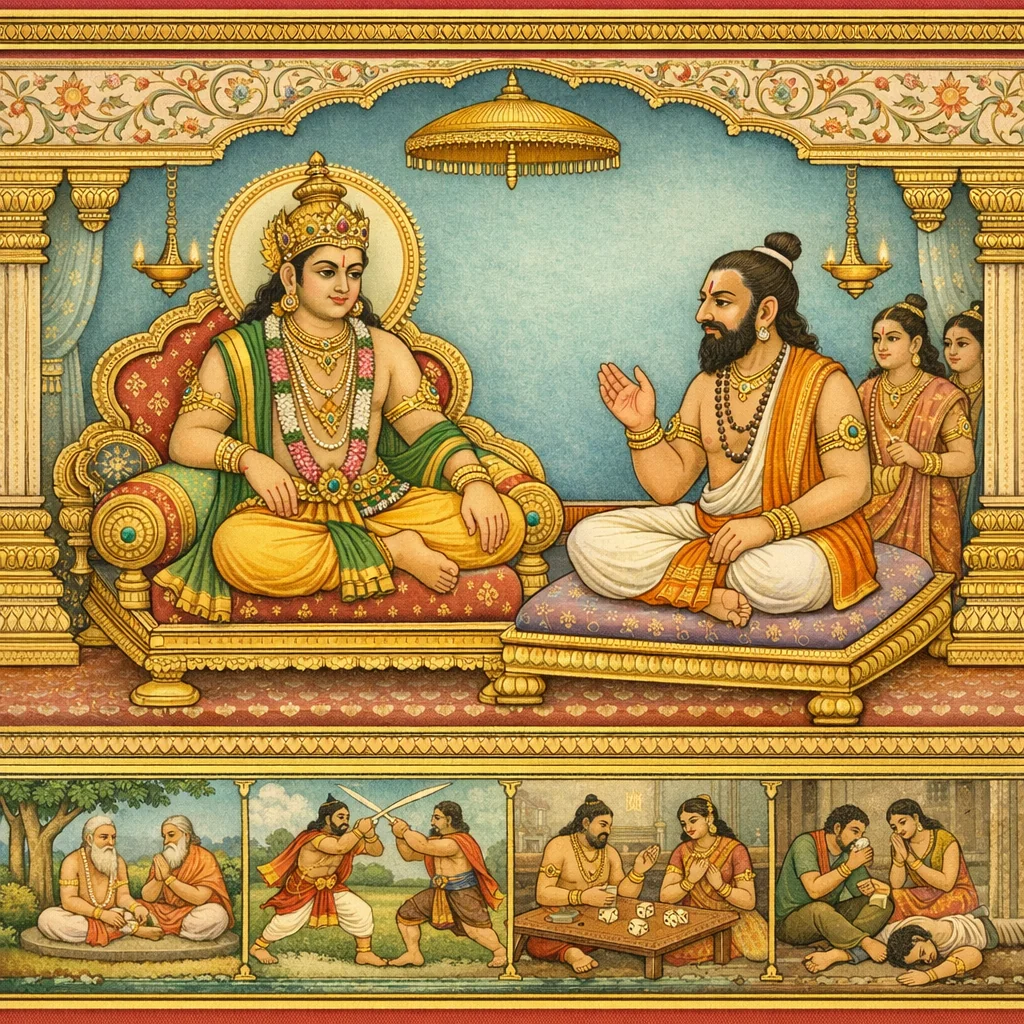
Chapter 27 is a carefully ordered theological teaching conveyed through a multi-layered dialogue. The sages ask Sūta to explain the four yugas in full—their measurable duration (pramāṇa), defining nature (svarūpa), and their “māhātmya,” the religious and ethical significance. Sūta then recounts an older scene: Indra (Śakra), seated in assembly with gods and other beings, respectfully questions Bṛhaspati about the origin and standards of the yugas. Bṛhaspati describes the yugas in sequence. In Kṛtayuga, dharma is complete (four-footed), human lifespan is long, social and ritual order is steady, and there is no disease, naraka, or preta-state; rites are performed without selfish desire. In Tretāyuga, dharma declines (three-footed), rivalry and desire-driven religiosity increase, and a taxonomy is given for the rise of socially marginalized groups through mixed unions (as framed by the text). In Dvāparayuga, dharma and pāpa are balanced (two and two), ambiguity grows, and ritual fruits correspond more to intention. In Kaliyuga, dharma is minimal (one-footed), social trust collapses, lifespan diminishes, ecological and moral disorder intensify, and religious institutions degrade. The chapter ends with a phalaśruti, declaring that reciting or hearing this yuga-teaching removes pāpa across cycles of life.
Shlokas
Verse 1
। ऋषय ऊचुः । चतुर्युगस्वरूपं तु माहात्म्यं चैव सूतज । प्रमाणं वद कार्त्स्न्येन परं कौतूहलं हि नः
The sages said: O son of Sūta, declare in full the true measure, the form of the four yugas, and their greatness; for our curiosity is indeed profound.
Verse 2
सूत उवाच । इममर्थं पुरा पृष्टो वासवेन बृहस्पतिः । यथा प्रोवाच विप्रेंद्रास्तद्वो वक्ष्यामि सांप्रतम्
Sūta said: Long ago, Vāsava (Indra) asked Bṛhaspati about this very matter. O best of Brāhmaṇas, just as he explained it, so shall I now tell it to you.
Verse 3
पुरा शक्रं समासीनं सभायां त्रिदशैः सह । सह शच्या महात्मानमुपासांचक्रिरे सुराः
Once, when Śakra (Indra) sat in the assembly together with the thirty gods, with Śacī beside him, the deities gathered and attended upon that great-souled lord.
Verse 4
गन्धर्वाप्सरसश्चैव सिद्धविद्याधराश्च ये । गुह्यकाः किंनरा दैत्या राक्षसा उरगास्तथा
Gandharvas and Apsarases, Siddhas and Vidyādharas, Guhyakas and Kiṃnaras, as well as Daityas, Rākṣasas, and Nāgas—all were present.
Verse 5
कलाः काष्ठानिमेषाश्च नक्षत्राणि ग्रहास्तथा । सांगा वेदास्तथा मूर्तास्तीर्थान्यायतनानि च
There too were the divisions of time—kalās, kāṣṭhās, and nimeṣas—along with the constellations and planets; the Vedas with their auxiliaries (Vedāṅgas), embodied forms (divinities), and also the tīrthas and sacred abodes.
Verse 6
तथा चक्रुः कथाश्चित्रा देवदानवरक्षसाम् । राजर्षीणां पुराणानां ब्रह्मर्षीणां विशेषतः
And they related wondrous narratives—of gods, dānavas, and rākṣasas; of royal sages and ancient lore, and especially of the great Brahmarṣis.
Verse 7
कस्मिंश्चिदथ संप्राप्ते प्रस्तावे त्रिदशेश्वरः । पप्रच्छ विनयोपेतो विप्रश्रेष्ठं बृहस्पतिम्
Then, on a certain occasion when the context arose, the lord of the gods, with humility, questioned Bṛhaspati—the foremost of brāhmaṇas.
Verse 8
भगवञ्छ्रोतुमिच्छामि प्रमाणं युगसंभवम् । माहात्म्यं च स्वरूपं च यथावद्वक्तुमर्हसि
O venerable one, I wish to hear the measure and origin of the yuga—its greatness and its true nature. Please explain it correctly, as it ought to be told.
Verse 9
बृहस्पति रुवाच । अहं ते कीर्तयिष्यामि माहात्म्यं युगसंभवम् । यत्प्रमाणं स्वरूपं च शृणुष्वावहितः स्थितः
Bṛhaspati said: I shall recount to you the greatness and the origin of the yuga—its measure and its essential nature as well. Listen attentively, remaining fully focused.
Verse 10
अष्टाविंशतिसहस्राणि लक्षाः सप्तदशैव तु । प्रमाणेन कृतं प्रोक्तं यत्र शुक्लो जनार्दनः
By the stated measure it is declared to be twenty‑eight thousand and seventeen lakṣas; it is said to be the Kṛta (Satya) Age, wherein Janārdana appears in a white and pure form.
Verse 12
चतुष्पादस्तथा धर्मः सुसंपूर्णा वसुन्धरा । कामक्रोधविनिर्मुक्ता भयद्वेषविवर्जिताः । जनाश्चिरायुषस्तत्र शान्तात्मानो जितेन्द्रियाः । पञ्चतालप्रमाणाश्च दीप्तिमन्तो बहुश्रुताः
There dharma stands upon all four feet, and the earth is wholly abundant. People are free from desire and anger, devoid of fear and hatred; long‑lived, serene of mind, masters of the senses—five tālas in stature, radiant, and deeply learned.
Verse 13
तत्र षोडशसाहस्रं बालत्वं जायते नृणाम् । ततश्च यौवनं प्रोक्तं द्वात्रिंशद्यावदेव हि
There, human childhood lasts for sixteen thousand years. After that, youth is said to extend up to thirty‑two thousand years.
Verse 14
ततः परं च वार्द्धक्यं शनैः संजायते नृणाम् । लक्षांते परमं यावदन्येषामधिकं क्वचित्
Thereafter, old age gradually comes upon people. It reaches its utmost only at the end of a lakṣa of years—and in some cases, for others, even beyond that.
Verse 15
तत्र सत्त्वाश्च ये केचित्पशवः पक्षिणो मृगाः । दैवीं वाचं प्रजल्पंति न विरोधं व्रजंति च ।ा
There, whatever living beings exist—cattle, birds, and wild animals—speak a divine speech, and they do not fall into conflict with one another.
Verse 19
धेनवश्च प्रयच्छंति वांछितं स्वादु सत्पयः । सर्वेष्वपि हि कालेषु भूरि सर्प्पिःप्रदं नृणाम्
Cows grant people the desired milk—sweet, pure, and wholesome; indeed, at all times they bestow abundant ghee upon humankind.
Verse 20
न तत्र विधवा नारी जायते न च दुर्भगा । काकवंध्या सुतैर्हीना न च शीलविवर्जिता
There, no woman becomes a widow, nor is any woman unfortunate; none is barren or without children, and none is deprived of good conduct.
Verse 21
यथाजन्म तथा मृत्युः क्रमात्संजायते नृणाम् । न वीक्षते पिता पुत्रं मृतं क्वापि कदाचन
As birth occurs, so too death comes to people in due sequence; yet there, a father never has to behold his son lying dead anywhere at any time.
Verse 22
न प्रेतत्वं च लोकानां मृतानां तत्र जायते । न चापि नरके वासो न च रोगव्यथा क्वचित्
There, among those who die, no state of restless ‘preta’-hood arises; nor is there dwelling in hell, nor any affliction of disease anywhere.
Verse 23
वेदांतगा द्विजाः सर्वे नित्यं स्वाध्यायशीलिनः । वेदव्याख्यानसंहृष्टा ब्रह्मज्ञानविचक्षणाः
All the twice-born there are grounded in Vedānta, ever devoted to svādhyāya, sacred study; delighted in expounding the Veda, they are discerning in the knowledge of Brahman.
Verse 24
क्षत्रियाश्चापि भूपालमेकं कृत्वा सुभक्तितः । तदादेशात्प्रभुंजंति महीं धर्मेण नित्यशः
The kṣatriyas too, with deep devotion, acknowledge a single sovereign; by his command they govern and enjoy the earth continually, in accordance with dharma.
Verse 25
वैश्या वैश्यजनार्हाणि चक्रुः कर्माणि भूरिशः । पशुपालनपूर्वाणि क्रयविक्रयजानि च
The vaiśyas performed many tasks proper to the merchant class—beginning with cattle-rearing and including works arising from buying and selling.
Verse 26
मुक्त्वैकां द्विजशुश्रूषा न शूद्रास्तत्र चक्रिरे । किंचित्कर्म सुरश्रेष्ठ श्रद्धया परया युताः
Except for serving the twice-born, the śūdras there did not undertake other work; O best of the gods, endowed with supreme faith, they performed only limited duties.
Verse 27
न तत्र चांत्यजो जज्ञे न च संकरसंभवः । नापवित्रो न वर्णानां पञ्चमो दृश्यते भुवि
There, no ‘antyaja’ was born, nor any offspring of mixed unions; none was deemed impure, and on that earth no ‘fifth’ group outside the four varṇas was seen.
Verse 28
यजनं याजनं दानं व्रतं नियम एव च । तीर्थयात्रां नरास्तत्र निष्कामा एव कुर्वते
There, people perform sacrifice and officiate at sacrifices, give charity, observe vows and disciplines, and undertake pilgrimages to tīrthas—doing all of it free from selfish desire.
Verse 29
एवंविधं सहस्राक्ष मया ते परिकीर्तितम् । आद्यं कृतयुगं पुण्यं सर्वलोकसुखावहम्
Thus, O Thousand-Eyed One, I have described to you that primal Kṛta Yuga—holy and bringing happiness to all worlds.
Verse 30
ततस्त्रेतायुगं नाम द्वितीयं संप्रवर्तते । वर्षाणां षण्णवत्याढ्या लक्षा द्वादश संख्यया
Thereafter begins the second age, called Tretā Yuga, with a span measured as twelve lakṣas of years, enriched by ninety-six thousand more.
Verse 31
सोऽपि साक्षाजगन्नाथः श्वेतद्वीपाश्रयाश्रितः । तत्र रक्तत्वमायाति भग वान्गरुडध्वजः
Even the Lord of the universe Himself—dwelling in the refuge of Śvetadvīpa—there assumes a red hue: the Blessed One whose banner bears Garuḍa.
Verse 32
त्रिपादस्तत्र धर्मः स्यात्पादेनैकेन पातकम् । तेनापि जायते स्पर्द्धा वर्णानामितरेतरम्
There, Dharma stands on three feet, while sin stands on one; yet even so, rivalry arises among the social orders against one another.
Verse 33
ततः फलानि वांछंति तीर्थयात्रोद्भवानि ते । व्रतानां नियमानां च स्वर्गवासादिहेतवः
Thereafter, they long for the fruits born of pilgrimage to sacred fords, and for the results of vows and disciplines—seeking heaven and similar rewards.
Verse 34
ततः कामवशान्मोहं सर्वे गच्छंति मानवाः । मोहाद्द्रोहं ततो गत्वा पापं कुर्वंत्यनुक्रमात्
Then, driven by desire, all people fall into delusion; from delusion they proceed to malice, and thereafter, step by step, they commit sin.
Verse 35
ततस्तु रौरवादीनि नरकाणि यमः स्वयम् । सज्जीकरोति देवेन्द्र ह्येकविंशतिसंख्यया
Then Yama himself makes ready the hells beginning with Raurava—O Lord of the gods—numbering twenty-one in all.
Verse 36
कर्मानुसारतस्तानि सेवयंति नराधमाः । केचिदन्ये महेन्द्रादिलोकान्मोक्षं तथा परे
In accordance with their deeds, the vile among men undergo those hellish states. Others attain the worlds of Mahendra and the like; and still others, liberation.
Verse 37
त्रिविधाः पुरुषास्तत्र श्रेष्ठाश्चाधममध्यमाः । त्रिविधानि च कर्माणि प्रकुर्वंति सुरेश्वर
There, people are of three kinds—excellent, middling, and base; and they perform three corresponding kinds of actions, O Lord of the gods.
Verse 38
उन्नतास्तालमात्रेण तेजोवीर्यसमन्विताः । चक्रुश्च कृषिकर्माणि वैश्याश्चैवान्नलिप्सया
They were taller by a palm’s measure and endowed with vigor and energy; and the Vaiśyas performed agricultural work, driven by the desire for food and produce.
Verse 39
उप्तक्षेत्रं सकृच्चापि सप्तवारं लुनंति ते । यथर्तु फलिनो वृक्षा यथर्तु कुसुमान्विताः
Even if a field is sown but once, they reap it seven times; trees bear fruit in their proper seasons, and in those seasons they are adorned with blossoms.
Verse 40
यथर्तु पत्रसंयुक्तास्तत्र स्युः सुमनोहराः । अग्निष्टोमादिका यज्ञाः प्रवर्तंते सहस्रशः
There all is lovely, furnished with leaves in their proper seasons; and sacrifices such as the Agniṣṭoma are carried on by the thousands.
Verse 41
इतरेतरसंस्पर्धैः क्रियमाणा नृपोत्तमैः । ब्राह्मणैश्च सुरश्रेष्ठ स्वर्गलोकमभीप्सुभिः
O best of the gods, this holy undertaking is performed in mutual emulation by excellent kings and by brāhmaṇas as well—by those who long to attain the world of heaven.
Verse 42
तीर्थयात्रां व्रतं दानं नियमं संयमं तथा । परलोकमभीप्संतस्तत्र कुर्वंति मानवाः
There, people make pilgrimage to the sacred tīrthas, undertake vows, give gifts in charity, and practice observances and self-restraint—seeking the world beyond this life.
Verse 43
सहस्रेण तु वर्षाणां तत्र स्याद्यौवनं नृणाम् । सहस्रपञ्चकं यावदूर्ध्वं वार्द्धक मुच्यते
There, the youthfulness of men endures for a thousand years; and for up to five thousand years beyond that, old age is held at bay.
Verse 44
रजकश्चर्मकारश्च नटो बुरुड एव च । कैवर्त्तमेदभिल्लाश्च चंडालाः शूद्रमानवाः
Washermen, leather-workers, performers (actors), and the Buruḍa; as well as Kaivartas, Medas, Bhillas, and Caṇḍālas—these are described as śūdra communities among men.
Verse 46
इन्द्र उवाच । उत्पत्तिः कथमेतेषामंत्यजानां द्विजो त्तम । यथावद्वद कार्त्स्न्येन अत्र कौतूहलं महत्
Indra said: O best of the twice-born, how did the origins of these antyajas come about? Speak correctly and in full—for my curiosity here is great.
Verse 47
बृहस्पतिरुवाच । एतेषामष्टधा सृष्टिर्जायतेंऽत्यजसंभवा । योनि दोषात्सुरश्रेष्ठ जातेर्वक्ष्याम्यहं स्फुटम्
Bṛhaspati said: O best of the gods, the creation of these arises in eightfold form, connected with antyaja lineages. Due to defect in the womb/lineage, I shall explain their categories clearly.
Verse 48
ब्राह्मण्यां क्षत्रियाज्जातः सूत इत्यभिधीयते । सूतेन रजकश्चैव रजकेन च चर्मकृत्
From a brāhmaṇa woman and a kṣatriya man, one is called a Sūta. From a Sūta comes the Rajaka (washerman), and from a Rajaka comes the Carmakṛt (leather-worker).
Verse 49
चर्मकारेण संजज्ञे नटश्चांत्यजसंज्ञकः । चत्वारः क्षेत्रसंभूता एते क्षेत्रे द्विजन्मनाम्
From the leather-worker arose the Naṭa, designated as an antyaja. These four are said to be born from the ‘field’ (kṣetra), within the field of the twice-born.
Verse 50
तथा च मागधो जज्ञे वैश्येन द्विजसंभवे । क्षेत्रे मागधवीर्येण बुरुडो मरुदुत्तम
So too, the Māgadha was born from a vaiśya within a twice-born (dvija) lineage. And in this “field” (kṣetra), through the seed of the Māgadha, the Buruḍa arose—O chief of the Maruts (Indra).
Verse 51
बुरुडेन च कैवर्तः कैवर्तेन च मेदकः । चत्वारो वैश्यसंभूता एते क्षेत्रे द्विजन्मनाम् । प्रजायन्ते सुरश्रेष्ठ सवकर्मसु गर्हिताः
From the Buruḍa comes the Kaivarta, and from the Kaivarta comes the Medaka. These four are born from the vaiśya line within the “field” (kṣetra) of the twice-born; and, O best of the gods, they are said to be reproached in their respective occupations.
Verse 52
तथा शूद्रेण संजज्ञे ब्राह्मण्यां सुरसत्तम । भिल्लाख्यश्चापि भिल्लेन चंडालश्च प्रजायते
Likewise, O best of the gods, when a brāhmaṇa woman conceives by a śūdra, a child known as a “Bhilla” is born; and from a Bhilla arises a Caṇḍāla.
Verse 53
एतौ द्वावपि शूद्रेण भवतो द्विजसंभवे । क्षेत्रे सर्वसुराधीश सत्यमेतन्मयोदितम्
Both of these results arise from a śūdra in the case of offspring connected with the twice-born. O lord of all the gods, this is truly what I have declared—as it is known in this sacred region.
Verse 54
एतत्त्रेतायुगे प्रोक्तं मया ते सुरसत्तम । आकर्णय प्रयत्नेन द्वापरस्याधुना स्थितिम्
This, O best of the gods, I have explained to you concerning the Tretā age. Now listen attentively, with earnest effort, to the condition of the Dvāpara age.
Verse 55
लक्षाष्टकप्रमाणेन तद्युगं परिकीर्तितम् । चतुःषष्टिसहस्राणि वर्षाणां परिसं ख्यया । कपिशो जायते तत्र भगवान्गरुडध्वजः
That age is proclaimed to be of the measure of eight lakṣas. By the full count it comprises sixty-four thousand years. In that age the Blessed Lord—whose banner bears Garuḍa—is born with a tawny, monkey-like complexion.
Verse 56
द्वौ पादौ चैव धर्मस्य द्वौ पापस्य व्यवस्थितौ । तत्र स्याद्यौवनं नृणां गते वर्षशतेऽ खिले
There, two quarters of dharma and two quarters of sin remain established. In that age, people attain youth only after a full hundred years have passed.
Verse 57
ततोऽन्यैः समतिक्रांतैर्वार्धक्यं पञ्चभिः शतैः । तत्र सत्यानृता लोका देवा भूपास्तथा परे
Then, after another span has passed, old age comes at five hundred years. In that age, beings—gods, kings, and others—are a mixture of truth and untruth.
Verse 58
नार्यश्चापि सुरश्रेष्ठ तत्स्व रूपाः प्रकीर्तिताः । पंचहस्तप्रमाणेन चतुर्हस्तास्तथा परं
And women too, O best of the gods, are described as having their own distinct forms; their measure is said to be five hands, and then (in another class) four hands as well.
Verse 59
नातिरूपेण संयुक्ता न च रूपविवर्जिताः । अव्यक्तजल्पकाश्चापि पशवः पक्षिणो मृगाः
They are not endowed with excessive beauty, nor are they devoid of beauty. Even animals—beasts, birds, and deer—utter indistinct sounds.
Verse 60
नातिपुष्पफलैर्युक्ता वृक्षाश्चापिसुरेश्वर । सस्यानि तानि जायन्ते तत्र चोप्तानिकर्षुकैः
O Lord of the gods, even the trees there are not excessively laden with flowers and fruits. Crops arise only from what the cultivators sow.
Verse 61
वर्षंति जलदाः कामं भवन्त्योषधयोऽखिलाः । यत्किंचिद्भूतले ज्ञानं शास्त्रं वा सुरसत्तम । तत्तत्र समभावेन न सत्यं नैव चानृतम्
Clouds rain as one wishes, and all medicinal herbs flourish. Whatever knowledge or scripture exists upon the earth, O best of the gods—there, by an even balance, it is neither wholly true nor wholly untrue.
Verse 62
तीर्थानां च मखानां च द्वापरे सुरसत्तम । फलं भावानुरूपेण दानानां च प्रजायते
O best of the gods, in the Dvāpara age the fruits of visiting tīrthas, performing sacrifices (makhas), and giving gifts (dāna) arise in accordance with one’s inner disposition—each act bearing results proportional to the devotee’s faith and intent.
Verse 63
एतत्तव समाख्यातं युगं द्वापरसंज्ञकम् । मया सर्वं सुराधीश यथादृष्टं यथा श्रुतम्
Thus have I explained to you the age known as Dvāpara. O Lord of the gods, I have related everything as I have seen it and as I have heard it in sacred tradition.
Verse 64
शृणुष्वावहितो भूत्वा वदतो मम सांप्रतम् । रौद्रं कलियुगंनाम यत्र कृष्णो जनार्दनः
Now listen attentively as I speak: there is a fierce age called Kali—an era in which Kṛṣṇa, Janārdana the Protector, is no longer present among humankind.
Verse 65
द्वात्रिंशच्च सहस्राणि वर्षाणां कथितं विभो । तथा लक्षचतुष्केण साधुलोकविवर्जितम्
O mighty one, Kali-yuga is said to last for thirty-two thousand years, and further extended by four lakṣas—an age described as bereft of the company and guidance of the virtuous.
Verse 66
तत्रैकपादयुक्तश्च धर्मः पापं त्रिभिः स्मृतम् । पूर्वार्धेभ्यः परं सर्वं संभविष्यति पात कम्
There, dharma stands only on a single foot, while sin is said to prevail with three. Compared to the earlier ages, what follows will largely turn toward downfall and wrongdoing.
Verse 67
न शृण्वंति पितुः पुत्रा न स्नुषा भ्रातरो न च । न भृत्या न कलत्राणि यत्र द्वेषः परस्परम्
In that age, sons will not heed their fathers, nor daughters-in-law, nor brothers; neither servants nor spouses will be faithful—everywhere there will be mutual hatred.
Verse 68
यत्र षोडशमे वर्षे नराः पलित यौवनाः । तत्र द्वादशमे वर्षे गर्भं धास्यति चांगना
In that age, men will appear old while still in youth at sixteen years; and there, a woman will conceive even at twelve years.
Verse 69
आयुः परं मनुष्याणां शतसंख्यं सुरेश्वर । नागानां च तरूणां च वर्षाणां यत्र नाधिकम्
O lord of the gods, in that age the maximum human lifespan will be only about a hundred years; and even for serpents and trees, the span of years there will not be greater.
Verse 70
द्वात्रिंशद्धयमुख्यानां चतुर्विंशतिः खरोष्ट्रयोः । अजानां षोडश प्रोक्तं शुनां द्वादशसंख्यया
The lifespan is declared: thirty-two years for horses and the like; twenty-four for donkeys and camels; sixteen for goats; and twelve years for dogs.
Verse 71
चतुष्पदानामन्येषां विंशतिः पंचभिर्युता । यत्र काकाश्च गृध्राश्च कौशिकाश्चिरजीविनः
For other four-footed creatures, the span is twenty-five years. Yet in that age, crows, vultures, and owls will be long-lived.
Verse 72
तथा पापपरा लोका दुःस्थिताश्च विशेषतः । तथा कण्टकिनो वृक्षा रूक्षाः पुष्पफलच्युताः । सेवितास्तेऽपि गृध्राद्यैर्यत्र च्छायाविवर्जिताः
In that place, people become devoted to sin and fall into wretched conditions. Even the trees turn thorny and harsh, stripped of flowers and fruits; they give no shade and are frequented only by vultures and the like.
Verse 73
यत्र धर्मो ह्यधर्मेण पीड्यते सुरसत्तम । असत्येन तथा सत्यं भूपाश्चौरैः सदैव तु
O best of the gods, in that place Dharma is oppressed by Adharma; truth is crushed by falsehood, and kings are continually treated like thieves (or become thief-like).
Verse 74
गुरवश्च तथा शिष्यैः स्त्रीभिश्च पुरुषाधमाः । स्वामिनो भृत्यवर्गैश्च मूर्खैश्चापि बहुश्रुताः
There, teachers are disrespected by their disciples; worthy men are dominated by base persons (even by women); masters are overruled by their servants, and the truly learned are belittled by fools.
Verse 75
यत्र सीदंति धर्मिष्ठा नराः सत्यपरायणाः । दान्ता विवेकिनः शान्तास्तथा परहिते रताः
In that place, even the most righteous—devoted to truth, self-restrained, discerning, serene, and intent on others’ welfare—sink into hardship and distress.
Verse 76
आधयो व्याधयश्चैव तथा पीडा महाद्भुता । सदैव संस्थिता यत्र साधुपीडनवांछया
There, mental afflictions and bodily diseases—along with astonishing forms of suffering—remain ever present, driven by the desire to harass and oppress the good.
Verse 77
अल्पायुषस्तथा मर्त्या जायंते वर्णसंकरात् । ये केचन प्रजीवंति दुःखेन ते समन्विताः
Because of confusion in social order and the mixing of ranks, mortals are born short-lived; and those who manage to endure do so only with hardship as their companion.
Verse 78
न वर्षति घनः काले संप्राप्तेऽपि यथोचिते । न सस्यं स्यात्सुवृष्टेपि कर्षुकस्यापि वांछितम्
Even when the proper season arrives, the clouds do not rain; and even if heavy showers fall, the crops still do not become what the farmer longs for.
Verse 79
न च क्षीरप्रदा गावो यद्यपि स्युः सुपोषिताः । न भवंति प्रभू ताश्च यत्नेनापि सुरक्षिताः
Even if the cows are well fed, they do not yield milk; and though protected with careful effort, they still do not thrive or become fruitful.
Verse 80
आविकानां तथोष्ट्रीणां यत्र क्षीरप्रशंसकाः । लोका भवंति निःश्रीकास्तथा ये च मलिम्लुचाः
Where people praise the milk of sheep and camels, the populace becomes bereft of prosperity and dignity; and there, too, are those who live by impure, predatory ways (malimluca).
Verse 81
तथा तपस्विनः शूद्राः शूद्रा धर्मपरायणाः । शूद्रा वेदविचारज्ञा यज्ञकर्मणि चोद्यताः
Likewise, there are Śūdras who live as ascetics; Śūdras devoted to dharma; Śūdras skilled in discussing the Veda; and Śūdras actively engaged in sacrificial rites.
Verse 82
शूद्राः प्रतिग्रहीतारः शूद्रा दानप्रदास्तथा । शूद्राश्चापि तथा वन्द्याः शद्रास्तीर्थेषु संस्थिताः
“Śūdras become receivers of gifts; Śūdras become givers of charity as well. Śūdras are even to be saluted—Śūdras established and honored at the sacred tīrthas.”
Verse 83
पंचगर्तान्खनंत्येव मृत्युकाले नराधमाः । शिरसा हस्तपादाभ्यां मोहात्संनष्टचेतनाः
“At the time of death, the basest of men dig five pits indeed—using head, hands, and feet—deluded and bereft of awareness.”
Verse 84
वेदविक्रयकर्तारो ब्राह्मणाः शौचवर्जिताः
“Brāhmaṇas will become sellers of the Veda, devoid of purity and proper cleanliness.”
Verse 85
स्वाध्यायरहिताश्चैव शूद्रान्ननिरताः सदा । असत्प्रतिग्रहाः प्रायो जिह्वालौल्यसमुत्सुकाः
Devoid of svādhyāya (Vedic self-study), ever intent on food from Śūdras, mostly accepting improper gifts, and eager through greed of the tongue—such will they be.
Verse 86
पाखंडिनो विकर्मस्थाः परदारोपजीविनः । कार्यकारणमाश्रित्य यत्र स्नेहः प्रजायते
Hypocritical heretics, engaged in forbidden acts, living off others’ women—forming attachments wherever some pretext of “cause and purpose” is taken up.
Verse 87
न स्वभावात्सहस्राक्ष कथंचिदपि देहिनाम् । यास्यंति म्लेच्छभावं च सर्वे वर्णा द्विजातयः
O Sahasrākṣa (Indra), not by innate nature alone, yet in some way embodied beings—indeed all the varṇas, even the twice-born—will drift into a mleccha-like condition.
Verse 88
नष्टोत्सवाविधर्माणो नित्यं संकरकारकाः । सार्धहस्तत्रयाः पूर्वं भविष्यंति युगादितः
With festivals ruined and dharma disrupted, ever causing mixture and confusion, they will exist for three and a half ‘hands’ of time from the beginning of the age.
Verse 89
ततो ह्रासं प्रयास्यंति वृद्धिं याति कलौ युगे । भविष्यन्ति ततश्चांते मनुष्या बिलशायिनः
Thereafter they will proceed into decline as the Kali age advances. And then, at its end, people will become dwellers in caves and holes.
Verse 90
अल्पत्वाद्दुर्लभत्वाच्च अशक्ता गृहकर्मणि । भविष्यंत्यफला यज्ञास्तथा वेदव्रतानि च
Because of scarcity and the hardship of obtaining what is needed, people will be unable to perform the household rites; the yajñas will become fruitless, and so too the Vedic vows.
Verse 91
नियमाः संयमाः सर्वे मंत्रवादास्तथैव च । तीर्थानि म्लेच्छसंस्पर्शाद्दूषितानि शतक्रतो
O Śatakratu (Indra), all observances and restraints, and likewise mantra-practices too—the tīrthas become defiled by contact with mlecchas.
Verse 92
स्वस्वभावविहीनानि हीनानि च तथा जलैः । कुत्सिता मंत्रवादा ये कुत्सिताश्च तपस्विनः
In that age, people will be devoid of their true nature and inner restraint, and will be diminished in purity—even in matters as basic as water. Those who trade in mantras will become base, and even ascetics will fall into disgrace.
Verse 93
तत्र ते संभविष्यंति कुत्सिता ये च मानवाः । कुलीनमपि संत्यज्य वरं रूपवयोन्वितम्
There, disgraceful men will prosper. Casting aside even noble lineage, people will choose what merely appears ‘excellent’—beauty and youth—over true worth.
Verse 94
वित्तलोभात्प्रदास्यंति कुत्सिताय नराः सुताम् । कन्यकाः प्रसविष्यंति कन्यकाः सुरतोत्सुकाः
Driven by greed for wealth, men will give their daughters in marriage to the unworthy. Young women, eager for sensual pleasure, will bear children while still unmarried girls.
Verse 95
कन्यकाः प्रकरिष्यंति पुरुषैः सह संगतिम् । भर्तारं वंचयिष्यंति कुलीना अपि योषितः
Young women will form liaisons with men, and even women of noble families will deceive their husbands.
Verse 96
सर्वकृत्येषु दुःशीलाः ।सुयत्नेनापि रक्षिताः । निर्दयाश्चापि भूपालाः पीडयिष्यंति कर्षुकान्
In every duty, people will be ill-conducted—even when carefully guarded and instructed. And merciless kings, too, will oppress the cultivators.
Verse 97
पीडयिष्यंति निर्दोषान्वित्तलोभादसंशयम् । वधार्हमपि संप्राप्य वित्तलोभान्मलिम्लुचम्
Without doubt, out of greed for wealth they will harass the innocent. Even when they have obtained someone deserving of punishment, they will—because of the same greed—let the criminal go free.
Verse 98
संत्यक्ष्यंति युगे तस्मिन्प्राणिद्रोहेऽपि वर्तिनम् । क्षात्रधर्मं परित्यज्य करिष्यंति तथा रणम्
In that age, they will abandon even one engaged in violence against living beings. Forsaking the proper kṣatriya code, they will still wage war—but without righteousness.
Verse 99
बृहस्पतिरुवाच । एतद्वः सर्वमाख्यातं युगानां लक्षणं मया । प्रमाणं च सुरश्रेष्ठ चतुर्णामप्यसंशयम्
Bṛhaspati said: ‘All these characteristics of the yugas have been explained to you by me—along with their measures, O best of the gods, for all four, without doubt.’
Verse 100
यश्चैतत्कीर्तयेन्मर्त्यः सदैव सुसा माहितः । स नूनं मुच्यते पापादाजन्ममरणांतिकात्
Whoever among mortals recites this always, devoted and of good intent, is surely freed from sin—from the beginning of birth up to the end marked by death.
Verse 101
शृणुयाद्वा नरो यश्च श्रद्धापूतेन चेतसा । सोऽपि मुच्येन्न सन्देहः पापाच्च दिवसोद्भवात्
Or if a man listens to it with a mind purified by faith, he too is freed—without doubt—from sins accumulated day after day.
Verse 458
संभवंति युगे तस्मिन्यो निसंसर्गतो विभो । तथान्ये संख्यया हीना एतेभ्यो निंदिता नराः
O Lord, in that age there arise people who live without wholesome association; and there are others, fewer in number, who are censured as being worse than even those.