Adhyaya 267
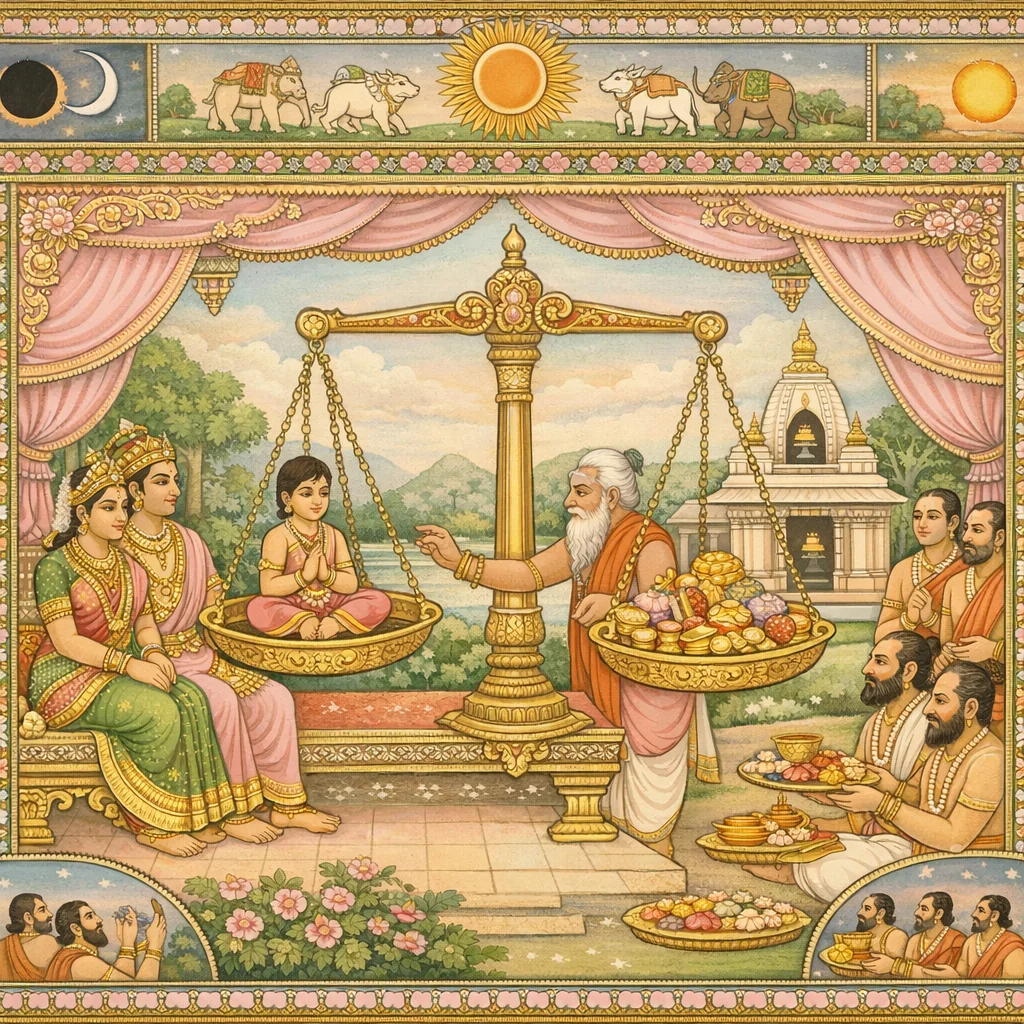
This chapter, cast as a continuing dialogue, combines doctrine with ritual procedure. Sūta affirms the worth of observances such as Śivarātri for those who seek benefit in both worlds. After hearing earlier praise connected with Śivarātri and Maṅkaṇeśvara, the listener Ānarta asks for a full account of Siddheśvara’s manifestation. Bhartṛyajña replies by stressing the tangible fruit of encountering Siddheśvara, invoking themes of universal kingship (cakravartitva), and commending the Tulā-Puruṣa donation as a celebrated rite. The vidhi is then set out: choosing auspicious occasions (eclipses, solstices, equinoxes), building a ritual pavilion and altars, selecting qualified Brahmins and distributing gifts properly, and installing a balance (tulā) with pillars of prescribed auspicious woods while invoking Tulā as a sacred principle. The donor weighs himself against gold, silver, or desired goods and offers them according to rule with water and sesame. The phalaśruti declares proportional destruction of accumulated wrongdoing, protection from afflictions, and greatly increased merit—said to be “a thousandfold”—when the offering is made before Siddheśvara. The chapter concludes by proclaiming the kṣetra’s integrative holiness, where many tīrthas and shrines converge, and the complete benefit of seeing, touching, and worshipping Siddheśvara.
Shlokas
Verse 1
सूत उवाच । तस्मादेषा महाराज शिवरात्रिर्विपश्चिता । कर्तव्या पुरुषेणात्र लोकद्वयमभीप्सुना
Sūta said: Therefore, O great king, this discerning observance of Śivarātri should indeed be performed by one who seeks the welfare of both worlds—this world and the next.
Verse 2
आनर्त उवाच । मंकणेश्वरमाहात्म्यं मया विस्तरतः श्रुतम् । शिवरात्रिसमोपेतं यत्त्वया परिकीर्तितम्
Ānarta said: I have heard in detail the greatness of Maṅkaṇeśvara, as you have recounted it—together with the observance of Śivarātri.
Verse 3
सांप्रतं वद मे कृत्स्नं सिद्धेश्वरसमुद्भवम् । विस्तरेण महाभाग परं कौतूहलं हि मे
Now tell me in full the origin of Siddheśvara—at length, O blessed one—for my curiosity is exceedingly great.
Verse 4
भर्तृयज्ञ उवाच । सिद्धेश्वर इति ख्यातो महादेवो महीपते । तस्योत्पत्तिस्त्वया पूर्वं श्रुतात्र वदतो मम
Bhartṛyajña said: “O lord of the earth, the Great God Mahādeva is renowned here by the name ‘Siddheśvara.’ You have heard of his origin before; even so, listen as I recount it.”
Verse 5
सांप्रतं तत्फलं वच्मि तस्मिन्दृष्टे तु दानजम् । यत्फलं जायते नॄणां चक्रवर्तित्व संभवम्
Now I shall declare its fruit: the merit born of giving after one has beheld that holy place. From that merit there arises for people the possibility of attaining the status of a cakravartin, a universal sovereign.
Verse 6
तुलापुरुषदानं च तत्र राजन्प्रशश्यते । य इच्छेच्चक्रवर्तित्वं समस्ते धरणीतले
O King, in that place the gift called Tulāpuruṣa-dāna is especially extolled—for whoever desires universal sovereignty over the entire earth.
Verse 7
आनर्त उवाच । तुलापुरुषदानस्य यो विधिः परिकीर्तितः । तं मे सर्वं समाचक्ष्व विस्तरेण महामुने
Ānarta said: “O great sage, please explain to me in detail the entire procedure that is proclaimed for the Tulāpuruṣa-dāna.”
Verse 8
भर्तृयज्ञ उवाच । चंद्रसूर्योपरागे वा अयने विषुवे तथा । तीर्थे वा पुरुषश्रेष्ठ तुलापुरुषसंभवम्
Bhartṛyajña said: “O best of men, the Tulāpuruṣa rite may be undertaken at a lunar or solar eclipse, at the solstice, at the equinox, or at a sacred tīrtha.”
Verse 9
प्रशंसंति विधिं सम्यक्प्राप्ते वा चेंदुसंक्षये । ब्राह्मणानां सुदांतानामनुष्ठानवतां सताम्
The proper procedure is especially commended when the time of the moon’s waning (or eclipse) arrives—performed with Brahmins who are well-disciplined, virtuous, and steadfast in sacred observances.
Verse 10
वेदाध्ययनयुक्तानां निर्दोषाणां च पार्थिव । विभज्य स भवेद्देयो नैकस्य च कथंचन
O King, the gift should be given only to those engaged in Vedic study and free from fault; it should be distributed among many—never, in any circumstance, to just one person alone.
Verse 12
शुचौ देशे समे पुण्ये पूर्वोत्तरप्लवे शुभे । मंडपं कारयेद्विद्वान्रम्यं ष़ोशहस्तकम् । तन्मध्ये कारयेद्वेदिं चतुर्हस्त प्रमाणतः । यजमानस्य हस्तेन हस्तैकेन समुच्छ्रिताम्
In a pure, level, and sacred place—on auspicious ground sloping to the east or north—the learned man should have a beautiful pavilion built, sixteen cubits in measure. In its center he should construct an altar-platform of four cubits, raised by one cubit as measured by the sacrificer’s hand.
Verse 14
चतुर्हस्तानि कुण्डानि चतुर्दिक्षु प्रकल्पयेत । एकहस्तप्रमाणानि आयामव्यासविस्तरात् । ऐशान्यामपरां वेदिं हस्तमात्रां न्यसेच्छुभाम् । रत्निमात्रोत्थितां चैव ग्रहांस्तत्र प्रकल्पयेत्
He should arrange fire-pits (kuṇḍas) of four cubits in the four directions, each having one-cubit measures in length, breadth, and spread. In the northeast he should place another auspicious altar-platform measuring one cubit, and there he should set up the ritual supports (grahas), raised to the height of a span.
Verse 15
युग्मांश्च ऋत्विजः कार्याश्चतुर्दिक्षु यथाक्रमम् । बह्वृचोऽध्वर्यश्चैव च्छंदोगाथर्वणावपि
Pairs of officiating priests should be appointed in the four directions in proper order—namely, the Bahvṛcas (Ṛg-vedic priests), the Adhvaryus (Yajur-vedic priests), and also the Chāndogas and Atharvaṇas.
Verse 16
तूष्णीं तु देवताहोमस्तैः कार्यः सुसमाहितैः । तल्लिंगैर्नृपतेमंत्रैः स्वशक्त्या जप एव च
Then, with full concentration, those priests should perform the deity-offerings (homa) in silence; and, O King, japa should also be done to the best of one’s ability, using mantras marked by their proper signs (liṅgas).
Verse 17
एकहस्तप्रविष्टं तु चतुर्हस्तोच्छ्रितं तथा । स्तंभद्वयं तु कर्तव्यं वेदियाम्योत्तरे स्थितम्
They should be fixed one hasta into the ground and raised to a height of four hastas. Two pillars are to be constructed, placed to the south and the north of the altar.
Verse 18
तन्मध्ये सुशुभं काष्ठं स्तंभजात्यं दृढं न्यसेत् । चन्दनः खदिरो वाथ बिल्वोवाऽश्वत्थ एव वा
Between them, one should firmly set a splendid, sturdy piece of timber fit for a pillar—whether sandalwood, khadira, bilva, or even aśvattha.
Verse 19
तिंदुको देवदारुर्वा श्रीपर्णी वा वटोऽथवा । अष्टौ वृक्षाः शुभाः शस्ताः स्तंभार्थं नृपसत्तम्
Or it may be from tinduka, devadāru, śrīparṇī, or vaṭa. These eight trees are auspicious and commended for pillar-making, O best of kings.
Verse 20
शिक्यद्वय समोपेतां तन्मध्ये विन्यसेत्तुलाम् । स्नातः शुक्लांबरधरः शुक्लमाल्यानुलेपनः
He should set a balance (tulā) in the center, furnished with two slings. Having bathed, he should don white garments and be adorned with white garlands and fragrant unguents.
Verse 21
पूरयित्वा समंताच्च लोकपालान्यथाक्रमम् । स्तंभान्संपूजयत्पश्चाद्गन्धमाल्यानुलेपनैः
After making offerings all around to the Lokapālas in due order, he should then worship the pillars with perfumes, garlands, and unguents.
Verse 22
तुलां च पार्थिवश्रेष्ठ पुण्याहं च प्रकीर्तयेत् । यजमानो निजैः सर्वैरायुधैः कायसंस्थितैः
And, O best of kings, he should duly proclaim the tulā rite and recite the auspicious ‘puṇyāha’. The sacrificer (yajamāna) should be present with all his own weapons borne upon his person.
Verse 23
पश्चिमां दिशमास्थाय प्राङ्मुखः श्रद्धयाऽन्वितः । कृतांजलिपुटो भूत्वा इमं मंत्रमुदीरयेत्
Standing in the western direction, facing east, filled with faith, and with hands joined in añjali, he should recite this mantra.
Verse 24
ब्रह्मणो दुहिता नित्यं सत्यं परममाश्रिता । काश्यपी गोत्रतश्चैव नामतो विश्रुता तुला
Tulā is renowned by name as the eternal daughter of Brahmā, steadfastly established in the supreme Truth, and belonging to the lineage of Kāśyapa.
Verse 25
त्वं तुले सत्यनामासि स्वभीष्टं चात्मनः शुभम् । करिष्यामि प्रसादं मे सांनिध्यं कुरु सांप्रतम्
O Tulā, you are named “Truth.” Grant the auspicious fulfillment of my rightful desire. I shall perform this act of devotion—be gracious to me and be present here now.
Verse 26
ततस्तस्यां समारुह्य स्वशक्त्या यत्समाहृतम् । दानार्थं पूर्वमायोज्यं शिक्येन्यस्मिन्नरोत्तम
Then, mounting that balance, whatever has been gathered according to one’s capacity should first be arranged for donation in the sling—O best of men—in that (scale).
Verse 27
सुवर्णं रजतं वाऽथ वस्त्रं चान्यदभीप्सितम् । यावत्साम्यं भवेद्राजन्नात्मनोऽभ्यधिकं च वा
Gold, silver, garments, or any other desired gift should be offered—O King—until it equals one’s own weight, or even exceeds it.
Verse 28
ततोऽभीष्टां समासाद्य देवतां शिक्यमाश्रितः । उदकं जलमध्ये च तदर्थं प्रक्षिपेद्द्रुतम्
Then, approaching the desired deity and taking support of the sling (suspended balance), one should promptly cast the water-offering into the midst of the water for that rite.
Verse 29
सतिलं सहिरण्यं च साक्षतं विधिपूर्वकम् । अवतीर्य ततः सर्वं ब्राह्मणेभ्यो निवेदयेत्
With sesame, with gold, and with akṣata (unbroken grains), in due ritual order—then, having descended from the balance/platform, one should present everything to the brāhmaṇas.
Verse 30
यत्फलं प्राप्यते पश्चात्तदिहैकमनाः शृणु
Now listen with single-pointed attention to the fruit that is obtained thereafter from this act.
Verse 31
अजानता जानता वा यत्पापं तु भवेत्कृतम् । तत्सर्वं नाशयेन्मर्त्यो दानस्यास्य प्रभावतः
Whether done unknowingly or knowingly, whatever sin a mortal may have committed—he destroys it all by the power of this donation.
Verse 32
यावन्मात्रं कृतं पापमतीतं नृपसत्तम । तावन्मात्रं क्षयं याति तुलापुरुषदानतः
O best of kings, whatever measure of sin has been committed in the past—by the Tulāpuruṣa donation, to that very measure it is brought to destruction.
Verse 33
ईश्वराणां समादिष्टं कायक्लेशभयात्मनाम् । पुरश्चरणमेतद्धि दानं तौल्यसमुद्भवम्
This weighing-born donation is enjoined by the lords for those who fear bodily hardship; indeed, it serves as their ‘puraścaraṇa’ (a complete preparatory observance).
Verse 34
एतद्दत्तं दिलीपेन कार्तवीर्येण भूपते । पृथुना पुरुकुत्सेन तथान्यैरपि पार्थिवैः
O King, this has been given by Dilīpa, by Kārtavīrya, by Pṛthu, by Purukutsa, and by other rulers as well.
Verse 35
एतत्पुण्यं प्रशस्यं च सर्वकामप्रदं नृणाम् । तुलापुरुषदानं च सर्वोपद्रवनाशनम्
This Tulāpuruṣa-gift is holy merit and greatly praised; it grants people every desired aim and destroys all adversity.
Verse 36
आधयो व्याधयो न स्युर्न वैधव्यं गदोद्भवम् । संजायते नृपश्रेष्ठ न वियोगः स्वबन्धुभिः । तुलापुरुषदानस्य फलमेतदुदाहृतम्
Afflictions and diseases do not arise, nor widowhood born of illness; O best of kings, separation from one’s own kin does not occur—this is declared as the fruit of the Tulāpuruṣa-gift.
Verse 37
तुलापुरुषदानस्य प्रदत्तस्य नृपोत्तम । न शक्यते कथयितुं फलं यत्स्यात्कलौ युगे
O best of kings, the fruit of the Tulāpuruṣa-gift, when duly bestowed in the Kali age, cannot truly be described—it is beyond telling.
Verse 38
दक्षिणामूर्तिमासाद्य सिद्धेश्वरविभोः पुरः । यः प्रयच्छति भूपाल सहस्रगुणितं फलम्
O king, whoever approaches Dakṣiṇāmūrti and makes an offering in the very presence of the glorious Lord Siddheśvara obtains fruit multiplied a thousandfold.
Verse 39
तस्मात्सर्वप्रयत्नेन प्राप्य सिद्धेश्वरं विभुम् । तुलापुरुषदानं च कर्तव्यं सुविवेकिना
Therefore, with every effort, having reached the mighty Lord Siddheśvara, the wise person should indeed perform the Tulāpuruṣa-gift.
Verse 40
एकत्र सर्वतीर्थानि सर्वाण्यायतनानि च । हाटकेश्वरजे क्षेत्रे कथितानि स्वयंभुवा
In the Hāṭakeśvara kṣetra, all tīrthas and all sacred shrines are said to be gathered into a single place—so proclaimed by Svayambhū (Brahmā) himself.
Verse 41
सिद्धेश्वरः सुरश्रेष्ठ एकत्र समुदाहृतः । तस्मिन्दृष्टे तथा स्पृष्टे पूजिते नृपसत्तम । सर्वेषां लभते मर्त्यः फलं यत्परिकीर्तितम्
O best among the noble, Siddheśvara—the foremost among the divine—is declared to abide here in one place. When He is beheld, touched, and worshipped, O best of kings, a mortal gains the proclaimed fruit of all (tīrthas and sanctuaries).
Verse 267
इति श्रीस्कांदे महापुराण एकाशीतिसाहस्र्यां संहितायां षष्ठे नागरखण्डे हाटकेश्वरक्षेत्रमाहात्म्ये श्रीसिद्धेश्वरमाहात्म्ये तुलापुरुषदानमाहात्म्यवर्णनं नाम सप्तषष्ट्युत्तरद्विशततमोऽध्यायः
Thus ends the two-hundred-and-sixty-seventh chapter, entitled “The Description of the Greatness of the Tulāpuruṣa-gift,” in the Śrī Skanda Mahāpurāṇa, within the Ekāśīti-sāhasrī Saṃhitā, in the Sixth Nāgara Khaṇḍa, under the Māhātmya of the Hāṭakeśvara kṣetra and the Māhātmya of Śrī Siddheśvara.