Adhyaya 256
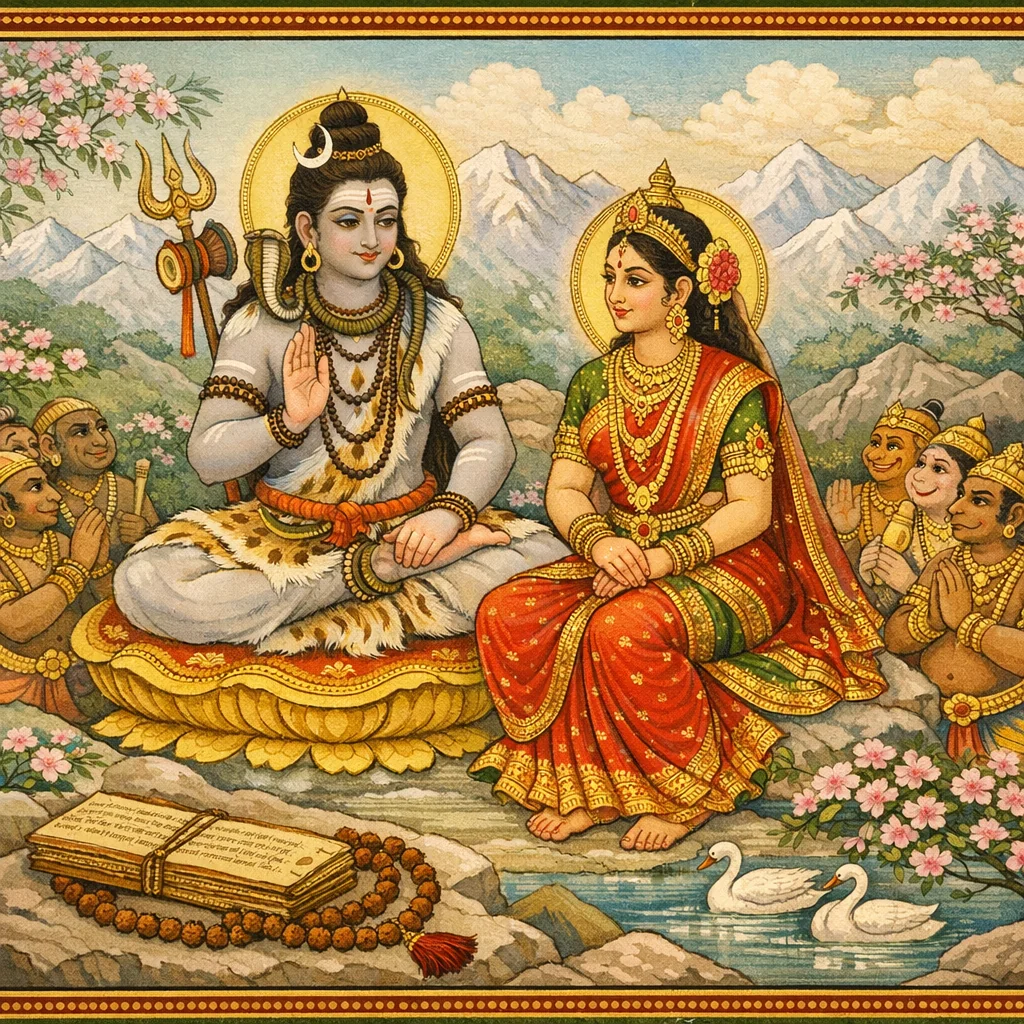
The chapter opens on Kailāsa, where Rudra (Śiva) sits with Umā amid a vast assembly of gaṇas whose names are recited, forming a liturgical, cosmic court. As spring arrives, sensory beauty and playful restlessness arise; Śiva commands the gaṇas to curb frivolity and turn to tapas (austerity). Pārvatī notices Śiva’s rosary and asks what he repeats in japa, for though he is the primordial Lord, what transcendent object does he contemplate? Śiva replies that he continually meditates on the essence of Hari’s thousand names, and he teaches mantra-discipline: the praṇava (Om) and a twelve-syllable (dvādaśākṣara) formula are praised as Veda-essence—pure, liberating, and especially potent in the Cāturmāsya season—able to destroy immense accumulations of wrongdoing. The teaching then turns to accessibility: for those said not to employ praṇava-linked forms, Śiva recommends Rāma-nāma as the supreme two-syllable mantra. The chapter culminates in sustained glorification of “Rāma” as dispelling fear and disease, granting victory, and universally purifying, declaring that reliance on the Name removes obstacles and nullifies punitive afterlife outcomes, particularly during Cāturmāsya.
Shlokas
Verse 1
गालव उवाच । एकदा भगवान्रुद्रः कैलासशिखरे स्थितः । दधार परमां लक्ष्मीमुमया सहितः किल
Gālava said: Once, the Blessed Rudra, abiding upon the summit of Kailāsa, indeed assumed the supreme Lakṣmī, together with Umā.
Verse 2
गणानां कोटयस्तिस्रस्तं यदा पर्यवारयन् । वीरबाहुर्वीरभद्रो वीरसेनश्च भृङ्गिराट्
When three crores of Śiva’s gaṇas surrounded him on every side, among them were Vīrabāhu, Vīrabhadra, Vīrasena, and Bhṛṅgirāṭ.
Verse 3
रुचिस्तुटिस्तथा नन्दी पुष्पदन्तस्तथोत्कटः । विकटः कण्टकश्चैव हरः केशो विघंटकः
There were Ruci, Tuṭi, and Nandī; Puṣpadanta and also Utkaṭa; likewise Vikaṭa and Kaṇṭaka; and (others) Hara, Keśa, and Vighaṃṭaka—among the gaṇas.
Verse 4
मालाधरः पाशधरः शृङ्गी च नरनस्तथा । पुण्योत्कटः शालिभद्रो महाभद्रो विभद्रकः
Mālādhara, Pāśadhara, and Śṛṅgī were there, as well as Naranas; and Puṇyotkaṭa, Śālibhadra, Mahābhadra, and Vibhadraka too were present.
Verse 5
कणपः कालपः कालो धनपो रक्तलोचनः । विकटास्यो भद्रकश्च दीर्घजिह्वो विरोचनः
Kaṇapa, Kālapa, Kāla, Dhanapa, and Raktalocana; Vikaṭāsya, Bhadraka, Dīrghajihva, and Virocana—these too were among them.
Verse 6
पारदो घनदो ध्वांक्षी हंसक्री नरकस्तथा । पंचशीर्षस्त्रिशीर्षश्च क्रोडदंष्ट्रो महाद्भुत
Pārada, Ghanada, Dhvāṃkṣī, Haṃsakrī, and also Naraka; Paṃcaśīrṣa and Triśīrṣa; and Kroḍadaṃṣṭra—wondrous indeed.
Verse 7
सिंहवक्त्रो वृषहनुः प्रचण्डस्तुंडिरेव च । एते चान्ये च बहवस्तदा भवसमीपगाः
Siṃhavaktra, Vṛṣahanu, Pracaṇḍa, and Tuṃḍi as well—these and many others were then gathered near Bhava (Śiva).
Verse 8
महादेव जयेत्युच्चैर्भद्रकालीसमन्विताः । भूतप्रेतपिशाचानां समूहा यस्य वल्लभाः
Accompanied by Bhadrakālī, they cried aloud, “Victory to Mahādeva!”—he to whom the hosts of bhūtas, pretas, and piśācas are dear and devoted.
Verse 9
अस्तुवंस्तं समीपस्था वसन्ते समुपागते । वनराजिर्विभाति स्म नवकोरकशोभिता
Standing near him, they praised him; and when spring arrived, the stretches of forest shone forth, beautified by fresh new buds.
Verse 10
दक्षिणानिलसंस्पर्शः कवीनां सुखकृद्बभौ । वियोगिहृदयाकर्षी किंशुकः पुष्पशोभितः
The touch of the southern breeze became a delight to poets; and the kiṃśuka tree, adorned with blossoms, drew the hearts of those pained by separation.
Verse 11
द्वन्द्वादिविक्रियाभावं चिक्रीडुश्च समंततः । तस्मिन्विगाढे समये मनस्युन्मादके तथा
And all around they sported, as if freed from the agitations born of opposites (like pleasure and pain); in that deeply absorbing time—one that could also intoxicate the mind.
Verse 12
नंदी दंडधरः संज्ञां दृष्ट्वा चक्रे हरो परः । अलं चापलदोषेण तपः कुर्वंतु भो गणाः
Seeing Nandī and the staff-bearing attendant give the signal, the supreme Hara (Śiva) issued the command: “Enough of the fault of restlessness—O Gaṇas, undertake austerity (tapas)!”
Verse 13
तदा सर्वे वनमपि भूकांडजमभूत्पुनः । गणास्ते तप आतस्थुर्दृष्ट्वा कान्तिंवसन्तजाम्
Then even the whole forest became, once again, as though sprung fresh from the earth; and those Gaṇas, seeing a radiance like that born of springtime, took their stand in austerity.
Verse 14
ततः सा विश्वजननी पार्वती प्राह शंकरम् । इयं ते करगा नित्यमक्षमाला महेश्वर
Then Pārvatī, the Mother of the universe, said to Śaṅkara: “O Maheśvara, this rosary (akṣamālā) is ever in your hand.”
Verse 15
त्वया किं जप्यते देव संदेहयति मे मनः । त्वमेकः सर्व भूतानामादिकृत्सकलेश्वरः
“O Deva, what is it that You repeat in japa? My mind is filled with doubt—for You alone are the primal maker of all beings, the Lord of all.”
Verse 16
न माता न पिता बंधुस्तव जातिर्न कश्चन । अहं तव परं किंचिद्वेद्मि नास्तीति किंचन
“For You there is no mother, no father, no kinsman, nor any (limited) birth or lineage. Yet I know this about You: there is nothing whatsoever beyond You.”
Verse 17
श्रमेण त्वं समायुक्तो श्वासोच्छ्वासपरायणः । जपन्नपि महाभक्त्या दृश्यसे त्वं मया सदा
“Yet You appear to me as though engaged in exertion, intent on inhalation and exhalation; and with great devotion You are always seen by me, even while repeating japa.”
Verse 18
त्वत्तःपरतरं किचिद्यत्त्वं ध्यायसि चेतसा । तन्मे कथय देवेश यद्यहं दयिता तव
“If there is anything higher than You that You contemplate in Your mind, tell it to me, O Lord of gods—if indeed I am dear to You.”
Verse 19
इति स्पृष्टस्तदा शंभुरुवाच हरिसेवकः । हरेर्नामसहस्राणां सारं ध्यायामि नित्यशः
Thus addressed, Śambhu replied—he who is devoted to Hari: “I constantly meditate upon the essence of Hari’s thousand names.”
Verse 20
जपामि रामनामांकमवातरं ससप्तमम् । चतुर्विशतिसंख्याकान्प्रादुर्भावान्हरेर्गुणान्
In japa I repeat the Name of Rāma—his descent, the seventh avatāra—and I contemplate the manifested qualities and appearances of Hari, counted as twenty-four.
Verse 21
एतेषामपि यत्सारं प्रणवाख्यं महत्फलम् । द्वादशाक्षरसंयुक्तं ब्रह्मरूपं सना तनम्
And the essence of all these is the Pranava (Oṃ), yielding great fruit—joined with the twelve-syllabled mantra—the eternal reality whose form is Brahman.
Verse 22
अक्षरत्रयसंबद्धं ग्रामत्रयसमन्वितम् । सबिंदुं प्रणवं शश्वज्जपामि जपमालया
Ever, with a rosary, I chant the Praṇava (Oṃ) endowed with the bindu—joined to a triad of syllables and accompanied by the three grāmas (modes of utterance).
Verse 23
वेदसारमिदं नित्यं द्व्यक्षरं सततोद्यतम् । निर्मलं ह्यमृतं शांतं सदूपममृतोपमम्
This is the very essence of the Vedas—eternal, two-syllabled, and ever to be upheld. It is stainless, deathless nectar; peaceful in nature, truly existent in form, and like immortality itself.
Verse 24
कलातीतं निर्वशगं निर्व्यापारं महत्परम् । विश्वाधारं जगन्मध्यं कोटिब्रह्मांडबीजकम्
Transcending all divisions of time and measure, independent and actionless, supreme and vast—support of the universe, the heart of the worlds, the seed of countless cosmic eggs (brahmāṇḍas).
Verse 25
जडं शुद्धक्रियं वापि निरंजनं नियामकम् । यज्ज्ञात्वा मुच्यते क्षिप्रं घोरसंसारबंधनात्
Whether conceived as still and unchanging, or as pure activity; as stainless and as the inner Regulator—on knowing That, one is swiftly freed from the dreadful bondage of saṃsāra.
Verse 26
ओंकारसहितं यच्च द्वादशाक्षरबीजकम् । जपतः पापकोटीनां दावाग्नित्वं प्रजायते
And that twelve-syllabled seed-mantra, joined with Oṃ—when one repeats it in japa, crores of sins become like fuel for a forest-fire and are consumed away.
Verse 27
एतदेव परं गुह्यमेतदेव परं महः । एतद्धि दुर्लभं लोके लोकत्रयविभूषणम्
This alone is the supreme secret; this alone is the highest splendour. Indeed, it is rare in the world—an ornament of all the three worlds.
Verse 28
प्राप्यते जन्मकोटीभिः शुभाशुभविनाशकम् । एतदेव परं ज्ञानं द्वादशाक्षरचिन्तनम्
It is attained only after crores of births, and it destroys the karmic residues of both the auspicious and the inauspicious. This alone is the highest knowledge: contemplation on the twelve-syllabled mantra.
Verse 29
चातुर्मास्ये विशेषेण ब्रह्मदं चिंतितप्रदम् । एतदक्षरजं स्तोत्रं यः समाश्रयते सदा
Especially during Cāturmāsya, it bestows Brahman (the highest state) and grants what is contemplated. Whoever always takes refuge in this hymn born of these sacred syllables—
Verse 30
मनसा कर्मणा वाचा तस्य नास्ति पुनर्भवः । द्वादशाक्षरसंयुक्तं चक्रद्वादशभूषितम्
For him—by mind, by deed, and by speech—there is no rebirth. This observance/teaching is joined to the Twelve-Syllabled Mantra and adorned with twelve cakra-marks.
Verse 31
मासद्वादशनामानि विष्णोर्यो भक्तितत्परः । शालग्रामेषु तान्युक्त्वा न्यसेदघहराणि च
He who is steadfast in bhakti should recite Viṣṇu’s twelve monthly names; uttering them over the Śālagrāma stones, he should place them as a nyāsa, for they remove sin.
Verse 32
दिवसेदिवसे तस्य द्वादशाहफलं लभेत् । द्वादशाक्षर माहात्म्यं वर्णितुं नैव शक्यते
Day after day, one gains the fruit of a twelve-day sacred observance. The greatness of the Twelve-Syllabled Mantra is truly impossible to describe in full.
Verse 33
जिह्वासहस्रैरपि च ब्रह्मणापि न वार्यते । महामन्त्रो ह्ययं लोके जप्यो ध्यातः स्तुतस्तथा
Even with a thousand tongues—even by Brahmā himself—its praise cannot be exhausted. Truly, this is a Great Mantra in the world, to be repeated in japa, meditated upon in dhyāna, and likewise hymned in praise.
Verse 34
पापहा सर्वमासेषु चातुर्मास्ये विशेषतः । इदं रहस्यं वेदानां पुराणानामनेकशः
It destroys sin in every month—most especially during the sacred Cāturmāsya season. This is a secret repeatedly taught in the Vedas and in many Purāṇas.
Verse 35
स्मृतीनामपि सर्वासां द्वादशाक्षरचिन्तनम् । चिंतनादेव मर्त्यानां सिद्धिर्भवति हीप्सिता
Even among all the Smṛtis, contemplation of the Twelve‑Syllabled Mantra is upheld. By contemplation alone, mortals attain the success they desire.
Verse 36
पुण्यदानेन याम्येन मुक्तिर्भवति शाश्वती । वर्णैस्तथाश्रमैरेव प्रणवेन समन्वितैः
By meritorious giving—according to the prescribed rule—there arises everlasting liberation; this is taught for the social orders and life‑stages, when conjoined with the Praṇava (Oṃ).
Verse 37
जपैर्ध्यानैः शमपरैर्मोक्षं यास्येत निश्चितम । शूद्राणां चापि नारीणां प्रणवेन विवर्जितः
Through repetition, meditation, and disciplines grounded in tranquility, one certainly attains liberation. For Śūdras and for women as well, it is stated to be without the Praṇava (Oṃ).
Verse 38
प्रकृतीनां च सर्वासां न मन्त्रो द्वादशाक्षरः । न जपो न तपः कार्यं कायक्लेशाद्विशुद्धिता
And for all such persons, the Twelve‑Syllabled Mantra is not to be used as their mantra. No japa and no austerity should be undertaken—purity does not arise from tormenting the body.
Verse 39
विप्रभक्त्या च दानेन विष्णुध्यानेन सिद्ध्यति । तासां मन्त्रो रामनाम ध्येयः कोट्यधिको भवेत्
Through devotion to the brāhmaṇas, through charity, and through meditation on Viṣṇu, it is accomplished. For them, the mantra is the Name of Rāma—worthy to be meditated upon—surpassing other mantras by tens of millions.
Verse 40
रामेति द्व्यक्षरजपः सर्वपापापनोदकः । गच्छंस्तिष्ठञ्छयानो वा मनुजो रामकीर्तनात्
The two-syllabled japa—“Rāma”—removes every sin. Whether walking, standing, or even lying down, a person is purified through the chanting of Rāma’s Name.
Verse 41
इह निर्वर्ततो याति प्रान्ते हरिगणो भवेत् । रामेति द्व्यक्षरो मन्त्रो मंत्रकोटिशताधिकः
One who completes this practice here departs, and in the end becomes a member of Hari’s divine retinue. The two-syllabled mantra—“Rāma”—surpasses hundreds of crores of other mantras.
Verse 42
सर्वासां प्रकृतीनां च कथितः पापनाशकः । चातुर्मास्येऽथ संप्राप्ते सोऽप्यनंतफलप्रदः
It has been declared a destroyer of sins for beings of every disposition; and when the holy Cāturmāsya season arrives, that same practice bestows limitless fruits.
Verse 43
चातुर्मास्ये महापुण्ये लभ्यते भक्तितत्परैः । देववन्निष्फलं तेषां यमलोकस्यसेवनम्
In the greatly meritorious Cāturmāsya, it is attained by those devoted to bhakti; for them, attendance upon Yama’s realm becomes fruitless, bearing no result.
Verse 44
न रामादधिकं किंचित्पठनं जगतीतले । रामनामाश्रया ये वै न तेषां यमयातना
On the face of the earth there is no recitation superior to the Name “Rāma.” Those who take refuge in the name “Rāma” do not undergo Yama’s torments.
Verse 45
ये च दोषा विघ्नकरा मृतका विग्रहाश्च ये । राम नामैव विलयं यांति नात्र विचारणा
Whatever faults bring about obstacles—whether latent impurities like the dead, or hostile conflicts—by the name “Rāma” alone they pass into dissolution; of this there is no doubt nor further inquiry.
Verse 46
रमते सर्वभूतेषु स्थावरेषु चरेषु च । अन्तरात्मस्वरूपेण यच्च रामेति कथ्यते
That which delights within all beings—within the immovable and the moving—by the very form of the Inner Self, is what is called “Rāma”.
Verse 47
रामेति मत्रराजोऽयं भयव्याधिनिषूदकः । रणे विजयदश्चापि सर्वकार्यार्थसाधकः
This king of mantras—“Rāma”—destroys fear and disease; it grants victory in battle as well, and accomplishes every purpose and undertaking.
Verse 48
सर्वतीर्थफलः प्रोक्तो विप्राणामपि कामदः । रामचन्द्रेति रामेति रामेति समुदाहृतः
It is declared to grant the fruit of all tīrthas, and to fulfill even the desires of brāhmaṇas; it is uttered as “Rāmacandra”, as “Rāma”, as “Rāma”.
Verse 49
द्व्यक्षरो मन्त्रराजोऽयं सर्वकार्यकरो भुवि । देवा अपि प्रगायंति रामनामगुणाकरम्
This two-syllabled king of mantras accomplishes every undertaking on earth; even the gods sing forth Rāma’s name, the treasure-house of virtues.
Verse 50
तस्मात्त्वमपि देवेशि रामनाम सदा वद । रामनाम जपेद्यो वै मुच्यते सर्वकिल्बिषैः
Therefore, O Goddess, you too should always utter the name “Rāma”. Whoever indeed repeats Rāma’s name is freed from all sins.
Verse 51
सहस्रनामजं पुण्यं रामनाम्नैव जायते । चातुर्मास्ये विशेषेण तत्पुण्यं दशधोत्तरम्
The merit born of a thousand names arises from the name “Rāma” alone; and in Cāturmāsya especially, that merit becomes tenfold greater.
Verse 52
हीनजातिप्रजातानां महदह्यति पातकम्
For those born in a socially low station, even great sin is burned away (by this sacred means).
Verse 53
रामो ह्ययं विश्वमिदं समयं स्वतेजसा व्याप्य जनांतरात्मना । पुनाति जन्मांतरपातकानि स्थूलानि सूक्ष्माणि क्षणाच्च दग्ध्वा
For this Rāma pervades the whole universe at all times by His own radiance, abiding as the inner Self within all beings; and having burned them in an instant, He purifies the sins of many births—both the gross and the subtle.
Verse 256
इति श्रीस्कांदे महापुराण एकाशीति साहस्र्यां संहितायां षष्ठे नागरखण्डे हाटकेश्वरक्षेत्रमाहात्म्ये शेषशाय्युपाख्याने ब्रह्मनारदसंवादे चातुर्मास्यमाहात्म्ये रामनाममहिमवर्णनं नाम षट्पंचाशदुत्तरद्विशततमोऽध्यायः
Thus ends the two-hundred-and-fifty-sixth chapter, entitled “The Description of the Glory of the Name of Rāma,” in the Śrī Skanda Mahāpurāṇa, in the Ekāśīti-sāhasrī Saṃhitā, within the Sixth Nāgara Khaṇḍa—within the Māhātmya of the sacred Hāṭakeśvara region, in the narrative of Śeṣaśāyī, in the dialogue of Brahmā and Nārada, in the Māhātmya of Cāturmāsya.