Adhyaya 233
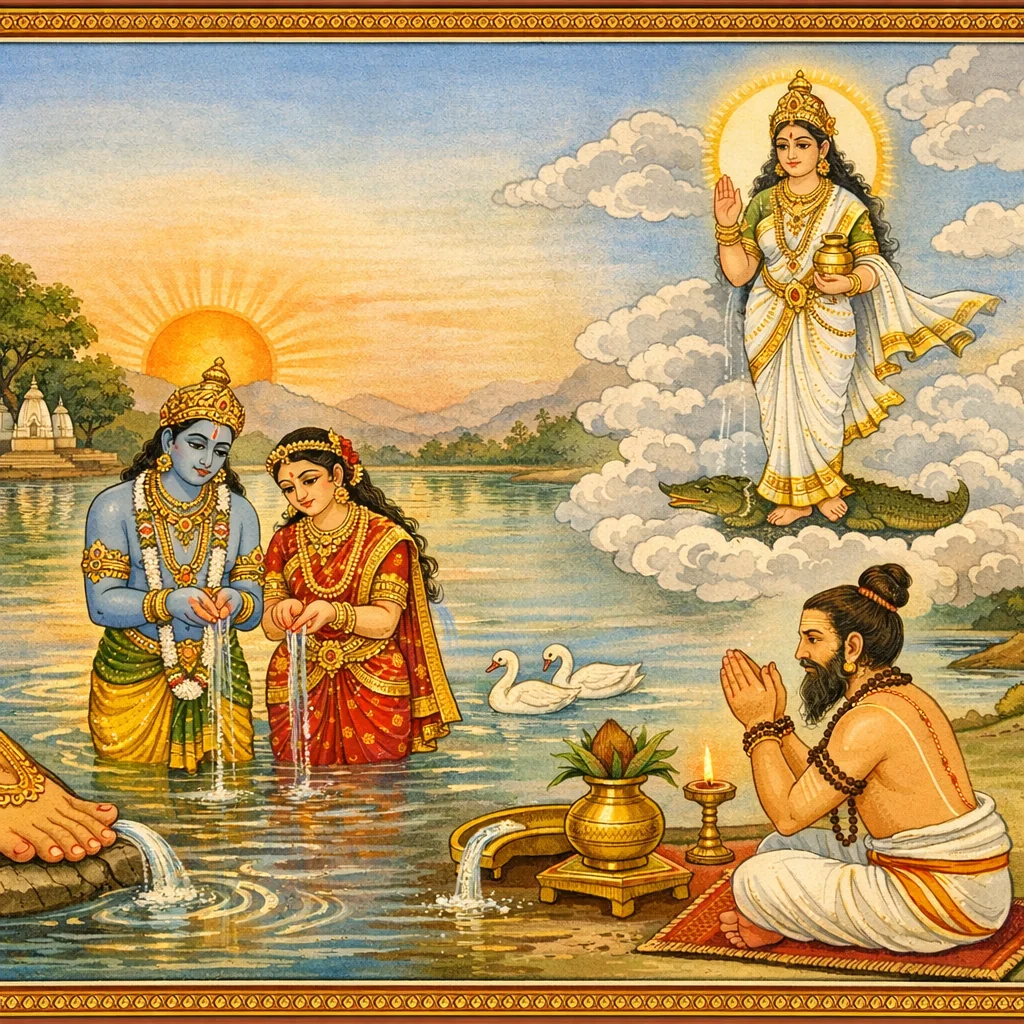
Chapter 233 presents a layered theological teaching on the Cāturmāsya observance (the sacred four-month season), framed by Sūta’s reply to questioning sages and containing an embedded dialogue between Brahmā and Nārada. It establishes Cāturmāsya as an intensified ritual window in which devotion to Viṣṇu and disciplines of purity bear exceptional fruit. Morning bathing is upheld as the key practice, repeatedly praised for pāpa-kṣaya (the dissolution of accumulated fault) and for restoring the efficacy of other religious acts. The chapter classifies waters and holy sites: rivers and great tīrthas such as Puṣkara and Prayāga; regional waters like Reva/Narmadā and Godāvarī; oceanic confluences; and substitute waters, including sesame-infused, āmalaka-infused, and bilva-leaf–infused water. It also teaches a devotional “method of remembrance”: mentally invoking Gaṅgā beside a water vessel is said to yield ritual merit, grounded in the doctrine that Gaṅgā is connected to the Lord’s foot-water (pāda-udaka). Procedural cautions are given—avoid night bathing and emphasize purification when the sun is visible. The chapter closes with an accessibility clause: when physical bathing is not possible, ash-bathing, mantra-bathing, or bathing with Viṣṇu’s foot-water is affirmed as purificatory alternatives.
Shlokas
Verse 1
ऋषय ऊचुः । सूत सूत महाभाग श्रोतुमिच्छामहे वयम् । चातुर्मास्यव्रतानां हि त्वत्तो माहात्म्यविस्तरम्
The sages said: O Sūta, O fortunate one, we wish to hear from you in detail the greatness of the Cāturmāsya vows.
Verse 2
तदस्माकं महाभाग कृपां कृत्वाऽधुना वद । त्वद्वचोऽमृतपानेन भूयः श्रद्धाभिवर्धते
Therefore, O most fortunate one, show us compassion and speak now; by drinking the nectar of your words, our faith increases all the more.
Verse 3
सूत उवाच । शृणुध्वं मुनयः सर्वे चातुर्मास्यव्रतोद्भवम् । माहात्म्यं विस्तरेणैव कथयिष्यामि वोऽग्रतः
Sūta said: Listen, all you sages, to the origin of the Cāturmāsya vow. I shall recount its greatness to you in full detail, right before you.
Verse 4
पुरा ब्रह्ममुखाच्छ्रुत्वा नानाव्रतविधानकम् । नारदः परिपप्रच्छ भूयो ब्रह्माणमादरात्
Formerly, having heard from Brahmā’s own mouth the various rules and procedures of vows, Nārada again questioned Brahmā with reverence.
Verse 5
नारद उवाच । देवदेव महाभाग व्रतानि सुबहून्यपि । श्रुतानि त्वन्मुखाद्ब्रह्मन्न तृप्तिमधिगच्छति
Nārada said: O God of gods, O greatly fortunate Brahmā—though I have heard many vows from your mouth, my heart does not yet reach satisfaction.
Verse 6
अधुना श्रोतुमिच्छामि चातुर्मास्यव्रतं शुभम्
Now I wish to hear the auspicious Cāturmāsya vow.
Verse 7
ब्रह्मोवाच । शृणु देवमुने मत्तश्चातुर्मास्यव्रतं शुभम् । यच्छ्रुत्वा भारते खंडे नृणां मुक्तिर्न दुर्लभा
Brahmā said: O divine sage, hear from me the auspicious Cāturmāsya vow; by hearing it in Bhārata, liberation for human beings is not difficult to obtain.
Verse 8
मुक्तिप्रदोऽयं भगवान्संसारोत्तारकारणम् । यस्य स्मरणमात्रेण सर्वपापैः प्रमुच्यते
This Blessed Lord bestows liberation and is the cause of crossing beyond saṃsāra; by His mere remembrance one is released from all sins.
Verse 9
मानुष्ये दुर्लभं लोके तत्राऽपि च कुलीनता । तत्रापि सदयत्वं च तत्र सत्संगमः शुभः
In this world, human birth is hard to attain; rarer still is noble conduct. Rarer even than that is compassion—and within such compassion, the auspicious company of the virtuous is the highest blessing.
Verse 10
सत्संगमो न यत्रास्ति विष्णुभक्तिर्व्रतानि च । चातुर्मास्ये विशेषेण विष्णुव्रतकरः शुभः
Where there is no company of the virtuous, devotion to Viṣṇu and the practice of vows do not truly arise. Especially during Cāturmāsya, the one who undertakes a Viṣṇu-vrata becomes auspicious and blessed.
Verse 11
चातुर्मास्येऽव्रती यस्तु तस्य पुण्यं निरर्थकम् । सर्वतीर्थानि दानानि पुण्यान्यायतनानि च
But one who keeps no vow during Cāturmāsya—his merit becomes fruitless. For even the gains of all sacred bathing-places, gifts, and other abodes of merit are rendered ineffective for him without that discipline.
Verse 12
विष्णुमाश्रित्य तिष्ठंति चातुर्मास्ये समागते । सुपुष्टेनापि देहेन जीवितं तस्य शोभनम्
When Cāturmāsya arrives, those who remain taking refuge in Viṣṇu—only their life is truly beautiful, even if the body is well nourished and strong.
Verse 13
चातुर्मास्ये समायाते हरिं यः प्रणमेद्बुधः । कृतार्थास्तस्य विबुधा यावज्जीवं वरप्रदाः
When Cāturmāsya has come, the wise person who bows to Hari—toward him the gods become fulfilled in purpose, granting boons throughout his life.
Verse 14
संप्राप्य मानुषं जन्म चातुर्मास्यपराङ्मुखः । तस्य पापशतान्याहुर्देहस्थानि न संशयः
Having attained human birth, one who turns away from Cāturmāsya observance—of him, they say, hundreds of sins dwell in the body; of this there is no doubt.
Verse 15
मानुष्यं दुर्लभं लोके हरिभक्तिश्च दुर्लभा । चातुर्मास्ये विशेषेण सुप्ते देवे जनार्दने
Human birth is rare in this world, and devotion to Hari is rare as well—especially during Cāturmāsya, when the Lord Janārdana is said to be in divine sleep.
Verse 16
चातुर्मास्ये नरः स्नानं प्रातरेव समाचरेत् । सर्वक्रतुफलं प्राप्य देववद्दिवि मोदते
During Cāturmāsya, a person should perform morning bathing. Having obtained the fruit of all sacrifices, he rejoices in heaven like a god.
Verse 17
चातुर्मास्ये तु यः स्नानं कुर्यात्सिद्धिमवाप्नुयात् । तथा निर्झरणे स्नाति तडागे कूपिकासु च
During Cāturmāsya, whoever performs the sacred bath attains siddhi, spiritual fulfillment. Likewise, bathing in a waterfall-stream, in a pond, or even in wells bestows the same benefit.
Verse 18
तस्य पापसहस्राणि विलयं यांति तत्क्षणात् । पुष्करे च प्रयागे वा यत्र क्वापि महाजले । चातुर्मास्येषु यः स्नाति पुण्यसंख्या न विद्यते
For him, thousands of sins perish at that very moment. Whether at Puṣkara or at Prayāga—or anywhere upon a great expanse of water—one who bathes during Cāturmāsya gains merit beyond all counting.
Verse 19
रेवायां भास्करक्षेत्रे प्राच्यां सागरसंगमे । एकाहमपि यः स्नातश्चातुर्मास्ये न दोषभाक्
Whoever bathes even for a single day in the Revā (Narmadā) at Bhāskara-kṣetra, at the eastern confluence with the ocean, incurs no fault during the Cāturmāsya season.
Verse 20
दिनत्रयं च यः स्नाति नर्मदायां समाहितः । सुप्ते देवे जगन्नाथे पापं याति सहस्रधा
When the Lord of the world, Jagannātha, lies in divine sleep, one who bathes for three days in the Narmadā with a concentrated mind causes sin to be destroyed a thousandfold.
Verse 21
पक्षमेकं तु यः स्नाति गोदावर्यां दिनोदये । स भित्त्वा कर्मजं देहं याति विष्णोः सलोकताम्
But whoever bathes at sunrise in the Godāvarī for a full fortnight—having broken through the karma-born embodiment—attains salokatā, residence in Viṣṇu’s world.
Verse 22
तिलोदकेन यः स्नाति तथा चैवामलोदकैः । बिल्वपत्रोदकैश्चैव चातुर्मास्ये न दोषभाक्
Whoever bathes with sesame-water, likewise with āmalaka-water, and also with bilva-leaf water, incurs no fault during the Cāturmāsya season.
Verse 23
गंगां स्मरति यो नित्यमुदपात्रसमीपतः । तद्गांगेयं जलं जातं तेन स्नानं समाचरेत्
Whoever daily remembers the Gaṅgā while near a vessel of water—that water becomes ‘Gaṅgā-water’; with it one should duly perform bathing.
Verse 24
गंगाऽपि देवदेवस्य चरणांगुष्ठवाहिनी । पापघ्नी सा सदा प्रोक्ता चातुर्मास्ये विशेषतः
The Gaṅgā too is the stream that flows from the great toe of the Lord of lords; she is ever declared the destroyer of sins—especially during Cāturmāsya.
Verse 25
यतः पापसहस्राणि विष्णुर्दहति संस्मृतः । तस्मात्पादोदकं शीर्षे चातुर्मास्ये धृतं शिवम्
Because Viṣṇu, when remembered, burns away thousands of sins—therefore, to place the water of His feet upon one’s head during Cāturmāsya is auspicious and beneficent.
Verse 26
चातुर्मास्ये जलगतो देवो नारायणो भवेत् । सर्वतीर्थाधिकं स्नानं विष्णुतेजोंशसंगतम्
In Cāturmāsya, the God Nārāyaṇa is present within water; therefore bathing then is superior to all tīrthas, for it is joined to a portion of Viṣṇu’s splendor.
Verse 27
स्नानं दशविधं कार्यं विष्णुनाम महाफलम् । सुप्ते देवे विशेषेण नरो देवत्वमाप्नुयात्
One should perform the sacred bath in ten prescribed ways, while reciting the names of Viṣṇu, and thus obtain great fruit; especially when the Lord abides in divine sleep, a man may attain a godlike state.
Verse 28
विना स्नानं तु यत्कर्म पुण्यकार्यमयं शुभम् । क्रियते निष्फलं ब्रह्मंस्तत्प्रगृह्णंति राक्षसाः
But, O Brāhmaṇa, any auspicious deed meant to produce merit, if done without bathing, becomes fruitless; the Rākṣasas seize that merit.
Verse 29
स्नानेन सत्यमाप्नोति स्नानं धर्मः सनातनः । धर्मान्मोक्षफलं प्राप्य पुनर्नैवावसीदति
By sacred bathing one attains truth; bathing is the eternal duty (sanātana-dharma). From that dharma one gains the fruit of liberation, and having gained it, one never falls again into decline.
Verse 31
कृतस्नानस्य च हरिर्देहमाश्रित्य तिष्ठति । सर्वक्रियाकलापेषु संपूर्ण फलदो भवेत्
For one who has performed the sacred bath, Hari abides, taking that person’s body as His refuge; and in all rites and observances, He becomes the giver of complete results.
Verse 32
सर्वपापविनाशाय देवता तोषणाय च । चातुर्मास्ये जलस्नानं सर्वपापक्षयावहम्
For the destruction of all sins and for the satisfaction of the deities, water-bathing during Cāturmāsya brings about the exhaustion of every sin.
Verse 33
निशायां चैव न स्नायात्संध्यायां ग्रहणं विना । उष्णोदकेन न स्नानं रात्रौ शुद्धिर्न जायते
One should not bathe at night, nor at twilight—except during an eclipse. Nor should one bathe with hot water; at night, purity does not arise from such bathing.
Verse 34
भानुसंदर्शनाच्छुद्धिर्विहिता सर्वकर्मसु । चातुर्मास्ये विशेषेण जलशुद्धिस्तु भाविनी
In all rites, purification is enjoined through beholding the Sun; and during Cāturmāsya in particular, purification through water is especially efficacious.
Verse 36
नारायणाग्रतः स्नानं क्षेत्र तीर्थनदीषु च । यः करोति विशुद्धात्मा चातुर्मास्ये विशेषतः
He who, with a purified soul, performs bathing before Nārāyaṇa—at holy fields, tīrthas, and rivers—especially during Cāturmāsya, is extolled for that act.
Verse 233
इति श्रीस्कांदे महापुराण एकाशीतिसाहस्र्यां संहितायां षष्ठे नागरखण्डे हाटकेश्वरक्षेत्रमाहात्म्ये शेषशाय्युपाख्याने चातुर्मास्यमाहात्म्ये ब्रह्मनारदसंवादे गंगोदकस्नानफलमाहात्म्यवर्णनंनाम त्रयस्त्रिंशदुत्तरद्विशततमोऽध्यायः
Thus ends, in the Śrī Skanda Mahāpurāṇa—within the eighty-one-thousand-verse Saṃhitā, in the sixth (Nāgara) Khaṇḍa—within the Māhātmya of the Hāṭakeśvara sacred region, in the Śeṣaśāyī narrative, in the Cāturmāsya Māhātmya, in the dialogue of Brahmā and Nārada—the chapter entitled “The Glorification of the Great Merit arising from bathing with Gaṅgā-water,” being Chapter 233.
Verse 358
अशक्त्या तु शरीरस्य भस्मस्नानेन शुध्यति । मंत्रस्नानेन विप्रेंद्र विष्णुपादोदकेन वा
But if the body is unable to undertake full bathing, one becomes purified by bathing with ash, or by mantra-bathing, O best of Brahmins, or else by the water that has washed Viṣṇu’s feet.