Adhyaya 205
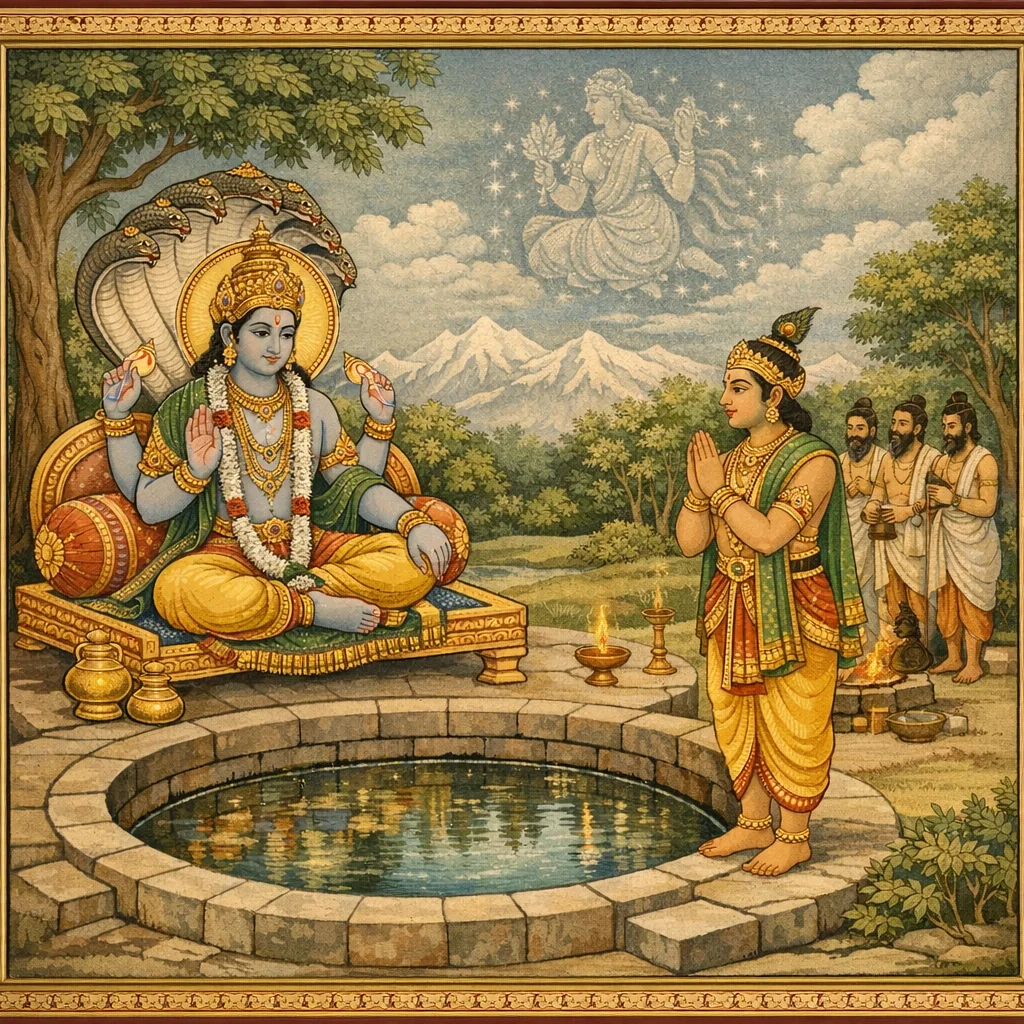
Within the Hāṭakeśvara-kṣetra Māhātmya of the Nāgara Khaṇḍa, this chapter unfolds as a doctrinal and ritual consultation. Viṣṇu instructs Indra that fallen warriors—whether slain while facing the enemy or struck from behind—may still be benefited through śrāddha offerings performed in a manner comparable to the rites of Gayā. Indra then raises a practical concern: since Gayā is far away and its annual rite is performed by Pitāmaha (Brahmā), how can śrāddha-siddhi be attained on earth in a workable way? Viśvāmitra recounts Viṣṇu’s reply: in the Hāṭakeśvara region there is a supremely meritorious tīrtha, centered on a particular well-site (kūpikā-madhya). On amāvāsyā and also on caturdaśī, Gayā is said to “transit” there, bearing the combined potency of all tīrthas. A further condition is given: when the sun is in Kanyā (Virgo), performing śrāddha there with brāhmaṇas of eight-lineage provenance (aṣṭa-vaṃśa) enables one to deliver the ancestors, including those in preta status, and by extension benefits even those in heavenly states. The chapter explains the origin of these brāhmaṇas as ascetics dwelling near the Himālaya, and instructs Indra to bring them with due honor, employ conciliatory means, and complete the śrāddha according to rule. It concludes with Indra’s satisfaction and journey to the Himālaya to find them, while Viṣṇu departs to the Kṣīra-sāgara, reaffirming the twin emphases of ritual logistics and tīrtha-based equivalence to Gayā.
Shlokas
Verse 1
विष्णुरुवाच । एवं ज्ञात्वा सहस्राक्ष मम वाक्यं समाचर । यदि ते वल्लभास्ते च ये हता रणमूर्धनि
Viṣṇu said: Having understood this, O Thousand-eyed (Indra), carry out my instruction. If those dear to you have been slain upon the battlefield’s forefront…
Verse 2
युध्यमानास्तवाग्रे च गयाश्राद्धेन तर्पय । तान्सर्वान्प्रेतभावाच्च येन मुक्तिं भजंति ते
Satisfy, by the Gaya-śrāddha, all those who fought before you; thereby they are freed from the condition of preta and attain liberation.
Verse 3
पलायनपरा ये च पृष्ठदेशे हता मृताः
And those who were intent on fleeing, who were struck down and died with wounds to the back…
Verse 4
इन्द्र उवाच । वर्षेवर्षे तदा श्राद्धं प्रकरोति पितामहः । गयां गत्वा दिने तस्मिन्पितॄणां दिव्यरूपिणाम्
Indra said: In that manner, year after year, Grandfather (Brahmā) performs the śrāddha—having gone to Gayā on that day—for the Pitṛs of divine form.
Verse 5
तत्कथं देव गच्छामि तत्राहं श्राद्धसिद्धये । तस्मात्कथय मे तेषां किंचिच्छ्राद्धाय भूतले । मुक्तिदं येन गच्छामि तव वाक्याज्जनार्दन
O Lord, how may I go there so that the śrāddha may be successfully accomplished? Therefore tell me some means to perform their śrāddha here upon the earth—something that bestows liberation—so that, by your word, O Janārdana, I may proceed accordingly.
Verse 6
विश्वामित्र उवाच । ततः स सुचिरं ध्यात्वा तमुवाच जनार्दनः । अस्ति तीर्थं महत्पुण्यं तस्मादप्यधिकं च यत्
Viśvāmitra said: Then, after meditating for a long time, Janārdana spoke to him: “There exists a great tīrtha of supreme merit—indeed, there is one even more excellent than that.”
Verse 7
हाटकेश्वरजे क्षेत्रे कूपिकामध्यसंस्थितम् । अमावास्यादिने तत्र चतुर्दश्याश्च देवप । गया संक्रमते सम्यक्सर्वतीर्थसमन्विता
In the sacred region of Hāṭakeśvara, at the spot situated in the midst of Kūpikā, on the day of the New Moon—and also on the Fourteenth—O Lord of the gods, Gayā herself duly transfers there, accompanied by the essence of all tīrthas.
Verse 8
कन्यासंस्थे रवौ तत्र यः श्राद्धं कुरुते नरः । अष्टवंशोद्भवैर्विप्रैः स पितॄंस्तारयेन्निजान्
When the Sun is in Kanyā (Virgo), whoever performs śrāddha there, with brāhmaṇas descended from eight lineages, delivers his own ancestors across to welfare and higher states.
Verse 9
अपि प्रेतत्वमापन्नान्किं पुनः स्वर्गसंस्थितान् । तत्क्षेत्रप्रभवा विप्रा अष्टवंशसमुद्भवाः
If even those who have fallen into the state of preta—restless spirits—can be helped, how much more those already established in heaven! Such are the brāhmaṇas originating from that sacred region, descended through eight lineages.
Verse 10
तप उग्रं समास्थाय वर्तंते हिमपर्वते । आनर्ताधिपतेर्दानाद्भीतास्तत्र समागताः
Undertaking severe austerities, they dwelt upon the Himālaya mountain. Frightened by the gifts and authority of the lord of Ānarta, they assembled there.
Verse 11
तान्गृहीत्वा द्रुतं गच्छ तत्र संबोध्य गौरवात् । सामपूर्वैरुपायैस्तैस्तेषामग्रे समाचर
Take them and go quickly; there, address them with due respect. Then, employing conciliatory means first, proceed properly in their presence.
Verse 12
श्राद्धं चैव यथान्यायं ततः प्राप्स्यसि वांछितम् । ते चाऽपि सुखिनः सर्वे भविष्यंति समागताः
And when you perform the śrāddha according to proper rule, you will obtain what you desire. They too—all of them—will become happy, having been duly gathered and honored.
Verse 13
त्वया सह प्रपूज्याश्च ह्यस्माभिः श्राद्धकारणात् । तच्छ्रुत्वा सहसा शक्रः सन्तोषं परमं गतः
“Along with you, they too should indeed be duly honored by us for the sake of the śrāddha.” Hearing this, Śakra (Indra) at once attained supreme satisfaction.
Verse 14
हिमवंतं समुद्दिश्य प्रस्थितस्त्वरयाऽन्वितः । वासुदेवोऽपि राजेंद्र क्षीराब्धिमगमत्तदा
Setting out toward Himavān in haste, he departed. And Vāsudeva too, O king, at that time went to the Ocean of Milk (Kṣīrābdhi).
Verse 15
हिमवन्तं समाश्रित्य शक्रोऽपि ददृशे द्विजान् । अष्टवंशसमुद्भूतान्विष्णुना समुदाहृतान्
Taking refuge near Himavān, Śakra too beheld the twice-born sages—those sprung from eight lineages—who had been summoned by Viṣṇu.
Verse 205
इति श्रीस्कान्दे महापुराण एकाशीतिसाहस्र्यां संहितायां षष्ठे नागरखण्डे हाटकेश्वरक्षेत्रमाहात्म्ये शक्रविष्णुसंवादे गयाश्राद्धफलमाहात्म्य वर्णनंनाम पञ्चोत्तरशततमोऽध्यायः
Thus ends the two-hundred-and-fifth chapter, entitled ‘The Description of the Greatness of the Fruit of Gayā-śrāddha,’ in the Hāṭakeśvara-kṣetra Māhātmya, within the Śakra–Viṣṇu dialogue, in the sixth Nāgara Khaṇḍa of the Śrī Skanda Mahāpurāṇa, in the Ekāśīti-sāhasrī Saṃhitā.