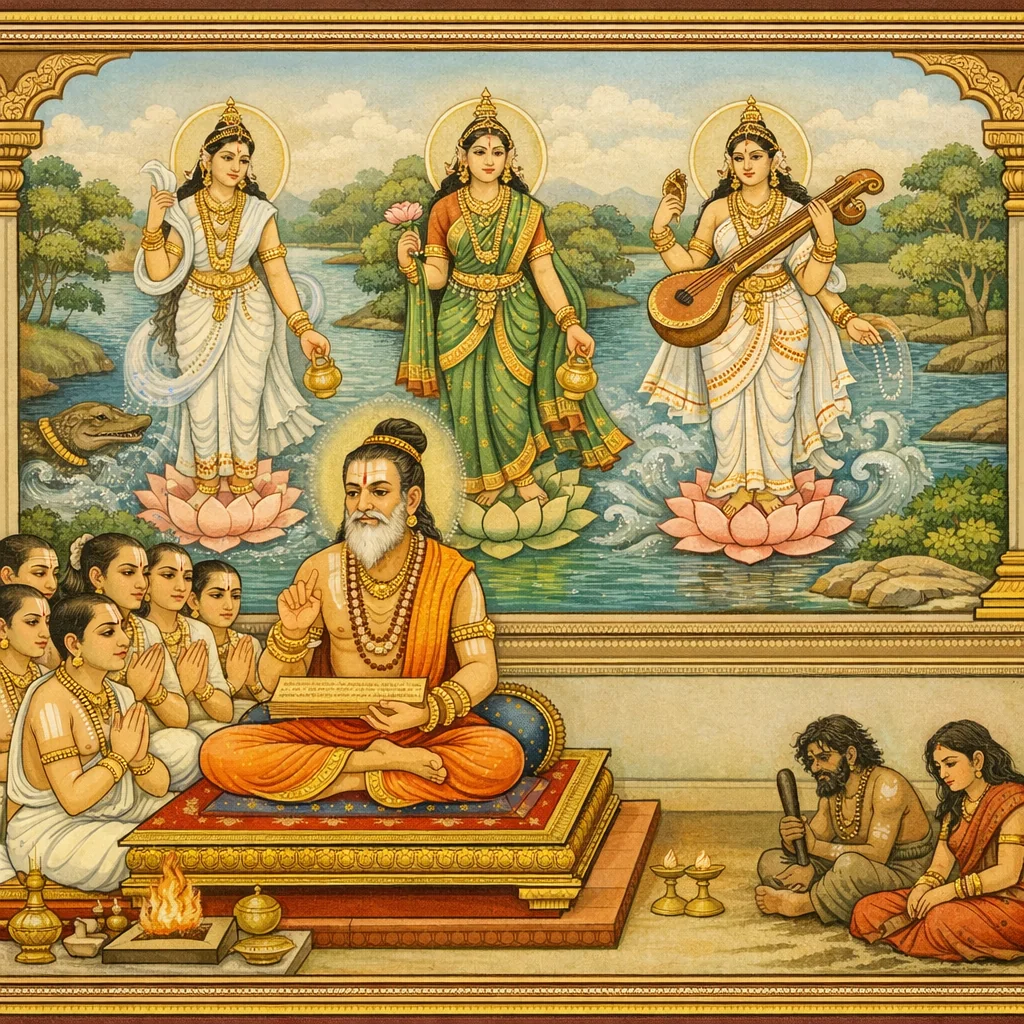
Adhyaya 199
The chapter opens with sages asking Sūta how beings in Kali-yuga, constrained by short lifespans, may gain the bathing-fruit of the earth’s innumerable tīrthas. Sūta answers by compressing the doctrine into a structured list of twenty-four sanctified entities arranged as eight triads—kṣetra, araṇya, purī, vana, grāma, tīrtha, parvata, and nadī—naming sets such as Kurukṣetra–Hāṭakeśvara-kṣetra–Prabhāsa; Puṣkara–Naimiṣa–Dharmāraṇya; Vārāṇasī–Dvārakā–Avantī; Vṛndāvana–Khāṇḍava–Dvaitavana; Kalpagrāma–Śāligrāma–Nandigrāma; Agnitīrtha–Śuklatīrtha–Pitṛtīrtha; Śrīparvata–Arbuda–Raivata; and the rivers Gaṅgā–Narmadā–Sarasvatī. The text declares that bathing at one member of a triad yields the fruit of the whole triad, and that completing all triads grants the full merit otherwise attributed to vast tīrtha totals. A second inquiry concerns the Hāṭakeśvara region, whose tīrthas and shrines are too many to finish even in a hundred years; the sages therefore seek an upāya—an accessible method for universal merit and deity-darśana, especially for the poor. Sūta recounts an older dialogue in which a king asks Viśvāmitra for an easy way by which bathing in a single tīrtha yields the fruit of all. Viśvāmitra identifies four principal tīrthas with observances: a sacred well linked to Gayā where śrāddha at specific lunar/solar timings rescues ancestors; Śaṅkha-tīrtha with Śaṅkheśvara-darśana in Māgha; a tīrtha tied to Viśvāmitra’s installed Hara-liṅga (Viśvāmitreśvara) on the bright eighth; and Śakra-tīrtha (Bālamaṇḍana), involving multi-day bathing and Śakreśvara-darśana on the Āśvina bright eighth. The chapter then lays out technical śrāddha protocol: insistence on locally qualified officiants (sthāna-udbhava brāhmaṇas), warnings that wrong personnel or impurity can nullify rites, and a hierarchy of preferred local lineages (including “aṣṭakula” claims). It closes with an etiological exemplum—curses, transgressions, and a dramatic episode of an outcaste disguised as a brāhmaṇa—used to reinforce ritual-ethical boundaries and the text’s logic of sacred efficacy.
Shlokas
Verse 1
ऋषय ऊचुः । तिस्रःकोट्योर्धकोटी च तीर्थानामिह भूतले । श्रूयते सूत कार्त्स्न्येन कीर्त्यमाना मुनीश्वरैः
The sages said: Here on earth, it is heard that there are three crores and a half-crore of tīrthas, fully celebrated by the lordly sages. O Sūta, (tell us of them).
Verse 2
कथं लभ्येत सर्वेषां तीर्थानां स्नानजं फलम् । अल्पायुर्भिर्महाभाग कलिकाल उपस्थिते
How may the fruit born of bathing at all tīrthas be obtained, O greatly fortunate one, when Kali-yuga has arrived and people are short-lived?
Verse 3
सूत उवाच । क्षेत्रत्रयमिहाख्यातं तथारण्यत्रयं महत् । पुरीत्रयं वनान्येव त्रीणि ग्रामास्तथात्रयः
Sūta said: Here is proclaimed a triad of sacred kṣetras, and likewise a great triad of āraṇya-forests; a triad of holy cities (purīs), three woodland tracts (vanas), and similarly three villages.
Verse 4
तथा तीर्थत्रयं चान्यत्पर्वतत्रितयान्वितम् । महानदीत्रयं चैव सर्वपातकनाशनम्
Likewise, there is another triad of tīrthas, accompanied by a triad of mountains; and a triad of great rivers as well—destroyers of every sin.
Verse 5
मर्त्यलोकेस्थितं विप्राः सर्वतीर्थफलप्रदम् । सर्वेष्वेतेषु यः स्नाति स सर्वेषां फलं लभेत्
O brāhmaṇas, established here in the mortal world is that which bestows the fruit of all tīrthas. Whoever bathes in all these attains the full merit of them all.
Verse 6
चतुर्विंशतिसंख्यानामिदमाह प्रजापतिः । य एकस्मिंस्त्रिके स्नाति सर्व त्रिकफलं लभेत्
Regarding the set numbered as twenty-four, Prajāpati declared this: whoever bathes in any single triad among them gains the merit of that entire triad.
Verse 7
ऋषय ऊचुः त्रीणि क्षेत्राणि कानीह तथारण्यानि कानि च । पुर्यस्तिस्रो महाभाग काःख्याताश्च वनानि च
The sages said: Which are the three sacred kṣetras here, and which are the three āraṇya-forests? O greatly fortunate one, which are the three famed cities, and which are the renowned woods (vanas) as well?
Verse 8
के ग्रामाः कानि तीर्थानि के नगाः सरितश्च काः । नामभिर्वद नः सूत सर्वाण्येतानि विस्तरात्
Which are the villages, which the tīrthas, which the mountains, and which the rivers? O Sūta, tell us all of these by their names, in full detail.
Verse 9
सूत उवाच कुरुक्षेत्रमिति ख्यातं प्रथमं क्षेत्रमुत्तमम् । हाटकेश्वरजं क्षेत्रं द्वितीयं परिकीर्तितम्
Sūta said: The first and most excellent sacred region is famed as Kurukṣetra. The second is proclaimed to be the kṣetra born of (or pertaining to) Hāṭakeśvara.
Verse 10
प्राभासिकं तृतीयं तु क्षेत्रं हि द्विजसत्तमाः । एतत्क्षेत्रत्रयं पुण्यं सर्वपातकनाशनम्
And the third kṣetra is Prābhāsika, O best of the twice-born. This triad of sacred regions is holy and destroys all sins.
Verse 11
यथोक्तविधिना दृष्ट्वा नरः पापात्प्रमुच्यते । यो यं काममभिध्यायन्क्षेत्रेष्वेतेषु भक्तितः
Having beheld these (holy places) according to the prescribed rule, a person is freed from sin. And whoever, with devotion in these kṣetras, meditates upon a particular desire—
Verse 12
स्नानं करोति तस्येष्टं मनसो जायते फलम् । चतुर्विंशतिमानेषु स्नातो भवति स द्विजाः
—and performs ritual bathing (snāna): for him, the desired fruit arises according to his intention. O brāhmaṇas, he is regarded as having bathed in the full set of the twenty-four.
Verse 13
एकं तु पुष्करारण्यं नैमिषारण्यमेव च । धर्मारण्यं तृतीयं तु तेषां संकीर्त्यते द्विजाः
One is Puṣkara-āraṇya, and another is indeed Naimiṣa-āraṇya. The third is Dharmāraṇya—thus it is proclaimed, O brāhmaṇas.
Verse 14
त्रिष्वेतेषु च यः स्नाति चतुर्विंशतिभाग्भवेत्
And whoever bathes in these three becomes a sharer in a twenty-fourfold portion of merit.
Verse 15
वाराणसी पुरीत्येका द्वितीया द्वारकापुरी । अवन्त्याख्या तृतीया च विश्रुता भुवनत्रये
Vārāṇasī is famed as the first sacred city; the second is Dvārakāpurī; and the third, renowned across the three worlds, is known as Avantī (Ujjayinī).
Verse 16
एतासु यो नरः स्नाति चतुर्विंशतिभाग्भवेत्
Any person who bathes in these (three sacred cities) becomes a recipient of a twenty-fourfold share of religious merit.
Verse 17
वृन्दावनं वनं चैकं द्वितीयं खांडवं वनम् । ख्यातं द्वैतवनं चान्यत्तृतीयं धरणीतले
Vṛndāvana is one foremost sacred forest; the second is the Khāṇḍava forest; and the third—also celebrated upon the earth—is the famed Dvaitavana.
Verse 18
त्रिष्वेतेषु च यः स्नाति चतुर्विंशतिभाग्भवेत्
Whoever bathes in these three sacred places becomes a recipient of a twenty-fourfold share of merit.
Verse 19
कल्पग्रामः स्मृतश्चैकः शालिग्रामो द्वितीयकः । नंदिग्रामस्तृतीयस्तु विश्रुतो द्विजसत्तमाः
Kalpagrāma is remembered as the first; Śāligrāma as the second; and the third, O best of the twice-born, is the renowned Nandigrāma.
Verse 20
त्रिष्वेतेषु च यः स्नाति चतुर्विंशतिभाग्भवेत्
Whoever bathes in these three sacred villages (tīrthas) becomes a recipient of a twenty-fourfold share of merit.
Verse 21
अग्नितीर्थं स्मृतं चैकं शुक्लतीर्थमथापरम् । तृतीयं पितृतीर्थं तु पितॄणामतिवल्लभम्
Agnitīrtha is remembered as one; another is Śuklatīrtha; and the third is Pitṛtīrtha—exceedingly dear to the Pitṛs, the ancestors.
Verse 22
त्रिष्वेतेषु च यः स्नाति चतुर्विंशतिभाग्भवेत्
Whoever bathes in these three tīrthas becomes a recipient of a twenty-fourfold share of merit.
Verse 23
श्रीपर्वतः स्मृतश्चैको द्वितीयश्चार्बुदस्तथा । तृतीयो रैवताख्योऽत्र विख्यातः पर्वतोत्तमाः
Śrīparvata is remembered as the first; Arbuda (Mount Ābū) likewise as the second; and here the third, called Raivata, is renowned—O best of mountains.
Verse 24
त्रिष्वेतेषु च यः स्नाति चतुर्विंशतिभाग्भवेत्
And whoever bathes in these three (mountain tīrthas) becomes a recipient of a twenty-fourfold share of merit.
Verse 25
गंगा नदी स्मृता पूर्वा नर्मदाख्या तथा परा । सरस्वती तृतीया तु नदी प्लक्षसमुद्भवा
First is remembered the river Gaṅgā; next is the one called Narmadā. The third is the river Sarasvatī, said to arise from the Plakṣa, the sacred source/tree.
Verse 26
आसु सर्वासु यः स्नाति चतुर्विंशतिभाग्भवेत्
Whoever bathes in all of these attains a share of merit measured in twenty-four parts (a twenty-fourfold apportioned merit).
Verse 27
एतेष्वेव हि सर्वेषु यः स्नानं कुरुते नरः । सार्धकोटित्रयस्यात्र स कृत्स्नं फलमाप्नुयात्
Indeed, the man who performs bathing in all of these obtains here the complete fruit, equivalent to three and a half crores of merits.
Verse 28
यश्चैकस्मिन्नरः स्नाति स त्रिकस्य फलं लभेत्
And the man who bathes in only one of them attains the fruit of a triad—the merit equal to bathing in three tīrthas.
Verse 29
एतद्वः सर्वमाख्यातं यत्पृष्टोऽस्मि द्विजोत्तमाः । संक्षेपात्तीर्थजं पुण्यं लभ्यते यन्नरैर्भुवि
O best of the twice-born, I have told you all that I was asked. In brief, thus do people upon the earth obtain the merit that arises from tīrthas.
Verse 30
सांप्रतं किं नु वो वच्मि यत्तद्वदत मा चिरम्
Now then, what more shall I tell you? Speak what you wish to ask, without delay.
Verse 31
ऋषय ऊचुः हाटकेश्वरजे क्षेत्रे यानि तीर्थानि सूतज । तानि प्रोक्तानि सर्वाणि त्वयाऽस्माकं सुविस्तरात्
The sages said: O son of Sūta, you have explained to us in full detail all the sacred tīrthas that are in the holy field of Hāṭakeśvara.
Verse 32
तथा चायतनान्येव संख्यया रहितानि च । अपि वर्षशतेनात्र स्नानं कर्तुं न शक्यते
And likewise the shrines (āyatanas) here are indeed beyond counting; even in a hundred years, bathing here in all of them cannot be accomplished.
Verse 33
तेषु सर्वेषु मर्त्येन यथोक्तविधिना स्फुटम् । देवतायतनान्येव तथा द्रष्टुं महा मते
Among all these, for a mortal to perform, clearly, the rites as prescribed—and likewise to behold the very shrines, the abodes of the deities—is indeed difficult, O great-minded one.
Verse 34
यस्मिन्स्नातो दिने चैव तस्य व्युष्टिः प्रकीर्तिता । अल्पायुषस्तदा मर्त्याः कृतेऽपि परिकीर्तिताः
For the very day on which one performs the sacred bath (snāna), a corresponding ‘vyuṣṭi’—a counted day of observance—is declared. Yet mortals are then proclaimed to be short-lived, even when effort is made.
Verse 35
त्रेतायां द्वापरे चापि किमु प्राप्ते कलौ युगे । एवमल्पायुषो ज्ञात्वा मानवान्सूतनंदन
In the Tretā and Dvāpara ages—and all the more now that the Kali age has arrived—knowing thus that human beings are short-lived, O beloved son of Sūta, one should seek an easier means to attain the fruits of pilgrimage.
Verse 36
लभेरंश्च कथं सर्वतीर्थानां स्नानजं फलम् । देवदर्शनजं वापि विशेषान्निर्धनाश्च ये
How could they obtain the fruit born of bathing at all tīrthas, and likewise the merit born of beholding the gods—especially those who are poor and without means?
Verse 37
अस्ति कश्चिदुपायोऽत्र दैवो वा मानुषोऽपि वा । येन तेषां भवेत्पुण्यं सर्वेषामेव हेलया
Is there here some means—divine or human—by which they may gain the merit of all tīrthas, even with ease?
Verse 38
सूत उवाच । अस्मिन्नर्थे पुरा पृष्टो विश्वामित्रो महामुनिः । समुपेत्याश्रमं तस्य आनर्तेन महीभुजा
Sūta said: Long ago, on this very matter, the great sage Viśvāmitra was questioned, when the king of Ānarta came to his hermitage.
Verse 39
राजोवाच । भगवन्नत्र तीर्थानि संख्यया रहितानि च । तेषु स्नानविधिः प्रोक्तः सर्वेष्वेव पृथक्पृथक्
The king said: O Blessed One, the sacred tīrthas here are beyond counting, and for each the rite of bathing is taught separately, one by one.
Verse 40
मासे वारे दिने चैव कुत्रचिन्मुनिसत्तमैः । दानानि च तथोक्तानि यथा स्नान विधिस्तथा
In some places, the best of sages prescribe observances by month, by weekday, and by day; and charities too are taught accordingly—just as the rules of bathing are.
Verse 41
देवानां दर्शनं चापि पृथक्तेन प्रकीर्तितम् । न शक्यते फलं प्राप्तुं सर्वेषां केनचिन्मुने
Even the beholding (darśana) of the gods is proclaimed separately for each; therefore, O sage, no one can obtain the fruits of them all.
Verse 42
अपि वर्षशतेनापि किं पुनः स्तोकवासरैः । तस्माद्वद महाभाग सुखोपायं च देहिनाम्
Not even in a hundred years could it be accomplished—how much less in a few short days. Therefore, O greatly fortunate one, tell me an easy means for embodied beings.
Verse 43
एकस्मिन्नपि च स्नातस्तीर्थे प्राप्नोति मानवः । सर्वेषामेव तीर्थानां स्नानजं सकलं फलम्
By bathing even in a single tīrtha, a person attains the complete fruit that arises from bathing in all tīrthas.
Verse 45
सूत उवाच । तच्छ्रुत्वा सुचिरं ध्यात्वा विश्वामित्रो महामुनिः । अब्रवीच्छृणु राजेंद्र सरहस्यं वदामि ते
Sūta said: Having heard that, the great sage Viśvāmitra reflected for a long time and then spoke: “Listen, O best of kings; I shall tell you this teaching together with its inner secret.”
Verse 46
चत्वार्यत्र प्रकृष्टानि मुख्यतीर्थानि पार्थिव । येषु स्नाने कृते राजञ्छ्राद्धे च तदनंतरम् । सर्वेषामेव तीर्थानां स्नानजं लभ्यते फलम्
O king, there are four supremely excellent principal tīrthas here. If one bathes in them and then performs the śrāddha immediately thereafter, one obtains the bathing-born merit of all tīrthas whatsoever.
Verse 47
सप्तविंशतिलिंगानि तथात्रैव स्थितानि च । सिद्धेश्वरप्रपूर्वाणि सर्वपापहराणि च
And here itself are established twenty-seven liṅgas—beginning with Siddheśvara—each of them a remover of all sins.
Verse 48
तेषु सर्वेषु दृष्टेषु भक्त्या पूतेन चेतसा । सर्वेषामेव देवानां भवेद्दर्शनजं फलम्
When all of those are beheld with a mind purified by devotion, the fruit born of darśana—seeing all the gods—is obtained.
Verse 49
तथैकस्मिन्सुरे दृष्टे सर्वदेवसमुद्भवम् । फलं दर्शनजं भावि नराणां द्विजसत्तम
Likewise, O best of the twice-born, by beholding here even a single deity—the very source from which all the gods arise—the fruit of darśana, as though one had seen them all, accrues to people.
Verse 50
राजोवाच । कानि चत्वारि तीर्थानि तत्र मुख्यानि सन्मुने । येषु स्नातो नरः सम्यक्सर्वेषां लभते फलम्
The King said: O holy sage, which are the four chief tīrthas there, bathing in which a man, duly and rightly, gains the fruit of all tīrthas?
Verse 51
विश्वामित्र उवाच । अत्रास्ति कूपिका पुण्या यस्यां संश्रयते गया । कृष्णपक्षे चतुर्दश्याममावास्यादिने तथा
Viśvāmitra said: Here there is a holy well (kūpikā), in which Gayā itself is said to abide—especially on the fourteenth day of the dark fortnight (kṛṣṇa-pakṣa), and likewise on the new-moon day (amāvāsyā).
Verse 52
विशेषेण महाभाग कन्यासंस्थे दिवाकरे । निर्विण्णा भूमिलोकानां कृतैः श्राद्धैरनेकधा
O greatly fortunate one, especially when the Sun abides in Virgo (Kanyā), Gayā became satisfied with the people of the earth through śrāddhas performed in many different ways.
Verse 53
यस्तस्यां कुरुते श्राद्धं सम्यक्छ्रद्धासमन्वितः
Whoever performs śrāddha there properly, endowed with faith,
Verse 54
तस्मिन्नहनि राजेंद्र स संतारयते पितॄन् । तथा तीर्थं द्वितीयं तु शंखतीर्थमिति स्मृतम्
On that very day, O lord of kings, he uplifts and delivers his ancestors. And the second tīrtha is remembered as “Śaṅkha-tīrtha”.
Verse 55
तत्र स्नात्वा नरो यस्तु पश्येच्छंखेश्वरं ततः । सर्वेषां फलमाप्नोति माघस्य प्रथमेऽहनि
There, after bathing, the man who then beholds Śaṅkheśvara obtains the fruit of all (tīrthas and rites) on the first day of Māgha.
Verse 56
तथा मन्नामकं तीर्थे तृतीयं मुख्यतां गतम् । अत्र स्नात्वा तु यः पश्येन्मया संस्थापितं हरम्
Likewise, the third tīrtha, bearing my very name, has attained foremost eminence. Having bathed here, whoever beholds Hara (Śiva) established by me…
Verse 57
विश्वामित्रेश्वरं नाम सर्वेषां स फलं लभेत् । नभस्यस्य सिताष्टम्यां सर्वेषां लभते फलम्
That Śiva is named Viśvāmitreśvara; by worship and darśana of him one obtains the fruit of all. On the bright eighth tithi of the month Nabhasya (Bhādrapada), one gains the fruit of all meritorious acts.
Verse 58
शक्रतीर्थमिति ख्यातं चतुर्थं बालमण्डनम् । तत्र स्नात्वा च पंचाहं शक्रेश्वरमवेक्ष्य च । आश्विनस्य सितेऽष्टम्यां सर्वेषां लभते फलम्
The fourth tīrtha is famed as Śakratīrtha, the “Bālamaṇḍana” (adorning and benefiting the young). Having bathed there for five days and beheld Śakreśvara (Śiva), on the bright eighth of Āśvina one obtains the fruit of all merits.
Verse 59
राजोवाच । विधानं वद मे विप्र गयाकूप्याः समुद्भवम् । विस्तरेण महाभाग श्रद्धा मे महती स्थिता
The King said: “O brāhmaṇa, tell me the proper procedure and the origin of Gayākūpī. Explain it in detail, O fortunate one—for my faith (śraddhā) is firmly and greatly established.”
Verse 60
विश्वामित्र उवाच । अमावास्यादिने प्राप्ते तत्र कन्यागते रवौ । यः श्राद्धं कुरुते भक्त्या स पितॄंस्तारयेन्निजान्
Viśvāmitra said: “When the day of Amāvāsyā (new moon) arrives, and the Sun is in Kanyā (Virgo), whoever performs śrāddha there with devotion delivers his own ancestors (pitṛs).”
Verse 61
भर्तृयज्ञविधानेन शुद्धैः स्थानोद्भवैर्द्विजैः । भर्तृयज्ञविधिं त्यक्त्वा योऽन्येन विधिना नरः
“According to the proper rule of the bhartṛ-yajña, it should be performed with pure twice-born (dvija) brāhmaṇas native to that very place. But the man who, abandoning the bhartṛ-yajña procedure, performs it by some other method…”
Verse 62
श्राद्धं करोति मूढात्मा विहीनं स्थानजैर्द्विजैः । स्थानजैरपि वाऽशुद्धैस्तस्य तद्व्यर्थतां व्रजेत्
“A deluded man performs śrāddha without the local brāhmaṇas; or even with local brāhmaṇas who are impure—then for him that rite goes to futility.”
Verse 63
वृष्टिः स्यादूषरे यद्वत्सत्यमेतन्मयोदितम् । अंधस्याग्रे यथा नृत्यं प्रगीतं बधिरस्य च । तथा च व्यर्थतां याति अन्यस्थानोद्भवैर्द्विजैः
“Just as rainfall upon barren ground—this is the truth I have spoken; and just as dancing before the blind, or singing for the deaf—so too the śrāddha becomes fruitless when performed with brāhmaṇas born in another place.”
Verse 64
ब्राह्मणैः कारयेच्छ्राद्धं मूर्खैरपि द्विजोत्तमाः । चतुर्वेदा अपि त्याज्या अन्यस्थानसमुद्भवाः
O best of the twice-born: let the śrāddha be performed by brāhmaṇas even if unlearned; but even those who know the four Vedas should be avoided if they are from another place (non-local).
Verse 65
दवे कर्मणि पित्र्ये वा सोमपाने विशेषतः । देशांतरगतो यस्तु श्राद्धं च कुरुते नरः । वैश्वानरपुरस्तेन कार्यं नान्यद्विजस्य च
In rites of dāna or ancestral observances, and especially in Soma-drinking ceremonies: if a man, having gone to another region, performs śrāddha, he should first perform the rite before Vaiśvānara (Agni), and he should not employ any other non-prescribed brāhmaṇa.
Verse 66
संनिवेश्य दर्भबटूञ्छ्राद्धं कुर्याद्द्विजोत्तमाः । दक्षिणा भोजनं देयं स्थानिकानां चिरादपि
O best of the twice-born: having seated the darbha-grass effigies, perform the śrāddha. Also give dakṣiṇā and a meal—even to the local residents—so that the rite is fulfilled in accord with the dharma of the sacred place.
Verse 67
पंचगव्यस्य संपूर्णो यथा कुम्भः प्रदुष्यति । बिंदुनैकेन मद्यस्य पतितेन नृपोत्तम
O best of kings: just as a pot filled with pañcagavya (the five cow-products) is tainted when even a single drop of liquor falls into it, so a sacred rite is spoiled by a small yet defiling admixture.
Verse 68
एकेनापि च बाह्येन बहूनामपि भूपते । मध्ये समुपविष्टेन तच्छ्राद्धं दोषमाप्नुयात्
O king: even if many are present, if even one outsider—unfit for the rite—sits in the midst, that śrāddha incurs fault and becomes blemished.
Verse 69
स्थानजोऽपि चतुर्वेदो यद्यपि स्यान्न शुद्धिभाक् । बहूनामपि शुद्धानां मध्ये श्राद्धं विनाशयेत्
Even a local brāhmaṇa learned in the four Vedas—if he lacks purity—can ruin the śrāddha when seated among many who are otherwise pure.
Verse 70
तस्मात्सर्वप्रयत्नेन शुद्धं ब्राह्मणमानयेत्
Therefore, with every effort, one should bring (invite) a pure brāhmaṇa for the rite.
Verse 71
स्थानिकं मूर्खमप्येवमलाभे गुणिनामपि । हीनांगमधिकांगं वा दूषितं नो तथा परम्
If qualified brāhmaṇas are unavailable, then even a local—though ignorant—may be accepted; for he is not as harmful as one who is defiled (impure), whether deficient or excessive in limbs.
Verse 72
कन्यादाने तथा श्राद्धे कुलीनो ब्राह्मणः सदा । आहर्तव्यः प्रयत्नेन य इच्छेच्छुभमात्मनः । सोऽपि शुद्धिसमायुक्तो यदि स्यान्नृपसत्तम
In kanyādāna and likewise in śrāddha, one who seeks auspiciousness for oneself, O best of kings, should always strive to procure a well-born brāhmaṇa—provided he is endowed with purity.
Verse 73
वृक्षाणां च यथाऽश्वत्थो देवतानां यथा हरिः । श्रेष्ठस्थानजविप्राणां तथा चाष्टकुलोद्भवः
Just as the aśvattha is foremost among trees, and Hari among the gods, so among the best of local brāhmaṇas the one born from the ‘eight lineages’ is considered pre-eminent.
Verse 74
आयुधानां यथा वज्रं सरसां सागरो यथा । श्रेष्ठस्थानजविप्राणां तथाष्टकुलसंभवः
As the vajra is foremost among weapons, and the ocean among waters, so the one born of the “eight lineages” is foremost among the finest local brāhmaṇas.
Verse 75
उच्चैःश्रवा यथाऽश्वानां गजानां शक्रवाहनः । श्रेष्ठस्थानजविप्राणां तथाष्टकुलसंभवः
Just as Uccaiḥśravā is foremost among horses, and Śakra’s mount Airāvata among elephants, so the aṣṭakula-born is foremost among the finest local brāhmaṇas.
Verse 76
नदीनां च यथा गंगा सतीनां चाप्यरुंधती । तद्वत्स्थानजविप्राणां श्रेष्ठोऽष्टकुलिकः स्मृतः
Just as Gaṅgā is foremost among rivers, and Arundhatī foremost among chaste women, so among the brāhmaṇas native to that sacred place the Aṣṭakulika is remembered as the śreṣṭha, the pre-eminent.
Verse 77
ग्रहाणां भास्करो यद्वन्नक्षत्राणां निशाकरः । तद्वत्स्थानजविप्राणां श्रेष्ठोऽष्टकुलिकः स्मृतः
As the Sun is chief among the planets, and the Moon chief among the stars, so among the brāhmaṇas native to that sacred locale the Aṣṭakulika is remembered as the foremost.
Verse 78
पर्वतानां यथा मेरुर्द्विपदानां द्विजोत्तमः । स्थानजानां तु विप्राणां श्रेष्ठोऽष्टकुलिकस्तथा
Just as Meru is supreme among mountains, and among bipeds the dvijottama—the best of the twice-born—is supreme, so among the brāhmaṇas native to that place the Aṣṭakulika is likewise the foremost.
Verse 79
पक्षिणां गरुडो यद्वत्सिंहोऽरण्यनिवासिनाम् । स्थानजानां तु विप्राणां श्रेष्ठोऽष्टकुलिकस्तथा
As Garuḍa is foremost among birds, and the lion foremost among those who dwell in the forest, so among the Brāhmaṇas native to that place, the Aṣṭakulika is likewise the pre-eminent one.
Verse 80
एवं ज्ञात्वा प्रयत्नेन श्राद्धे यज्ञे च पार्थिव । कन्यादाने विशेषेण योज्यश्चाष्टकुलोद्भवः
Knowing this, O king, one should with care employ a descendant of the Aṣṭakula—at Śrāddha rites and at sacrifices, and especially in the kanyādāna, the giving of a daughter in marriage.
Verse 81
नृत्यंति पितरस्तस्य गर्जंति च पितामहाः । वेदिमूले समालोक्य प्राप्तमष्टकुलं नृप
For him, O king, the Pitṛs dance and the forefathers roar with joy when they behold—at the very base of the altar—the arrival of an Aṣṭakula Brāhmaṇa.
Verse 82
पुनर्वदंति संहृष्टाः किमस्माकं प्रदास्यति । दौहित्रश्चापसव्येन जलं दर्भतिलान्वितम्
Rejoicing, they speak again: “What will he offer to us?”—when the daughter’s son (dauhitra) presents water together with darbha grass and sesame, wearing the sacred thread in the reverse manner (apasavya).
Verse 83
राजोवाच । यदेतद्भवता प्रोक्तं श्रैष्ठ्यमष्टकुलोद्भवम् । सर्वेषां नागराणां च तत्किं वद महामते
The King said: “You have declared the pre-eminence of one born from the Aṣṭakula. But among all the Nāgara Brāhmaṇas, why is it so? Tell me, O great-minded sage.”
Verse 84
न ह्यत्र कारणं स्वल्पं भविष्यति द्विजोत्तम
Surely, O best of the twice-born, the reason for this will not be a small one.
Verse 85
विश्वामित्र उवाच । सत्यमेतन्महाराज यत्त्वया व्याहृतं वचः । अन्येऽपि नागराः संति वेदवेदांगपारगाः
Viśvāmitra said: “True indeed, O great king, is the statement you have spoken. There are also other Nāgara Brāhmaṇas who have mastered the Vedas and the Vedāṅgas.”
Verse 86
श्राद्धार्हा यज्ञयोग्याश्च कन्यायोग्या विशेषतः । परं ते स्थापिता राजन्स्वयमिंद्रेण तत्र च
They are fit to be invited for śrāddha, qualified for sacrificial rites, and—most especially—suitable for marriage alliances. O King, they were established there in that supreme station by Indra himself.
Verse 87
प्रधानत्वेन सर्वेषां नागरैश्चापि कृत्स्नशः । तेन ते गौरवं प्राप्ताः स्थानेत्रैव विशेषतः
Because the Nāgaras hold primacy among all (such groups) in every respect, they have attained honor—especially in this very place.
Verse 88
तस्माच्छ्रूाद्धं प्रकर्तव्यं विप्रै श्चाष्टकुलोद्भवैः । अप्राप्तौ चैव तेषां तु कार्यं नागरसंभवैः
Therefore, śrāddha should be performed with brāhmaṇas born in the eight lineages; and if they are unavailable, then it should be carried out with those of Nāgara origin.
Verse 89
नान्यस्थानसमुद्भूतैश्चतुर्वेदैरपि द्विजैः । भर्तृयज्ञेन मर्यादा कृता ह्येषा महा त्मना
Not even dvija brāhmaṇas, though learned in the four Vedas yet born from other places, should perform it here. This boundary-rule was established by the great-souled Bhartṛyajña.
Verse 90
मुक्त्वा तु नागरं विप्रं योऽन्येनात्र करिष्यति । श्राद्धं वा यदि वा यज्ञं व्यर्थं तस्य भविष्यति
If someone, setting aside a Nāgara brāhmaṇa, has a śrāddha or a yajña performed here through another officiant, that rite will become fruitless for him.
Verse 91
राजोवाच । संत्यन्ये विविधा विप्रा वेदवेदांगपारगाः । मध्यदेशोद्भवाः शान्तास्तथान्ये तीर्थसंभवाः
The King said: “There are also many other brāhmaṇas—masters of the Vedas and the Vedāṅgas—born in Madhyadeśa and of tranquil conduct; and others too who are born in sacred pilgrimage-places (tīrthas).”
Verse 92
भर्तृयज्ञेन ये त्यक्ताः श्राद्धे यज्ञे विशेषतः । हीनांगाश्चाधिकांगाश्च द्विर्नग्नाः श्यावदंतकाः
(The King continued:) “Those whom Bhartṛyajña rejected—especially for śrāddha and yajña—are described as deficient-limbed or excessive-limbed, twice-naked, and dark-toothed.”
Verse 93
कुनखाः कुष्ठसंयुक्ता मूर्खा अपि विगर्हिताः । श्राद्धार्हाः सूचितास्तेन एतं मे संशयं वद
“Some have deformed nails, are afflicted with leprosy, are foolish and even censured—yet he indicated them as fit for śrāddha. Tell me, then, and resolve this doubt of mine.”
Verse 94
विश्वामित्र उवाच । कीर्तयिष्ये नरव्याघ्र कारणानि बहूनि च । चमत्कारस्य पत्न्याश्च दानेन पतिता यतः
Viśvāmitra said: “O tiger among men, I shall recount many causes. For Camatkāra’s wife fell from propriety because of a gift—an act of giving.”
Verse 95
स्त्रीणां प्रतिग्रहेणैव विप्रेषु प्रोषितेषु च । पृथक्त्वं च ततो जातं बाह्याभ्यन्तरसंज्ञकम्
Through accepting gifts from women—especially while the brāhmaṇas were away—there arose a division, designated as ‘external’ and ‘internal’.
Verse 96
दुर्वाससा ततः शप्ता रुष्टेनेवाहिना यथा । विद्याधनाभिमानेन शापेन पतिताः सदा
Then, cursed by Durvāsas—like those struck down by an enraged serpent—they fell from their state; for through pride in learning and wealth they were ever brought low by that curse.
Verse 97
कुशे राज्यगते राजन्राक्षसानां महाभयम् । प्रजयाऽवेदितं सर्वं तस्य राज्ञो महात्मनः
O King, when Kuśa had entered upon the rule, the great terror caused by the rākṣasas was fully reported to that noble sovereign by his subjects.
Verse 98
विभीषणस्य लंकायां दूतश्च प्रेषितस्तदा । सर्वं निवेदयामास प्रजानां भयसंभवम्
Then a messenger was dispatched to Vibhīṣaṇa in Laṅkā, and he reported in full the arising of fear among the people.
Verse 99
अभिवन्द्य कुशादेशं रामस्य चरितं स्मरन् । पुर्यां विलोकयामास लङ्कायां रामशासनात्
Having bowed in homage and received Kuśa’s command, and recalling Rāma’s sacred deeds, he surveyed the city of Laṅkā in accordance with Rāma’s ordinance.
Verse 100
उपप्लवस्य कर्तारो नष्टाः सर्वे दिशो दश । गन्धर्वाणां च लोकं हि भयेन महता गताः
The makers of the turmoil vanished into all the ten directions; indeed, driven by great fear, they departed to the world of the Gandharvas.
Verse 101
स्थातुं तत्र न शक्तास्ते विभीषणभयेन च । पृथिव्यां समनुप्राप्ताः स्थानान्यपि बहूनि च
Unable to remain there, and fearful of Vibhīṣaṇa, they came down upon the earth and reached many other places as well.
Verse 102
भयेन महता तत्र कुशस्यैव तु शासने । ब्राह्मणानां च रूपाणि कृत्वा तत्र समागताः
There, under Kuśa’s very rule, driven by great fear, they assembled—having assumed the forms of brāhmaṇas.
Verse 103
वाडवानां महिम्ना च मध्ये स्थातुं न तेऽशकन् । पतितानां च संस्थानं चमत्कारपुरं गताः
And because of the power (mahimā) of the Vāḍavas, they could not remain in the midst there; so they went to Camatkārapura, a settlement associated with the fallen.
Verse 104
मायाविशारदैस्तैश्च धनेन विद्यया ततः । अध जग्धं ततस्तैस्तु तेषां मध्ये स्थितं च तैः
Then those skilled in māyā, relying on wealth and learning, brought about a further downfall; thus what had been set in their midst was consumed and ruined by them.
Verse 105
ततःप्रभृति ते सर्वे राक्षसत्वं प्रपेदिरे । क्रूराण्यपि च कर्माणि कुर्वंति च पदेपदे
From that time onward, all of them attained the state of rākṣasas, and at every step they performed cruel deeds as well.
Verse 106
ततस्ते सर्वथा राजन्वर्जनीयाः प्रयत्नतः । श्राद्धे यज्ञे नरव्याघ्र नरके पातयंति च
Therefore, O King, they are in every way to be carefully avoided. O tiger among men, in śrāddha rites and in yajña worship they cause a fall into hell.
Verse 107
अन्यच्च दूषणं तेषां कीर्तयिष्ये तवाऽनघ । त्रिजाताः स्थापिता राजन्सर्पाणां गरनाशनात्
And another fault of theirs I shall declare to you, O sinless one. O King, they were established as “trijātā” because of destroying the poison of serpents.
Verse 108
नगरत्वं ततो जातं चमत्कार पुरस्य तु । त्रिजातत्वं तु सर्वेषां जातं तत्र विशेषतः
From that arose the “city-status” of the wondrous town. And there, in particular, the state of being “trijātā” arose for them all.
Verse 109
एतेभ्यः कारणेभ्यश्च भर्तृयज्ञेन वर्जिताः । पुनश्च कारणं तेषां स्पर्शादपि न शुद्धिभाक्
For these reasons they are excluded from the Bhartṛ-yajña. And further, for another reason, they do not become pure even by mere contact (with purifying means).
Verse 110
कुम्भकोत्थं च संप्राप्तं महच्चण्डालसंभवम्
And there occurred the rise of Kumbhaka—born from a great Caṇḍāla lineage.
Verse 111
राजोवाच । एतच्च कारणं विप्र कथयस्व प्रसादतः । स्थावरस्य चरस्यैव जगतो ज्ञानमस्ति ते
The King said: O brāhmaṇa, kindly tell me this reason as a favor. You possess knowledge of the whole world, of the moving and the unmoving.
Verse 112
विश्वामित्र उवाच । अत्र ते कीर्तयिष्यामि पूर्ववृत्तकथांतरम् । भर्तृयजेन ये त्यक्ताः सर्वेन्ये ब्राह्मणोत्तमाः
Viśvāmitra said: Here I shall recount to you another account of what happened before. Those whom the Bhartṛ-yajña cast aside—while all the others were excellent brāhmaṇas—listen to how it came to be.
Verse 113
वर्धमाने पुरे पूर्वमासीदंत्यजजातिजः । चण्डालः कुंभकोनाम निर्दयः पापकर्मकृत्
Formerly, in the city of Vardhamāna, there lived one born among the outcaste communities—a Caṇḍāla named Kumbhaka, cruel and engaged in sinful deeds.
Verse 114
कस्यचित्त्वथ कालस्य तस्य पुत्रो बभूव ह । विरूपस्यापि रूपाढ्यः पूर्वकर्मप्रभावतः
After some time, a son was born to him; though the father was ill-formed, the son was handsome—through the power of deeds done in the past.
Verse 115
पिंगाक्षस्य सुकृष्णस्य वयोमध्यस्य पार्थिव । दक्षः सर्वेषु कृत्येषु सर्वलक्षणलक्षितः
O King, he had tawny eyes and a pleasing dark complexion, and was in the prime of youth; he was capable in all duties and marked by every auspicious sign.
Verse 116
स वृद्धिं द्रुतमभ्येति शुक्लपक्षे यथोडुराट् । तथाऽसौ शंस्यमानस्तु सर्वलोकैः सुरूपभाक् । दृष्ट्वा कुटुंबकं नित्यं वैराग्यं परमं गतः
As the moon swiftly waxes in the bright fortnight, so did he quickly rise—praised by all people and endowed with a pleasing form. Yet, seeing the ever-repeating nature of household life, he attained supreme dispassion.
Verse 117
ततो देशांतरं दुःखाद्भ्रममाण इतस्ततः । चमत्कारपुरं प्राप्तो द्विजरूपं समाश्रितः । स स्नाति सर्वकृत्येषु भिक्षान्नकृतभोजनः
Then, pained by sorrow, he wandered from place to place. Reaching Camatkārapura, he assumed the guise of a twice-born (brāhmaṇa). He performed ritual bathing for all his religious duties and lived on food obtained by alms.
Verse 118
एतस्मिन्नेव काले तु ब्राह्मणः शंसितव्रतः । छांदोग्यगोत्रविख्यातः सुभद्रोनाम पार्थिवः
At that very time, there was a brāhmaṇa renowned for his praised vows, celebrated as belonging to the Chāndogya lineage—named Subhadra, a lord among men.
Verse 119
नागरो वर्षयाजी च वेदवेदांगपारगः । तत्रासीत्तस्य सञ्जाता कन्यका द्विगुणै रदैः
He was a man of the land of Nāgara, a performer of yearly yajñas, and one who had mastered the Vedas and their auxiliaries. To him was born a daughter, remarkable for having double teeth.
Verse 120
तथा त्रिभिःस्तनै रौद्रा पृष्ठ्यावर्तकसंयुता । दरिद्रोऽपि सुदुःस्थोऽपि कुलहीनोपि पार्थिव
Likewise, she was fierce in disposition, possessed of three breasts, and marked with a whorl upon her back. O king, even if a man be poor, sorely distressed, and even without lineage—
Verse 121
दीयमानामपि न तां प्रतिगृह्णाति कश्चन । यद्भक्षयति भर्तारं षण्मासाभ्यंतरे हि सा
Even when she was offered in marriage, no one would accept her, for within six months she would devour her husband.
Verse 122
यस्याः स्युर्द्विगुणा दंता एवं सामुद्रिका जगुः । त्रिस्तनी कन्यका या तु श्वशुरस्य कुलक्षयम् । संधत्ते नात्र सन्देहस्तस्मात्तां दूरतस्त्यजेत्
The experts in sāmudrika (physiognomy) declare: a girl with double teeth, and especially one who is three-breasted, brings about the ruin of her father-in-law’s lineage—of this there is no doubt. Therefore, one should abandon her from afar.
Verse 123
पृष्ठ्यावर्तो भवेद्यस्या असती सा भवेद्द्रुतम् । बहुपापसमाचारा तस्मात्तां परिवर्जयेत्
A woman who bears a whorl upon her back quickly becomes unchaste and engages in many sinful deeds; therefore, one should avoid her.
Verse 124
अथ तां वृद्धिमापन्नां दृष्ट्वा विप्रः सुभद्रकः । चिन्ताचक्रं समारूढो न शांतिमधिगच्छति
Then the brāhmaṇa Subhadra, seeing her grown to maturity, was caught in a whirl of anxiety and could not attain peace.
Verse 125
किं करोमि क्व गच्छामि कथमस्याः पतिर्भवेत् । न कश्चित्प्रतिगृह्णाति प्रार्थितोऽपि मुहुर्मुहुः
“What shall I do? Where shall I go? How will she obtain a husband? No one will accept her, even though I repeatedly entreat them.”
Verse 126
दरिद्रो व्याधितो वाऽपि वृद्धोऽपि ब्राह्मणो हि सः । स्मृतौ यस्मादिदं प्रोक्तं कन्यार्थे प्राङ्महर्षिभिः
Even if he is poor, diseased, or advanced in age, he is still a brāhmaṇa; for this very rule was declared in the Smṛti by the ancient great seers concerning the duty and protection of a maiden.
Verse 127
अष्टवर्षा भवेद्गौरी नववर्षा च रोहिणी । दशवर्षा भवेत्कन्या अत ऊर्ध्वं रजस्वला
At eight years she is called “Gaurī”; at nine, “Rohiṇī”; at ten, “Kanyā”. Beyond that age, she is regarded as rajasvalā—one who has reached menstruation.
Verse 128
माता चैव पिता चैव ज्येष्ठो भ्राता तथैव च । त्रयस्ते नरकं यांति दृष्ट्वा कन्यां रजस्वलाम्
The mother and the father, and likewise the elder brother—those three go to hell if, through neglect, they allow the maiden to be seen as rajasvalā (having reached menstruation) without due protection and care.
Verse 129
एवं चिन्तयतस्तस्य सोंऽत्यजो द्विजरूपधृक् । भिक्षार्थं तद्गृहं प्राप्तो दृष्टस्तेन महात्मना
As he pondered thus, an outcaste—wearing the guise of a twice-born—came to that house seeking alms, and was seen by that noble man.
Verse 130
पृष्टश्च विस्मयात्तेन दृष्ट्वा रूपं तथाविधम् । कुतस्त्वमिह सम्प्राप्तः क्व यास्यसि च भिक्षुक
Amazed at seeing such a form, he asked: “From where have you come here, and where are you going, O mendicant?”
Verse 131
ईदृग्भव्यतरो भूत्वा कस्मान्माधुकरीं गतः । किं गोत्रं तव मे ब्रूहि कतमः प्रवरश्च ते
“With such a noble appearance, why have you taken to mādhukarī—living by gathering small alms? Tell me your gotra, and which pravara is yours.”
Verse 132
सोऽब्रवीद्गौडदेशीयं स्थानं मे सुमहत्तरम् । नाम्ना भोजकटं ख्यातं नानाद्विजसमाश्रितम्
He replied: “My home is in the land of Gauḍa, in a very great place renowned as Bhojakaṭa, where many brāhmaṇas reside.”
Verse 133
तत्रासीन्माधवोनाम ब्राह्मणो वेदपारगः । वसिष्ठगोत्रविख्यात एकप्रवरसूचितः
“There lived a brāhmaṇa named Mādhava, a master of the Vedas, famed as belonging to the Vasiṣṭha gotra, and known as having a single pravara.”
Verse 134
तस्याहं तनयो नाम्ना चंद्रप्रभ इति स्मृतः
I am his son, remembered by the name Candraprabha.
Verse 135
ततोऽहमष्टमे वर्षे यदा व्रतधरः स्थितः । तदा पंचत्वमापन्नः पिता मे वेदपारगः
Then, when I was in my eighth year and established in observances (vrata), my father—versed in the Vedas—at that time met with death.
Verse 136
माता मे सह तेनैव प्रविष्टा हव्यवाहनम् । ततो वैराग्यमापन्नो निष्क्रांतोऽहं निजालयात्
My mother, together with him, entered the fire. Thereafter, seized by dispassion, I departed from my own home.
Verse 137
तीर्थानि भ्रममाणोऽत्र संप्राप्तस्तु पुरं तव । अधुना संप्रयास्यामि प्रभासं क्षेत्रमुत्तमम्
While wandering among sacred fords (tīrthas), I arrived here at your city. Now I shall depart for Prabhāsa, that unsurpassed holy region.
Verse 138
यत्र सोमेश्वरो देवस्त्यक्त्वा कैलासमागतः । न मया पठिता वेदा न च शास्त्रं नृपोत्तम । तीर्थयात्राप्रसंगेन तेन भिक्षां चराम्यहम्
There is the place where Lord Someśvara came, leaving Kailāsa. O best of kings, I have studied neither the Vedas nor the treatises (śāstra); it is only through the occasion of pilgrimage that I live by alms.
Verse 139
विश्वामित्र उवाच । तस्य तद्वचनं श्रुत्वा चिन्तयामास चेतसि । ब्राह्मणोऽयं सुदेशीयस्तथा भव्यतमाकृतिः । यदि गृह्णाति मे कन्यां तदस्मै प्रददाम्यहम्
Viśvāmitra said: Hearing his words, I pondered in my heart: “This man is a brāhmaṇa, from a worthy land, and of exceedingly auspicious form. If he will accept my daughter, then I shall give her to him.”
Verse 140
यावद्रजस्वला नैव जायते सा निरूपिता । कृत्स्नं दूषयति क्षिप्रं नैव वंशं ममाधमा
So long as she is not seen to become rajasvalā (to attain womanhood), the matter remains uncertain; that unworthy one would quickly taint my entire lineage.
Verse 141
ततः प्रोवाच तं म्लेच्छं संमंत्र्य सह भार्यया । यदि गृह्णासि मे कन्यां तव यच्छाम्यहं द्विज
Then, after consulting with his wife, he spoke to that mleccha: “O twice-born (dvija), if you will accept my daughter, I shall give her to you.”
Verse 142
भरणं पोषणं द्वाभ्यां करिष्यामि सदैव हि
Indeed, I shall always provide maintenance and sustenance for you both.
Verse 143
तच्छ्रुत्वा हर्षितः प्राह सोंऽत्यजो नृपसत्तमम् । तवादेशं करिष्यामि यच्छ मे कन्यकां नृप
Hearing this, that antyaja, delighted, said to the best of kings: “I shall do as you command; give me the maiden, O king.”
Verse 144
तथेत्युक्त्वा गतस्तेन तस्मै दत्ता निजा सुता । गृह्योक्तेन विधानेन विवाहो विहितस्ततः
Saying, “So be it,” he went with him; he gave him his own daughter, and then the marriage was duly solemnized according to the rites taught in the Gṛhya tradition.
Verse 145
ततो ददौ धनं धान्यं गृहं क्षेत्रं च गोधनम् । तस्मै तुष्टिसमायुक्तो मन्यमानः कृतार्थताम्
Then, satisfied and deeming the matter fulfilled, he bestowed on him wealth, grain, a house, fields, and cattle.
Verse 146
अथ सोऽपि च तां प्राप्य विलासानकरोद्बहून् । खाद्यैः पानैः सुवस्त्रैश्च गन्धमाल्यैर्विभूषणैः
Having obtained her, he too indulged in many pleasures—honoring her with delicacies and drinks, fine garments, perfumes and garlands, and ornaments.
Verse 147
परं स व्रजति प्रायो येन मार्गेण केनचित् । सारमेयाः सशब्दाश्च पृष्ठतोऽनुव्रजंति वै
But whenever he went along some road, dogs—making a clamor—would indeed follow behind him.
Verse 148
अन्येषामंत्यजात्यानां यद्वत्तस्य विशेषतः । वेदाभ्यासपरश्चैव यदि संजायते क्वचित् । रक्तं पतति वक्त्रेण तत्क्षणात्तस्य दुर्मतेः
And just as with others of outcaste condition—so in his case especially—if he ever set his mind upon Vedic recitation, at that very moment blood would fall from his mouth, because of his wicked disposition.
Verse 149
एतस्मिन्नंतरे लोकः सर्व एव प्रशंकितः । अब्रवीच्च मिथोऽभ्येत्य चंडालोऽयमसंशयम्
Meanwhile, all the people grew suspicious, and drawing near to one another they said, “This man is a caṇḍāla—without doubt.”
Verse 150
यदेते पृष्ठतो यांति भषमाणाः शुनीसुताः । सुभद्रोऽपि च तत्तेषां श्रुत्वा चिन्तापरोऽभवत्
“Because these dogs, barking, keep going behind him”—hearing their talk, Subhadra too became filled with anxiety.
Verse 151
मन्यमानश्च तत्सत्यं दुःखेन महतान्वितः । नूनमंत्यजजातीयो भविष्यति सुतापतिः
Believing that report to be true, overwhelmed with great sorrow, he thought: “Surely the husband of Sutā must be of outcaste birth (antyaja).”
Verse 152
ज्ञायते चेष्टितैः सर्वैर्यथाऽयं जल्पते जनः
For by all his actions it is known—so people say—just what sort of person he is.
Verse 153
एवं रात्रिंदिवं तस्य चिन्तयानस्य भूपतेः । लोकापवादयुक्तस्य कियान्कालोऽभ्यवर्तत
Thus, as that king brooded day and night—burdened by public slander—how much time passed by.
Verse 154
अन्यस्मिन्नहनि प्राप्ते आद्याद्या द्विजसत्तमाः । मध्यगेन समायुक्ता ब्रह्मस्थानं समागताः । तस्य शुद्धिकृते प्रोचुर्येन शंका प्रणश्यति
On another day, the eminent brāhmaṇas came again and again with the officiant and assembled at Brahmasthāna. There they spoke of the rite for his purification, by which all suspicion would be destroyed.
Verse 155
अथोचुस्तं द्विजश्रेष्ठा ब्रह्मस्थानस्य मध्यगम् । मध्यगस्य तु वक्त्रेण विवर्णवदनं स्थितम्
Then the foremost brāhmaṇas addressed him as he stood in the midst of Brahmasthāna; and at that moment the officiant’s face appeared pale and discolored.
Verse 156
कुलं गोत्रं निजं ब्रूहि प्रवरांश्च विशेषतः । स्थानं देशं च विप्राणां येन शुद्धिः प्रदीयते
“Declare your lineage and your gotra, and state your pravaras in particular; also tell the place and region of the brāhmaṇas, so that the proper rite of purification may be granted.”
Verse 157
अथासौ वेपमानस्तु प्रस्विन्नवदनस्तथा । अधोदृष्टिरुवाचेदं गद्गदं विहिताञ्जलिः
Then he, trembling, his face covered with sweat and his eyes cast downward, spoke these words in a choked voice, with palms joined in reverence.
Verse 158
गर्भाष्टमे पिता मह्यं वर्षे मृत्युं गतस्ततः । ततः सा तं समादाय जननी मे पतिव्रता । मां त्यक्त्वा दुःखितं दीनं प्रविष्टा हव्यवाहनम्
“In my eighth year, my father died. Then my mother—faithful to her husband—took him for the funeral rite and, leaving me sorrowful and helpless, entered the sacred fire.”
Verse 159
अहं वैराग्यमापन्नस्तीर्थयात्रां समाश्रितः । बालभावे पितुर्दुःखात्तापसैरपरैः सह
Thus I fell into vairāgya, holy detachment; and from childhood, grieving for my father, I took refuge in pilgrimage to the sacred tīrthas, in the company of other ascetics.
Verse 160
न मया पठितो वेदो न च शास्त्रं निरूपितम् । तीर्थयात्रापरोऽहं च समायातो भवत्पुरम्
I have not studied the Veda, nor have I examined the śāstras; devoted only to tīrtha-pilgrimage, I have come to your city.
Verse 161
अभद्रेण सुभद्रेण श्वशुरेण दुरात्मना । एतज्जानाम्यहं विप्रा गोत्रं वासिष्ठमेव वा
O Brāhmaṇas, I know only this—told by my wicked father-in-law, Abhadra, son of Subhadra—that my gotra is Vāsiṣṭha.
Verse 162
अथैकप्रवरो देशो गौडो मधुपुरं पुरम् । ततस्ते ब्राह्मणाः प्रोचुर्यस्य नो ज्ञायते कुलम् । तस्य शुद्धिः प्रदातव्या धटद्वारेण केवला
Then (he said): “My region is Gauḍa, my city is Madhupura, and I have but one pravara.” Thereupon the Brāhmaṇas declared: “For one whose lineage is not known, purification should be granted solely by the rite called ‘through the dhaṭa doorway’.”
Verse 163
स त्वं धटं समारुह्य ब्राह्मण्यार्थं च केवलम् । शुद्धिं प्राप्य ततो भोगान्भुंक्ष्वात्रस्थोऽपि केवलम्
Therefore, mount the dhaṭa solely for the sake of attaining Brāhmaṇa-status; having obtained purification, then enjoy here as well your rightful sustenance—according to rule alone.
Verse 164
सोऽब्रवीत्साहसं कृत्वा सर्वानेव द्द्विजोत्तमान् । प्रतिगृह्णाम्यहं कामं तप्तमाषकमेव च
Then he spoke—having steeled himself—before all those best of the twice-born: “I willingly accept this ordeal as I choose; even the heated māṣaka coin (taptamāṣaka) I will accept as well.”
Verse 165
प्रविशामि हुताशं वा भक्षयिष्याम्यहं विषम्
“If need be, I will enter the fire, or I will consume poison.”
Verse 166
किं पुनर्धटदिव्यं च क्रियमाणे सुखावहम् । ब्राह्मणस्य कृते विप्राश्चित्ते नो मामके घृणा
“How much more, then, when the divine ghaṭa-ordeal is performed, bringing auspicious benefit and joy! O brāhmaṇas, let there be no contempt in your hearts toward me, for this has been done for the sake of a brāhmaṇa.”
Verse 167
अथ ते ब्राह्मणास्तस्य धटारोहणसंभवम् । शुद्धिं निर्दिश्य वारं च सूर्यस्य च ततः परम् । जग्मुः स्वंस्वं गृहं सर्वे सोऽपि विप्रोंऽत्यजो द्विजाः
Then those brāhmaṇas, having indicated the purification arising from the rite of ascending the ghaṭa, and having also prescribed the proper solar observance, thereafter all departed to their respective homes. And that “vipra” too—revealed as an antyaja—was left behind, O twice-born.
Verse 168
ततः प्राह निजां भार्यां रहस्ये नृपसत्तम । ज्ञातोऽहं ब्राह्मणैः सर्वैरंत्यजातिसमुद्भवः । देशातरं गमिष्यामि त्वमागच्छ मया सह
Then he spoke to his own wife in private: “O best of kings, all the brāhmaṇas have recognized me as one born of an antyaja lineage. I shall go to another land; come with me.”
Verse 169
भार्योवाच । अहमग्निं प्रवेक्ष्यामि न यास्यामि त्वया सह । पापबुद्धे पतिष्यामि न चाहं नरकाग्निषु
The wife said: “I shall enter the fire; I will not go with you. O evil-minded one—let me fall (die) here; I will not fall into the fires of hell.”
Verse 170
बुध्यमाना न सेविष्ये त्वामंत्यजसमुद्भवम् । पाप संदूषितं सर्वं त्वयैतत्स्थानमुत्तमम्
“Now that I understand, I will not remain with you—one born from an antyaja line. Because of you, this whole excellent place has been defiled by sin.”
Verse 171
तथा मम पितुर्हर्म्यं संवत्सरप्रयाजिनः । तस्माद्द्रुततरं गच्छ यावन्नो वेत्ति कश्चन
“And avoid my father’s household as well—he has maintained the year-long sacrifices. Therefore go away more quickly, before anyone comes to know of this.”
Verse 172
नो चेत्पापसमाचार संप्राप्स्यसि महाऽपदम्
“Otherwise, O one of sinful conduct, you will meet with great calamity.”
Verse 173
ततो निशामुखे प्राप्ते कौपीनावरणान्वितः । नष्टोऽभीष्टां दिशं प्राप्य तदा जीवितजाद्भयात्
Then, when nightfall arrived, clad only in a loincloth, he slipped away and reached the direction he desired—driven then by fear for his very life.