Adhyaya 183
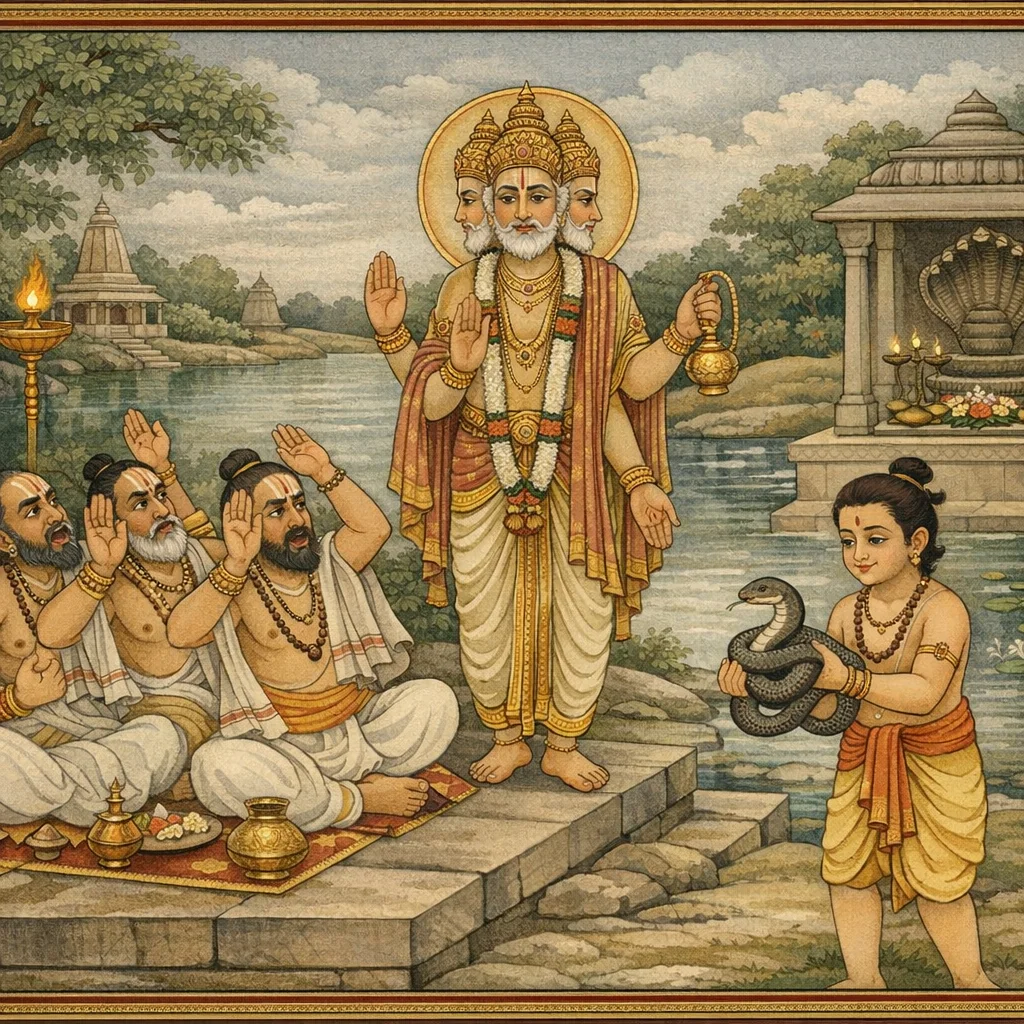
Chapter 183 describes a disruption during a multi-day yajña. A young ascetic student (baṭu), in play, tosses a harmless water-snake into the sacrificial assembly, alarming the officiants. The snake coils around the hotṛ (or a principal ritual functionary), heightening fear and confusion; a curse is uttered, and the baṭu is afflicted with serpenthood, illustrating Purāṇic insistence on ritual decorum and the unintended karmic weight of careless acts. Seeking release, the afflicted one approaches Bhṛgu; Chyavana’s connection is clarified as Bhṛgu compassionately intervenes, stressing the snake’s non-venomous nature and the disproportion of the punishment. Brahmā then arrives and reframes the episode as providential: the baṭu’s serpent-form becomes the seed for establishing the ninth nāga lineage on earth, regulated so as not to harm practitioners of mantra and medicine. The chapter identifies a beautiful water-source in the Hāṭakeśvara field and proclaims it Nāgatīrtha, prescribing worship and purifying bath (snāna), especially on the fifth lunar day (pañcamī) of the dark fortnight of Śrāvaṇa (with a parallel mention of Bhādrapada). It promises protection from snake-related fear, benefit to those afflicted by poison, and auspicious results such as relief from misfortune and the blessing of progeny. Major nāgas—Vāsuki, Takṣaka, Puṇḍarīka, Śeṣa, Kāliya—assemble; Brahmā assigns them protective duties for the yajña and establishes their periodic honor at Nāgatīrtha. The phalaśruti adds that hearing, reciting, writing, and keeping this māhātmya grants protective efficacy wherever the text is preserved.
Shlokas
Verse 1
सूत उवाच । द्वितीये दिवसे प्राप्ते यज्ञकर्मसमुद्भवे । द्वादश्यामभवत्तत्र शृणुध्वं तद्द्विजोत्तमाः । वृत्तान्तं सर्वदेवानां महाविस्मयकारकम्
Sūta said: When the second day arrived—arising in the course of the sacrificial rites—there it became the day of Dvādaśī. Listen, O best of brāhmaṇas, to an event concerning all the gods, wondrous indeed.
Verse 2
मखकर्मणि प्रारब्ध ऋत्विग्भिर्वेदपारगैः । जलसर्पं समादाय बटुः कश्चित्सुनर्मकृत्
When the sacrificial work had begun, carried out by officiants who had mastered the Vedas, a certain young brahmacārin—fond of mischief—took up a water-snake.
Verse 3
प्रविश्याथ सदस्तत्र तं सर्पं ब्राह्मणान्तिके । चिक्षेप प्रहसंश्चैव सर्वदुःखभयंकरम्
Entering the sacrificial assembly, he—laughing—threw that serpent near a brāhmaṇa; the deed became a cause of dread and a source of every sorrow.
Verse 4
ततस्तु डुण्डुभस्तूर्णं भ्रममाण इतस्ततः । विप्राणां सदसिस्थानां सक्तानां यज्ञकर्मणि
Then Ḍuṇḍubha hurriedly ran about here and there among the brāhmaṇas seated in the assembly, intent upon the sacrificial rites.
Verse 5
अहो होतुः स्थिते प्रैषे दीर्घसत्रसमुद्भवे । स सर्पो वेष्टयामास तस्य गात्रं समंततः
Alas—while the hotṛ stood at his appointed station in the midst of that long sacrificial session—the serpent coiled itself all around his body.
Verse 6
न चचाल निजस्थानात्प्रायश्चित्तविभीषया । नोवाच वचनं सोऽत्र चयनन्यस्तलोचनः
He did not stir from his own place, fearful at the thought of prāyaścitta, the rite of expiation; nor did he utter a single word there, keeping his gaze fixed upon the sacred act before him.
Verse 7
हाहाकारो महाञ्जज्ञे एतस्मिन्नंतरे द्विजाः । तस्मिन्सदसि विप्राणां विषा ढ्याहिप्रशंकया
Meanwhile a great cry of alarm arose among the dvija, the twice-born. In that assembly of brāhmaṇas, they feared the serpent was laden with poison.
Verse 9
हाहाकारो महानासीत्तं दृष्ट्वा सर्पवेष्टितम् । तस्य पुत्रो विनीतात्मा मैत्रावरुणकर्मणि
A great outcry arose on seeing him wrapped by the serpent. His son—self-controlled and disciplined—was engaged in the duties of the Maitrāvaruṇa priesthood within the rite.
Verse 10
यस्मात्पाप त्वया सर्पः क्षिप्तः सदसि दुर्मते । तस्माद्भव द्रुतं सर्पो मम वाक्यादसंशयम्
“Since you, O sinner of evil mind, threw a serpent into the sacred assembly, therefore—by my word, without doubt—become a serpent at once!”
Verse 11
बटुरुवाच । हास्येन जलसर्पोऽयं मया मुक्तोऽत्र लीलया । न ते तातं समुद्दिश्य तत्किं मां शपसि द्विज
The boy said: “In jest, playfully, I released this water-snake here. I did not aim it at your father—so why do you curse me, O brāhmaṇa?”
Verse 12
एतस्मिन्नंतरे मुक्त्वा तस्य गात्रं स पन्नगः । जगामान्यत्र तस्यापि सर्पत्वं समपद्यत
Just then, the serpent cast off his body and went elsewhere; and the offender too fell into the state of being a serpent.
Verse 13
सोऽपि सर्पत्वमापन्नः सनातनसुतो बटुः । दुःखशोकसमापन्नो ब्राह्मणैः परिवेष्टितः
That boy too—the son of Sanātana—became a serpent; overcome with grief and sorrow, he stood surrounded by the brāhmaṇas.
Verse 14
अथ गत्वा भृगुं सोऽपि बाष्पव्याकुललोचनः । प्रोवाच गद्गदं वाक्यं प्रणिपत्य पुरःसरः
Then he went to Bhṛgu; his eyes were troubled with tears. Bowing down in front, he spoke in a choked voice.
Verse 15
सनातनसुतश्चास्मि पौत्रस्तु परमेष्ठिनः । शप्तस्तव सुतेनास्मि च्यवनेन महात्मना
“I am the son of Sanātana, and the grandson of Parameṣṭhin. Yet I have been cursed by your son, the great-souled Cyavana.”
Verse 16
निर्दोषो ब्राह्मणश्रेष्ठ तस्माच्छापात्प्ररक्ष माम् । तच्छ्रुत्वा च्यवनं प्राह कृपाविष्टो भृगुः स्वयम्
“I am blameless, O best of brāhmaṇas; therefore protect me from this curse.” Hearing this, Bhṛgu himself—moved by compassion—addressed Cyavana.
Verse 17
अयुक्तं विहितं तात यच्छप्तोऽयं बटुस्त्वया । न मां धर्षयितुं शक्तो विषाढ्योऽपि भुजंगमः
Bhṛgu said: “My son, it was improper that you cursed this young brahmacārin. Even a serpent swollen with poison has no power to assail me.”
Verse 19
किं पुनर्जलसर्पोऽयं निर्विषो रज्जुसंनिभः । न मामुद्दिश्य निर्मुक्तः सर्पोऽनेन द्विजन्मना । शापमोक्षं कुरुष्वास्य तस्माच्छीघ्रं द्विजन्मनः
“How much less could this water-snake—venomless and like a mere rope—do anything? This serpent-form was not released by this twice-born one with me in mind. Therefore, O twice-born, quickly grant him release from the curse.”
Verse 20
तच्छ्रुत्वा वचनं तस्य स्वयमेव पितामहः । तत्रायातः स्थितो यत्र स पौत्रः सर्परूपधृक्
Hearing his words, the Grandfather himself came there and stood where that grandson—wearing the form of a serpent—was present.
Verse 21
प्रोवाच न विषादस्ते पुत्र कार्यः कथंचन । यत्सर्पत्वमनुप्राप्तः शृणुष्वात्र वचो मम
He said: “No sorrow should be entertained by you, my son, in any way. Since you have come to serpenthood, listen here to my words.”
Verse 22
पुरा संस्रष्टुकामोऽहं नागानां नवमं कुलम् । तद्भविष्यति त्वत्पार्श्वात्समर्यादं धरातले
“Formerly, desiring to bring forth a ninth lineage of Nāgas, I ordained this: from your side it shall arise upon the earth, established with proper bounds and order.”
Verse 23
मन्त्रौषधियुजां पुंसां न पीडामाचरिष्यति । संप्राप्स्यति परां पूजां समस्ते जगतीतले
He will not harm men who are furnished with mantras and medicines; and he will attain supreme veneration across the whole earth.
Verse 24
अत्राऽस्ति सुशुभं तोयं हाटकेश्वरसंज्ञिते । क्षेत्रे तत्र समावासः पुत्र कार्यस्त्वया सदा
Here there is splendid sacred water in the field called Hāṭakeśvara. There you should always dwell, my son.
Verse 25
तत्रस्थस्य तपस्थस्य नागः कर्कोटको निजम् । तव दास्यति सत्कन्यां ततः सृष्टिर्भविष्यति
To you, who remain there engaged in austerities, the Nāga Karkoṭaka will give his own virtuous maiden; and from that union, progeny—a lineage—shall arise.
Verse 26
नवमस्य कुलस्यात्र समर्यादस्य भूतले । श्रावणे कृष्णपक्षे तु संप्राप्ते पंचमीदिने
Here on earth, the ninth lineage—established within the proper bounds of dharma—shall, when the fifth lunar day arrives in the dark fortnight of Śrāvaṇa, come to its destined occasion.
Verse 27
संप्राप्स्यति परां पूजां पृथिव्यां नवमं कुलम् । अद्यप्रभृति तत्तोयं नागतीर्थमिति स्मृतम्
The ninth lineage will attain supreme honor upon the earth. From this very day onward, that water is remembered as “Nāga-tīrtha”.
Verse 28
ख्यातिं यास्यति भूपृष्ठे सर्वपातकनाशनम् । येऽत्र स्नानं करिष्यंति संप्राप्ते पंचमीदिने
It shall become renowned upon the face of the earth as the destroyer of all sins. Those who bathe here when the Pañcamī day arrives shall obtain that purifying merit.
Verse 29
न तेषां वत्सरंयावद्भविष्यत्यहिजं भयम् । विषार्द्दितस्तु यो मर्त्यस्तत्र स्नानं करिष्यति
For them, for as long as a year, there will be no fear arising from serpents. And any mortal afflicted by poison who bathes there…
Verse 31
करिष्यति तथा स्नानं फलहस्ता प्रभक्तितः । भविष्यति च सा शीघ्रं वंध्याऽपि च सुपुत्रिणी
If she likewise bathes there, holding fruits in her hands with sincere devotion, then even a barren woman will quickly be blessed with good sons.
Verse 32
सूत उवाच । एवं प्रवदतस्तस्य ब्रह्मणोऽव्यक्तजन्मनः । अन्ये नागाः समायातास्तत्र यज्ञे निमंत्रिताः
Sūta said: While that Brahmā—of unmanifest origin—was speaking thus, other Nāgas, invited to the sacrifice (yajña) there, arrived.
Verse 33
वासुकिस्तक्षकश्चैव पुण्डरीकः कृशोदरः । कम्बलाश्वतरौ नागौ शेषः कालिय एव च
Vāsuki and Takṣaka; Puṇḍarīka and Kṛśodara; the Nāgas Kambala and Aśvatara; and also Śeṣa and Kāliya.
Verse 34
ते प्रणम्य वचः प्रोचुः प्रोच्चैर्देवं पितामहम् । तवादेशाद्वयं प्राप्ता यज्ञेऽत्र प्रपितामह
Having bowed down, they spoke aloud to the divine Grandsire (Brahmā): “By your command we have come to this sacrifice here, O venerable Great-Grandfather.”
Verse 35
साहाय्यार्थं तदादेशो दीयतां प्रपितामह । येन कुर्मो वयं शीघ्रं नागराज्ये ह्यधिष्ठिताः
For the sake of aid, grant that instruction, O Great-Grandfather—by which, established in the sovereignty of the Nāgas, we may swiftly fulfill our duty.
Verse 36
ब्रह्मोवाच साहाय्यमेतदस्माकं भवदीयं महोरगाः । गत्वानेन समं शीघ्रं नागराजेन तिष्ठत
Brahmā said: “O great serpents, this assistance of yours is for our sake. Go quickly with him, and stand on guard with the king of the Nāgas.”
Verse 37
नागतीर्थे ततः स्थेयं सर्वैस्तत्र समास्थितैः
“Thereafter, all of you assembled there should remain stationed at Nāgatīrtha.”
Verse 38
यः कश्चिन्मम यज्ञेऽत्र दुष्टभावं समाश्रितः । समागच्छति विघ्नाय रक्षणीयः स सत्वरम्
“Whoever, taking refuge in wicked intent, comes here to obstruct my sacrifice—he must be restrained at once and guarded against.”
Verse 39
राक्षसो वा पिशाचो वा भूतो वा मानुषोऽपि वा । एतत्कृत्यतमं नागा मम यज्ञस्य रक्षणम्
Whether it be a rākṣasa, a piśāca, a bhūta, or even a human—O Nāgas, your foremost duty is to guard and protect my yajña, my sacred sacrifice.
Verse 40
तथा यूयमपि प्राप्ते मासि भाद्रपदे तथा । पंचम्यां कृष्णपक्षस्य तत्र पूजामवाप्स्यथ
Likewise, when the month of Bhādrapada arrives, on the fifth lunar day of the dark fortnight (kṛṣṇa-pakṣa), you too shall receive worship there.
Verse 41
सूत उवाच । बाढमित्येव ते प्रोच्य प्रणिपत्य पितामहम् । सनातनसुतोपेता नागतीर्थं समाश्रिताः
Sūta said: Saying, “So be it,” they bowed down to Pitāmaha (Brahmā). Accompanied by Sanātana’s sons, they took refuge at Nāgatīrtha.
Verse 42
ततःप्रभृति तत्तीर्थं नागतीर्थ मिति स्मृतम् । कामप्रदं च भक्तानां नराणां स्नानकारिणाम्
From that time onward, that sacred ford was remembered as “Nāgatīrtha,” and it became a bestower of desired blessings for devotees who bathe there.
Verse 43
यस्तत्र कुरुते स्नानं सकृद्भक्त्या समन्वितः । नान्वयेऽपि भयं तस्य जाय ते सर्पसंभवम्
Whoever bathes there even once with devotion—no fear arising from serpents will be born for him, not even within his lineage.
Verse 44
तत्र यच्छति मिष्टान्नं द्विजानां सज्जनैः सह । पूजयित्वा तु नागेंद्रान्सनातनपुरःसरान्
There, together with the virtuous, one should offer sweet food to the twice-born (brāhmaṇas), and then worship the lords of the Nāgas, with Sanātana at their head.
Verse 45
सप्तजन्मांतरं यावन्न स दौःस्थ्यमवाप्नुयात् । भूतप्रेतपिशाचानां शाकिनीनां विशेषतः । न च्छिद्रं न च रोगाश्च नाधयो न रिपोर्भयम्
For as long as seven lifetimes, he will not fall into misery. In particular, there will be no affliction from bhūtas, pretas, piśācas, or śākinīs; no misfortune, no diseases, no mental torments, and no fear from enemies.
Verse 46
यश्चैतच्छृणुयाद्भक्त्या वाच्यमानं द्विजोत्तमाः । सोऽपि संवत्सरं यावत्पन्नगैर्न च पीड्यते
O best of the twice-born, whoever listens with devotion as this glory is being recited—he too is not afflicted by serpents for as long as a year.
Verse 47
सर्पदष्टस्य यस्यैतत्पुरतः पठ्यते भृशम् । नागतीर्थस्य माहात्म्यं काल दष्टोऽपि जीवति
If this mighty recitation of the greatness of Nāga-tīrtha is read aloud in front of one who has been bitten by a serpent, then—even if he has been struck by death—he lives.
Verse 48
पुस्तके लिखितं चैतन्नागतीर्थसमुद्भवम् । माहात्म्यं तिष्ठते यत्र न सर्पस्तत्र तिष्ठति
And where this Nāga-tīrtha māhātmya—written down in a book—remains, no serpent stays in that place.
Verse 183
इति श्रीस्कांदे महापुराण एकाशीतिसाहस्र्यां संहितायां षष्ठे नागरखण्डे हाटकेश्वरक्षेत्रमाहात्म्ये नागतीर्थोत्पत्तिमाहात्म्यवर्णनंनाम त्र्यशीत्युत्तरशततमोऽध्यायः
Thus, in the revered Skanda Mahāpurāṇa, in the Saṁhitā of eighty-one thousand ślokas, in the sixth book—Nāgara-khaṇḍa—within the glorification of the sacred region of Hāṭakeśvara, the one-hundred-and-eighty-third chapter comes to an end, entitled “The Description of the Greatness of the Origin of Nāga-tīrtha.”