Adhyaya 18
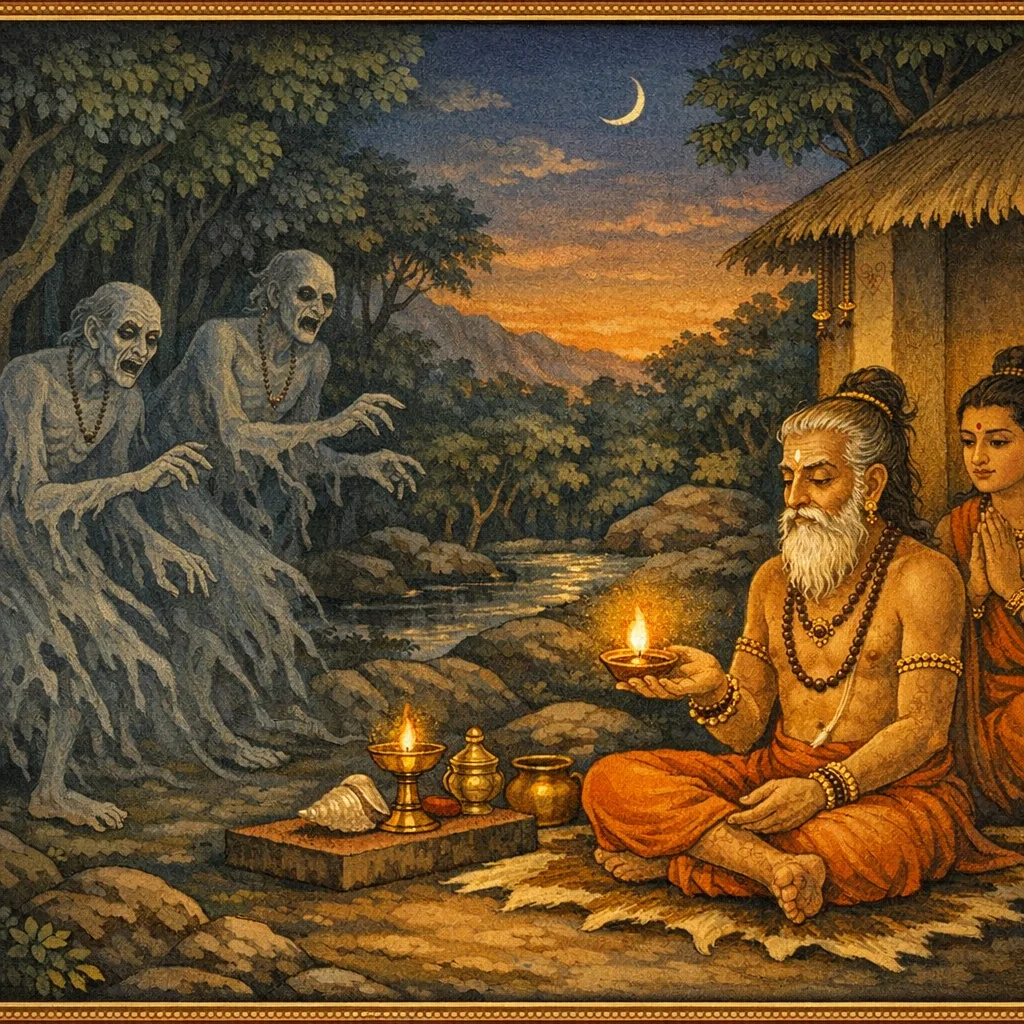
Chapter 18 moves in two connected parts. In a harsh forest, King Vidūratha, worn down by hunger and thirst, meets three terrifying preta-beings. In a structured dialogue they name themselves by karmic epithets (Māṃsāda, Vidaivata, Kṛtaghna) and explain the deeds that brought their fate: persistent unvirtuous conduct, neglect of worship, ingratitude, and other ethical breaches. The teaching then widens into a practical guide to household ritual ethics, listing occasions when pretas are said to “consume” offerings or food—improper śrāddha timing, deficient dakṣiṇā, lack of auspiciousness in the home, neglect of vaiśvadeva, disrespect to guests, and impurity or contamination of food. It also enumerates acts leading to preta-state—paradāra (pursuing another’s spouse), theft, slander, betrayal, misuse of others’ wealth, obstructing gifts to brāhmaṇas, abandoning a blameless wife—while praising protective virtues such as seeing others’ spouses as mother, generosity, equanimity, compassion to beings, devotion to yajña and tīrtha, and public-benefit works like wells and tanks. The pretas ask for Gayā-śrāddha as the decisive remedial rite. Thereafter the king travels north, finds a serene lake-side āśrama, meets the sage Jaimini and ascetics, receives water and fruit, recounts his distress, and joins the evening rites. As night falls, the imagery turns into moralized warnings about nocturnal dangers and the need for vigilance in dharma.
Shlokas
Verse 1
। सूत उवाच । ततः सोऽपि महीपालः क्षुत्पिपामासमाकुलः । पपात धरणीपृष्ठे पद्भ्यां गत्वा वनांतरम्
Sūta said: Then that protector of the earth, tormented by hunger and thirst, went on foot into the interior of the forest and collapsed upon the ground.
Verse 2
अथाऽपश्यद्वियत्स्थानात्स त्रीन्प्रेतान्सु दारुणान् । ऊर्ध्वकेशान्सुरक्ताक्षान्कृष्णदन्तान्कृशोदरान्
Then, from a place in the sky, he beheld three exceedingly terrifying pretas—hair standing upright, eyes blood-red, teeth black, and bellies gaunt.
Verse 3
तान्दृष्ट्वा भयसंत्रस्तो विशेषेण स भूपतिः । निराशो जीविते कृच्छ्रादिदं वचनमब्रवीत्
Seeing them, the king became especially terrified; despairing of life amid that hardship, he spoke these words.
Verse 4
के यूयं विकृताकारा मया दृष्टा न कर्हिचित् । एवंविधा नृलोकेऽत्र भ्रमता प्राग्विभीषणाः
“Who are you, of such distorted forms? Never before have I seen (beings) like you. How do such terrifying ones wander here in the human world?”
Verse 5
विदूरथो नरेन्द्रोऽहं क्षुत्पिपासातिपीडितः । मृगलिप्सुरिह प्राप्तो वने जन्तुविवर्जिते
“I am King Vidūratha, sorely afflicted by hunger and thirst. Seeking game, I have come here into this forest, deserted by living creatures.”
Verse 6
ततस्तेषां तु यो ज्येष्ठो मांसादः प्रत्युवाच तम् । कृतांजलिपुटो भूत्वा विनयावनतः स्थितः
Then the eldest among them—the flesh-eater—replied to him, standing with palms joined in reverence, bowed down in humble submission.
Verse 7
वयं प्रेता महाराज निवसामोऽत्र कानने । स्वकर्मजनिताद्दोषाद्दुःखेन महता वृताः
“We are pretas, O great king, dwelling in this forest. By the fault born of our own deeds, we are enveloped in immense suffering.”
Verse 8
अहं मांसादकोनाम द्वितीयोऽयं विदैवतः । कृतघ्नश्च तृतीयस्तु त्रयाणामेष पापकृत्
“I am named Māṃsāda. This second one is called Vidaivata. The third is Kṛtaghna; thus, these are the three—each a doer of sin.”
Verse 9
राजोवाच । सर्वेषां देहि नां नाम जायते पितृमातृजम् । किमेतत्कारणं येन सर्वे यूयं स्वनामकाः
The King said: “For all embodied beings, a name is born from the father and mother. What is the reason that all of you bear names of your own making?”
Verse 10
तच्छ्रुत्वा प्राह मांसादः कर्मनामानि पार्थिव । मिथः कृतानि संज्ञार्थमस्माभिः स्वयमेव हि
Hearing this, Māṃsāda said: “O King, these are names born of deeds—mutually assigned by us ourselves, as labels indicating our conduct.”
Verse 11
शृणुष्वाऽवहितो भूत्वा सर्वेषां नः पृथक्पृथक् । कर्मणा येन संजातं प्रेतत्वमिह भूमिप
Listen with full attention, O ruler of the earth, as I tell you—one by one—the deeds (karma) by which each of us has come here to the state of a preta.
Verse 12
वयं हि ब्राह्मणा जात्या वैदिशाख्ये पुरे नृप । देवरातस्य विप्रस्य गृहे जाता महात्मनः
We were Brahmins by birth, O King, born in the city called Vidiśā, in the house of the noble Brahmin Devarāta, a great-souled man.
Verse 13
नास्तिका भिन्नमर्यादाः परदाररताः सदा । पाप कर्मरतास्तत्र शुभकर्मविवर्जिताः
There we became unbelievers, breakers of proper bounds—ever attached to others’ wives—devoted to sinful acts and devoid of auspicious deeds.
Verse 14
जिह्वालौल्यप्रसंगेन मया भुक्तं सदाऽमिषम् । तेन मे कर्मजं नाम मांसादाख्यं व्यवस्थितम्
Driven by the craving of the tongue, I always ate flesh. Therefore my deed-born name has been fixed as “Māṃsāda,” the eater of meat.
Verse 15
द्वितीयोऽयं महाराज यस्तिष्ठति तवाऽग्रतः । अनेनाऽन्नं सदा भुक्तमकृत्वा देवतार्चनम्
O great king, this second one who stands before you always ate his food without first performing worship of the deities.
Verse 16
तेन कर्मविपाकेन प्रेतयोनिं समाश्रितः । विदैवत इति ख्यातो द्वितीयोऽयं सुपापकृत्
By the ripening of that deed, he has entered the womb-state of a preta. Thus he is known as ‘Vidaivata’; this second one is a great sinner.
Verse 17
सदैवाऽनुष्ठिताऽनेन सुपापेन कृतघ्नता । कृतघ्नः प्रोच्यते तेन कर्मणा नृपसत्तम
Ungratefulness was constantly practiced by this great sinner. Therefore, because of that deed, O best of kings, he is called ‘Kṛtaghna’.
Verse 18
राजोवाच । आहारेण नृलोकेऽस्मिन्सर्वे जीवन्ति जन्तवः । युष्माकं कतमो योऽत्र प्रोच्यतां मे सविस्तरम्
The King said: “In this human world, all creatures live by means of food. Tell me in detail—who among you is (especially) sustained here, and by what means?”
Verse 19
मांसाद उवाच । भोज्यकाले गृहे यत्र स्त्रीणां युद्धं प्रवर्तते । अपि मन्त्रौषधीप्रायं प्रेता भुंजति तत्र हि
Māṃsāda said: “In that house where, at the time of eating, quarrel breaks out among the women—there indeed the pretas partake of the food, even if it has been prepared with mantras and medicinal herbs.”
Verse 20
भुज्यते यत्र भूपाल वेंश्वदेवं विना नरैः । पाकस्याग्रमदत्त्वा च प्रेता भुंजति तत्र च
“O King, where people eat without performing the Vaiśvadeva offering, and where the first portion of the cooked food is not given—there too the pretas partake.”
Verse 21
रात्रौ यत्क्रियते श्राद्धं दानं वा पर्ववर्जितम् । तत्सर्वं नृपशार्दूल प्रेतानां भोजनं भवेत्
Whatever śrāddha or charity is performed at night, or done without regard for the proper sacred occasion (parvan)—all of it, O tiger among kings, becomes food for the pretas.
Verse 22
यस्मिन्नो मार्जनं हर्म्ये क्रियते नोपलेपनम् । न मांगल्यं च सत्कारः प्रेता भुंजति तत्र हि
In a house where there is sweeping but no proper smearing/plastering and upkeep, and where there is neither auspicious observance nor honoring of guests—there indeed the pretas partake.
Verse 23
भिन्नभाण्डपरित्यागो यत्र न क्रियते गृहे । न च वेदध्वनिर्यत्र प्रेता भुञ्जंति तत्र हि
In a house where broken vessels are not discarded, and where the sound of the Veda is not heard—there indeed the pretas partake.
Verse 24
यच्छ्राद्धं दक्षिणाहीनं क्रियाहीनं च वा नृप । तथा रजस्वलादृष्टं तदस्माकं प्रजायते
Any śrāddha, O King, performed without dakṣiṇā or lacking proper procedure—and likewise any śrāddha tainted by the presence or sight of a menstruating woman—comes to be ours, that is, it accrues to the pretas.
Verse 25
हीनांगा ह्यधिकांगा वा यस्मिञ्च्छ्राद्धे द्विजातयः । भुंजते वृषलीनाथास्तदस्माकं प्रजायते
That śrāddha at which the twice-born partake while being ritually unfit—whether defective-limbed or extra-limbed—and those bound by improper associations: such a śrāddha comes to be ours, that is, it accrues to the pretas.
Verse 26
अतिथिर्यत्र संप्राप्तः श्राद्धकाल उपस्थिते । अपूजितो गृहाद्याति तच्छ्राद्धं प्रेततृप्तिदम्
When an unexpected guest arrives at the time of śrāddha, and departs the house without being honored—such a śrāddha becomes one that satisfies the pretas.
Verse 27
किं वा ते बहुनोक्तेन शृणु संक्षेपतो नृप । अस्माकं भोजनं नित्यं यत्त्वं श्रुत्वा विगर्हसि
What is the use of saying much more? Hear it briefly, O King: our food is always that which—when you hear of it—you condemn.
Verse 28
यदन्नं केशसूत्रास्थिश्लेष्मादिभिरुपप्लुतम् । हीनजात्यैश्च संस्पृष्टं तदस्माकं प्रजायते
Food that is defiled by hairs, threads, bones, mucus and the like, and that has been touched by those deemed of inferior birth—such food, indeed, becomes ours.
Verse 29
राजोवाच । केन कर्मविपाकेन प्रेतत्वं जायते नृणाम् । एतन्मे सर्वमाचक्ष्व मांसाद मम पृच्छतः
The King said: “By what ripening of karma does the state of a preta arise for human beings? Tell me all of this in full, O eater of flesh, as I ask you.”
Verse 32
परदाररतश्चैव परवित्तापहारकः । परापवादसंतुष्टः स प्रेतो जायते नरः
A man who delights in another’s wife, who steals another’s wealth, and who takes pleasure in slandering others—such a man is born as a preta.
Verse 33
कन्यां यच्छति वृद्धाय नीचाय धनलिप्सया । कुरूपाय कुशीलाय स प्रेतो जायते नरः
A man who, out of greed for wealth, gives his daughter to an old man, to a base man, to an ill-favored man, to one of bad conduct—such a man is born as a preta.
Verse 34
कुले जातां विनीतां च धर्मपत्नीं सुखोच्छ्रिताम् । यस्त्यजेद्दोषनिर्मुक्तां स प्रेतो जायते नरः
He who abandons his lawful wife—born in a good family, modest, and well-established in comfort—though she is free from fault, that man is born as a preta.
Verse 35
देवस्त्रीगुरुवित्तानि यो गृहीत्वा न यच्छति । विशेषाद्ब्राह्मणस्वं च स प्रेतो जायते नरः
He who takes wealth belonging to a deity, to a woman, or to a guru and does not return it—especially property belonging to a Brāhmaṇa—such a man is born as a preta.
Verse 36
परव्यसनसंतुष्टः कृतघ्नो गुरुतल्पगः । दूषको देवविप्राणां स प्रेतो जायते नरः
One who delights in another’s misfortune, who is ungrateful, who violates the guru’s bed, and who maligns the gods and the Brāhmaṇas—such a man is born as a preta.
Verse 37
दीयमानस्य वित्तस्य ब्राह्मणेभ्यः सुपापकृत् । विघ्नमारभते यस्तु स प्रेतो जायते नरः
That great sinner who creates obstacles when wealth is being given to Brāhmaṇas—such a man is born as a preta.
Verse 38
शूद्रान्नेनोदरस्थेन ब्राह्मणो म्रियते यदि । स प्रेतो जायते राजन्यद्यपि स्यात्षडंगवित्
O King, if a Brāhmaṇa dies with food received from a Śūdra still in his stomach, he becomes a preta—even if he is a knower of the six limbs (of the Veda).
Verse 39
कुलदेशोचितं धर्मं यस्त्यक्त्वाऽन्यत्समाचरेत् । कामाद्वा यदि वा लोभात्स प्रेतो जायते नरः
A man who abandons the dharma appropriate to his family and region and practices another—whether out of desire or out of greed—such a man is born as a preta.
Verse 40
एतत्ते सर्वमाख्यातं मया पार्थिवसत्तम । येन कर्मविपाकेन प्रेतः संजायते नरः
O best of kings, I have now told you in full how, by the ripening of one’s deeds, a human being comes to be born as a preta (restless departed spirit).
Verse 41
राजोवाच । कृतेन कर्मणा येन न प्रेतो जायते नरः । तन्मे कीर्तय मांसाद विस्तरेण विशेषतः
The King said: “By what deeds, once performed, does a man not become a preta? Tell me that, O Māṃsāda—clearly, in detail, and with special precision.”
Verse 42
मांसाद उवाच । मातृवत्परदारान्यः परद्रव्याणि लोष्टवत् । यः पश्यत्यात्मवज्जंतून्न प्रेतो जायते नरः
Māṃsāda said: “He who regards another’s wife as a mother, another’s wealth as a clod of earth, and all living beings as his own self—such a man is not born as a preta.”
Verse 43
अन्नदानपरो नित्यं विशेषेणातिथिप्रियः । स्वाध्यायव्रतशीलो यो न प्रेतो जायते नरः
He who is ever devoted to the gift of food, who takes special joy in honoring guests, and who is disciplined in svādhyāya and sacred vows—such a man is not born as a preta.
Verse 44
समः शत्रौ च मित्रे च समलोष्टाश्मकांचनः । समो मानापमानेषु न प्रेतो जायते नरः
He who remains even-minded toward enemy and friend alike, who regards clod, stone, and gold as equal, and who is the same in honor and dishonor—such a man is not born as a preta.
Verse 46
यूकामत्कुणदंशादीन्सर्वसत्त्वानि यो नरः । पुत्रवत्पालयेन्नित्यं न प्रेतो जायते नरः
That man who continually protects all beings—even lice, bugs, and biting creatures—as if they were his own children, is not born as a preta.
Verse 47
सदा यज्ञक्रियोपेतः सदा तीर्थपरायणः । शास्त्रश्रवणसंयुक्तो न प्रेतो जायते नरः
He who is ever engaged in sacrificial and sacred rites, ever devoted to tīrthas and holy places, and joined to the listening of śāstra—such a man is not born as a preta.
Verse 48
वापीकूपतडागानामारामाणां विशे षतः । आरोपकः प्रपाणां च न प्रेतो जायते नरः
He who causes the making of wells, stepwells, and ponds, and especially lays out gardens and establishes drinking-water stations—such a man is not born as a preta.
Verse 49
दानधर्मप्रवृत्तानां धर्ममार्गा नुयायिनाम् । प्रोत्साहं वर्धयेद्यस्तु न प्रेतो जायते नरः
He who increases the zeal and encouragement of those devoted to charity (dāna) and dharma, and of those who follow the path of righteousness—such a man is not born as a preta.
Verse 50
गत्वा गयाशिरः पुण्यमेकैकस्य पृथक्पृथक् । श्राद्धं देहि महीपाल त्रयाणामपि सादरम्
Having gone to the holy Gayāśiras, O protector of the earth, perform śrāddha—separately for each one—and do so with reverence for all three.
Verse 51
प्रेतत्वं याति येनेदं त्वत्प्र सादात्सुदारुणम् । नाऽन्यथा मुक्तिरस्माकं भविष्यति कथंचन
By your grace, this most dreadful state has become the condition of a preta. In no other way whatsoever will liberation (mokṣa) ever be possible for us.
Verse 52
राजोवाच । ईदृग्जातिस्मृतिर्यस्यां प्रेतयोनौ च खे गतिः । धर्माधर्मपरिज्ञानं तच्च कस्मात्प्रनिंदसि
The King said: “In this preta-state there is remembrance of past births, movement through the sky, and discernment of dharma and adharma—why then do you condemn it?”
Verse 53
मांसाद उवाच । प्रेतयोनिरियं राजन्नवमी देवसंज्ञिता । गुणत्रयसमायुक्ता शेषैर्दोषैः समंततः
Māṃsāda said: “O King, this preta-condition is called the ‘Ninth’, and is even termed ‘divine’. It is endowed with the three guṇas, yet it is surrounded on every side by other defects.”
Verse 54
एका जातिस्मृतिः सम्यगस्यामेवप्रजायते । खेचरत्वं तथैवान्यद्धर्माधर्मविनिश्चयः
In this very state arise three distinct endowments: true memory of past births, the power to move through the sky, and clear ascertainment of dharma and adharma.
Verse 55
एतद्गुणत्रयं प्रोक्तं प्रेतयोनौ नृपोत्तम । दोषानपि च ते वच्मि ताञ्च्छृणुष्व समाहितः
O best of kings, these three qualities have been stated regarding the preta-state. Now I shall also tell you its defects—listen with a collected mind.
Verse 56
यदि तावद्वनादस्माद्यामोन्यत्र वयं नृप । अदृष्टमुद्गराघातैर्नूनं हन्यामहे ततः
O King, if we try to go elsewhere from this forest, then surely we are struck down there by unseen blows of a mace.
Verse 57
तथा धर्मक्रियाः सर्वा मानुषाणामुदाहृताः । न प्रेतानां न देवानां नान्येषां मानुषं विना
Likewise, all acts of dharma are declared to belong to human beings. Not for pretas, not for gods, nor for any others—human embodiment alone is the field for dharmic action.
Verse 58
पश्यामो दूरतो राजञ्जलपूर्णाञ्जला शयान् । पिपासाकुलिताः श्रांता भास्करे वृषसंस्थिते
O King, from afar we see others lying with their cupped hands filled with water—tormented by thirst and exhausted—while the sun stands in Taurus.
Verse 59
गच्छामः संनिधौ तेषां यदि पार्थिवसतम । अदृष्टमुद्गराघातैर्वयं हन्यामहे ततः
O best of kings, if we draw near to them, then even there we are struck down by unseen blows of a mace.
Verse 60
तथा रसवती सिद्धाः पश्यामो दूरसंस्थिताः । क्षुधाविष्टा गृहस्थानां गृहेषु विविधा नृप
So too, O King, from a distance we behold abundant, delicious foods prepared in the many homes of householders—yet we remain seized by hunger in various ways.
Verse 61
तथा सुफलिनो वृक्षान्कलपक्षिभिरावृतान् । स्निग्धान्सच्छाययोपेतान्सेवितुं न लभामहे
Likewise, we do not obtain the chance to rest by fruit-laden trees—trees covered with flocks of birds, fresh and verdant, endowed with pleasing shade.
Verse 62
किंवा ते बहुनोक्तेन यद्यत्कर्म विगर्हितम् । क्लेशदं च तदस्माकं स्वयमेवोपतिष्ठते
But what is the use of saying much? Whatever action is censurable and brings affliction—that alone comes to us of its own accord.
Verse 63
न च्छिद्रेण विनाऽस्माकं प्राणयात्रा प्रजायते । न जलानि न च च्छाया न यानं न च वाहनम्
Without a “gap” (some opening or support), our very continuance of life does not proceed. There is no water for us, no shade, no conveyance, and no mount.
Verse 64
एतस्मात्कारणान्नित्यं भ्रमामश्छिद्रहेतवे । प्राप्ते रात्रिमुखे राजन्न प्रातर्न च वासरे
For this reason we wander ceaselessly, seeking some “opening” (relief or support). When the threshold of night draws near, O King, there is no morning for us—nor any day.
Verse 65
यत्त्वं शंससि चाऽस्माकं खेचरत्वं महीपते । व्यर्थं तदपि न श्रेयः शृणु तत्रापि कारणम्
And as for what you praise in us—this ‘sky-going’ nature, O lord of the earth—even that is futile and not truly beneficial. Hear the reason for that as well.
Verse 66
क्रियते खेचरत्वेन किंकिं धर्मं विनिश्चयैः । यतो न सिध्यते मोक्षो जाति स्मृत्यादिकं तथा
What dharma, decided with certainty, is accomplished merely through ‘sky-going’? For by it liberation is not attained—nor even such things as remembrance of one’s birth and the like.
Verse 67
तस्माद्दोषादिमे राजन्गुणा यद्यपि कीर्तिताः । प्रेतानां यान्समाश्रित्य काचित्सिद्धिर्न जायते
Therefore, O King, even if these ‘qualities’ are spoken of, because of that fault no real attainment arises for pretas who depend upon them.
Verse 68
विषादो जायते भूयो गुणैरेतैर्नराधिप । अशक्ताः प्रेतयोगाद्वै सर्वस्य शुभकर्मणः
Rather, O ruler of men, sorrow increases because of these very ‘advantages’; for, bound to the preta condition, we are indeed incapable of every auspicious act.
Verse 69
राजोवाच यदि यास्यामि भूयोऽहं गृहमस्मान्महावनात् । तत्करिष्यामि सर्वेषां गयाश्राद्धमसंशयम्
The King said: If I return again from this great forest to my home, then without doubt I shall perform the Gayā-śrāddha for all of them.
Verse 70
तारयिष्यामि सर्वांश्च सर्वपापैः प्रयत्नतः । अप्यात्मदेहदानेन सत्येनात्मानमालभे
I shall strive to deliver them all from every sin. Even by giving my own body—by truth itself—I shall pledge myself to this resolve.
Verse 71
यस्माद्धृद्गतशंका मे हृता युष्माभिरद्य वै । येन तत्प्राप्य युष्माकमुपकारं करोम्यहम्
Since today you have truly removed the doubt that had lodged in my heart, I shall now—having obtained the means to do so—render service in return for your kindness.
Verse 72
मांसाद उवाच । इतः स्थानान्महाराज नातिदूरे जलाशयः । अस्ति नानाद्रुमोपेतश्चित्ताह्लादकरः परः
Māṃsāda said: “O great king, not far from this place there is a reservoir of water, adorned with many kinds of trees—truly a supremely delightful sight that gladdens the mind.”
Verse 73
तस्मादुदङ्मुखो गच्छ यत्र ते जलपक्षिणः । दृश्यंते व्योममार्गेण प्रगच्छतः समंततः
Therefore go facing north, to the place where those water-birds are seen, moving along the pathways of the sky, flying all around.
Verse 74
सूत उवाच । अथासौ नृपशार्दूलः समुत्थाय शनैःशनैः । सौम्यां दिशं समुद्दिश्य प्रतस्थे स तु दुःखितः
Sūta said: Then that tiger among kings rose up slowly, and setting his course toward the gentle northern direction, he set out—yet his heart was sorrowful.
Verse 76
एवं प्रगच्छता तेन क्षुत्पिपासाकुलेन च । अदूरादेव संदृष्टं नीलं द्रुमकदंबकम् । भ्रममाणैर्बकैर्हंसैः सारसैर्मद्गुभिस्तथा
As he went on, distressed by hunger and thirst, he saw not far away a dark-blue thicket of trees, around which cranes, swans, sārasa birds, and madgu birds were circling.
Verse 77
अथाऽपश्यन्मनोहारि सौम्यसत्त्वनिषेवितम् । आश्रमं ह्रदतीरस्थं तापसैः सर्वतो वृतम्
Then he beheld a charming hermitage, frequented by gentle beings, set upon the lake’s bank and surrounded on every side by ascetics.
Verse 78
पुष्पितैः फलितैर्वृक्षैः समंतात्परिवेष्टितम् । विचित्रैर्मधुरारावैर्नादितं विहगोत्तमैः
It was encircled on every side by trees in blossom and fruit, and it resounded with the varied, sweet calls of excellent birds.
Verse 79
तत्रापश्यन्नगाधस्तात्तपस्विगणसेवितम् । शिवधर्मपरं शांतं जैमिनिं मुनिसत्तमम्
There he saw Jaimini, best among sages—serene, devoted to the dharma of Śiva, and attended by companies of ascetics, O dear one.
Verse 80
अथ गत्वा स राजेंद्रः प्रणिपत्य मुनीश्वरम् । तथान्यानपि तच्छिष्यान्निपपात धरातले
Then the majestic king drew near; bowing low before the lord of sages, he also fell upon the earth in reverence before that sage’s other disciples.
Verse 81
ते दृष्ट्वाऽदृष्टपूर्वं तं राजलक्षणलक्षितम् । धूलिधूसरितांगं च भस्मावृतमिवाचलम्
Seeing him—one they had never beheld before—yet marked with the signs of royalty, and with limbs greyed by dust like a mountain veiled in ash, they took notice.
Verse 82
मन्यमाना महीपालं विस्मयोत्फुल्ललोचनाः । प्रोचुश्च मधुरैर्वाक्यैराशीर्वादपुरःसरैः
Taking him to be a king, their eyes wide with wonder, they addressed the protector of the earth with sweet words, prefacing their speech with blessings.
Verse 84
पार्थिवस्येव लिंगानि दृश्यंते तव भूरिशः । न विद्मो निश्चयं तस्माद्वदागमनकारणम्
O mighty one, the marks of a sovereign are clearly seen upon you; yet we cannot be certain—therefore, tell us the reason for your arrival.
Verse 85
अथोवाच नृपः कृच्छ्रात्पिपासा मां प्रबाधते । तस्माद्वदत पानीयं यत्पीत्वा कीर्तयाम्यहम्
Then the king said, distressed: “Thirst torments me. Therefore, tell me of that water—having drunk it, I shall proclaim its glory.”
Verse 86
ततस्तैर्दर्शितं तोयं समीपे यन्महीपतेः । सोऽपि पीत्वाऽवगाह्याथ वितृष्णः समपद्यत
Then they showed him the water nearby. The king too, having drunk and bathed in it, became free from thirst.
Verse 87
ततः फलानि पक्वानि तरूणां पतितान्यधः । सुमृष्टानि समादाय भक्षयामास वांछया
After that, he took ripe fruits that had fallen beneath the trees, cleaned them well, and ate them as he desired.
Verse 88
ततस्तृप्तिं परां प्राप्य गत्वा जैमिनिसंनिधौ । उपविष्टः प्रणम्योच्चैस्तथान्यांश्च मुनीन्क्रमात्
Then, having attained full satisfaction, he went into Jaimini’s presence; he sat down after bowing respectfully, and likewise bowed to the other sages in due order.
Verse 89
उवाच च निजां वार्तां कृतांजलिपुटः स्थितः । स पृष्टस्तापसैः सर्वैः सुविस्मयसमन्वितैः
Standing with hands joined in reverence, he related his own story—having been questioned by all the ascetics, who were filled with great astonishment.
Verse 90
विदूरथो महीपोऽहं माहिष्मत्यां कृतास्पदः । मृगलिप्सुर्वने घोरे प्रविष्टः सैनिकैः सह
“I am King Vidūratha, established in Māhiṣmatī. Desiring game, I entered a dreadful forest together with my soldiers.”
Verse 91
ततो मे भ्रममाणस्य प्रणष्टाः सर्वसैनिकाः । गुल्मैरंतरिताश्चाऽन्ये न जानेऽहं कथं स्थिताः
Then, as I wandered, all my soldiers vanished; others were cut off by thickets—I do not know how they fared.
Verse 92
आसीद्धयो ममाऽधस्ताज्जात्यः सर्वगुणान्वितः । सोऽपि कर्मविपाकेन पञ्चत्वं समुपस्थितः ।ा
There was my horse beneath me—of fine breed and endowed with every good quality. Yet even he, by the ripening of karma, met his end and returned to the five elements.
Verse 93
कुतस्त्वमनुसंप्राप्तो वनेऽस्मिञ्जनवर्जिते । एकाकी सुकुमारांगः पदातिः श्रमविह्वलः
From where have you come into this forest, so devoid of people? All alone, of delicate limbs, traveling on foot, you appear overcome by weariness.
Verse 94
ततस्ते तापसाः प्रोचुर्विद्महे न वयं पुरीम् । त्वां च देशं च ते राजन्कोऽयं देशश्च कीर्त्यते
Then those ascetics said: “We do not know of cities. O King, we know neither you nor your realm—what is this country, and by what name is it renowned?”
Verse 95
नरेन्द्रैर्नैव नः कार्यं न दिशैर्न पुरैर्नृप । वनेचरा वयं नित्यं शिवाराधनतत्पराः
O King, we have no business with monarchs, nor with directions and territories, nor with cities. We dwell in the forest always, intent upon the worship of Śiva.
Verse 96
सर्वे शीर्णानि वृक्षाणां पुष्पाणि च फलानि च । भक्षयामोऽथ पत्राणि शरी रस्थितिहेतुना
We eat only what has fallen from the trees—flowers and fruits—and then leaves as well, solely for the maintenance of the body.
Verse 97
मानुषैः सह संसर्गं संभाषं च नराधिप । न कुर्मो न च पश्यामो गच्छामोऽन्यत्र दूरतः
O lord of men, we neither associate nor converse with ordinary people; we do not even look upon them—rather, we go elsewhere, far away.
Verse 98
एकैकस्य तरोर्मूले दिवसं वा दिनद्वयम् । तिष्ठामो न भवेद्येन ममत्वं तत्समुद्भवम्
At the root of each tree we stay for a day, or at most two days—so that no sense of ‘mine-ness’ arises from dwelling there.
Verse 99
कारणात्तव राजेंद्र निशामेतां वनस्पतौ । नेष्यामोऽन्यत्र यास्यामः प्रभा तेऽन्यत्र कानने
But for your sake, O king of kings, we shall pass this night here by the tree. At daybreak we shall go elsewhere, and your radiance will shine in another forest.
Verse 101
एकाकी पार्थिवेन्द्रोऽयं नेष्यति च कथं निशाम् । वनेऽस्मिन्मंत्रयित्वैवं ततोऽत्रैव व्यवस्थिताः
“How will this lord among kings, all alone, pass the night in this forest?” Having thus deliberated in this woodland, they then resolved to remain right there.
Verse 102
तस्मादत्रैव नेष्यामः समेताः शर्वरीमिमाम् । गंतव्यं प्रातरुत्थाय ततः सर्वैर्यदृच्छया
Therefore, let us all remain here together and pass this night. Rising in the morning, then each may go on as fate allows.
Verse 103
एवं संवदतां तेषां भगवांस्तीक्ष्णदीधितिः । अस्ताचलमनुप्राप्तः कुंकुमक्षोदसंनिभः
As they spoke thus, the Blessed one of piercing rays—the Sun—reached the mountain of setting, appearing like powdered saffron.
Verse 104
अथ तास्तापसान्राजा प्रोवाच प्रणतः स्थितः । संध्याकालः समायातः सांप्रतं मुनिसत्तमाः । तस्मात्संध्याविधिः कार्यः सर्वैरेव यथोचितः
Then the king, standing with reverence and humility, addressed those ascetics: “O best of sages, the time of Sandhyā has now arrived. Therefore, let the Sandhyā-rites be performed by all, each in the proper manner.”
Verse 105
अथ ते मुनयः सर्वे स च राजा तथा द्विजाः । चक्रुः सायंतनं कर्म यथोद्दिष्टं पुरातनैः
Then all those sages—along with the king and the twice-born—performed the evening observances, exactly as the ancients had prescribed.
Verse 106
कामिभिः कामिनीलोकैः प्रियोक्तैरभिवां छिता । असत्स्त्रीभिर्विशेषेण संप्राप्ता रजनी ततः
Thereupon night arrived—longed for by lustful men and by the company of wanton women, and sought after for its sweet, enticing words—especially by women of unvirtuous conduct.
Verse 107
पीयूषार्णववेलेव विषवृक्षलतेव च । उलूकैश्चक्रवाकैश्च युगपद्या विलोक्यते
It is beheld at once in two contrary ways—like the shore of the ocean of amṛta, and also like a creeper clinging to a poison-tree—by owls and by cakravāka birds alike.
Verse 108
उलूका राक्षसाश्चौराः कामिनः कुलटांऽगनाः । यां वांछंति सदा सोत्काः सुवृष्टिमिव कर्षुकाः
Owls, rākṣasas, thieves, lust-driven men, and wanton women ever yearn for that (night) with eager longing—just as farmers long for a благословенный rainfall.