Adhyaya 178
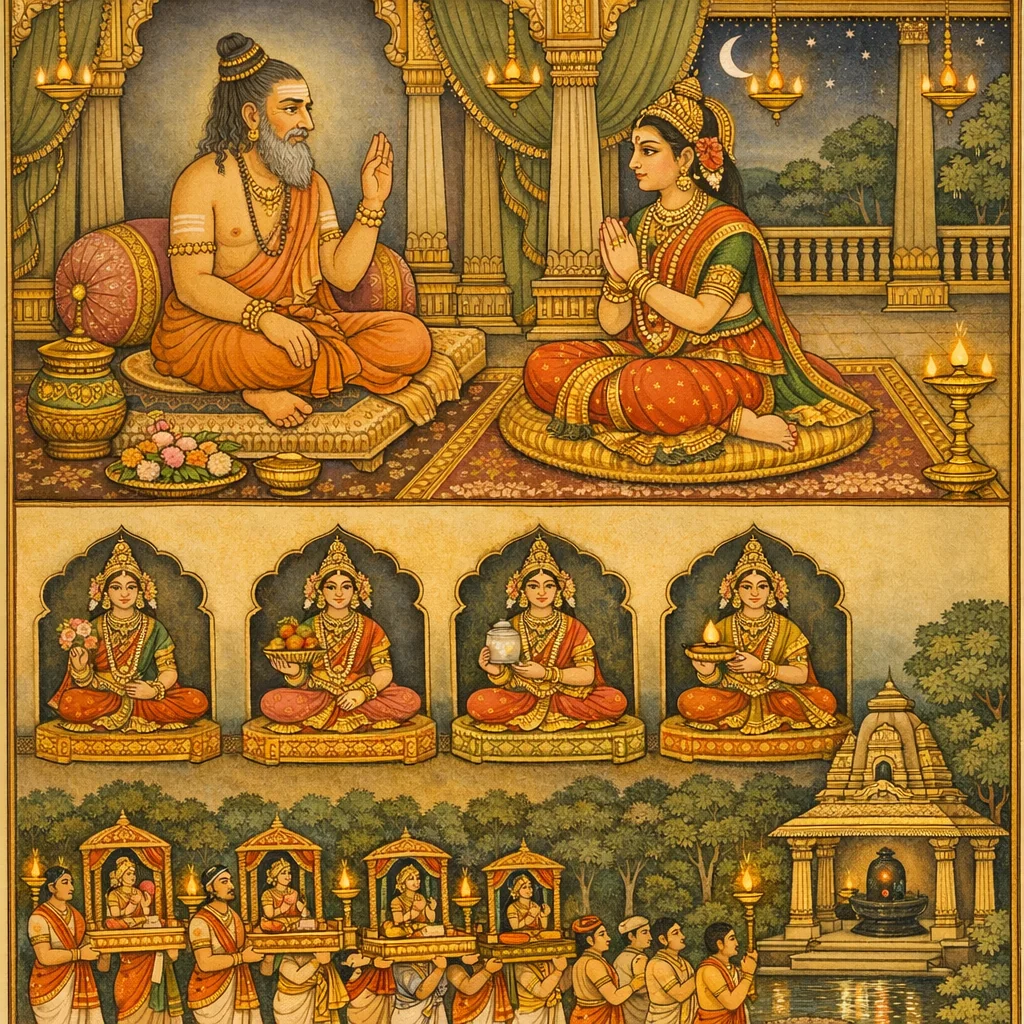
This adhyāya unfolds as a multi-voiced theological discourse. Lakṣmī laments that, though she has gained royal prosperity through worship of Gaurī, she remains distressed for want of offspring. During cāturmāsya the sage Durvāsas arrives at the Ānarta king’s palace, and through exemplary hospitality and devoted service (śuśrūṣā) Lakṣmī becomes fit to receive instruction. Durvāsas teaches that divine presence is not inherently lodged in wood, stone, or clay, but is realized through bhāva (devotional intent) joined to mantra. He prescribes a regulated vrata: fashion and worship a fourfold arrangement of Gaurī across the night’s divisions (prahara), offering dhūpa, dīpa, naivedya, and arghya with specific invocations; at dawn, gift a brāhmaṇa couple and complete the rite with conveyance and deposition. A corrective then follows: the deity forbids immersing the four forms in water and directs their installation in Hāṭakeśvara-kṣetra, securing akṣaya benefit for women’s welfare. Lakṣmī asks for a boon—release from repeated human gestation and enduring union with Viṣṇu—while the phalaśruti promises lasting Lakṣmī (good fortune) and freedom from misfortune for faithful reciters.
Shlokas
Verse 1
लक्ष्मीरुवाच । एवं राज्यं मया प्राप्तं गौरीपूजा कृते विभो । सौभाग्यं परमं चैव दुर्लभं सर्वयोषिताम्
Lakṣmī said: “Thus I attained sovereignty through the worship of Gaurī, O mighty one; and I also gained the highest good fortune—so rare for all women.”
Verse 2
न चापत्यं मया लब्धं तथापि परमेश्वर । तादृशेऽपि च सौभाग्ये तारुण्ये तादृशे स्थिते
“Yet I have not obtained progeny, O Supreme Lord—though I remain endowed with such fortune and established in such youthful prime.”
Verse 3
दह्यामि तेन दुःखेन दिवानक्तं सुखं न मे । कस्यचित्त्वथ कालस्य दुर्वासा मुनिसत्तमः
“I burn with that sorrow; day and night there is no happiness for me. Then, after some time, Durvāsā—the best of sages—arrived.”
Verse 4
आनर्ताधिपतेर्हर्म्यं संप्राप्तो गौरवाय सः । चातुर्मास्यकृते चैव मृत्तिकाग्रहणाय च
He reached the palace of the ruler of Ānarta, bringing honor to that house, in order to undertake the Cāturmāsya observance and also to gather sacred clay.
Verse 5
ततः संपूजितो राज्ञा आनर्तेन यथाक्रमम् । दत्त्वार्घ्यं मधुपर्कं च ततः प्रोक्तं प्रणम्य च
Then the king of Ānarta duly honored him in proper order; having offered arghya and madhuparka, the king spoke, bowing down in reverence.
Verse 6
स्वागतं ते मुनिश्रेष्ठ भूयः सुस्वागतं च ते । नान्यो धन्यतमो लोके भूयोऽस्ति सदृशो मया
Welcome to you, O best of sages—again, a most excellent welcome to you. None in the world is more blessed than I, for no fortune equals mine in receiving you.
Verse 7
यौ ते पादौ रजोध्वस्तौ केशैर्मे निर्मलीकृतौ । तद्ब्रूहि किंकरोम्यद्य गृहायातस्य ते मुने
Those two feet of yours, dust-covered, have been cleansed by my hair as I bowed. Tell me then, O sage: what shall I do today for you who have come to my house?
Verse 8
अपि राज्यं प्रयच्छामि का वार्तान्येषु वस्तुषु
I would even give my kingdom—what need is there to speak of other things?
Verse 9
दुर्वासा उवाच । चातुर्मासीविधानं ते करिष्ये नृप मंदिरे । मृत्तिकाग्रहणं तावच्छुश्रूषा क्रियतां मम । स तथेति प्रतिज्ञाय मामूचे पार्थिवोत्तमः
Durvāsā said: “O king, I shall undertake the Cāturmāsya observance in your palace. Until the sacred clay is gathered, let service be rendered to me.” The best of rulers promised, “So be it,” and spoke to me.
Verse 10
शुश्रूषा चास्य कर्तव्या सर्व दैव वरानने । चातुर्मासीव्रतं यावद्देवतार्चनपूर्वकम्
O fair-faced one, render him service in every way throughout the Cāturmāsya vow, beginning with—and grounded in—the worship of the deities.
Verse 11
बाढमित्येवमुक्त्वाथ मया सर्वमनुष्ठितम् । शुश्रूषार्हं च यत्कर्म दुहितेव पितुर्यथा
Saying, “So be it,” I then carried out everything. And whatever acts of service were fitting, I performed them—like a daughter serving her father.
Verse 12
चातुर्मास्यां व्यतीतायां यदा संप्रस्थितो मुनिः । तदा प्रोवाच मां तुष्टः पुत्रि किं करवाणि ते
When the four-month sacred season had passed and the sage was about to depart, being pleased he said to me: “Daughter, what shall I do for you?”
Verse 13
ततः स भगवान्प्रोक्तः प्रणिपत्य मया मुहुः । अपत्यं नास्ति मे ब्रह्मंस्तेन दह्याम्यहर्निशम्
Then I repeatedly bowed down and spoke to that revered one: “O Brāhman, I have no child; because of that I burn day and night.”
Verse 14
ईदृशे सति राज्ञोऽपि यौवने च महत्तरे । तत्त्वं वद मुनिश्रेष्ठ येन स्यान्मम संततिः
“Even though the king is in the fullness of youth, matters are thus. O best of sages, tell me the true means by which I may obtain progeny.”
Verse 15
व्रतेन नियमेनाथ दानेन च हुतेन च । ततः स सुचिरं ध्यात्वा मामुवाच स्मयन्निव
“By sacred vows, by disciplined restraint, by charity, and by offerings into the fire…” Then, after pondering for a long while, he spoke to me as if with a gentle smile.
Verse 16
अन्यदेहांतरे पुत्रि त्वया गौरी प्रपूजिता । तप्ताभिर्वालुकाभिः सा मृत्युकाल उपस्थिते
He said: “Daughter, in another body—in a former life—you worshipped Gaurī with grains of sand made hot, at a time when death was near.”
Verse 17
तद्भक्त्या लब्धराज्यापि दाहेन परियुज्यसे । गौरी यत्तापसंयुक्ता बालुकाभिः कृता त्वया
“Though by that devotion you obtained a kingdom, you are still afflicted with burning pain—because the Gaurī you fashioned from sand was made in connection with heat.”
Verse 18
न देवो विद्यते काष्ठे पाषाणे मृत्तिकासु च । भावेषु विद्यते देवो मन्त्रसंयोगसंयुतः
“The deity is not inherently present in wood, stone, or clay. The deity is present in a devotion-filled inner disposition, conjoined with the proper union of mantra.”
Verse 19
भावभक्तिसमा युक्ता मंत्रसंयोजनेन च । देवी मन्त्रसमायाता त्वया वालुकयाऽर्चिता
“Joined with heartfelt devotion and with the proper application of mantra, the Goddess—made present through mantra—was worshipped by you with sand.”
Verse 21
वृषस्थे भास्करे पश्चात्तस्या उपरि स्रावि यत् । जलयन्त्रं दिवारात्रं धारयस्व प्रयत्नतः
Afterwards, when the Sun enters Taurus, carefully maintain a water‑dripping device above her, day and night.
Verse 22
ततो यथायथा तस्याः शीतभावो भविष्यति । तथातथा च ते दाहः शांतिं यास्यत्यहर्निशम्
Then, as her condition becomes cooler and cooler, so too your burning pain will, in the same measure, come to peace—day and night.
Verse 23
दाहांते भविता गर्भस्ततः पुत्रमवाप्स्यसि । राज्यभारक्षमं शूरं त्रिषु लोकेषु विश्रुतम्
At the end of your burning ordeal, you will conceive; thereafter you shall obtain a son—heroic, able to bear the burden of kingship, and renowned throughout the three worlds.
Verse 24
अन्यापि कामिनी यात्र एवं तां पूजयिष्यति । ज्येष्ठे मासे तथा सापि यथा त्वं प्रभविष्यति
Any other woman, too, who undertakes the pilgrimage and worships her in this very way—she also, in the month of Jyeṣṭha, will prosper and attain success just as you will.
Verse 25
लक्ष्मीरुवाच । ततो मया पुनः प्रोक्तो भगवान्स मुनीश्वरः । मानुषत्वे न मे रागो विरक्तिर्महती स्थिता
Lakṣmī said: Then I again addressed that blessed lord among sages: ‘For human existence I have no attachment; a great dispassion abides in me.’
Verse 26
नदीवेगोपमं दृष्ट्वा जीवितंसर्वदेहिनाम् । तन्मे वद महाभाग यत्किंचिद् व्रतमुत्तमम्
Seeing the life of all embodied beings to be like the rushing current of a river, tell me, O greatly fortunate one, of some supreme vow—whatever observance is the highest.
Verse 27
मानुषत्वं न येन स्यात्सम्यक्चीर्णेन सद्द्विज । ततः स सुचिरं ध्यात्वा मामाह परमेश्वर
“O noble brāhmaṇa, tell me of that observance which, when properly performed, ensures there is no return to mere human status.” Then that lordly sage, after reflecting for a long time, spoke to me.
Verse 28
अस्ति पुत्रि व्रतं पुण्यं गौरी तुष्टिकरं परम् । येन चीर्णेन वै सम्यग्योषिद्देवत्वमाप्नुयात्
“Daughter, there is a meritorious vow, supremely pleasing to Goddess Gaurī. When it is properly observed, a woman may attain divine status.”
Verse 29
गोमयाख्या महादेवी कृता वै गोमयेन सा । ततो गोलोकमापन्नाः सर्वास्ता वरवर्णिनि
That Great Goddess, named “Gomayā”, was fashioned from cow-dung; thereafter, O fair-complexioned one, all those women attained Goloka.
Verse 30
तां त्वं कुरुष्व कल्याणि येन देवत्वमाप्स्यसि । ततो मया पुनः प्रोक्तः स मुनिः सुरसत्तम
“You, auspicious one, perform that vow, by which you will attain divinity.” Then again I addressed that sage, O best among the gods.
Verse 31
कस्मिन्काले प्रकर्तव्या विधिना केन सन्मुने । सर्वं विस्तरतो ब्रूहि येन तां प्रकरोम्यहम्
“At what time should it be performed, and by what proper procedure, O virtuous sage? Explain everything in full detail, so that I may carry it out.”
Verse 32
दुर्वासा उवाच । नभस्ये चासिते पक्षे तृतीयादिवसे स्थिते । प्रातरुत्थाय पश्चाच्च भक्षयेद्दंतधावनम्
Durvāsā said: “In the month of Nabhasya, in the dark fortnight, when the third lunar day arrives—rising in the morning, one should then take only the tooth-cleaning twig or paste as one’s intake.”
Verse 33
ततश्च नियमं कृत्वा उपवाससमुद्भवम् । गौरीनामसमुच्चार्य श्रद्धापूतेन चेतसा
Then, having undertaken the vow of discipline that arises from fasting, and uttering the name of Gaurī with a mind purified by faith, one should proceed in steadfast observance.
Verse 34
ततो निशागमे प्राप्ते कृत्वा गौरीचतुष्टयम् । मृन्मयं यादृशं चैव तदिहैकमनाः शृणु
Then, when night arrives, having fashioned the set of four Gaurīs, listen with single-pointed attention to how those earthen forms should be made.
Verse 35
एका गौरी प्रकर्तव्या पंचपिंडा यथोदिता । प्रहरेप्रहरे प्राप्ते तासु पूजां समाचरेत् । यैर्मंत्रैस्तान्निबोध त्वमेकैकस्याः पृथक्पृथक्
One Gaurī-image should be made from five lumps of clay, as prescribed. As each watch of time arrives, worship should be performed to them. Now understand, separately for each one, the mantras by which they are to be honored.
Verse 36
हिमाचलगृहे जाता देवि त्वं शंकरप्रिये । मेनागर्भसमुद्भूता पूजां गृह्ण नमोस्तु ते
O Goddess, born in the house of Himācala, beloved of Śaṅkara, sprung from the womb of Menā—accept this worship. Salutations to you.
Verse 37
धूपं दद्यात्ततश्चैव कर्पूरं श्रद्धया सह । रक्तसूत्रेण दीपं च घृतेन परिकल्पयेत्
Then one should offer incense and camphor with faith; and one should prepare a lamp with a red wick-thread, using ghee.
Verse 38
जातिपुष्पैः समभ्यर्च्य नैवेद्ये मोदकान्न्यसेत् । रक्तवस्त्रेण संछाद्य अर्घ्यं दत्त्वा ततः परम्
Having duly worshipped with jasmine flowers, one should place sweet modakas as the food-offering; then, covering (the image) with a red cloth, one should offer arghya thereafter.
Verse 39
यस्य वृक्षस्य पुष्पं च तस्य स्याद्दन्तधावनम् । मातुलिंगेन तस्यास्तु मन्त्रेणानेन भक्तितः
From the very tree whose flower is offered, one should take the twig for cleaning the teeth. And for her, with citron (mātuliṅga), one should act devotionally using this mantra.
Verse 40
अर्घ्यं दद्यात्प्रयत्नेन गन्धपुष्पाक्षतान्वितम् । शंकरस्य प्रिये देवि हिमाचलसुते शुभे । अर्घ्यमेनं मया दत्तं प्रतिगृह्ण नमोऽस्तु ते
With care one should offer arghya accompanied by fragrance, flowers, and unbroken grains. O auspicious Goddess, beloved of Śaṅkara, daughter of Himācala—this arghya has been offered by me; accept it. Salutations to you.
Verse 41
तदेव प्राशनं कुर्यात्ततः कायविशुद्धये । प्रहरांते च संपूज्य अर्धनारीश्वरं ततः
Then one should partake of that consecrated offering for the purification of the body. And at the end of the watch, having worshipped, one should thereafter worship Ardhanārīśvara.
Verse 42
सुरभ्या पूजयेद्भक्त्या मन्त्रेणानेन पार्वति । वाममर्धं शरीरस्य या हरस्य व्यवस्थिता । सा मे पूजां प्रगृह्णातु तस्यै देव्यै नमोऽस्तु ते
With devotion one should worship Pārvatī with this mantra, offering fragrant substances: “She who abides as the left half of Hara’s body—may that Goddess accept my worship. Salutations to that Devī.”
Verse 43
अगरुं च ततो भक्त्या धूपं दद्यात्तथा शुभे । नैवेद्ये गुणकांश्चैव नालिकेरेण चार्घकम्
Then, O auspicious lady, with devotion one should offer agaru as incense; as naivedya one should present guṇakā sweets, and prepare the arghya (honor-water) with coconut.
Verse 44
मन्त्रेणानेन दातव्यं तदेव प्राशनं स्मृतम् । अर्धनारीश्वरौ यौ च संस्थितौ परमेश्वरौ
It should be offered with this very mantra; and that offering is also to be partaken of, as is taught. Thus are invoked the two supreme Lords who abide as Ardhanārīśvara.
Verse 45
अर्घ्यो मे गृह्यतां देवौ स्यातं सर्वसुखप्रदौ । तृतीये प्रहरे प्राप्ते शतपत्र्या प्रपूजयेत्
“May my arghya be accepted, O divine Pair; may you bestow all happiness.” When the third watch arrives, one should worship with the śatapatrī flower.
Verse 46
उमामहेश्वरौ देवौ मंत्रेणानेन पूजयेत्
With this mantra one should worship the divine couple, Umā and Maheśvara.
Verse 47
उमामहेश्वरौ देवौ यौ तौ सृष्टिलयान्वितौ । तौ गृह्णीतामिमां पूजां मया दत्तां प्रभक्तितः
Umā and Maheśvara—the divine Pair who preside over creation and dissolution—may they accept this worship offered by me with deep devotion.
Verse 48
गुग्गुलोत्थं ततो धूपं नैवेद्यं घारिकात्मकम् । जातीफलेन चार्घ्यं च तदेव प्राशनं स्मृतम्
Thereafter, incense made from guggulu should be offered; the food-offering should be ghārikā preparations; and the arghya should be made with nutmeg. That same offering is taught to be partaken of as prasāda.
Verse 49
ततश्चार्घ्यः प्रदातव्यो मंत्रेणानेन भक्तितः । ग्रंथिचूर्णेन धूपं च अर्घ्यं मदनजं फलम्
Then, with devotion, one should offer arghya using this mantra. Incense should be made with granthi-powder, and the arghya should include a fruit born of Madana (a love-fruit).
Verse 50
तदेव प्राशनं कार्यं ततः कायविशुद्धये
That very consecrated offering should be partaken of; thereby the body becomes purified.
Verse 52
चतुर्थे प्रहरे प्राप्ते तां गौरीं पंचपिंडिकाम् । भृंगराजेन संपूज्य मंत्रेणानेन भक्तितः
When the fourth watch arrives, one should worship Gaurī in her form as Pañcapiṇḍikā, honoring her with bhṛṅgarāja and, with devotion, reciting this mantra.
Verse 53
पृथिव्यादीनि भूतानि यानि प्रोक्तानि पंच च । पंचरूपाणि देवेशि पूजां गृह्ण नमोऽस्तु ते
The five elements taught, beginning with earth—these are your five forms, O Goddess who rules over the gods. Accept this worship; salutations to you.
Verse 54
नैवेद्ये घृतपूपांश्च दद्याद्देव्याः प्रभक्तितः । ग्रंथिचूर्णेन धूपं च ह्यर्घ्यं मदनजं फलम् । तदेव प्राशनं कार्यमर्घ्यमंत्रमिदं स्मृतम्
With deep devotion one should offer the Goddess, as naivedya, fried cakes prepared with ghee. One should also offer incense made from fragrant powdered resin, and present arghya together with a fruit “born of love”. That very offering is then to be reverently partaken; this is remembered as the arghya-mantra rite.
Verse 55
पंचभूतमयी देवी पंचधा या व्यवस्थिता । अर्घ्यमेनं मया दत्तं सा गृह्णातु सुरे श्वरी
O Goddess constituted of the five elements and abiding in fivefold form—may Sureshvarī, the Lady of the gods, accept this arghya that I have offered.
Verse 56
एवं सर्वा निशा सा च गीतवाद्यादिनिःस्वनैः । तासां चैवाग्रतो नेया नैव निद्रां समाचरेत्
Thus the whole night should pass amid the sounds of song and instruments. One should remain in their presence and not indulge in sleep.
Verse 57
ततः प्रभाते विमले प्रोद्गते रविमण्डले । स्नात्वा संपूजयेद्विप्रं सह पत्न्या प्रभक्तितः
Then, in the pure morning when the sun’s disc has risen, having bathed, one should devoutly honor a brāhmaṇa together with his wife.
Verse 58
वस्त्रैराभरणैश्चैव स्वशक्त्या नृपनंदिनि । गौर्यै भक्ष्यं च दातव्यं मिष्टान्नेन शुचिस्मिते
O princess, according to one’s means one should offer garments and ornaments; and to Gaurī also one should present edible gifts together with sweet food, O pure-smiling one.
Verse 59
ततः करेणुमानीय वडवां वा सुमध्यमे । गौरीचतुष्टयं तच्च समारोप्य तथोपरि
Then, O fair-waisted one, bringing a female elephant—or else a mare—one should place upon it that set of four Gaurīs, arranging them properly on top.
Verse 60
गीतवादित्रशब्देन वेदध्वनियुतेन च । नद्यां वाऽथ तडागे वा वाप्यां वाथ परिक्षिपेत्
Accompanied by the sound of songs and instruments, and joined with the resonant chanting of the Veda, one should immerse it in a river, or else in a pond, or in a tank/reservoir.
Verse 61
मंत्रेणानेन सद्भक्त्या तवेदं वच्मि सुन्दरि
With this mantra, in true devotion, I speak this to you, O beautiful one.
Verse 62
आहूतासि मया देवि पूजितासि मया शुभे । मम सौभाग्यदानाय यथेष्टं गम्यतामिति
O Goddess, I have invoked you; O auspicious one, I have worshiped you. For the bestowal of good fortune upon me—depart now as you desire.
Verse 63
लक्ष्मीरुवाच । एवं मया कृता देव सा तृतीया यथोदिता । नभस्ये मासि संप्राप्ते भक्त्या परमया विभो
Lakṣmī said: “Thus, O Lord, I performed that third-day observance exactly as it was enjoined. When the month of Nabhasya arrived, O mighty one, I carried it out with supreme devotion.”
Verse 64
द्वितीये च तथा प्राप्ते तृतीये च विशेषतः । यावत्पश्यामि प्रत्यूषे तावद्गौरीचतुष्टयम् । जातं रत्नमयं तच्च मया यत्परिपूजितम्
When the second day came, and especially when the third arrived, at dawn I beheld Gaurī’s fourfold manifestation. That very form shone like a jewel, and I worshiped it duly with full reverence.
Verse 65
प्रस्थितां मां नदीतीरमुद्दिश्य च विसर्जनम् । करिष्यामीति सा प्राह व्यक्तीभूता सुरेश्वरी
As I set out toward the riverbank to perform the concluding dismissal of the rite (visarjana), the Goddess—now clearly manifest—spoke: “There I shall have you perform the rite of dismissal.”
Verse 66
मा पुत्रि जलमध्येऽत्र मम मूर्तिचतुष्टयम् । परिभावय मद्वाक्यं श्रुत्वा चैव विधीयताम्
“O daughter, do not immerse here in midstream my four sacred forms. Reflect well upon my words; having heard them, act accordingly.”
Verse 67
हाटकेश्वरजे क्षेत्रे स्थापय त्वं च मा क्षिप । अक्षयं जायते येन सर्वस्त्रीणां हिताय च
Install them in the sacred kṣetra of Hāṭakeśvara—do not cast them away. By this, imperishable merit arises, for the welfare of all women.
Verse 68
त्वं प्रार्थय वरं सर्वं ददाम्यहमिहार्चिता । अभ्यर्चिता गिरिसुता मया प्रोक्ता सुरेश्वरी
Ask for whatever boon you desire; here, as I am worshipped, I grant it. Thus spoke the Lady of the gods—Girisūtā—duly honoured by me.
Verse 69
यदि यच्छसि मे देवि वरं तुष्टा सुरेश्वरि । तदहं मानुषे गर्भे मा भूयासं कथंचन
If you, O Goddess, O Sovereign of the gods, pleased as you are, grant me a boon—then let me never, in any way, enter a human womb again.
Verse 70
भर्त्ता भवतु मे विष्णुः शाश्वताभीष्टदः सदा । नान्यत्किंचिदभीष्टं मे राज्यं त्रिदिवशोभनम्
Let Viṣṇu be my husband—everlasting, and ever the giver of what is truly desired. I seek nothing else, not even a kingdom radiant like heaven.
Verse 71
अन्यापि कुरुते या च व्रतमेतत्समाहिता । सर्वैर्त्रतैर्यथातुष्टिस्तथा देवि प्रजायते
Any other woman too, who performs this vow with a focused mind—O Goddess—gains satisfaction and blessing equal to that obtained through all vows.
Verse 72
तथा तस्याः प्रकर्तव्यमकेनानेन पार्वति । तथेति गौरी मामुक्त्वा ततश्चादर्शनं गता
Thus, O Pārvatī, it should be done for her by this very means. Saying, “So be it,” Gaurī spoke to me and then vanished from sight.
Verse 73
सा देवी च मया तत्र तच्च गौरीचतुष्टयम् । हाटकेश्वरजे क्षेत्रे शुभे संस्थापितं विभो
Thereupon, O mighty one, I established in that auspicious Hāṭakeśvara-kṣetra both the Goddess and that fourfold form of Gaurī.
Verse 74
तत्प्रभावान्मया लब्धो भर्त्ता त्वं परमेश्वर । शाश्वतश्चाक्षयश्चैव मुखप्रेक्षश्च सर्वदा
“By the power of that merit, I have attained You as my Lord and husband, O Supreme Lord—everlasting and imperishable—and I may behold Your face at all times.”
Verse 75
एतत्त सर्वमाख्यातं यत्पृष्टास्मि सुरेश्वर । सत्येनानेन देवेश तव पादौ स्पृशाम्यहम्
“I have declared all this, O Lord of the gods, just as I was questioned. By this truth, O Lord of devas, I touch Your feet in reverence.”
Verse 76
सूत उवाच । तच्छ्रुत्वा वचनं तस्याः शंखचक्रगदाधरः । विहस्याथ महालक्ष्मीं तामुवाच प्रहर्षितः । मुहुर्मुहुः समालिंग्य वक्षसश्चोपरि स्थिताम्
Sūta said: Hearing her words, the Lord who bears conch, discus, and mace smiled; then, delighted, he spoke to Mahālakṣmī—embracing her again and again as she rested upon his chest.
Verse 77
साधुमाधु महाभागे सत्यमेतत्त्वयोदितम् । जानतापि मया पृष्टा भवतीं वरवर्णिनि
Well done, well done, O greatly fortunate one—what you have spoken is true. Though I already knew, I questioned you, O fair-complexioned lady.
Verse 78
सूत उवाच । एतद्वः सर्वमाख्यातं यत्पृष्टोऽस्मि द्विजोत्तमाः । चतुर्भुजा यथा गौरी संजाता पंचपिंडिका
Sūta said: “O best of the twice-born, I have told you all that you asked. Thus did Gaurī become four-armed and manifest as Pañcapiṇḍikā.”
Verse 79
यश्चैतत्पठते भक्त्या प्रातरुत्थाय मानवः । न स लक्ष्म्या विमुच्येत न च दौर्भाग्यमाप्नुयात्
Whoever, rising early in the morning, recites this with devotion is not separated from Lakṣmī (prosperity), nor does misfortune befall him.
Verse 80
तस्मात्सर्वप्रयत्नेन पठनीयमिदं शुभम् । आख्यानं गौरिकं विप्रा यन्मया परिकीर्तितम्
Therefore, O brāhmaṇas, with every effort this auspicious Gaurī narrative should be read—the account that has been recounted by me.
Verse 91
उमामहेश्वरौ देवौ सर्वकामसुखप्रदौ । गृह्णीतामर्घ्यमेतं मे दयां कृत्वा महत्तमाम्
“O divine Umā and Maheśvara, bestowers of the happiness that fulfills all desires—please accept this arghya offering from me, showing the greatest compassion.”
Verse 178
इति श्रीस्कान्दे महापुराण एकाशीतिसाहस्र्यां संहितायां षष्ठे नागरखण्डे हाटकेश्वरक्षेत्रमाहात्म्ये पंचपिंडिकागौर्युत्पत्तिमाहात्म्य वर्णनंनामाष्टसप्तत्युत्तरशततमोऽध्यायः
Thus, in the Śrī Skanda Mahāpurāṇa, in the eighty-one-thousand-verse Saṃhitā, in the sixth book, the Nāgara Khaṇḍa, within the Māhātmya of the sacred region of Hāṭakeśvara—ends the one-hundred-and-seventy-eighth chapter, called “The Description of the Glory of the Origin of Pañcapiṇḍikā Gaurī.”