Adhyaya 148
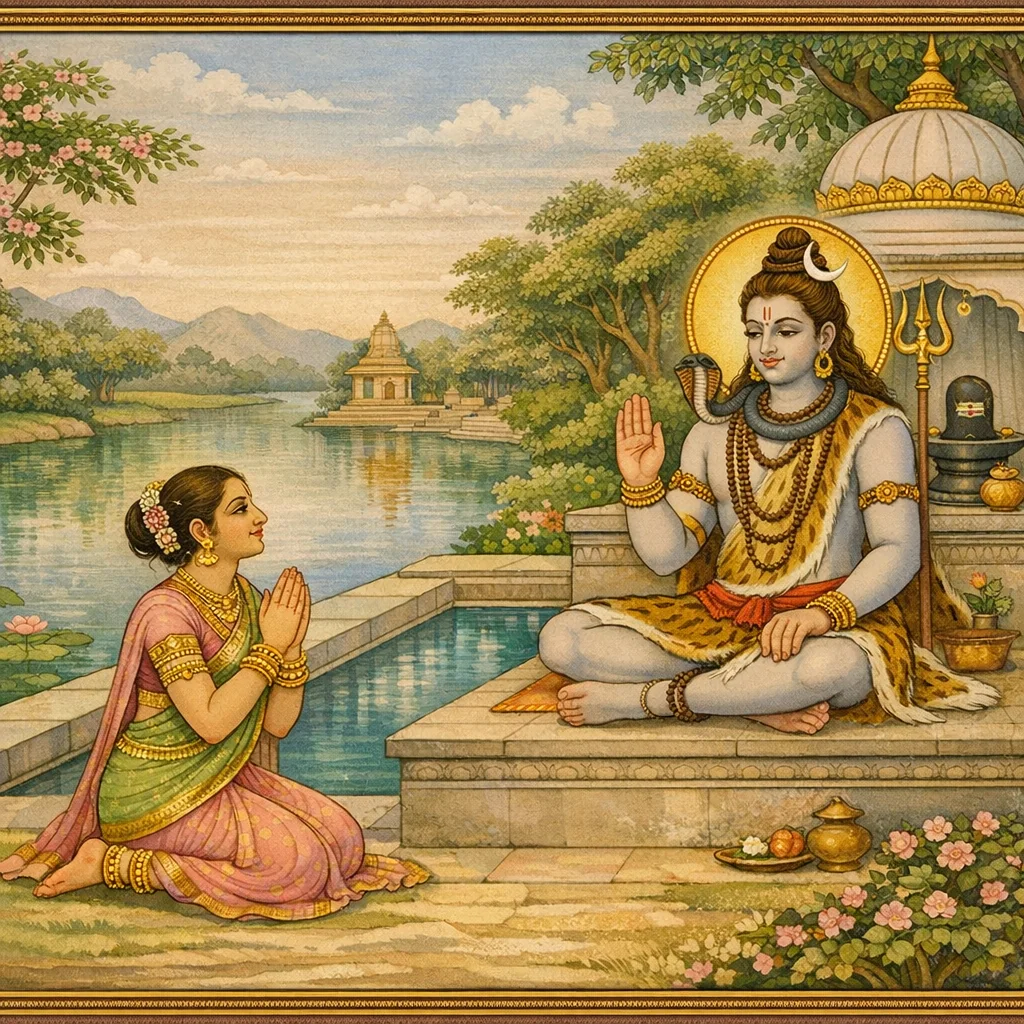
Chapter 148, as transmitted by Sūta, presents a tightly ordered tīrtha narrative. Pingalā, distressed at having no son, seeks a sage’s permission (with Vyāsa contextually referenced) to undertake tapas to please Maheśvara. Reaching the appointed kṣetra, she installs Śaṅkara, establishes the liṅga, and creates a broad vāpī (pond/well) filled with pure water, expressly proclaimed a sin-destroying place of sacred bathing. Tripurāntaka (Mahādeva) appears, declares His satisfaction, and grants her the boon of a virtuous son who will enhance the lineage. The teaching then universalizes the site’s power: women who bathe and worship the installed liṅga on specified lunar days (especially in the bright fortnight) are promised excellent sons, and those under misfortune are assured good fortune within a year through bathing and worship. Men who bathe and worship gain fulfillment of desires, while the desireless attain mokṣa. The chapter ends with Mahādeva’s disappearance, the birth of the promised son named Kapinjala, and a brief allusion to an earlier establishment of Kelīvarī Devī associated with all-around success.
Shlokas
Verse 1
। सूत उवाच । एवं तं निःस्पृहं ज्ञात्वा गृहं प्रति निजात्मजम् । पिंगला दुःखसंयुक्ता व्यासमेतदुवाच ह
Sūta said: “Thus, knowing her own son to be free from worldly desire and no longer turned toward home, Piṅgalā—filled with grief—spoke these words to Vyāsa.”
Verse 2
अहं तपश्चरिष्यामि पुत्रार्थं द्विजसत्तम । अनुज्ञां देहि मे येन तोषयामि महेश्वरम् । पुत्रो येन भवेन्मह्यं वंशवृद्धिकरः परः
“O best of the twice-born, for the sake of a son I shall undertake austerities. Grant me leave, that I may please Maheśvara; and by his grace may an excellent son be born to me, one who increases our lineage.”
Verse 3
एवं सा निश्चयं कृत्वा लब्ध्वानुज्ञां मुनेस्ततः । क्षेत्रमेतत्समासाद्य तपस्तेपे पतिव्रता
Thus, having formed her resolve and obtained the sage’s permission, that devoted wife reached this sacred field and performed austerities.
Verse 4
संस्थाप्य शंकरं देवं तदग्रे निर्मलोदकम् । कृत्वा वापीं सुविस्तीर्णां स्नानात्पातकनाशनीम्
After installing Lord Śaṅkara, she set pure water before him; and she made a broad sacred tank, whose bathing destroys sins.
Verse 5
ततस्तस्या गतस्तुष्टिं भगवांस्त्रिपुरांतकः । वरदोऽस्मीति तां प्राह प्रहृष्टेनांतरात्मना
Then the Blessed Lord Tripurāntaka became pleased with her and, his inner being delighted, said to her, “I am a giver of boons.”
Verse 6
श्रीमहादेव उवाच । परितुष्टोऽस्मि ते भद्रे वरं वरय सुव्रते । यः स्थितो हृदये नित्यं नादेयं विद्यते मम
Śrī Mahādeva said: “O auspicious one, I am wholly pleased with you. O lady of noble vow, choose a boon. For one who ever abides in my heart, there is nothing that I would withhold as ‘not to be given’.”
Verse 7
वटिकोवाच । सुतं देहि सुरश्रेष्ठ मम वंशविवर्धनम् । चित्ताह्लादकरं नित्यं सुशीलं विनयान्वितम्
Vaṭikī said: “O best among the gods, grant me a son to increase my lineage—one who ever gladdens the heart, of noble conduct, and endowed with humility.”
Verse 8
श्रीमहादेव उवाच । भविष्यति न संदेहस्तव पुत्रः सुशोभने । यादृक्त्वया महाभागे प्रार्थितस्तद्विशेषतः
Śrī Mahādeva said: “O radiant one, there is no doubt—you shall have a son, precisely as you, O fortunate lady, have prayed for in every detail.”
Verse 9
अन्यापि मानुषी याऽत्र वाप्यां स्नात्वा समाहिता । पञ्चम्यां वत्सरं यावच्छुक्लपक्षे ह्युपस्थिते । पूजयिष्यति मल्लिंगं यच्चाद्य स्थापितं त्वया
“Any other woman as well, who—steady and collected in mind—bathes here in this sacred tank, and on the fifth lunar day in the bright fortnight, continuing for a full year, worships the Malliṅga that you have installed here today—”
Verse 10
साथ लप्स्यति सत्पुत्रं दत्त्वा फलमनुत्तमम् । या च दौर्भाग्यसंयुक्ता तृतीयादिवसेऽत्र वै
“—she will obtain a virtuous son, receiving an unsurpassed reward. And any woman afflicted with misfortune who, on the third lunar day (Tṛtīyā) and the like, comes here—”
Verse 11
स्नात्वाऽत्र सलिले पश्चान्मल्लिंगं पूजयिष्यति । सा सौभाग्य समोपेता वर्षांते च भविष्यति
After bathing here in these waters and then worshipping the Malliṅga, she will be endowed with auspicious good fortune—indeed, by the year’s end it shall come to pass.
Verse 12
यः पुनः पुरुषश्चात्र स्नात्वा मां पूजयिष्यति । सकामो लप्स्यते कामान्विकामो मोक्षमेव च
Moreover, any man who bathes here and worships Me: if he harbors desires, he attains the objects of desire; if he is free of desire, he attains liberation (mokṣa) alone.
Verse 13
एवमुक्त्वा महादेवस्ततश्चादर्शनं गतः । साऽपि लेभे सुतं व्यासात्कपिंजलमिति श्रुतम्
Having spoken thus, Mahādeva then vanished from sight. And she too obtained a son from Vyāsa—heard to be named Kapiñjala.
Verse 14
यादृक्तेन पुरा प्रोक्तो देवदेवेन शूलिना । येनैव स्थापिता चात्र देवी केलीवरी पुरा । सर्वसिद्धिप्रदा लोके तत्र याऽराधिता पुरा
Just as it was formerly proclaimed by the God of gods, the trident-bearing Lord—by whom the Goddess Kelīvarī was once installed here—so too that Goddess, worshipped there in ancient times, is renowned in the world as the bestower of every siddhi and accomplishment.