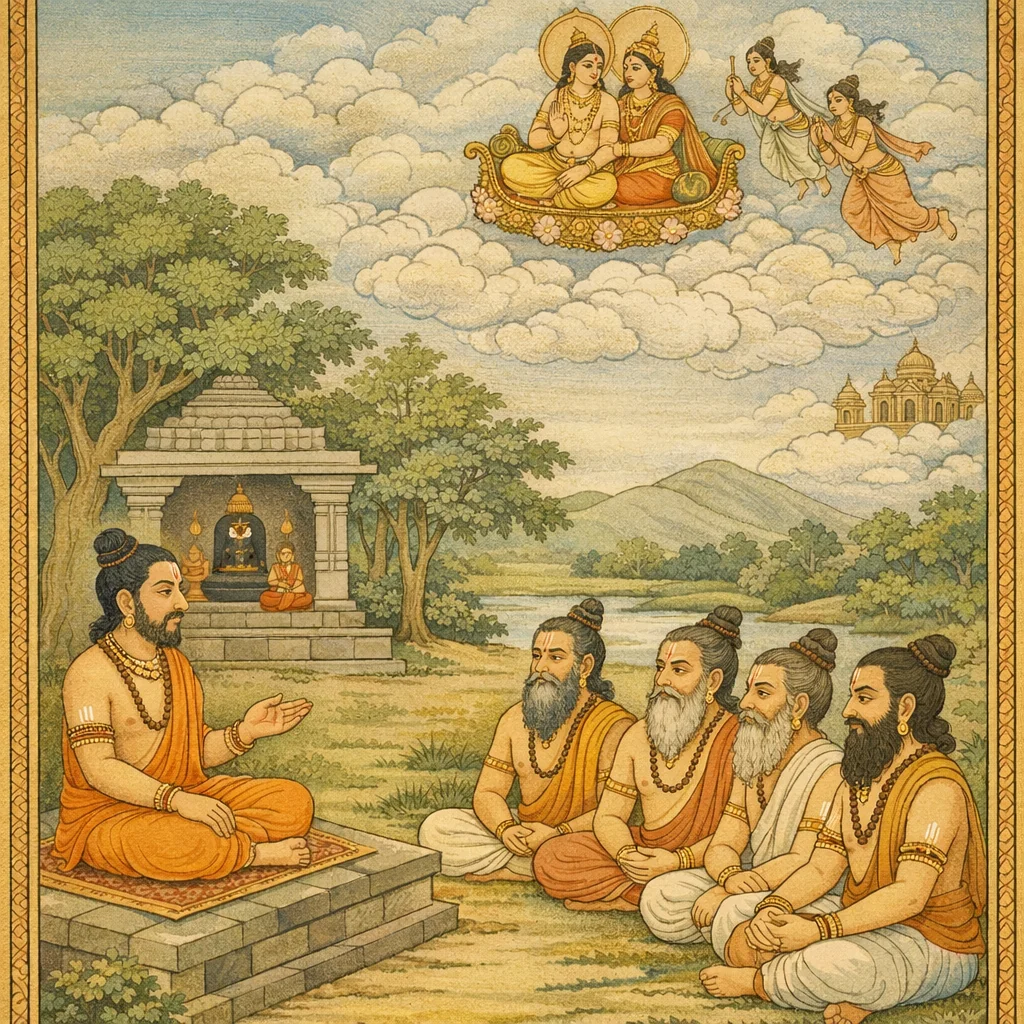
Adhyaya 115
Chapter 115 proceeds as a question-led catalog. The ṛṣis ask Sūta to identify Trijāta—his name, origin, gotra, and why he is held exemplary though socially marked as “trijāta” by birth-status. Sūta replies that he arises in the lineage of the sage Sāṅkṛtya; he is known as Prabhāva, also called Datta, and is connected with Nimi’s line. Trijāta uplifts the local sacred place and builds an auspicious shrine of Śiva named Trijāteśvara; by unbroken worship he attains heaven with his very body. A ritual rule is then given: those who behold the deity with devotion and bathe it at the viṣuva are protected, so that “trijāta” birth does not recur in their lineage. The discourse turns to communal restoration as the ṛṣis request the names of gotras once lost and later re-established. Sūta enumerates many gotra-groups and counts—Kauśika, Kāśyapa, Bhāradvāja, Kauṇḍinya, Garga, Hārīta, Gautama, and others—recalling an earlier disruption from fear of Nāgaja and a subsequent re-gathering at this place. The chapter ends with a phalaśruti: reciting or hearing this gotra-account and the mention of ṛṣis prevents lineage severance, mitigates sins arising across the life-cycle, and averts separation from what is dear.
Shlokas
Verse 1
त्रिजातो ब्राह्मणस्तत्र किन्नामा कस्य सम्भवः । किंगोत्रश्चैव किंसंज्ञः कीर्तयस्व महामते
That brāhmaṇa named Trijāta there—what was his full name, from whom was he born, what was his gotra, and by what appellation was he known? Declare it, O great-minded one.
Verse 2
किं कुलीनैर्गुणाढ्यैर्वा तेजोविद्याविचक्षणैः । त्रिजातोऽपि वरं सोऽपि स्वं स्थानं येन चोद्धृतम्
What need is there of high-born men, or of those rich in virtues, or skilled in brilliance and learning? Even Trijāta—he too is the best, since by him his own place was uplifted and restored.
Verse 3
सूत उवाच सांकृत्यस्य मुनेर्वंशे स संभूतो द्विजोत्तमः । प्रभाव इति विख्यातो दत्तसंज्ञो निमेः सुतः
Sūta said: In the lineage of the sage Sāṃkṛtya there arose an excellent brāhmaṇa. He was famed as Prabhāva, also called Datta, and he was the son of Nimi.
Verse 4
स एवं स्थानमुद्धृत्य चकारायतनं शुभम् । त्रिजातेश्वरनाम्ना च देवदेवस्य शूलिनः
Thus, having restored the sacred place, he built an auspicious shrine for Śūlin, the God of gods, and installed Him under the name Trijāteśvara.
Verse 5
तमाराध्य दिवा नक्तं सम्यक्छ्रद्धासमन्वितः । सशरीरो गतः स्वर्गं ततः कालेन केनचित्
Having duly worshipped Him by day and by night, endowed with steadfast faith, one—after some time has passed—attains heaven in that very body.
Verse 6
यस्तं पश्यति सद्भक्त्या स्नापयेद्विषुवे सदा । न त्रिजातः कुले तस्य कथञ्चिदपि जायते
Whoever beholds Him with true devotion and regularly bathes that sacred presence at the equinox—within that person’s lineage, one of ‘mixed or degenerate birth’ is never born in any way.
Verse 7
ऋषय ऊचुः । यानि गोत्राणि नष्टानि यानि संस्थापितानि च । नामतस्तानि नो ब्रूहि तत्पुरं सूत नन्दन
The sages said: “Tell us by name which gotras were lost and which were re-established. O Sūta’s son, also describe that city to us.”
Verse 8
सूत उवाच । तत्रोपमन्युगोत्रा ये क्रौंचगोत्रसमुद्भवाः । कैशोर्यं गोत्रसंभूतास्त्रैवणेया द्विजोत्तमः
Sūta said: “There were those of the Upamanyu gotra, sprung from the Krauñca gotra, and those born in the Kaiśorya gotra; and also the Traivaṇeya Brahmin, foremost among the twice-born.”
Verse 9
ते भूयोऽपि न संप्राप्ता यथा गोत्रचतुष्टयम् । तत्पूर्वकं शुकादीनां यन्नष्टं नागजाद्भयात्
Yet they did not come again, just as that set of four gotras did not return. Formerly, the lineages beginning with Śuka and others, lost through fear arising from the Nāgas, likewise did not reappear.
Verse 10
शेषान्वः संप्रवक्ष्यामि ब्राह्मणान्गोत्रसंभवान् । कौशिकान्वयसं भूताः षड्विंशतिश्च ते स्मृताः
Now I shall tell you of the remaining Brahmins, born from various gotras. Those born in the Kauśika lineage are remembered as twenty-six.
Verse 11
कश्यपान्वयसंभूताः सप्ताशीतिर्द्विजोत्तमाः । लक्ष्मणान्वयसंभूता एकविंशतिरागताः
Of the Kaśyapa lineage, the foremost among the twice-born were eighty-seven. Of the Lakṣmaṇa lineage, twenty-one arrived there.
Verse 12
तत्र नष्टाः पुनः प्राप्तास्तस्मिन्स्थाने सुदुःखिताः । भारद्वाजास्त्रयः प्राप्ताः कौंडनीयाश्चतुर्दश
There, those who had been lost returned again to that place, sorely afflicted. Three of the Bhāradvāja line returned, and fourteen of the Kauṇḍinīya line.
Verse 13
रैतिकानां तथा विंशत्पाराशर्याष्टकं तथा । गर्गाणां च द्विविंशं च हारीतानां विविंशतिः
Likewise, there were twenty of the Raitika line, eight of the Pārāśarya line, twenty-two of the Garga line, and twenty of the Hārīta line.
Verse 14
और्वभार्गवगोत्राणां पञ्चविंशदुदाहृताः । गौतमानां च षड्विंशमालूभायनविंशतिः
Of the Aurva-Bhārgava gotras, twenty-five are stated; of the Gautamas, twenty-six; and of the Ālūbhāyanas, twenty.
Verse 15
मांडव्यानां त्रिविंशच्च बह्वृचानां त्रिविंशतिः । सांकृत्यानां विशिष्टानां पृथक्त्वेन दशैव तु
Of the Māṇḍavya lineage there are said to be twenty-three; of the Bahvṛca (Ṛgvedic) group, twenty; and of the distinguished Sāṃkṛtyas, separately counted, ten indeed.
Verse 16
तथैवांगिरसानां च पंच चैव प्रकीर्तिताः । आत्रेया दश संख्याताः शुक्लात्रेयास्तथैव च
Likewise, five of the Āṅgirasa group are proclaimed; the Ātreyas are counted as ten—so too the Śuklātreyas.
Verse 19
याजुषास्त्रिंशतिः ख्याताश्च्यावनाः सप्त विंशतिः । आगस्त्याश्च त्रयस्त्रिंशज्जैमिनेया दशैव तु
The Yājuṣas are renowned as thirty; the Cyāvanas are twenty-seven; the Āgastyas are thirty-three; and the Jaimineyas are ten indeed.
Verse 21
औशनसाश्च दाशार्हास्त्रयस्त्रय उदाहृताः । लोकाख्यानां तथा षष्टिरैणिशानां द्विसप्ततिः
The Auśanas and the Dāśārhas are declared to be three each. The Lokākhyas are sixty in number, and the Aiṇiśas are seventy-two.
Verse 22
कापिष्ठलाः शार्कराख्या दत्ताख्याः सप्तसप्ततिः । शार्कवानां शतं प्रोक्तं दार्ज्यानां सप्तसप्ततिः
The Kāpiṣṭhalas, those called Śārkaras, and those known as Dattas are seventy-seven. The Śārkavas are said to be a hundred, and the Dārjyas are seventy-seven.
Verse 23
कात्यायन्यास्त्रयोऽधिष्ठा वैदिशाश्च त्रयः स्मृताः । कृष्णात्रेयास्तथा पंच दत्तात्रेया स्तथैव च
Among the Kātyāyanīs there are three presiding ones; the Vaidiśas are remembered as three. Likewise the Kṛṣṇātreyas are five, and so too the Dattātreyas.
Verse 24
नारायणाः शौनकेया जाबालाः शतसंख्यया । गोपाला जामदन्याश्च शालिहोत्राश्च कर्णिकाः
The Nārāyaṇas, the Śaunakeyas, and the Jābālas are a hundred in number; and there are also the Gopālas, the Jāmadanyas, the Śālihotras, and the Karṇikas.
Verse 25
भागुरायणकाश्चैव मातृकास्त्रैणवास्तथा । सर्वे ते ब्राह्मणश्रेष्ठाः क्रमेण द्विजसत्तमाः
And also the Bhāgurāyaṇakas, the Mātṛkas, and likewise the Traiṇavas—all of them are foremost among Brahmins, the best of the twice-born, each in due order.
Verse 26
एतेषामेव सर्वेषां सत्काराय द्विजोतमाः । चत्वारिंशत्तथाष्टौ च पुरा प्रोक्ताः स्वयंभुवा
For the honoring of all these very groups, O best among the twice-born, forty-eight were formerly appointed and proclaimed by Svayaṃbhū (Brahmā) himself.
Verse 27
ते सर्वे च पृथक्त्वेन निर्दिष्टाः पद्मयोनिना । संध्यातर्पणकृत्यानि वैश्वदेवोद्भवानि च । श्राद्धानि पक्षकृत्यानि पितृपिंडांस्तथैव च
All of them were separately set forth by the Lotus-born (Brahmā): the duties of sandhyā and tarpaṇa, the rites connected with Vaiśvadeva, the śrāddha ceremonies, the fortnightly observances, and likewise the offering of piṇḍas to the Pitṛs.
Verse 28
यज्ञोपवीतसंयुक्ताः प्रवराश्चैव कृत्स्नशः । तथा मौंजीविशेषाश्च शिखाभेदाः प्रकीर्तिताः
They were duly invested with the yajnopavīta (sacred thread); their pravaras (ṛṣi lineages) were fully declared, and likewise the specific kinds of muñja-girdles and the distinctions of śikhā (tuft/tonsure) were set forth.
Verse 29
त्रिजातेन समाराध्य देवदेवं पितामहम् । तेषां कृत्वा द्विजेद्राणामात्मकीर्तिकृते तदा
Having worshipped the Grandfather—Brahmā, the god of gods—by means of that ‘threefold’ rite, he then made these arrangements for those foremost of the twice-born, for the sake of his own renown.
Verse 30
ऋषय ऊचुः । कथं सन्तोषितो ब्रह्मा त्रिजातेन महात्मना । कर्मकांडं कथं भिन्नं कृतं तेन महात्मना । सर्वं विस्तरतो ब्रूहि परं कौतूहलं हि नः
The sages said: “How was Brahmā satisfied by that great-souled Trijāta through the Trijāta rite? How did he distinguish the ritual portion (karmakāṇḍa)? Tell us everything in detail, for our curiosity is most keen.”
Verse 31
सूत उवाच । तस्यार्थे ब्राह्मणैः सर्वैस्तोषितः प्रपितामहः । अनेनैवोद्धृतं स्थानमस्माकं सकलं विभो
Sūta said: “For his purpose, the Ancient Grandfather (Brahmā) was pleased by all the brāhmaṇas. By this very act, O Lord, our entire sacred station was upheld and restored.”
Verse 32
तस्मादस्य विभो यच्छ वेदज्ञानमनुतमम् । येन कर्मविशेषाश्च जायतेऽत्र पुरोत्तमे
Therefore, O mighty Lord, grant him unsurpassed knowledge of the Veda—by which, here in this best of cities, the special forms of ritual action may properly arise and be established.
Verse 33
एतस्य च गुरुत्वं च प्रसादात्तव पद्मज । यथा भवति देवेश तया नीतिर्विधीयताम्
And may his authority as a teacher arise through your grace, O Lotus-born. O Lord of gods, let the proper course of conduct be ordained in the manner by which it will truly come to pass.
Verse 34
ब्रह्मा ददौ ततस्तस्य मंत्रग्राममनुत्तमम् । येन विज्ञायते सर्वं वेदार्थो यज्ञकर्म च
Then Brahmā granted him an unsurpassed collection of mantras—by which everything becomes known: the meaning of the Veda and the procedures of sacrificial rites as well.
Verse 35
ततः प्रोवाच तान्सर्वान्प्रहष्टेनातरात्मना । एष वेदार्थसंपन्नो भविष्यति महायशाः
Then, with an inwardly delighted heart, he addressed them all: “This one will become accomplished in the meaning of the Veda, and he will be greatly renowned.”
Verse 37
तत्कार्यं स्वर्गमोक्षाय मम वाक्यात्प्रबोधितैः । वेदार्थानेष सर्वेषां युष्माकं योजयिष्यति
That work is for the attainment of heaven and liberation (mokṣa). Awakened by my instruction, he will connect and impart the meanings of the Veda to all of you.
Verse 38
ये चान्येषु च देशेषु स्थानेषु च गताः क्वचित् । एतत्स्थानं परित्यज्य सत्यमेतद्विजोत्तमाः
And those who have gone elsewhere—to other lands and other places—having abandoned this sacred station: this is the truth, O best of the twice-born.
Verse 39
वेदस्थाने च बुद्ध्यैष यत्कर्म प्रचरिष्यति । नानृते वाथ पापे च वाणी चास्य चरिष्यति
Established in the seat of the Veda, his intellect will proceed rightly in whatever duty he undertakes; and his speech too will never move in falsehood, nor in sin.
Verse 40
एवमुक्त्वा स देवेशो विरराम पितामहः । भर्तृयज्ञोऽपि ताः सर्वाश्चक्रे यज्ञक्रियाः शुभाः
Having spoken thus, that Lord of the gods—Pitāmaha (Brahmā)—fell silent. And Bhartṛyajña too performed all those auspicious sacrificial rites (yajña).
Verse 41
ब्राह्मणानां हितार्थाय श्रुत्यर्थं तस्य केवलम् । दशप्रमाणाः संप्रोक्ताः सर्वे ते ब्राह्मणोत्तमाः
For the welfare of the brāhmaṇas, and solely to preserve and convey the meaning of the śruti, ten authorities were duly appointed—each of them an excellent brāhmaṇa.
Verse 42
चतुःषष्टिषु गोत्रेषु ह्येवं ते ब्राह्मणोत्तमाः । तेन तत्र समानीतास्त्रिजातेन महात्मना
Thus, those excellent brāhmaṇas—distributed among sixty-four gotras—were brought and assembled there by the great-souled Trijāta.
Verse 43
तेषामेकत्र जातानि दशपंचशतानि च । सामान्य भोगमोक्षाणि तानि तेन कृतानि च
There, in one place, there came to be fifteen hundred (households/units) of them; and for them he established common provisions for livelihood and for liberation (spiritual welfare).
Verse 44
अष्टषष्टिविभागेन पूर्वमायुव्ययोद्भवम् । तत्रासीदथ गोत्रे च पुरुषाणां प्रसंख्यया
Formerly, by a division into sixty-eight parts, there arose there an ordered arrangement connected with life and its expenditure; and in the gotras too there was a reckoning of men by their numbers.
Verse 45
ततः प्रभृति सर्वेषां सामान्येन व्यवस्थितम् । त्रिजातस्य च वाक्येन येन दूरादपि द्रुतम्
From that time onward, for all of them it was established as a common rule; and by Trijāta’s word—by which even those far away acted swiftly—the arrangement endured.
Verse 46
समागच्छंति विप्रेन्द्राः पुरवृद्धिः प्रजायते । न कश्चिद्याति संत्यक्त्वा दौस्थ्यादन्यत्र च द्विजाः
The foremost brāhmaṇas gather together, and the town prospers. No twice-born person departs, abandoning it out of hardship, to go elsewhere.
Verse 47
ततस्तेषां सुतैः पौत्रैर्नप्तृभिश्च सहस्रशः । दौहित्रैर्भागिनेयैश्च भूयो भूरि प्रपूरितम्
Then, by their sons, grandsons, and great-grandsons—by the thousands—and by their daughters’ sons and sisters’ sons as well, it was filled again and again in great abundance.
Verse 48
तत्पुरं वृद्धिमायाति दूर्वांकुरैरिव द्विजाः । कांडात्कांडात्प्ररोहद्भिः संख्याहीनैरनेकधा
That town attains great increase—like sprouts of dūrvā grass, O brāhmaṇas—springing up from stem after stem, countless and in many ways.
Verse 49
सूत उवाच । एतद्वः सर्वमाख्यातं गोत्रसंख्यानकं शुभम् । ऋषीणां कीर्तनं चापि सर्वपातकनाशनम्
Sūta said: “All this auspicious account of the enumeration of lineages (gotras) has been fully related to you. The very recitation of the sages’ names as well is a destroyer of all sins.”
Verse 50
यश्चैतत्पठते नित्यं शृणुयाद्वा प्रभक्तितः । न स्यात्तस्य कुलच्छेदः कदाचिदपि भूतले
Whoever recites this daily—or listens to it with deep devotion—will never suffer the severance of his family line at any time upon the earth.
Verse 51
तथा विमुच्यते पापैराजन्ममरणोद्भवैः । न पश्यति वियोगं च कदाचित्प्रियसंभवम्
In the same way, he is freed from sins that arise from birth and death throughout embodied existence. And he never beholds separation from those dear to him.