Adhyaya 113
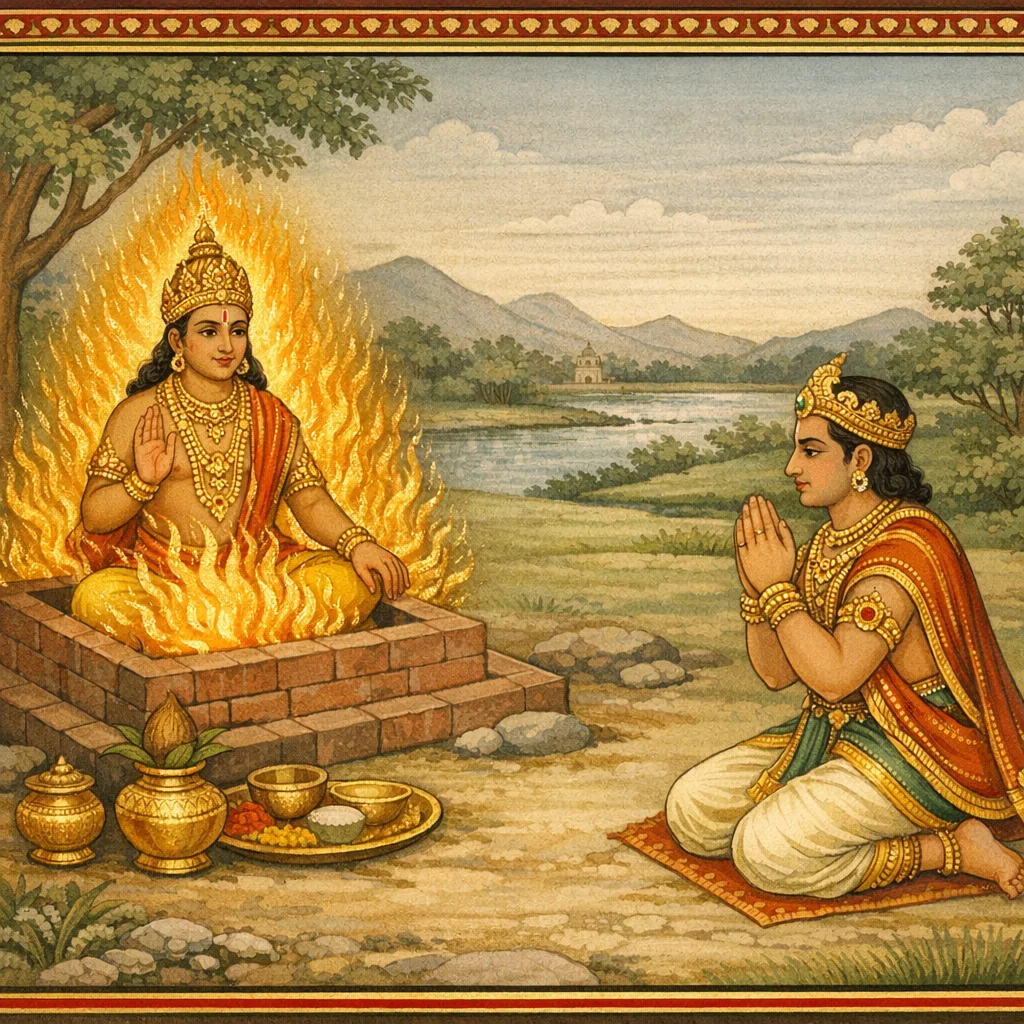
This adhyāya, narrated by Sūta, unfolds through several theological scenes. First, a king reverently approaches brāhmaṇas settled in household life and, at their request, builds a fortified settlement with homes and endowments, establishing social stability through patronage and protection. The narrative then turns to an earlier episode of King Prabhañjana of Ānarta. Astrologers judge a royal birth to be surrounded by inauspicious planetary conditions and prescribe repeated śānti rites performed by sixteen brāhmaṇas. Yet the troubles worsen—disease, loss of animals, and political danger—so the cause is sought. Agni appears in person and reveals that the rite is polluted because a “trijāta” (a brāhmaṇa of disputed/other birth) is among the officiants. To avoid direct accusation, Agni institutes a diagnostic purification: the sixteen bathe in a kuṇḍa formed from Agni’s sweat-water, and the impure one is marked by eruptions (visphoṭaka). A covenant is set: this water-body becomes a lasting means of purification for brāhmaṇas; ineligible bathers will be visibly marked; and social-ritual legitimacy is to be confirmed through bathing and manifest purity. The chapter ends with the king’s immediate recovery after proper purification and with phalaśruti-like assurances of ongoing efficacy—such as Kārttika bathing and release from specified sins—presenting the tīrtha as an enduring ethical and ritual institution.
Shlokas
Verse 1
सूत उवाच । ततस्ते ब्राह्मणाः सर्वे गतकोपा दधुर्मतिम् । यज्ञकर्मसु गार्हस्थ्ये पुत्रपौत्रसमुद्भवे
Sūta said: Then all those brāhmaṇas, their anger spent, set their minds upon the rites of sacrifice, upon the householder’s path, and upon the continuance of sons and grandsons.
Verse 2
एतस्मिन्नंतरे राजा स तान्प्राप्तान्द्विजोत्तमान् । श्रुत्वा भक्ति समायुक्तः प्रणामार्थमुपागतः
Meanwhile, the king, hearing that those excellent brāhmaṇas had arrived, came forward, filled with devotion, to bow before them.
Verse 3
श्रुत्वा कोपगतां वार्तामुपशामकृतां तथा । गार्हस्थ्याप्रतिपन्नानां वाक्यैर्भार्यासमुद्भवैः
He heard the report that wrath had arisen—and that it had likewise been pacified—by words that sprang from the wives of those devoted to the householder’s life.
Verse 4
ततः प्रणम्य तान्सर्वान्साष्टांगं स महीपतिः । ततः कृतांजलिपुटः प्रोवाच विनतः स्थितः
Then the king bowed to them all with full prostration (sāṣṭāṅga). After that, standing with folded hands, he spoke in humility.
Verse 5
युष्मदीयप्रसादेन संप्राप्तं जन्मनः फलम् । मया रोगविनाशेन तस्माद्ब्रूत करोमि किम्
“By your grace, the fruit of my very birth has been attained; by the destruction of my illness, I have been restored. Therefore tell me—what shall I do in return?”
Verse 6
ब्राह्मणा ऊचुः । भार्यया तव राजेंद्र वयं सर्वत्र वासिनः । नीताः कृतार्थतां दत्त्वा रत्नानि विविधानि च
The brāhmaṇas said: “O king of kings, through your queen we—though dwelling in many places—have been brought to fulfillment, having received gifts of jewels of many kinds.”
Verse 7
तस्मात्पुरवरं कृत्वा क्षेत्रेऽत्रैव सुशोभने । अस्माकं देहि गार्हस्थ्यं येन सम्यक्प्रजायते
“Therefore, having founded an excellent city right here in this beautiful sacred region, grant us household establishments, so that we may properly flourish with progeny.”
Verse 8
यजामो विविधैर्यज्ञैः सदा संपूर्णदक्षिणैः । इमं लोकं परं चैव साधयामः सदास्थिताः
“We shall worship through many kinds of sacrifices, always with the dakṣiṇā fully complete; thus, steadfastly established, we shall secure both this world and the next.”
Verse 9
तच्छ्रुत्वा पार्थिवो हृष्टस्तथेत्युक्त्वा ततः परम् । अनुकूलदिने प्राप्ते शिल्पानाहूय भूरिशः
Hearing this, the king rejoiced and said, “So be it.” Then, when an auspicious day arrived, he summoned many craftsmen.
Verse 10
पुरं प्रकल्पयामास बहुप्राकारसंकुलम् । प्राकारपरिखायुक्तं गोपुरैः समलंकृतम्
He caused a city to be laid out, filled with many ramparts—furnished with walls and moats, and beautifully adorned with gateways.
Verse 11
अथाष्टषष्टिविप्राणां तत्र मध्ये नृपोत्तमः । अष्टषष्टिगृहाण्येव चकार सुबृहंति च
Then, in the midst of that place, the best of kings built exactly sixty-eight houses for the sixty-eight brāhmaṇas—truly spacious dwellings.
Verse 12
मत्तवारणजुष्टानि दीर्घिकासहितानि च । गृहोद्यानैः समेतानि यथा राजगृहाणि च
Those homes were like royal residences: they were visited by intoxicated elephants, furnished with long tanks and ponds, and adorned with house-gardens.
Verse 13
तथा कृत्वाऽथ रत्नौघैः पूरयित्वा तथा परैः । ददौ तेभ्यो अष्टषष्टिं च ग्रामाणां तदनंतरम्
After doing so, he further filled their hands with heaps of gems and other precious valuables; and immediately thereafter he granted them sixty-six villages.
Verse 14
ततः सर्वान्समाहूय पुत्रपौत्रांस्तदग्रतः । प्रोवाच तारनादेन श्रूयतां जल्पतो मम
Then, summoning everyone—his sons and grandsons before him—he spoke in a clear, ringing voice: “Listen to what I am about to declare.”
Verse 15
एतत्पुरं मया दत्तमेभिर्ग्रामैः समन्वितम् । एतेभ्यो ब्राह्मणेंद्रेभ्यः श्रद्धापूतेन चेतसा
“This city, together with these villages, has been bestowed by me upon these foremost of brāhmaṇas, with a mind purified by faith (śraddhā).”
Verse 16
तस्माद्रक्षा प्रकर्तव्या यथा न स्यात्क्षतिः क्वचित् । कष्टं वा ब्राह्मणेंद्राणां तथा चैव पराभवम्
Therefore, protection must be firmly ensured, so that no harm arises anywhere—no hardship for the foremost of Brahmins, and no humiliation either.
Verse 17
अस्मद्वंशसमुद्भूतो यस्त्वेतांस्तोषयिष्यति । अन्यो वा भूपतिर्वृद्धिमग्र्यां नूनं स यास्यति
Whether born in our lineage or another ruler altogether—whoever pleases and supports these Brahmin lords will surely attain the highest prosperity.
Verse 18
यश्चापराधसंयुक्तानेतान्खेदं नयिष्यति । योजयिष्यति वा क्लेशैर्विविधैर्वा पराभवैः । स शत्रुभिः पराभूतो वेष्टितो विविधैर्गदैः
But whoever, driven by wrongdoing, brings distress upon these (Brahmins), or subjects them to diverse afflictions and humiliations—he will be defeated by enemies and beset by many diseases.
Verse 19
इह लोके वियोगादीन्प्राप्य क्लेशान्सुदारुणान् । रौरवादिषु रौद्रेषु नरकेषु प्रयास्यति
In this very world he will suffer cruel hardships—separation and the like; and after that he will go to fierce hells such as Raurava.
Verse 20
एवमुक्त्वा ततः सर्वं तेषां कृत्यं महीपतिः । स्वयमेवाकरोन्नित्यं दिवारात्रमतंद्रितः
Having spoken thus, the king then personally carried out all their required duties—constantly, day and night, without negligence.
Verse 21
अथ ता ब्राह्मणेंद्राणां भार्याः सर्वाः द्विजोत्तमाः । दमयंत्याः समासाद्य प्रासादं स्नेहवत्सलाः
Then the wives of those foremost Brahmins—virtuous ladies among the twice-born—full of love and tenderness, approached Damayantī’s palace.
Verse 22
कुंकुमागरुकर्पूरैः पुष्पैर्गंधैः पृथग्विधैः । तदर्च्चा पूजयामासुः स च राजा दिनेदिने
With kunkuma (saffron), agaru wood, camphor, flowers, and many kinds of fragrances, they performed arcana and worshipped that revered form; and the king too honored it day after day.
Verse 23
अथ ताः प्रोचुरन्योन्यं तापस्यस्तत्पुरः स्थिताः । तस्यभूपस्य संतोषं जनयंत्यो द्विजोत्तमाः
Then those ascetic women, standing in his very presence, spoke among themselves—excellent in spiritual stature—thus filling that king’s heart with contentment.
Verse 24
यदास्माकं गृहे वृद्धिः कदाचित्संभविष्यति । तदग्रतश्च पश्चाच्च दमयंत्याः प्रपूजनम् । करिष्यामो न संदेहः सर्वकृत्येषु सर्वदा
Whenever prosperity arises in our household, then both before it and after it we shall, without doubt, perform the special worship of Damayantī—in every duty and at all times.
Verse 25
एनां दृष्ट्वा कुमारी या वेदिमध्यं गमिष्यति । सा भविष्यत्यसंदेहः पत्युः प्राणसमा सदा
Any maiden who, after beholding her, goes into the midst of the vedi (altar) for the rite will, without doubt, become ever as dear to her husband as his very life-breath.
Verse 26
तस्मात्सर्वप्रयत्नेन कन्यायज्ञ उपस्थिते । दमयंती प्रद्रष्टव्या पूजनीया प्रयत्नतः
Therefore, when the maiden-rite (kanyāyajña) is at hand, Damayantī should be approached for darśana and worshipped with every effort and careful devotion.
Verse 27
सूत उवाच । एवं तत्र पुरे तेन भूभुजा सुमहात्मना । अष्टषष्टिं च संस्थाप्य गोत्राणां निर्वृतिः कृता
Sūta said: Thus, in that city, by that great-souled king, the sixty-eight gotras were duly established, and the brāhmaṇa clans were settled in peace and security.
Verse 28
तेषामपि च चत्वारि गोत्राण्युर गजाद्भयात् । गतानि तत्र यत्र स्युस्तानि पूर्वोद्भवानि च । चतुःषष्टिः स्थिता तत्र पुरे शेषा द्विजन्मनाम्
Of those, four gotras also departed out of fear of the serpent-elephant; they went away wherever they could—those were the lineages of earlier origin. The remaining sixty-four gotras of the twice-born stayed there in that city.
Verse 29
ऋषय ऊचुः । कीदृङनागभयं तेषां येन ते विगता विभो । परित्यज्य निजं स्थानमेतन्नो विस्तराद्वद
The sages said: What kind of fear of the Nāga was it, O mighty one, by which they departed, abandoning their own place? Tell us this in detail.
Verse 30
सूत उवाच । आनर्त्ताधिपतिः पूर्वमासीन्नाम्ना प्रभंजनः । धर्मज्ञः सुप्रतापी च परपक्षक्षयावहः
Sūta said: Formerly there was a ruler of Ānarta named Prabhañjana—one who knew dharma, was exceedingly valorous, and who brought ruin to hostile factions.
Verse 32
ततस्तेन समाहूय दैवज्ञाञ्छास्त्रपंडितान् । तेषां निवेदितं सर्वं कालं तस्य समुद्भवम्
Then he summoned astrologers and scholars learned in the śāstras, and to them he reported everything—especially the time and the circumstances of that child’s birth.
Verse 33
दैवज्ञा ऊचुः । एष ते पृथिवीपाल जातः पुत्रः सुगर्हित । काले ऽनिष्टप्रदे रौद्रे गंडांत त्रितयोद्भवे
The astrologers said: O ruler of the earth, this son of yours has been born under a highly blameworthy condition—at a fierce time that yields inauspicious results, in a gaṇḍānta junction arising from a triple convergence.
Verse 34
कथंचिदपि यद्येष जीवयिष्यति पार्थिव । पितृमातृपुरार्थे च देशानुत्सादयिष्यति
O king, if by some means this child manages to survive, then—driven by the aims of mother and father and the pursuit of cities and dominion—he will lay waste to regions.
Verse 35
राजोवाच । अस्ति कश्चिदुपायोऽत्र दैवो वा मानुषोऽपि वा । येन संजायते क्षेमं पुत्रस्य विषयस्य च
The king said: Is there any remedy here—whether divine or human—by which safety and well-being may arise for my son and for my realm?
Verse 36
ब्राह्मणा ऊचुः । यथा समुत्थितं यंत्रं यंत्रेण प्रतिहन्यते । यथा बाणप्रहाराणां कवचं वारणं भवेत । तथा ग्रहविकाराणां शांतिर्भवति वारणम्
The brāhmaṇas said: Just as a machine set in motion is checked by another device, and just as armor becomes a protection against the blows of arrows, so pacificatory rites become a warding protection against the disturbances caused by the planets.
Verse 37
तस्मान्नित्यमनुद्विग्नः शांतिकं कुरु भूपते । येन सर्वे ग्रहाः सौम्या जायंते च शुभावहाः
Therefore, O king, remain ever untroubled and perform the pacificatory rite (śānti), by which all the planets become gentle and bestow auspicious results.
Verse 38
अनिष्टस्थानसंस्थेषु ग्रहेषु विषमेषु च । ततः स सत्वं गत्वा चमत्कारपुरं नृपः
When the planets were placed in inauspicious positions and adverse conditions prevailed, the king gathered his resolve and went to the city called Camatkārapura.
Verse 39
तत्र विप्रान्समावेश्य सर्वान्प्रोवाच सादरम् । वयं युष्मत्प्रसादेन राज्यं कुर्मः सदैव हि
There, having assembled all the brāhmaṇas, he addressed them respectfully: “Indeed, it is by your favor that we govern the kingdom at all times.”
Verse 40
ये ऽतीता ये भविष्यंति वंशे ऽस्माकं नृपोत्तमाः । भवंतो ऽत्र गतिस्तेषां सस्यानां नीरदो यथा
For the best of kings in our lineage—those who have passed and those yet to come—you are their refuge here, just as a rain-cloud is the support of crops.
Verse 41
यदत्र मत्सुतो जातो दुष्टस्थानस्थितैर्ग्रहैः । दैवज्ञैः शांतिकं प्रोक्तं तस्यानिष्टस्य शांतिदम्
Since my son was born when the planets were placed in inauspicious positions, the astrologers have declared a pacificatory rite (śānti), one that brings relief from that misfortune.
Verse 42
तस्मात्कुरुत विप्रेंद्रा यथोक्तं शांतिकं मम । न पुत्रश्च राष्ट्रं च विभवश्च विवर्धते
Therefore, O foremost of brāhmaṇas, perform for me the prescribed pacificatory rite (śāntika); otherwise neither my son, nor my kingdom, nor my prosperity can flourish.
Verse 43
ततस्ते ब्राह्मणाः प्रोचुः संमंत्र्याऽथ परस्परम् । क्षेमाय तव भूनाथ करिष्यामोऽत्र शांतिकम्
Then those brāhmaṇas, after consulting with one another, said: “For your welfare, O lord of the earth, we shall perform the pacificatory rite (śāntika) here.”
Verse 44
सदेव नियताः संतः शांताः षोडश ते द्विजाः । उपहाराः सदा प्रेष्यास्त्वया भक्त्या महीपते । मासांते चाभिषेकश्च ग्राह्यो रुद्रघटोद्भवः
Those sixteen brāhmaṇas are ever disciplined—virtuous and serene. O king, with devotion you should continually send them offerings; and at the end of each month you should duly receive and perform the Rudra-abhiṣeka with water drawn from the consecrated Rudra-pot (Rudra-ghaṭa).
Verse 45
एवं प्रकुर्वतस्तुभ्यं पुत्रो वृद्धिं प्रयास्यति । तथा राष्ट्रं च कोशश्च यच्चान्यदपि किंचन
If you act in this manner, your son will surely flourish; likewise your kingdom and treasury—and whatever else pertains to your welfare—will prosper.
Verse 46
ततः प्रणम्य तान्हृष्टो गत्वा निजनिवेशनम् । उत्सवं पुत्रजन्मोत्थं चक्रे तैः प्रेरितः सदा
Then, delighted, he bowed to them and returned to his own residence; urged on by them, he continually held celebrations arising from the birth of a son.
Verse 47
संभारान्प्रेषयामास चमत्कारपुरे ततः । मासांते चाभिषेकश्च ग्राह्यो वै विधिपूर्वकम्
Thereafter he dispatched the required materials to Camatkārapura; and at the close of each month the abhiṣeka was indeed to be performed, duly and in accordance with the prescribed rule.
Verse 48
तेऽपि ब्राह्मणशार्दूलाश्चातुश्चरणसंभवाः । क्रमेण शांतिकं चक्रुर्ब्रह्मचर्यपरायणाः
Those brāhmaṇas too—tiger-like, born of the fourfold Vedic tradition—performed the pacificatory śāntika rites in due sequence, steadfast in brahmacarya.
Verse 49
मासं मासं प्रति सदा शांता दांता जितेंद्रियाः । ततो मासा वसानेऽन्ये चक्रुस्तच्छांतिकं द्विजाः
Month after month, ever peaceful, self-restrained, and masters of the senses, the brāhmaṇas performed that very śānti rite; then, when the month was complete, other brāhmaṇas likewise carried out the same śānti.
Verse 50
सोऽपि राजाऽथ मासांते समागत्य सुभक्तितः । अभिषेकं समादाय पूजयित्वा द्विजोत्तमान्
That king too, at the month’s end, arrived with deep devotion; taking up the abhiṣeka rite and having honored the foremost of brāhmaṇas,
Verse 51
वासोभिर्मुकुटैश्चैव गोभूदानेन केवलम् । संतर्प्यान्यांस्तथा विप्रान्स्वस्थानं याति भूमिपः
With garments and crowns, and solely through gifts of cows and land, the king satisfied the other brāhmaṇas as well; then the lord of the earth returned to his own abode.
Verse 52
एवं प्रवर्तमाने च शांतिके तत्र भूपतेः । जगाम सुमहान्कालः क्षेमारोग्यधनागमैः
As that śānti observance of pacification continued for the king, a very long time passed, attended by safety, good health, and the steady coming of wealth.
Verse 53
कस्यचित्त्वथ कालस्य मासादावपि भूपतेः । प्रारब्धे शांतिके तस्मिन्महाव्याधिरजायत
But at a certain time, even at the very start of a month, while that śānti observance had been set in motion for the king, a grievous illness arose.
Verse 54
तत्पुत्रस्य विशेषेण तथैवांतःपुरस्य च । राष्ट्रस्य च समग्रस्य वाहनानां तथा क्षयः
In particular, ruin came upon his son and likewise upon the women of the inner palace; and in the entire kingdom too there was a wasting away—especially of vehicles and mounts.
Verse 55
स ततः प्रेषयामास शांत्यर्थं तत्र सत्पुरे । सुसंभारान्विशेषेण दक्षिणाश्च विशेषतः
Then he sent to that noble city, for the sake of the śānti rites of pacification, abundant ritual requisites—and especially generous dakṣiṇās, the honoraria offered to the priests.
Verse 56
यथायथा द्विजास्तत्र होमं कुर्वंति पावके । तथा सर्वे विशेषेण रोगा वर्धंति सर्वशः
But as the dvijas—the twice-born priests—there performed homa, casting oblations into the sacred fire, so too did the diseases increase all the more, everywhere and in every way.
Verse 57
म्रियन्ते वाजिनस्तस्य बृहन्तो वारणास्तथा । शत्रवः सर्वकाष्ठासु विग्रहार्थमुपस्थिताः
His horses died, and likewise his mighty elephants. And enemies, from every quarter, stood poised—intent on strife.
Verse 58
ततः स व्याकुलीभूतो रोगग्रस्तो महीपतिः । चमत्कारपुरं प्राप्य सर्वान्विप्रानुवाच ह
Then the king, distressed and stricken with illness, reached Camatkārapura and addressed all the Brahmins there.
Verse 59
युष्माभिः स्वामिभिः संस्थैरापदोऽभिभवंति माम् । तत्किमेतन्महाभागाः क्षीयन्ते मम संपदः । रोगाश्चैव विवर्धंते शत्रुसंघैः समन्विताः
“Though you, my revered lords, are present, calamities overpower me. What is this, O fortunate ones? My wealth is dwindling; diseases are increasing—and they come accompanied by hosts of enemies.”
Verse 60
तस्माद्विशेषतो होमः कार्यो रोगप्रशांतये । दानानि च विशिष्टानि प्रदास्यामि द्विजन्मनाम्
“Therefore, a homa should be performed with special care for the pacification of disease; and I shall bestow excellent gifts in charity upon the twice-born.”
Verse 61
ततस्ते ब्राह्मणाः सर्वे प्रत्यक्षं तस्य भूपतेः । चक्रुः समाहिता भूत्वा शांतिकं तद्धिताय च
Then all those Brahmins, in the king’s very presence, became composed and performed the pacificatory rite (śāntika) for his welfare.
Verse 62
यथायथा प्रयुञ्जीरन्होमांते सुसमा हिताः । तथातथास्य भूपस्य वृद्धिं रोगः प्रगच्छति
Yet, as they kept applying the rite—carefully composed—at the conclusion of the homa, so too the king’s disease advanced and grew all the more.
Verse 63
एतस्मिन्नंतरे क्रुद्धास्ते सर्वे द्विजसत्तमाः । ग्रहानुद्दिश्य सूर्यादीञ्छापाय कृतनिश्चयाः
Meanwhile, all those best of Brahmins became angry; fixing their intention upon the celestial grahas—beginning with the Sun—they resolved to curse them.
Verse 65
एवं ते निश्चयं कृत्वा शुचीभूय समाहिताः । यावद्यच्छंति तच्छापं ग्रहेभ्यः क्रोधमूर्छिताः
Having thus reached a firm resolve, becoming purified and composed, those Brahmins—overcome by anger—were on the point of hurling a curse against the planets (Grahas).
Verse 66
तावद्वह्निरुवाचेदं मूर्तो भूत्वा द्विजोत्तमान् । मा प्रयच्छत विप्रेंद्राः शापं कोपात्कथंचन
Just then, Fire (Agni), taking on a visible form, spoke to the best of Brahmins: “O foremost among the twice-born, do not, in any way, pronounce a curse out of anger.”
Verse 67
ग्रहेभ्यो दोषमुक्तेभ्यः श्रूयतां वचनं मम । मासिमासि प्रकुर्वंति होमं ते षोडश द्विजाः
“Listen to my words regarding those planets that are free from fault: month after month, those sixteen Brahmins perform the homa.”
Verse 68
तेषां मध्यस्थितश्चैकस्त्रिजातो ब्राह्मणाधमः । तेन तद्दूषितं द्रव्यं समग्रं होमसंभवम्
In their midst stands one—called thrice-born, yet wrongly initiated, a wretch among Brahmins. Because of him, the entire offering-material meant for the homa has been defiled.
Verse 69
ब्राह्मणा ऊचुः । पूजिता अपि सद्भक्त्या विधानेन तथा ग्रहाः । पीडयंति पुरं राज्ञः सपुत्रपशुबांधवम्
The Brahmins said: “Though the grahas—the planetary powers—have been worshipped with true devotion and according to proper rite, they still afflict the king’s city, along with his sons, cattle, and kinsmen.”
Verse 70
तस्मादेनं परित्यज्य होमं कुरुत मा चिरम् । येन प्रीतिं परां यांति ग्रहाः सर्वेऽर्कपूर्वकाः
Therefore, abandon this man and perform the homa without delay; by it all the grahas, beginning with the Sun, will attain supreme satisfaction.
Verse 71
आरोग्यश्च भवेद्राजा गतशत्रुः सुतान्वितः । सततं सुखमभ्येति मच्छांतिकप्रभावतः
The king will become healthy, rid of enemies, and blessed with sons; and he will continually attain happiness, through the power of the pacificatory śāntika rite performed for me.
Verse 72
एवमुक्त्वा स भगवान्वह्निश्चादर्शनं गतः । तेऽपि विप्रा विषण्णास्या लज्जया परया वृताः
Having spoken thus, the blessed Fire, Agni, vanished from sight. Those Brahmins too, their faces downcast, were overwhelmed by profound shame.
Verse 73
ततस्तं पावकं भूयः स्तुवंतस्तत्र च स्थिताः । प्रोचुर्वैश्वानरं ब्रूहि त्रिजातो योऽत्र च द्विजः
Then, remaining there, they again praised that sacred Fire and said: “O Vaiśvānara, tell us about this ‘thrice-born’ man here who claims the rank of a twice-born.”
Verse 74
येन तं संपरित्यज्य कुर्मः कर्म प्रशांतये । निःशेषमेव दोषाणां भूपस्यास्य महात्मनः
“So that, abandoning him, we may perform the rite of pacification—bringing about the complete eradication of all faults afflicting this great-souled king.”
Verse 75
वह्निरुवाच । नाहं दोषं द्विजेद्राणां जानन्नपि कथंचन । ब्रवीमि ब्राह्मणा वन्द्या मम सर्वे धरातले
Agni said: “Even if I were to know some fault, I would never speak of any defect in the foremost of the twice-born. For to me, all brāhmaṇas upon the earth are worthy of reverence.”
Verse 76
ब्राह्मणा ऊचुः । यदि तं ब्राह्मणं वह्ने नास्माकं कीर्तयिष्यसि । तत्ते शापं प्रदास्यामस्तस्माच्छीघ्रं वदस्व नः
The brāhmaṇas said: “If you will not point out that brāhmaṇa to us, O Agni, then we shall pronounce a curse upon you. Therefore, tell us quickly.”
Verse 77
सूत उवाच । तेषां तद्वचनं श्रुत्वा वह्निर्भयसमन्वितः । चिरं विचिंतयामास कुर्वेऽतः किं शुभावहम्
Sūta said: Hearing their words, Agni—overcome with fear—pondered for a long time: “What course of action here will bring the most auspicious outcome?”
Verse 78
ब्राह्मणं दूषयिष्यामि यदि तावच्च पातकम् । भविष्यति न संदेहः शापश्चापि तदुद्भवः
“If I were to disparage a brāhmaṇa, that much sin would surely arise—no doubt—and a curse too would be born from it.”
Verse 79
कीर्तयिष्यामि वा नैव विद्यमानं द्विजोत्तमम् । शपिष्यति न संदेहः क्रुद्धा आशीविषोपमाः
“But if I do not identify the eminent brāhmaṇa who is present, then—no doubt—those brāhmaṇas, angered and like venomous serpents, will curse me.”
Verse 80
एवं चिंतयतस्तस्य गात्रे स्वेदोऽभवन्महान् । येन तत्पूरितं कुण्डं होमार्थं यत्प्रकल्पितम्
As he pondered thus, a great sweat arose upon his body—by which the kuṇḍa that had been prepared for the purpose of the homa became filled.
Verse 81
ततः प्रोवाच तान्विप्रान्कृतांजलिपुटः स्थितः । वेपमानो भयत्रस्तःकुण्डान्निष्क्रम्य पावकः
Then Pāvaka (Agni), coming out from the kuṇḍa, stood with folded hands and addressed those brāhmaṇas—trembling, distressed with fear.
Verse 83
अत्र स्वेद जले विप्रा ये स्थिताः षोडश द्विजाः । ते स्नानमद्य कुर्वंतु प्रविशुद्ध्यर्थमात्मनः
“O brāhmaṇas, let those sixteen twice-born who are standing here bathe today in this water of sweat, for the sake of complete purification of themselves.”
Verse 84
एतेषां मध्यगो यश्च त्रिजातः स भविष्यति । तस्य विस्फोटकैर्युक्तं स्नातस्यांगं भविष्यति
And whoever among them stands in the middle shall become the thrice-born; upon his body, after bathing, eruptive boils will arise.
Verse 85
ततस्ते ब्राह्मणाः सर्वे क्रमात्तत्र निमज्जनम् । चक्रुः शुद्धिं गताश्चापि मुक्त्वैकं ब्राह्मणं तदा
Then all those brāhmaṇas, in due order, immersed themselves there. They too attained purification—except that at that time they left aside one brāhmaṇa.
Verse 86
हाहाकारस्ततो जज्ञे महांस्तत्र जनोद्भवः । दृष्ट्वा विस्फोटकैर्युक्तमकस्मात्तं द्विजोत्तमम्
Then a great cry of distress arose among the people there, when they suddenly saw that foremost of the twice-born afflicted with eruptive boils.
Verse 87
सोऽपि लज्जान्वितो विप्रः कृत्वाऽधो वदनं ततः । निष्क्रांतोऽथ सभामध्यात्स्थानाद्विप्रसमुद्भवात्
That brāhmaṇa too, overcome with shame, lowered his face; then he departed from the midst of the assembly, from that seat among the brāhmaṇas.
Verse 88
वह्निरुवाच । एतद्वः साधितं कृत्यं मया पूर्वं द्विजोत्तमाः । तस्माद्यास्ये निजं स्थानं भवद्भिः पारमापितः
Fire spoke: “O best of the twice-born, I have already accomplished this task for you before. Therefore I shall now depart to my own abode, for by you it has been brought to completion.”
Verse 89
न वृथा दर्शनं मे स्यादपि स्वप्रे द्विजोत्तमाः । तस्मात्सम्प्रार्थ्यतां किंचिदभीष्टं हृदि संस्थितम्
O best of brāhmaṇas, let my appearance not be in vain, even if only in a dream. Therefore ask of me the boon you desire, which abides within your heart.
Verse 90
ब्राह्मणा ऊचुः । एतत्तव जलं वह्ने स्वेदजं सर्वदैव तु । स्थिरं भवतु चात्रैव विशुद्ध्यर्थं द्विजन्मनाम्
The brāhmaṇas said: “O Fire, may this water of yours—born of your sweat—remain established here forever, for the purification of the twice-born.”
Verse 91
अन्यजातो नरो योऽत्र प्रकरोति निमज्जनम् । तस्य चिह्नं त्वया कार्यं विस्फोटकसमुद्भवम्
If any man of another birth-group performs immersion here, then you should place upon him a mark: the arising of eruptive boils.
Verse 92
नाहं स्वजिह्वया दोषं ब्राह्मणस्य समुद्भवम् । कथञ्चित्कीर्तयिष्यामि तस्माच्छृण्वन्तु भो द्विजाः
I shall not, with my own tongue, openly proclaim the fault that has arisen in a brāhmaṇa; yet I will mention it in some manner. Therefore listen, O twice-born.
Verse 93
अद्यप्रभृति सर्वेषां ब्राह्मणानां समुद्भवम् । शुद्धिरत्र प्रकर्तव्या पितृमातृसमुद्द्भवा
From today onward, for all brāhmaṇas, purification is to be performed here—purification pertaining to what arises from father and mother, that is, lineage and birth.
Verse 94
चमत्कारपुरोत्थो यः कश्चिद्विप्रः प्रकीर्तितः । सोऽत्र स्नातो विशुद्धश्च विज्ञेयः कुलपुत्रकः
Whatever brāhmaṇa is spoken of as “born from Camatkārapura,” once he bathes here, becomes purified and should be known as a rightful son of a noble family.
Verse 95
तस्मै कन्या प्रदातव्या स श्राद्धार्हो भविष्यति धर्मकृत्येषु सर्वेषु योजनीयः स एव हि
To him a maiden should be given in marriage. He will become fit to receive śrāddha offerings, and indeed he alone should be engaged in all rites of dharma.
Verse 96
अष्टषष्टिषु गोत्रेषु मिलितेषु यथाक्रमम् । तत्प्रत्यक्षं विशुद्धो यः स शुद्धः पंक्तिपावनः
When the sixty-eight lineages are assembled in due order, the one who is found, by evident signs, to be pure—he is truly pure, a purifier of the entire dining line.
Verse 97
अपवादाश्च ये केचिद्ब्रह्महत्यादिकाः स्थिताः । अन्येऽपि दुर्जनैः प्रोक्ता धर्मसन्देहकारकाः
And whatever accusations there may be—such as charges of brahmin-slaying and the like—as well as other allegations spoken by wicked people that generate doubts about dharma—
Verse 98
ते सर्वेऽत्र विशुद्धाः स्युर्विज्ञेयाः कुलपुत्रकाः । अपवादास्तथा चान्ये नाशं यास्यंति चाखिलाः
All such persons are to be understood here as fully purified, worthy sons of noble families; and those accusations, and all other slanders too, will be utterly brought to ruin.
Verse 99
यावन्नात्र कृतं स्नानं प्रत्यक्षं च द्विजन्मनाम् । सर्वेषां तावदेवाऽत्र न स विप्रो भवेत्स्फुटम्
So long as the twice-born do not perform here a direct and plainly visible sacred bath, so long—in this matter for them all—he does not truly become a brāhmaṇa in the full and evident sense.
Verse 100
सूत उवाच । एवं ते समयं कृत्वा चमत्कारपुरोद्भवाः । ब्राह्मणाः शांतिकं चक्रुर्हितार्थं तस्य भूपतेः
Sūta said: Thus having made an agreement, the brāhmaṇas who had come forth from the wondrous city performed pacificatory (śāntika) rites for the welfare of that king.
Verse 101
तस्मिन्कुण्डे ततः स्नानं कृतं सर्वैर्महात्मभिः । भयत्रस्तैर्विशुद्ध्यर्थं शेषैरपि महात्मभिः
Then, in that sacred pond (kuṇḍa), bathing was performed by all the great-souled ones; and the remaining great souls too—shaken by fear—bathed there for the sake of purification.
Verse 102
ततो नीरोगतां प्राप्तः स भूपस्तत्क्षणाद्विजाः । यस्तत्र कुरुते स्नानमद्यापि द्विजसत्तमाः
Thereupon, O twice-born, that king attained freedom from disease at that very moment. Even today, O best of the twice-born, whoever performs bathing there—
Verse 103
कार्तिक्यां परदारोत्थैः स विमुच्येत पातकैः । एषां युगत्रये शुद्धिरासीत्तत्र द्विजन्मनाम्
In the month of Kārttika, he is released from sins arising from another’s wife (adultery). For these twice-born, through the three yugas, there was purity there at that tīrtha.
Verse 104
कुलशीलविहीनानामन्येषामपि पाप्मनाम् । मत्वा कलियुगं घोरं परदारसुरंजितम् । तत्र शुद्धिस्ततः सर्वैः कृता विप्रैश्च वाचिका
Considering the dreadful Kali age—filled with the ‘demon’ of adultery—and seeing people devoid of family-discipline and good conduct, and other sinners as well, therefore purification there was established by all, and also a verbal purification by the brāhmaṇas.
Verse 106
अद्यापि कुरुते तत्र यः स्नानं द्विजसत्तमाः । त्रिजातो दह्यते तत्र वह्निना स न संशयः
Even today, O best of the twice-born, whoever bathes there—any thrice-born one is burned clean there by the fire of purification; of this there is no doubt.
Verse 113
इति श्रीस्कांदे महापुराण एकाशीतिसाहस्र्यां संहितायां षष्ठे नागरखण्डे हाटकेवरक्षेत्रमाहात्म्ये दमयन्त्युपाख्याने त्रिजातकविशुद्धयेऽग्निकुंडमाहात्म्यवर्णनंनाम त्रयोदशोत्तरशततमोऽध्यायः
Thus, in the holy Skanda Mahāpurāṇa—within the eighty-one-thousand-verse compilation, in the sixth book, the Nāgara Khaṇḍa—concludes the one-hundred-and-thirteenth chapter, entitled “The Description of the Greatness of the Agnikuṇḍa, for the purification of Trijāta.”