Adhyaya 111
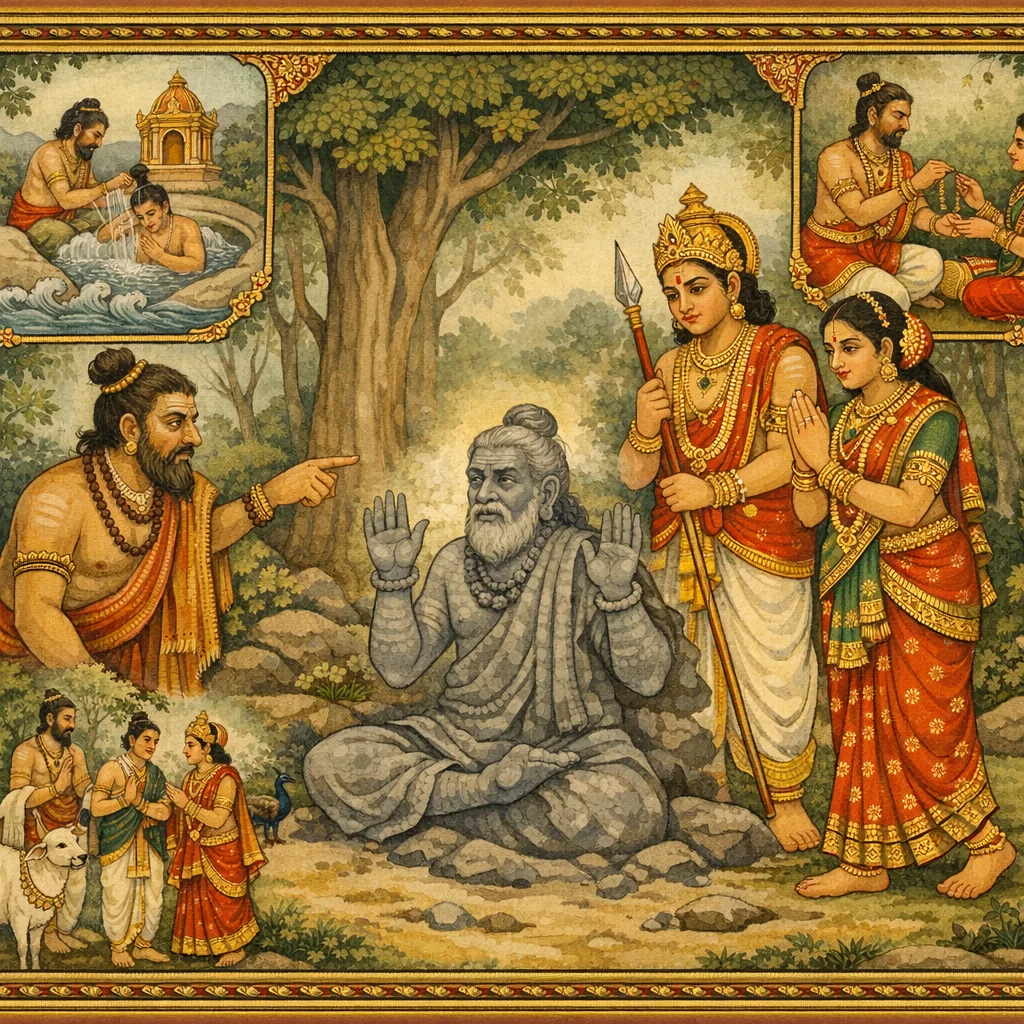
In this chapter, sages ask Sūta to enumerate the gotras of brāhmaṇas connected with Śiva-kṣetras and to clarify their numbers and particulars. Sūta replies by recalling an earlier teaching: a king of Ānarta, afflicted with leprosy, is instantly relieved after bathing at Śaṅkha-tīrtha, revealing the potency of the tīrtha and the grace of Śiva. The king seeks to repay the ascetics, but they refuse material gifts, observing a vow of non-possession. The discussion turns to a moral maxim: ingratitude is a uniquely heavy fault, not easily expiated. When the sages depart on a Kārttika pilgrimage to Puṣkara, the king instructs Damayantī to offer ornaments to the sages’ wives, believing this to be service that does not violate ascetic discipline. The matter worsens: some ascetic women accept the ornaments in a spirit of rivalry, while four refuse. On the sages’ return, the āśrama appears “distorted” by ornamentation; anger flares and a curse is uttered. Damayantī is immediately turned to stone, followed by the king’s grief and attempts at reconciliation. The chapter teaches the boundary between devotional giving and the integrity of ascetic vows—how even well-meant acts become adharma when they breed attachment, competition, or a breach of established discipline.
Shlokas
Verse 1
ऋषय ऊचुः । शिवक्षेत्राणि यैर्विप्रैः समानीतानि तत्र च । तेषां सर्वाणि गोत्राणि वद सूतज विस्तरात्
The sages said: “O Sūta’s son, explain in detail the lineages (gotras) of all those brāhmaṇas by whom the sacred Śiva-sites were brought there and established.”
Verse 2
कस्य गोत्रोद्भवैर्विप्रैः किं क्षेत्रं समुपार्जितम् । शंकरस्य प्रसादेन तस्मिन्काल उपस्थिते
“From which gotras did those brāhmaṇas arise, and what sacred site was obtained and established—by Śaṅkara’s grace—at that time?”
Verse 3
कियत्यपि च गोत्राणि चमत्कारपुरोत्तमे । स्थापितानि सुभक्तेन तेनानर्तेन सूतज
“How many gotras were established in that excellent city of Camatkāra, O Sūta’s son—set in place by that devoted Ānarta ruler?”
Verse 4
त्वया प्रोक्तं पुरा दत्तं पुरं कृत्वा द्विजन्मनाम् । न च तेषां कृता संख्या तस्मात्तां परिकीर्तय
Earlier you said that a city was granted after it was made a settlement for the twice-born; yet their number was not counted. Therefore, recount that number.
Verse 5
सूत उवाच । उपदेशः पुरा दत्तो द्विसप्ततिमुनीश्वरैः । आनर्ताधिपतिः पूर्वं कुष्ठरोग प्रपीडितः । शंखतीर्थं समागत्य स्नानं चक्रे त्वरान्वितः
Sūta said: “Long ago, instruction was given by seventy-two great sages. Formerly, the lord of Ānarta, afflicted with leprosy, came to Śaṃkha-tīrtha and, in urgency, performed a purifying bath.”
Verse 6
तेन नाशं गतः कुष्ठो भूपतेस्तस्य तत्क्षणात् । तस्य तीर्थस्य माहात्म्यान्निर्वि ण्णस्य तनुं प्रति
By that act, the king’s leprosy was destroyed instantly—through the greatness of that tīrtha—leaving him deeply chastened regarding his own body.
Verse 7
ततः स नीरुजो भूत्वा तोषेण महतान्वितः । तानुवाच मुनिश्रेष्ठान् प्रणिपत्य मुहुर्मुहुः
Then, becoming free from disease and filled with great joy, he addressed those best of sages, repeatedly bowing down to them.
Verse 8
सुवर्णं वा गजाश्वं वा राज्यं सकलमेव वा । भवद्भ्यः संप्रदास्यामि तस्मादब्रूत द्विजोत्तमाः
“Whether gold, or elephants and horses, or even my entire kingdom—I will give it to you. Therefore, O best of twice-born, speak (tell me what is to be done).”
Verse 9
यद्यस्य रोचते यावन्मात्रमन्यदपि द्विजाः । प्रसादः क्रियतां मह्यं दीनस्य प्रणतस्य च
“Whatever each of you desires—however much, and even something else besides—grant me your gracious favor; for I am wretched and bowed down before you.”
Verse 10
ब्राह्मणा ऊचुः । निष्परिग्रहधर्माणो वानप्रस्था वयं द्विजाः । सद्यःप्रक्षालकाः किं नो राज्येन विभवेन च
The brāhmaṇas said: “We are twice-born vānaprasthas, devoted to the dharma of non-possession. We purify ourselves at once—what need have we of a kingdom or worldly splendor?”
Verse 11
राजोवाच उपकारं समासाद्य यः करोति न पापकृत् । उपकारं पुनस्तस्य स कृतघ्न उदाहृतः
The King said: “One who, having received a kindness, does not act sinfully—meaning, does not repay it with harm—is not a wrongdoer. But one who, in return for that kindness, does not render kindness back is declared ‘ungrateful’ (kṛtaghna).”
Verse 12
ब्रह्मघ्नं च सुरापे च चौरे भग्नव ते शठे । निष्कृतिर्विहिता सद्भिः कृतघ्ने नास्ति निष्कृतिः
“For the slayer of a brāhmaṇa, for the drinker of liquor, for a thief, for one who breaks vows, and for a deceitful person—the righteous have laid down expiations. But for the ungrateful person, there is no expiation.”
Verse 16
तस्मात्त्वं गच्छ राज्यं स्वं स्वधर्मेण प्रपालय । इह लोके परे चैव येन सौख्यं प्रजायते
“Therefore, go to your own kingdom and protect it according to your rightful duty (svadharma). By such conduct, happiness arises both in this world and in the world beyond.”
Verse 18
तत्र गत्वा प्रहृष्टा त्माकृत्वा रम्यं महेश्वरम् । गीतनृत्यसवाद्यैश्च रात्रिजागरणादिभिः । चकार पूर्ववद्राज्यं समंताद्धतकंटकम्
Having gone there, joyful at heart, he established and worshipped a beautiful shrine of Maheśvara (Śiva). With singing, dancing, instrumental music, and observances such as the night-vigil, he restored his kingdom as before—free from thorns (troubles) on every side.
Verse 19
चिंतयानो दिवानक्तं ब्राह्मणान्प्रति तत्सदा । कथं तेषां द्विजेंद्राणामुपकारो भविष्यति । मदीयो मम यैर्दत्तं गात्रमेतत्पुनर्नवम्
Day and night he continually reflected upon those brāhmaṇas: “How may I render service to those best of the twice-born, by whom this very body of mine has been granted anew, as if renewed?”
Verse 20
तेऽपि सर्वे मुनिश्रेष्ठाः खेचरत्व समन्विताः । तपःशक्त्या यांति नानातीर्थेषु भक्तितः
Those best of sages too—endowed with the power to move through the sky—by the force of their austerities travel with devotion to many tīrthas, the sacred bathing-places.
Verse 21
तेषु स्नानं जपं कृत्वा तथैव पितृतर्पणम् । प्राणयात्रां पुनश्चक्रुस्तत्रागत्य स्व आश्रमे
There, having performed bathing, mantra-recitation (japa), and likewise tarpaṇa—offerings to the ancestors—they resumed their life’s course and returned to their own hermitage.
Verse 22
अन्ये तत्रैव कुर्वंति नित्यकृत्यानि ये द्विजाः । तथान्ये दूरमासाद्य तीर्थं दृष्ट्वा मनोहरम्
Some twice-born performed their daily obligatory rites (nitya-kṛtya) right there; others, having come from far away, beheld that charming tīrtha, the sacred ford.
Verse 23
उषित्वा रजनीं तत्र द्विरात्रं वा पुनर्गृहम् । समागच्छंति चान्ये तु त्रिरात्रेण समाययुः
Having stayed there for a night—or for two nights—some returned home; others, however, came back after three nights.
Verse 24
वाराणस्यां प्रयागे वा पुष्करे वाथ नैमिषे । प्रभासे वाऽथ केदारे ह्यन्यस्मिन्नहि वांछ्यते
Whether in Vārāṇasī, or at Prayāga, or at Puṣkara, or at Naimiṣa; whether at Prabhāsa or at Kedāra—indeed, no other place is desired as superior to these renowned tīrthas.
Verse 25
कदाचिदथ ते सर्वे कार्तिक्यां पुष्करत्रये । गता विनिश्चयं कृत्वा स्नानार्थं द्विजसत्तमाः
Once, in the month of Kārttika, all those best of twice-born Brahmins, having firmly resolved, went to Puṣkara-traya for the purpose of sacred bathing.
Verse 26
पंचरात्रं वसिष्यामो वयं तत्र समाहिताः । तस्माद्वह्निषु दारेषु रक्षा कार्या स्वशक्तितः
“We shall dwell there, composed and intent, for five nights; therefore, to the best of your ability, ensure protection regarding the sacred fires and the household (wives).”
Verse 27
एवं ते समयं कृत्वा गता यावद्द्विजोत्तमाः । तावद्ध पतिना ज्ञाता न कश्चित्तत्र तिष्ठति
Having thus settled their agreement, those best of Brahmins departed; then the husband came to know that no one at all remained there.
Verse 28
तेषां मध्ये मुनींद्राणां सुतीर्थाश्रमवासिनाम् । दमयंतीति विख्याता चंद्रबिंबसमानना
Among the great sages dwelling in the Sutīrtha āśrama was a woman famed as Damayantī, her face lovely like the disk of the full moon.
Verse 29
तामुवाच रहस्येवं व्रज त्वं चारुहासिनि । हाटकेश्वरजे क्षेत्रे ममादेशोऽधुना ध्रुवम्
He spoke to her in secret: “Go, O sweet-smiling one, to the sacred region of Hāṭakeśvara; my command now is indeed firm.”
Verse 30
तत्र तिष्ठंति याः पत्न्यो मुनीनां भावितात्मनाम् । भूषणानि विचित्राणि तासां यच्छ यथेच्छया
“There dwell the wives of sages of disciplined minds; give them various ornaments, as you please.”
Verse 31
न तासां पतयोऽस्माकं प्रकुर्वंति प्रतिग्रहम् । कथंचिदपि सुश्रोणि लोभ्यमानापि भूरिशः
“Their husbands—our sages—do not accept gifts; even if tempted greatly in many ways, O fair-hipped one, they do not take them.”
Verse 32
स्त्रीणां भूषणजा चिन्ता सदा चैवाधिका भवेत् । लौल्यं च कौतुकं चैव सदा भूषणजं भवेत्
“Concern arising from ornaments is often especially strong in women; and fickle craving and curiosity, too, are repeatedly stirred by ornaments.”
Verse 33
अपि मृन्मयकं किंचित्काष्ठसूत्रमयं च वा । जतुकाचमयं वापि नारी धत्ते विभूषणम्
Even if it is but a small trinket made of clay, or of wood and thread, or even of resin and glass—still a woman wears it as an ornament.
Verse 34
एष एव भवेत्तेषामुपकारस्यसंभवः । उपायः पद्मपत्राक्षि न चान्योऽस्ति कथंचन
This alone will become the means by which help to them is made possible; this is the method, O lotus-petal-eyed one—there is no other way at all.
Verse 35
सा तथेति प्रतिज्ञाय विचित्राभरणानि च । गृहीत्वा हर्षसंयुका ततस्तत्क्षेत्रमाययौ
She assented, saying, “So be it,” and, taking up those wondrous ornaments with a heart filled with joy, she then set out for that sacred kṣetra (holy region).
Verse 36
मणिमुक्तामयान्येव कुण्डलानि शुभानि च । तथा चन्द्रोज्ज्वलाहारान्नूपुराणि बृहंति च
Earrings made of gems and pearls—auspicious indeed—along with necklaces gleaming like the moon, and large anklets as well.
Verse 37
इन्द्रनीलमहानीलवैडूर्यखचितानि च । पद्मरागैस्तथा वज्रैर्माणिक्यैश्च मनोरमैः
Set with indranīla and mahānīla sapphires and with vaiḍūrya (cat’s-eye) stones; also with rubies, diamonds, and delightful crystals and jewels.
Verse 38
केशैः कंकणैर्दिव्यैः शक्रचापनिभैः शुभैः । हेमसूत्रैश्च जात्यैश्च मेखलाभिस्तथैव च
With divine bracelets—auspicious, radiant like Indra’s bow—along with golden threads, choice fine ornaments, and girdles as well.
Verse 39
अथ सा बोधने विष्णोः संप्राप्ते दिवसे शुभे । उपवासपरा स्नाता एकस्मिन्सलिलाशये
Then, when the auspicious day of Viṣṇu’s Bodhana—His awakening—arrived, she, devoted to fasting, bathed in a certain water-reservoir.
Verse 40
तीरदेशे निवेश्यैव महाभूषणपर्वतम् । यस्य प्रभाभिरुग्राभिर्व्याप्तं गगनमंडलम्
And having set upon the riverbank a great “mountain of ornaments,” whose fierce radiance spread forth and filled the circle of the sky,
Verse 41
एतस्मिन्नंतरे प्राप्तास्तापस्यः कौतुकान्विताः । कीदृशा राजपत्नी सा किंरूपा किंविभूषणा
In the meantime, ascetic women arrived, filled with curiosity: “What manner of queen is she—what form has she, and with what adornments is she arrayed?”
Verse 42
अथ तास्तां समालोक्य दिव्यभूषणभूषिताम् । सुरूपांगीं समाधिस्थां चित्ते चिन्तां प्रचक्रिरे
Then, seeing her adorned with divine ornaments—beautiful-limbed and established in meditation—they began to ponder within their hearts.
Verse 43
धन्येयं भूपतेर्भार्या यैवं भूषणभूषिता । दमयंती सुरूपाढ्या सर्वलक्षणलक्षिता
Blessed indeed is this king’s wife, thus adorned with ornaments—Damayantī, rich in beauty, marked by every auspicious sign.
Verse 44
समाध्यंतं समासाद्य तापसीर्वीक्ष्य साऽपि च । दमयंती नमश्चक्रे ताः सर्वा विधिपूर्वकम्
Coming out of her meditation and seeing the ascetic women before her, Damayantī too offered reverent salutations to them all, duly and according to proper rite.
Verse 45
ताः कृतांजलिना प्राह वल्गुवाक्यं मनोहरम् । मयायं भूषणस्तोम उद्दिश्य गरुडध्वजम् । कल्पितोऽद्य दिने स्नात्वा समुपोष्य दिने हरेः
With palms joined, she spoke to them sweet and charming words: “This collection of ornaments has been prepared by me as an offering dedicated to Garuḍa-bannered Hari. Having bathed today and observed a fast on Hari’s sacred day…”
Verse 46
तस्माद्गृह्णंतु तापस्यो मया दत्तानि वांछया । भूषणानि विचित्राणि प्रसादः क्रियतां मम
“Therefore, O ascetic ladies, please accept these wondrous ornaments that I have given with heartfelt desire; show me your favor—grant me your gracious acceptance.”
Verse 47
ततश्चैकाऽब्रवीत्तासामेषा मुक्तावली मम । इमां देहि न मे वांछा विद्यतेऽन्या नृपप्रिये
Then one among them said, “This pearl-necklace is mine—give it to me. I desire nothing else, O beloved of the king.”
Verse 48
ततस्तया विहस्योच्चैः प्रक्षाल्य चरणौ स्वयम् । दत्ता मुक्तावली तस्या वस्त्रैर्दिव्यैः समन्विता । यस्याः षण्माषतुल्यानि मौक्तिकान्यमलानि च
Then she laughed aloud, washed her feet herself, and bestowed upon her that pearl-necklace together with divine garments; its flawless pearls weighed six māṣas each.
Verse 49
शरत्काले यथा व्योम्नि नक्षत्राणि द्विजोत्तमाः । तथान्या स्पर्द्धया युक्ता ययाचेऽमलवर्चसम् । हारं निर्मूल्यतायुक्तं चित्ताह्लादकरं परम्
O best of the twice-born, as stars gleam in the autumn sky, so another—stirred by rivalry—asked for a radiant, spotless necklace, priceless in worth and supremely gladdening to the heart.
Verse 50
अथ सा तं करे कृत्वा तस्या हारं प्रयच्छति । तावदन्या प्रजग्राह हारं शृंगारलालसा
Then she placed it in her hand and offered her the necklace; but at that very moment another woman, eager for adornment, snatched up the necklace.
Verse 51
ततः शेषाश्च तापस्यो भूषणार्थं समुत्सुकाः । सस्पर्द्धा जगृहुस्तानि भूषणानि स्वयं द्विजाः
Then the remaining ascetic women, eager for ornaments, took those ornaments for themselves—filled with rivalry, O twice-born.
Verse 52
अन्याश्चान्याकरे कृत्वा भूषणं सुमनोहरम् । बलादाकृष्य जग्राह धर्षयित्वा ततः परम्
And another, placing a most charming ornament into another’s hand, then dragged it away by force and seized it, committing further affront thereafter.
Verse 53
यथायथा प्रगृह्णंति तापस्यो भूषणार्चिताः । तथातथास्याः संजज्ञे दमयंत्या मुदा हृदि
As the ascetic women—now adorned with ornaments—kept taking them, so too, again and again, joy arose in Damayantī’s heart.
Verse 54
अन्यानि च प्रचिक्षेप शतशोऽथ सहस्रशः । न तृप्तिर्जायते तासां तथापि द्विजसत्तमाः
She kept casting forth other gifts too—by the hundreds and even by the thousands; yet their satisfaction did not arise, O best of twice-born.
Verse 55
भूषणाभावमासाद्य ततः सा पार्थिवप्रिया । हृष्टा प्रोवाच ताः सर्वाः संतोषः क्रियतामिति
Having found herself without ornaments, the king’s beloved queen became delighted and said to them all: “Let contentment be cultivated.”
Verse 56
पुनश्चैवानयिष्यामि प्रभाते नात्र संशयः । अन्यानि च विचित्राणि यस्या रोचंति यानि च
“And again I shall bring (them) in the morning—of this there is no doubt—along with other wondrous things, whatever may please you.”
Verse 57
ततस्ताः सकलाः प्रोचुर्गच्छ त्वं पार्थिवप्रिये । आगंतव्यं च भूयोऽपि प्रगृह्याभरणानि च
Then all of them said: “Go, O beloved of the king; and you must return again, bringing ornaments as well.”
Verse 58
एवमुक्ता ततस्ताभिः प्रणिपत्य नृपप्रिया । प्रहृष्टा प्रययौ तूर्णं स्वपुरं प्रति सद्द्विजाः
Thus addressed by them, the king’s beloved queen bowed down in reverence and, filled with joy, quickly departed toward her own city, O noble brāhmaṇas.
Verse 59
तापस्योपि गृहं गत्वा वस्त्राणि विविधानि च । भूषणानि च गात्रेषु सस्पर्द्धा निदधुस्तदा
Then, having gone to the ascetic woman’s dwelling, they put on various garments and also ornaments upon their bodies—competitively, as it were.
Verse 60
तापसीनां चतुष्कं च परित्यज्य यतव्रतम् । शेषाभिः प्रगृहीतानि मण्डनानि यथेच्छया
But a group of four ascetic women, firm in their vows, renounced such adornment; the rest accepted the ornaments according to their own liking.
Verse 61
ततः प्रभाते विमले प्रोद्गते रविमण्डले । भूयोपि राजपत्नी सा भूषणान्यंबराणि च
Then, at the pure dawn when the orb of the sun had risen, that queen again brought ornaments and garments as well.
Verse 62
तथैव प्रददौ तासां जगृहुश्च तथैव ताः । एवं तस्याः प्रयच्छंत्या अहन्यहनि भक्तितः
Just so she gave to them, and just so they accepted. In this manner, as she kept giving day after day with devotion,
Verse 63
पंचरात्रमतिक्रांतं तृप्तास्तास्तापसप्रियाः । न राज्ञी तृप्तिमायाति प्रयच्छंती प्रभक्तितः
When five nights had passed, those ascetic women were satisfied; yet the queen did not come to satiety, for she continued giving with deep devotion.
Verse 64
ततः शुश्राव तापस्यश्चतस्रोऽत्र सुनिःस्पृहाः । वल्कलाजिनधारिण्यो न तस्याः पार्श्वमागताः । न चान्या भूषिता दृष्ट्वा चक्रुरीर्ष्यां कथंचन
Then it was heard that four ascetic women here—utterly free from desire, wearing bark-garments and antelope-skins—did not come near her. And the other women, even on seeing some adorned, did not feel jealousy in any way.
Verse 65
अथ सा त्वरितं गत्वा तासां पार्श्वमनिंदिता । भूषणानि महार्हाणि गृहीत्वा पंचमीदिने
Then that blameless lady quickly went to their side and, on the fifth lunar day (pañcamī), took up the highly precious ornaments.
Verse 66
ततः प्रोवाच ताः सर्वाः प्रसादः क्रियतामिति । इमानि भूषणार्थाय भूषणानि प्रगृह्यताम्
Then she addressed them all: “Be gracious (show favor). Please accept these ornaments, meant for adornment.”
Verse 67
तापस्य ऊचुः । नास्माकं भूषणैः कार्यं भूषिता वल्कलैर्वयम् । तस्माद्गच्छ निजं हर्म्यमर्थिभ्यः संप्रदीयताम्
The ascetic women said: “We have no need of ornaments; we are adorned with bark-garments. Therefore, go back to your own mansion—let these be properly given to those who are in need.”
Verse 68
वदन्तीनां तया सार्धमेवं तासां द्विजोत्तमाः । चत्वारः पतयः प्राप्ता एकैकस्याः पृथक्पृथक्
As they spoke thus with her, four eminent brāhmaṇas—the husbands of those women—arrived, each coming separately to his own wife.
Verse 69
शुनःशेपोऽथ शाक्रेयो बौद्धो दान्तश्चतुर्थकः । वियन्मार्गं हि चत्वारः स्वाश्रममाययुः
They were Śunaḥśepa, Śākreya, Bauddha, and Dānta as the fourth; all four returned to their own hermitages by the path of the sky.
Verse 70
शेषाः सर्वे गतिभ्रंशं प्राप्य भूमार्गमाश्रिताः । अथ ते स्वाश्रमं दृष्ट्वा विकृताकारभूषणम् । किमिदंकिमिदं प्रोचुर्यत्तापस्यो विडंबिताः
But the others, having lost their former mode of movement, took to the earthly path. Then, seeing their hermitage strangely altered and ‘adorned’ in a distorted way, they cried again and again, “What is this—what is this?”, for the ascetic women had been mocked.
Verse 71
केनैवं पाप्मनाऽस्माकमाश्रमोऽयं विडंबितः । प्रदत्त्वा तापसीनां च भूषणान्यंबराणि च
“By what sinner has our hermitage been thus disgraced—after giving the ascetic women ornaments and garments?”
Verse 72
अनया संप्रदत्तानि सर्वासां भूषणानि वै
Indeed, it was by her that the ornaments of all of them were given away.
Verse 73
अस्माकमपि संप्राप्ता गृहे वै नृपवल्लभा । दातुं विभूषणान्येव निषिद्धाऽस्माभिरद्य सा
The king’s beloved consort came to our house as well. Today we forbade her from giving away those very ornaments.
Verse 74
सूत उवाच । तासां तद्वचनं श्रुत्वा ततस्ते कोप मूर्च्छिताः । ऊचुस्तां नृपतेर्भार्यां शापं दातुं मुहुर्मुहुः
Sūta said: Hearing those words, they were overcome by anger and repeatedly spoke of giving a curse to the king’s wife.
Verse 75
द्विसप्ततिर्वयं पापे स्नानार्थं पुष्करे गताः । कार्तिक्यां व्योममार्गेण मनोमारुतरंहसा
“Sinful as we were, seventy-two of us went to Puṣkara for the sake of sacred bathing. In the month of Kārttika, we travelled by the path of the sky, swift as the mind and the wind.”
Verse 76
चत्वारस्त इमे प्राप्ता येषां दारैः प्रतिग्रहः । न कृतस्तस्य भूपस्य कुभार्यायाः कथंचन
“These four have arrived—those for whom acceptance of gifts through their wives was never done in any way; and for that king’s wicked wife, no proper acceptance was made at all.”
Verse 78
अथ सा तत्क्षणादेव शिलारूपा बभूव ह । निश्चेष्टा तत्क्षणादेव मुनिवाक्यादनंतरम्
Then, that very instant, she became stone-formed indeed—motionless at once, immediately following the sage’s words.
Verse 79
ततः स परिवारोऽस्यास्तद्दुःखेन समाकुलः । वाष्पपूर्णेक्षणो दीनः प्रस्थितः स्वपुरं प्रति
Thereupon her family, overwhelmed by that sorrow, departed—wretched, with eyes filled with tears—toward their own city.
Verse 80
कथयामास तत्सर्वं दमयंत्याः समुद्भवम् । वृत्तांतं ब्राह्मणश्रेष्ठास्तस्याः शापसमुद्भवम्
The foremost Brāhmaṇas related the entire occurrence—how it arose in connection with Damayantī—and the account of the curse that had come upon her.
Verse 81
श्रुत्वा स पार्थिवस्तूर्णं वृत्तांतं शापजं तदा । प्रसादनाय विप्राणां दुःखितः स वनं ययौ
Hearing then, at once, that account born of the curse, the king—grieved—went to the forest in order to seek the Brāhmaṇas’ appeasement.
Verse 82
ततस्ते मुनयस्तूर्णं चत्वारोऽपि महीपतिम् । ज्ञात्वा प्रसादनार्थाय भार्यार्थं समुपस्थितम्
Then those four sages, quickly understanding that the king had come seeking appeasement for the sake of his wife, approached to meet him.
Verse 83
अग्रिहोत्राणि दारांश्च समादाय ततः परम् । कुरुक्षेत्रं समाजग्मुः खमार्गेण द्रुतं तदा
After that, taking along their sacred fires for agnihotra and their wives, they then swiftly went to Kurukṣetra by the path of the sky.
Verse 85
ततो जगाम तं देशं यत्र भार्या शिलामयी । सा स्थिता तापसीवृन्दैः सर्वतोऽपि समन्विता
Then he went to that place where his wife, turned to stone, stood—surrounded on every side by groups of ascetic women.
Verse 87
ततः कृच्छ्रात्समासाद्य संज्ञां तोयसमुक्षितः । प्रलापमकरोत्पश्चात्स्मृत्वास्मृत्वा प्रियान्गुणान्
Then, sprinkled with water, he regained consciousness with difficulty; afterwards he began to lament, again and again recalling his beloved’s virtues.
Verse 88
हा प्रिये मृगशावाक्षि मम प्राणविनाशिनि । मां मुक्त्वाऽद्य प्रियं कांतं क्व गतासि शुभानने
“Alas, my beloved—doe-eyed one—destroyer of my very life-breath! Leaving me today, your dear husband, where have you gone, O auspicious-faced one?”
Verse 89
नाभुक्ते मयि भुक्तासि निद्रां नाऽनिद्रिते गता । न सौभाग्यस्य गर्वेण ममाज्ञा लंघिता क्वचित्
“You never ate when I had not eaten; you never went to sleep while I remained awake. Never, out of pride in your good fortune, did you ever disregard my command.”
Verse 90
न स्मरामि त्वया प्रोक्तं कदाचिद्वि कृतं वचः । रहस्यपि विशालाक्षि किमु भोजनसंसदि
“I do not recall that you ever spoke a harsh or improper word—even in private, O large-eyed one—how much less in an assembly at meals.”
Verse 91
सूत उवाच । एवं प्रलपतस्तस्य भूपतेः करुणं बहु । आयाता मंत्रिणस्तस्य श्रुत्वा भूपं तथाविधम्
Sūta said: “As that king lamented in many piteous ways, his ministers came—having heard the ruler in such a state.”
Verse 92
ततः संबोध्य तं कृच्छाद्दृष्टान्तैर्वहुविस्तरैः । राजर्षीणां पुराणानां महद्व्यसनसंभवैः
“Then, with difficulty, they roused him by many wide-ranging examples—drawn from ancient accounts of royal sages and the great calamities that befell them.”
Verse 93
निन्युस्तं भूपतिं दीनं वाष्पव्याकुललोचनम् । निश्वसंतं यथानागं तेजसा परिवर्जितम्
“They led that wretched king away—his eyes troubled by tears—sighing like an elephant, and bereft of his former splendor.”
Verse 94
पार्थिवोऽपि समन्वेष्य यत्नात्तान्सर्वतो मुनीन् । निर्विण्णः श्रमार्तश्च भार्याव्यसनदुःखितः
“The king too, after diligently searching everywhere for those sages, became dejected and exhausted—afflicted by the misery born of his wife’s calamity.”
Verse 96
अथ तां तादृशीं दृष्ट्वा सेवकैः सकलैर्वृतः । हाहेति स मुहुः प्रोच्य मूर्च्छितः प्रापतत्क्षितौ
“Then, seeing her in that condition, surrounded by all his attendants, he repeatedly cried ‘Alas!’ and, fainting, fell upon the ground.”
Verse 111
इति श्रीस्कांदे महापुराण एकाशीतिसाहस्र्यां संहितायां षष्ठे नागरखण्डे श्रीहाटकेश्वरक्षेत्रमाहात्म्ये दमयन्त्युपाख्याने दमयन्त्या विप्रशापेन शिलात्वप्राप्तावानर्ताधिपतिकृतशोककथनंनामैकादशोत्तर शततमोऽध्यायः
Thus ends the one-hundred-and-eleventh chapter, called “The Account of the Anarta King’s Lament upon Damayantī’s Becoming Stone through a Brāhmaṇa’s Curse,” in the Damayantī narrative within the Śrīhāṭakeśvara-kṣetra Māhātmya, in the sixth Nāgara-khaṇḍa of the venerable Skanda Mahāpurāṇa of eighty-one thousand verses.
Verse 707
तस्माद्विडंबितो यस्मादाश्रमोऽयं तपस्विनाम् । शिलारूपा च भवती तस्माद्भवतु कुत्सिता
Therefore—since this hermitage of ascetics has been mocked, and since you have taken on a stone-like form—therefore be disgraced and condemned.