Adhyaya 101
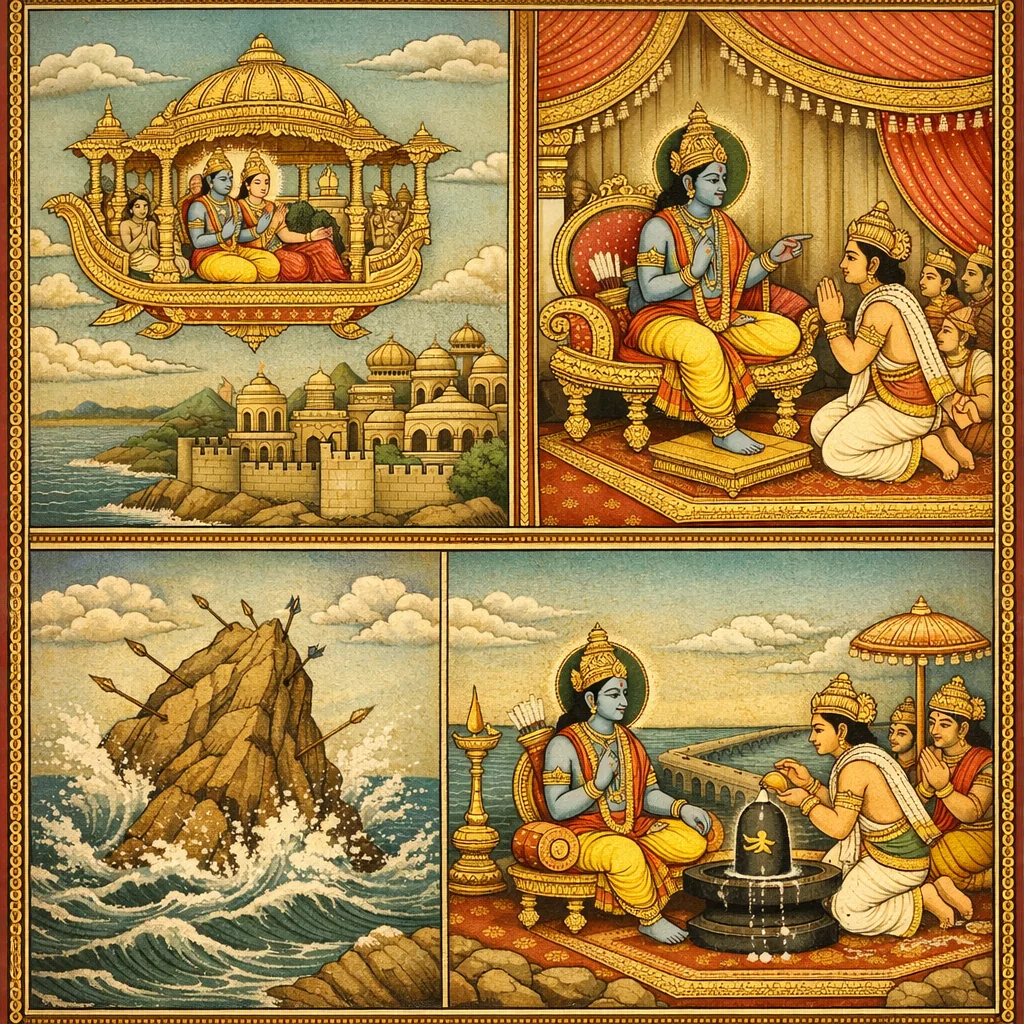
Sūta relates that after spending the night, at dawn Rāma departs in the Puṣpaka vimāna with the leading vānaras—Sugrīva, Suṣeṇa, Tārā, Kumuda, Aṅgada, and others—and swiftly reaches Laṅkā, revisiting the scenes of the former war. Vibhīṣaṇa recognizes Rāma’s arrival, comes with ministers and attendants, prostrates, and reverently receives him in Laṅkā. Seated in Vibhīṣaṇa’s palace, Rāma is offered complete submission of the kingdom and household affairs, and Vibhīṣaṇa seeks instruction. Grieving for Lakṣmaṇa and intent on departing to the divine realm, Rāma gives ethical and royal counsel: sovereignty can intoxicate; remain free of pride, honor the devas (Śakra/Indra and others), and enforce firm boundaries—rākṣasas must not cross Rāma’s Setu to harm humans, and humans are to be treated as under Rāma’s protection. Fearing that in the coming Kali age pilgrims will arrive for darśana and for gold, leading to rākṣasa transgression and fault, Vibhīṣaṇa asks for a safeguard. Rāma makes the passage impassable by severing a famed central feature with arrows, causing a marked peak and a liṅga-bearing prominence to fall into the sea. After staying ten nights recounting war narratives, Rāma departs toward his city; at the Setu’s end he establishes Mahādeva and, with śraddhā, installs the Rāmeśvara triad at the beginning, middle, and end of the Setu, thus ordaining an enduring charter of worship for pilgrimage.
Shlokas
Verse 1
सूत उवाच । एवं तां रजनीं तत्र स उषित्वा रघूत्तमः । उपास्यमानः सर्वैस्तैः सद्भक्त्या वानरोत्तमैः
Sūta said: Thus, having spent that night there, Raghūttama remained, being reverently attended by all those foremost Vānaras with sincere devotion.
Verse 2
ततः प्रभाते विमले प्रोद्गते रविमण्डले । कृत्वा प्राभातिकं कर्म समाहूयाथ पुष्पकम्
Then, at the pure and radiant dawn, when the orb of the sun had risen, having performed the morning duties, he summoned Puṣpaka, the aerial chariot.
Verse 3
सुग्रीवेण सुषेणेन तारेण कुमुदेन च । अंगदेनाथ कुण्डेन वायुपुत्रेण धीमता
With Sugrīva, Suṣeṇa, Tārā, and Kumuda; and also with Aṅgada, and Kuṇḍa, and the wise son of Vāyu (Hanumān)…
Verse 4
गवाक्षेण नलेनेव तथा जांबवतापि च । दशभिर्वानरैः सार्धं समारूढः स पुष्पके
Along with Gavākṣa, Nala, and also Jāmbavān, he boarded Puṣpaka together with ten Vānara warriors.
Verse 5
ततः संप्रस्थितः काले लंकामुद्दिश्य राघवः । मनोजवेन तेनैव विमानेन सुवर्चसा
Then, at the proper time, Rāghava set out, directing his course toward Laṅkā—traveling in that same radiant aerial chariot, swift as the mind.
Verse 6
संप्राप्तस्तत्क्षणादेव लंकाख्यां च महापुरीम् । वीक्षयंस्तान्प्रदेशांश्च यत्र युद्धं पुराऽभवत्
In that very instant he reached the great city called Laṅkā, looking upon those regions where the battle had once taken place.
Verse 7
ततो विभीषणो दृष्ट्वा प्रोद्द्योतं पुष्पकोद्भवम् । रामं विज्ञाय संप्राप्तं प्रहृष्टः सम्मुखो ययौ । मंत्रिभिः सकलैः सार्धं तथा भृत्यैः सुतैरपि
Then Vibhīṣaṇa, seeing the brilliant radiance of the Puṣpaka chariot and knowing that Rāma had arrived, went forward joyfully to meet him—together with all his ministers, and also with his attendants and sons.
Verse 8
अथ दृष्ट्वा सुदूरात्तं रामदेवं विभीषणः । पपात दण्डवद्भूमौ जयशब्दमुदीरयन्
Then, seeing Rāma—the divine Lord—from afar, Vibhīṣaṇa fell upon the earth like a staff, crying out the shout of victory: “Jaya!”
Verse 9
तथागतं परिष्वज्य सादरं स विभीषणम् । तेनैव सहितः पश्चाल्लंकां तां प्रविवेश ह
Embracing Vibhīṣaṇa—who had thus come—with honor and affection, he then entered that Laṅkā together with him.
Verse 10
विभीषणगृहं प्राप्य तत्र सिंहासने शुभे । निविष्टो वानरैस्तैश्च समन्तात्परिवारितः
Reaching Vibhīṣaṇa’s residence, he sat there upon an auspicious throne, surrounded on all sides by those very vānaras.
Verse 11
ततो निवेदयामास तस्मै सर्वं विभीषणः । राज्यं पुत्रकलत्रादि यच्चान्यदपि किंचन
Then Vibhīṣaṇa offered to him everything—his kingdom, his sons and wife, and whatever else there was besides.
Verse 12
ततः प्रोवाच विनयात्कृतांजलिपुटः स्थितः । आदेशो दीयतां देव ब्रूहि कृत्यं करोमि किम्
Then, standing humbly with hands joined in reverence, he said: “O Lord, grant your command—tell me what must be done; what shall I do?”
Verse 14
सूत उवाच । निवेद्य राघवस्तस्मै सर्वं गद्गदया गिरा । वाष्पपूरप्रतिच्छन्नवक्त्रो भूयो विनिःश्वसन्
Sūta said: Having disclosed everything to him, Rāghava spoke in a choked voice; his face was veiled by a flood of tears, and again and again he heaved deep sighs.
Verse 15
ततः प्रोवाच सत्यार्थं विभीषणकृते हितम् । तं चापि शोकसंतप्तं संबोध्य रघुनंदनः
Then the glory of the Raghu line spoke words of truth, beneficial for Vibhīṣaṇa; and he also consoled him, who was scorched by grief.
Verse 16
अहं राज्यं परित्यज्य सांप्रतं राक्षसोत्तम । यास्यामि त्रिदिवं तूर्णं लक्ष्मणो यत्र संस्थितः
O best of Rākṣasas, abandoning kingship now, I shall swiftly depart to the divine realms—there where Lakṣmaṇa is established.
Verse 17
न तेन रहितो मर्त्ये मुहूर्तमपि चोत्सहे । स्थातुं राक्षसशार्दूल बांधवेन महात्मना
Without him, I do not have the heart to remain in the mortal world even for a moment, O tiger among Rākṣasas—without that great-souled kinsman.
Verse 18
अहं शिक्षापणार्थाय तव प्राप्तो विभीषण । तस्मादव्यग्रचित्तेन संशृणुष्व कुरुष्व च
Vibhīṣaṇa, I have come to you for the sake of giving instruction; therefore, with an undistracted mind, listen well—and act accordingly.
Verse 19
एषा राज्योद्भवा लक्ष्मीर्मदं संजनयेन्नृणाम् । मद्यवत्स्वल्पबुद्धीनां तस्मात्कार्यो न स त्वया
This prosperity born of kingship breeds intoxication in men; to the small-minded it is like wine—therefore you should not be swayed by it.
Verse 20
शक्राद्या अमराः सर्वे त्वया पूज्याः सदैव हि । मान्याश्च येन ते राज्यं जायते शाश्वतं सदा
All the immortals—beginning with Śakra—are ever to be worshipped by you and held in honor; by such reverence your sovereignty arises and endures continually.
Verse 21
मम सत्यं भवेद्वाक्य मेतस्मादहमागतः । प्राप्तराज्यप्रतिष्ठोऽपि तव भ्राता महाबलः
Let my words be true—this is why I have come: although your mighty brother has obtained and been established in kingship, remember the peril of pride and keep restraint in accordance with dharma.
Verse 22
विनाशं सहसा प्राप्तस्तस्मान्मान्याः सुराः सदा । यदि कश्चित्समायाति मानुषोऽत्र कथंचन । मत्काय एव द्रष्टव्यः सर्वैरेव निशाचरैः
Sudden destruction befalls the arrogant; therefore the gods must always be honored. And if by any chance any human comes here, then by all night-rangers he is to be regarded as my very body—revered and left unharmed.
Verse 23
तथा निशाचराः सर्वे त्वया वार्या विभीषण । मम सेतुं समुल्लंघ्य न गंतव्यं धरातले
Likewise, Vibhīṣaṇa, you must restrain all the night-rangers: having crossed beyond my bridge, they must not go upon the earth to trouble the world.
Verse 24
विभीषण उवाच । एवं विभो करिष्यामि तवादेशमसंशयम् । परं त्वया परित्यक्ते मर्त्ये मे जीवितं व्रजेत्
Vibhīṣaṇa said: “So shall I do, O Lord—your command, without doubt. Yet if you abandon the mortal world, my very life would depart.”
Verse 25
तस्मान्मामपि तत्रैव त्वं विभो नेतुमर्हसि । आत्मना सह यत्रास्ते प्राग्गतो लक्ष्मणस्तव
Therefore, O Lord, you should take me also there—together with yourself—where your Lakṣmaṇa, who went before, now abides.
Verse 26
श्रीराम उवाच । मया तेऽक्षयमादिष्टं राज्यं राक्षससत्तम । तस्मान्नार्हसि मां कर्तुं मिथ्याचारं कथंचन
Śrī Rāma said: “O best of the Rākṣasas, I have ordained for you an imperishable kingship. Therefore you should never make me appear to act falsely in any manner.”
Verse 27
अहमस्मिन्स्वके सेतौ शंकरत्रितयं शुभम् । स्थापयिष्यामि कीर्त्यर्थं तत्पूज्यं भवता सदा । भक्तिमान्प्रतिसंधाय यावच्चंद्रार्कतारकम्
“Upon this bridge that is my own, I shall install an auspicious triad of Śaṅkara-liṅgas for the sake of enduring renown. You must worship them always—established in devotion—for as long as the moon, sun, and stars endure.”
Verse 28
एवमुक्त्वा रघुश्रेष्ठो राक्षसेन्द्रं विभीषणम् । दशरात्रं तत्र तस्थौ लंकायां वानरैः सह
Having spoken thus to Vibhīṣaṇa, lord of the Rākṣasas, the best of the Raghu line remained there in Laṅkā for ten nights together with the Vānaras.
Verse 29
कुर्वन्युद्धकथाश्चित्रा याः कृताः पूर्वमेव हि । पश्यन्युद्धस्य सर्वाणि स्थानानि विविधानि च
They recounted the many vivid tales of the war that had happened before, and they beheld all the varied places where the battle had been fought.
Verse 30
शंसमानः प्रवीरांस्तान्राक्षसान्बलवत्तरान् । कुम्भकर्णेन्द्रजित्पूर्वान्संख्ये चाभिमुखागतान्
He spoke in praise of those mighty, valiant Rākṣasas—foremost among them Kumbhakarṇa and Indrajit—who had come face to face in battle.
Verse 31
ततश्चैकादशे प्राप्ते दिवसे रघुनंदनः । पुष्पकं तत्समारुह्य प्रस्थितः स्वपुरीं प्रति
Then, when the eleventh day arrived, Rāma, the delight of the Raghu line, mounted the Puṣpaka and set out toward his own city.
Verse 32
वानरैस्तैः समोपेतो विभीषणपुरःसरः । ततः संस्थापयामास सेतुप्रांते महेश्वरम्
Accompanied by those Vānaras, with Vibhīṣaṇa at the forefront, he then installed Maheśvara at the end of the Setu.
Verse 33
मध्ये चैव तथादौ च श्रद्धापूतेन चेतसा । रामेश्वरत्रयं राम एवं तत्र विधाय सः
With a mind purified by faith, Rāma arranged there a triad of Rāmeśvaras—one in the middle and likewise one at the beginning—thus establishing them in that place.
Verse 34
सेतुबंधं तथासाद्य प्रस्थितः स्वगृहं प्रति । तावद्विभीषणेनोक्तः प्रणिपत्य मुहुर्मुहुः
Having thus reached Setubandha, he set out toward his own home. Just then Vibhīṣaṇa spoke, bowing down again and again.
Verse 35
विभीषण उवाच । अनेन सेतुमार्गेण रामेश्वरदिदृक्षया । मानवा आगमिष्यंति कौतुकाच्छ्रद्धयाविताः
Vibhīṣaṇa said: “Along this route of the Setu, people will come—eager to behold Rāmeśvara—drawn by holy wonder and inspired by faith.”
Verse 36
राक्षसानां महाराज जातिः क्रूरतमा मता । दृष्ट्वा मानुषमायांतं मांसस्येच्छा प्रजायते
O great king, the race of the Rākṣasas is regarded as the most cruel. On seeing a human approach, the desire for flesh arises in them.
Verse 37
यदा कश्चिज्जनं कश्चिद्राक्षसो भक्षयिष्यति । आज्ञाभंगो ध्रुवं भावी मम भक्तिरतस्य च
If at any time some Rākṣasa were to devour some person, then the breach of my command would certainly occur—even for one devoted to my bhakti.
Verse 38
भविष्यंति कलौ काले दरिद्रा नृपमानवाः । तेऽत्र स्वर्णस्य लोभेन देवतादर्शनाय च
In the age of Kali, O king, humans will become impoverished. Yet they will come here—driven by longing for gold, and also to behold the deity.
Verse 39
नित्यं चैवागमिष्यन्ति त्यक्त्वा रक्षःकृतं भयम् । तेषां यदि वधं कश्चिद्राक्षसात्प्रापयिष्यति
They will indeed come continually, having cast off the fear wrought by the Rākṣasas. If anyone were to bring about their death at the hands of a Rākṣasa…
Verse 40
भविष्यति च मे दोषः प्रभुद्रोहोद्भवः प्रभो । तस्मात्कंचिदुपायं त्वं चिन्तयस्व यथा मम । आज्ञाभंगकृतं पापं जायते न गुरो क्वचित्
And a fault will fall upon me, O Lord—born of betraying my master. Therefore, O Guru, devise some means, so that the sin arising from breaking the command may never be incurred by me.
Verse 41
तस्य तद्वचनं श्रुत्वा ततः स रघुसत्तमः । बाढमित्येव चोक्त्वाथ चापं सज्जीचकार सः
Hearing those words, that best of the Raghu line replied, “So be it,” and then made his bow ready.
Verse 42
ततस्तं कीर्तिरूपं च मध्यदेशे रघूत्तमः । अच्छिनन्निशितैर्बाणैर्दशयोजनविस्तृतम्
Then Raghūttama cut through that famed formation in the middle region with sharp arrows—(a stretch) extending ten yojanas.
Verse 43
तेन संस्थापितो यत्र शिखरे शंकरः स्वयम् । शिखरं तत्सलिंगं च पतितं वारिधेर्जले
Where he had established Śaṅkara himself upon a peak, both that peak and the liṅga upon it fell into the waters of the ocean.
Verse 44
एवं मार्गमगम्यं तं कृत्वा सेतुसमुद्भवम् । वानरै राक्षसैः सार्धं ततः संप्रस्थितो गृहम्
Thus, having made that once-impassable path into Setu, the causeway born of the sea, he then set out for his home together with the Vānaras and the Rākṣasas.
Verse 101
इति श्रीस्कांदे महापुराणएकाशीतिसाहस्र्यां संहितायां षष्ठे नागरखण्डे हाटकेश्वरक्षेत्रमाहात्म्ये सेतुमध्ये श्रीरामकृतरामेश्वरप्रतिष्ठावर्णनंनामैको त्तरशततमोऽध्यायः
Thus ends the one-hundred-and-first chapter, entitled “Description of the Installation of Rāmeśvara performed by Śrī Rāma in the midst of Setu,” in the Hāṭakeśvara-kṣetra-māhātmya of the sixth Nāgara-khaṇḍa of the Śrī Skanda Mahāpurāṇa, the Saṃhitā of eighty-one thousand verses.