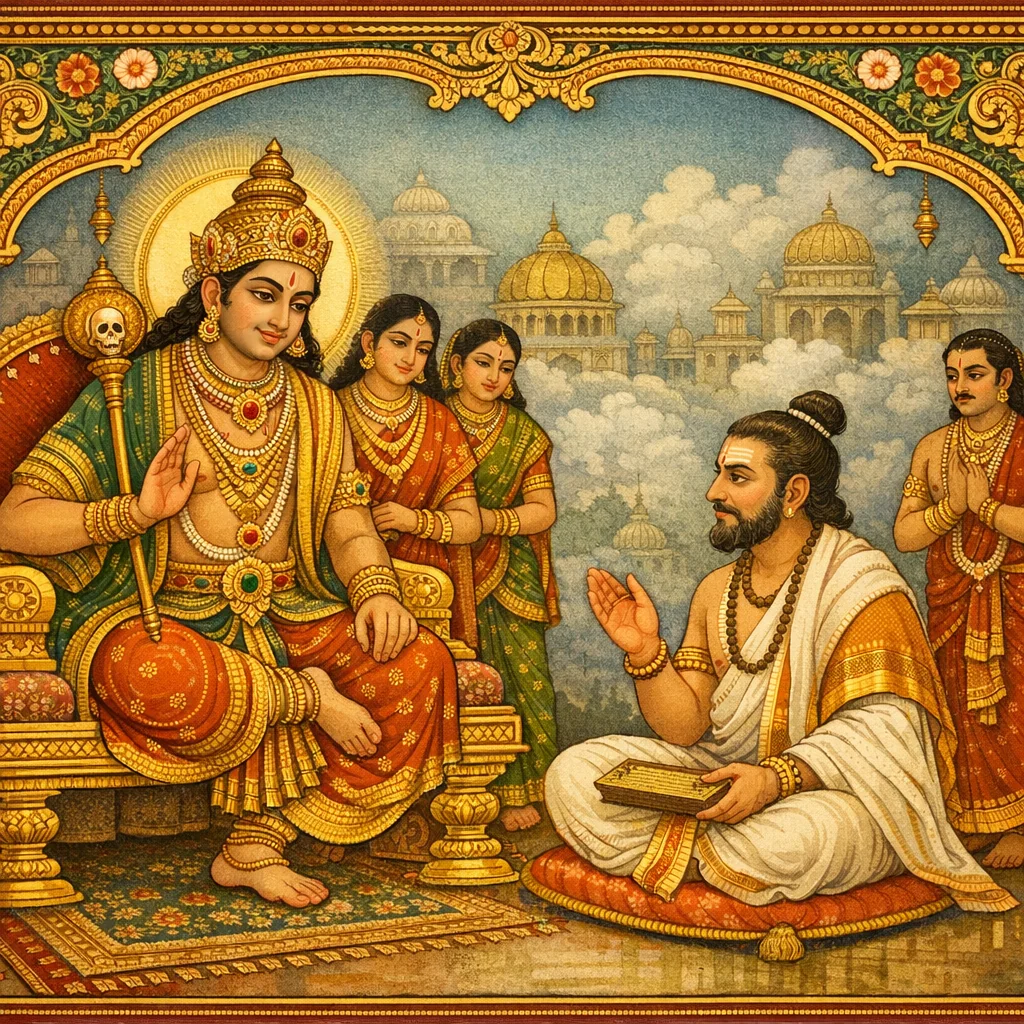
Adhyaya 8
Chapter 8 is framed as a dialogue: Lopāmudrā’s sustained curiosity about a “holy narrative” tied to sacred cities leads Agastya to recount an instructive itihāsa, warning that liberation does not arise automatically merely by association with famed “cities of liberation.” The story centers on the Brahmin Śivaśarmā, who meets two divine attendants introducing themselves as Puṇyaśīla and Suśīla. They guide Śivaśarmā through graded lokas that mirror ethical patterns: a piśāca-loka for scant merit and charity given with regret; a guhyaka-loka for honest wealth, social sharing, and a non-malicious nature; a gandharva-loka where musical skill and patronage become meritorious when wealth is redirected to Brahmins and devotional praise; and a vidyādhara-loka marked by teaching, support for healing, and humility in learning. Dharmarāja (Yama) then appears in an unexpectedly gentle form for the righteous, praising Śivaśarmā’s learning, reverence for the guru, and dharma-guided use of embodied life. The chapter also contrasts this with terrifying punitive commands for specific transgressions—sexual misconduct, slander, theft, betrayal, sacrilege, and social harm—offering a catalog-like mapping of faults to consequences. It concludes by stating who sees Yama as fearsome versus auspicious, noting exemplary kings in Dharmarāja’s assembly, and ending as Śivaśarmā beholds an apsaras-city, signaling the narrative’s continued ascent.
Shlokas
Verse 1
लोपामुद्रोवाच । जीवितेश कथामेतां पुण्यां पुण्यपुरीश्रिताम् । न तृप्तिमधिगच्छामि श्रुत्वा त्वच्छ्रीमुखेरिताम्
Lopāmudrā said: O lord of my life, having heard from your blessed lips this holy narrative set in the sacred city, I still do not attain satisfaction.
Verse 2
मायापुर्यां मुक्तिपुर्यां शिवशर्मा द्विजोत्तमः । मृतोपि मोक्षं नैवाप ब्रूहि तत्कारणं विभो
In Māyāpurī—the city of liberation—Śivaśarmā, the best of brāhmaṇas, did not attain mokṣa even after death. O mighty one, tell me the reason for that.
Verse 3
अगस्त्य उवाच । साक्षन्मोक्षो न चैतासु पुरीषु प्रियभाषिणि । पुरोद्दिश्यामुमेवार्थमितिहासो मयाश्रुतः
Agastya said: O sweet-speaker, in these cities liberation is not obtained automatically or directly. Concerning precisely this matter, I have heard an ancient account.
Verse 4
शृणु कांते विचित्रार्थां कथां पापप्रणाशिनीम् । पुण्यशीलसुशीलाभ्यां कथितां शिवशर्मणे
Listen, beloved, to a tale of wondrous import that destroys sin—told by the virtuous Puṇyaśīla and Suśīlā to Śivaśarmā.
Verse 5
शिवशर्मोवाच । अयि विष्णुगणौ पुण्यौ पुंडरीकदलेक्षणौ । किंचिद्विज्ञप्तुकामोहं प्रवृद्धकरसंपुटः
Śivaśarmā said: “O holy attendants of Viṣṇu, lotus-petal-eyed ones, I wish to submit a request—standing with my hands joined in reverence.”
Verse 6
न नाम युवयोर्वेद्मि वेद्म्याकृत्या च किंचन । पुण्यशीलसुशीलाख्यौ युवां भवितुमर्हथः
“I do not know your names, though from your very appearance I understand something: you both deserve to be called Puṇyaśīla and Suśīla—men of merit and good conduct.”
Verse 7
गणा वूचतुः । भगवद्भक्तियुक्तानां किमज्ञातं भवादृशाम् । एतदेव हि नौ नाम यदुक्तं श्रीमता त्वया
The Gaṇas said: “For one like you, endowed with devotion to the Lord, what could possibly be unknown? Indeed, the very names we bear are exactly as you, the venerable one, have spoken.”
Verse 8
यदन्यदपि ते चित्ते प्रष्टव्यं तदशंकितम् । संपृच्छस्व महाप्राज्ञ प्रीत्या तत्प्रब्रवावहे
“And if anything else remains in your mind to ask, inquire without hesitation, O great wise one; with affection we shall gladly explain it.”
Verse 9
इति श्रुत्वा स वचनं भगवद्गणभाषितम् । अतिप्रीतिकरं हृद्यं ततस्तौ प्रत्युवाच ह
Hearing these words spoken by the Lord’s Gaṇas—most pleasing and heart-delighting—he then replied to the two of them.
Verse 10
दिव्य द्विज उवाच । क एष लोको ऽल्पश्रीकः स्वल्पपुण्यजनाकृतिः । क इमे विकृताकारा ब्रूतमेतन्ममाग्रतः
The celestial brāhmaṇa said: “What is this world, scant in splendor, filled with people of little merit? And who are these beings of distorted form? Tell me this clearly, before me.”
Verse 11
गणावूचतुः । अयं पिशाचलोकोत्र वसंति पिशिताशनाः । दत्त्वानुतापभाजो ये नोनो कृत्वा ददत्यपि
The Gaṇas said: “This is the Piśāca-world; here dwell flesh-eaters. Those who give, yet afterward fall into remorse—having given with repeated regret—come to share this state.”
Verse 12
शिवं प्रसंगतोभ्यर्च्य सकृत्त्वशुचिचेतसः । अल्पपुण्याल्पलक्ष्मी काः पिशाचास्त इमे सखे
“These, friend, are piśācas—of little merit and little fortune—who, though they once happened to worship Śiva, did so with an impure mind.”
Verse 13
ततो गच्छन्ददर्शाग्रे हृष्टपुष्टजनावृतम् । पिचंडिलैः स्थूलवक्त्रैर्मेघगंभीरनिःस्वनैः
Then, as they proceeded, he saw ahead a region crowded with cheerful, well-nourished beings—broad and stout of face—whose voices rumbled deep like thunderclouds.
Verse 14
लोकैरप्युषितं लोकं श्यामलांगैश्च लोमशैः । गणौ कथयतां केमी को लोकः पुण्यतः कुतः
“This world is inhabited by many beings—dark-limbed and hairy. O Gaṇas, explain: who are these, what is this world, and from what kind of merit does it arise?”
Verse 15
गणावूचतुः । गुह्यकानामयं लोकस्त्वेते वै गुह्यकाः स्मृताः । न्यायेनोपार्ज्य वित्तानि गूहयंति च ये भुवि
The Gaṇas said: “This is the realm of the Guhyakas, and these are indeed remembered as Guhyakas—those who, having gained wealth by righteous means, conceal it and keep it safeguarded upon the earth.”
Verse 16
स्वमार्गगाधनाढ्याश्च शूद्रप्रायाः कुटुंबिनः । संविभज्य च भोक्तारः क्रोधासूयाविवर्जिताः
They are prosperous in their own callings, mostly of śūdra-like station—householders who eat only after sharing. Free from anger and envy, they live in a spirit of mutual distribution.
Verse 17
न तिथिं नैव वारं च संक्रात्यादि न पर्व च । नाधर्मं न च धर्मं च विदंत्येते सदा सुखाः
They reckon neither lunar days nor weekdays, nor do they observe saṅkrānti and other festivals. They do not even distinguish ‘unrighteous’ from ‘righteous’—and yet they remain ever at ease.
Verse 18
एकमेव हि जानंति कुलपूज्यो हि यो द्विजः । तस्मै गाः संप्रयच्छंति मन्यंते तद्वचःस्फुटम्
They know only one principle: the twice-born (dvija) revered by the lineage is worthy of honor. To him they present cows, and they accept his words as clear and authoritative.
Verse 19
समृद्धिभाजोह्यत्रापि तेन पुण्येन गुह्यकाः । भुंजते स्वर्गसौख्यानि देववच्चाकुतोभयाः
By that merit, even here the Guhyakas become sharers in prosperity; they enjoy heavenly pleasures like the gods, free from fear on any side.
Verse 20
ततो विलोकयामास लोकं लोचनशर्मदम् । केऽमी जनास्त्वसौ लोकः किंनामा वदतां गणौ
Then he gazed upon that world, delightful to the eyes, and asked: “Who are these beings, and what is this realm called? Tell me, O attendants.”
Verse 21
गणावूचतुः । गांधर्वस्त्वेषलोकोऽमी गंधर्वाश्च शुभव्रताः । देवानां गायनाद्येते चारणाः स्तुतिपाठकाः
The attendants replied: “This is the Gāndharva world; these are Gandharvas of auspicious observances. They sing for the gods and serve as celestial bards, reciters of hymns.”
Verse 22
गीतज्ञा अतिगीतेन तोषयंति नराधिपान् । स्तुवंति च धनाढ्यांश्च धनलोभेन मोहिता
Skilled in music, they delight kings with elaborate singing; and, driven by greed for wealth, they also praise the rich.
Verse 23
राज्ञां प्रसादलब्धानि सुवासांसि धनान्यपि । द्रव्याण्यपि सुगंधीनि कर्पूरादीन्यनेकशः
From the favor of kings they obtain fine garments and wealth, and also many fragrant substances—camphor and the like in abundance.
Verse 24
ब्राह्मणेभ्यः प्रयच्छंति गीतं गायंत्यहर्निशम् । श्रुतावेव मनस्तेषां नाट्यशास्त्रकृतश्रमाः
They offer their song to brāhmaṇas and sing day and night. Their minds are fixed only on what is heard (music), and they toil in the disciplines taught by the Nāṭyaśāstra.
Verse 25
तेन पुण्येन गांधर्वो लोकस्त्वेषां विशिष्यते । ब्राह्मणास्तोषिता यद्वै गीतविद्यार्जितैर्धनैः
By that merit their Gandharva-world becomes distinguished, for they have truly gratified brāhmaṇas with wealth earned through the sacred art of song.
Verse 26
गीतविद्याप्रभावेन देवर्षिर्नारदो महान् । मान्यो वैष्णवलोके वै श्रीशंभोश्चातिवल्लभः
By the power of the sacred science of song, the great divine sage Nārada is honored in the Vaiṣṇava realm, and he is exceedingly dear to the auspicious Śambhu (Śiva) as well.
Verse 27
तुंबुरुर्ना रदश्चोभौ देवानामतिदुर्लभौ । नादरूपी शिवः साक्षान्नादतत्त्वविदौ हि तौ
Tumburu and Nārada—both are exceedingly rare even among the gods. For Śiva himself is the very form of Nāda (sacred sound), and those two are indeed knowers of the principle of Nāda.
Verse 28
यदि गीतं क्वचिद्गीतं श्रीमद्धरिहरांतिके । मोक्षस्तु तत्फलं प्राहुः सा न्निध्यमथवा तयोः
If a song is sung anywhere in the presence of the glorious Hari and Hara, they declare its fruit to be liberation—or else intimate nearness to those two.
Verse 29
गीतज्ञो यदि गीतेन नाप्नोति परमं पदम् । रुद्रस्यानुचरो भूत्वा तेनैव सह मोदते
If a knower of song does not, through singing, attain the supreme state, then becoming an attendant of Rudra, he rejoices together with him.
Verse 30
अस्मिंल्लोके सदा कालं स्मृतिरे षा प्रगीयते । तद्गीतमालया पूज्यौ देवौ हरिहरौ सदा
In this world, at all times, this remembrance is sung: by that garland of song, the two deities—Hari and Hara—are ever to be worshiped.
Verse 31
इति शृण्वन्क्षणात्प्राप पुनरन्यन्मनोहरम् । शिवशर्माथ पप्रच्छ किं संज्ञं नगरं त्विदम्
Hearing thus, he at once came upon yet another delightful sight. Then Śivaśarmā asked: “What is the name of this city?”
Verse 32
गणावूचतुः । असौ वैद्याधरो लोको नाना विद्या विशारदाः । एते विद्यार्थिनामन्नमुपानद्वस्त्रकंबलम्
The Gaṇas said: “That is the world of the Vidyādharas, skilled in many branches of knowledge. They provide students with food, footwear, garments, and blankets.”
Verse 33
औषधान्यपि यच्छं ति तत्पीडाशमनानि हि । नानाकलाः शिक्षयंति विद्यागर्वविवर्जिताः
They also give medicines that truly relieve those afflictions. Free from the pride of learning, they teach many arts.
Verse 34
शिष्यं पुत्रेण पश्यंति वस्त्र तांबूल भोजनैः । अलंकृताश्च सत्कन्या धर्मा दुद्वाहयंति च
They regard a disciple as a son, supporting him with clothing, betel, and food. And in accordance with dharma, they arrange marriages for well-born maidens, adorned and honored.
Verse 35
अभिलाषधिया नित्यं पूजयंतीष्टदेवताः । एतः पुण्यैर्वसंतीह विद्याधर वरा इमे
With hearts filled with devoted intention, they worship their chosen deities each day. By such merits, these excellent Vidyādharas dwell here.
Verse 36
यावदित्थं कथां चक्रुस्तावत्संयमिनीपतिः । धर्मराजोभिसंप्राप्तो देवदुंदुभि निःस्वनैः
While they were speaking in this manner, Dharmarāja—the lord of Saṁyamanī—arrived there, accompanied by the resounding beats of celestial kettledrums.
Verse 37
सोम्यमूर्तिर्विमानस्थो धर्मज्ञैः परिवारितः । सेवाकर्मसु चतुरैर्भृत्यैस्त्रिचतुरैः सह
Gentle in form, seated in a celestial chariot, he was surrounded by knowers of dharma and accompanied by three or four attendants skilled in service.
Verse 38
धर्मराज उवाच । साधुसाधु महाबुद्धे शिवशर्मन्द्विजोत्तम । कुलोचितं ब्राह्मणानां भवता प्रतिपादितम्
Dharmarāja said: “Well done, well done! O great-minded Śivaśarman, best of the twice-born—by you the conduct befitting Brahmins and worthy of your lineage has been properly upheld.”
Verse 39
वेदाभ्यासः कृतः पूर्वं गुरवश्चापि तोषिताः । धर्मशास्त्रपुराणे षु दृष्टो धर्मस्त्वयाऽदृतः
“Formerly you pursued Vedic study and also satisfied your teachers; and the dharma seen in the Dharmaśāstras and Purāṇas has been honored by you.”
Verse 40
क्षालितं मुक्तिपुर्यद्भिराशुगंतृशरीरकम् । कोविदोऽस्ति भवानेव जीविते जीवितेतरे
Your body—so swift to depart—has been washed clean by the waters of the City of Liberation; indeed, you alone are truly discerning regarding life and what lies beyond life.
Verse 41
कलेवरं पूतिगंधि सदैवाशुचिभाजनम् । सुतीर्थपुण्य पण्येन सम्यग्विनिमितं त्वया
This body—foul-smelling and ever a vessel of impurity—has been rightly “recast” by you through the precious “currency” of merit gained from excellent sacred fords.
Verse 42
अतएवाहि पांडित्यमाद्रिंयते विचक्षणाः । अहःक्षेपं न क्षिपंति क्षणमेकं हि ते बुधाः
Therefore, the discerning honor true learning; the wise do not squander their days—indeed, they do not waste even a single moment.
Verse 43
निमेषान्पंचपान्मर्त्ये प्राणंति प्राणिनो ध्रुवम् । तत्रापि न प्रवर्तेयुरघकर्मणि गर्हिते
In the mortal realm, beings surely live only for a handful of blinks; even so, they should not engage in blameworthy, sinful deeds.
Verse 44
स्थिरापायः सदा कायो न धनं निधनेऽवति । तन्मूढः प्रौढकार्ये किं न यतेत भवानिव
The body is ever headed toward ruin, and wealth does not protect one at death. Then why would a deluded person not strive for the truly great aim—like you have done?
Verse 45
सत्वरं गत्वरं चायुर्लोकः शोकसमाकुलः । तस्माद्धर्मे मतिः कार्या भवतेव सुधार्मिकैः
Life is swift and ever slipping away, and the world is overwhelmed by sorrow. Therefore the virtuous must fix their mind upon dharma—just as you have done.
Verse 46
सत्कर्मणो विपाकोऽयं तव वंद्यौ ममाप्यहो । यदेतौ भगवद्भक्तौ सखित्वं भवतो गतौ
This is indeed the fruition of your good deeds—marvelous indeed! For these two devotees of the Lord, worthy of reverence for you and for me as well, have attained friendship with you.
Verse 47
ममाज्ञा दीयतां तस्मात्साहाय्यं करवाणि किम् । यत्कर्तव्यं मादृशैस्ते तत्कृतं भवतैवहि
Therefore, give me your command—what assistance shall I render? Whatever is to be done by beings like me, that has already been accomplished by you alone.
Verse 48
अद्य धन्यतरोस्मीह यद्दृष्टौ भगवद्गणौ । सेवा सदैव मे ज्ञाप्या श्रीमच्चरणसन्निधौ
Today I am most blessed, for I have beheld the Lord’s attendants. May I always be assigned service in the presence of His revered feet.
Verse 49
ततः प्रस्थापितस्ताभ्यां प्राविशत्स्वपुरीं यमः । अप्राक्षीच्च ततो विप्रस्तौ गणौ प्रस्थिते यमे
Then, respectfully sent off by those two, Yama entered his own city. After Yama had departed, the brāhmaṇa questioned those two attendants.
Verse 50
शिवशर्मोवाच । साक्षादयं धर्मराजो ननु सौम्यतराकृतिः । धर्म्याण्येव वचांस्यस्य मनः प्रीतिकराणि च
Śivaśarmā said: “This is truly Dharmarāja himself—yet his form is exceedingly gentle. His words are wholly righteous, and they delight the mind.”
Verse 51
पुरी संयमनी सेयमतीव शुभलक्षणा । आकर्ण्य यस्य नामापि पापिनोऽतीव बिभ्यति
This city, Saṃyamanī, is indeed adorned with the most auspicious marks; yet merely hearing its name, sinners become greatly afraid.
Verse 52
यमरूपं वर्ण यंति मर्त्यलोकेऽन्यथा जनाः । अन्यथाऽयं मया दृष्टो ब्रूतं तत्कारणं गणौ
In the mortal world, people describe Yama’s form in another way. But I have seen him otherwise—tell me, O attendants, the reason for that.
Verse 53
केन पश्यंत्यमुं लोकं निवसंति तथात्र के । इदमेवास्य किं रूपं किं चान्यच्च निवेद्यताम्
By what means is that world perceived, and who dwell there? Is this alone his form, or is there another also? Let it be explained.
Verse 54
गणावूचतुः । शृणु सौम्य सुसौम्योऽसौ दृश्यतेत्र भवादृशैः । धर्ममूर्तिः प्रकृत्यैव निःशंकैः पुण्यराशिभिः
The two attendants said: “Listen, gentle one. Here he is seen as most gentle by people like you—by those rich in merit, free from fear. For by his very nature he is the embodiment of Dharma.”
Verse 55
अयमेव हि पिंगाक्षः क्रोधरक्तांतलोचनः । दंष्ट्राकरालवदनो विद्युल्ललनभीषणः
This very same one indeed is the tawny-eyed, with eyes reddened at the edges with wrath—his face terrifying with protruding fangs, dreadful like a flash of lightning.
Verse 56
ऊर्ध्वकेशोऽतिकृष्णांगः प्रलयांबुदनिःस्वनः । कालदंडोद्यतकरो भुकुटी कुटिलाननः
His hair stands upright; his limbs are black as night; his roar resembles the thunder of dissolution-clouds. With the rod of Time raised in his hand, his brows are knitted, and his face is grim and twisted.
Verse 57
आनयैनं पातयैनं बधानामुंच दुर्दम । घातयैनं सुदुर्वृत्तं मूर्ध्नि तीव्रमयोघनैः
Bring him here; throw him down; bind him—do not release him, O ungovernable one. Strike that thoroughly depraved man upon the head with heavy iron maces.
Verse 58
आताडयैनं दुर्वृत्तं धृत्वा पादौ शिलातले । उत्पाटयास्य नेत्रे त्वं निधाय चरणं गले
Beat that evil-doer; pin his feet upon the stone-surface. Then, setting your foot upon his throat, tear out his eyes.
Verse 59
एतस्य गल्लावुत्फुल्लौ क्षुरेणाशुवि पाटय । पाशेन कंठं बद्धास्य समुल्लंबय भूरुहे
Split open his swollen cheeks at once with a razor. Bind his neck with a noose, and hang him up upon a tree.
Verse 60
विदारयास्य मूर्धानं करपत्रेण दारुवत् । पार्ष्णिघातैर्घ्नतास्यास्यं समुच्चूर्णय दारुणैः
Split open his skull as though it were wood, using a hand-saw. Strike his mouth with fierce heel-blows, and crush it utterly.
Verse 61
परदारप्रसृमरं करं छिंध्यस्य पापिनः । परदारगृहं यातुः पादौ चास्य विखंडय
Cut off the sinner’s hand that reaches toward another’s wife; and shatter his feet as well—he who goes to another man’s home for another’s wife.
Verse 62
सूचीभी रोमकूपेषु तनुं व्यधिहि सर्वतः । दातुः परकलत्रांगे नखपंक्ती दुरात्मनः
Pierce his body everywhere—into the very pores of the hair—with needles. On the limbs of that evil-souled man who violates another’s wife, set rows of nails.
Verse 63
परदारमुखाघ्रातुर्मुखे निष्ठीवयास्य हि । वक्तुः परापवादस्य कीलं तीक्ष्णं मुखे क्षिप
Spit into the face of him who seeks the scent of another’s wife’s mouth. And into the mouth of the one who speaks slander of others, thrust a sharp peg.
Verse 64
भर्जयैनं चणकवत्तप्तवालुक कर्परैः । भ्राष्ट्रे विकटवक्त्रत्वं परसंतापकारिणम्
Roast him like chickpeas with potsherds filled with scorching sand. In the roasting-pan, make the face of that tormentor of others grotesque and misshapen.
Verse 65
दोषारोपं सदाकर्तुरदोषे क्रूरलोचन । निमज्जयास्य वदनं पूयशोणितकर्दमे
O cruel-eyed one, immerse the face of that man who always imputes faults where there is no fault—plunge his mouth into the mire of pus and blood.
Verse 66
अदत्तपरवस्तूनां गृह्णतः करपल्लवम् । आप्लुत्याप्लुत्य तैलेन तप्तांगारे पचोत्कट
For one who takes another’s goods without their being given, seize the hand (the palm) that grasps; again and again immerse it in oil and roast it fiercely upon burning coals.
Verse 67
अपवादं गुरोर्वक्तुर्निंदाकर्तुः सुपर्वणाम् । तप्तलोहशलाकाश्च मुखे भीषण निक्षिप
For the one who speaks slander of the guru, and for the one who utters blame of the virtuous, place terrifying, red-hot iron spikes into the mouth.
Verse 68
परमर्म स्पृशश्चास्य परच्छिद्रप्रकाशितुः । सुतप्तायोमयाञ्च्छंकून्सर्वसंधिषु रोपय
And for the one who strikes at another’s deepest vulnerability, and for the one who exposes another’s faults, implant well-heated iron pegs into all the joints.
Verse 69
अन्ये न दीयमाने स्वे निषेद्धुःपापकारिणः । आच्छेत्तुः परवृत्तीनां जिह्वां छिंध्यस्य दुर्मुख
For the sinner who forbids others when they are giving from their own wealth, and for the one who cuts off another’s rightful livelihood, cut out his tongue—O foul-faced one.
Verse 70
देवस्वभोक्तुः क्रोडास्य ब्राह्मणस्वस्यभोजिनः । विदार्योदरमस्याशु विट्कीटैः परिपूरय
For the one who eats what belongs to the Deity, and for the one who consumes a Brahmin’s wealth—make him boar-faced; swiftly split open his belly and fill it with worms bred from filth.
Verse 71
न देवार्थे न विप्रार्थे नातिथ्यर्थे पचेत्क्वचित् । तममुं स्वार्थपक्तारं कुंभीपाके पचांधक
One who never cooks for the Deities, nor for Brahmins, nor for guests—cook that self-serving cook in the hell called Kumbhīpāka, O Andhaka.
Verse 72
उग्रास्य शिशुहंतारममुं विश्रंभघातिनम् । कृतघ्नं नय वेगेन महारौरव रौरवम्
O fierce-faced one, take swiftly this killer of children, this betrayer who murders one who trusts him, this ungrateful man—take him to Raurava and to Mahāraurava.
Verse 73
ब्रह्मघ्नं चांधतामिस्रे सुरापं पूयशोणिते । कालसूत्रे हेमचौरमवीचौ गुरुतल्पगम्
The slayer of a Brahmin goes to Andhatāmisra; the drinker of intoxicants to Pūyaśoṇita; the thief of gold to Kālasūtra; and the violator of the guru’s bed to Avīci.
Verse 74
तत्संसर्गिणमावर्षमसिपत्रवने तथा । एतान्महापातकिनस्तप्ततैलकटाहके
And their associates go to Āvarṣa, and likewise to the forest of sword-leaves (Asipatravana). These great sinners are also cast into cauldrons of boiling oil.
Verse 75
आप्लुत्याप्लुत्य दुर्दंष्ट्रकाकोलैर्लोहतुंडकैः । संतोद्यमानान्पापिष्ठान्नित्यं कल्पं निवासय
After repeatedly immersing them, have those most sinful ones continually pierced by iron-beaked, hard-fanged crows, and keep them dwelling there for an entire aeon, without respite.
Verse 76
स्त्रीघ्नं गोघ्नं च मित्रघ्नं कूटशाल्मलिपादपे । उल्लंबय चिरंकालमूर्ध्वपादमधोमुखम्
Hang for a very long time—feet upward and face downward—upon the false Shalmali tree, the slayer of a woman, the slayer of a cow, and the slayer of a friend.
Verse 77
त्वचमस्य च संदंशैस्त्रोटय त्वं महाभुज । आश्लेषितुर्मित्रपत्न्या भुजावुत्पाटया शुच
Tear his skin with pincers, O mighty-armed one. And wrench out the arms of that impure man who embraced his friend’s wife.
Verse 78
ज्वालाकीले महाघोरे नरकेऽमुं नि पातय । यो वह्निना दाहयति परक्षेत्रं परालयम्
Cast him into the most dreadful hell called Jvalakila—he who burns with fire another’s field and another’s dwelling.
Verse 79
कालकूटे च गरदं कूटसाक्ष्याभिवादिनम् । मानकूटं तुलाकूटं कंठमोटे निपातय
Hurl into Kalakuta the poisoner and the one who gives false testimony. And cast into Manakuta, Tulakuta, and Kanthamota those who cheat by measures and by weights.
Verse 80
लालापिबेच दुष्प्रेक्ष्य तीर्थासुष्ठीविनं नय । आमपाके च गर्भघ्नं शूलपाकेऽन्यतापिनम्
Lead the impure one who spits in the sacred tīrthas to the hell called Lālāpiba, hard to behold. Consign the slayer of the unborn to Āmapāka, and the tormentor of others to Śūlapāka.
Verse 81
रसविक्रयिणं विप्रमिक्षुयंत्रे प्रपीडय । प्रजापीडाकरं भूपमंधकूपे निपातय
Crush in the sugarcane-press the brāhmaṇa who sells the forbidden ‘rasa’. And cast into Andhakūpa the king who oppresses his subjects.
Verse 82
गोतिलांश्च तुरंगांश्च विक्रेतारं द्विजाधमम् । मातुलान्याः सुरायाश्च विक्रेतारं हलायुध
And punish that vile brāhmaṇa who sells cows, sesame, and horses; and punish the seller of intoxicating liquor—O Halāyudha.
Verse 83
मुसलोलूखले वैश्यं कंडयैनं पुनःपुनः । शूद्रं द्विजावमंतारं द्विजाग्रे मंचसेविनम्
In Musalolūkhala, scrape and torment the vaiśya again and again. And punish the śūdra who insults the twice-born and sits upon a couch in the presence of brāhmaṇas.
Verse 84
अधोमुखे च नरके दीर्घग्रीवप्रपीड्य
And in the hell called Adhomukha, they are crushed, their long necks being pressed down.
Verse 85
शूद्रं ब्राह्मणजेतारं वैश्यं बाह्मणमानिनम् । क्षत्रियं याजकं चापि विप्रं वेदविवर्जितम्
Punish the śūdra who seeks to lord over brāhmaṇas; the vaiśya who deems himself a brāhmaṇa; the kṣatriya who performs as a priest; and the brāhmaṇa who is bereft of the Veda.
Verse 86
लाक्षालवणमांसानां सतैलविषसर्पिषाम् । आयुधेक्षुविकाराणां विक्रेतारं द्विजाधमम्
“Seize that vile brāhmaṇa who makes his living by selling lac, salt, and meat, and also oil, poison, and ghee—along with weapons and products of sugarcane.”
Verse 87
पाशपाणेकशापाणे बद्ध्वैतांश्चरणेदृढम् । घातयंतौ कशाघातैर्नयतं तप्तकर्दमे
“O you—one holding a noose and the other a whip—bind them tightly by the feet; strike them with lashes, and drag them into the burning mire.”
Verse 88
इमां स्त्रियं श्लेषयाशु पुंश्चलीं कुलकल्मषाम् । तेनोपपतिना सार्धं तप्तायसमयेन च
“Quickly press this woman—faithless and a stain upon her family—into embrace with that paramour, together with a red-hot iron contrivance.”
Verse 89
स्वयं गृहीत्वा नियमं यस्त्यजेदजितेंद्रियः । तं प्रापय दुराधर्षं बहुभ्रमरदंशके
“He who, having himself undertaken a vow, abandons it—his senses unconquered—take that hard-to-endure wretch to the place where many bees sting.”
Verse 90
इत्यादिजल्पन्दुर्वृत्तैः श्रूयते दूरतो यमः । स्वकर्मशंकितैः पापै र्दृश्यतेति भयंकरः
With such and similar talk from the wicked, Yama is heard from afar; and by sinners, terrified of their own deeds, he is seen—thus he is dreadful.
Verse 91
ये प्रजाः पालयंतीह पुत्रानेव निजौरसान् । दंडयंति च धर्मेण भूपास्तेऽस्य सभासदः
Those kings who here protect their subjects as their own true-born sons, and who punish in accordance with dharma—those rulers are members of his (Yama’s) court.
Verse 92
वर्णाश्रमाश्च यद्राष्ट्रे ऽनुतिष्ठंति निजां क्रियाम् । कालेनापन्ननिधना भूपास्तेऽस्य सभासदः
In whose kingdom the classes and stages of life duly perform their own duties—those kings, when their time comes and they meet their end, become members of his (Yama’s) court.
Verse 93
नैव दीनो न दुर्वृत्तो नापद्ग्रस्तो न शोकभाक् । येषां राष्ट्रे प्रदृश्यंते भूपास्तेऽस्य सभासदः
In whose realm one sees none destitute, none given to wickedness, none crushed by calamity, and none consumed by grief—those kings are members of his (Yama’s) court.
Verse 94
ब्राह्मणाः क्षत्रिया वैश्याः स्वधर्म निरताः सदा । अन्येपि ये संयमिनः संयमिन्यां वसंति ते
Brāhmaṇas, kṣatriyas, and vaiśyas—ever devoted to their own duties—and others too who are disciplined: they dwell in Saṃyaminī, the abode of Yama.
Verse 95
उशीनरः सुधन्वा च वृषपर्वा जयद्रथः । रजिः सहस्रजित्कुक्षिर्दृढधन्वा रिपुंजयः
Among them are Uśīnara, Sudhanvā, Vṛṣaparvā, Jayadratha, Raji, Sahasrajit, Kukṣi, Dṛḍhadhanvā, and Ripunjaya.
Verse 96
युवनाश्वो दंतवक्त्रो नाभागो रिपुमंगलः । करंधमो धर्मसेनः परमर्दः परांतकः
These renowned kings are named: Yuvanāśva, Daṃtavaktra, Nābhāga, Ripumaṅgala, Karaṃdhama, Dharmasena, Paramarda, and Parāṃtaka.
Verse 97
एते चान्ये च बहवो राजानो नीतिवर्तिनः । धर्माधर्मविचारज्ञाः सुधर्मायां समासते
These, and many other kings besides, who live by righteous governance—skilled in discerning dharma from adharma—sit together in the celestial assembly called Sudharmā.
Verse 99
गोविंदमाधवमुकुंद हरेमुरारे शंभो शिवेश शशिशेखर शूलपाणे । दामोदराच्युत जनार्दन वासुदेव त्याज्या भटाय इति संततमामनंति
“Govinda, Mādhava, Mukunda, Hari, Murāri; Śambhu, Śiveśa, Śaśiśekhara, Śūlapāṇi; Dāmodara, Acyuta, Janārdana, Vāsudeva”—thus they constantly proclaim: “Leave him be, O soldiers of Yama!”
Verse 100
गंगाधरांधकरिपो हरनीलकंठ वैकुंठ कैटभरिपो कमठाब्जपाणे । भूतेशखंडपरशोमृडचंडिकेश त्याज्या भटाय इति संततमामनंति
“Gaṅgādhara, Andhakaripu, Hara, Nīlakaṇṭha; Vaikuṇṭha, Kaiṭabharipu, Kamaṭha, Abjapāṇi; Bhūteśa, Khaṇḍaparaśu, Mṛḍa, Caṇḍikeśa”—thus they ceaselessly declare: “Leave him alone, O soldiers!”
Verse 110
इत्थं द्विजेंद्र निजभृत्यगणान्सदैव संशिक्षयेदवनिगान्स हि धर्मराजः । अन्येपि ये हरिहरांकधरा धरायां ते दूरतः पुनरहो परिवर्जनीयाः
Thus, O best of Brahmins, Dharmarāja (Yama) continually instructs his own attendants. And those others on earth who merely bear the outward marks of Hari and Hara—alas—are to be avoided from afar if their conduct is impure.
Verse 112
इति शृण्वन्कथां रम्यां शिवशर्माप्रियेऽनघाम । प्रहृष्टवक्त्रः पुरतो ददर्शाप्सरसापुरीम्
Hearing this delightful account, the blameless beloved of Śivaśarmā—her face bright with joy—beheld before her a city of Apsarases.