Adhyaya 6
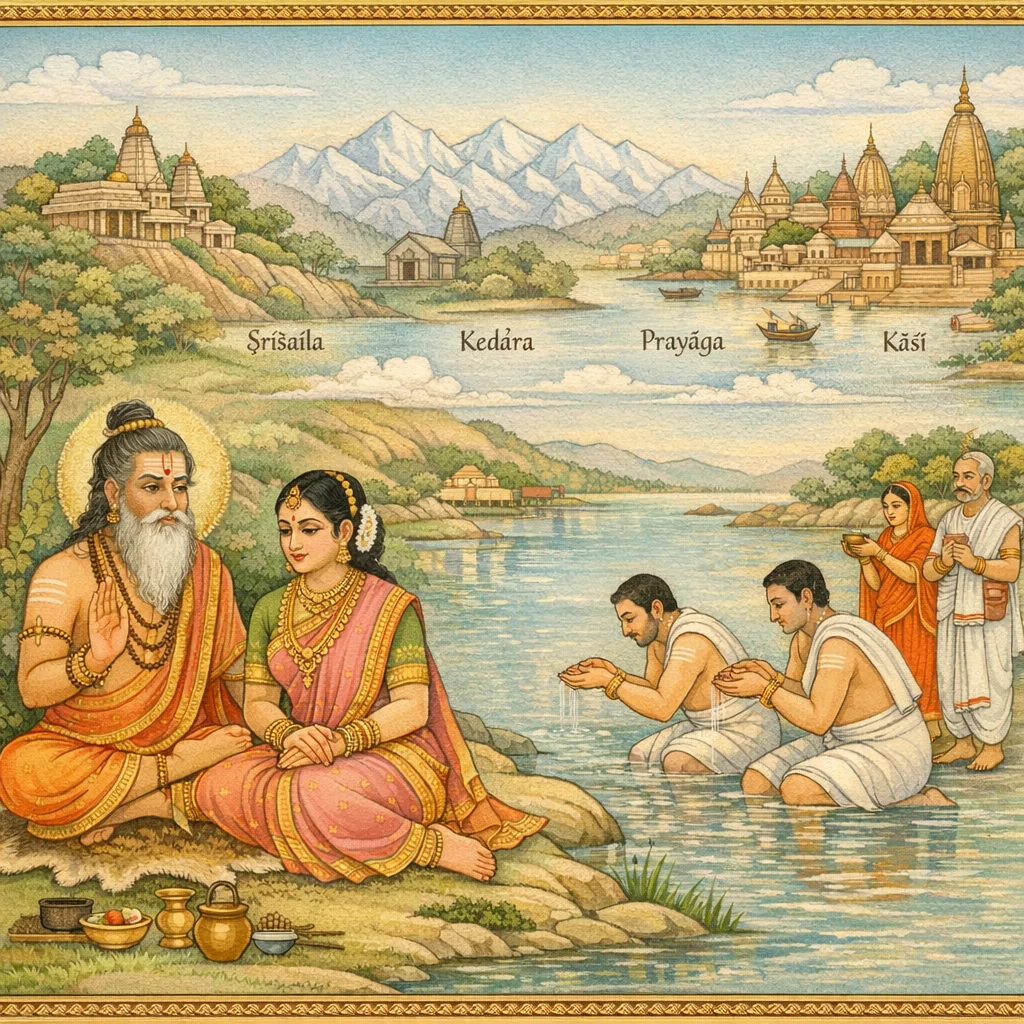
Chapter 6 begins with Parāśara addressing Sūta in a didactic setting, praising ethical uplift—especially paropakāra, “benefiting others”—as a higher dharma than mere external ritual merit. The narrative then turns to Agastya and Lopāmudrā: upon beholding Śrīśaila, the Śiva-linked peak of Tripurāntaka, it is claimed that the very sight of the mountain can negate rebirth. Lopāmudrā asks why, if this is so, Kāśī (Avimukta) is still sought. Agastya replies by classifying many mokṣa-granting kṣetras and tīrthas, naming famed pilgrimage centers across the land, and then teaching “mānasa tīrthas”—inner sacred fords of virtue: satya (truth), kṣamā (forbearance), indriya-nigraha (sense-restraint), dayā (compassion), ārjava (integrity), dāna (charity), dama (self-control), santoṣa (contentment), brahmacarya, priya-vāditā (gentle speech), jñāna, dhṛti, and tapas. He insists that water-bathing alone cannot cleanse a mind stained by greed, cruelty, slander, hypocrisy, or obsessive attachment; true tīrtha is mental purification and dispassion. The chapter also lays out pilgrimage etiquette and observances: preparatory fasting, honoring Gaṇeśa, ancestors, Brahmins, and sādhus; rules for feeding at tīrthas; modes of śrāddha/tarpaṇa; and proportional “shares” of tīrtha merit according to intention and manner of travel. It culminates in a soteriological ranking: though Śrīśaila and Kedāra are praised as mokṣa-giving, Prayāga is declared superior, and Avimukta (Kāśī) surpasses even Prayāga, affirming Kāśī’s unrivaled place in the geography of liberation. A closing, phalaśruti-like note links faithful hearing or recitation with moral purification and freedom from inauspicious rebirth.
Shlokas
Verse 1
पाराशर्य उवाच । शृणु सूत महाभाग कथां श्रुतिसहोदराम् । यां वै हृदि निधायेह पुरुषः पुरुषार्थभाक्
Pārāśarya said: “Listen, O blessed Sūta, to a sacred account, akin to the Śruti itself. By enshrining it in the heart, one attains here the fruits of human life—dharma, artha, kāma, and mokṣa.”
Verse 2
ततः श्रीदर्श नानंद सुधाधाराधुनीं मुनिः । अवगाह्य सपत्नीकः परां मुदमवाप सः
Then the sage, together with his wife, bathed in that river-like stream—an ambrosial flow of bliss born of the vision of Śrī—and he attained supreme joy.
Verse 3
वह्निकुंडसमुद्भूत सूतनिर्मलमानस । शृणुष्वैकं पुरा विद्भिर्भाषितं यत्सुभा षितम्
O Sūta—born from the fire-pit and pure in mind—listen to this single teaching, an excellent saying spoken long ago by the wise.
Verse 4
परोपकरणं येषां जागर्ति हृदये सताम् । नश्यंति विपदस्तेषां संपदः स्युः पदेपदे
For the noble, in whose hearts the urge to help others stays awake, misfortunes perish, and prosperity arises at every step.
Verse 5
तीर्थस्नानैर्न सा शुद्धिर्बहुदानैर्न तत्फलम् । तपोभिरुग्रैस्तन्नाप्यमुपकृत्याय दाप्यते
That purity is not gained merely by bathing at sacred tīrthas, nor is that fruit won by abundant gifts; even fierce austerities cannot purchase what is obtained through doing good to others.
Verse 6
परोपकृत्या यो धर्मो धर्मो दानादिसंभवः । एकत्र तुलितौ धात्रा तत्र पूर्वो भवद्गुरुः
The dharma born of helping others and the dharma born of gifts and the like—when the Creator weighs them together, the former stands as the greater teacher, the superior path.
Verse 7
परिनिर्मथ्य वाग्जालं निर्णीतमिदमेव हि । नोपकारात्परो धर्मो नापकारादवं परम्
After churning through the web of words, this alone is the settled conclusion: there is no dharma higher than doing good, and no downfall worse than doing harm.
Verse 8
उपकर्तुरगस्त्यस्य जातमेतन्निदर्शनम् । क्व तादृक्काशिजं दुःखं क्व तादृक्श्रीमुखेक्षणम्
This is the illustration born from Agastya, the benefactor: where is there such Kāśī-born suffering, and where such a vision of Śrī’s radiant face?
Verse 9
करिकर्णाग्रचपलं जीवितं विविधं वसु । तस्मात्परोपकरणं कार्यमेकं विपश्चिता
Life is as fickle as the tip of an elephant’s ear, and wealth takes many unstable forms; therefore the wise should do one thing above all—help others.
Verse 10
यल्लक्ष्मीनाममात्राप्त्या नरो नो माति कुत्रचित् । साक्षात्समीक्ष्यतां लक्ष्मीं कृतकृत्यो भवन्मुनिः
By merely obtaining the Name of Lakṣmī, a man never perishes anywhere. Therefore, behold Lakṣmī herself directly; then, O sage, you will become one whose purpose is fulfilled.
Verse 11
गच्छन्यदृच्छयासोथ दूराच्छ्रीशैलमैक्षत । यत्र साक्षान्निवसति देवः श्रीत्रिपुरांतकः
Then, while going on as if by chance, he beheld Śrīśaila from afar—where the Lord Tripūrāntaka himself dwells in manifest presence.
Verse 12
उवाच वचनं पत्नीं तदा प्रीतमना मुनिः । इहस्थितैव पश्य त्वं कांते कांततरं परम्
Then the sage, delighted at heart, spoke to his wife: “Beloved, remain right here and behold that supremely enchanting sight—more enchanting than all else.”
Verse 13
श्रीशैल शिखरं श्रीमदिदंतद्यद्विलोकनात् । पुनर्भवो मनुष्याणां भवेत्र नभवेत्क्वचित्
This glorious summit of Śrīśaila—by the very act of beholding it—rebirth for human beings may come to an end and never arise again.
Verse 14
गिरि श्चतुरशीत्यायं योजनानां हि विस्मृतः । सर्वलिंगमयो यस्मादतः कुर्यात्प्रदक्षिणम्
This mountain spans eighty-four yojanas—so vast it eludes all description. Since it is pervaded everywhere by liṅgas, therefore one should perform its pradakṣiṇā, the sacred circumambulation.
Verse 15
लोपामुद्रोवाच । किंचिद्विज्ञप्तुमिच्छामि यद्याज्ञा स्वामिनो भवेत् । ब्रूते हि याऽनुज्ञाता पत्या सा पतिता भवेत्
Lopāmudrā said: “I wish to submit something, if my lord grants permission. For it is said that a wife who speaks without her husband’s consent incurs fault.”
Verse 16
अगस्त्य उवाच । किं वक्तुकामा देवि त्वं ब्रूहि तत्त्वमशंकिता । न त्वादृशीनां वाक्यं हि पत्युः खेदाय जायते
Agastya said: “Goddess, what do you wish to say? Speak the truth without hesitation. The words of women like you never become a cause of distress to one’s husband.”
Verse 17
ततः पप्रच्छ सा देवी प्रणम्य मुनिमानता । सर्वेषां च हितार्थाय स्वसंदेहापनुत्तये
Then that noble lady, bowing down to the sage with reverence, asked—both for the welfare of all and to remove her own doubt.
Verse 18
लोपामुद्रोवाच । श्रीशैलशिखरं दृष्ट्वा पुनर्जन्म न विद्यते । इदमेव हि सत्यं चेत्किमर्थं काशिरिष्यते
Lopāmudrā said: “Having seen the summit of Śrīśaila, rebirth does not arise again. If this alone is truly so, then for what purpose would one go to Kāśī?”
Verse 19
अगस्तिरुवाच । आकर्णय वरारोहे सत्यं पृष्टं त्वयामले । निर्णीतमसकृच्चैतन्मुनिभिस्तत्त्वचिंतकैः
Agastya said: “Listen, O fair-hipped, stainless one—you have asked a true question. This matter has been determined again and again by sages who contemplate the highest truth.”
Verse 20
मुक्तिस्थानान्यनेकानि कृतस्तत्रापिनिर्णयः । तानि ते कथयाम्यत्र दत्तचित्ता भव क्षणम्
There are many places that bestow liberation, and their determination has indeed been made there. I shall now recount them to you here—be attentive for a moment, with your mind fully given.
Verse 21
प्रथमं तीर्थराजं तु प्रयागाख्यं सुविश्रुतम् । कामिकं सर्वतीर्थानां धर्मकामार्थमोक्षदम्
First is the famed king of tīrthas, renowned as Prayāga. It is the most desired among all holy places, granting dharma, kāma, artha, and mokṣa.
Verse 22
नैमिषं च कुरुक्षेत्रं गंगाद्वारमवंतिका । अयोध्या मथुरा चैव द्वारकाप्यमरावती
Naimiṣa and Kurukṣetra; Gaṅgādvāra (Haridvāra) and Avantikā (Ujjayinī); Ayodhyā and Mathurā; and also Dvārakā and Amarāvatī—these too are famed as liberation-linked sacred realms.
Verse 23
सरस्वती सिंधुसंगो गंगासागरसंगमः । कांती च त्र्यंबकं चापि सप्तगोदावरीतटम्
Sarasvatī; the confluence with the Sindhu; the meeting-place of the Gaṅgā and the ocean; Kāṃtī; Tryambaka; and the seven sacred stretches upon the Godāvarī’s banks—these are also praised among the liberating tīrthas.
Verse 24
कालंजरं प्रभासश्च तथा बद रिकाश्रमः । महालयस्तथोंकारक्षेत्रं वै पौरुषोत्तमम्
Kālañjara and Prabhāsa; likewise Badarikāśrama; Mahālaya; and the sacred kṣetra of Oṃkāra; and Pauruṣottama—these are indeed renowned as holy grounds that lead toward mokṣa.
Verse 25
गोकर्णो भृगुकच्छश्च भृगुतुंगश्च पुष्करम् । श्रीपर्वतादि तीर्थानि धारातीर्थं तथैव च
Gokarṇa; Bhṛgukaccha; Bhṛgutunga; Puṣkara; the tīrthas beginning with Śrīparvata; and likewise Dhārātīrtha—these too are counted among the sacred places famed for granting mokṣa.
Verse 26
मानसान्यपि तीर्थानि सत्यादीनि च वै प्रिये । एतानि मुक्तिदान्येव नात्र कार्या विचारणा
Even the ‘mental’ tīrthas—such as those beginning with Satya—are so, my dear. These indeed bestow mokṣa; there is no need for doubt or debate here.
Verse 27
गया तीर्थं च यत्प्रोक्तं पितॄणां हि मुक्तिदम् । पितामहानामृणतो मुक्तास्तत्तनया अपि
And Gayā-tīrtha, which is proclaimed as the giver of mokṣa to the ancestors—when the debt to forefathers is discharged, even their descendants too are said to be freed.
Verse 28
सधर्मिण्युवाच । मानसान्यपि तीर्थानि यान्युक्तानि महामते । कानि कानि च तानीह ह्येतदाख्यातुमर्हसि
The faithful wife said: “O great-minded one, you spoke of ‘mental’ tīrthas as well. What, precisely, are those here? Please be pleased to explain this to me.”
Verse 29
अगस्त्य उवाच । शृणु तीर्थानि गदतो मानसानि ममानघे । येषु सम्यङ्नरः स्नात्वा प्रयाति परमां गतिम्
Agastya said: “Listen, O blameless one, as I describe the tīrthas of the mind—those in which, when a person bathes rightly, he attains the supreme state.”
Verse 30
सत्यं तीर्थं क्षमा तीर्थं तीर्थमिन्द्रियनिग्रहः । सर्वभूतदयातीर्थं तीर्थमार्जवमेव च
Truthfulness is a tīrtha; forgiveness is a tīrtha; mastery of the senses is a tīrtha. Compassion toward all beings is a tīrtha—and so too is straightforwardness, inner honesty.
Verse 31
दानं तीर्थं दमस्तीर्थं संतोषस्तीर्थमुच्यते । ब्रह्मचर्यं परं तीर्थं तीर्थं च प्रियवादिता
Charity is a tīrtha; self-discipline is a tīrtha; contentment is called a tīrtha. Brahmacarya is the supreme tīrtha—and so is gentle, pleasing speech.
Verse 32
ज्ञानं तीर्थं धृतिस्तीर्थं तपस्तीर्थमुदाहृतम् । तीर्थानामपि तत्तीर्थं विशुद्धिर्मनसः परा
Knowledge is a tīrtha; steadfastness is a tīrtha; austerity is proclaimed a tīrtha. Yet among all tīrthas, that tīrtha is supreme—the complete purification of the mind.
Verse 33
न जलाप्लुतदेहस्य स्नानमित्यभिधीयते । स स्नातो यो दमस्नातः शुचिः शुद्धमनोमलः
Mere wetting of the body with water is not truly called ‘bathing’. He alone is bathed who is bathed in self-restraint—pure, with the mind’s impurity cleansed away.
Verse 34
यो लुब्धः पिशुनः क्रूरो दांभिको विषयात्मकः । सर्वतीर्थेष्वपि स्नातः पापो मलिन एव सः
One who is greedy, slanderous, cruel, hypocritical, and absorbed in sense-objects—even if he has bathed at every sacred tīrtha—remains sinful and stained all the same.
Verse 35
न शरीर मल त्यागान्नरो भवति निर्मलः । मानसे तु मले त्यक्ते भवत्यंतः सुनिर्मलः
A person does not become pure merely by casting off bodily dirt; but when the impurity of the mind is cast away, one becomes inwardly very pure.
Verse 36
जायंते च म्रियंते च जलेष्वेव जलौकसः । न च गच्छंति ते स्वर्गमविशुद्धमनोमलाः
Water-dwelling creatures are born and die in water itself; yet they do not attain heaven, for the impurity of their minds is not purified.
Verse 37
विषयेष्वति संरागो मानसो मल उच्यते । तेष्वेव हि विरागो स्य नैर्मल्यं समुदाहृतम्
Excessive attachment to sense-objects is called the mind’s impurity; detachment toward those very objects is declared to be purity.
Verse 38
चित्तमंतर्गतं दुष्टं तीर्थस्नानान्न शुद्ध्यति । शतशोथ जलैर्धौतं सुराभांडमिवाशुचि
A mind corrupted within is not purified by bathing at sacred tīrthas—just as a liquor-vessel remains unclean even when washed hundreds of times with water.
Verse 39
दानमिज्यातपःशौचं तीर्थसेवा श्रुतं तथा । सर्वाण्येतान्यतीर्थानि यदि भावो न निर्मलः
Charity, worship, austerity, purity, service to tīrthas, and even the study of śruti—none of these are truly ‘tīrtha’ if one’s inner disposition is not pure.
Verse 40
निगृहीतेंद्रियग्रामो यत्रैव च वसेन्नरः । तत्र तस्य कुरुक्षेत्रं नैमिषं पुष्कराणि च
Wherever a man dwells with the host of his senses restrained, that very place becomes for him Kurukṣetra, Naimiṣa, and Puṣkara as well.
Verse 41
ज्ञानपूते ज्ञानजले रागद्वेषमलापहे । यः स्नाति मानसे तीर्थे स याति परमां गतिम्
He who bathes in the mental tīrtha—purified by knowledge, in the waters of knowledge that wash away the stains of attachment and aversion—attains the supreme state.
Verse 42
एतत्ते कथितं देवि मानसं तीर्थलक्षणम् । भौमानामपि तीर्थानां पुण्यत्वे कारणं शृणु
Thus, O Goddess, the defining mark of the mental tīrtha has been told to you. Now hear the reason why even earthly tīrthas possess their holiness.
Verse 43
यथा शरीरस्योद्देशाः केचिन्मेध्यतमाः स्मृताः । तथा पृथिव्यामुद्देशाः केचित्पुण्यतमाः स्मृताः
Just as certain regions of the body are regarded as especially pure, so too on the earth certain regions are remembered as especially holy.
Verse 44
प्रभावादद्भुताद्भूमेः सलिलस्य च तेजसः । परिग्रहान्मुनीनां च तीर्थानां पुण्यता स्मृता
The holiness of the tīrthas is remembered as springing from the wondrous power of the earth, from the radiance abiding in their waters, and from the presence and sanctifying acceptance of the sages.
Verse 45
तस्माद्भौमेषु तीर्थेषु मानसेषु च नित्यशः । उभयेष्वपि यः स्नाति स याति परमां गतिम
Therefore, he who bathes continually—both in the earthly tīrthas and in the tīrthas of the mind—attains the supreme state.
Verse 46
अनुपोष्य त्रिरात्राणि तीर्थान्यनभिगम्य च । अदत्त्वा कांचनं गाश्च दरिद्रो नाम जायते
He who does not fast for three nights, does not visit the tīrthas, and does not give gold and cows, comes to be known as ‘poor’—bereft of merit.
Verse 47
अग्निष्टोमादिभिर्यज्ञैरिष्ट्वा विपुलदक्षिणैः । न तत्फलमवाप्नोति तीर्थभिगमनेन यत्
Even after performing sacrifices such as the Agniṣṭoma, with abundant dakṣiṇā, one does not obtain that fruit which is gained by visiting the tīrthas.
Verse 48
यस्य हस्तौ च पादौ च मनश्चैव सुसंयतम् । विद्या तपश्च कीर्तिश्च स तीर्थफलमश्नुते
He whose hands, feet, and mind are well-restrained—whose life bears learning (vidyā), austerity (tapas), and good repute—he partakes of the true fruit of the tīrthas.
Verse 49
प्रतिग्रहादुपावृत्तः संतुष्टो येनकेनचित् । अहंकार विमुक्तश्च स तीर्थफलमश्नुते
He who refrains from accepting gifts, is content with whatever comes, and is free from ego—he partakes of the true fruit of the tīrthas.
Verse 50
अदंभको निरारंभो लघ्वाहारो जितेंद्रियः । विमुक्तसर्वसंगैर्यः स तीर्थफलमश्नुते
He who is free from hypocrisy, who does not engage in self-serving display, who eats lightly, who has mastered the senses, and who is released from all attachments—such a person truly partakes of the full fruit of pilgrimage to the sacred tīrthas.
Verse 52
अकोपनोऽमलमतिः सत्यवादी दृढव्रतः । आत्मोपमश्च भूतेषु सतीर्थफलमश्नुते । तीर्थान्यनुसरन्धीरः श्रद्दधानः समाहितः । कृतपापो विशुद्ध्येत किं पुनः शुद्धकर्मकृत्
One who is free from anger, whose mind is stainless, who speaks truth, who is firm in vows, and who regards all beings as equal to himself—he attains the true fruit of the tīrthas. The steadfast pilgrim who follows the sacred places with faith and collected mind—even if he has committed sins becomes purified; how much more, then, one whose actions are already pure.
Verse 53
तिर्यग्योनि न वै गच्छेत्कुदेशे नैव जायते । न दुःखी स्यात्स्वर्गभाक्च मोक्षोपायं च विंदति
He does not fall into an animal birth, nor is he born in a wretched land; he does not become miserable—he attains heaven and also discovers the means to liberation.
Verse 54
अश्रद्दधानः पापात्मा नास्तिकोऽच्छिन्नसंशयः । हेतुनिष्ठश्च पंचैते न तीर्थफलभागिनः
The faithless, the sinful-minded, the nihilist, the one whose doubts do not cease, and the one devoted only to disputation and mere reasoning—these five do not partake of the fruit of the tīrthas.
Verse 55
तीर्थानि च यथोक्तेन विधिना संचरंति ये । सर्वद्वंद्वसहा धीरास्ते नराः स्वर्गभागिनः
Those who traverse the sacred tīrthas according to the prescribed rule, steadfast and enduring all pairs of opposites—such people become partakers of heaven.
Verse 56
तीर्थयात्रां चिकीर्षुः प्राग्विधायोपोषणं गृहे । गणेशं च पितॄन्विप्रान्साधूञ्छक्त्या प्रपूज्य च
One who intends to undertake a pilgrimage should first observe a fast at home, and then, according to his ability, worship Gaṇeśa, the Pitṛs, the brāhmaṇas, and the sādhus.
Verse 57
कृतपारणको हृष्टो गच्छेन्नियमधृक्पुनः । आगत्याभ्यर्च्य पितॄन्यथोक्तफलभाग्भवेत्
Having completed the fast and its proper breaking, joyful and observant of discipline, he should then set forth. Returning, after worshipping the ancestors, he becomes a recipient of the fruits declared in the scriptures.
Verse 58
न परीक्ष्यो द्विजस्तीर्थेष्वन्नार्थी भोज्य एव च । सक्तुभिः पिंडदानं च चरुणा पायसेन च
At a tīrtha, a brāhmaṇa who seeks food is not to be tested or scrutinized; he should indeed be fed. And piṇḍa-offerings may be given with barley flour (saktu), with caru, and with pāyasa.
Verse 59
कर्तव्यमृषिभिर्दृष्टं पिण्याकेन गुडेन च । श्राद्धं तत्र प्रकर्तव्यमर्घ्यावाहनवर्जितम्
As seen and sanctioned by the sages, it is proper to perform the offering even with oil-cake (piṇyāka) and jaggery (guḍa). In that tīrtha, śrāddha should be performed, omitting arghya and formal invocation (āvāhana).
Verse 60
अकालेप्यथवा काले तीर्थे श्राद्धं च तर्पणम् । अविलंबेन कर्तव्यं नैव विघ्नं समाचरेत्
Whether at an improper time or at the proper time, in a tīrtha one should perform śrāddha and tarpaṇa without delay; one should neither create nor invite any obstruction.
Verse 61
तीर्थं प्राप्य प्रसंगेन स्नानं तीर्थे समाचरेत् । स्नानजं फलमाप्नोति तीर्थयात्राश्रितं स च
Even if one reaches a sacred ford only incidentally, one should still bathe there in the tīrtha. Such a person attains the merit born of that holy bath, and also the merit connected with having undertaken a pilgrimage.
Verse 62
नृणां पापकृतां तीर्थे पापस्य शमनं भवेत् । यथोक्तं फलदं तीर्थं भवेच्छ्रद्धात्मनां नृणाम्
For people who have committed sins, a tīrtha becomes a place where sin is pacified. And a tīrtha yields the declared fruits especially for those whose hearts are filled with faith.
Verse 63
षोडशांशं स लभते यः पराथं च गच्छति । अर्धं तीर्थफलं तस्य यः प्रसंगेन गच्छति
He who goes to a tīrtha for another’s sake receives only a sixteenth share of the full merit. But he who goes only incidentally receives half of the tīrtha’s fruit.
Verse 64
कुश प्रतिकृतिं कृत्वा तीर्थवारिणि मज्जयेत् । मज्जयेच्च यमुद्दिश्य सोष्टमांशं लभेत वै
Having fashioned a representation from kuśa grass, one should immerse it in the waters of the tīrtha. If one immerses it with Yama in mind, one indeed obtains an eighth share of the full tīrtha-merit.
Verse 65
तीर्थोपवासः कर्तव्यः शिरसो मुंडनं तथा । शिरोगतानि पापानि यांति मुंडनतो यतः
At the tīrtha one should undertake fasting, and likewise the shaving of the head; for the sins that cling to the head depart through the very act of shaving.
Verse 66
यदह्नि तीर्थप्राप्तिः स्यात्ततोह्नः पूर्ववासरे । उपवासस्तु कर्तव्यः प्राप्ताह्नि श्राद्धदो भवेत्
On the day before the day one is to reach the tīrtha, fasting should be observed. On the day of arrival, one should perform śrāddha and make offerings for the departed.
Verse 67
तीर्थप्रसंगात्तीर्थांगमप्युक्तं त्वत्पुरोमया । स्वर्गसाधनमेवैतन्मोक्षोपायश्च वै भवेत्
On the occasion of speaking of tīrthas, I have also set forth before you the ancillary disciplines of pilgrimage. This indeed becomes a means to heaven, and likewise a true means to liberation (mokṣa).
Verse 68
काशीकांती च मायाख्या त्वयोध्याद्वारवत्यपि । मथुरावंतिका चैताः सप्त पुर्योत्र मोक्षदाः
Kāśī, Kāñcī, Māyā (Haridvāra), Ayodhyā, Dvāravatī, Mathurā, and Avantikā—these are the seven sacred cities here, bestowing liberation (mokṣa).
Verse 69
श्रीशैलो मोक्षदः सर्वः केदारोपि ततोऽधिकः । श्रीशैलाच्चापि केदारात्प्रयागं मोक्षदं परम्
Śrīśaila is wholly liberation-giving; Kedāra is even greater than that. And superior even to Śrīśaila and Kedāra is Prayāga—the supreme bestower of liberation (mokṣa).
Verse 70
प्रयागादपि तीर्थाग्र्यादविमुक्तं विशिष्यते । यथाविमुक्ते निर्वाणं न तथाक्वाप्यसंशयम्
Even beyond Prayāga, the foremost of tīrthas, Avimukta is more exalted. For nirvāṇa is attained in Avimukta as nowhere else—of this there is no doubt.
Verse 73
अन्यानि मुक्तिक्षेत्राणि काशीप्राप्तिकराणि च । काशीं ध्यायमिमं श्रुत्वा नरो नियतमानसः । श्रावयित्वा द्विजांश्चापि श्रद्धाभक्तिसमन्वितान्
Other sacred fields of liberation too become causes for attaining Kāśī. A man of disciplined mind, meditating on Kāśī, having heard this account and also causing faithful, devoted Brāhmaṇas to hear it, gains the merit that leads toward Kāśī and release.
Verse 74
क्षत्रियान्धर्मनिरतान्वैश्यान्सन्मार्गवर्तिनः । शूद्रान्द्विजेषु भक्तांश्च निष्पापो जायते द्विजः
When Kṣatriyas devoted to dharma, Vaiśyas who walk the good path, and Śūdras devoted to the twice-born take part (in such faithful hearing and practice), the twice-born becomes free from sin.