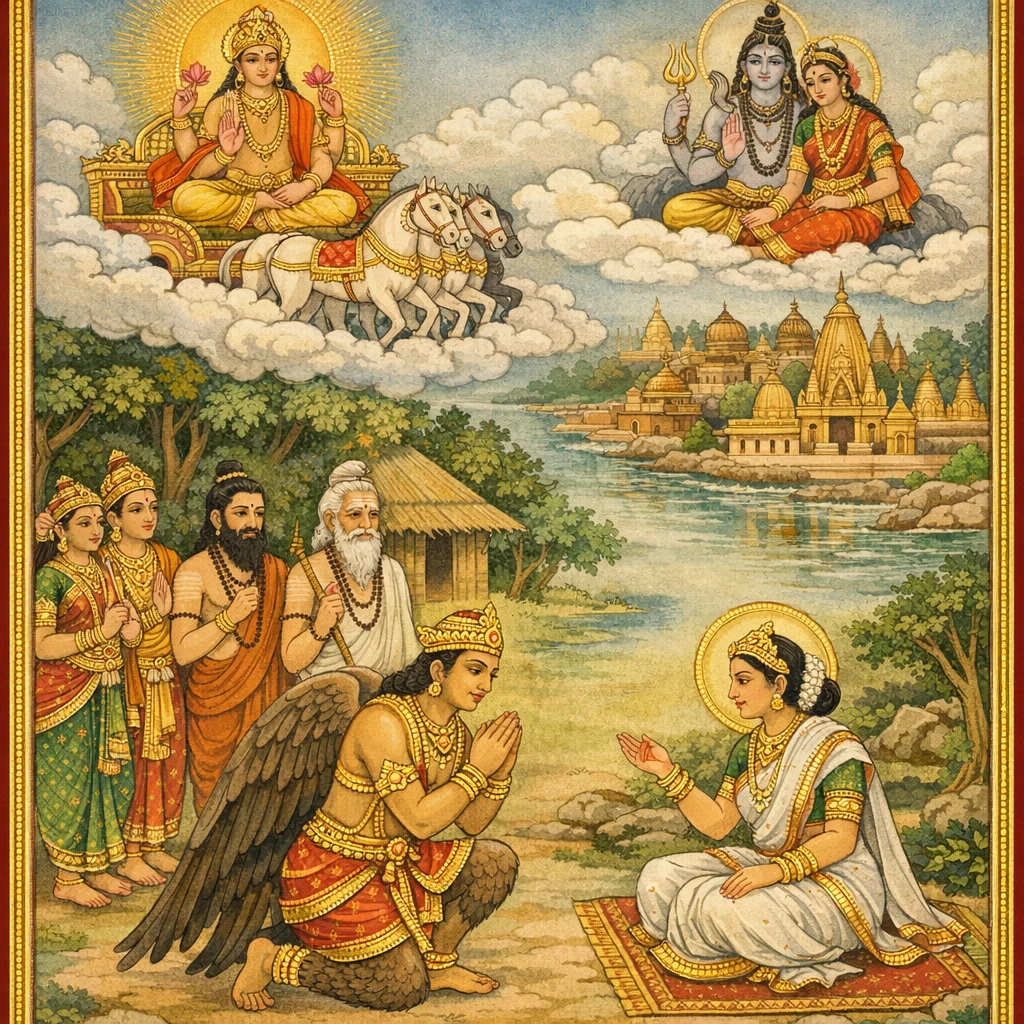
Adhyaya 50
This adhyāya opens with Skanda listing the solar forms (Ādityas) worshiped in Vārāṇasī and introducing a particular manifestation, Khakholka Āditya, extolled as a remover of affliction and disease. The account then situates this local sun-shrine within an older myth of Kadrū and Vinatā: a wager over the appearance of Uccaiḥśravas leads to deceit by Kadrū’s serpent sons and to Vinatā’s enslavement. Grieved for his mother, Garuḍa asks the terms of her release and is told to procure amṛta (sudhā). Vinatā instructs Garuḍa in dharmic discernment—especially how to avoid harming a brāhmaṇa who may be found among the niṣādas—giving practical marks of identity and warning of the moral peril of wrongful violence. Garuḍa’s obtaining of amṛta is portrayed as duty undertaken for his mother’s liberation, not for personal gain. The chapter concludes by re-rooting the myth in Kāśī, where Śaṅkara and Bhāskara are shown as gracious presences. The phalāśruti declares that merely beholding Khakholka at the named tīrtha brings swift relief from illness, fulfillment of aims, and purification through hearing this sacred account.
Shlokas
Verse 1
स्कंद उवाच । वाराणस्यां तथादित्या ये चान्ये तान्वदाम्यतः । कलशोद्भव ते प्रीत्या सर्वे सर्वाघनाशनाः
Skanda said: In Vārāṇasī, the Ādityas and the other sacred manifestations that are there—I shall now describe them. O Kumbha-born (Agastya), to please you: all of them are destroyers of every sin.
Verse 2
खखोल्को नाम भगवानादित्य परिकीर्तितः । त्रिविष्टपोत्तरे भागे सर्वव्याधिविघातकृत्
A blessed Āditya is praised by the name Khakholka. In the northern part of Triviṣṭapa, that sacred realm, he destroys all diseases.
Verse 3
यथा खखोल्क इत्याख्या तस्यादित्यस्य तच्छृणु । पुरा कद्रूश्च विनता दक्षस्य तनये शुभे
Hear how that Āditya came to be known by the name “Khakholka.” In ancient times, the auspicious daughters of Dakṣa—Kadrū and Vinatā—appear in this account.
Verse 4
कश्यपस्य च ते पत्न्यौ मारीचेः प्राक्प्रजापतेः । क्रीडंत्यावेकदान्योन्यं मुने ते ऊचतुस्त्विति
Those two were the wives of Kaśyapa, a descendant of the Prajāpati Marīci. Once, while they played together, they spoke to that sage as follows.
Verse 5
कद्रूरुवाच । विनते त्वं विजानासि यदि तद्ब्रूहि मेग्रतः । अखंडिता गतिस्तेस्ति यतो गगनमंडले
Kadrū said: “Vinatā, if you truly know, then tell me plainly. Your course is unbroken, for you move within the circle of the sky.”
Verse 6
योसावुच्चैःश्रवा वाजी श्रूयते सवितूरथे । किं रूपःसोस्ति शबलो धवलो वा वदाशु मे
“That horse Uccaiḥśravā, famed as being in the chariot of Savitṛ—what is his appearance? Is he mottled, or is he white? Tell me quickly.”
Verse 7
पणं च कुरु कल्याणि तुभ्यं यो रोचतेनघे । एवमेव न यात्येष कालक्रीडनकं विना
“And make a wager, O auspicious, sinless one—whatever pleases you. For this matter does not proceed by talk alone; it moves forward only through the sport of Time, the fated play.”
Verse 8
विनतोवाच । किं पणेन भगिन्यत्र कथयाम्येवमेव हि । त्वज्जये का च मे प्रीतिर्मज्जये किं नु ते सुखम्
Vinatā said: “Sister, what need is there of a wager here? I will tell you plainly. If you win, what joy is there for me? If I win, what happiness would there be for you?”
Verse 9
ज्ञात्वा पणो न कर्तव्यो मिथः स्नेहमभीप्सता । ध्रुवमेकस्य विजये क्रोधोन्स्येह जायते
Knowing this, one who seeks mutual affection should not make wagers; for surely, when one party wins, anger arises in the other.
Verse 10
कद्रूरुवाच । क्रीडेयं नात्र भगिनि कारणं किमपि क्रुधः । खेलस्य व्यवहारोयं पणे यत्किंचिदुच्यते
Kadrū said: “Sister, this is only a game—there is no reason at all for anger here. This is merely the customary way of play, when something or other is spoken of as a wager.”
Verse 11
विनतोवाच । तथा कुरु यथा प्रीतिस्तवास्ति पवनाशिनि । अथ तां विनतामाह कद्रूः कुटिलमानसा
Vinatā said: “Then do as you wish, so that you may be pleased, O ‘wind-eater’ (swift one).” Then Kadrū—crooked in intent—spoke to Vinatā.
Verse 12
तस्यास्तु सा भवेद्दासी पराजीयेत या यया । अस्मिन्पणे इमाः सर्वाः सख्यः साक्षिण्य एव नौ
Let she who is defeated by the other become her handmaid. And in this wager, let all these female companions here be witnesses for us both.
Verse 13
इत्यन्योन्यं पणीकृत्य सर्पिण्यपि पतत्त्रिणी । उवाच कर्बुरं कद्रूरश्वं श्वेतं गरुत्मती
Thus, having made a wager with each other, Kadrū—the mother of serpents—and Vinatā—the mother of the winged one (Garuḍa)—spoke of the horse: Kadrū declared it dark and spotted, while Garuḍa’s mother asserted it to be white.
Verse 14
कदागंतव्यमिति च चक्राते ते गमावधिम् । जग्मतुश्च विरम्याथ क्रीडनात्स्वस्वमालयम्
They also fixed a time-limit, deciding when they should go; then, ceasing from their play, the two returned to their respective dwellings.
Verse 15
विनतायां गतायां तु कद्रूराहूय चांगजान् । उवाच यात वै पुत्रा द्रुतं वचनतो मम
But after Vinatā had departed, Kadrū summoned her sons and said: “Go, my sons—quickly—according to my command.”
Verse 16
तुरंगमुच्चैःश्रवसं प्रोद्भूतं क्षीरनीरधेः । सुरासुरैर्मथ्यमानान्मंदराघातसाध्वसात्
“Uccaiḥśravas, the celestial steed, arose from the Ocean of Milk when it was being churned by gods and asuras, shaken by the blows and heaving of Mount Mandara.”
Verse 17
कार्यकारणरूपस्य सादृश्यमधिगच्छति । अतस्तं क्षीरवर्णाभं कल्माषयत पुत्रकाः
“The effect resembles its cause in form; therefore, since that horse is milk-white in hue, stain it with dark marks, my sons.”
Verse 18
तस्य वालधिमध्यास्य कृष्णकुंतलतां गताः । तथा तदंगलोमानि विधत्तविषसीत्कृतैः
“Clinging to the middle of its tail, become like black locks of hair; and likewise arrange its body-hairs by your venomous hissing.”
Verse 19
इति श्रुत्वा वचो मातुः काद्रवेयाः परस्परम् । संमंत्र्य मातरं प्रोचुः कद्रूं कद्रूपमागताः
“Hearing their mother’s words, the Kādraveya serpents consulted among themselves; then, approaching Kadrū, they spoke to their mother.”
Verse 20
नागा ऊचुः । मातर्वयं त्वदाह्वानाद्विहाय क्रीडनं बलात् । प्राप्ताः प्रहृष्टा मृष्टान्नं दास्यत्यद्य प्रसूरिति
The Nāgas said: “Mother, at your summons we have forcibly left our play and come here, delighted—thinking, ‘Today our mother will surely give us fine food.’”
Verse 21
मृष्टं तिष्ठतु तद्दूरं विषादप्यधिकं कटु । तत्त्वया वादियन्मंत्रैरौषधैर्नोपशाम्यति
“Let that ‘fine food’ remain far away—what you have proposed is more bitter than poison; even with mantras and medicines applied by you, it cannot be appeased.”
Verse 22
वयं न यामो यद्भाव्यं तदस्माकं भवत्विह । इति प्रोक्तं विषास्यैस्तैस्तदा कुटिलगामिभिः
Thus spoke those venom-mouthed, crooked-moving ones: “We will not go; whatever is destined—let that befall us here.”
Verse 23
स्कंद उवाच । अन्येपि ये कुटिलगाः पररंध्रनिषेविणः । अकर्णाः कूरहृदयाः पितरौ व्रीडयंति ते
Skanda said: Even those who move in crooked ways—who pry into others’ faults, refuse to listen, and whose hearts are harsh—bring shame upon their own parents.
Verse 24
पित्रोर्गिरं निराकृत्य ये तिष्ठेयुः सुदुर्मदाः । अत्याहितमिह प्राप्य गच्छेयुस्तेऽचिराल्लयम्
Rejecting the words of their parents, those who stand arrogant and deeply intoxicated with pride soon meet severe harm here itself, and before long go to destruction.
Verse 25
तेषां वचनमाकर्ण्य नयाम इति सोरगी । शशाप तान्क्रुधाविष्टा नागांश्चागः समागतान्
Hearing their words—“We will lead her away”—that celestial lady, seized by anger, cursed them, and also the Nāgas who had assembled there.
Verse 26
तार्क्ष्यस्य भक्ष्या भवत यूयं मद्वाक्यलंघनात् । जातमात्राश्च सर्पिण्यो भक्षयंतु स्वबालकान्
“Because you have violated my word, you shall become the prey of Tārkṣya (Garuḍa). And let the she-serpents, immediately upon giving birth, devour their own young.”
Verse 27
इति शापानलाद्भीतैः कैश्चित्पातालमाश्रितम् । जिजीविषुभिरन्यैश्च द्वित्रैश्चक्रे प्रसूवचः
Terrified by that fire-like curse, some sought refuge in Pātāla; others, longing to survive, devised with two or three companions a plan concerning childbirth.
Verse 28
ते पुच्छमौच्चैःश्रवसमधिगम्य महाधियः । सुनीलचिकुराभासं चक्रुरंगं च कर्बुरम्
Those keen-witted ones, reaching the tail of Uccaiḥśravas, made their bodies appear like dark-blue hair, mottled in hue.
Verse 29
तत्क्ष्वेडानल धूमौघैः फूत्कारभरनिःसृतैः । मातृवाक्कृतिजाद्धर्मान्न दग्धा भानुभानुभिः
From their hissing fire rose masses of smoke, driven out by heavy blasts; yet, by the dharma born of their mother’s word, they were not burned—even by the Sun’s blazing rays.
Verse 30
विनतापृष्ठमारुह्य कद्रूः स्नेहवशात्ततः । वियन्मार्गमलंकृत्य ददर्शोष्णांशुमंडलम्
Then Kadrū, moved by affection, mounted Vinatā’s back; and, adorning the pathway of the sky, she beheld the orb of the hot-rayed Sun.
Verse 31
तिग्मरश्मिप्रभावेण व्याकुलीभूतमानसा । कद्रुस्ततः खगीं प्राह विस्रब्धं विनते व्रज
Her mind disturbed by the power of the Sun’s sharp rays, Kadrū then said to the bird-lady: “Go on confidently, O Vinatā.”
Verse 32
उष्णगोरुष्णगोभिर्मे ताप्यते नितरां तनुः । विस्रब्धाहं स्वभावेन त्वं सापेक्षाहि सर्वतः
By those blazing rays my body is scorched intensely. I am, by nature, fearless; but you are dependent on others in every way.
Verse 33
स्वरूपेण पतंगी त्वं पतंगोसौ सहस्रगुः । अतएव न ते बाधा गगने तापसंभवा
By your very nature you are a female moth, and that one is the Sun—who moves with a thousand rays. Therefore, in the sky, the heat that arises from him does not trouble you.
Verse 34
वियत्सरसि हंसोयं भवती हंसगामिनी । चंडरश्मिप्रतापाग्निस्त्वामतो नेह बाधते
In the lake of the sky this one is a swan, and you too move like a swan. Therefore, the blazing fire of the fierce-rayed one does not afflict you here.
Verse 35
खगीमुद्गीयमानां खे पुनरूचे बिलेशया । त्राहित्राहि भगिन्यत्र यावोन्यत्र वियत्पथः
When the bird-woman was being carried aloft in the sky, the serpent-dweller again cried out: “Save me, save me, sister—let us go elsewhere, away from this path through the heavens!”
Verse 36
विनते विनतां मां त्वं किं नावसि पतत्त्रिणी । तव दासी भविष्यामि त्वदुच्छिष्टनिषेविणी
O Vinatā, why do you not protect me—me who am bowed down—O winged one? I shall become your maidservant, living upon what remains from your food.
Verse 37
यावज्जीवमहं भूयां त्वत्पादोदकपायिनी । खखोल्कानि पतेदेषा भृशगद्गदभाषिणी
“As long as I live, may I be one who drinks the water that has washed your feet.” Then she, her voice choked by violent trembling, in her confusion blurted out, “khakholkāni…”.
Verse 38
मूर्च्छां गतवती पक्षपुटौ धृत्वा बिडोरगी । सख्युल्कानि पतेदेषा वक्तव्ये त्विति संभ्रमात्
The serpent-woman, having swooned, was held within the shelter of (Vinatā’s) folded wings. In her agitation, meaning to say one thing, she instead blurted out, “sakhyulkāni…”.
Verse 39
खखोल्केति यदुक्ता गीः कद्र्वा संभ्रातचेतसा । तदा खखोल्कनामार्कः स्तुतो विनतया बहु
Because Kadrū, her mind bewildered, had uttered the word “khakholka,” at that time the Sun—bearing the name Khakholka—was greatly praised by Vinatā.
Verse 40
मनागतिग्मतां प्राप्ते खे प्रयाति विवस्वति । ताभ्यां तुरंगमो दर्शि किंचित्किर्मीरवान्रथे
When the Sun (Vivasvān), having reached a gentler intensity, moved along in the sky, the steed upon the chariot appeared to them, somewhat dappled in color.
Verse 41
उक्ता विनतयैवैषा तापोपहतलोचना । क्रूरा सरीसृपी सत्यवादिन्या विश्वमान्यया
Thus she—the cruel creeping one—her eyes afflicted by the heat, was addressed by Vinatā herself, the truth-speaking lady honored by the whole world.
Verse 42
कद्रु त्वया जितं भद्रे यत उच्चैःश्रवा हयः । चंद्ररश्मिप्रभोप्येष कल्माष इव भासते
“O Kadrū, you have won, dear one, for the horse Uccaiḥśravā is truly yours. Though he bears the splendor of moonbeams, he appears as if mottled and darkened in hue.”
Verse 43
विधिर्बलीयान्भुजगि चित्रं जयपराजये । क्रूरोपि विजयी क्वापि त्वक्रूरोपि पराजयी
“O serpent-maid, destiny is stronger; victory and defeat are truly wondrous. Sometimes even the cruel prevail, and sometimes even the gentle are overcome.”
Verse 44
विनताविनताधारा वदंतीति यथागतम् । कद्रूनिवेशनं प्राप्ता तस्या दास्यमचीकरत्
“As the tradition recounts in due order, Vinatā, brought low, came to Kadrū’s dwelling and accepted servitude under her.”
Verse 45
कदाचिद्विनतादर्शि सुपर्णनाश्रुलोचना । विच्छाया मलिना दीना दीर्घनिःश्वासवत्यपि
“Once, Suparṇa saw Vinatā—her eyes brimming with tears—bereft of radiance, sullied and dejected, breathing long and heavy sighs.”
Verse 46
सुपर्ण उवाच । प्रातःप्रातरहो मातः क्व यासि त्वं दिनेदिने । सायमायासि च कुतो विच्छाया दीनमानसा
“Suparṇa said: ‘Mother, each morning—alas, Mother—where do you go day after day? And from where do you return in the evening, bereft of radiance and heavy at heart?’”
Verse 47
कुतो निःश्वसिसि प्रोच्चैरश्रुपूर्ण विलोचना । यथा क्लीबसुता योषिद्यथापति तिरस्कृता
“Why do you sigh so loudly, your eyes brimming with tears—like a woman born to an impotent man, like one scorned by her husband?”
Verse 48
ब्रूहि मातर्झटित्यद्य कुतो दूनासि पत्त्रिणि । मयि जीवति ते बाले कालेपि कृतसाध्वसे
“Tell me at once, mother—today—why you are so afflicted, O winged one. While I am alive, even Death should not be a cause of fear for you, O gentle lady.”
Verse 49
अश्रुनिर्माणकरणे कारणं किं तपस्विनि । सुचरित्रा सुनारीषु नामंगलमिहेष्यते
“What is the cause that brings forth these tears, O austere one? For women of good conduct, in this world, misfortune should not befall.”
Verse 50
धिक्तांश्च पुत्रान्यन्माता तेषु जीवत्सु दुःखभाक् । वरं वंध्यैव सा यस्याः सुता वंध्यमनोरथाः
“Shame upon those sons, if their mother suffers sorrow while they yet live. Better that she be childless, whose sons have barren intentions and bring no fulfillment.”
Verse 51
इत्यूर्जस्वलमाकर्ण्य वचः सूनोर्गरुत्मतः । विनता प्राह तं पुत्रं मातृभक्तिसमन्वितम्
Hearing these vigorous words of her son Garutmān, Vinatā then spoke to that son who was filled with devotion to his mother.
Verse 52
अहं दास्यस्मि रे बाल कद्र्वाश्च क्रूरचेतसः । पृष्ठे वहामि तां नित्यं तत्पुत्रानपि पुत्रक
Vinatā said: “My child, I have become the servant of Kadrū, cruel of mind. Each day I bear her upon my back—her sons as well, my dear son.”
Verse 53
कदाचिन्मंदरं यामि कदाचिन्मलयाचलम् । कदाचिदंतरीपेषु चरेयं तदुदन्वताम्
“At one time I go to Mount Mandara; at another, to the Malaya mountain. At times I wander among the islands that lie amid those oceans.”
Verse 54
यत्रयत्र नयेयुस्ते काद्रवेयाः सुदुर्मदाः । व्रजेयं तत्रतत्राहं तदधीना यतः सुत
“Wherever the sons of Kadrū—insolent with pride—may lead me, there I must go, for I am under their control, my son.”
Verse 55
गरुड उवाच । दासीत्वकारणं मातः किं ते जातं सुलक्षणे । दक्षप्रजापतेः पुत्रि कश्यपस्यप्रियेऽनघे
Garuḍa said: “Mother, by what cause did you fall into servitude, O auspicious one? O daughter of Prajāpati Dakṣa, beloved of Kaśyapa, O blameless one—what happened to you?”
Verse 56
विनतोवाच गरुडं पुरावृत्तमशेषतः । दासीत्वकारणं यद्वदादित्याश्वविलोकनम्
Then Vinatā told Garuḍa the whole account of what had happened before—how her servitude arose, in connection with the matter of beholding the Sun’s horse, Uccaiḥśravas.
Verse 57
श्रुत्वेति गरुडः प्राह मातरं सत्वरं व्रज । पृच्छाद्य मातस्तान्दुष्टान्काद्रवेयानिदं वचः
Having heard it, Garuḍa said to his mother: “Go quickly. Today, Mother, ask those wicked Kādraveyas (serpents) this message.”
Verse 58
यद्दुर्लभं हि भवतां यत्रात्यंतरुचिश्च वः । मद्दासीत्वविमोक्षाय तद्याचध्वं ददाम्यहम्
“Whatever is hard for you to obtain, and whatever you desire most—ask for that as the price of freeing my mother from servitude; I will give it.”
Verse 59
तथाकरोच्च विनता तेपि श्रुत्वा तदीरितम् । सर्पाः संमंत्र्य तां प्रोचुर्विनतां हृष्टमानसाः
Vinatā did so. And those serpents too, having heard what was conveyed, consulted among themselves and then spoke to Vinatā with delighted hearts.
Verse 60
मातृशापविमोक्षाय यदि दास्यति नः सुधाम् । तदा समीहितं तेस्तु न दास्यत्यथ दास्यसि
“If, for release from your mother’s curse, he will give us the nectar (amṛta), then let what you desire be fulfilled. But if he will not give it, then you shall remain a servant.”
Verse 61
इत्योंकृत्य समापृच्छ्य कद्रूं द्रुतगतिः खगी । गरुत्मंतं समाचष्ट दृष्ट्वा संहृष्टमानसम्
So saying ‘Oṃ’, and taking leave of Kadrū, the swift-moving bird-mother (Vinatā) went and informed Garuḍa, seeing him joyful at heart.
Verse 62
नागांतकस्ततः प्राह मातरं चिंतयातुराम् । आनीतं विद्धि पीयूषं मातर्मे देहि भोजनम्
Then Nāgāntaka (Garuḍa), speaking to his mother distressed with anxious thought, said: “Know that I have brought the amṛta, the nectar. Mother, give me food.”
Verse 63
विनता प्राह तं पुत्रं संप्रहृष्टतनूरुहा । भोः सुपर्णार्णवं तूर्णं याहि मंगलमस्तु ते
Vinatā, her whole body thrilled with joy, said to her son: “O Suparṇa (Garuḍa), go swiftly to the ocean. May auspiciousness attend you.”
Verse 64
संति तत्रापि बहुशो निषादा मत्स्यघातिनः । वेलातटनिवासाश्च तान्भक्षय दुरात्मनः
“There too are many Niṣādas, killers of fish, dwelling along the seashore. Devour those evil-minded ones.”
Verse 65
परप्राणैर्निजप्राणान्ये पुष्णंतीह दुर्धियः । शासनीयाः प्रयत्नेन श्रेयस्तच्छासनं परम्
“Those foolish people who nourish their own lives by taking the lives of others should be restrained with effort; such discipline is the highest good.”
Verse 66
बहुहिंसाकृतां हिंसा भवेत्स्वर्गस्य साधनम् । विहिंसितेषु दुष्टेषु रक्ष्यते भूरिशो यतः
“Violence directed against those who commit much violence can become a means to heaven, for when the wicked are subdued, many are thereby protected.”
Verse 67
निषादेष्वपि चेद्विप्रः कश्चिद्भवति पुत्रक । संरक्षणीयो यत्नेन भक्षणीयो न कर्हिचित्
But if among the Niṣādas there is some brāhmaṇa, my son, he must be protected with great care—never to be devoured at any time.
Verse 68
गरुड उवाच । मत्स्यादिनां वसन्मध्ये कथं ज्ञेयो द्विजो मया अभक्ष्यो यस्त्वया प्रोक्तस्तच्चिह्नं किं चनात्थ मे
Garuḍa said: “Dwelling among fishers and the like, how am I to recognize a dvija? Tell me a sign by which the one you have declared ‘not to be eaten’ may be known.”
Verse 69
विनतोवाच । यज्ञसूत्रं गले यस्य सोत्तरीयं सुनिर्मलम् । नित्यधौतानि वासांसि भालं तिलक लांछितम्
Vinatā said: “He whose neck bears the sacred thread (yajñopavīta), whose upper cloth is spotless, whose garments are regularly washed, and whose forehead is marked with a tilaka—”
Verse 70
सपवित्रौ करौ यस्य यन्नीवी कुशगर्भिणी । यन्मौलिः सशिखाग्रंथिः स ज्ञेयो ब्राह्मणस्त्वया
“—he whose hands bear the purifying rings (pavitra), whose waist-band holds kuśa grass, and whose head has a topknot with the śikhā tied: he should be known by you as a brāhmaṇa.”
Verse 71
उच्चरेदृग्यजुःसाम्नामृचमेकामपीह यः । गायत्रीमात्रमंत्रोपि स विज्ञेयो द्विजस्त्वया
“And he who recites even a single ṛc from the Ṛg, Yajus, or Sāman—indeed even the Gāyatrī-mantra alone—should be understood by you as a dvija.”
Verse 72
गरुड उवाच । मध्ये सदा निषादानां यो वसेज्जननि द्विजः । तस्यैतेष्वेकमप्येव न मन्ये लक्ष्मबोधकम्
Garuḍa said: “Mother, if a dvija dwells always among the Niṣādas, I do not think even one of these signs would surely reveal him.”
Verse 73
लक्ष्मांतरं समाचक्ष्व द्विजबोधकरं प्रसूः । येन विज्ञाय तं विप्रं त्यजेयमपि कंठगम्
“O Mother, tell me another distinguishing mark by which a brāhmaṇa may be known; knowing him, I would cast away even one lodged in my throat.”
Verse 74
तच्छ्रुत्वा विनता प्राह यस्ते कंठगतोंऽगज । खदिरांगारवद्दह्यात्तमपाकुरु दूरतः
Hearing this, Vinatā said: “Son, whoever has entered your throat would burn like a khadira ember; cast him far away from you.”
Verse 75
द्विजमात्रेपि या हिंसा सा हिंसा कुशलाय न । देशं वंशं श्रियं स्वं च निर्मूलयति कालतः
“Even violence toward a single brāhmaṇa is not conducive to welfare; in time it uproots one’s land, lineage, and prosperity altogether.”
Verse 76
निशम्य काश्यपिरितिप्रसूपादौप्रणम्य च । गृहीताशीर्ययौ शीघ्रं खमार्गेण खगेश्वरः
Having heard his mother Kāśyapī (Vinatā) speak thus, and bowing at her feet, the lord of birds swiftly departed along the path of the sky, bearing her blessings.
Verse 77
दूरादालोकयांचक्रे निषादान्मत्स्यजीविनः । पक्षौ विधूय पक्षींद्रो रजसापूर्य रोदसी
From afar, the King of Birds beheld the Nishada fishermen. Shaking his wings, he filled heaven and earth with dust.
Verse 78
अंधीकृत्य दिशोभागानब्धिरोधस्युपाविशत् । व्यादाय वदनं घोरं महाकंदरसन्निभम्
Darkening all quarters, he settled upon the seashore, opening his dreadful mouth wide like a vast cavern.
Verse 79
कांदिशीका निषादास्तु विविशुस्तत्र च स्वयम् । मन्वानेष्वथ पंथानं तेषु कंठं विशत्स्वपि
The bewildered Nishadas entered therein of their own accord, mistaking it for a path, and thus walked straight into his throat.
Verse 80
जज्वालेंगलसंस्पर्शो द्विजस्तत्कंठकंदलीम् । प्राक्प्रविष्टानथो तार्क्ष्यो निषादानौदरीं दरीम्
The Brahmana, burning like fire, scorched the throat-tunnel. Meanwhile, Tarkshya had already swallowed the Nishadas into his belly-cave.
Verse 81
प्रवेश्य कंठतालुस्थं तं विज्ञाय द्विजस्फुटम् । भयादुदगिरत्तूर्णं मातृवाक्येन यंत्रितः
Perceiving clearly the Brahmana lodged at his throat-palate, he—restrained by his mother's words—quickly vomited him out in fear.
Verse 82
तमुद्गीर्णं नरं दृष्ट्वा पक्षिराट्समभाषत । कस्त्वं जात्यासि निगद मम कंठविदाहकृत्
Seeing that man cast out, the king of birds spoke: “Who are you by birth? Tell me—you who caused the burning of my throat.”
Verse 83
स तदाहेति विप्रोहं पृष्टः सन्गरुडाग्रतः । वसाम्येषु निषादेषु जातिमात्रोपजीवकः
Questioned there in front of Garuḍa, the brāhmaṇa replied: “I dwell among the Niṣādas, living only by my birth-status, with no other true livelihood.”
Verse 84
तं प्रेष्य गरुडो दूरं भक्षयित्वाथ भूरिशः । नभो विक्षोभयांचक्रे प्रलयानिल सन्निभः
Casting him far away and then devouring him, mighty Garuḍa—like the wind of cosmic dissolution—set the very sky into violent turmoil.
Verse 85
तं दृष्ट्वा तिग्मतेजस्कं ज्वालाततदिगंतरम् । ज्वलद्दावानलं शैलमिव बिभ्युर्दिवौकसः
Seeing him blazing with sharp brilliance, with flames spreading to the horizons, the dwellers of heaven trembled—as if beholding a mountain wrapped in a raging forest-fire.
Verse 86
ते सन्नह्यंत युद्धाय सज्जीकृत बलायुधाः । अध्यास्य वाहनान्याशु सर्वे वर्मभृतः सुराः
They armed themselves for battle, making ready their forces and weapons; and all the gods, clad in armor, swiftly mounted their vehicles.
Verse 87
तिर्यग्गतीरविर्नायं नायमग्निः सधूमवान् । क्षणप्रभाप्यसौ नैव को नः सम्मुख एत्यसौ
This is not the sun that courses across the sky, nor is it a smoky fire. Yet it is not even a momentary flash—who is this that comes straight toward us?
Verse 88
न दैत्येषु प्रभेदृक्स्यान्नाकृतिर्दानवेष्वियम् । महासाध्वसदः कोयमस्माकं हृत्प्रकंपनः
This is no known kind among the Daityas, nor is this form found among the Dānavas. Who is this, bringing great dread—making our hearts quake?
Verse 89
यावत्संभावयंतीति नीतिज्ञा अपि निर्जराः । तावद्दुधाव स्वौ पक्षौ पक्षिराजो महाबलः
While the deathless gods—though skilled in policy—were still trying to assess what was happening, the mighty king of birds beat his two wings.
Verse 90
निपेतुः पक्षवातेन सायुधाश्च सवाहनाः । न ज्ञायंते क्व संप्राप्ता वात्यया पार्णतार्णवत्
By the wind from his wings, they fell—still holding weapons and seated on their mounts. It could not even be known where they were flung, like leaves driven by a whirlwind.
Verse 91
अथ तेषु प्रणष्टेषु बुद्ध्या विज्ञाय पक्षिराट् । कोशागारं सुधायाः स तत्रापश्यच्च रक्षिणः
Then, when they had been scattered, the king of birds, discerning with his intelligence, beheld the treasury-vault of sudhā (nectar), and there he also saw its guardians.
Verse 92
शस्त्रास्त्रोद्यतपाणींस्तान्सुरानाधूय सर्वशः । ददर्श कर्तरीयंत्रममृतोपरिसंस्थितम्
Shaking off on every side those gods whose hands were raised with weapons and missiles, he beheld a scissor-like mechanism set above the amṛta, the sacred nectar.
Verse 93
मनःपवनवेगेन भ्रममाणं महारयम् । अपिस्पृशंतं मशकं यत्खंडयति कोटिशः
It whirled with the speed of mind and wind, driven by tremendous force—so fearsome that it could shatter into millions even a mosquito that merely drew near, without even touching it.
Verse 94
उपोपविश्य पक्षींद्रस्तस्य यंत्रस्य निर्भयः । क्षणं विचारयामास किमत्र करवाण्यहो
Then the king of birds, fearless, sat down near that contrivance and reflected for a moment: “Alas—what can I do here?”
Verse 95
स्प्रष्टुं न लभ्यते चैतद्वात्या न प्रभवेदिह । क उपायोत्र कर्तव्यो वृथा जातो ममोद्यमः
“It cannot even be touched, and here not even a storm-wind can prevail against it. What means should be employed in this matter? My effort seems to have become futile.”
Verse 96
न बलं प्रभवेदत्र न किंचिदपि पौरुषम् । अहो प्रयत्नो देवानामेतत्पीयूषरक्षणे
“Here, brute strength avails nothing—nor does mere human-like valor. Astonishing indeed is the effort the gods have made to guard this pīyūṣa, this nectar!”
Verse 97
यदि मे शंकरे भक्तिर्निर्द्वंद्वातीव निश्चला । तदा स देवदेवो मां वियुनक्तु महाऽधिया
If my devotion to Śaṅkara is truly unwavering, utterly free from inner conflict, then may that God of gods, in His great wisdom, lead me to right discernment and the way through.
Verse 98
यद्यहं मातृभक्तोस्मि स्वामिनः शंकरादपि । तदा मे बुद्धिरत्रास्तु पीयूषहरणं क्षमा
If I am truly devoted to my mother—even more, in duty, than to my Lord Śaṅkara—then let right understanding arise in me here, so that the taking and bearing away of amṛta, the nectar, may be possible.
Verse 99
आत्मार्थं नोद्यमश्चायं हृत्स्थो वेत्तीति विश्वगः । मातुर्दास्यविमोक्षाय यतेहममृतं प्रति
This endeavor is not for my own sake—the All-pervading One who dwells within the heart knows it. Toward amṛta I strive only to free my mother from servitude.
Verse 100
जरितौ पितरौ यस्य बालापत्यश्च यः पुमान् । साध्वी भार्या च तत्पुष्ट्यै दोषोऽकृत्येपि तस्य न
For a man whose parents are aged, whose children are still young, and who has a virtuous wife—if, for their sustenance, he acts even in a way that would otherwise be improper, he incurs no fault.
Verse 110
ततः कैटभजित्प्राह वैनतेयं मुदान्वितः । वृतंवृतं महोदार देहिदेहि वरद्वयम्
Then the slayer of Kaiṭabha (Viṣṇu), filled with joy, said to Vainateya (Garuḍa): “O noble and generous one, choose—choose! Ask of me two boons.”
Verse 120
इत्युक्त्वा सहितो मात्रा वैनतेयो विनिर्ययौ । कुशासने च तैरुक्तो धृत्वा पीयूषभाजनम्
Having spoken thus, Vainateya went forth together with his mother; and, as they instructed, he set the vessel of amṛta upon a seat of kuśa-grass and held it there.
Verse 130
विश्वेशानुगृहीतानां विच्छिन्नाखिलकर्मणाम् । भवेत्काशीं प्रति मतिर्नेतरेषां कदाचन
Only those who are graced by Viśveśa, Lord of Kāśī, and whose accumulated karmas have been cut off, develop true inclination toward Kāśī; for others, such a turning of the mind toward Kāśī never arises.
Verse 140
काश्यां प्रसन्नौ संजातौ देवौ शंकरभास्करौ । गरुडस्थापिताल्लिंगादाविरासीदुमापतिः
In Kāśī, the two deities—Śaṅkara and Bhāskara—became pleased; and from the liṅga established by Garuḍa, Umāpati, Lord of Umā, manifested.
Verse 150
तस्य दर्शनमात्रेण सर्वपापैः प्रमुच्यते । काश्यां पैशंगिले तीर्थे खखोल्कस्य विलोकनात् । नरश्चिंतितमाप्नोति नीरोगो जायते क्षणात्
By mere sight of it, one is freed from all sins. In Kāśī, at the Paiśaṃgila tīrtha, by beholding Khakholka, a person attains the very object desired and becomes free from disease in an instant.
Verse 151
नरः श्रुत्वैतदाख्यानं खखोल्कादित्यसंभवम् । गरुडेशेन सहितं सर्वपापैः प्रमुच्यते
A person who hears this sacred account—of Khakholka, born in connection with Āditya, together with Garuḍeśa—becomes freed from all sins.