Adhyaya 46
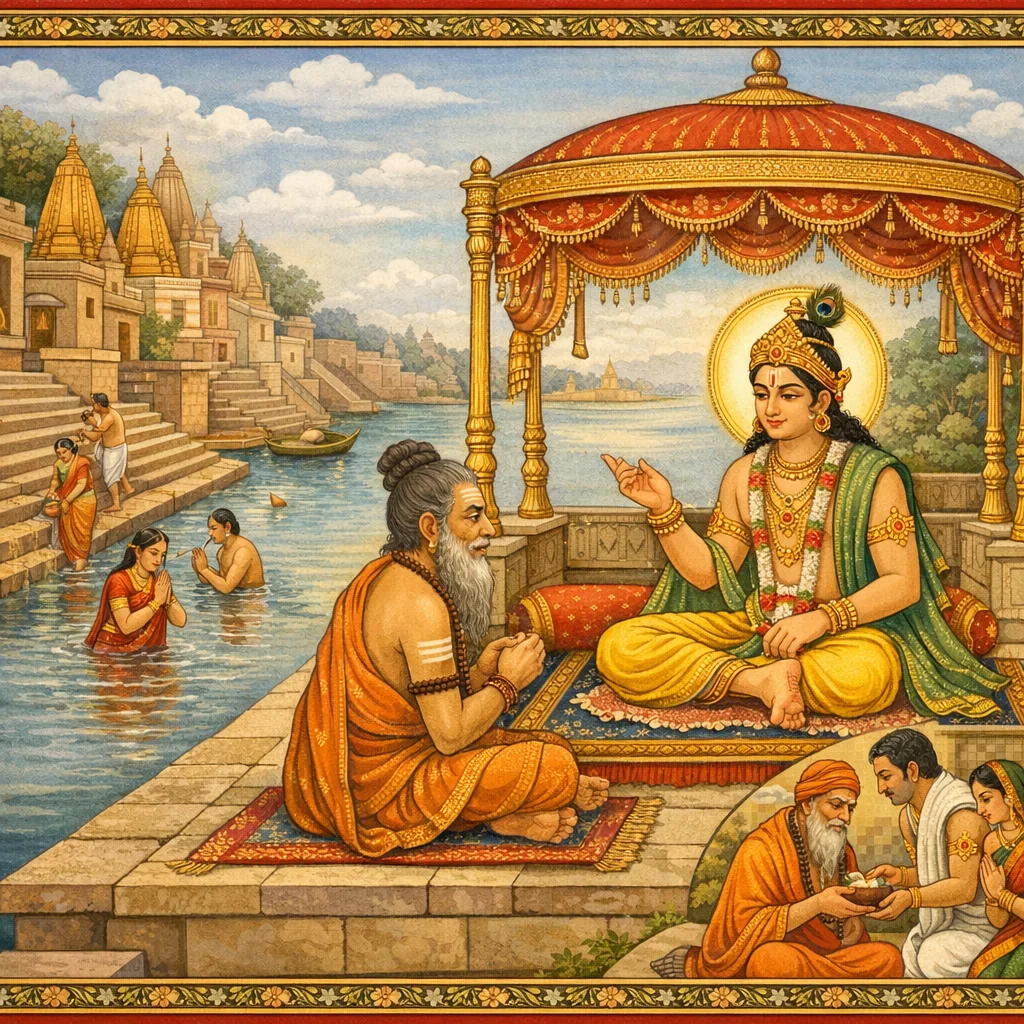
Chapter 46 unfolds a theological and ethical narrative: after a yoginī episode, the Lord commissions the Sun (Aṃśumālī/Ravi) to hasten to auspicious Kāśī–Vārāṇasī and see whether King Divodāsa—praised as an embodiment of dharma—can be unsettled through opposition to dharma. The charge warns that disparaging a dharma-established ruler incurs grave fault, and that kāma, krodha, lobha, moha, matsara, and ahaṃkāra must not prevail where steadfast resolve in dharma endures. Eager to behold Kāśī, Ravi spends a year in many disguises—ascetic, mendicant, ritual innovator, magician, scholar, householder, renunciant—yet finds no moral breach in the king’s realm. Fearing to return without fulfilling the task, Ravi contemplates remaining in Kāśī, extolling its incomparable worth and its power to neutralize the faults of those who enter. He then establishes in Kāśī a twelvefold solar presence (the twelve Ādityas), with special emphasis on Lolārka, so named from the Sun’s intense longing (lola) to see Kāśī. The chapter places Lolārka at Asisaṃbheda in the southern quarter and prescribes pilgrimage observances: an annual yātrā around Mārgaśīrṣa (notably on the 6th/7th tithi and on Sunday), snāna at the Gaṅgā–Asi confluence, śrāddha procedures, and the heightened fruits of gifts and rites—especially during a solar eclipse—declared superior even to famed tīrthas. It concludes by affirming these claims as truthful rather than mere eulogy, rejecting skeptical disparagement and withholding the account from those portrayed as hostile to Vedic norms.
Shlokas
Verse 1
स्कंद उवाच । गतेथ योगिनीवृंदे देवदेवो घटोद्भव । काशीप्रवृत्तिं जिज्ञासुः प्राहिणोदंशुमालिनम्
Skanda said: When the host of Yoginīs had departed, the God of gods—Ghaṭodbhava—wishing to learn the course of events in Kāśī, dispatched Aṃśumālin.
Verse 2
देवदेव उवाच । सप्ताश्व त्वरितो याहि पुरीं वाराणसीं शुभाम् । यत्रास्ति स दिवोदासो धर्ममूर्तिर्महीपतिः
The God of gods said: “O Saptāśva, go swiftly to the auspicious city of Vārāṇasī, where King Divodāsa dwells—the very embodiment of Dharma.”
Verse 3
तस्य धर्मविरोधेन यथातत्क्षेत्रमुद्वसेत् । तथा कुरुष्व भो क्षिप्रं मावमंस्थाश्च तं नृपम्
O (Sun), act swiftly so that, through his opposition to dharma, that king may abandon the sacred kṣetra (Kāśī). Yet do not despise that ruler.
Verse 4
धर्ममार्ग प्रवृत्तस्य क्रियते यावमानना । सा भवेदात्मनो नूनं महदेनश्च जायते
When one who has set out upon the path of dharma is met with contempt, that insult surely becomes a grave fault for the one who scorns, and great sin arises.
Verse 5
तवबुद्धिविकासेन च्यवते चेत्स धर्मतः । तदा सा नगरी भानो त्वयोद्वास्याऽसहैः करैः
If, through the unfolding of your discernment, that king turns away from his opposition to dharma (returning to dharma), then, O Bhānu, do not drive that city out by means of unbearable taxes.
Verse 6
कामक्रोधौ लोभमोहौ मत्सराहंकृती अपि । ते तत्र न भवेतां यत्तत्कालोपि न तं जयेत्
Let desire and anger, greed and delusion, envy and egoism not arise there, so that even Time itself may not overcome him.
Verse 7
यावद्धर्मे स्थिराबुद्धिर्यावद्धर्मेस्थिरं मनः । तावद्विघ्नोदयः क्वास्ति विपद्यपि रवे नृषु
So long as the intellect is steady in dharma, and so long as the mind is firm in dharma, where can obstacles arise for people—even in adversity, O Sun?
Verse 8
सर्वेषामिह जंतूनां त्वं वेत्सि ब्रध्नचेष्टितम् । अतएव जगच्चक्षुर्व्रज त्वं कार्यसिद्धये
You know the movements and intentions of all beings here, and you know the activity of Bradhna (the Sun). Therefore, O Eye of the World, go forth for the accomplishment of the task.
Verse 9
रविरादाय देवाज्ञां मूर्तिमन्यां प्रकल्प्य च । नभोध्वगामहोरात्रं काशीमभिमुखोऽभवत्
Ravi (the Sun), having received the command of the gods and assuming another form, traveled the sky day and night, turning his course toward Kāśī.
Verse 10
मनसातीवलोलोऽभूत्काशीदर्शनलालसः । सहस्रचरणोप्यैच्छत्तदा खे नैकपादताम्
Eager to behold Kāśī, he became exceedingly restless in mind; though possessing a thousand feet, he then desired, in the sky, the state of having but one foot—so that he might go faster.
Verse 11
हंसत्वं तस्य सूर्यस्य तदा सफलतामगात् । सदा नभोध्वनीनस्य काशीं प्रति यियासतः
Then the Sun’s taking the form of a haṃsa (swan) became truly effective, for he was ever traveling the paths of the sky, intent on going toward Kāśī.
Verse 12
अथ काशीं समासाद्य रविरंतर्बहिश्चरन् । मनागपि न तद्भूपे धर्मध्वस्तिमवेक्षत
Then, having reached Kāśī, Ravi moved about both within and without; yet he did not see, even in the slightest degree, the ruin of dharma in that king.
Verse 13
विभावसुर्वसन्काश्यां नानारूपेण वत्सरम् । क्वचिन्नावसरं प्राप तत्र राज्ञि सुधर्मिणि
Vibhāvasu (the Sun), dwelling in Kāśī for a full year and assuming many different disguises, found not even a single opening there against that king who was firmly established in righteousness.
Verse 14
कदाचिदतिथिर्भूतो दुर्लभं प्रार्थयन्रविः । न तस्य राज्ञो विषये दुर्लभं किंचिदैक्षत
At times Ravi (the Sun) became a guest and asked for something difficult to obtain; yet, in the domain of that king, he saw nothing that was truly ‘unattainable’.
Verse 15
कदाचिद्याचको जातो बहुदोपि कदाप्यभूत् । कदाचिद्दीनतां प्राप्तः कदाचिद्गणकोप्यभूत्
Sometimes he became a beggar; sometimes, though wealthy, he appeared otherwise. At times he took on a wretched condition, and at other times he even became an accountant—thus shifting roles again and again.
Verse 16
वेदबाह्यां क्रियां चापि कदाचित्प्रत्यपादयत् । कदाचित्स्थापयामास दृष्टप्रत्ययमैहिकम्
At times he even promoted rites that lay outside the Veda; and at other times he established worldly doctrines resting only on visible, immediate ‘proof’.
Verse 17
कदाचिज्जटिलो जातः कदाचिच्च दिगंबरः । स कदाचिज्जांगुलिको विषविद्याविशारदः
Sometimes he became a matted-haired ascetic; sometimes a sky-clad renunciant. At times he appeared as a snake-charmer, skilled in the lore of poisons.
Verse 18
सर्वपाषंडधर्मज्ञः कदाचिद्ब्रह्मवाद्यभूत् । ऐंद्रजालिक आसीच्च कदाचिद्भ्रामयञ्जनान्
Sometimes he became one who knew the doctrines of every heretical sect; at times he posed as a speaker of Brahman, a lofty theologian. And sometimes he was an illusionist, bewildering people with magical feats.
Verse 19
नानाव्रतोपदेशैश्च कदाचित्स पतिव्रताः । क्षोभयामास बहुशः सदृष्टांत कथानकैः
Sometimes, by teaching many kinds of vows, he repeatedly unsettled even devoted faithful women (pativratās), using stories furnished with examples as persuasive bait.
Verse 20
कापालिक व्रतधरः कदाचिच्चाभवद्द्विजः । कदाचिदपि विज्ञानी धातुवादी कदाचन
Sometimes he bore the Kāpālika vow; sometimes he became a twice-born brāhmaṇa. At times he appeared as a learned man, and at other times as an alchemical theorist, speaking of transmuting metals.
Verse 21
क्वचिद्विप्रः क्वचिद्राजपुत्रो वैश्योंत्यजः क्वचित । ब्रह्मचारी क्वचिदभूद्गृही वनचरः क्वचित्
At one time he was a brāhmaṇa; at another, a prince; at another, a vaiśya or even an outcaste. Sometimes he was a celibate student, sometimes a householder, and sometimes a forest-dweller.
Verse 22
यतिः कदाचिदिति सरूपैरभ्रामयज्जनान् । सर्वविद्यासु कुशलः सर्वज्ञश्चाभवत्क्वचित्
Thus, at times becoming a yati, a renunciant, he deluded people through many forms; at times he appeared skilled in every branch of knowledge, and at times even as one who is omniscient.
Verse 23
इति नानाविधै रूपैश्चरन्काश्यां ग्रहेश्वरः । न कदापि जने क्वापि च्छिद्रं प्राप कदाचन
Thus, roaming about in Kāśī in many different disguises, the Lord of the planets could never find—anywhere, in anyone—so much as a single flaw.
Verse 24
ततो निनिंद चात्मानं चिंतार्तः कश्यपात्मजः । धिक्परप्रेष्यतां यस्यां यशो लभ्येत न क्वचित्
Then the son of Kaśyapa, tormented by anxious thought, condemned himself: “Fie on the state of being another’s errand-runner, in which no fame is gained anywhere!”
Verse 25
मार्तंड उवाच । मंदरं यदि याम्यद्य सद्यस्तत्क्रुद्ध्यतीश्वरः । अनिष्पादितकार्यार्थे मयि सामान्यभृत्यवत्
Mārtaṇḍa said: “If I go to Mandara today, the Lord will at once be angry with me—for the task has not been accomplished—and will treat me like an ordinary servant.”
Verse 26
कोपमप्युररीकृत्य यदि यायां कथंचन । कथं तिष्ठे पुरस्तस्य तर्हि वै मूढभृत्यवत्
Even if I were somehow to accept his anger and go nonetheless, how could I then stand before him—like a foolish servant?
Verse 27
अथोंकृत्यावहेलं वा यामि चेच्च कथंचन । क्रोधान्निरीक्षेत्त्र्यक्षो मां विषं पेयं तदा मया
Or if, with a mere contemptuous “hūṃ,” I somehow depart—then, should the Three-eyed Lord glance at me in wrath, it would be better for me to drink poison.
Verse 28
हरकोपानले नूनं यदि यातः पतंगताम् । पितामहोपि मां त्रातुं तदा शक्ष्यति नस्फुटम्
If indeed I were to become a moth in the blazing fire of Hara’s anger, then even the Grandfather (Brahmā) would scarcely be able to save me.
Verse 29
स्थास्याम्यत्रैव तन्नित्यं न त्यक्ष्यामि कदाचन । क्षेत्रसंन्यासविधिना वाराणस्यां कृताश्रमः
I shall stay right here forever; I will never abandon it. By the rite of kṣetra-saṃnyāsa, I have taken up my vowed residence in Vārāṇasī.
Verse 30
पुरः पुरारेः कायार्थमनिवेद्येह तिष्ठतः । यत्पापं भावि मे तस्य काशीपापस्यनिष्कृतिः
If, while staying here, I fail to report the matter of the task in the very presence of Purāri (Śiva), then whatever sin may arise for me from that—Kāśī itself will be the expiation for that sin.
Verse 31
अन्यान्यपि च पापानि महांत्यल्पानि यानि च । क्षयंति तानि सर्वाणि काशीं प्रविशतां सताम्
Moreover, whatever other sins there may be—great or small—all of them perish for the righteous who enter Kāśī.
Verse 32
बुद्धिपूर्वं मया चैतन्न पापं समुपार्जितम् । पुरारिणैव हि पुराऽशासि धर्मो हि रक्ष्यताम्
This sin was not committed by me with deliberate intent; I did not knowingly accrue it. Indeed, long ago Purāri (Śiva) himself enjoined: “Let Dharma be protected.”
Verse 33
धर्मो हि रक्षितो येन देहे सत्वरगत्वरे । त्रैलोक्यरक्षितं तेन किं कामार्थैः सुरक्षितैः
He who protects Dharma—even within this body that is fleeting and swiftly passing—thereby safeguards the three worlds. What need has such a one of carefully guarded pleasures (kāma) or possessions (artha)?
Verse 34
रक्षणीयो यदि भवेत्कामः कामारिणा कथम् । क्षणादनंगतां नीतो बहूनां सुखकार्यपि
If pleasure (kāma) were truly something that could be protected, how did the ‘enemy of Kāma’ reduce Kāma to bodilessness in an instant—though Kāma is said to bring delight to many?
Verse 35
अर्थश्चेत्सर्वथारक्ष्य इति कैश्चिदुदाहृतम् । तत्कथं न हरिश्चंद्रोऽरक्षत्कुशिकनंदने
Some say that wealth (artha) can always be safeguarded. If so, why could King Hariścandra not protect it, when he faced the son of Kuśika (Viśvāmitra)?
Verse 36
धर्मस्तु रक्षितः सर्वैरपिदेहव्ययेन च । शिबिप्रभृतिभूपालैर्दधीचिप्रमुखैर्द्विजैः
But Dharma has been protected by all—even at the cost of their bodies—by kings beginning with Śibi and by brāhmaṇas beginning with Dadhīci.
Verse 37
अयमेव हि वै धर्मः काशीसेवनसंभवः । रुषितादपि रुद्रान्मां रक्षिष्यति न संशयः
This alone is true Dharma, born of serving Kāśī. Even if Rudra is angered, this Dharma will protect me; of that there is no doubt.
Verse 38
अवाप्य काशीं दुष्प्रापां को जहाति सचेतनः । रत्नं करस्थमुत्सृज्य कः काचं संजिघृक्षति
Having attained hard-to-obtain Kāśī, what sensible person would abandon her? Who, throwing away a jewel already in hand, would wish to pick up mere glass?
Verse 39
वाराणसीं समुत्सृज्य यस्त्वन्यत्र यियासति । हत्वा निधानं पादेन सोर्थमिच्छति भिक्षया
One who abandons Vārāṇasī and seeks to go elsewhere is like a man who kicks a buried treasure with his foot and then tries to gain wealth by begging.
Verse 40
पुत्रमित्रकलत्राणि क्षेत्राणि च धनानि च । प्रतिजन्मेह लभ्यंते काश्येका नैव लभ्यते
Sons, friends, spouses, lands, and wealth can be obtained again in each birth; but Kāśī alone is not so easily obtained.
Verse 41
येन लब्धा पुरी काशी त्रैलोक्योद्धरणक्षमा । त्रैलोक्यैश्वर्यदुष्प्रापं तेन लब्धं महासुखम्
He who has attained the city of Kāśī—capable of uplifting the three worlds—has gained a great happiness, rarer than sovereignty over the three worlds.
Verse 42
कुपितोपि हि मे रुद्रस्तेजोहानिं विधास्यति । काश्यां च लप्स्ये तत्तेजो यद्वै स्वात्मावबोधजम्
Even if Rudra is angered with me, he may bring about the loss of my outward splendor; yet in Kāśī I shall obtain that true radiance which is born from the realization of one’s own Self.
Verse 43
इतराणीह तेजांसि भासंते तावदेव हि । खद्योताभानि यावन्नो जृंभते काशिजं महः
All other lights shine here only for a while; until the splendor born of Kāśī unfolds, they appear merely like the glow of fireflies.
Verse 44
इति काशीप्रभावज्ञो जगच्चक्षुस्तमोनुदः । कृत्वा द्वादशधात्मानं काशीपुर्यां व्यवस्थितः
Thus the Sun—knower of Kāśī’s power, the eye of the world and dispeller of darkness—having divided himself into twelve forms, took his station in the city of Kāśī.
Verse 45
लोलार्क उत्तरार्कश्च सांबादित्यस्तथैव च । चतुर्थो द्रुपदादित्यो मयूखादित्य एव च
They are: Lolārka, Uttarārka, Sāmbāditya; the fourth is Drupadāditya, and also Mayūkhāditya.
Verse 46
खखोल्कश्चारुणादित्यो वृद्धकेशवसंज्ञकौ । दशमो विमलादित्यो गंगादित्यस्तथैव च
Khakholka and Āruṇāditya, and the one known as Vṛddhakeśava; the tenth is Vimalāditya, and likewise Gaṅgāditya.
Verse 47
द्वादशश्च यमादित्यः काशिपुर्यां घटोद्भव । तमोऽधिकेभ्यो दुष्टेभ्यः क्षेत्रं रक्षंत्यमी सदा
And the twelfth is Yamāditya. O Ghaṭodbhava, these ever protect the sacred kṣetra in Kāśīpuri from wicked beings steeped in darkness.
Verse 48
तस्यार्कस्य मनोलोलं यदासीत्काशिदर्शने । अतो लोलार्क इत्याख्या काश्यां जाता विवस्वतः
When that Sun’s mind grew eager and restless upon beholding Kāśī, therefore in Kāśī Vivasvat came to be known by the name “Lolārka”.
Verse 49
लोलार्कस्त्वसिसंभेदे दक्षिणस्यां दिशिस्थितः । योगक्षेमं सदा कुर्यात्काशीवासि जनस्य च
Lolārka is situated at Asisaṃbheda, in the southern direction. He ever ensures yoga and kṣema—welfare and security—for the people dwelling in Kāśī.
Verse 50
मार्गशीर्षस्य सप्तम्यां षष्ठ्यां वा रविवासरे । विधाय वार्षिकीं यात्रां नरः पापै प्रमुच्यते
On the seventh tithi—or on the sixth—of Mārgaśīrṣa, when it is a Sunday, by performing the annual yātrā a person is freed from sins.
Verse 51
कृतानि यानि पापानि नरैः संवत्सरावधि । नश्यंति क्षणतस्तानि षष्ठ्यर्के लोलदर्शनात्
Whatever sins people have committed over the course of a year are destroyed in an instant by the darśana of Lolārka on the Ṣaṣṭhī-arka, the Sun of the sixth tithi.
Verse 52
नरः स्नात्वासिसंभेदे संतर्प्य पितृदेवताः । श्राद्धं विधाय विधिना पित्रानृण्यमवाप्नुयात्
Having bathed at Asisaṃbheda and duly satisfied the deities of the ancestors, one who performs Śrāddha according to the proper rule attains freedom from the debt owed to the forefathers.
Verse 53
लोलार्कसंगमे स्नात्वा दानं होमं सुरार्चनम् । यत्किंचित्क्रियते कर्म तदानंत्याय कल्पते
Having bathed at the sacred confluence of Lolārka, whatever act one performs—charity, fire-offering, or worship of the gods—becomes a cause of inexhaustible spiritual merit.
Verse 54
सूर्योपरागे लोलार्के स्नानदानादिकाः क्रियाः । कुरुक्षेत्राद्दशगुणा भवंतीह न संशयः
At Lolārka, during a solar eclipse, acts such as bathing and giving charity yield tenfold the merit compared to Kurukṣetra—of this there is no doubt.
Verse 55
लोलार्के रथसप्तम्यां स्नात्वा गंगासिसंगमे । सप्तजन्मकृतैः पापैर्मुक्तो भवति तत्क्षणात्
Bathing at Lolārka, at the Gaṅgā–Asi confluence on Ratha-saptamī, one is instantly freed from sins accumulated over seven lifetimes.
Verse 56
प्रत्यर्कवारं लोलार्कं यः पश्यति शुचिव्रतः । न तस्य दुःखं लोकेस्मिन्कदाचित्संभविष्यति
Whoever, observing purity and sacred vows, beholds Lolārka every Sunday—sorrow will never arise for him in this world.
Verse 57
न तस्य दुःखं नो पामा न दद्रुर्न विचर्चिका । लोलार्कमर्के यः पश्येत्तत्पादोदकसेवकः
One who beholds sacred Lolārka on Sundays and partakes of the water sanctified by his feet has no sorrow—nor scabies, nor ringworm, nor any eruption of the skin.
Verse 58
वाराणस्यामुषित्वापि यो लोलार्कं न सेवते । सेवंते तं नरं नूनं क्लेशाः क्षुद्व्याधिसंभवाः
Even while dwelling in Vārāṇasī, one who does not honor Lolārka is surely attended by troubles born of hunger and disease.
Verse 59
सर्वेषां काशितीर्थानां लोलार्कः प्रथमं शिरः । ततोंऽगान्यन्यतीर्थानि तज्जलप्लावितानिहि
Among all the tīrthas of Kāśī, Lolārka is the foremost—the ‘head’; the other tīrthas are, as it were, the limbs, for they are sanctified by the overflow of its waters.
Verse 60
तीर्थांतराणि सर्वाणि भूमीवलयगान्यपि । असिसंभेदतीर्थस्य कलां नार्हंति षोडशीम्
All other tīrthas—even those spread across the whole circle of the earth—do not equal even a sixteenth part of the glory of the Asi-saṃbheda Tīrtha.
Verse 61
सर्वेषामेव तीर्थानां स्नानाद्यल्लभ्यते फलम् । तत्फलं सम्यगाप्येत नरैर्गंगासिसंगमे
Whatever fruit is gained from bathing and related rites at all tīrthas—people obtain that very fruit completely at the Gaṅgā–Asi confluence.
Verse 62
नार्थवादोयमुदितः स्तुतिवादो न वै मुने । सत्यं यथार्थवादोयं श्रद्धेयः सद्भिरादरात्
O sage, this is neither exaggeration nor flattery; it is truth, a statement exactly as it is, to be accepted with reverence by the good.
Verse 63
यत्र विश्वेश्वरः साक्षाद्यत्र स्वर्गतरंगिणी । मिथ्या तत्रानुमन्यंते तार्किकाश्चानुसूयकाः
Where Viśveśvara (Śiva) Himself is directly present, and where the heavenly Gaṅgā flows, there the jealous logicians still presume it all to be ‘false’.
Verse 64
उदाहरंति ये मूढाः कुतर्कबलदर्पिताः । काश्यां सर्वेर्थवादोयं ते विट्कीटा युगेयुगे
Those fools, puffed up by the strength of crooked reasoning, who call this about Kāśī ‘mere exaggeration’—they are dung-insects, age after age.
Verse 65
कस्यचित्काशितीर्थस्य महिम्नो महतस्तुलाम् । नाधिरोहेन्मुने नूनमपि त्रैलोक्यमंडपः
O sage, surely not even the whole pavilion of the three worlds could mount the scale to match the vast greatness of even a single tīrtha of Kāśī.
Verse 66
नास्तिका वेदबाह्याश्च शिश्नोदरपरायणाः । अंत्यजाताश्च ये तेषां पुरः काशी न वर्ण्यताम्
Before atheists, those outside the Veda, those devoted only to lust and belly, and such low-minded people—before them Kāśī should not be described.
Verse 67
लोलार्ककरनिष्टप्ता असिधार विखंडिताः । काश्यां दक्षिणदिग्भागे न विशेयुर्महामलाः
Scorched by the rays of Lolārka and hewn apart by sword-edges, the greatly impure should not enter Kāśī’s southern quarter.
Verse 68
महिमानमिमं श्रुत्वा लोलार्कस्य नरोत्तमः । न दुःखी जायते क्वापि संसारे दुःखसागरे
Having heard this glory of Lolārka, the best of men is never born into sorrow anywhere within this world, an ocean of suffering.