Adhyaya 3
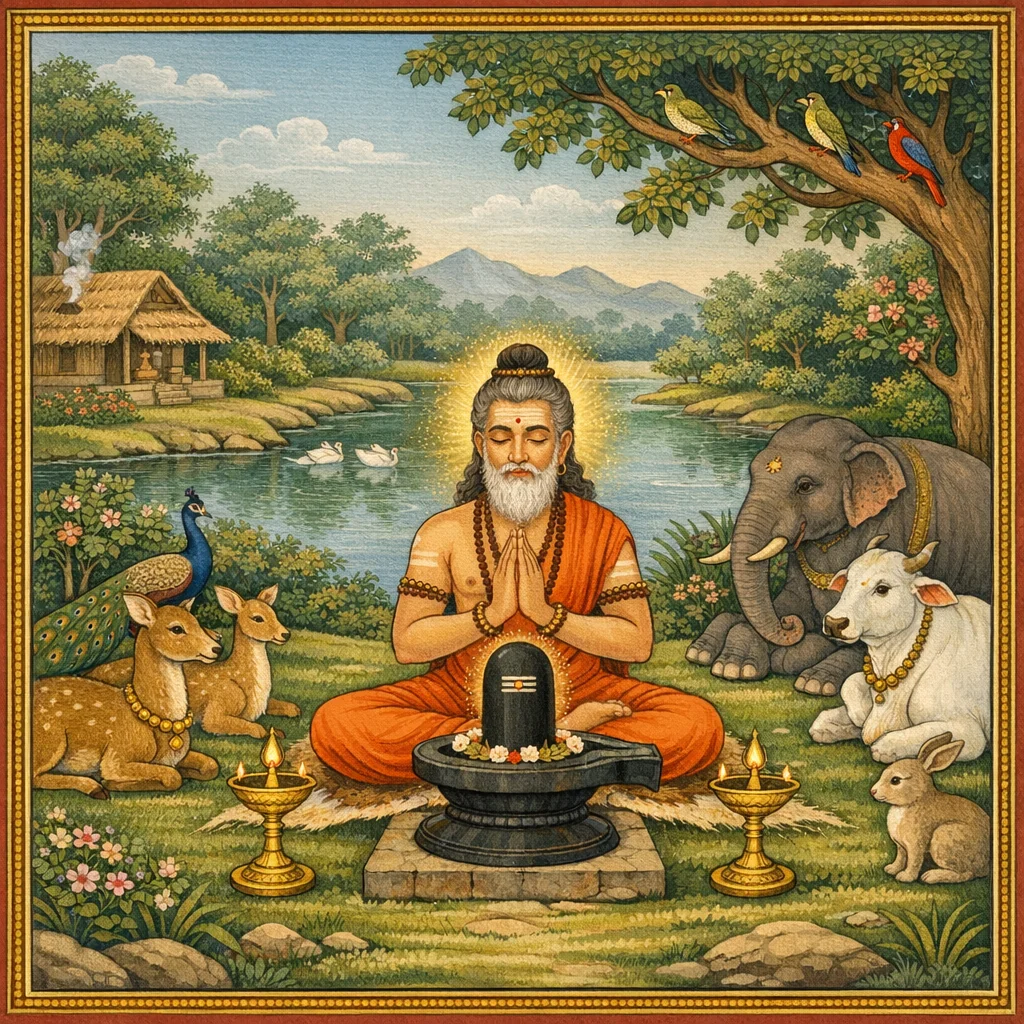
This chapter unfolds as a question-led theological dialogue. Sūta asks what the devas did upon reaching Kāśī and how they approached Agastya. Parāśara replies that the devas immediately began their ritual course in Vārāṇasī: they went first to Maṇikarṇikā for the prescribed bath, performed sandhyā and allied observances, and offered tarpaṇa to the ancestors. The narration then expands into a wide catalogue of dāna (pious gifting): food, grains, garments, metals, vessels, bedding, lamps, and household goods, along with temple-support expenditures such as repairs, offerings of music and dance, pūjā materials, and season-appropriate public welfare. After multi-day observances and repeated darśana of Viśvanātha, the devas travel to Agastya’s abode, where he is portrayed establishing a liṅga and engaging in intense ascetic recitation—especially the Śatarudrīya—radiant with tapas. A distinctive pivot follows: the āśrama is depicted as so pacified that natural enmity among animals and birds is suspended, revealing Kāśī’s kṣetra-prabhāva, the sanctifying power of the sacred field. Ethical instruction is then given, explicitly censuring attachment to meat and intoxicants as incompatible with Śiva-bhakti, and reaffirming liberation promises tied to Viśveśvara—above all, that beings in Kāśī may be released through divine instruction at the time of death. The chapter concludes with strong praise of Kāśī-residence and Viśveśvara-darśana as uniquely efficacious for all four aims of life: dharma, artha, kāma, and mokṣa.
Shlokas
Verse 1
सूत उवाच । भगवन्भूतभव्येश सर्वज्ञानमहानिधे । अवाप्य काशीं गीर्वाणैः किमकारि वदाच्युत
Sūta said: O Blessed One, Lord of past and future, great treasury of all knowledge—having reached Kāśī with the gods, what was done there? Tell me, O unfailing one.
Verse 2
अधीत्येमां कथां दिव्यां न तृप्तिमधियाम्यहम् । शेवधिस्तपसां देवैरगस्तिः प्रार्थितः कथम्
Having studied this divine account, I still do not attain satisfaction. How was Agastya—treasure-house of austerities—entreated by the gods?
Verse 3
कथं विंध्योप्यवाप स्वां प्रकृतिं तादृगुन्नतः । तववागमृतांभोधौ मनो मे स्नातुमुत्सुकम्
How did the Vindhya—so greatly risen—return to its own natural state? My mind longs to bathe in the nectar-ocean of your speech.
Verse 4
इति कृत्स्नं समाकर्ण्य व्यासः पाराशरो मुनिः । श्रद्धावते स्वशिष्याय वक्तुं समुपचक्रमे
Having heard the entire account, the sage Vyāsa, son of Parāśara, then began to speak to his own disciple, who was endowed with faith.
Verse 5
पाराशर उवाच । शृणु सूत महाबुद्धे भक्तिश्रद्धासमन्वितः । शुकवैशंपायनाद्याः शृण्वंत्वेते च बालकाः
Parāśara said: “Listen, O Sūta of great understanding—listen with devotion and faith. Let Śuka, Vaiśaṃpāyana, and the others, and these young students too, also listen.”
Verse 6
ततो वाराणसीं प्राप्य गीर्वाणाः समहर्षयः । अविलंबं प्रथमतो म णिकर्ण्यां विधानतः
Then, having reached Vārāṇasī, the gods together with the great sages, without delay, first of all proceeded—according to proper ordinance—to Maṇikarṇikā.
Verse 7
सचैलमभिमज्ज्याथ कृतसंध्यादिसत्क्रियाः । संतर्प्य तर्प्यादिपितॄन्कुशगंधतिलोदकैः
Bathing there even with their garments on, and having duly performed the twilight-prayers and other sacred observances, they satisfied the Pitṛs through offerings of water mixed with kuśa grass, fragrant substances, and sesame.
Verse 8
तीर्थवासार्थिनः सर्वान्संतर्प्य च पृथक्पृथक् । रत्नैर्हिरण्यवासोभिरश्वाभरणधेनुभिः
And, having satisfied each pilgrim who had come to dwell at the sacred tīrtha, they bestowed dāna—jewels, gold, garments, horses, ornaments, and cows.
Verse 9
विचित्रैश्च तथा पात्रैः स्वर्णरौप्यादि निर्मितैः । अमृतस्वादुपक्वान्नैः पायसै श्च सशर्करैः
They also offered exquisite vessels fashioned of gold, silver, and the like, together with delicious cooked foods—sweet as amṛta—and pāyasa (rice-milk) mixed with sugar.
Verse 10
सगोरसैरन्नदानैर्धान्यदानैरनेकधा । गंधचंदनकर्पूरैस्तांबूलैश्चारुचामरैः
With gifts of food rich in ghee and milk-products, and with many kinds of grain-gifts, they also offered perfumes, sandalwood, camphor, betel, and lovely yak-tail fans (cāmara).
Verse 11
सतूलैर्मृदुपर्यंकैर्दीपिकादर्पणासनैः । शिबिकादासदासीभिर्विमानैःपशुभिर्गृहैः
They gave soft couches with cushions, lamps, mirrors, and seats; palanquins, male and female attendants, vehicles, animals, and even houses.
Verse 12
चित्रध्वजपताकाभिरुल्लोचैश्चंद्रचारुभिः । वर्षाशनप्रदानैश्च गृहोपस्करसंयुतैः
With colorful banners and flags, with lovely moon-bright canopies, with provisions for the rainy season, and with gifts furnished with household equipment as well, they made their offerings.
Verse 13
उपानत्पादुकाभिश्च यतिनश्च तपस्विनः । योग्यैः पट्टदुकूलैश्च विविधैश्चित्ररल्लकैः
And to the yatis and austere ascetics they bestowed footwear—shoes and sandals—together with fitting silks and fine garments, and various cloths adorned with beautiful patterns.
Verse 14
दंडैः कमंडलुयुतैरजिनैर्मृगसंभवैः । कौपीनैरुच्चमंचैश्च परिचारककांचनैः
By providing staffs, kamandalu water-pots, garments of deer-skin, loincloths, high seats and bedsteads, and also gold as wages for attendants—one sustains the religious life bound to Kāśī’s sacred establishments.
Verse 15
मठैर्विद्यार्थिनामन्नैरतिथ्यर्थं महाधनैः । महापुस्तकसंभारैर्लेखकानां च जीवनैः
By establishing monasteries (maṭhas), by feeding students, by offering great wealth for the reception of guests, by supplying abundant collections of books, and by providing livelihood for scribes—one upholds learning and dharma in sacred Kāśī.
Verse 16
बहुधौषधदानैश्च सत्रदानैरनेकशः । ग्रीष्मे प्रपार्थद्रविणैर्हेमंतेग्निष्टिकेंधनैः
By many gifts of medicines, and by numerous endowments for free feeding-houses (sattras); by providing resources for water-stations in the summer, and by supplying fuel for fires in the winter—one performs season-appropriate charity in Kāśī.
Verse 17
छत्राच्छादनिकाद्यर्थे वर्षाकालोचितैर्बहु । रात्रौ पाठप्रदीपैश्च पादाभ्यंजनकादिभिः
By giving many items suited to the rainy season—umbrellas, coverings, and the like; and at night, by providing lamps for reading, along with foot-anointing and similar comforts—one renders considerate service for worship and study in Kāśī.
Verse 18
पुराणपाठकांश्चापि प्रतिदेवालयं धनैः । देवालये नृत्यगीतकरणार्थैरनेकशः
And also, by granting funds to Purāṇa reciters in each temple; and in the temple, by repeatedly providing resources for dance, song, and their performance—(one enhances the glory of worship in Kāśī).
Verse 19
देवालय सुधाकार्यैर्जीर्णोद्धारैरनेकधा । चित्रलेखनमूल्यैश्च रंगमालादिमंडनैः
Through plastering and repair-works of temples, through restoration of what has become dilapidated in many ways; through paying for sacred paintings, and through decorations such as colored garlands and the like—(one serves the holy shrines of Kāśī).
Verse 20
नीराजनैर्गुग्गुलुभिर्दशां गादि सुधूपकैः । कर्पूरवर्तिकाद्यैश्च देवार्चार्थैरनेकशः
By offerings for nīrājana (ārati, the waving of lights), by guggulu incense, by fine fumigations such as the ten-ingredient incense and others, and by camphor wicks and the like—again and again for divine worship—(one increases the merit of temple service in Kāśī).
Verse 21
पंचामृतानां स्नपनैः सुगंध स्नपनैरपि । देवार्थं मुखवासैश्च देवोद्यानैरनेकशः
By bathing the deity with pañcāmṛta, and also with fragrant bathing-rites; by offerings for the deity’s mouth-perfumes (mukhavāsa), and by establishing divine gardens—again and again—(one serves the sacred worship in Kāśī).
Verse 22
महापूजार्थमाल्यादि गुंफनार्थैस्त्रिकालतः । शंखभेरीमृदंगादिवाद्यनादैः शिवालये
For the sake of great pūjā, at the three times of day, by arranging and stringing garlands and the like; and in Śiva’s temple, by the resonant sounds of instruments—conch (śaṅkha), kettle-drum (bherī), mṛdaṅga, and others—(the grandeur of Kāśī’s worship is celebrated).
Verse 23
घंटागुडुककुंभादि स्नानोपस्करभाजनैः । श्वेतैर्मार्जनवस्त्रैश्च सुगंधैर्यक्षकर्दमैः
With vessels and implements for bathing—bells, small water-pots, pitchers, and the like; with white cloths for cleansing; and with fragrant unguents and scented pastes—(the shrine in Kāśī is furnished for pure and fitting worship).
Verse 24
जपहोमैः स्तोत्रपाठैः शिवनामोच्चभाषणैः । रासक्रीडादिसंयुक्तैश्चलनैः सप्रदक्षिणैः
With japa and fire-offerings, with recitation of hymns, with the loud utterance of Śiva’s names, and with movements joined to sacred dance and play—performing them together with pradakṣiṇā, circumambulation—(they worshipped in Kāśī).
Verse 25
एवमादिभिरुद्दंडैः क्रियाकांडैरनेकशः । पंचरात्रमुषित्वा तु कृत्वा तीर्थान्यनेकशः
Thus, by many such rigorous ritual observances and by repeatedly performing the prescribed acts, they stayed for five nights and visited many tīrthas—sacred fords and holy places.
Verse 26
दीनानाथांश्च संतर्प्य नत्वा विश्वेश्वरं विभुम् । ब्रह्मचर्यादिनियमैस्तीर्थमेवं प्रसाध्य च
After satisfying the poor and the helpless, and bowing to the mighty Lord Viśveśvara, they duly fulfilled the tīrtha-observance by disciplines such as brahmacarya and other restraints.
Verse 27
पुनः पुनर्विश्वनाथं दृष्ट्वा स्तुत्वा प्रणम्य च । जग्मुः परोपकारार्थमगस्तिर्यत्र तिष्ठति
Again and again, having beheld Viśvanātha, praised Him, and bowed down, they went—seeking the welfare of others—to the place where Agastya dwells.
Verse 28
स्वनाम्ना लिंगमास्थाप्य कुंडं कृत्वा तदग्रतः । शतरुद्रियसूक्तेन जपन्निश्चलमानसः
Setting up a liṅga in his own name and making a fire-pit before it, he chanted the Śatarudrīya hymn with a mind unmoving and wholly concentrated.
Verse 29
तं दृष्ट्वा दूरतो देवा द्वितीयमिव भास्करम् । ज्वलज्ज्वलनसंकाशैरंगैः सर्वत्रसोज्ज्वलम्
Seeing him from afar, the gods deemed him like a second sun—his limbs like blazing fire, radiant everywhere.
Verse 30
साक्षात्किंवाडवाग्निर्वा मूर्त्या वै तप्यते तपः । स्थाणुवन्निश्चलतरं निर्मलं सन्मनो यथा
Was it the submarine fire itself made manifest, performing tapas in bodily form? Like a pillar he was utterly motionless—pure, like the mind of the good.
Verse 31
अथवा सर्व तेजांसि श्रित्वेमां ब्राह्मणीं तनुम् । शीलयंति परं धाम शातंशांत पदाप्तये
Or else, all splendors, taking refuge in this brahminical body, abide in the supreme abode—seeking the attainment of the utterly peaceful state.
Verse 32
तपनस्तप्यतेऽत्यर्थं दहनोपि हि दह्यते । यत्तीव्रतपसाद्यापि चपलाऽचपलाभवत्
The sun seems scorched exceedingly, and even fire itself as though burned; for through fierce tapas, even what is by nature restless became steadfast.
Verse 33
यस्याश्रमे ऽत्र दृश्यंते हिंस्रा अपि समंततः । सत्त्वरूपा अमी सत्त्वास्त्यक्त्वा वैरं स्वभावजम्
In his hermitage here, even violent creatures are seen on every side as gentle beings, for they have cast away the hostility innate to their nature.
Verse 34
शुंडादंडेन करटिः सिंहं कंडूयतेऽभयः । अष्टापदांके स्वपिति केसरी केसरोद्भटः
In fearless Kāśī, the elephant scratches the lion with the staff of its trunk; and the lion, mighty-maned and splendid in his mane, sleeps upon the elephant’s lap.
Verse 35
सूकरः स्तब्धरोमापि विहाय निजयूथकम् । चरेद्वनशुनां मध्ये मुस्तान्यस्तेक्षणोबली
Even the bristly-haired boar, leaving its own herd behind, roams among wild dogs—strong, yet with its gaze gently lowered—within Kāśī’s fearless domain.
Verse 36
भूदारोपि न भूदारं तथाकुर्याद्यथाऽन्यतः । सर्वा लिंगमयी काशी यतस्तद्भीतियंत्रितः
Even one fierce by nature does not act fiercely here as he would elsewhere; for all of Kāśī is pervaded by the Liṅga, and beings are restrained by reverent awe of That.
Verse 37
क्रोडीकृत्य क्रोडपोतं तरक्षुः क्रीडयत्यहो । शार्दूलबालानुत्सार्य शार्दूलीमेणपोतकः
Wondrous indeed: the hyena, having taken a young boar into its lap, plays with it; and the tigress, sending away her own cubs, sports with a fawn.
Verse 38
चलत्पुच्छोथ पिबति फेनिलेनाननेन वै । स्वपंतं लोमशं भल्लं वानरश्चलदंगुलिः
Wagging its tail, the monkey—its fingers ever restless—drinks with a foaming mouth, while a shaggy bear sleeps nearby.
Verse 39
यूका संवीक्ष्यवीक्ष्यैव भक्षयेद्दंतकोटिभिः । गोलांगूलारक्तमुखानीलां गा यूथथनायकाः
After examining them again and again, even a louse would bite with the tips of its teeth; and the leaders of the herd—blue-bodied, red-mouthed, with rounded tails—move about without dread.
Verse 40
जातिस्वभावमात्सर्यं त्यक्त्वैकत्र रमंति च । शशाः क्रीडंति च वृकैस्तैः पृष्ठलुंठनैर्मुहुः
Abandoning the jealousy born of their species and nature, they delight together in one place; and hares even play with wolves, again and again, rolling upon their backs.
Verse 41
आखुश्चाखुभुजः कर्णं कंडूयेत चलाननः । मयूरपुच्छपुटगो निद्रात्योतुः सुखाधिकम्
A rat, with its twitching face, scratches the ear of the rat-eater; and one who lies within the enclosure of a peacock’s tail sleeps exceedingly, with greater comfort.
Verse 42
स्वकंठं घर्षयत्येव केकिकंठे भुजंगमः । भुजंगमफणापृष्ठे नकुलः स्वकुलोचितम्
A serpent rubs its own throat upon a peacock’s neck; and upon the hooded serpent’s back, the mongoose acts in a manner befitting its own kind—yet in Kāśī there is no enmity.
Verse 43
वैरं परित्यज्य लुठेदुत्प्लुत्योत्प्लुत्य लीलया । आलोक्य मूषकं सर्पश्चरंतं वदनाग्रतः
Casting aside enmity, the serpent rolls about, leaping again and again in play, even as it watches the mouse moving right before the tip of its mouth.
Verse 44
क्षुधांधोपि न गृह्णाति सोपि तस्माद्बिभेति नो । प्रसूयमानां हरिणीं दृष्ट्वा कारुण्यपूर्णदृक्
Even though blinded by hunger, he does not seize her, nor does she fear him. Seeing the doe in the pangs of giving birth, his gaze becomes filled with compassion.
Verse 45
तद्दृष्टिपातं मुंचन्वै व्याघ्रो दूरं व्रजत्यहो । व्याघ्री व्याघ्रस्य चरितं मृगी मृगविचेष्टितम् । उभे कथयतो ऽन्योन्यं सख्याविवमुदान्विते
Casting that glance away, the tiger—marvelously—goes far off. The tigress relates the tiger’s conduct, and the doe the ways of the deer; the two speak to each other as though friends, filled with joy.
Verse 46
दृष्ट्वाप्युद्दंडकोदंडं शबरं शंबरोमृगः । धृष्टो न वर्त्म त्यजति सोपि कंडूयतेपि तम्
Even on seeing the hunter with his staff and bow raised, the bold śambara-deer does not leave the path; and the hunter, too, merely scratches himself—he does not harm him.
Verse 47
रोहितोऽरण्यमहिषमुद्धर्षति निराकुलः । चमरीशबरीकेशैः संमिमीते स्ववालधिम्
The rohita deer, untroubled and fearless, sports with the wild buffalo of the forest; and with the hair of a camarī-yak and a śabarī forest-beast, he even measures—comparing—the length of his own tail.
Verse 49
हुंडौ च मुंड युद्धाय न सज्जेते जयैषिणौ । एणशावं सृगालोपि मृदुस्पृशति पाणिना
Even Huṇḍa and Muṇḍa, eager for victory, do not ready themselves for battle; even a jackal gently touches a fawn with its paw.
Verse 50
तृण्वंति तृणगुल्मादीन्श्वापदास्त्वापदास्पदम् । लोकद्वये दुःखहंहि धिक्तन्मांसस्य भक्षणम्
Wild beasts feed on grass, shrubs, and the like—yet meat becomes a seat of calamity. Indeed it brings suffering in both worlds; shame on the eating of that flesh.
Verse 51
यः स्वार्थं मांसपचनं कुरुते पापमोहितः । यावंत्यस्य तु रोमाणि तावत्स नरके वसेत्
Whoever, deluded by sin, cooks meat for his own gratification—he shall dwell in hell for as many years as there are hairs upon his body.
Verse 52
परप्राणैस्तु ये प्राणान्स्वान्पुष्णं ति हि दुर्धियः । आकल्पं नरकान्भुक्त्वा ते भुज्यंतेत्र तैः पुनः
Those of wicked understanding who nourish their own lives by taking the lives of others—after enduring hells for an aeon, they are in turn devoured here by those very beings.
Verse 53
जातुमांसं न भोक्तव्यं प्राणैः कंठगतैरपि । भोक्तव्यं तर्हि भोक्तव्यं स्वमांसं नेतरस्य च
Meat should never be eaten—even if one’s very life is at the throat’s edge. If something must be eaten, then let it be one’s own flesh, not another’s.
Verse 54
वरमेतेश्वापदा वै मैत्रावरुणि सेवया । येषां न हिंसने बुद्धिर्नतु हिंसापरा नराः
O Maitrāvaruṇi, better are these wild beasts—whose minds are not set on harming—than men devoted to violence.
Verse 55
बकोपि पल्वले मत्स्यान्नाश्नात्यग्रेचरानपि । न महांतोप्यमहतो मत्स्या मत्स्यानदंति वै
Even a heron in a pond does not eat the fish right before it; and even large fish do not devour smaller fish. (So too, in the sanctified field of Kāśī, natural cruelty is restrained.)
Verse 56
एकतः सर्वमांसानि मत्स्यमांसं तथकैतः । स्मृतिः स्मृतेति किंत्वेभिरतोमत्स्याञ्जहत्यमी
On one side are all kinds of meats, fish-flesh as well; yet what use is merely quoting “Smṛti, Smṛti”? Therefore these creatures give up eating fish. (Such is the discipline induced by Kāśī’s sacred power.)
Verse 57
श्येनोपि वर्तिकां दृष्ट्वा भवत्येष पराङ्मुखः । चित्रमत्रापि मधुपा भ्रमंति मलिनाशयाः
Even a hawk, on seeing a quail, turns away from it. Yet it is strange that here the bees still wander—those whose inner intentions remain impure.
Verse 58
सुचिरं नरकान्भुक्त्वा मदिरापानलंपटाः । मधुपा एव गायंते भ्रांतिभाजः पुनः पुनः
Having long endured the hells, those addicted to drinking liquor are born as bees; they keep ‘singing’ again and again, as beings destined for delusion.
Verse 59
अतएव पुराणेषु गाथेति परिगीयते । स्फुटार्थात्र पुराणज्ञैर्ज्ञात्वा तत्त्वं पिनाकिनः
Therefore, in the Purāṇas it is praised as a “gāthā,” a traditional sacred verse. Its meaning here is clear: those skilled in the Purāṇas, having understood the true principle of Pinākin (Śiva), know its truth.
Verse 60
क्व मांसं क्व शिवे भक्तिः क्व मद्यं क्व शिवार्चनम् । मद्यमांसरतानां च दूरे तिष्ठति शंकरः
What has meat to do with devotion to Śiva? What has liquor to do with the worship of Śiva? For those attached to liquor and meat, Śaṅkara remains far away.
Verse 61
विना शिवप्रसादं हि भ्रांतिः क्वापि न नश्यति । अतएव भ्रमंत्येते भ्रमराः शिववर्जिताः
Without Śiva’s grace, delusion never truly perishes anywhere. Therefore these “bhramaras” (bees)—devoid of Śiva—keep wandering.
Verse 62
इत्याश्रमचरान्दृष्ट्वा तिर्यञ्चोपि मुनीनिव । अबोधिविबुधैरित्थं प्रभावः क्षेत्रजस्त्वयम्
Thus, seeing even animals behaving like sages who dwell in hermitages, the wise understood: “Such is this power born of the sacred field (kṣetra).”
Verse 63
यतो विश्वेश्वरेणैते तिर्यञ्चोप्यत्रवासिनः । निधनावसरे मोच्यास्तारक स्योपदेशतः
For Viśveśvara has ordained that even these animals who reside here shall be liberated at the time of death, through the instruction of the Tāraka—the saving mantra and teaching.
Verse 64
ज्ञात्वा क्षेत्रस्य माहात्म्यं यो वसेत्कृतनिश्चयः । तं तारयति विश्वेशो जीवंतमथवा मृतम्
Whoever, knowing the greatness of this sacred kṣetra, dwells here with steadfast resolve—Viśveśa delivers that one, whether living or dead.
Verse 65
अविमुक्तरहस्यज्ञा मुच्यंते ज्ञानि नो नराः । अज्ञानिनोपि तिर्यञ्चो मुच्यंते गतकिल्बिषाः
The wise who know the secret of Avimukta (Kāśī) are liberated. Even the ignorant—yes, even animals—are freed, their sins washed away.
Verse 66
इत्याश्चर्यपरा देवा यावद्यांत्याश्रमं मुनेः । तावत्पक्षिकुलं दृष्ट्वा भृशं मुमुदिरे पुनः
Thus, filled with wonder, the gods proceeded toward the sage’s āśrama; and on the way, seeing a flock of birds, they rejoiced greatly once again.
Verse 67
सारसो लक्ष्मणाकंठे कंठमाधाय निश्चलः । मन्यामहे न निद्रातिध्यायेद्विश्वेश्वरं किल
A crane, resting its neck upon Lakṣmaṇā’s neck, stands motionless. We think it is not asleep at all—surely it is meditating on Viśveśvara (Śiva).
Verse 68
कंडूयमाना वरटा स्वचंचुपुटकोटिभिः । हंसं कामयमानं तु वारयेत्पक्षधूननैः
A female bird, scratching herself with the tips of her own beak, restrains a desire-struck swan by shaking her wings.
Verse 69
निरुद्ध्यमान चक्रेण चक्रीक्रेंकितभाषणैः । वदतीति किमत्रापि कामिता कामिनां वर
Though restrained by the wheel, the cakravāka-bird still speaks with its creaking cries—what then is to be said here, O best of lovers, of one who is desired by the passionate?
Verse 70
कलकंठः किलोत्कंठं मंजुगुंजति कुंजगः । ध्यानस्थः श्रोष्यति मुनिः पारावत्येति वार्यते
The cuckoo, longing, hums sweetly in the grove. “The sage is absorbed in meditation—he will hear!” Thus the she-dove is restrained from calling.
Verse 71
केकीकेकां परित्यज्य मौनं तिष्ठति तद्भयात् । चकोरश्चंद्रिका भोक्ता नक्तव्रतमिवास्थितः
Abandoning its “kekī” cry, the peacock stands silent out of fear of disturbing the sage. And the cakora-bird, a drinker of moonlight, remains as though observing a night-vow.
Verse 72
पठंती सारिकासारं शुकंसंबोधयत्यहो । अपारावारसंसारसिंधुपारप्रदः शिवः
A myna-bird recites the essence and awakens the parrot—marvel indeed! Śiva is the one who grants passage beyond the boundless ocean of saṃsāra.
Verse 73
कोकिलः कोमलालापैः कलयन्किलकाकलीम् । कलिकालौ कलयतः काशीस्थान्नेतिभाषते
The cuckoo, shaping sweet notes into its song, seems to say to those who reckon only the harshness of the Kali age: “Not so for those who dwell in Kāśī!”
Verse 74
मृगाणां पक्षिणामित्थं दृष्ट्वा चेष्टां त्रिविष्टपम् । अकांडपातसंकष्टं निनिंदुस्त्रिदशा बहु
Seeing such conduct among deer and birds, the gods greatly censured Svarga itself, distressed by the sudden “fall” from heaven and its anguish.
Verse 75
वरमेतेपक्षिमृगाः पशवः काशिवासिनः । येषां न पुनरावृत्तिर्नदेवानपुनर्भवाः
Truly blessed are even the birds, beasts, and animals who dwell in Kāśī, for for them there is no return to saṃsāra. Such freedom from rebirth is not easily attained even by the gods.
Verse 76
काशीस्थैः पतितैस्तुल्या न वयं स्वर्गिणः क्वचित् । काश्यां पाताद्भयं नास्ति स्वर्गेपाताद्भयं महत्
We do not wish at all to be heaven-goers; we would rather be like those called “fallen” who yet remain in Kāśī. In Kāśī there is no fear of falling, but in heaven the fear of falling back when merit is spent is great.
Verse 77
वरं काशीपुरी वासो मासोपवसनादिभिः । विचित्रच्छत्रसंछायं राज्यं नान्यत्र नीरिपु
Better is residence in the city of Kāśī, even with monthly fasts and austerities, than a kingdom elsewhere—though shaded by splendid parasols—O king without enemies.
Verse 78
शशकैर्मशकैः काश्यां यत्पदं हेलयाप्यते । तत्पदं नाप्यतेऽन्यत्र योगयुक्त्यापि योगिभिः
That spiritual station which in Kāśī is attained even lightly, even by the most insignificant beings, is not attained elsewhere even by yogins through disciplined yogic methods.
Verse 79
वरं वाराणसीरंको निःशंकोयो यमादपि । न वयं त्रिदशायेषां गिरितोपीदृशी दशा
Better to be poor in Vārāṇasī, living without fear—even of Yama—than to suffer such a state elsewhere, even as a lord among the devas upon a mountain.
Verse 80
ब्रह्मणो दिवसाष्टांशेषपदमैंद्रं विनश्यति । सलोकपाल सार्कं च सचंद्रग्रहतारकम्
When only an eighth of Brahmā’s day remains, Indra’s station perishes—along with the world-guardians, the sun, and even the moon, planets, and stars.
Verse 81
परार्धद्वयनाशेपि काशीस्थो यो न नश्यति । तस्मात्सर्वप्रयत्नेन काश्यां श्रेयः समाचरेत्
Even when two parārdhas are destroyed in vast cosmic dissolution, the one who abides in Kāśī does not perish. Therefore, with every effort, one should pursue the highest good in Kāśī.
Verse 82
यत्सुखं काशिवासेत्र न तद्ब्रह्मांडमंडपे । अस्ति चेत्तत्कथं सर्वे काशीवासाभिलाषुकाः
The joy found in dwelling in Kāśī is not found even in the grand pavilion of the universe. If it were found there, then why would everyone long to live in Kāśī?
Verse 83
जन्मांतरसहस्रेषु यत्पुण्यं समुपार्जितम् । तत्पुण्यपरिवर्तेन काश्यां वासोऽत्र लभ्यते
The merit accumulated across thousands of lifetimes is, as it were, ‘exchanged’ for this: by the transformation of that puṇya, one obtains residence here in Kāśī.
Verse 84
लब्धोपि सिद्धिं नो यायाद्यदि कुद्ध्येत्त्रिलोचनः । तस्माद्विश्वेश्वरं नित्यं शरण्यं शरणं व्रजेत्
Even one who has attained siddhis would not reach fulfillment if the Three-Eyed Lord were displeased. Therefore one should always take refuge in Viśveśvara, the ever-protecting sanctuary.
Verse 85
धर्मार्थकाममोक्षाख्यं पुरुषार्थचतुष्टयम् । अखंडं हि यथा काश्यां न तथा न्यत्र कुत्रचित्
The four aims of human life—dharma, artha, kāma, and mokṣa—are found in an unbroken, integral way in Kāśī; nowhere else, in any place whatsoever, is it so.
Verse 86
आलस्येनापि यो यायाद्गृहाद्विश्वेश्वरालयम् । अश्वमेधाधिको धर्मस्तस्य स्याच्च पदेपदे
Even if, out of mere laziness, one goes from home to the temple of Viśveśvara, for him dharma arises at every step—greater even than the merit of an Aśvamedha sacrifice.
Verse 87
यः स्नात्वोत्तरवाहिन्यां याति विश्वे शदर्शने । श्रद्धया परया तस्य श्रेयसोंतो न विद्यते
Whoever bathes in the north-flowing river and then goes for the darśana of Viśveśa with supreme faith—there is no limit to his highest welfare (śreyas).
Verse 88
स्वर्धुनी दर्शनात्स्पर्शात्स्नानादाचमनादपि । संध्योपासनतो जप्यात्तर्पणाद्देवपूजनात्
From merely seeing the celestial river, from touching it, from bathing and even from sipping its water; from Sandhyā worship, from japa, from tarpaṇa, and from worship of the gods—(in Kāśī) merit continually accrues.
Verse 89
पंचतीर्थावलोकाच्च ततो विश्वेश्वरेक्षणात् । श्रद्धास्पर्शनपूजाभ्यां धूपदीपादिदानतः
By beholding the Five Tīrthas, and then by gazing upon Viśveśvara; by devoted touch and worship; and by offering gifts such as incense and lamps—merit rises ever higher in Kāśī.
Verse 90
प्रदक्षिणैः स्तोत्रजपैर्नमस्कारैस्तु नर्त्तनैः । देवदेवमहादेव शंभो शिवशिवेति च
Through circumambulations, hymn-recitation and japa, through prostrations and even dancing—crying, “God of gods, Mahādeva! Śambho! Śiva, Śiva!”—one’s devotion in Kāśī becomes a powerful source of merit.
Verse 91
धूर्जटे नीलकंठेश पिनाकिञ्शशिशेखर । त्रिशूलपाणे विश्वेश रक्षरक्षेतिभाषणैः
By uttering prayers such as: “O Dhūrjaṭi! O Lord Nīlakaṇṭha! O Pinākin, O Moon-crested One! O Triśūla-bearing Viśveśa—protect, protect!”—one invokes Śiva’s guardianship and gains auspicious merit in Kāśī.
Verse 92
मुक्तिमंडपिकायां च निमेषार्धो पवेशनात् । तत्र धर्मकथालापात्पुराणश्रवणादपि
And by entering the Mukti-Maṇḍapikā even for half a blink of an eye; and there, by conversing on dharma and by listening to the Purāṇas—great merit is obtained in Kāśī.
Verse 93
नित्यादिकर्मकरणात्तथातिथिसमर्चनैः । परोपकरणाद्यैश्च धर्मस्स्यादुत्तरोत्तरः
By performing daily and obligatory duties, by properly honoring guests, and by acts of service to others and the like—dharma becomes greater and greater for those dwelling in Kāśī.
Verse 94
शुक्लपक्षे यथा चंद्रः कलया कलयैधते । एवं काश्यां निवसतां धर्मराशिः पदेपदे
Just as, in the bright fortnight, the moon increases phase by phase, so for those who dwell in Kāśī the store of dharma grows step by step.
Verse 95
श्रद्धाबीजो विप्रपादांबुसिक्तः शाखाविद्यास्ताश्चतस्रो दशापि । पुष्पाण्यर्था द्वे फले स्थूलसूक्ष्मे मोक्षःकामो धर्मवृक्षोयमीड्यः
This venerable Tree of Dharma has faith as its seed and is watered by the water that has washed the feet of the brāhmaṇas. Its branches are the disciplines of knowledge—four, and also ten. Its blossoms are the aims of prosperity, and it bears two fruits, gross and subtle: worldly enjoyment and liberation (mokṣa). Such is this praiseworthy tree of righteousness.
Verse 96
सर्वार्थानामत्रदात्री भवानी सर्वान्कामान्पूरयेदत्र ढुंढिः । सर्वाञ्जंतून्मोचयेदंतकाले विश्वेशोत्रश्रोत्रमंत्रोपदेशात्
Here, Bhavānī bestows every kind of prosperity; here, Ḍhuṃḍhi fulfills all desires. And here, at the final moment, Viśveśvara grants release to all beings by imparting the saving mantra into the ear.
Verse 97
काश्यां धर्मस्तच्चतुष्पादरूपः काश्यामर्थः सोप्यने कप्रकारः । काश्यां कामः सर्वसौख्यैकभूमिः काश्यां श्रेयस्तत्तु किंनात्र यच्च
In Kāśī, Dharma stands firm in its four-footed form; in Kāśī, Artha is gained in many ways. In Kāśī, Kāma finds a single ground of all happiness; and in Kāśī is the highest good itself—so what excellence is there that is not found here?
Verse 98
विश्वेश्वरो यत्र न तत्र चित्रं धर्मार्थकामामृतरूपरूपः । स्वरूपरूपः स हि विश्वरूपस्तस्मान्न काशी सदृशी त्रिलोकी
Where Viśveśvara is present, it is no wonder that Dharma, Artha, Kāma—and the nectar-like gift of liberation—are found in their very forms. For He is the very form of Reality, the One of universal form; therefore, in all the three worlds, there is no city equal to Kāśī.
Verse 99
इति ब्रुवाणा गीर्वाणा ददृशुस्तूटजं मुनेः । होमधूमसुगंधाढ्यं बटुभिर्बहुभिर्वृतम्
As the gods spoke thus, O sage, they beheld the rishi’s leaf-hut, rich with the fragrant scent of homa smoke, and surrounded by many young students.
Verse 100
श्यामाकांजलियाञ्चार्थमृषिकन्यानुयायिभिः । धृतोपग्रहदर्भास्यैर्मृगशावैरलंकृतम्
It was adorned with fawn-deer, their mouths bearing darbha grass as a ritual accessory, and attended by the daughters of sages who came with handfuls of śyāmā grain for alms.
Verse 107
विधूय सर्व पापानि ज्ञात्वाऽज्ञात्वा कृतान्यपि । हंसवर्णेन यानेन गच्छेच्छिवपुरं ध्रुवम्
Having shaken off all sins—even those committed knowingly or unknowingly—one surely goes to Śiva’s city, borne upon a swan-hued celestial vehicle.