Adhyaya 21
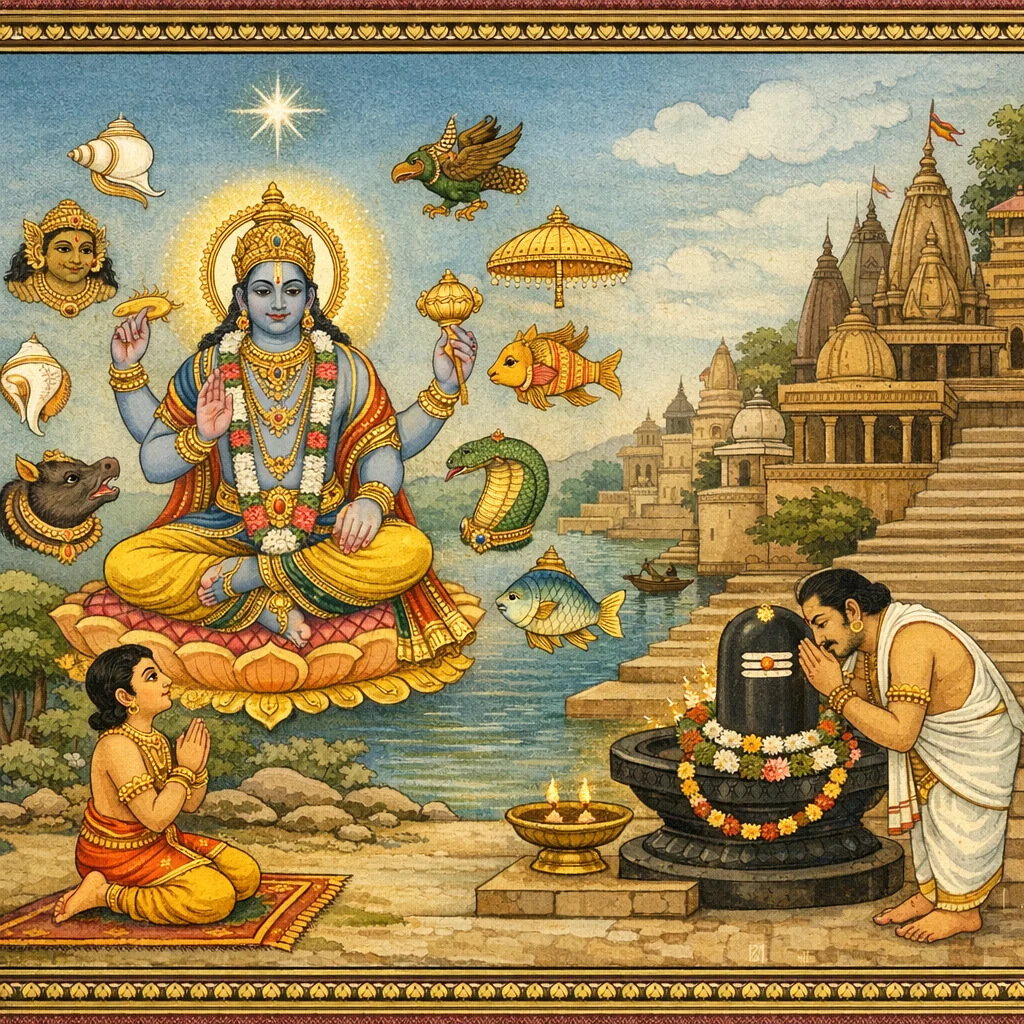
This adhyāya opens with Dhruva’s long stotra to Bhagavān Viṣṇu, offering repeated salutations through many names, epithets, and avatāra allusions. The praise moves from Viṣṇu’s cosmic roles—creation, preservation, and dissolution—to His iconic emblems (śaṅkha, cakra, gadā), and then to a catalog-like identification of the Lord with sacred exemplars: the Vedas, rivers and mountains, tulasī, the śālagrāma stone, and tīrthas such as Kāśī and Prayāga. The discourse then turns to devotional ethics: nāma-kīrtana and remembrance are said to pacify disease, dissolve accumulated wrongdoing, and steady the mind. Ritual signs of bhakti are also noted—worship of tulasī and śālagrāma, gopīcandana markings, and conch-associated bathing—presented as protective expressions of devotion. Viṣṇu responds, acknowledging Dhruva’s inner intent and granting him a cosmic office: Dhruva becomes the fixed support (ādhāra) for the revolving celestial order and rules the Dhruva-pada for a full kalpa. A phalaśruti adds that thrice-daily recitation of the hymn reduces sin, stabilizes prosperity and social harmony, and yields benefits such as progeny, wealth, and devotion. Finally, the chapter pivots to Kāśī: Viṣṇu declares His intention to go to auspicious Vārāṇasī, where Viśveśvara abides as a cause of mokṣa, and describes the saving mantra whispered into the ear of the distressed. Kāśī is proclaimed a singular remedy for worldly suffering, with added merits tied to lunar dates, darśana, and gifting in Brahmapurī/Kāśī, concluding with the merit of remembering Dhruva’s narrative.
Shlokas
Verse 1
ध्रुव उवाच । नमो हिरण्यगर्भाय सर्वसृष्टिविधायिने । हिरण्यरेतसे तुभ्यं सुहिरण्यप्रदायिने
Dhruva said: Salutations to Hiraṇyagarbha, the ordainer of all creation; salutations to You, Hiraṇyareta, the giver of excellent gold—of auspicious prosperity and sacred abundance.
Verse 2
नमो हरस्वरूपाय भूतसंहारकारिणे । महाभूतात्मभूताय भूतानां पतये नमः
Salutations to You whose form is Hara, who brings about the dissolution of beings; salutations to You who are the very Self of the great elements, the Lord and master of all creatures.
Verse 3
नमः स्थितिकृते तुभ्यं विष्णवे प्रभविष्णवे । तृष्णाहराय कृष्णाय महाभार सहिष्णवे
Salutations to You, the author of preservation—Viṣṇu, the all-powerful Viṣṇu; salutations to Kṛṣṇa who removes craving, who bears the mighty burden of the world with unfailing forbearance.
Verse 4
नमो दैत्यमहारण्य दाववह्निस्वरूपिणे । दैत्यद्रुमकुठाराय नमस्ते शार्ङ्गपाणये
Salutations to You, who are like a wildfire in the great forest of demons; salutations to the axe that fells the demon-trees—obeisance to You, O Śārṅgapāṇi, bearer of the Śārṅga bow.
Verse 5
नमः कौमोदकीव्यग्र कराग्राय गदाधर । महादनुजनाशाय नमो नंदकधारिणे
Salutations to the Bearer of the mace—whose foremost hand is poised with Kaumodakī; salutations to the Destroyer of the mighty Dānavas; salutations to the Wielder of Nandaka, the sword.
Verse 6
नमः श्रीपतये तुभ्यं नमश्चक्रधराय च । धराधराय वाराह रूपिणे परमात्मने
Salutations to You, the Lord of Śrī (Lakṣmī); salutations to the Wielder of the discus; salutations to the Uplifter of the Earth, who assumed the form of the Boar—salutations to the Supreme Self.
Verse 7
नमः कमलहस्ताय कमलावल्लभाय ते । नमो मत्स्यादिरूपाय नमः कौस्तुभवक्षसे
Salutations to You whose hands bear the lotus; salutations to the Beloved of Kamalā (Lakṣmī). Salutations to You who take forms beginning with Matsya; salutations to You whose chest is adorned with the Kaustubha jewel.
Verse 8
नमो वेदांतवेद्याय नमः श्रीवत्सधारिणे । नमो गुणस्वरूपाय गुणिने गुणवर्जिते
Salutations to the One known through Vedānta; salutations to the Bearer of Śrīvatsa. Salutations to the very form of the guṇas, to the Lord of the guṇas—yet beyond the guṇas altogether.
Verse 9
नमस्ते पद्मनाभाय पांचजन्यधराय च । वासुदेव नमस्तुभ्यं देवकीनंदनाय च
Salutations to You, Padmanābha, and to the Wielder of Pāñcajanya (the conch). O Vāsudeva, salutations to You; salutations to Devakī’s son.
Verse 10
प्रद्युम्नाय नमस्तुभ्यमनिरुद्धाय ते नमः । नमः कंसविनाशाय नमश्चाणूरमर्दिने
Salutations to Pradyumna; salutations to Aniruddha. Salutations to the Destroyer of Kaṃsa; salutations to the Crusher of Cāṇūra.
Verse 11
दामोदरहृषीकेश गोर्विदाच्युतमाधव । उपेंद्रकैटभाऽराते मधुहंतरधोक्षज
O Dāmodara, Hṛṣīkeśa, Govinda, Acyuta, Mādhava; O Upendra; O Foe of Kaiṭabha; O Slayer of Madhu; O Adhokṣaja—to You be salutations.
Verse 12
नारायणाय नरकहारिणे पापहारिणे । वामनाय नमस्तुभ्यं हरये शौरये नमः
Salutations to Nārāyaṇa, the Remover of hellish suffering and the Remover of sin. Salutations to Vāmana; salutations to Hari; salutations to Śauri.
Verse 13
अनंताय नमस्तुभ्यमनंतशयनाय च । रुक्मिणीपतये तुभ्यं रुक्मिप्रमथनाय च
Salutations to Ananta; salutations to the One who reclines upon Ananta. Salutations to the Lord of Rukmiṇī; salutations to the Subduer of Rukmī.
Verse 14
चैद्यहंत्रे नमस्तुभ्यं दानवारेसुरारये । मुकुंदपरमानंद नंदगोपप्रियाय च
Salutations to You, slayer of Caidya (Śiśupāla), enemy of the Dānavas and foe of those who oppose the devas. O Mukunda, Supreme Bliss—salutations also to the Beloved of Nanda the cowherd.
Verse 15
नमस्ते पुंडरीकाक्ष दनुजेंद्र निषूदिने । नमो गोपालरूपाय वेणुवादनकारिणे
Salutations to You, O Lotus-eyed Lord, slayer of the demon-kings. Salutations to You who appear as Gopāla, the divine Cowherd, the One who makes the flute resound.
Verse 16
गोपीप्रियाय केशिघ्ने गोवर्धनधराय च । रामाय रघुनाथाय राघवाय नमोनमः
Homage again and again to the Beloved of the Gopīs, the slayer of Keśī, and the lifter of Govardhana—homage to Rāma, to Raghu’s Lord, to Rāghava.
Verse 17
रावणारे नमस्तुभ्यं विभीषणशरण्यद । अजाय जयरूपाय रणांगणविचक्षण
Salutations to You, O foe of Rāvaṇa, O giver of refuge to Vibhīṣaṇa. Homage to the Unborn, whose very nature is Victory, the wise strategist upon the battlefield.
Verse 18
क्षणादि कालरूपाय नानारूपाय शार्ङ्गिणे । गदिने चक्रिणे तुभ्यं दैत्यचक्रविमर्दिने
Salutations to You who are Time itself—from the instant onward—who assume countless forms; to the wielder of Śārṅga, to the bearer of mace and discus; to You who crush the hostile circles of the daityas.
Verse 19
बलाय बलभद्राय बलारातिप्रियाय च । बलियज्ञप्रमथन नमो भक्तवरप्रद
Homage to the Mighty One; to Balabhadra; and to Him who is dear to the foe of Bala. O subduer of Bali’s sacrifice, salutations to You, the giver of boons to devotees.
Verse 20
हिरण्यकशिपोर्वक्षो विदारण रणप्रिय । नमो ब्रह्मण्यदेवाय गोब्राह्मणहिताय च
O You who tore open Hiraṇyakaśipu’s chest, delighting in righteous battle—homage to the God who honors the sacred order, and to the benefactor of cows and brāhmaṇas.
Verse 21
नमस्ते धर्मरूपाय नमः सत्त्वगुणाय च । नमः सहस्रशिरसे पुरुषाय पराय च
Salutations to You who are the very form of Dharma; salutations to You who are pure Sattva. Salutations to the Thousand-headed Puruṣa, and to the Supreme beyond all.
Verse 22
सहस्राक्ष सहस्रांघ्रे सहस्रकिरणाय च । सहस्रमूर्ते श्रीकांत नमस्ते यज्ञपूरुष
O Thousand-eyed, Thousand-footed One; O One of a thousand rays; O Thousand-formed Lord, beloved of Śrī—salutations to You, the Puruṣa who is the very Yajña.
Verse 23
वेदवेद्यस्वरूपाय नमो वेदप्रियाय च । वेदाय वेदगदिने सदाचाराध्वगामिने
Homage to You whose very nature is what the Vedas reveal; homage to You who love the Vedas. Homage to You who are the Veda, who proclaim the Veda, and who lead souls along the path of right conduct.
Verse 24
वैकुंठाय नमस्तुभ्यं नमो वैकुंठवासिने । विष्टरश्रवसे तुभ्यं नमो गरुडगामिने
Salutations to You, O Vaikuṇṭha; salutations to the Dweller in Vaikuṇṭha. Salutations to You whose fame spreads far and wide; salutations to You who ride upon Garuḍa.
Verse 25
विष्वक्सेन नमस्तुभ्यं जगन्मय जनार्दन । त्रिविक्रमाय सत्याय नमः सत्यप्रियाय च
Salutations to You, Viṣvaksena—O Janārdana who pervades the entire universe. Salutations to Trivikrama, to Truth itself, and to the One who delights in truth.
Verse 26
केशवाय नमस्तुभ्यं मायिने ब्रह्मागायिने । तपोरूपाय तपसां नमस्ते फलदायिने
Salutations to You, Keśava—wielder of divine māyā, praised even by Brahmā. Salutations to You who are the very form of austerity, and the giver of the fruits of all tapas.
Verse 27
स्तुत्याय स्तुतिरूपाय भक्तस्तुतिरताय च । नमस्ते श्रुतिरूपाय श्रुत्याचार प्रियाय च
Salutations to You who are worthy of praise, who are yourself the very form of praise, and who delight in the praises of devotees. Salutations to You who are the form of Śruti (revealed scripture) and who cherish conduct aligned with Śruti.
Verse 28
अंडजाय नमस्तुभ्यं स्वेदजाय नमोस्तु ते । जरायुज स्वरूपाय नम उद्भिज्जरूपिणे
Salutations to You as the One born from the egg; salutations to You as the One born from sweat. Salutations to You whose very nature is birth from the womb, and to You who take the form of those sprouting from the earth.
Verse 29
देवानामिंद्ररूपोसि ग्रहाणामसि भानुमान् । लोकानां सत्यलोकोऽसि सिंधूनां क्षीरसागरः
Among the gods you are in the form of Indra; among the planets you are the radiant Sun. Among the worlds you are Satyaloka; among the oceans you are the Ocean of Milk.
Verse 30
सुरापगाऽसि सरितां सरसां मानसं सरः । हिमवानसि शैलानां धेनूनां कामधुग्भवान्
Among rivers you are Surāpagā, the divine Gaṅgā; among lakes you are the Mānasa lake. Among mountains you are Himavān; among cows you are Kāmadhenu, the wish-fulfilling one.
Verse 31
धातूनां हाटकमसि स्फटिकश्चोपलेष्वसि । नीलोत्पलं प्रसूनेषु वृक्षेषु तुलसी भवान्
Among metals you are gold; among stones you are crystal. Among flowers you are the blue lotus; among trees you are Tulasī.
Verse 32
सर्वपूज्यशिलानां वै शालग्राम शिला भवान् । मुक्तिक्षेत्रेषु काशी त्वं प्रयागस्तीर्थपंक्तिषु
Among all stones worthy of worship, you are the Śālagrāma stone. Among the fields of liberation you are Kāśī; and among the rows of sacred fords you are Prayāga.
Verse 33
वर्णेषु श्वेतवर्णोऽसि द्विपदां ब्राह्मणो भवान् । गरुडोस्यंडजेष्वीश व्यवहारेषु वाग्भवान्
Among colors you are the white color; among two-footed beings you are the brāhmaṇa. Among the egg-born you are Garuḍa, O Lord; and in all dealings you are speech itself.
Verse 34
वेदेषूपनिषद्रूपा मंत्राणां प्रणवोह्यसि । अक्षराणामकारोसि यज्वनां सोमरूपधृक्
Within the Vedas you are the very form of the Upaniṣads; among mantras you are indeed the Praṇava (Oṃ). Among letters you are the sound “A”; and for the sacrificers you bear the form of Soma.
Verse 35
प्रतापिनामग्निरसि क्षमाऽसि त्वं क्षमावताम् । दातॄणामसि पर्जन्यः पवित्राणां परोह्यसि
For the mighty, you are fire itself; for the forbearing, you are their very forgiveness. For givers, you are the nourishing rain-cloud; among the pure, you are the Supreme—O Lord of Kāśī.
Verse 36
चापोसि सर्वशस्त्राणां वातो वेगवतामसि । मनोसींद्रियवर्गेषु निर्भयाणां करोह्यसि
Among all weapons, you are the bow; among the swift, you are the wind. Within mind and the host of senses, you are the power that makes the fearless—O Lord.
Verse 37
व्योमव्याप्तिमतां त्वं वै परमात्माऽसि चात्मनाम् । संध्योपास्तिर्भवान्देव सर्वनित्येषु कर्मसु
To those who contemplate the all-pervading expanse, you are indeed the Supreme Self within all selves. O God, in every daily obligatory rite, you are the very worship of the Sandhyā.
Verse 38
क्रतूनामश्वमेधोसि दानानामभयं भवान् । लाभानां पुत्रलाभोसि वसंतस्त्वमृतुष्वहो
Among sacrifices you are the Aśvamedha; among gifts you are the gift of fearlessness. Among attainments you are the gain of a son; among seasons—ah!—you are spring.
Verse 39
युगानां प्रथमोसि त्वं तिथीनां त्वं कुहूर्ह्यसि । पुष्योसि नक्षत्रगणे संक्रमः सर्वपर्वसु
Among the ages you are the first; among the lunar days you are Kuhū. In the host of constellations you are Puṣya; and in every sacred observance-day you are Saṅkrama, the solar transition.
Verse 40
योगेषु व्यतिपातस्त्वं तृणेषु हि कुशो भवान् । उद्यमानां हि सर्वेषां निर्वाणं त्वमसि प्रभो
Among the marked yogas you are Vyatipāta; among grasses you are Kuśa. For all who strive, O Lord, you are the final release—nirvāṇa.
Verse 41
सर्वासामिह बुद्धीनां धर्मबुद्धिर्भवानज । अश्वत्थः सर्ववृक्षेषु सोमवल्ली लतासु च
Of all understandings here, you are the understanding of dharma, O Unborn One. Among all trees you are the Aśvattha; and among creepers you are the Soma-vine.
Verse 42
प्राणायामोसि सर्वेपु साधनेषु शुचिष्वहो । सर्वदः सर्वलिंगेषु श्रीमान्विश्वेश्वरो भवान्
Among all disciplines you are prāṇāyāma—ah, O Pure One. In every liṅga you are the giver of all; you are the glorious Viśveśvara.
Verse 43
मित्राणां हि कलत्रं त्वं धर्मस्त्वं सर्वबंधुषु । त्वत्तो नान्यज्जगत्यस्मिन्नारायण चराचरे
For friends, you are as dear as a spouse; among all relatives, you are dharma itself. Apart from you there is nothing else in this world, O Nārāyaṇa—moving and unmoving.
Verse 44
त्वमेव माता त्वं तातस्त्वं सुतस्त्वं महाधनम् । त्वमेव सौख्यसंपत्तिस्त्वमायुर्जीवनेश्वरः
You alone are the Mother; You are the Father; You are the Son; You are the great wealth. You alone are the treasure of bliss; You are life-span itself—the Lord of living beings.
Verse 45
सा कथा यत्र ते नाम तन्मनो यत्त्वदर्पितम् । तत्कर्म यत्त्वदर्थं वै तत्तपो यद्भवत्स्मृतिः
That alone is sacred discourse wherein Your Name is spoken; that alone is the mind when it is offered to You. That alone is action when done for Your sake; that alone is austerity when it is remembrance of You.
Verse 46
तद्धनं धनिनां शुद्धं यत्त्वदर्थे व्ययीकृतम् । स एव सकलः कालो यस्मिञ्जिष्णो त्वमर्च्यसे
That wealth of the wealthy is truly purified which is spent for Your sake. That alone is time well-spent—the whole of time—during which, O Conqueror, You are worshiped.
Verse 47
तावच्च जीवितं श्रेयो यावत्त्वं हृदि वर्तसे । रोगाः प्रशममायांति त्वत्पादोदक सेवनात्
Life is truly auspicious only so long as You abide within the heart. Diseases come to peace and subside by partaking of the water that has washed Your feet.
Verse 48
महापापानि गोविंद बहुजन्मार्जितान्यपि । सद्यो विलयमायांति वासुदेवेति कीर्तनात्
O Govinda, even the greatest sins accumulated over many births melt away at once by the chanting of the Name ‘Vāsudeva’.
Verse 49
अहो पुंसां महामोहस्त्वहो पुंसां प्रमादता । वासुदेवमनादृत्य यदन्यत्र कृतश्रमाः
Alas—what great delusion in people, what heedlessness in people: neglecting Vāsudeva, they toil and strain elsewhere for lesser aims.
Verse 50
इदमेव हि मांगल्यमिदमेव धनार्जनम् । जीवितस्य फलं चैतद्यद्दामोदरकीर्तनम्
This alone is true auspiciousness; this alone is real ‘wealth-gaining’: the very fruit of life is this—chanting and praising Dāmodara.
Verse 51
अधोक्षजात्परोधर्मो नार्थो नारायणात्परः । न कामः केशवादन्यो नापवर्गो हरिं विना
There is no higher dharma than devotion to Adhokṣaja; no higher goal of wealth than Nārāyaṇa. No desire is superior to Keśava, and there is no liberation without Hari.
Verse 52
इयमेव परा हानिरुपसर्गो यमेवहि । अभाग्यं परमं चैतद्वासुदेवं न यत्स्मरेत्
This alone is the greatest loss; this alone is the affliction indeed: the supreme misfortune is when one does not remember Vāsudeva.
Verse 53
हरेराराधनं पुंसां किं किं न कुरुते बत । पुत्रमित्रकलत्रार्थ राज्यस्वर्गापवर्गदम्
The worship of Hari—what does it not accomplish for people? It grants sons, friends, spouse and prosperity; it bestows kingdom, heaven, and even liberation.
Verse 54
हरत्यघं ध्वंसयति व्याधीनाधीन्नियच्छति । धर्मं विवर्धयेत्क्षिप्रं प्रयच्छति मनोरथम्
It removes sin, utterly destroys it, and restrains diseases and the torments of the mind. It swiftly increases dharma and grants the heart’s desired aims.
Verse 55
भगवच्चरणद्वंद्वं निर्द्द्वंद्व ध्यानमुत्तमम् । पापिनापि प्रसंगेन विहितं स्वहितं परम्
Meditation on the Lord’s pair of feet—free from all inner conflict—is the highest contemplation. Even a sinner, if led to it by some providential association, thereby secures the supreme good for oneself.
Verse 56
पापिनां यानि पापानि महोपपदभांज्यपि । सुलीनध्यानसंपन्नो नामोच्चारो हरेर्हरेत्
Whatever sins belong to sinners—even those that drag one toward great downfall—the utterance of Hari’s Name, when joined with steady, absorbed meditation, carries them away.
Verse 57
प्रमादादपि संस्पृष्टो यथाऽनलकणो दहेत् । तथौष्ठपुटसंस्पृष्ट हरिनाम हरेदघम्
Just as a spark of fire burns even when touched inadvertently, so too the Name of Hari—once it has merely touched the lips—burns away sin.
Verse 58
नितांतं कमलाकांते शांतचित्तं विधाय यः । संशीलयेत्क्षणं नूनं कमला तत्र निश्चला
Whoever, making the mind profoundly tranquil, fixes it upon Kamalākānta (the Beloved of Lakṣmī) and abides even for a moment in such contemplation—surely Kamalā (Lakṣmī) remains steady there.
Verse 59
अयमेव परोधर्मस्त्विदमेव परं तपः । इदमेव परं तीर्थं विष्णुपादांबु यत्पिबेत
This alone is the highest dharma, and this alone the supreme austerity; this alone is the greatest tīrtha—when one drinks the sacred water from Viṣṇu’s feet.
Verse 60
तवोपहारं भक्त्याय सेवते यजपूरुष । सेवितस्तेन नियतं पुरोडाशो महाधिया
O Yajña-Puruṣa, whoever, with devotion, offers and tends Your oblation—by that wise intent the puroḍāśa offering is surely served in due form.
Verse 61
स चैवावभृथस्नातः स च गंगाजलाप्लुतः । विष्णुपादोदकं कृत्वा शंखे यः स्नाति मानवः
That person is as though bathed in the avabhṛtha concluding bath, and as though immersed in the waters of the Gaṅgā—who, having prepared Viṣṇu’s foot-water, bathes with it from a conch.
Verse 62
शालग्राम शिला येन पूजिता तुलसी दलैः । स पारिजातमालाभिः पूज्यते सुरसद्मनि
Whoever worships the Śālagrāma stone with tulasī leaves—he is worshipped in the abode of the gods with garlands of pārijāta blossoms.
Verse 63
ब्राह्मणः क्षत्रियो वैश्यः शूद्रो वा यदि वेतरः । विष्णुभक्ति समायुक्तो ज्ञेयः सर्वोत्तमश्च सः
Whether one is a brāhmaṇa, kṣatriya, vaiśya, śūdra, or of any other station—whoever is united with devotion to Viṣṇu should be known as the best among all.
Verse 64
शंखचक्रांकिततनुः शिरसां मंजरीधरः । गोपीचंदनलिप्तांगो दृष्टश्चेत्तदघं कुतः
If one beholds a devotee whose body bears the marks of conch and discus, whose head is adorned with a tulasī sprig, and whose limbs are anointed with gopī-candana—then where could sin remain?
Verse 65
प्रत्यहं द्वादशशिलाः शालग्रामस्य योऽर्चयेत् । द्वारवत्याः शिलायुक्तः स वैकुंठे महीयते
Whoever worships the Śālagrāma daily with the twelve sacred stones, and also with the Dvāravatī stone, is honored and exalted in Vaikuṇṭha.
Verse 66
तुलसी यस्य भवने प्रत्यहं परिपूज्यते । तद्गृहं नोपसर्पंति कदाचिद्यमकिंकराः
In whose home Tulasī is reverently worshiped every day, to that house the servants of Yama never approach at any time.
Verse 67
हरिनामाक्षरमुखं भाले गोपीमृदांकितम् । तुलसीमालितोरस्कं स्पृशेयुर्नयमानुगाः
One whose mouth bears the syllables of Hari’s Name, whose forehead is marked with gopī-candana clay, and whose chest is adorned with a Tulasī garland—such a person the followers of Yama do not dare to touch.
Verse 68
गोपीमृत्तुलसी शंखः शालग्रामः सचक्रकः । गृहेपि यस्य पंचैते तस्य पापभयं कुत
Gopī-candana clay, Tulasī, the conch, Śālagrāma, and the discus (emblem)—if these five are present in someone’s home, how could there be any fear of sin for that person?
Verse 69
ये मुहूर्ताः क्षणा ये च या काष्ठा ये निमेषकाः । ऋते विष्णुस्मृतेर्यातास्तेषु मुष्टो यमेन सः
All the moments—muhūrtas, instants, kāṣṭhās, even the blinking of an eye—that pass without remembrance of Viṣṇu: for those wasted times, that person is seized by Yama.
Verse 70
क्व द्वयक्षरं हरेर्नाम स्फुलिंगसदृशं ज्वलेत । महती पातकानां च राशिस्तूलोपमा क्व च
What comparison can there be between the two-syllabled Name of Hari, blazing like a spark, and the great heap of sins, like a mound of cotton? (The spark consumes it.)
Verse 71
गोविंद परमानंदं मुकुंदं मधुसूदनम । त्यक्त्वान्यं नैव जानामि न भजामि स्मरामि न
Govinda—the supreme bliss; Mukunda; Madhusūdana: abandoning all else, I know none other; I worship none other; I remember none other.
Verse 72
न नमामि न च स्तौमि न पश्यामीह चक्षुषा । न स्पृशामि न वायामि गायामि न न हरिं विना
I do not bow, nor do I praise; I do not even look with my eyes here. I do not touch, I do not move about, I do not sing—without Hari.
Verse 73
जले स्थले च पातालेप्यनिले चानलेऽचले । विद्याधरासुरसुरे किं नरे वानरे नरे
In water and on land; in the netherworld as well; in wind, in fire, and on mountains—among Vidyādharas, Asuras, and Devas—what to say of humans and even monkeys: (everywhere I behold Him).
Verse 74
तृणेस्त्रैणे च पाषाणे तरुगुल्मलतासु च । सर्वत्र श्यामलतनुं वीक्षे श्रीवत्सवक्षसम्
In grass, in straw, and in stones; in trees, shrubs, and creepers too—everywhere I behold the dark-hued One, bearing Śrīvatsa upon His chest.
Verse 75
सर्वेषां हृदयावासः साक्षात्साक्षी त्वमेव हि । बहिरंतर्विना त्वां तु नह्यन्यं वेद्मि सर्वगम्
You dwell in the hearts of all, and You alone are the direct Witness. Apart from You—within and without—I know no other all-pervading Lord.
Verse 76
इत्युक्त्वा विररामासौ शिवशर्मन्ध्रुवस्तदा । देवोपि भगवान्विष्णुस्तमुवाच प्रसन्नदृक्
Having spoken thus, Dhruva—named Śivaśarmā—fell silent. Then the blessed Lord Viṣṇu, gracious in countenance, addressed him.
Verse 77
श्रीभगवानुवाच । अपि बाल विशालाक्ष ध्रुव ध्रुवमतेऽनघ । परिज्ञातो मया सम्यक्तवहृत्स्थो मनोरथः
The Blessed Lord said: O child, wide-eyed Dhruva—steadfast in resolve, sinless one—your heart-held desire is fully known to Me.
Verse 78
अन्नाद्भवंति भूतानि वृष्टेरन्नसमुद्भवः । तद्वृष्टेः कारणं सूर्यः सूर्याधारो ध्रुवैधि भोः
From food beings arise, and from rain food is produced. The Sun is the cause of that rain—therefore, O Dhruva, become the support of the Sun.
Verse 79
ज्योतिश्चक्रस्य सर्वस्य ग्रहर्क्षादेः समंततः । गगने भ्रमतो नित्यं त्वमाधारो भविष्यसि
For the entire wheel of lights—planets, stars, and all the rest—circling ceaselessly through the sky on every side, you shall become the support.
Verse 80
मेढीभूतस्तु वै सर्वान्वायुपाशैर्नियंत्रितान् । आकल्पं तत्पदं तिष्ठ भ्रामयञ्ज्योतिषांगणान्
Become the fixed pivot, holding all by bonds of wind; stand in that station for the whole aeon, causing the hosts of luminaries to revolve.
Verse 81
आराध्य श्री महादेवं पुरापदमिदं मया । आसादियत्तदेतत्ते तपसा प्रतिपादितम्
Formerly, by worshipping glorious Mahādeva, I attained this station; that very station is now granted to you, established by your austerity.
Verse 82
केचिच्चतुर्युगं यावत्केचिन्मन्वंतरं ध्रुव । तिष्ठंति त्वं तु वै कल्पं पदमेतत्प्रशास्यसि
Some endure only for a four-yuga cycle, others for a manvantara; but you, O Dhruva, shall rule this station for an entire kalpa.
Verse 83
मनुनापि न यत्प्रापि किमन्यैर्मानवैर्ध्रुव । तत्पदं विहितं त्वत्साच्छक्राद्यैरपि दुर्लभम्
That station which not even Manu attained—what then of other mortals, O Dhruva—has been ordained for you; it is difficult to obtain even for Indra and the gods.
Verse 84
अन्यान्वरान्प्रयच्छामि स्तवेनानेन तोषितः । सुनीतिरपि ते माता त्वत्समीपे चरिष्यति
Pleased by this hymn, I grant you other boons as well; and your mother Sunīti too shall dwell near you.
Verse 85
इदं स्तोत्रवरं यस्तु पठिष्यति समाहितः । त्रिसंध्यं मनुजस्तस्य पापं यास्यति संक्षयम्
Whoever, with a collected mind, recites this excellent hymn at the three daily junctions (dawn, noon, and dusk)—that person’s sins steadily diminish and are brought to an end.
Verse 86
न तस्य सदनं लक्ष्मीः परित्यक्ष्यत्यसंशयम् । न जनन्या वियोगश्च न बंधुकलहोदयः
Without doubt, prosperity (Lakṣmī) will not abandon that person’s home; nor will there be separation from one’s mother, nor the arising of quarrels among relatives.
Verse 87
ध्रुवस्तुतिरियं पुण्या महापातकनाशिनी । ब्रह्महापि विशुद्ध्येत का कथेतर पापिनाम्
This Dhruva-hymn is holy and destroys the great sins. Even one guilty of brahma-hatyā could be purified by it—what then need be said of other sinners?
Verse 88
महापुण्यस्य जननी महासंपत्तिदायिनी । महोपसर्गशमनी महाव्याधिविनाशिनी
It is the mother of great merit, the giver of great prosperity; it pacifies great calamities and destroys severe diseases.
Verse 89
यस्याऽस्तिपरमा भक्तिर्मयि निर्मलचेतसः । ध्रुवस्तुतिरियं तेन जप्या मत्प्रीतिकारिणी
Whoever, with a pure mind, has supreme devotion toward Me—by that person this Dhruva-hymn should be recited as japa, for it brings Me delight.
Verse 90
समस्त तीर्थस्नानेन यत्फलं लभते नरः । तत्फलं सम्यगाप्नोति जपन्स्तुत्यानया मुदा
Whatever fruit a person gains by bathing at all sacred fords, that very fruit is fully attained by joyfully repeating this hymn in japa.
Verse 91
संति स्तोत्राण्यनेकानि मम प्रीतिकराणि च । ध्रुवस्तुतेर्न चैतस्याः कलामर्हंति षोडशीम्
Many hymns exist that delight Me; yet they do not equal even a sixteenth part of this Dhruva-hymn.
Verse 92
श्रुत्वापीमां स्तुतिं मर्त्यः श्रद्धया परया मुदा । पातकैर्मुच्यते सद्यो महत्पुण्यमवाप्नुयात्
Even by merely hearing this hymn with supreme faith and joy, a mortal is instantly freed from sins and attains great merit.
Verse 93
अपुत्रः पुत्रमाप्नोति निर्धनो धनमाप्नुयात् । अभक्तो भक्तिमाप्नोति कीर्तनाच्च ध्रुवस्तुतेः
By proclaiming (kīrtana) the Dhruva-hymn, the childless gains a son, the poor gains wealth, and even the un-devoted attains devotion.
Verse 94
दत्त्वा दानान्यनेकानि कृत्वा नाना व्रतानि च । यथालाभानवाप्नोति तथा स्तुत्याऽनया नरः
Just as a person gains the expected fruits by giving many charities and observing various vows, so too does one obtain those same fruits through this sacred hymn.
Verse 95
त्यक्त्वा सर्वाणि कार्याणि त्यक्त्वा जप्यान्यनेकशः । ध्रुवस्तुतिरियं जप्या सर्वकामप्रदायिनी
Setting aside all other duties and relinquishing many other recitations, one should repeat this unfailing Dhruva-hymn alone; it grants the fulfillment of every worthy desire.
Verse 96
श्रीभगवानुवाच । ध्रुवावधेहि वक्ष्यामि हितं तव महामते । येन ते निश्चलं सम्यक्पदमेतद्भविष्यति
The Blessed Lord said: “O Dhruva, listen attentively. I shall tell you what is truly for your welfare, O great-minded one—by which this supreme, unwavering state shall rightly become yours.”
Verse 97
अहं जिगमिषुस्त्वासं पुरीं वाराणसीं शुभाम् । साक्षाद्विश्वेश्वरो यत्र तिष्ठते मोक्षकारणम्
“I desire to go to that auspicious city of Vārāṇasī, where Viśveśvara Himself abides in person—the very cause of liberation.”
Verse 98
विपन्नानां च जंतूनां यत्र विश्वेश्वरः स्वयम् । कर्णे जापं प्रकुरुते कर्मनिर्मूलन क्षमम्
“There, for distressed beings, Viśveśvara Himself whispers the mantra into the ear—powerful enough to uproot karma.”
Verse 99
अस्य संसारदुःखस्य सर्वोपद्रवदायिनः । उपाय एक एवास्ति काशिकानंदभूमिका
For this sorrow of worldly existence, which gives rise to every affliction, there is but one remedy: the blissful holy ground of Kāśī.
Verse 100
इदं रम्यमिदं नेति बीजं दुःखमहातरोः । तस्मिन्काश्यग्निना दग्धे दुःखस्यावसरः कुतः
“This is pleasing, this is not”—such grasping and rejection is the seed of the great tree of sorrow. When that seed is burned by the fire of Kāśī, where can suffering find any foothold?
Verse 110
कार्तिकस्य चतुर्दश्यां विश्वेशं यो विलोकयेत् । स्नात्वा चोत्तरवाहिन्यां न तस्य पुनरागतिः
Whoever beholds Viśveśa on the fourteenth day of Kārtika, and bathes in the north-flowing river, has no return again (to rebirth).
Verse 120
अत्र ब्रह्मपुरीं कृत्वा यो विप्रेभ्यः प्रयच्छति । वर्षाशनेन संयुक्तां तस्य पुण्यफलं शृणु
Here, whoever prepares a ‘Brahmapurī’ offering and gives it to brāhmaṇas—together with a rain-season meal—hear now the meritorious fruit that comes to him.
Verse 130
नरो ध्रुवस्य चरितं प्रसंगेन स्मरन्नपि । न पापैरभिभूयेत महत्पुण्यमवाप्नुयात्
Even a man who merely remembers Dhruva’s life in the course of conversation is not overpowered by sins; he attains great merit.