Adhyaya 2
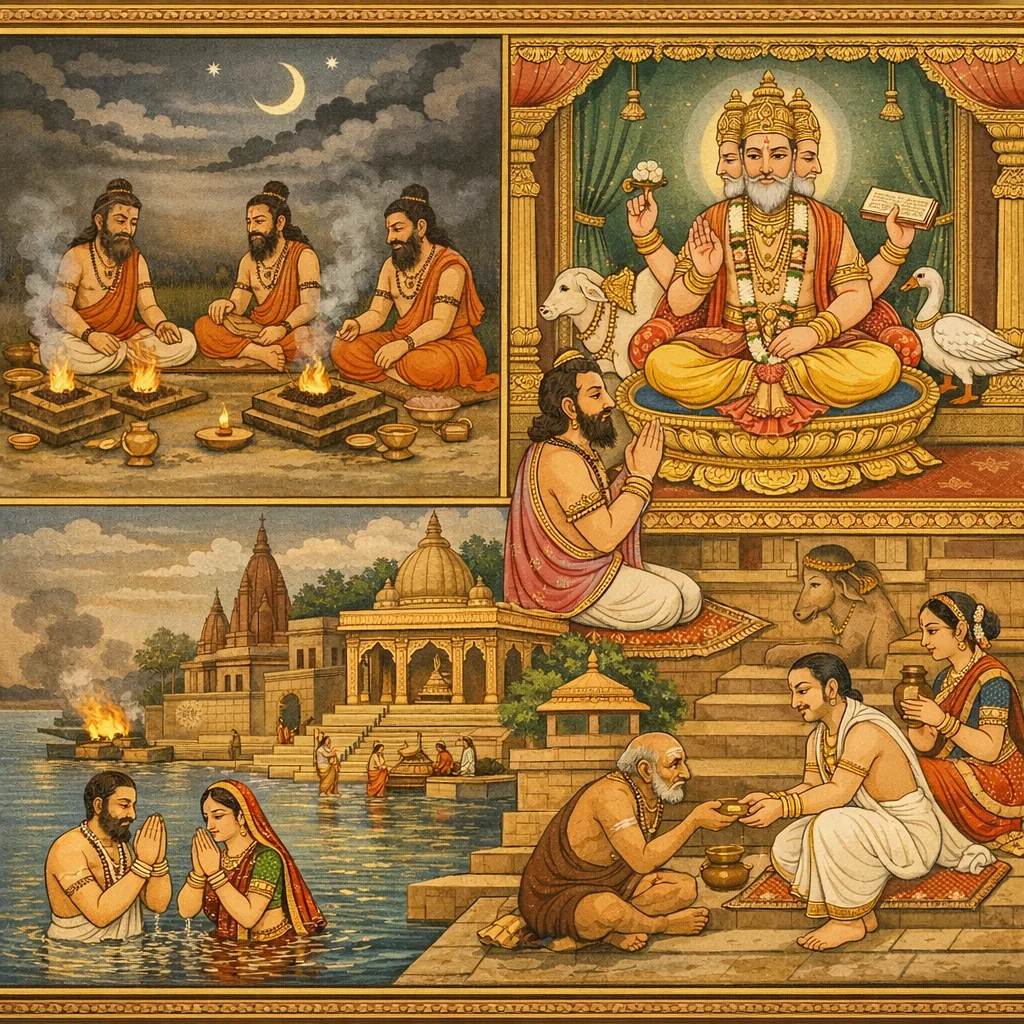
This adhyāya opens with a cosmic scene: the Sun rises as the regulator of dharma and ritual time, sustaining offerings and the daily cycles of yajña. An ensuing episode tells how the Sun’s course is obstructed when the Vindhya mountain, swollen with pride, rises up—triggering a systemic crisis in which ritual schedules collapse, sacrifices are interrupted, and the world loses its bearings between night and day. Alarmed at the fracture of cosmic order, the Devas approach Brahmā and present an extended hymn that praises the Supreme Principle in both cosmological and inward terms: the Vedas as breath, the Sun as the divine eye, and the universe as an embodied form. Brahmā replies by declaring the hymn efficacious for prosperity, protection, and success, emphasizing disciplined recitation as the means to obtain desired results. The teaching then turns to ethical and ritual guidance: Brahmā commends truthfulness, restraint, vrata observances, and charity—especially gifts to Brāhmaṇas and reverence for the sanctity of cows. The chapter culminates in a Kāśī-centered path of liberation: bathing and giving in Vārāṇasī (including Maṇikarṇikā and seasonal rites) lead to long residence in divine realms and, by the grace of Viśveśvara, assured mokṣa; even small acts in Avimukta are said to yield liberating fruits across births.
Shlokas
Verse 1
व्यास उवाच । सूर्य आत्मास्य जगतस्तस्थुषस्तमसोरिपुः । उदियायोदयगिरौ शुचिप्रसृमरैः करैः
Vyāsa said: The Sun—the very life of this world, of the moving and the unmoving, and the foe of darkness—rose upon the eastern mountain, spreading his pure rays.
Verse 2
संवर्धयन्सतां धर्मान्त्यक्कुर्वंस्तामसीं स्थितिम् । पद्मिनीं बोधयंस्त्विष्टां रात्रौ मुकुलिताननाम्
He strengthens the dharmas of the righteous and drives away the tamasic condition; he awakens the radiant lotus-pond, whose faces were closed through the night.
Verse 3
हव्यं कव्यं भूतबलिं देवादीनां प्रवर्तयन् । प्राह्णापराह्णमध्याह्न क्रियाकालं विजृंभयन्
Setting in motion the offerings to the Devas, the ancestral oblations, and the bali for beings, he unfolds the proper times for rites—morning, midday, and afternoon.
Verse 4
असतां हृदि वक्त्रेषु निर्दिशंस्तमसः स्थितिम् । यामिनीकालकलितं जगदुज्जीवयन्पुनः
Revealing the seat of darkness within the hearts and faces of the wicked, and dispelling the night’s gathered gloom, by his rising he revives the world again.
Verse 5
यस्मिन्नभ्युदिते जातः सम्यक्पुण्यजनोदयः । अहो परोपकरणं सद्यः फलति नेति चेत्
When he rises, the true and proper awakening of the meritorious arises. Indeed—if one doubts that helping others bears fruit at once, behold this.
Verse 6
सायमस्तमितः प्रातः कथं जीवेद्रविः पुनः । सानुरागकरस्पर्शैः प्राचीमाश्वास्य खंडिताम्
Having set in the evening, how does the Sun live again by morning? By the loving touch of his rays, he consoles the wounded eastern quarter and restores her.
Verse 7
यामं भुक्त्वा तथाग्नेयीं ज्वलंतीं विरहादिव । लवंगैलामृगमदचंद्रचंदनचर्चिताम
After enduring a yāma, the south‑eastern quarter, blazing as if with the fire of separation, is anointed with clove, cardamom, musk, camphor, and sandalwood—as though cooled and adorned.
Verse 8
तांबूलीरागरक्तौष्ठीं द्राक्षास्तबकसुस्तनीम् । लवलीवल्लिदोर्वल्ली कंको ली पल्लवांगुलिम्
With lips reddened by the hue of betel, with breasts like clusters of grapes; with arms like the creepers of lavalī, and fingers like tender kaṅkolī shoots—thus is that quarter envisioned, delicately adorned.
Verse 9
मलयानिल निःश्वासां क्षीरोदकवरांबराम् । त्रिकूटस्वर्णरत्नांगीं सुवेलाद्रि नितंबिनीम
Breathing the breeze of Malaya, clad in garments as pure as milk-white water; her limbs adorned with Trikūṭa’s gold and jewels, her hips like the Suvela mountain—so is she envisioned in poetic praise.
Verse 10
कावेरीगौतमीजंघां चोलचोलां शुकावृताम् । सह्यदर्दुरवक्षोजां कांतीकांचीविभूषणाम
Her shanks are the Kāverī and the Gautamī; she is robed in the garments of the Cola lands, as though covered with parrots; her bosom is the Sahya and Dardura ranges; her ornament is a radiant girdle—thus the land and quarter are praised.
Verse 11
सुकोमलमहाराष्ट्रीवाग्विलासमनोहराम् । अद्यापि न महालक्ष्मीर्या विमुंचति सद्गुणाम्
Charming with the gentle speech of Mahārāṣṭrī, she delights in playful eloquence; even today Mahālakṣmī does not forsake her, for she abounds in noble virtues.
Verse 12
सुदक्षदक्षिणामाशामाशानाथः प्रतस्थिवान् । क्रमतः सर्वमर्वन्तो हेलया हेलिकस्य खम्
Then the Lord of the quarters set forth toward the well-ordered southern direction; moving in due sequence, all proceeded—lightly, as though the sky itself belonged to a playful wanderer.
Verse 13
न शेकुरग्रतो गंतुं ततोऽनूरुर्व्यजिज्ञपत्
They were unable to go forward; therefore Anūru made inquiry.
Verse 14
अनूरुरुवाच । भानो मानोन्नतो विन्ध्यो निद्ध्यय गगनं स्थितः । स्पर्धते मेरुणाप्रेप्सु स्त्वद्दत्तां तु प्रदक्षिणाम्
Anūru said: “O Sun, the Vindhya—swollen with pride—now stands in the sky, blocking the way. Seeking to rival Mount Meru, he even obstructs the pradakṣiṇā route that was granted to you.”
Verse 15
अन्रूरुवाक्यमाकर्ण्य सविता हृद्यचिन्तयत् । अहो गगनमार्गोपि रुध्यते चातिविस्मयः
Hearing Anūru’s words, Savitṛ pondered within his heart: “Alas! Even the pathway of the sky can be blocked—how astonishing!”
Verse 16
व्यास उवाच । सूरः शूरोपि किं कुर्यात्प्रांतरे वर्त्मनिस्थितः । त्वरावानपि को रुद्धं मागर्मेको विलंघयेत्
Vyāsa said: “Even the brave Sun—what could he do when held fast at the edge of his path? Even if swift, who alone can overstep a road that has been blocked?”
Verse 17
गृह्यत्राप्रत्यूष्टेः क्षणं नावतिष्ठति । शून्यमार्गे निरुद्धः स किंकरोतु विधिर्बली
For here, at daybreak, he does not remain even for a moment. Yet when blocked upon an empty course, what could that mighty Ordainer—the Sun, regulator of time—do?
Verse 18
योजनानां सहस्रे द्वे द्वे शते द्वे च योजने । योजनस्य निमेषार्धाद्याति सोपि चिरं स्थितः
Though he could traverse two thousand two hundred and two yojanas in half a blink, even he stood halted there for a long time.
Verse 19
गते बहुतिथेकाले प्राच्यौदीच्यां भृशार्दिताः । चण्डरश्मेः करव्रातपातसन्तापतापिताः
As many days passed, the peoples of the east and the north were grievously afflicted—scorched by the burning heat from the fierce-rayed Sun’s pouring beams.
Verse 20
पाश्चात्या दक्षिणात्याश्च निद्रामुद्रितलोचनाः । शयिता एव वीक्षन्ते सतारग्रहमंबरम्
But the peoples of the west and the south, their eyes sealed by sleep, lay down continually—beholding the sky filled with stars and planets even as they lay.
Verse 21
अहोनाहस्कराभावान्निशानैवाऽनिशाकरात् । अस्तंगतर्क्षान्नभसः कः कालस्त्वेप नेक्ष्यते
“Alas! With no Sun, day itself is absent; and without the Moon, even night is not night. When the constellations have set from the sky, what mark of time at all can now be perceived?”
Verse 22
ब्रह्मांडं किमकांडे वै लयमेष्यति तत्कथम् । परापतंति नाद्यापि पारावारा इतस्ततः
“Will the very Brahmāṇḍa—the cosmic egg of the universe—suddenly rush toward dissolution; how could this be? Even now, the oceans surge and crash about on every side.”
Verse 23
स्वाहास्वधावषट्कारवर्जिते जगतीतले । पंचयज्ञक्रियालोपाच्चकंपे भुवनत्रयम्
When upon the earth the cries of “svāhā,” “svadhā,” and “vaṣaṭ” fell silent, and the rites of the five great sacrifices were forsaken, the three worlds began to tremble.
Verse 24
सूर्योदयात्प्रवर्तंते यज्ञाद्याः सकलाः क्रियाः । ताभिर्यज्ञभुजांतृप्तिः सविता तत्र कारणम्
From sunrise onward all acts—beginning with sacrifice—come into operation. By those rites the enjoyers of the offering are satisfied; in this, Savitṛ, the Sun, is the decisive cause.
Verse 25
चित्रगुप्तादयः सर्वे कालं जानंति सूर्यतः । स्थितिसर्गविसर्गाणां कारणं केवलं रविः
Citragupta and all the rest know time by the Sun. For preservation, creation, and dissolution, Ravi—the Sun alone—is the causal foundation.
Verse 26
तत्सूर्यस्य गतिस्तंभात्स्तंभितं भुवनत्रयम् । यद्यत्रतत्स्थितं तत्र चित्रन्यस्तमिवा खिलम्
When the Sun’s movement is arrested, the three worlds become immobilized. Whatever stands wherever then appears wholly as if fixed in a painted tableau.
Verse 27
एकतस्तिमिरान्नैशादेकतस्तु दिवातपात् । बहूनां प्रलयो जातः कांदिशीकमभूज्जगत्
On one side, from the darkness of night; on the other, from the heat of day—many met destruction, and the world became bewildered and directionless.
Verse 28
इति व्याकुलिते लोके सुरासुरनरोरगे । आःकिमेतदकांडेभूद्रुरुदुर्दुद्रुवुः प्रजाः
Thus, when the world was thrown into turmoil—among gods, asuras, men, and serpents—the beings cried, “Ah! What sudden calamity, uncaused, is this?”; wailing, the creatures ran about in panic.
Verse 29
ततः सर्वे समालोक्य ब्रह्माणं शरणं ययुः । स्तुवंतो विविधैः स्तोत्रै रक्षरक्षेति चाब्रुवन्
Then all, looking toward Brahmā, went to him for refuge—praising him with many hymns and crying, “Protect us, protect us!”
Verse 30
देवा ऊचुः । नमो हिरण्यरूपाय ब्रह्मणे ब्रह्मरूपिणे । अविज्ञातस्वरूपाय कैवल्यायामृताय च
The gods said: Salutations to Brahmā of golden form, to him whose very nature is Brahman. Salutations to the One whose true form is unknowable, to Liberation itself, and to the Deathless.
Verse 31
यन्न देवा विजानंति मनो यत्रापि कुंठितम् । न यत्र वाक्प्रसरति नमस्तस्मै चिदात्मने
To That which even the gods do not fully know—where the mind itself is checked, and where speech cannot proceed—to that Conscious Self, salutations.
Verse 32
योगिनो यं हृदाकाशे प्रणिधानेन निश्चलाः । ज्योतीरूपं प्रपश्यंति तस्मै श्रीब्रह्मणे नमः
Salutations to that auspicious Brahmā whom yogins—steadfast through deep absorption—behold within the heart-space as a form of light.
Verse 33
कालात्पराय कालाय स्वेच्छयापुरुषाय च । गुणत्रय स्वरूपाय नमः प्रकृतिरूपिणे
Salutations to Time beyond time, and to Time itself; salutations to the Puruṣa who acts by sovereign will; salutations to Him whose very nature is the three guṇas, and who appears as Prakṛti.
Verse 34
विष्णवे सत्त्वरूपाय रजोरूपाय वेधसे । तमसे रुद्ररूपाय स्थितिसर्गांतकारिणे
Salutation to Viṣṇu, whose form is Sattva; to the Creator Brahmā, whose form is Rajas; and to Rudra, whose form is Tamas—He who brings about preservation, creation, and dissolution.
Verse 35
नमो बुद्धिस्वरूपाय त्रिधाहंकृतये नमः । पंचतन्मात्र रूपाय पंचकर्मेद्रियात्मने
Salutation to Him whose very nature is Buddhi, Intelligence; salutation to Him who becomes the threefold Ahaṅkāra. Salutation to Him who takes the form of the five tanmātras, and who is the very Self of the five organs of action.
Verse 36
अनित्यनित्यरूपाय सदसत्पतये नमः । समस्तभक्तकृपया स्वेच्छाविष्कृतविग्रह
Salutations to Him who appears as both the transient and the eternal; salutations to the Lord of being and non-being. Out of compassion for all devotees, He manifests a form by His own free will.
Verse 37
नमो ब्रह्मांडरूपाय तदंतर्वर्तिने नमः । अर्वाचीनपराची न विश्वरूपाय ते नमः
Salutations to You whose form is the Brahmāṇḍa, the cosmic egg, and salutations to You who dwell within it. Salutations to You who are both near and far, O You of the universal form.
Verse 39
तव निःश्वसितं वेदास्तव स्वे दोखिलं जगत् । विश्वा भूतानि ते पादः शीर्ष्णो द्यौः समवर्तत
The Vedas are Your very exhalation; in You the whole world rests. All beings are Your feet, and the sky stands as Your head.
Verse 40
नाभ्या आसीदंतरिक्षं लोमानि च वनस्पतिः । चन्द्रमा मनसो जातश्चक्षोः सूर्यस्तव प्रभो
From Your navel arose the mid-space; from Your hairs, vegetation. The moon was born from Your mind, and from Your eye the sun, O Lord.
Verse 41
त्वमेव सर्वं त्वयि देव सर्वं स्तोता स्तुतिः स्तव्य इह त्वमेव । ईश त्वयाऽवास्यमिदं हि सर्वं नमोस्तु भूयोपि नमो नमस्ते
You alone are everything; in You, O God, everything abides. Here, You alone are the worshipper, the hymn, and the One to be praised. O Lord, this entire world is pervaded and clothed by You. Salutations—again and again, salutations to You.
Verse 42
इति स्तुत्वा विधिं देवा निपेतुर्दंडवत्क्षितौ । परितुष्टस्तदा ब्रह्मा प्रत्युवाच दिवौकसः
Having thus praised Vidhī (Brahmā), the gods fell upon the ground like a staff in prostration. Then Brahmā, well pleased, replied to the dwellers of heaven.
Verse 43
ब्रह्मोवाच । यथार्थयाऽनया स्तुत्या तुष्टोस्मि प्रणताः सुराः । उत्तिष्ठत प्रसन्नोस्मि वृणुध्वं वरमुत्तमम्
Brahmā said: By this truthful and fitting hymn, I am pleased, O gods who have bowed down. Rise; I am gracious—choose an excellent boon.
Verse 44
यः स्तोष्यत्यनया स्तुत्या श्रद्धावान्प्रत्यहं शुचिः । मां वा हरं वा विष्णुं वा तस्य तुष्टाः सदा वयम्
Whoever, pure and faithful, praises daily with this hymn—whether addressing me, or Hara (Śiva), or Viṣṇu—to him we are always pleased.
Verse 45
दास्यामः सकलान्कामान्पुत्रान्पौत्रान्पशून्वसु । सौभाग्यमायुरारोग्यं निर्भयत्वं रणे जयम्
“We shall grant all desired enjoyments—sons and grandsons, cattle and wealth; good fortune, long life and health; fearlessness, and victory in battle.”
Verse 46
ऐहिकामुष्मिकान्भोगानपवर्गं तथाऽक्षयम् । यद्यदिष्टतमं तस्य तत्तत्सर्वं भविष्यति
“He will obtain enjoyments here and hereafter, and also imperishable liberation; whatever is most desired by him—everything of that kind will surely come to pass.”
Verse 47
तस्मात्सर्वप्रयत्नेन पठितव्यः स्तवोत्तमः । अभीष्टद इति ख्यातः स्तवोयं सर्वसिद्धिदः
“Therefore, with every effort one should recite this excellent hymn. It is famed as ‘the Bestower of Desired Boons’; this hymn grants every attainment.”
Verse 48
पुनः प्रोवाच तान्वेधाः प्रणिपत्योत्थितान्सुरान् । स्वस्थास्तिष्ठत भो यूयं किमत्रापि समाकुलाः
“Then Vedhā (Brahmā) again addressed those gods who had risen after bowing: ‘Stand at ease, O deities—why are you anxious even here?’”
Verse 49
एते वेदा मूर्तिधरा इमा विद्यास्तथाखिलाः । सदक्षिणा अमी यज्ञाः सत्यं धर्मस्तपो दमः
These are the Vedas made manifest in embodied form; these too are all the sacred sciences. These are the yajñas complete with proper dakṣiṇā; this is truth, dharma, tapas, and self-restraint.
Verse 50
ब्रह्मचर्यमिदं चैषा करुणा भारतीत्वियम् । श्रुतिस्मृतीतिहासार्थ चरितार्था अमीजनाः
This is brahmacarya, and this is compassion; this indeed is sacred speech, Bhāratī. These people are the very fulfillment of the meaning of Śruti, Smṛti, and Itihāsa.
Verse 51
नेह क्रोधो न मात्सर्यं लोभः कामोऽधृतिर्भयम् । हिंसा कुटिलता गर्वो निंदासूयाऽशुचिः क्वचित्
Here there is no anger and no envy; no greed or lust, no faintheartedness or fear. Nor are there violence, deceit, pride, slander, malice, or impurity—at any time.
Verse 52
ये ब्राह्मणा ब्रह्मरतास्तपोनिष्ठास्तपोधनाः । मासोपवासषण्मासचातुर्मास्यादि सद्व्रताः
Those brāhmaṇas who delight in Brahman, steadfast in austerity and rich in tapas—observing noble vows such as month-long fasts, six-month disciplines, the Cāturmāsya, and the like—
Verse 53
पातिव्रत्यरता नार्यो ये चान्ये ब्रह्मचारिणः । ते चामीपश्यत सुरा ये षंढाः परयोषिति
Women devoted to the vow of wifely fidelity (pativratā), and others too who are brahmacārins—behold them as well, O gods. Behold also those who are impotent, and those attached to others’ women.
Verse 54
मातापित्रोरमी भक्ता अमी गोग्रहणे हताः । व्रते दाने जपे यज्ञे स्वाध्याये द्विजतर्पणे
These are devoted to mother and father; these have perished while protecting cows. In vows, in charity, in mantra-japa, in sacrifice (yajña), in Vedic study, and in the offering that satisfies the twice-born—
Verse 55
तीर्थे तपस्युपकृतौ सदाचारादिकर्मणि । फलाभिलाषिणीबुद्धिर्न येषां ते जना अमी
Whether in acts at a tīrtha, in austerities and their disciplines, or in duties such as good conduct—those whose minds do not yearn for reward, such people are truly exemplary.
Verse 56
गायत्री जाप्यनिरता अग्निहोत्र परायणाः । द्विमुखी गो प्रदातारः कपिलादान तत्पराः
They are devoted to the repeated japa of the Gāyatrī, steadfast in the Agnihotra; they are givers of cows and are intent on gifting the tawny, auspicious Kapilā cows.
Verse 57
निस्पृहाः सोमपा ये वै द्विजपादोदपाश्च ये । मृताः सारस्वते तीर्थे द्विजशुश्रूषकाश्च ये
Those who are free from craving; those who have partaken of Soma in sacrifice; those who have drunk the water that has washed a brāhmaṇa’s feet; those who have died at the Sarasvatī tīrtha; and those who serve the twice-born—such people are specially esteemed.
Verse 58
प्रतिग्रहे समर्था हि ये प्रतिग्रहवर्जिताः । त एते मत्प्रिया विप्रास्त्यक्ततीर्थ प्रतिग्रहाः
Though able to accept gifts, those brāhmaṇas who refrain from taking them—renouncing especially gift-taking connected with livelihood at tīrthas—those are dear to me.
Verse 59
प्रयागे माघ मासो यैरुषः स्नातोऽमलात्मभिः । मकरस्थे रवौ शुद्धास्त इमे सूर्यवर्चसः
Those pure-souled ones who bathed at dawn at Prayāga in the month of Māgha—when the Sun is in Makara—are purified and shine with the splendor of the Sun.
Verse 60
वाराणस्यां पांचनदे त्र्यहं स्नातास्तु कार्तिके । अमी ते शुद्धवपुषः पुण्यभाजोतिनिर्मलाः
In Vārāṇasī, at Pañcanada, those who bathe for three days in the month of Kārtika become pure-bodied, heirs to great merit, and exceedingly stainless.
Verse 61
स्नात्वा तु मणिकर्णिक्यां प्रीणिता ब्राह्मणा धनैः । त एते सर्वभोगाढ्याः कल्पं स्थास्यंति मत्पुरे
Having bathed at Maṇikarṇikā and pleased the brāhmaṇas with gifts of wealth, they become rich in every enjoyment and dwell in my city for a full aeon.
Verse 62
ततः काशीं समासाद्य तेन पुण्येन नोदिताः । विश्वेश्वरप्रसादेन मोक्षमेष्यंत्यसंशयम्
Then, reaching Kāśī—impelled by that very merit—they will, by the grace of Viśveśvara, attain liberation without doubt.
Verse 63
अविमुक्ते कृतं कर्म यदल्पमपि मानवैः । श्रेयोरूपं तद्विपाको मोक्षो जन्मांतरेष्वपि
Even the smallest deed done by human beings in Avimukta bears a result that takes the form of the highest good—liberation—even across future births.
Verse 64
अहो वैश्वेश्वरे क्षेत्रे मरणादपिनोभयम् । यत्र सर्वे प्रतीक्षंते मृत्युं प्रियमिवाति थिम्
Ah! In the sacred kṣetra of Viśveśvara there is no fear even of death; there all await death as though it were a beloved guest.
Verse 65
ब्राह्मणेभ्यः कुरुक्षेत्रे यैर्दत्तं वसु निर्मलम् । निर्मलांगास्त एते वै तिष्ठंति मम संनिधा
Those who, at Kurukṣetra, have given pure and untainted wealth to Brāhmaṇas—those devotees, purified in limb, truly abide in my very presence.
Verse 66
पितामहं समासाद्य गयायां यैः पितामहाः । तर्पिता ब्राह्मणमुखे तेषामेते पितामहाः
Those who, having reached Gayā, have satisfied their forefathers by offering tarpaṇa through the mouth of Brāhmaṇas—those very forefathers are uplifted for them.
Verse 67
न स्नानेन न दानेन न जपेन न पूजया । मल्लोकः प्राप्यते देवाः प्राप्यते द्विज तर्पणात्
Not by bathing, not by charity (dāna), not by japa, nor even by pūjā is my world attained; rather, O twice-born, through tarpaṇa the devas are reached.
Verse 68
सोपस्कराणिवेश्मानिमु सलोलूखलादिभिः । यैर्दत्तानि सशय्यानि तेषां हर्म्याण्यमूनि वै
Those who have donated furnished houses—complete with household implements such as water-pots and mortars, and also beds—truly obtain these splendid mansions.
Verse 69
ब्रह्मशालां कारयंति वेदमध्यापयंति च । विद्यादानं च ये कुर्युः पुराणं श्रावयंति च
Those who establish a Brahmaśālā, who cause the Veda to be taught, who bestow the gift of knowledge, and who arrange for the Purāṇas to be recited—
Verse 70
पुराणानि च ये दद्युः पुस्तकानि ददत्यपि । धर्मशास्त्राणि ये दद्युस्तेषां वासोत्र मे पुरे
Those who donate Purāṇas, who also give books, and who give Dharmaśāstras—for them there is dwelling here in my city.
Verse 71
यज्ञार्थं च विवाहार्थं व्रतार्थं ब्राह्मणाय वै । अखंडं वसु ये दद्युस्तेत्र स्युर्वसुवर्चसः
Those who give undiminished wealth to a Brāhmaṇa for the sake of sacrifice, for marriage rites, or for a vow—there they become radiant with prosperity.
Verse 72
आरोग्यशालां यः कुर्याद्वैद्यपोषणतत्परः । आकल्पमत्र वसति सर्वभोग समन्वितः
Whoever establishes a house of healing (ārogyaśālā) and is devoted to supporting physicians—he dwells here for an aeon, endowed with every enjoyment.
Verse 73
मुक्ती कुर्वंति तीर्थानि ये च दुष्टावरोधतः । ममावरोधे ते मान्या औरसास्तनया इव
Those who enable the tīrthas to grant liberation by restraining the wicked—such people, as my attendants, are honored by me like my own born sons.
Verse 74
विष्णोर्वाममवाशंभोर्ब्राह्मणा एव सुप्रियाः । तेषां मूर्त्या वयं साक्षाद्विचरामो महीतले
To Viṣṇu and to Śambhu alike, the Brāhmaṇas are most dear; assuming their very form, we ourselves move openly upon the earth.
Verse 75
ब्राह्मणाश्चैव गावश्च कुलमेकं द्विधाकृतम् । एकत्र मंत्रास्तिष्ठंति हविरेकत्र तिष्ठति
Brāhmaṇas and cows are one sacred family, appearing in two forms: in one abide the mantras, and in the other abides the sacrificial offering, havis.
Verse 76
ब्राह्मणा जंगमं तीर्थं निर्मितं सार्वभौमिकम् । येषां वाक्योदकेनैव शुद्ध्यंति मलिना जनाः
Brāhmaṇas are a moving tīrtha, established for all the world; by the water of their words alone, the impure are purified.
Verse 77
गावः पवित्रमतुलं गावो मंगलमुत्तमम् । यासां खुरोत्थितो रेणुर्गंगावारिसमो भवेत्
Cows are an incomparable purifier; cows are the highest auspiciousness. The dust raised by their hooves becomes equal to the waters of the Gaṅgā.
Verse 78
शृंगाग्रे सर्वतीर्थानि खुराग्रे सर्व पर्वताः । शृंगयोरंतरे यस्याः साक्षाद्गौरीमहेश्वरी
At the tip of a cow’s horns are all tīrthas; at the tip of her hooves are all mountains. Between her two horns abides Gaurī Maheśvarī herself in manifest form.
Verse 79
दीयमानां च गां दृष्ट्वा नृत्यंति प्रपितामहाः । प्रीयंते ऋषयः सर्वे तुष्यामो दैवतैः सह
Seeing a cow being given as a sacred gift, the forefathers dance in joy; all the ṛṣis rejoice, and the deities too are satisfied along with them.
Verse 80
रोरूयंते च पापानि दारिद्र्यं व्याधिभिः सह । धात्र्यः सर्वस्य लोकस्य गावो मातेव सर्वथा
Sins wail and flee, and poverty departs along with disease. For cows sustain the whole world—like a mother in every way.
Verse 81
गवां स्तुत्वा नमस्कृत्य कृत्वा चैव प्र दक्षिणाम् । प्रदक्षिणीकृतातेन सप्तद्वीपा वसुंधरा
Having praised the cows, bowed to them, and performed pradakṣiṇā, one thereby circumambulates the entire earth with its seven continents.
Verse 82
या लक्ष्मीः सवर्भूतानां या देवेषु व्यवस्थिता । धेनुरूपेण सा देवी मम पापं व्यपोहतु
May that Goddess Lakṣmī—who abides in all beings and is established among the gods—remove my sin, appearing in the form of a cow.
Verse 83
विष्णोर्वक्षसि या लक्ष्मीः स्वाहा चैव विभावसोः । स्वधा या पितृमुख्यानां सा धेनुर्वरदा सदा
She who is Lakṣmī upon Viṣṇu’s chest, and she who is Svāhā for the Fire-god; she who is Svadhā for the foremost of the ancestors—she is the cow, forever the bestower of boons.
Verse 84
गोमयं यमुना साक्षाद्गोमूत्रं नर्मदा शुभा । गंगा क्षीरं तु यासां वै किं पवित्रमतः परम्
Cow-dung is verily the Yamunā; cow-urine is the auspicious Narmadā; and the milk of those cows is the Gaṅgā itself—what purifier could be higher than this?
Verse 85
गवामंगेषु तिष्ठंति भुवनानि चतुर्दश । यस्मात्तस्माच्छिवं मे स्यादिहलोके परत्र च
The fourteen worlds abide within the limbs of the cows. Therefore, by that truth, may auspiciousness (Śiva) be mine—here in this world and also hereafter.
Verse 86
इति मंत्रं समुच्चार्य धेनूर्वाधेनु मेव वा । यो दद्याद्द्विजवर्याय स सर्वेभ्यो विशिष्यते
Reciting this mantra, whoever gives a milch-cow—or even a cow that is not milking—to an excellent brāhmaṇa, becomes distinguished above all others.
Verse 87
मया च विष्णुना सार्धं शिवेन च महर्षिभिः । विचार्य गोगुणान्नित्यं प्रार्थनेति विधीयते
Having reflected continually on the virtues of the cow—by me, together with Viṣṇu, with Śiva, and with the great ṛṣis—this is ordained as a prayer.
Verse 88
गावो मे पुरतः संतु गावो मे संतु पृष्ठतः । गावो मे हृदये संतु गवां मध्ये वसाम्यहम्
May cows be before me; may cows be behind me. May cows abide in my heart; may I dwell in the midst of cows.
Verse 89
नीराजयति योंगानि गवां पुच्छेन भाग्यवान् । अलक्ष्मीः कलहो रोगास्तस्यांगाद्यांति दूरतः
That blessed person who performs the protective nīrājana over the limbs with a cow’s tail—misfortune, quarrel, and disease depart far from his body.
Verse 90
गोभिर्विप्रश्च वेदैश्च सतीभिः सत्यवादिभिः । अलुब्धैर्दा नशीलैश्च सप्तभिर्धार्यते मही
The earth is upheld by seven: cows, brāhmaṇas, the Vedas, chaste women, truth-speakers, the non-greedy, and those devoted to charity.
Verse 91
मम लोकात्परोलोको वैकुंठ इति गीयते । तस्योपरिष्टात्कौमार उमालोकस्ततः परम्
Beyond my world, it is sung, is Vaikuṇṭha. Above that lies the realm of Kaumāra; and beyond that is the world of Umā.
Verse 92
शिवलोकस्तदुपरि गोलो कस्तत्समीपतः । गोमातरः सुशीलाद्यास्तत्र संति शिवप्रियाः
Above that is Śiva’s world, and near it is Goloka. There dwell the cow-mothers—Suśīlā and others—beloved of Śiva.
Verse 93
गवां शुश्रूरूषकाये च गोप्रदाये च मानवाः । एषामन्यतमे लोके ते स्युः सर्वसमृद्धयः
Those who serve cows, and those who gift cows as dāna—such people dwell in one or another of those worlds, endowed with every prosperity.
Verse 94
यत्र क्षीरवहा नद्यो यत्र पायस कर्दमाः । न जरा बाधते यत्र तत्र गच्छंति गोप्रदाः
Where rivers flow as milk, where the mire is sweet rice-pudding, and where old age does not afflict—there the givers of cows go.
Verse 95
श्रुतिस्मृतिपुराणज्ञा ब्राह्मणाः परिकीर्तिताः । तदुक्ताचारचरणा इतरे नामधारकाः
Those who truly know Śruti, Smṛti, and the Purāṇas are proclaimed Brāhmaṇas; those who live by the conduct taught therein are Brāhmaṇas in truth—others are Brāhmaṇas in name alone.
Verse 97
श्रुतिस्मृती तु नेत्रे द्वे पुराणं हृदयं स्मृतम् । श्रुतिस्मृतिभ्यां हीनोंधः काणः स्यादेकया विना । पुराणहीनाद्धृच्छून्यात्काणांधावपि तौ वरौ । श्रुतिस्मृत्युदितोधर्मः पुराणे परिगीयते
Śruti and Smṛti are said to be the two eyes, and the Purāṇa is remembered as the heart. Devoid of both Śruti and Smṛti one is blind; lacking even one of them one is one-eyed. But without Purāṇa the heart is empty; even the one-eyed and the blind are better than that. The Dharma taught by Śruti and Smṛti is sung and made clear in the Purāṇas.
Verse 98
तद्बाह्मणाय गोर्देया सर्वत्र सुखमिच्छता । न देया द्विजमात्राय दातारं सोप्यधो नयेत्
Therefore, one who desires happiness everywhere should give a cow in charity to such a true Brāhmaṇa; it should not be given merely to someone called a ‘twice-born’, for such a recipient would drag the donor downward.
Verse 99
यस्य धर्मेऽस्ति जिज्ञासा यस्य पापाद्भयं महत् । श्रोतव्यानि पुराणानि धमर्मूलानि तेन वै
Whoever longs to understand Dharma, and whoever greatly fears sin—by that person the Purāṇas, which are roots of Dharma, should certainly be listened to.
Verse 100
चतुर्दशसु विद्यासु पुराणं दीप उत्तमः । अंधोपि न तदा लोकात्संसाराब्धौ क्वचित्पतेत्
Among the fourteen branches of knowledge, the Purāṇa is the supreme lamp; by its light, even the ‘blind’ do not, in this world, fall into the ocean of saṃsāra.
Verse 110
उत्फुल्लपद्मनयना निर्मिताः सुकृतार्थिनः । तावेव चरणौ धन्यौ काशीमभिप्रयायिनौ
Lotus-eyed ones were fashioned as seekers of merit; blessed indeed are those very feet that set forth toward Kāśī.
Verse 114
इह वंशं परिस्थाप्य भुक्त्वा सर्व सुखानि च । सत्यलोके चिरं स्थित्वा ततो यास्यंति शाश्वतम्
Here, after establishing their lineage and enjoying all prosperities, they dwell long in Satyaloka; thereafter they proceed to the eternal state.