Adhyaya 15
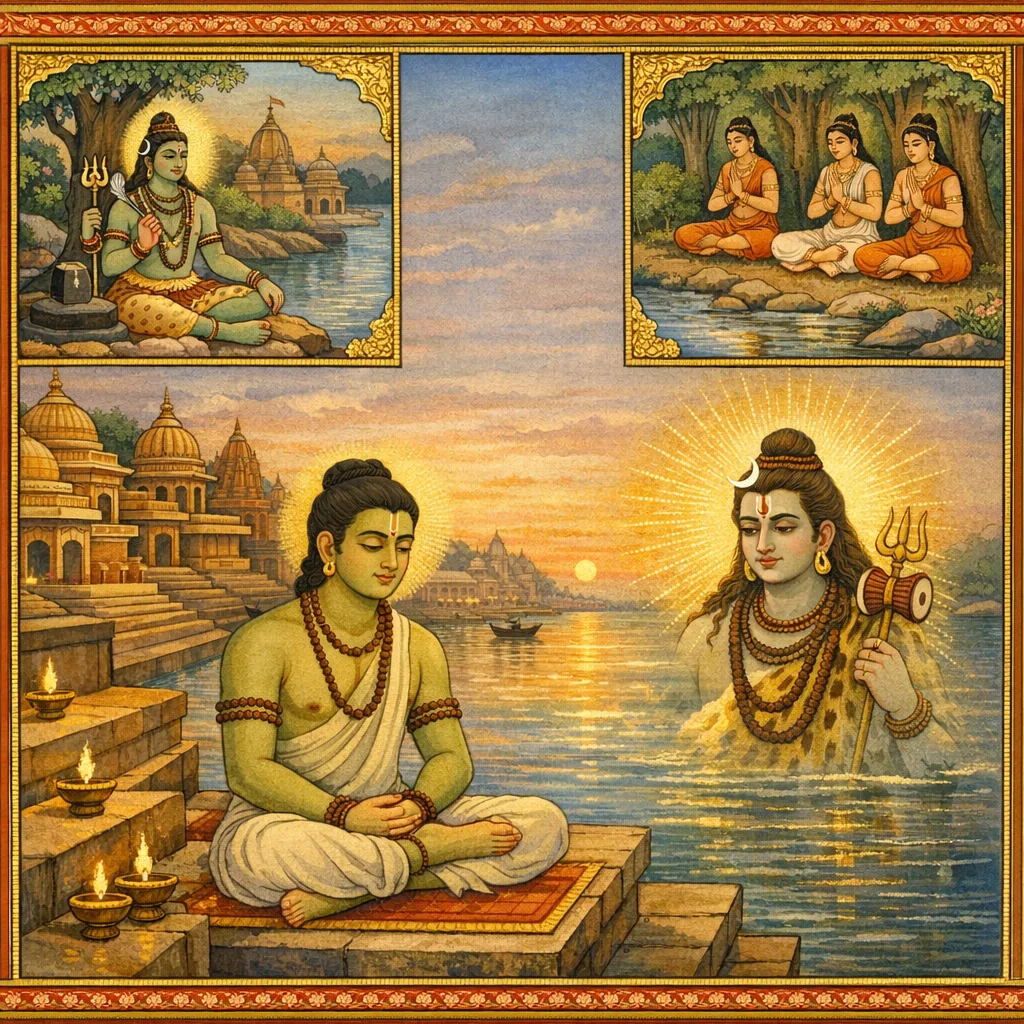
Adhyāya 15 unfolds through layered dialogue. Agastya speaks to Lopāmudrā, recalling a tale conveyed to Śivaśarman by Śiva’s gaṇas. The gaṇas first narrate the origin of the nakṣatra-linked daughters of Dakṣa: after fierce tapas in Kāśī, they install a liṅga named Nakṣatreśvara on the Vārāṇasī riverbank near Saṅgameśvara. Śiva grants boons—eminence within the jyotiṣ-cakra, connection with the rāśis, a distinct “nakṣatra-loka,” and protection for those who worship and keep nakṣatra-related vows in Kāśī. The discourse then turns to a second shrine-etiology focused on Budha (Mercury), born from the Tārā–Soma–Bṛhaspati episode. Budha performs intense austerities in Kāśī, establishes the Budheśvara-liṅga, and receives Śiva’s epiphany and grace: a superior loka above the nakṣatra realm, exceptional honor among the grahas, and the promise that Budheśvara worship bestows buddhi (intellect) and removes durbuddhi (confusion). The chapter closes with a brief phala: darśana of Budheśvara (east of Candreśvara) prevents the decline of intelligence, and the narrative proceeds toward an account of Śukra-loka.
Shlokas
Verse 1
अगस्तिरुवाच । शृणु पत्नि महाभागे लोपामुद्रे सधर्मिणि । कथा विष्णुगणाभ्यां च कथितां शिवशर्मणे
Agastya said: Listen, O blessed wife Lopāmudrā, my companion in dharma, to the tale that was told by two attendants of Viṣṇu to Śivaśarman.
Verse 2
शिवशर्मोवाच । अहो गणौ विचित्रेयं श्रुता चांद्रमसी कथा । उडुलोककथां ख्यातं विष्वगाख्यानकोविदौ
Śivaśarman said: “Ah, O two Gaṇas—how wondrous is this lunar tale I have heard! You are famed as masters of sacred narration, skilled in telling the celebrated story of the world of stars.”
Verse 4
गणावूचतुः । पुरा सिसृक्षतः सृष्टिं स्रष्टुरंगुष्ठपृष्ठतः । दक्षः प्रजाविनिर्माणे दक्षो जातः प्रजापतिः । षष्टिर्दुहितरस्तस्य तपोलावण्यभूषणाः । सर्वलावण्यरोहिण्यो रोहिणीप्रमुखाः शुभाः
The Gaṇas said: “In ancient times, when the Creator longed to bring forth creation, Dakṣa—the able Prajāpati—arose from the back of the Creator’s thumb, skilled in generating beings. He had sixty auspicious daughters, adorned with tapas and beauty, radiant with all loveliness, with Rohiṇī foremost among them.”
Verse 5
ताभिस्तप्त्वा तपस्तीव्रं प्राप्य वैश्वेश्वरीं पुरीम् । आराधितो महादेवः सोमः सोमविभूपणः
Having performed intense tapas, they reached the city of Vaiśveśvarī (Kāśī). There Mahādeva was worshipped; and Soma too was propitiated—the one who adorns Soma, lord of the Moon and the nakṣatras.
Verse 6
यदा तुष्टोयमीशानो दातुं वरमथाययौ । उवाच च प्रसन्नात्मा याचध्वं वरमुत्तमम्
When this Lord, Īśāna, was pleased and came forward to grant a boon, he spoke with a gracious heart: “Ask for the highest boon.”
Verse 7
शंभोर्वाक्यमथाकर्ण्य ऊचुस्ताश्च कुमारिकाः । यदि देयो वरोऽस्माकं वरयोग्याः स्म शंकर
Hearing Śambhu’s words, those maidens replied: “O Śaṅkara, if a boon is to be granted to us, we are worthy to receive a boon.”
Verse 8
भवतोपि महादेव भवतापहरो हि यः । रूपेण भवता तुल्यः स नो भर्ता भवत्विति
“O Mahādeva, let him who can rival even you—who can take away your very pride—be our husband; one equal to you in beauty: let him become our lord.”
Verse 9
लिंगं संस्थाप्य सुमहन्नक्षत्रेश्वर संज्ञितम् । वारणायास्तटे रम्ये संगमेश्वरसन्निधौ
They established a very great Liṅga named Nakṣatreśvara, on the lovely bank of the Vāraṇā river, in the vicinity of Saṅgameśvara.
Verse 10
दिव्यं वर्ष सहस्रं तु पुरुषायितसंज्ञितम् । तपस्तप्तं महत्ताभिः पुरुषैरपि दुष्करम्
For a thousand divine years—known as ‘Puruṣāyita’—those great ones performed austerity, a discipline difficult even for men to accomplish.
Verse 11
ततस्तुष्टो हि विश्वेशो व्यतरद्वरमुत्तमम् । सर्वासामेकपत्नीनामकत्रे स्थिरचेतसाम्
Then Viśveśvara, pleased, bestowed the highest boon: that all of them, steadfast in mind, would have one husband—together (as co-wives of a single lord).
Verse 12
श्री विश्वेश्वर उवाच । न क्षांतं हि तपोत्युग्रमेतदन्याभिरीदृशम् । पुराऽबलाभिस्तस्माद्वो नाम नक्षत्रमत्र वै
Śrī Viśveśvara said: “Such exceedingly intense austerity as this has not been endured by other women like you before. Therefore, here indeed, your very name shall be ‘Nakṣatra’.”
Verse 13
पुरुषायितसंज्ञेन तप्तं यत्तपसाधुना । भवतीभिस्ततः पुंस्त्वमिच्छया वो भविष्यति
Because you have duly performed the austerity known as Puruṣāyita, therefore, by your own wish, manhood—the masculine state—shall come to you.
Verse 14
ज्योतिश्चक्रे समस्तेऽस्मिन्नग्रगण्या भविष्यथ । मेषादीनां च राशीनां योनयो यूयमुत्तमाः
In this entire wheel of celestial light you shall be counted foremost; and among the zodiacal signs beginning with Aries, you shall be the excellent wombs—sources and matrices—from which they arise.
Verse 15
ओषधीनां सुधायाश्च ब्राह्मणानां च यः पतिः । पतिमत्यो भवत्योपि तेन पत्या शुभाननाः
He who is the Lord of healing herbs, of amṛta—ambrosia—and of the Brāhmaṇas: by that very auspicious Lord you too, fair-faced ones, shall become ‘possessed of a true protector’, blessed with rightful guardianship and fortune.
Verse 16
भवतीनामिदं लिंगं नक्षत्रेश्वर संज्ञितम् । पूजयित्वा नरो गंता भवतीलोकमुत्तमम्
This liṅga belongs to you and is known as ‘Nakṣatreśvara’. Having worshipped it, a man shall attain your excellent world.
Verse 17
उपरिष्टान्मृगांकस्य लोको वस्तु भविष्यति । सर्वासां तारकाणां च मध्ये मान्या भविष्यथ
Above the Moon there shall indeed be your dwelling-world; and among all the stars, in their very midst, you shall be revered.
Verse 18
नक्षत्रपूजका ये च नक्षत्रव्रतचारिणः । ते वो लोके वसिष्यंति नक्षत्र सदृशप्रभाः
Those who worship the nakṣatras and those who keep vows dedicated to the nakṣatras—such persons shall dwell in your world, shining with a radiance like the stars themselves.
Verse 19
नक्षत्रग्रहराशीनां बाधास्तेषां कदाचन । न भविष्यंति ये काश्यां नक्षत्रेश्वरवीक्षकाः
For those who, in Kāśī, behold and seek Nakṣatreśvara, afflictions caused by nakṣatras, planets, or zodiacal signs will never arise.
Verse 20
अगस्त्य उवाच । अतिथित्वमवाप नेत्रयोर्बुधलोकः शिवशर्मणस्त्वथ । गणयोर्भगणस्य संकथां कथयित्रो रिति विष्णुचेतसोः
Agastya said: Then Śivaśarman—who had attained the realm of Budha—received the two Gaṇas as guests; and those two, whose minds were fixed on Viṣṇu, related the tale of that stellar host.
Verse 21
शिवशर्मोवाच । कस्य लोकोयमतुलो ब्रूतं श्रीभगवद्गणौ । पीयूषभानोरिव मे मनः प्रीणयतेतराम्
Śivaśarman said: O venerable Gaṇas of the Blessed Lord, tell me—whose incomparable world is this? My mind is delighted exceedingly, as though by the moon of amṛta.
Verse 22
गणावूचतुः । शिवशर्मञ्छृणु कथामेतां पापापहारिणीम् । स्वर्गमार्गविनोदाय तापत्रयविनाशिनीम्
The two Gaṇas said: O Śivaśarman, listen to this narrative—one that removes sins, brings joy upon the path to heaven, and destroys the threefold afflictions.
Verse 23
योसौ पूर्वं महाकांतिरावाभ्यां परिवर्णितः । साम्राज्यपदमापन्नो द्विजराजस्तवाग्रतः
That very one of great splendor, whom we two described earlier, has attained the station of sovereignty; the “king among the twice-born” now stands before you.
Verse 24
दक्षिणा राजसूयस्य येन त्रिभुवनं कृता । तपस्तताप योत्युग्रं पद्मानां दशतीर्दश
He by whom the sacrificial fee (dakṣiṇā) of the Rājasūya was made to encompass the three worlds; he who performed exceedingly fierce austerity for ten tens of thousands of lotus-cycles—an immeasurable span.
Verse 25
अत्रिनेत्रसमुद्भूतः पौत्रो वै द्रुहिणस्य यः । नाथः सर्वौषधीनां च ज्योतिषां पतिरेव च
He who was born from Atri’s eye; who is indeed the grandson of Druhiṇa (Brahmā); who is the lord of all healing herbs and also the very ruler of the luminaries.
Verse 26
निर्मलानां कलानां च शेवधिर्यश्च गीयते । उद्यन्परोपतापं यः स्वकरैर्गलहस्तयेत्
He is sung as the treasury of spotless phases; and when he rises, with his own rays he seizes by the throat and dispels the burning torment of others—the oppressive heat.
Verse 27
मुदंकुमुदिनीनांयस्तनोति जगता सह । दिग्वधू चारु शृंगारदर्शनादर्शमंडलः
He spreads joy among the kumudinī, the night-blooming lotuses, along with the whole world; his orb is a mirror for beholding the lovely adornment of the quarter-brides—the directions.
Verse 28
किमन्यैर्गुणसंभारैरतोपि न समं विधोः । निजोत्तमांगे सर्वज्ञः कलां यस्यावतंसयेत्
What need is there of any other store of virtues? Nothing equals the Moon, for the Omniscient Śiva sets its very phase as an ornament upon His highest limb—His head.
Verse 29
बृहस्पतेस्स वै भार्यामैश्वर्यमदमोहितः । पुरोहितस्यापिगुरोर्भ्रातुरांगिरसस्य वै
Deluded by the intoxication of power, he took the wife of Bṛhaspati—the priest and guru, indeed the teacher of his own brother, the Āṅgirasa.
Verse 30
जहार तरसा तारां रूपवान्रूपशालिनीम् । वार्यमाणोपि गीर्वाणैर्बहुदेवर्षिभिः पुनः
In sudden force the handsome one carried off Tārā—she who was abundant in beauty—though the gods and many divine seers restrained him again and again.
Verse 31
नायं कलानिधेर्दोषो द्विजराजस्य तस्य वै । हित्वा त्रिनेत्रं कामेन कस्य नो खडितं मनः
This is not truly the fault of that lord of phases, the king among the twice-born. For, driven by desire, even the Three-eyed One (Śiva) is forsaken—whose mind has not been broken and led astray?
Verse 32
ध्वांतमेतदभितः प्रसारियत्तच्छमाय विधिनाविनिर्मितम् । दीपभास्करकरामहौषधं नाधिपत्य तमसस्तुकिंचन
This darkness spreads on every side; to quell it, the Creator, in due order, has fashioned remedies—lamp, sun, moonbeams, and great healing herbs. Yet darkness holds no true sovereignty at all.
Verse 33
आधिपत्यमदमोहितं हितं शंसितं स्पृशति नो हरेर्हितम् । दुर्जनविहिततीर्थमज्जनैः शुद्धधीरिव विरुद्धमानसम्
Good counsel, though well spoken, does not touch one deluded by the pride of dominion; even what is wholesome and dear to Hari is not grasped. Like a pure-minded person whose heart turns contrary after bathing at a tīrtha contrived by the wicked—a false holy place—so does such a one’s mind become perverse.
Verse 34
धिग्धिगेतदधिकर्द्धि चेष्टितं चंक्रमेक्षणविलक्षितं यतः । वीक्षते क्षणमचारुचक्षुषा घातितेन विपदःपदेन च
Fie, fie upon this restless striving for excessive prosperity—this peculiar roaming about and casting glances here and there. For even a moment’s look with unbeautiful, undisciplined eyes, together with a step set upon a perilous path, strikes a person down into misfortune.
Verse 35
कः कामेन न निर्जितस्त्रिजगतां पुष्पायुधेनाप्यहो कः क्रोधस्यवशंगतो ननच को लोभेन संमोहितः । योषिल्लोचनभल्लभिन्नहृदयः को नाप्तवानापदं को राज्यश्रियमाप्यनांधपदवीं यातोपि सल्लोचनः
Who has not been conquered by desire—by that flower-weaponed power that subdues the three worlds? Who has not fallen under the sway of anger, and who indeed has not been deluded by greed? Whose heart, pierced by the arrows of a woman’s eyes, has not met calamity? And who, even after attaining royal fortune, has not still gone down the path of blindness—though possessing eyes?
Verse 36
आधिपत्यकमलातिचंचला प्राप्यतां च यदिहार्जितं किल । निश्चलं सदसदुच्चकैर्हितं कार्यमार्यचरितैः सदैव तत्
Sovereignty—like Lakṣmī upon a lotus—is exceedingly fickle, even if it is gained here by one’s own efforts. Therefore the noble should always cultivate what is steady and truly beneficial: right conduct that stands firm amid high and low, good and bad.
Verse 37
न यदांगिरसे तारां स व्यसर्जयदुल्बणः । रुद्रोथ पार्ष्णिं जग्राह गृहीत्वाजगवं धनुः
When that fierce one would not release Tārā back to Āṅgirasa (Bṛhaspati), Rudra then seized his heel, taking up the Ajagava bow.
Verse 38
तेन ब्रह्मशिरोनाम परमास्त्रं महात्मना । उत्सृष्टं देवदेवायतेन तन्नाशितं ततः
By him the supreme weapon called “Brahmaśiras” was hurled against the God of gods; yet by that very Lord it was then destroyed.
Verse 39
तयोस्तद्युद्धमभवद्घोरं वै तारकामयम् । ततस्त्वकांड ब्रह्मांड भंगाद्भीतोभवद्विधिः
Between the two, the battle became truly dreadful, bound up with the affair of Tārā. Then, fearing the sudden shattering of the cosmic egg, the Ordainer (Brahmā) grew alarmed.
Verse 40
निवार्य रुद्रं समरात्संवर्तानलवर्चसम् । ददावांगिरसे तारां स्वयमेव पितामहः
Holding Rudra back from the battle—Rudra blazing like the fire of dissolution—Pitāmaha (Brahmā) himself returned Tārā to Āṅgirasa.
Verse 41
अथांतर्गर्भमालोक्य तारां प्राह बृहस्पतिः । मदीयायां न ते योनौ गर्भो धार्यः कथंचन
Then, seeing that Tārā was pregnant, Bṛhaspati said to her: “Within my marriage-bed, in your womb, this pregnancy must not be carried—by no means.”
Verse 42
इषीकास्तंबमासाद्य गर्भं सा चोत्ससर्ज ह । जातमात्रः स भगवान्देवानामाक्षिपद्वपुः
Reaching a clump of reeds, she cast out the embryo there. The moment he was born, that radiant Lord drew the gods’ gaze by his very form.
Verse 43
ततः संशयमापन्नास्तारामूचुः सुरोत्तमाः । सत्यं बूहि सुतः कस्य सोमस्याथ बृहस्पतेः
Then the foremost gods, fallen into doubt, said to Tārā: “Speak the truth—whose son is he, Soma’s or Bṛhaspati’s?”
Verse 44
पृच्छमाना यदा देवै र्नाह ताराऽतिसत्रपा । तदा सा शप्तुमारब्धा कुमारेणातितेजसा
When the gods questioned her, Tārā—overcome with intense shame—could not reply. Then the exceedingly radiant Kumāra (Skanda) began to curse her.
Verse 45
तं निवार्य तदा ब्रह्मा तारां पप्रच्छ संशयम् । प्रोवाच प्रांजलिः सा तं सोमस्येति पितामहम्
Restraining him, Brahmā then questioned Tārā to resolve the doubt. With folded hands she replied to the Grandfather (Brahmā): “(The child is) Soma’s.”
Verse 46
तदा स मूर्ध्न्युपाघ्राय राजा गर्भं प्रजापतिः । बुध इत्यकरोन्नाम तस्य बालस्य धीमतः
Then Prajāpati, the royal lord, smelling the child upon the crown of his head, gave that wise boy the name “Budha.”
Verse 47
ततश्च सर्वदेवेभ्यस्तेजोरूपबलाधिकः । बुधः सोमं समापृच्छय तपसे कृतनिश्चयः
Thereafter Budha—surpassing all the gods in radiance, form, and strength—approached Soma and questioned him, having resolved to undertake austerity.
Verse 48
जगाम काशीं निर्वाणराशिं विश्वेशपालिताम् । तत्र लिगं प्रतिष्ठाप्य स स्वनाम्ना बुधेश्वरम्
He went to Kāśī, a treasury of liberation, protected by Viśveśa. There he installed a liṅga and, naming it after himself, called it Budheśvara.
Verse 49
तपश्चचार चात्युग्रमुग्रं संशीलयन्हृदि । वर्षाणामयुतं बालो बालेंदुतिलकं शिवम्
That boy performed fierce—indeed exceedingly fierce—austerities, meditating in his heart on Śiva, whose brow bears the crescent moon; and he did so for ten thousand years.
Verse 50
ततो विश्वपतिः श्रीमान्विश्वेशो विश्वभावनः । बुधेश्वरान्महालिंगादाविरासीन्महोदयः
Then the glorious Lord of the universe—Viśveśa, the sustainer of all—manifested in great splendor from the great liṅga of Budheśvara.
Verse 51
उवाच च प्रसन्नात्मा ज्योतीरूपो महेश्वरः । वरं ब्रूहि महाबुद्धे बुधान्य विबुधोत्तमः
Pleased at heart, Maheśvara—of the form of light—spoke: “O Budha, great in understanding, best among the wise, speak and choose a boon.”
Verse 52
तवानेनाति तपसा लिंगसंशीलनेन च । प्रसन्नोस्मि महासौम्य नादेयं त्वयि विद्यते
“By this extraordinary austerity of yours—and by your devoted attendance upon the liṅga—I am pleased, O most gentle one. There is nothing that cannot be granted to you.”
Verse 53
इति श्रुत्वा वचः सोथ मेघगंभीर निःस्वनम् । अवग्रहपरिम्लान सस्यसंजीवनोपमम्
Having heard those words, he then heard a resonance deep as thunderclouds—like the reviving of crops withered by drought.
Verse 54
उन्मील्यलोचने यावत्पुरः पश्यति बालकः । तावल्लिंगे ददर्शाथ त्र्यंबकं शशिशेखरम्
As soon as the child opened his eyes and looked ahead, at that very moment he beheld within the liṅga Tryambaka—Śiva, the three-eyed Lord—crowned with the crescent moon.
Verse 55
बुध उवाच । नमः पूतात्मने तुभ्यं ज्योतीरूप नमोस्तु ते । विश्वरूप नमस्तुभ्यं रूपातीताय ते नमः
Budha said: Salutations to You, the Pure Self; salutations to You whose form is Light. Salutations to You, the Form of the universe; salutations to You who transcend all form.
Verse 56
नमः सर्वार्ति नाशाय प्रणतानां शिवात्मने । सर्वज्ञाय नमस्तुभ्यं सर्वकर्त्रे नमोस्तु ते
Salutations to You, destroyer of every sorrow, the Lord whose very nature is Śiva for those who bow in refuge. Salutations to You, the all-knowing; salutations to You, the doer of all.
Verse 57
कृपालवे नमस्तुभ्यं भक्तिगम्याय ते नमः । फलदात्रे च तपसां तपोरूपाय ते नमः
Salutations to You, the compassionate; salutations to You who are reached through devotion (bhakti). Salutations to You, giver of the fruits of austerity (tapas); salutations to You whose very form is tapas.
Verse 58
शंभो शिवशिवाकांत शांतश्री कंठशूलभृत् । शशिशेखरशर्वेश शंकरेश्वर धूर्जटे
O Śambhu—O auspicious one, beloved of Śivā; O serene and radiant one, bearer of the trident at your neck; O moon-crested Lord, ruler of all; O Śaṅkara, supreme Lord, O Dhūrjaṭi!
Verse 59
पिनाकपाणे गिरिश शितिकंठ सदाशिव । महादेव नमस्तुभ्यं देवदेव नमोस्तु ते
O wielder of the Pināka bow, O Girīśa, O blue-throated Śitikaṇṭha, O Sadāśiva—O Mahādeva, salutations to you; O God of gods, salutations be to you.
Verse 60
स्तुतिकर्तुं न जानामि स्तुतिप्रिय महेश्वर । तव पादांबुजद्वंद्वे निर्द्वंद्वा भक्तिरस्तु मे
I do not know how to offer fitting praise, O Maheśvara who delights in hymns. Yet may unwavering, conflict-free devotion abide in me at the pair of your lotus feet.
Verse 61
अयमेव वरो नाथ प्रसन्नोसि यदीश्वर । नान्यं वरं वृणे त्वत्तः करुणामृतवारिधे
This alone is my boon, O Lord: if you are pleased, O Īśvara, I ask for no other gift from you—O ocean of nectar-like compassion.
Verse 62
ततः प्राह महेशानस्तत्स्तुत्या परितोषितः । रौहिणेय महाभाग सौम्यसौम्यवचोनिधे
Then Maheśāna, delighted by that hymn of praise, spoke: “O Rauhiṇeya, greatly fortunate one—O gentle one, treasure-house of sweetest words!”
Verse 63
नक्षत्रलोकादुपरि तव लोको भविष्यति । मध्ये सर्वग्रहाणां च सपर्यां लप्स्यसे पराम्
Above the realm of the stars, your own world shall come to be; and in the midst of all the planets you shall obtain supreme honor and worship.
Verse 64
त्वयेदं स्थापितं लिंगं सर्वेषां बुद्धिदायकम् । दुर्बुद्धिहरणं सौम्य त्वल्लोकवसतिप्रदम्
This liṅga has been established by you; it bestows wisdom upon all. O gentle one, it removes evil understanding and grants residence in your own world.
Verse 65
इत्युक्त्वा भगवाञ्छंभुस्तत्रैवांतरधीयत । बुधः स्वर्लोकमगमद्देवदेवप्रसादतः
Having spoken thus, the Blessed Lord Śaṃbhu vanished there itself. And Budha, by the grace of the God of gods, went to Svarga-loka.
Verse 66
गणावूचतुः । काश्यां बुधेश्वरसमर्चनलब्धबुद्धिः संसारसिंधुमधिगम्य नरो ह्यगाधम् । मज्जेन्न सज्जनविलोचन चंद्रकांतिः कांताननस्त्वधिवसेच्च बुधेऽत्र लोके
The Gaṇas said: “In Kāśī, a man who gains awakened intelligence by worshipping Budheśvara does not sink into the unfathomable ocean of worldly existence. Radiant like moonlight to the eyes of the virtuous, and lovely-faced, he dwells here in Budha’s realm.”
Verse 67
चंद्रेश्वरात्पूर्वभागे दृष्ट्वा लिंगं बुधेश्वरम् । न बुद्ध्या हीयते जंतुरंतकालेपि जातुचित्
To the east of Candreśvara, having beheld the liṅga called Budheśvara, a person is never deprived of intelligence—even at the time of death.
Verse 68
गणौ यावत्कथामित्थं चक्राते बुधलोकगाम् । तावद्विमानं संप्राप्तं शुक्रलोकमनुत्तमम्
While the two Gaṇas were thus recounting the tale that leads to Budha’s realm, at that very moment a celestial vimāna arrived, coming from the unsurpassed realm of Śukra.