Adhyaya 10
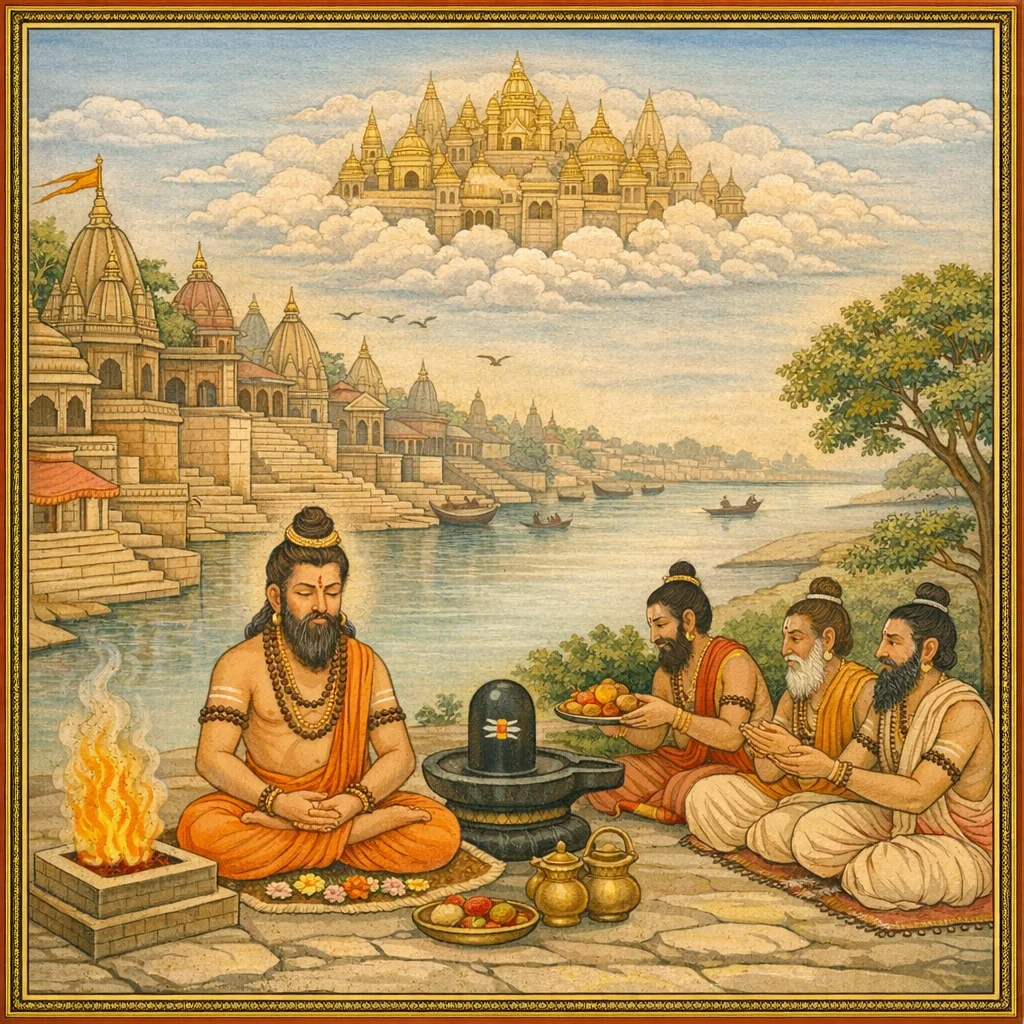
The chapter begins with Śivaśarman’s amazement at a radiant, joy-bestowing city. The gaṇas explain it as a heavenly polity linked with Mahendra (Indra), whose luminous palaces, wish-fulfilling abundance, and emblematic treasures (such as celestial horse and elephant motifs) teach the doctrine of karmic recompense and cosmic governance. The text then turns to an Agni-centered path of uplift: Agni/Jātavedas is praised as purifier, inner witness, and the axis of sacrifice. It lists deeds that lead to Agni-loka—supporting agnihotra, aiding the needy through fire-rites, gifting fuel or ritual implements, and maintaining disciplined conduct. Within the narrative frame, the gaṇas recount the sage Viśvānara of the Śāṇḍilya lineage, his reflection on the four āśramas with special esteem for gṛhastha-dharma, and his dialogue with his wife Śuciṣmatī, who asks for a son comparable to Maheśa. Viśvānara journeys to Vārāṇasī, performs extensive tīrtha-circulation—liṅga-darśana, bathing, offerings, honoring ascetics—chooses among Kāśī’s many liṅgas for swift siddhi, and undertakes rigorous worship at a siddhi-giving seat. The chapter concludes with a phala-claim: a specified hymn/practice, observed for a set period, grants desired results, including progeny.
Shlokas
Verse 1
शिवशर्मोवाच । रमयंती मनोतीव केयं कस्येयमीशितुः । नयनानंदसंदोहदायिनीपूरनुत्तमा
Śivaśarman said: “Who is this—so delighting the mind—and of which Lord is this city? This unsurpassed town pours forth a multitude of joys for the eyes.”
Verse 2
गणावूचतुः । शिवशर्मन्महाभागसुतीर्थफलितद्रुम । लोकोऽत्र रमते विप्र सहसाक्षपुरी त्वियम्
The Gaṇas said: “O Śivaśarman, noble one—like a tree laden with the fruits of excellent tīrthas—people rejoice here, O brāhmaṇa. This indeed is Sahasrākṣa-purī.”
Verse 3
तपोबलेन महता विहिता विश्वकमर्णा । दिवापि कौमुदी यस्याः सौधश्रेणीश्रियं श्रयेत्
Fashioned by Viśvakarman through mighty ascetic power, the splendor of her rows of palaces is such that even by day it seems suffused with moonlight.
Verse 4
यदाकलानिधिः क्वापि दर्शे ऽदृश्यत्वमावहेत् । तदा स्वप्रेयसीं ज्योत्स्नां सौधेष्वेषु निगूहयेत्
Whenever the Moon—the treasury of his phases—becomes unseen at the new moon, he then hides his beloved moonlight within these palaces.
Verse 5
यदच्छभित्तौ वीक्ष्य स्वमन्ययोपिद्विशंकिता । मुग्धानाशुविशेच्चित्रमपिस्वांचित्रशालिकाम्
Seeing her own reflection upon a flawless wall, a bewildered woman—doubting whether it is herself or another—might swiftly enter even a painted image, as though into her own picture-gallery.
Verse 6
हर्म्येषु नीलमणिभिर्निर्मितेष्वत्रनिर्भयम् । स्वनीलिमानमाधाय तमोहःस्वपि तिष्ठति
In the mansions here, built of blue sapphires, even darkness lingers without fear, taking on their own deep blueness—even in daytime.
Verse 7
चंद्रकांतशिलाजालस्रुतमात्रामलंजलम् । तत्र चादाय कलशैर्नेच्छंत्यन्यज्जलं जनाः
The water there is perfectly pure, merely oozing from networks of moonstone slabs. Having filled their pots from it, people desire no other water.
Verse 8
कुविंदा न च संत्यत्र न च ते पश्यतो हराः । चैलान्यलंकृतीरत्र यतः कल्पद्रुमोर्पयेत्
Here there are no weavers, nor are merchants seen; for garments and adornments are bestowed here by the wish-fulfilling tree Kalpadruma itself.
Verse 9
गणका नात्र विद्यंते चिंताविद्याविशारदाः । यतश्चिकेति सर्वेषां चिंता चिंतामणिर्द्रुतम्
Here there is no need for numerologists or calculators skilled in the science of anxieties; for the very moment one thinks, the jewel called Cintāmaṇi swiftly fulfills every wish.
Verse 10
सूपकारा न संत्यत्र रसकर्म विचक्षणाः । दुग्धे सर्वरसानेका कामधेनुरतोयतः
Here there are no cooks expert in crafting flavors, because from milk alone arise countless tastes; Kāmadhenu, the wish-granting cow, provides them without any need for water.
Verse 11
कीर्तिरुच्चैःश्रवा यस्य सर्वतो वाजिराजिषु । रत्नमुच्चैःश्रवाः सोत्र हयानां पौरुषाधिकः
His fame is like Uccaiḥśravā, renowned among all kings of horses; and here Uccaiḥśravā himself—the jewel among steeds—shines forth, surpassing all horses in valor.
Verse 12
ऐरावतो दंतिवरश्चतुर्दंतोत्र राजते । द्वितीय इव कैलासो जंगमस्फटिकोज्ज्वलः
Here shines Airāvata, the best of elephants, four-tusked and splendid—like a second Kailāsa, radiant as moving crystal.
Verse 13
तरुरत्नंपारिजातः स्त्रीरत्नं सोर्वशी त्विह । नंदनं वनरत्नं च रत्नं मंदाकिनी ह्यपाम्
The jewel among trees is Pārijāta; the jewel among women here is Urvaśī; Nandana is the jewel among forests; and among waters, the jewel is the Mandākinī.
Verse 14
त्रयस्त्रिंशत्सुराणां या कोटिः श्रुति समीरिता । प्रतीक्षते साऽवसरं सेवायै प्रत्यहंत्विह
That ‘crore’ of the thirty-three devas spoken of in the Veda waits here each day for an opportunity to render service.
Verse 15
स्वर्गेष्विंद्रपदादन्यन्न विशिष्येत किंचन । यद्यत्त्रिलोक्यामैश्वर्यं न तत्तुल्यमनेन हि
In heaven there is nothing higher than Indra’s station; yet whatever lordship exists across the three worlds is not equal to this.
Verse 16
अश्वमेधसहस्रस्य लभ्यं विनिमयेन यत् । किं तेन तुल्यमन्यत्स्यात्पवित्रमथवा महत
Even if one could obtain, by exchange, the fruit of a thousand Aśvamedha sacrifices—what other thing could equal this, whether in purity or in greatness?
Verse 17
अर्चिष्मती संयमिनी पुण्यवत्यमलावती । गंधवत्यलकेशी च नैतत्तुल्या महर्धिभिः
Arciṣmatī, Saṃyaminī, Puṇyavatī, Amalāvatī, Gandhavatī, and Alakeśī—though endowed with great prosperities—are not equal to this.
Verse 18
अयमेव सहस्राक्षस्त्वयमेव दिवस्पतिः । शतमन्युरयं देवो नामान्येतानि नामतः
This very one is called Sahasrākṣa; this very one is Divaspati. This god is Śatamanyu—these are simply his names, name by name.
Verse 19
सप्तापि लोकपाला ये त एनं समुपासते । नारदाद्यैर्मुनिवरैरयमाशीर्भिरीड्यते
Even the seven guardians of the worlds revere and worship him. He is praised with blessings by the foremost sages, beginning with Nārada.
Verse 20
एतत्स्थैर्येण सर्वेषां लोकानां स्थैर्यमिष्यते । पराजयान्महेंद्रस्य त्रैलोक्यं स्यात्पराजितम्
By the stability of this seat, the stability of all worlds is secured. If Mahendra were defeated, the three worlds themselves would be as though defeated.
Verse 21
दनुजा मनुजा दैत्यास्तपस्यंत्युग्रसंयमाः । गंधर्व यक्षरक्षांसि महेंद्रपदलिप्सवः
Dānavas, humans, and Daityas practice austerities with fierce self-restraint; Gandharvas, Yakṣas, and Rākṣasas too—desiring to attain Mahendra’s rank.
Verse 22
सगराद्या महीपाला वाजिमेधविधायकाः । कृतवंतो महायत्नं शक्रैश्वर्यजिघृक्षवः
Kings such as Sagara, who performed Aśvamedha sacrifices, undertook mighty efforts—seeking to seize the sovereignty and splendor of Śakra (Indra).
Verse 23
निष्प्रत्यूहं क्रतुशतं यः कश्चित्कुरुतेऽवनौ । जितेंद्रियोमरावत्यां स प्राप्नोति पुलोमजाम्
Whoever on earth completes, without obstruction, a hundred sacrifices—and with senses conquered—attains in Amarāvatī Pulomajā (Śacī), the consort of Indra.
Verse 24
असमाप्तक्रतुशता वसंत्यत्र महीभुजः । ज्योतिष्टोमादिभिर्यागैर्ये यजंत्यपि ते द्विजाः
Here dwell rulers whose hundred sacrifices remain unfinished; and here too dwell the twice-born who worship through rites such as the Jyotiṣṭoma and other sacrifices.
Verse 25
तुलापुरुषदानादि महादानानि षोडश । ये यच्छंत्यमलात्मानस्ते लभंतेऽमरावतीम्
The sixteen great gifts—beginning with the Tulāpuruṣa-dāna—those pure-souled ones who bestow them attain Amarāvatī.
Verse 26
अक्लीबवादिनो धीराः संग्रामेष्वपराङ्मुखाः । विक्रांता वीरशयने तेऽत्र तिष्ठंति भूभुजः
Here abide those kings who speak no coward’s words—steadfast, never turning away in battle; valorous, they rest upon the heroes’ bed, having met a hero’s death.
Verse 27
इत्युद्देशात्समाख्याता महेंद्रनगरी स्थितिः । यायजूका वसंत्यत्र यज्ञविद्याविशारदाः
Thus, by this brief indication, the condition of Mahendra’s city has been described. Here dwell the Yāyajūkas—experts deeply skilled in the science of sacrifice.
Verse 28
इमामर्चिष्मतीं पश्य वीतिहोत्रपुरीं शुभाम् । जातवेदसि ये भक्तास्ते वसंत्यत्र सुव्रताः
Behold this radiant, auspicious city—Vītihotrapurī. Those devoted to Jātavedas (Agni) dwell here, steadfast in noble vows.
Verse 29
अग्निप्रवेशं ये कुर्युर्दृढसत्त्वा जितेंद्रियाः । स्त्रियो वा सत्त्वसंपन्नास्ते सर्वे अग्नितेजसः
Those steadfast and self-controlled who enter the fire, and likewise women endowed with firm courage—such people all become radiant with Agni’s very splendor.
Verse 30
अग्निहोत्ररता विप्रास्तथाग्निब्रह्मचारिणः । पंचाग्निव्रतिनो ये वै तेऽग्निलोकेग्नितेजसः
Brāhmaṇas devoted to the Agnihotra, those who practice brahmacarya in service of the sacred fire, and those observing the vow of the five fires—indeed, they dwell in Agni’s world, shining with Agni’s splendor.
Verse 31
शीते शीतापनुत्यै यस्त्विध्मभारान्प्रयच्छति । कुर्यादग्निष्टिकां वाऽथ स वसेदग्निसन्निधौ
In times of cold, one who gives bundles of firewood to dispel another’s chill—or who prepares a fire-hearth—dwells in the blessed proximity of Agni.
Verse 32
अनाथस्याग्निसंस्कारं यः कुर्याच्छ्रद्धयान्वितः । अशक्तः प्रेरयेदन्यं सोग्निलोके महीयते
Whoever, with faith, performs the funerary fire-rites for one who has no protector—or, if unable, inspires another to do so—becomes honored in the world of Agni.
Verse 33
जठराग्निविवृद्ध्यै यो दद्यादाग्नेयमौषधम् । मंदाग्नये स पुण्यात्मा वह्निलोके वसेच्चिरम्
Whoever gives an Agni-kindling medicine to one of weak digestion, to increase the gastric fire—such a meritorious soul dwells long in the world of Vahni (Agni).
Verse 34
यज्ञोपस्कर वस्तूनि यज्ञार्थं द्रविणं तु वा । यथाशक्ति प्रदद्याद्यो ह्यर्चिष्मत्यांवसेत्स वै
One who, according to ability, gives the implements needed for yajña—or wealth for the sake of yajña—indeed dwells in Arciṣmatī, the radiant realm.
Verse 35
अग्निरेको द्विजातीनां निःश्रेयसकरः परः । गुरुर्देवो व्रतं तीर्थं सर्वमग्निर्विनिश्चितम्
For the twice-born, Agni alone is the supreme bestower of the highest good; truly it is determined that Agni is guru, deity, vow, and tīrtha—everything is established in Agni.
Verse 36
अपावनानि सर्वाणि वह्निसंसर्गतः क्षणात् । पावनानि भवंत्येव तस्माद्यः पावकः स्मृतः
All that is impure becomes pure in a moment through contact with fire; therefore he is remembered as “Pāvaka”, the purifier.
Verse 37
अपि वेदं विदित्वा यस्त्यक्त्वा वै जातवेदसम् । अन्यत्र बध्नाति रतिं ब्राह्मणो न स वेदवित्
Even if a brāhmaṇa has learned the Veda, if he abandons Jātavedas (Agni) and binds his delight elsewhere, he is not truly a knower of the Veda.
Verse 38
अंतरात्मा ह्ययं साक्षान्निश्चितो ह्याशुशुक्षणिः । मांसग्रासान्पचेत्कुक्षौ स्त्रीणां नो मांसपेशिकाम्
This Agni is surely the manifest Inner Self and the direct Witness, swiftly consuming. In the belly he cooks flesh-morsels, but not the “flesh-lump” of women.
Verse 39
तैजसी शांभवी मूर्तिः प्रत्यक्षा दहनात्मिका । कर्त्री हंत्री पालयित्री विनैनां किं विलोक्यते
This radiant form is Śāmbhavī—Śiva’s own presence—manifest before the eyes as the very essence of burning fire. She is the doer, the destroyer, and the protector; without Her, what at all could be seen or known?
Verse 40
चित्रभानुरयं साक्षान्नेत्रं त्रिभुवनेशितुः । अंधं तमोमये लोके विनैनं कः प्रकाशकः
This brilliant Sun is truly the very eye of the Lord of the three worlds. In a universe made of darkness, without him who could possibly illumine anything?
Verse 41
धूपप्रदीपनैवेद्य पयो दधि घृतैक्षवम् । एतद्भुक्तं निषेवंते सर्वे दिवि दिवौकसः
Incense, lamps, and food-offerings—along with milk, curd, ghee, and sugarcane-juice—when these are offered and partaken as prasāda, all the gods dwelling in heaven are satisfied and receive their subtle share.
Verse 42
शिवशर्मोवाच । कोयं कृशानुः कस्यायं सूनुः कथमिदं पदम् । आग्नेयं लब्धमेतेन ब्रूतमेतन्ममाग्रतः
Śivaśarman said: “Who is this Fire (Kṛśānu)? Whose son is he? And how has this one attained this ‘fiery’ station? Tell me this clearly, here before me.”
Verse 43
गणावूचतुः । आकर्णय महाप्राज्ञ वर्णयावो यथातथम् । योयं यस्य यथाऽनेन प्रापि ज्योतिष्मतीपुरी
The Gaṇas said: “Listen, O great wise one. We shall relate it just as it happened—who this one is, to whom he belongs, and by what means he attained the radiant city, Jyotiṣmatīpurī.”
Verse 44
नर्मदायास्तटे रम्ये पुरे नर्मपुरे पुरा । पुरारिभक्तः पुण्यात्माऽभवद्विश्वानरो मुनिः
Formerly, on the lovely bank of the Narmadā, in the city called Narmapur, there lived the holy sage Viśvānara—pure-souled and devoted to the Enemy of Tripura (Śiva).
Verse 45
ब्रह्मचर्याश्रमे निष्ठो ब्रह्मयज्ञरतःसदा । शांडिल्यगोत्रः शुचिमान्ब्रह्मतेजो निधिर्वशी
Steadfast in the āśrama of brahmacarya, ever devoted to the Brahma-yajña—study and recitation of sacred lore—of the Śāṇḍilya lineage: pure, self-controlled, a treasury of brahmanical splendor.
Verse 46
विज्ञाताखिलशास्त्रार्थो लौकिकाचारचंचुरः । कदाचिच्चिंतयामास हृदि ध्यात्वा महेश्वरम्
He had understood the meanings of all the śāstras and was adept in proper worldly conduct. Once, having meditated upon Maheśvara within his heart, he began to reflect deeply.
Verse 47
चतुर्णामप्याश्रमाणां कोतीव श्रेयसे सताम् । यस्मिन्प्राप्नोति संक्षुण्णे परत्रेह च वा सुखम्
“Among the four āśramas, which one is truly most conducive to the welfare of the good—by following which, even amid life’s pressures, one attains happiness both here and hereafter?”
Verse 48
इदं श्रेयस्त्विदं श्रेयस्त्विदं तु सुकरं भवेत् । इत्थं सर्वं समालोड्य गार्हस्थ्यं प्रशशंस ह
“This is good, and that too is good; and this path as well is practicable.” Thus, having weighed everything, he praised the householder’s way of life (gārhasthya).
Verse 49
ब्रह्मचारी गृहस्थो वा वानप्रस्थोऽथ भिक्षुकः । एषामाधारभूतोसौ गृहस्थो नान्यथेति च
Whether one is a brahmacārin, a householder, a forest-dweller, or a mendicant—among them all, the householder is the very support; it cannot be otherwise.
Verse 50
देवैर्मनुष्यैः पितृभिस्तिर्यग्भिश्चोपजीव्यते । गृहस्थः प्रत्यहं यस्मात्तस्माच्छ्रेष्ठो गृहाश्रमी
Because gods, humans, ancestors, and even other creatures depend day by day upon the householder for sustenance, the gṛhastha is therefore foremost among those who live the āśrama life.
Verse 51
अस्नात्वा चाप्यहुत्वा वाऽदत्त्वा वाश्नाति यो गृही । देवादीनामृणी भूत्वा नरकं प्रतिपद्यते
A householder who eats without bathing, or without making offerings, or without giving in charity becomes a debtor to the gods and others, and falls into hell.
Verse 52
अस्नाताशी मलं भुंक्ते त्वजपी पूयशोणितम् । अहुताशी कृमीन्भुंक्तेप्यदत्त्वाविड्विभोजनः
One who eats without bathing eats filth; one who eats without japa eats pus and blood; one who eats without offerings eats worms; and one who eats without giving eats excrement as food.
Verse 53
ब्रह्मचर्यं हि गार्हस्थ्ये यादृक्कल्पनयोज्झितम् । स्वभावचपले चित्ते क्व तादृग्ब्रह्मचारिणि
The continence found in the householder’s life—free from fanciful contrivance—is truly rare; in a mind naturally fickle, where is such steadfastness to be found even in a vowed brahmacārī?
Verse 54
हठाद्वा लोकभीत्या वा स्वार्थाद्वा ब्रह्मचर्यभाक् । संकल्पयति चित्ते चेत्कृतमप्यकृतं तदा
If one takes up continence out of compulsion, fear of society, or self-interest, yet still fashions desire within the mind, then even what is outwardly ‘done’ becomes as though not done.
Verse 55
परदारपरित्यागात्स्वदारपरितुष्टितः । ऋतुकालाभिगामित्वाद्ब्रह्मचारी गृहीरितः
Because he renounces another’s wife, is content with his own wife, and approaches her only in the proper season, a householder is called a ‘brahmacārī’—continent in conduct.
Verse 56
विमुक्तरागद्वेषो यः कामक्रोधविवर्जितः । साग्निः सदारः स गृही वानप्रस्थाद्विशिष्यते
That householder who is free from attachment and aversion, devoid of lust and anger—who maintains the sacred fires and lives with his wife—surpasses even the forest-dweller.
Verse 57
वैराग्याद्गृहमुत्सृज्य गृहधर्मान्हृदि स्मरेत् । स भवेदुभयभ्रष्टो वानप्रस्थो न वा गृही
If, out of misapplied dispassion, one abandons the home yet keeps remembering and longing for the duties of household life within the heart, he falls from both—neither a true forest-dweller nor a true householder.
Verse 58
अयाचितोपस्थितया यो वृत्त्या वर्तते गृही । येन केनापि संतुष्टो भिक्षुकात्स विशिष्यते
The householder who lives by what comes unasked, content with whatever he obtains, is superior even to a mendicant.
Verse 59
प्राथयेद्यत्क्वचित्किंचिद्दुष्प्रापं वा भविष्यति । अशनेषु न संतुष्टः स यतिः पतितो भवेत्
If an ascetic begs anywhere for something—especially what is hard to obtain—and remains dissatisfied with the food received, that renunciant is deemed fallen from his vow.
Verse 60
गुणागुणविचार्येत्थं स वै विश्वानरो द्विजः । उद्ववाह विधानेन स्वोचितां कुलकन्यकाम्
Thus weighing merits and faults, that brāhmaṇa Viśvānara duly married, according to proper rites, a maiden suitable to his lineage.
Verse 61
अग्निशुश्रूषणरतः पंचयज्ञपरायणः । षट्कर्मनिरतो नित्यं देवपित्रतिथिप्रियः
He was devoted to tending the sacred fires, intent upon the five daily sacrifices, ever engaged in the six duties, and dear to the gods, the ancestors, and to guests.
Verse 62
धर्मार्थकामान्युक्तात्मा सोर्जयन्स्वस्वकालतः । परस्परमसंकोचं दंपत्योरानुकूल्यतः
Composed in mind, he pursued dharma, prosperity, and desire each in its proper season; and the couple lived without mutual constraint, in harmony and mutual goodwill.
Verse 63
पूर्वाह्णे दैविकं कर्म सोकरोत्कर्मकांडवित् । मध्यंदिने मनुष्याणां पितॄणामपराह्नके
Skilled in the order of rites, he performed divine observances in the forenoon; at midday, duties toward people; and in the afternoon, the offerings due to the ancestors.
Verse 64
एवं बहुतिथे काले गते तस्याग्रजन्मनः । भार्या शुचिष्मती नाम कामपत्नी वसुव्रता
Thus, after many days had passed in the life of that first-born, his wife—named Śuciṣmatī—devoted to her husband and steadfast in virtuous observances, lived in that manner.
Verse 65
अपश्यंत्यंकुरमपि संततेः स्वर्गसाधनम् । विज्ञाय शंकंरं कांतं प्रणिपत्य व्यजिज्ञपत्
Seeing not even the slightest sprout of offspring—held to be a means to heaven—she approached her beloved Śaṅkara, bowed down, and made her request known.
Verse 66
शुचिष्मत्युवाच । आर्यपुत्रार्यधिषण प्राणनाथ प्रियव्रत । न दुर्लभं ममास्तीह किंचित्त्वच्चरणार्चनात्
Śuciṣmatī said: O noble husband of noble understanding, O lord of my life, steadfast in beloved vows—here nothing is difficult for me to obtain, because I worship at your feet.
Verse 67
ये वै भोगाः समुचिताः स्त्रीणां ते त्वत्प्रसादतः । अलंकृत्य मया भुक्ताः प्रसंगाद्वच्मि तान्यपि
Whatever enjoyments are proper for women, those I have received through your favor; adorned, I have partaken of them, and in this context I mention even those as well.
Verse 68
सुवासांसि सुवासाश्च सुशय्या सुनितंबिनी । स्रक्तांबूलान्नपानाश्च अष्टौ भोगाः स्वधर्मिणाम्
Fine garments, pleasing fragrances, a good bed, a beloved of shapely form; garlands, betel, food, and drink—these are the eight enjoyments for those who abide in their own dharma.
Verse 69
एकं मे प्रार्थितं नाथ चिराय हृदिसंस्थितम् । गृहस्थानां समुचितं तत्त्वं दातुमिहार्हसि
O Lord, I have one request long abiding in my heart. Please grant here the true principle that is fitting for householders.
Verse 70
विश्वानर उवाच । किमदेयं हि सुश्रोणि तव प्रियहितैषिणि । तत्प्रार्थय महाभागे प्रयच्छाम्यविलंबितम्
Viśvānara said: O fair-hipped one, seeker of what is dear and beneficial—what indeed is there that cannot be given to you? Ask, O fortunate lady; I shall grant it without delay.
Verse 71
महेशितुः प्रसादेन मम किंचिन्न दुर्ल्भम् । इहामुत्र च कल्याणि सर्वकल्याणकारिणः
By the grace of Maheśa, nothing at all is hard for me to obtain. O auspicious one, here and in the world beyond, He is the maker of all well-being.
Verse 72
इति श्रुत्वा वचः पत्युस्तस्य सा पतिदेवता । उवाच हृष्टवदना यदि देयो वरो मम
Hearing her husband’s words, that devoted wife, her face bright with joy, spoke: “If a boon is to be granted to me…”
Verse 73
वरयोग्यास्मि चेन्नाथ नान्यं वरमहं वृणे । महेशसदृशं पुत्रं देहि माहेश्वरानव
O Lord, if I am worthy of a boon, I choose no other. Grant me a son like Maheśa, a fresh sprout of the Māheśvara (Śaiva) lineage.
Verse 74
इति तस्या वचः श्रुत्वा शुचिष्मत्याः शुचिव्रतः । क्षणं समाधिमाधाय हृ द्येतत्समचिंतयत्
Having heard the words of that pure lady, the man of pure vows entered contemplation for a moment and pondered it within his heart.
Verse 75
अहो किमेतया तन्व्या प्रार्थितं ह्यतिदुर्लभम् । मनोरथपथाद्दूरमस्तुवा स हि सर्वकृत्
Alas—what this slender lady has asked for is exceedingly hard to obtain, far beyond the road of ordinary desires; for He (Maheśa) is indeed the doer of all.
Verse 76
तेनैवास्या मुखे स्थित्वा वाक्स्वरूपेण शंभुना । व्याहृतं कोऽन्यथाकर्तुमुत्सहेत भवेदिदम्
For Śambhu Himself, abiding in her mouth in the very form of speech, has uttered it—who could possibly have the power to make it otherwise?
Verse 77
ततः प्रोवाच तां पत्नीमेकपत्निव्रते स्थितः । विश्वानरमुनिः श्रीमानिति कांते भविष्यति
Then the illustrious sage Viśvānara, steadfast in the vow of one wife, spoke to his wife: “So it shall be, my beloved.”
Verse 78
इत्थमाश्वास्य तां पत्नीं जगाम तपसे मुनिः । यत्र विश्वेश्वरः साक्षात्काशीनाथोधितिष्ठति
Thus, having reassured his wife, the sage went forth to perform austerities—to the place where Viśveśvara Himself, the Lord of Kāśī, abides in manifest presence.
Verse 79
प्राप्य वाराणसीं तूर्णं दृष्ट्वाथ मणिकर्णिकाम् । तत्याज तापत्रितयमपिजन्मशतार्जितम्
Having swiftly reached Vārāṇasī and beholding Maṇikarṇikā, he cast off the threefold afflictions—though accumulated over hundreds of births.
Verse 80
दृष्ट्वा सर्वाणि लिंगानि विश्वेश प्रमुखानि च । स्नात्वा सर्वेषु कुंडेषु वापीकूटसरःसु च
Having beheld all the liṅgas—foremost among them Viśveśa—and having bathed in all the sacred pools, wells, embankments, and lakes,
Verse 81
नत्वा विनायकान्सर्वान्गौरीः सर्वाः प्रणम्य च । संपूज्य कालराजं च भैरवं पापभक्षणम्
Having bowed to all the Vināyakas and saluted all the Gaurīs, and having duly worshipped Kālarāja and Bhairava, the devourer of sins,
Verse 82
दण्डनायकमुख्यांश्च गणान्स्तुत्वा प्रयत्नतः । आदिकेशवमुख्यांश्च केशवान्परितोष्य च
Praising with due effort the Gaṇas headed by Daṇḍanāyaka, and gratifying the Keśavas headed by Ādikeśava as well,
Verse 83
लोलार्कमुख्य सूर्यांश्च प्रणम्य च पुनः पुनः । कृत्वा पिण्डप्रदानानि सर्वतीर्थेष्वतंद्रितः
Again and again he bowed to the solar shrines, foremost among them Lolārka, and tirelessly offered piṇḍas at all the sacred tīrthas,
Verse 84
सहस्रभोजनाद्यैश्च यतीन्विप्रान्प्रतर्प्य च । महापूजोपचारैश्च लिंगान्यभ्यर्च्य भक्तितः
And with offerings—beginning with abundant feeding—he satisfied the ascetics and brāhmaṇas; and with grand services of pūjā he worshipped the liṅgas in devotion.
Verse 85
असकृच्चिन्तयामास किं लिंगं क्षिप्रसिद्धिदम् । यत्र निश्चलतामेति तपस्तनयकाम्यया
Again and again he pondered: “Which liṅga grants swift attainment—where, through tapas, one may gain unwavering steadfastness for the sake of desiring a son?”
Verse 86
श्रीमदोंकारनाथं वा कृत्तिवासेश्वरं किमु । कालेशं वृद्धकालेशं कलशेश्वरमेव च
“Should it be the glorious Oṃkāranātha, or perhaps Kṛttivāseśvara—Kāleśa, Vṛddhakāleśa, or indeed Kalaśeśvara?”
Verse 87
केदारेशं तु कामेशं चन्द्रेशं वा त्रिलोचनम् । ज्येष्ठेशं जंबुकेशं वा जैगीषव्येश्वरं तु वा
“Or Kedāreśa, Kāmeśa, Candreśa, or Trilocana; or Jyeṣṭheśa, Jaṃbukeśa, or Jaigīṣavyeśvara?”
Verse 88
दशाश्वमेधमीशानं द्रुमि चंडेशमेव च । दृक्केशं गरुडेशं च गोकर्णेशं गणेश्वरम्
Or else: Daśāśvamedha-Īśāna; Drumi-Caṇḍeśa; Dṛkkeśa; Garuḍeśa; Gokarṇeśa; or Gaṇeśvara.
Verse 89
ढुंढ्याशागजसिद्धाख्यं धर्मेशं तारकेश्वरम् । नन्दिकेशं निवासेशं पत्रीशं प्रीतिकेश्वरम्
(One may worship) the Liṅga known as Ḍhuṃḍhyāśāgajasiddha—Dharma-īśa, Tārakeśvara, Nandikeśa, Nivāseśa, Patrīśa, and Prītikeśvara.
Verse 90
पर्वतेशं पशुपतिं ब्रह्मेशं मध्यमेश्वरम् । बृहस्पतीश्वरं वाथ विभांडेश्वरमेव च
(One may worship) Parvateśa, Paśupati, Brahmeśa, Madhyameśvara, Bṛhaspatīśvara, and also Vibhāṇḍeśvara.
Verse 91
भारभूतेश्वरं किं वा महालक्ष्मीश्वरं तु वा । मरुत्तेशं तु मोक्षेशं गंगेशं नर्मदेश्वरम्
Or (one may worship) Bhārabhūteśvara, or Mahālakṣmīśvara; likewise Marutteśa, Mokṣeśa, Gaṅgeśa, and Narmadeśvara.
Verse 92
मार्कंडं मणिकर्णीश रत्नेश्वरमथापि वा । अथवा योगिनीपीठं साधकस्यैव सिद्धिदम्
(One may worship) Mārkaṇḍa, Maṇikarṇīśa, and also Ratneśvara; or else the Yoginī-seat (Yoginī-pīṭha)—truly bestowing siddhis upon the sādhaka.
Verse 93
यामुनेशं लांगलीशं श्रीमद्विश्वेश्वरं विभुम् । अविमुक्तेश्वरं वाथ विशालाक्षीशमेव च
“(One may worship) Yāmuneśa, Lāṃgalīśa, the glorious and all-pervading Viśveśvara, Avimukteśvara, and also Viśālākṣīśa.”
Verse 94
व्याघ्रेश्वरं वराहेशं व्यासेशं वृषभध्वजम् । वरुणेशं विधीशं वा वसिष्ठेशं शनीश्वरम्
“(One may worship) Vyāghreśvara, Varāheśa, Vyāseśa, the Bull-bannered Lord, Varuṇeśa, or Vidhīśa; also Vasiṣṭheśa and Śanīśvara.”
Verse 95
सोमेश्वरं किमिन्द्रेशं स्वर्लीनं संगमेश्वरम् । हरिश्चंद्रेश्वरं किं वा हरिकेशेश्वरं तु वा
“(One may worship) Someśvara, or Indreśa; Svarlīna, Saṅgameśvara; or Haricandreśvara; or again Harikeśeśvara.”
Verse 96
त्रिसंध्येशं महादेवमुपशांति शिवं तथा । भवानीशं कपर्दीशं कंदुकेशं मखेश्वरम्
“(One may worship) Trisaṃdhyeśa, Mahādeva, Upaśānti, and also Śiva; Bhavānīśa, Kapardīśa, Kaṃdukeśa, and Makheśvara.”
Verse 97
मित्रावरुणसंज्ञं वा किमेषामाशुपुत्रदम् । क्षणं विचार्य स मुनिरिति विश्वानरः सुधीः
“Or is it known as ‘Mitrāvaruṇa’? Which among these grants a son swiftly? Thinking for a moment, that wise sage Viśvānara spoke thus.”
Verse 98
आज्ञातं विस्मृतं तावत्फलितो मे मनोरथः । सिद्धैः संसेवितं लिंगं सर्वसिद्धिकरं परम्
Though it was once known and then forgotten, my longing has now borne fruit. This supreme Liṅga—served by the Siddhas—bestows every accomplishment.
Verse 99
दर्शनात्स्पर्शनाद्यस्य मनो निर्वृतिभाग्भवेत् । उद्घाटितं सदैवास्ते स्वर्गद्वारं हि यत्र वै
That place—by whose mere sight and touch the mind attains deep contentment—truly has the gate of heaven standing ever open.
Verse 100
दिवानिशं पूजनार्थं विज्ञाप्य त्रिदशेश्वरम् । पञ्चमुद्रे महापीठे सिद्धिदे सर्वजंतुषु
Day and night, having sought permission for worship from the Lord of the gods, one should worship at the great seat called Pañcamudrā, bestower of spiritual attainments upon all beings.
Verse 110
षण्मासात्सिद्धिमगमद्बहुनीराजनैरिह । किन्नरी हंसपद्यत्र भर्त्रा वेणुप्रियेण वै
Here, through many acts of ārati, she attained success within six months—the Kinnarī named Haṃsapadā, together with her husband Veṇupriya.
Verse 120
पंचगव्याशनो मासं मासं चांद्रायणव्रती । मासं कुशाग्रजलभुङ्मासं श्वसनभक्षणः
For a month he subsists on pañcagavya; for a month he observes the Cāndrāyaṇa vow; for a month he lives on water taken from kuśa-tips; and for a month he ‘feeds on breath’ alone.
Verse 130
शब्दं गृह्णास्यश्रवास्त्वं हि जिघ्रेरघ्राणस्त्वं व्यंघ्रिरायासि दूरात् । व्यक्षः पश्येस्त्वं रसज्ञोप्यजिह्वः कस्त्वां सम्यग्वेत्त्यतस्त्वां प्रपद्ये
Though earless, you perceive sound; though noseless, you smell; though footless, you come from afar. Though eyeless, you see; though tongueless, you know taste. Who can truly comprehend you? Therefore I take refuge in you.
Verse 140
अभिलाषाष्टकं पुण्यं स्तोत्रमेतत्त्वयेरितम् । अब्दं त्रिकालपठनात्कामदं शिवसंनिधौ
This holy hymn called the Abhilāṣāṣṭaka has been spoken by you. If it is recited for a year, three times daily, in Śiva’s presence, it becomes a fulfiller of desires.
Verse 147
अब्दं जप्तमिदं स्तोत्रं पुत्रदं नात्र संशयः । इत्युक्त्वांतर्दधे बालः सोपि विप्रो गृहं गतः
‘If this hymn is recited for a year, it grants a son—there is no doubt.’ Saying this, the boy vanished; and that brāhmaṇa too returned home.