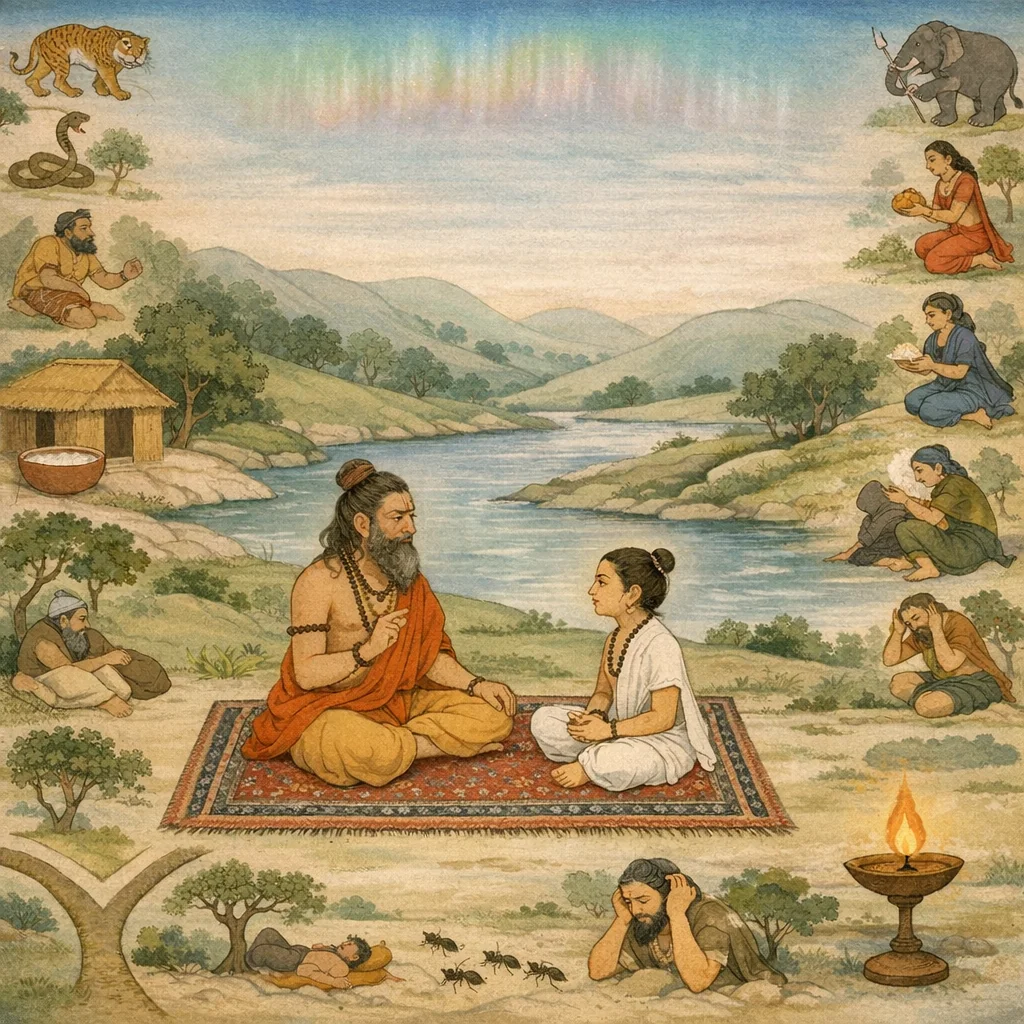
अन्तराय-उपसर्ग-विवेचनम् / Analysis of Yogic Obstacles (Antarāyas) and Upasargas
Upamanyu gives a technical teaching on the impediments that confront yogic practitioners (antarāya). He lists ten chief obstacles—laziness, severe illness, negligence, doubt about the path or the place of practice, mental instability, lack of faith, deluded perception, suffering, depression, and restlessness toward sense-objects—and then defines each with diagnostic clarity. Illness is traced to bodily and karmic causes; doubt is split cognition between alternatives; instability is the mind’s lack of grounding; faithlessness is a bhāva-less disposition in the yogic course; delusion is inverted judgment. Suffering is classified as ādhyātmika (internal), ādhibhautika (creatural/physical), and ādhidaivika (divine/elemental). Depression arises from frustrated desire, and restlessness is the mind’s dispersion among many objects. When these vighna are pacified, the devoted yogin may encounter “divine” upasarga—signs of nearness to siddhi that can distract if misunderstood. Six are named: pratibhā (flash of insight), śravaṇa (supernormal hearing), vārtā (receiving communications), darśana (visionary perception), āsvāda (extraordinary taste), and vedanā (heightened tactile sensation). The chapter guides interpretation and restraint so that sādhanā remains aimed at liberation rather than fascination with powers.
Shlokas
Verse 1
उपमन्युरुवाच । आलस्यं व्याधयस्तीव्राः प्रमादः स्थानसंशयः । अनवस्थितचित्तत्वमश्रद्धा भ्रांतिदर्शनम्
Upamanyu said: Laziness, severe illnesses, heedlessness, doubt about the right place (and method), an unsteady mind, lack of faith, and deluded perception—these are the obstacles that obstruct the aspirant on the path of Śiva’s worship and yoga.
Verse 2
दुःखानि दौर्मनस्यं च विषयेषु च लोलता । दशैते युञ्जतां पुंसामन्तरायाः प्रकीर्तिताः
Sufferings, dejection of mind, and restlessness toward sense-objects—these and other such factors, making ten in all, are declared to be obstacles for men engaged in Yoga.
Verse 3
आलस्यमलसत्त्वं तु योगिनां देहचेतनोः । धातुवैषम्यजा दोषा व्याधयः कर्मदोषजाः
For yogins, the states of body and mind are affected by laziness and dull impurity. Bodily faults arise from imbalance of the bodily constituents, while diseases arise from defects created by past actions (karma).
Verse 4
प्रमादो नाम योगस्य साधना नाम भावना । इदं वेत्युभयाक्रान्तं विज्ञानं स्थानसंशयः
In yoga, negligence is called the great fault, while disciplined contemplation (bhāvanā) is called its true means. But cognition seized by both notions—“this” and “that”—remains doubtful knowledge, uncertain of its true ground.
Verse 5
अप्रतिष्ठा हि मनसस्त्वनवस्थितिरुच्यते । अश्रद्धा भावरहिता वृत्तिर्वै योगवर्त्मनि
“Lack of grounding” is said to be the mind’s instability. And on the path of Yoga, the mind’s movement that is without śraddhā (faith) and bereft of inner bhāva, the devotional feeling, is indeed another form of that same instability.
Verse 6
विपर्यस्ता मतिर्या सा भ्रांतिरित्यभिधीयते । दुःखमज्ञानजं पुंसां चित्तस्याध्यात्मिकं विदुः
That understanding which is inverted is called “bhrānti” (delusion). The wise know that human suffering, born of ignorance (ajñāna), is an inner (ādhyātmika) affliction belonging to the mind.
Verse 7
आधिभौतिकमंगोत्थं यच्च दुःखं पुरा कृतैः । आधिदैविकमाख्यातमशन्यस्त्रविषादिकम्
The suffering that arises from bodily and material conditions—brought about by one’s actions performed in the past—is called ādhibhautika. And what is termed ādhi-daivika is the affliction caused by divine and cosmic forces, such as lightning, weapons, poison, and the like.
Verse 8
इच्छाविघातजं मोक्षं दौर्मनस्यं प्रचक्षते । विषयेषु विचित्रेषु विभ्रमस्तत्र लोलता
They describe as “liberation born of the frustration of desire” a state that is truly dejection of mind; for amid the many-varied sense-objects delusion arises, and there the mind becomes restless and fickle.
Verse 9
शान्तेष्वेतेषु विघ्नेषु योगासक्तस्य योगिनः । उपसर्गाः प्रवर्तंते दिव्यास्ते सिद्धिसूचकाः
When these obstacles have been pacified, for the yogin firmly absorbed in Yoga, extraordinary divine manifestations begin to arise; they are signs that spiritual attainments (siddhis) are drawing near.
Verse 10
प्रतिभा श्रवणं वार्ता दर्शनास्वादवेदनाः । उपसर्गाः षडित्येते व्यये योगस्य सिद्धयः
Inner intuition (pratibhā), clairaudient hearing, knowledge of distant events, visionary sight, extraordinary taste, and subtle tactile sensation—these six are called upasargas, secondary attainments. When they arise, they indicate a waning of true Yoga, for they can divert the yogin from union with Śiva, the Supreme Pati.
Verse 11
सूक्ष्मे व्यवहिते ऽतीते विप्रकृष्टे त्वनागते । प्रतिभा कथ्यते यो ऽर्थे प्रतिभासो यथातथम्
When the object is subtle, concealed, past, far away, or even yet to come, the cognition by which it is apprehended is called pratibhā (inner intuition); and the object’s appearance in awareness is its pratibhāsa—exactly as it truly is.
Verse 12
श्रवणं सर्वशब्दानां श्रवणे चाप्रयत्नतः । वार्त्ता वार्त्तासु विज्ञानं सर्वेषामेव देहिनाम्
All embodied beings naturally possess the power to hear all sounds, and they hear without deliberate effort; likewise, they gain ordinary understanding through everyday reports and conversations.
Verse 13
दर्शनं नाम दिव्यानां दर्शनं चाप्रयत्नतः । तथास्वादश्च दिव्येषु रसेष्वास्वाद उच्यते
‘Vision’ is said to be the effortless beholding of divine beings; likewise, ‘taste’ is called the savoring of the divine essences (rasas).
Verse 14
स्पर्शनाधिगमस्तद्वद्वेदना नाम विश्रुता । गन्धादीनां च दिव्यानामाब्रह्मभुवनाधिपाः
Likewise, the cognition that arises through touch is well known as “vedanā” (sensation). And the divine objects beginning with fragrance and the rest are experienced by all rulers of worlds, up to the Lord of Brahmā’s realm.
Verse 15
संतिष्ठन्ते च रत्नानि प्रयच्छंति बहूनि च । स्वच्छन्दमधुरा वाणी विविधास्यात्प्रवर्तते
There, jewels remain ever-present and are bestowed in abundance; and speech—free-flowing and sweet—arises in diverse ways.
Verse 16
रसायनानि सर्वाणि दिव्याश्चौषधयस्तथा । सिध्यंति प्रणिपत्यैनं दिशंति सुरयोषितः
All rejuvenating rasāyanas and even the celestial medicines become perfected by bowing to him; and the wives of the gods, in reverence, show the way toward him. Thus the Purāṇa intimates that auspicious attainments arise when one approaches the Lord with surrender and devotion.
Verse 17
योगसिद्ध्यैकदेशे ऽपि दृष्टे मोक्षे भवेन्मतिः । दृष्टमेतन्मया यद्वत्तद्वन्मोक्षो भवेदिति
Even by beholding only a partial attainment of yogic perfection, conviction in liberation arises: “Just as I have directly seen this, so too mokṣa will surely come to be.”
Verse 18
कृशता स्थूलता बाल्यं वार्धक्यं चैव यौवनम् । नानाचातिस्वरूपं च चतुर्णां देहधारणम्
Emaciation, corpulence, childhood, old age, and youth—along with countless other distinct conditions—are the modes by which the fourfold embodied state assumes a body.
Verse 19
पार्थिवांशं विना नित्यं सुरभिर्गन्धसंग्रहः । एवमष्टगुणं प्राहुः पैशाचं पार्थिवं पदम्
Apart from the earthy portion, fragrance is ever-present as a gathering of scents. Thus the sages declare that the “earthly state,” in its piśāca-like mode (gross and tamasic), is endowed with eight qualities.
Verse 20
जले निवसनं चैव भूम्यामेवं विनिर्गमः । इच्छेच्छक्तः स्वयं पातुं समुद्रमपि नातुरः
He can dwell even within water, and likewise emerge upon the earth. Endowed with the power of will, he is not distressed—by himself he can even drink up the ocean.
Verse 21
यत्रेच्छति जगत्यस्मिंस्तत्रैव जलदर्शनम् । विना कुम्भादिकं पाणौ जलसञ्चयधारणम्
Wherever he wishes in this world, there itself water becomes visible; and, without a pot or other vessel, he is able to gather and hold collected water in his very hand.
Verse 22
यद्वस्तु विरसञ्चापि भोक्तुमिच्छति तत्क्षणात् । रसादिकं भवेच्चान्यत्त्रयाणां देहधारणम्
Whatever object is in itself tasteless—if one wishes to enjoy it, at that very moment it becomes endowed with taste and the like; and from that enjoyment there arises something else: the sustaining of the body through the three doṣa (humours).
Verse 23
निर्व्रणत्वं शरीरस्य पार्थिवैश्च समन्वितम् । तदिदं षोडशगुणमाप्यमैश्वर्यमद्भुतम्
The body becomes free from wounds and ailments, and is endowed with the earth-born excellences as well. This is the wondrous lordly attainment, to be gained sixteenfold.
Verse 24
शरीरादग्निनिर्माणं तत्तापभयवर्जनम् । शक्तिर्जगदिदं दग्धुं यदीच्छेदप्रयत्नतः
From his own body he can bring forth fire, yet he remains untouched by any fear of its heat. Indeed, if he so wills—and applies himself—he has the power to burn up this entire world.
Verse 25
द्वाभ्यां देहविनिर्माणमाप्यैश्वर्यसमन्वितम् । एतच्चतुर्विंशतिधा तैजसं परिचक्षते
From the two (principles) arises the construction of the body, endowed with the sovereign power of the waters. This is called the taijasa (luminous principle), spoken of as twenty‑fourfold in manifestation.
Verse 26
मनोजवत्वं भूतानां क्षणादन्तःप्रवेशनम् । पर्वतादिमहाभारधारणञ्चाप्रयत्नतः
For the beings, there is the speed of thought, entry within (any place) in an instant, and the effortless bearing of immense weights—such as mountains and the like.
Verse 27
गुरुत्वञ्च लघुत्वञ्च पाणावनिलधारणम् । अंगुल्यग्रनिपाताद्यैर्भूमेरपि च कम्पनम्
He manifests heaviness and lightness; in the very palm He can hold and govern the vital wind (prāṇa). By the mere falling or striking of a fingertip and the like, even the earth is made to tremble.
Verse 28
एकेन देहनिष्पत्तिर्युक्तं भोगैश्च तैजसैः । द्वात्रिंशद्गुणमैश्वर्यं मारुतं कवयो विदुः
By a single (measure of this discipline), the formation of a body is attained, together with enjoyments of a luminous (subtle) order. The sages know the ‘māruta’ power as a lordship multiplied thirty-twofold.
Verse 29
छायाहीनविनिष्पत्तिरिन्द्रियाणामदर्शनम् । खेचरत्वं यथाकाममिन्द्रियार्थसमन्वयः
One attains a state in which the body’s shadow no longer appears; the sense-organs become imperceptible; one gains the power to move through the sky at will; and the faculties of sense come into complete mastery and coordination with their objects—these are described as yogic attainments arising from the discipline taught in the Vāyu Saṃhitā, yet they are to be subordinated to devotion to Pati (Śiva) for liberation.
Verse 30
आकाशलंघनं चैव स्वदेहे तन्निवेशनम् । आकाशपिण्डीकरणमशरीरत्वमेव च
He attains the yogic powers of traversing the sky, of causing that (subtle element) to abide within his own body, of condensing the sky-element into a tangible mass, and even of becoming bodiless. Such attainments arise as secondary fruits on the path of Śiva-yoga, while liberation is gained by the Lord’s grace and right knowledge.
Verse 31
अनिलैश्वर्यसंयुक्तं चत्वारिंशद्गुणं महत् । ऐन्द्रमैश्वर्यमाख्यातमाम्बरं तत्प्रचक्षते
That great sovereignty, joined with the lordly power of the Wind, is said to be fortyfold in excellence. It is proclaimed as Indra’s majesty and described as belonging to the celestial, ethereal realm.
Verse 32
यथाकामोपलब्धिश्च यथाकामविनिर्गमः । सर्वस्याभिभवश्चैव सर्वगुह्यार्थदर्शनम्
He grants attainment according to one’s wish, and also departure—release—according to one’s wish; He overcomes all, and He reveals the vision of the innermost, most secret truths of all things.
Verse 33
कर्मानुरूपनिर्माणं वशित्वं प्रियदर्शनम् । संसारदर्शनं चैव भोगैरैन्द्रैस्समन्वितम्
In accordance with one’s own karma, a corresponding embodiment arises; with it come lordship and a pleasing appearance. One also experiences the panorama of saṃsāra, accompanied by Indra-like enjoyments.
Verse 34
एतच्चांद्रमसैश्वर्यं मानसं गुणतो ऽधिकम् । छेदनं ताडनं चैव बंधनं मोचनं तथा
This lunar sovereignty—mental in nature—is superior in quality. It includes the powers of cutting, striking, binding, and likewise releasing from bondage.
Verse 35
ग्रहणं सर्वभूतानां संसारवशवर्तिनाम् । प्रसादश्चापि सर्वेषां मृत्युकालजयस्तथा
He brings all beings—held under the sway of saṃsāra—under his governance, and he bestows grace upon all. Thus too, he is the conqueror of the appointed time of death.
Verse 36
आभिमानिकमैश्वर्यं प्राजापत्यं प्रचक्षते । एतच्चान्द्रमसैर्भोगैः षट्पञ्चाशद्गुणं महत्
They declare that the lordship called “Ābhimānika” is the Prajāpatya sovereignty, of the rank of Prajāpati; and this greatness is fifty-six times superior to the enjoyments attainable in the lunar (Chāndramasa) sphere.
Verse 37
सर्गः संकल्पमात्रेण त्राणं संहरणं तथा । स्वाधिकारश्च सर्वेषां भूतचित्तप्रवर्तनम्
Creation arises by His mere volition; likewise protection and dissolution. He is also the inner authority of all beings, setting in motion the minds of creatures according to their nature—thus revealing the Lord (Pati) as the sovereign cause behind manifestation, maintenance, and withdrawal.
Verse 38
असादृश्यं च सर्वस्य निर्माणं जगतः पृथक् । शुभाशुभस्य करणं प्राजापत्यैश्च संयुतम्
He brings forth the manifold diversity of all beings and fashions the universe in distinct forms. He also becomes the cause of auspicious and inauspicious outcomes, in conjunction with the Prajāpati powers that govern creation.
Verse 39
चतुष्षष्ठिगुणं ब्राह्ममैश्वर्यं च प्रचक्षते । बौद्धादस्मात्परं गौणमैश्वर्यं प्राकृतं विदुः
They declare that Brahmā’s lordly power (aiśvarya) is sixty-fourfold. Beyond even the Buddhic, intellect-based power, they understand this higher yet secondary sovereignty to be ‘prākṛta’—arising from Prakṛti, the material principle.
Verse 40
वैष्णवं तत्समाख्यातं तस्यैव भुवनस्थितिः । ब्रह्मणा तत्पदं सर्वं वक्तुमन्यैर्न शक्यते
That is declared to be “Vaiṣṇava”; in that alone the worlds abide. That state even Brahmā can describe in full, but others are not capable of expressing it.
Verse 41
तत्पौरुषं च गौणं च गणेशं पदमैश्वरम् । विष्णुना तत्पदं किंचिज्ज्ञातुमन्यैर्न शक्यते
That sovereign station—both in its primary (essential) and secondary (attributed) sense—belongs to Gaṇeśa, the Lordly principle. Even Viṣṇu can know that state only partially; by others it cannot be known at all.
Verse 42
विज्ञानसिद्धयश्चैव सर्वा एवौपसर्गिकाः । निरोद्धव्या प्रयत्नेन वर्राग्येण परेण तु
All attainments (siddhis) born of yogic knowledge are, indeed, only obstacles. Therefore they must be restrained with earnest effort—above all through supreme dispassion (vairāgya)—so that one may remain fixed on the path leading to Śiva’s liberating grace.
Verse 43
प्रतिभासेष्वशुद्धेषु गुणेष्वासक्तचेतसः । न सिध्येत्परमैश्वर्यमभयं सार्वकामिकम्
For one whose mind clings to impure guṇas and to mere appearances, the supreme lordly attainment does not arise—nor the fearless state that fulfills all aims.
Verse 44
तस्माद्गुणांश्च भोगांश्च देवासुरमहीभृताम् । तृणवद्यस्त्यजेत्तस्य योगसिद्धिः परा भवेत्
Therefore, whoever casts aside as mere straw the worldly qualities and enjoyments sought even by the gods, the asuras, and the rulers of the earth—for that yogin, the supreme perfection of Yoga arises.
Verse 45
अथवानुग्रहेच्छायां जगतो विचरेन्मुनिः । यथाकामंगुणान्भोगान्भुक्त्वा मुक्तिं प्रयास्यति
Or else, by the very wish of Śiva’s grace, the sage may continue to move about in the world; having enjoyed as he desires the experiences born of the guṇas without bondage, he finally attains liberation.
Verse 46
विजने जंतुरहिते निःशब्दे बाधवर्जिते । सुप्रलिप्ते स्थले सौम्ये गन्धधूपादिवासिते
In a secluded place, free from creatures, silent and without disturbance—on a clean, well-prepared, gentle spot, perfumed with fragrance and incense and the like—one should undertake worship and contemplation of Śiva.
Verse 47
मुक्तपुष्पसमाकीर्णे वितानादि विचित्रिते । कुशपुष्पसमित्तोयफलमूलसमन्विते
It was strewn with pearl-like flowers and beautifully adorned with canopies and the like; and it was well supplied with kuśa grass, flowers, sacred fuel-sticks (samit), water, fruits, and roots—fully prepared for worship and rite.
Verse 48
नाग्न्यभ्याशे जलाभ्याशे शुष्कपर्णचये ऽपि वा । न दंशमशकाकीर्णे सर्पश्वापदसंकुले
One should not sit or perform worship/meditation near fire, near water, or even upon a heap of dry leaves; nor in a place crowded with biting insects and mosquitoes, or in an area infested with snakes and wild beasts.
Verse 49
न च दुष्टमृगाकीर्णे न भये दुर्जनावृते । श्मशाने चैत्यवल्मीके जीर्णागारे चतुष्पथे
Even in places crowded with ferocious beasts, even amid fear and surrounded by the wicked—whether in a cremation ground, near a caitya shrine or an anthill, in a dilapidated house, or at a crossroads—one should not be shaken. For the devotee established in Śiva, the Lord (Pati) is the inner refuge that cuts the bonds of fear.
Verse 50
नदीनदसमुद्राणां तीरे रथ्यांतरे ऽपि वा । न जीर्णोद्यानगोष्ठादौ नानिष्टे न च निंदिते
One should not undertake Śiva’s sacred observance on the banks of rivers, streams, or the sea, nor in the middle of a roadway. Nor should it be done in dilapidated gardens, cow-sheds, and the like—nor in places that are inauspicious or condemned. For Śiva’s worship, the place must be pure, fitting, and free from blame.
Verse 51
नाजीर्णाम्लरसोद्गारे न च विण्मूत्रदूषिते । नच्छर्द्यामातिसारे वा नातिभुक्तौ श्रमान्विते
One should not undertake the sacred Śaiva observance when indigestion brings sour belching, nor when the body is tainted by excreta or urine. Nor should it be done during vomiting or diarrhoea, nor after overeating, nor when wearied by exertion.
Verse 52
न चातिचिंताकुलितो न चातिक्षुत्पिपासितः । नापि स्वगुरुकर्मादौ प्रसक्तो योगमाचरेत्
One should not practise Yoga when agitated by excessive worry, nor when tormented by extreme hunger or thirst; nor should one undertake Yoga while overly preoccupied with one’s own heavy duties and actions. Yoga is to be performed with steadiness and a balanced condition of body and mind.
Verse 53
युक्ताहारविहारश्च युक्तचेष्टश्च कर्मसु । युक्तनिद्राप्रबोधश्च सर्वायासविवर्जितः
He is measured in food and recreation, measured in effort while performing his duties, and measured in sleep and wakefulness—thus he remains free from every strain and agitation.
Verse 54
आसनं मृदुलं रम्यं विपुलं सुसमं शुचि । पद्मकस्वस्तिकादीनामभ्यसेदासनेषु च
One should prepare a seat that is soft, pleasing, spacious, even, and pure; and upon such a seat one should practice postures such as Padmaka (lotus), Svastika, and the like.
Verse 55
अभिवंद्य स्वगुर्वंतानभिवाद्याननुक्रमात् । ऋजुग्रीवशिरोवक्षा नातिष्ठेच्छिष्टलोचनः
Having respectfully bowed to one’s own gurus and then saluted the other venerable elders in due order, one should stand with neck, head, and chest held upright, keeping the eyes disciplined and modest.
Verse 56
किंचिदुन्नामितशिरा दंतैर्दंतान्न संस्पृशेत् । दंताग्रसंस्थिता जिह्वामचलां सन्निवेश्य च
With the head slightly raised, one should not let the teeth touch each other. Placing the tongue steadily at the tips of the teeth, one should keep it motionless.
Verse 57
पार्ष्णिभ्यां वृषणौ रक्षंस्तथा प्रजननं पुनः । ऊर्वोरुपरि संस्थाप्य बाहू तिर्यगयत्नतः
Protecting the testicles and the generative organ with the heels, and then placing the forearms crosswise without strain upon the thighs, one should steady the body—thus preparing for inward, Śiva-oriented meditation.
Verse 58
दक्षिणं करपृष्ठं तु न्यस्य वामतलोपरि । उन्नाम्य शनकैः पृष्ठमुरो विष्टभ्य चाग्रतः
Placing the back of the right hand upon the left palm, one should slowly raise the back of the body, firmly steadying the chest in front.
Verse 59
संप्रेक्ष्य नासिकाग्रं स्वं दिशश्चानवलोकयन् । संभृतप्राणसंचारः पाषाण इव निश्चलः
Fixing his gaze upon the tip of his own nose and not looking toward any direction, with the movement of the life-breath carefully restrained, he remained motionless—like a stone.
Verse 60
स्वदेहायतनस्यांतर्विचिंत्य शिवमंबया । हृत्पद्मपीठिकामध्ये ध्यानयज्ञेन पूजयेत्
Contemplating within the abode of one’s own body Śiva together with Ambā (the Divine Mother), one should worship Him on the pedestal within the lotus of the heart, offering the sacrifice of meditation.
Verse 61
मूले नासाग्रतो नाभौ कंठे वा तालुरंध्रयोः । भ्रूमध्ये द्वारदेशे वा ललाटे मूर्ध्नि वा स्मरेत्
One should contemplate (Śiva) at the root (support), or at the tip of the nose, or at the navel; or in the throat, or in the openings of the palate; or in the space between the eyebrows, or at the ‘gateway’ region; or on the forehead, or on the crown of the head.
Verse 62
परिकल्प्य यथान्यायं शिवयोः परमासनम् । तत्र सावरणं वापि निरावरणमेव वा
Having duly arranged, according to proper rite, the supreme seat for Śiva and the Goddess, one may establish it there either with a surrounding enclosure (as in a formed, saguna arrangement) or else entirely without any enclosure (as in a simple, unobstructed setting).
Verse 63
द्विदलेषोडशारे वा द्वादशारे यथाविधि । दशारे वा षडस्रे वा चतुरस्रे शिवं स्मरेत्
In a lotus of two petals with sixteen spokes, or in one of twelve spokes as prescribed—or else in one of ten spokes, or in a hexagon, or in a square—one should meditate upon Lord Śiva.
Verse 64
भ्रुवोरंतरतः पद्मं द्विदलं तडिदुज्ज्वलम् । भ्रूमध्यस्थारविन्दस्य क्रमाद्वै दक्षिणोत्तरे
Within the space between the two eyebrows is a lotus of two petals, radiant like lightning. In the lotus stationed at the brow-centre, these are arranged in order as the right and the left—indeed, the southern and the northern.
Verse 65
विद्युत्समानवर्णे च पर्णे वर्णावसानके । षोडशारस्य पत्राणि स्वराः षोडश तानि वै
On a petal whose hue is like lightning, and upon which the letters are set in due order, the sixteen petals of the sixteen-spoked mystic form are indeed the sixteen vowels.
Verse 66
पूर्वादीनि क्रमादेतत्पद्मं कन्दस्य मूलतः । ककारादिटकारांता वर्णाः पर्णान्यनुक्रमात्
From the very base of the kanda (bulb), this lotus is arranged in due order beginning with the eastern direction and so on; and, in sequence, its petals are the letters beginning with “ka” and ending with “ṭa.”
Verse 67
भानुवर्णस्य पद्मस्य ध्येयं तद्१ हृदयान्तरे । गोक्षीरधवलस्योक्ता डादिफान्ता यथाक्रमम्
Within the region of the heart, one should meditate upon that lotus, radiant like the sun. It is taught to be white like cow’s milk, and (its features or letters) are said to proceed in due order, beginning with “ḍa” and ending with “pha”.
Verse 68
अधो दलस्याम्बुजस्य एतस्य २ च दलानि षट् । विधूमांगारवर्णस्य वर्णा वाद्याश्च लान्तिमाः
Below, in the lower lotus, besides these two there are six petals. Their hues are like smokeless embers, and the corresponding sounds (vibrations) are described accordingly.
Verse 69
मूलाधारारविंदस्य हेमाभस्य यथाक्रमम् । वकारादिसकारान्ता वर्णाः पर्णमयाः स्थिताः
In the lotus of the Mūlādhāra, shining like gold, the letters—beginning with “va” and ending with “sa”—are arranged in due order, abiding upon the petals.
Verse 70
एतेष्वथारविंदेषु यत्रैवाभिरतं मनः । तत्रैव देवं देवीं च चिंतयेद्धीरया धिया
Among these lotus-like supports, wherever the mind becomes truly absorbed, right there the steadfast aspirant should contemplate both the Lord (Śiva) and the Goddess (Śakti) with a calm, discerning intellect.
Verse 71
अंगुष्ठमात्रममलं दीप्यमानं समंततः । शुद्धदीपशिखाकारं स्वशक्त्या पूर्णमण्डितम्
It is stainless and only the size of a thumb, radiating brilliance on every side—shaped like the pure flame of a lamp, and fully adorned by its own innate Power (Śakti).
Verse 72
इन्दुरेखासमाकारं तारारूपमथापि वा । नीवारशूकस्सदृशं बिससुत्राभमेव वा
It may appear like a streak of the crescent moon, or even like a star; it may resemble the awn of wild rice, or again look like a filament of lotus fibre.
Verse 73
कदम्बगोलकाकारं तुषारकणिकोपमम् । क्षित्यादितत्त्वविजयं ध्याता यद्यपि वाञ्छति
Even if a meditator longs to conquer and transcend the principles (tattva) beginning with earth, he should contemplate That Reality as spherical like a kadamba fruit and resembling a tiny particle of frost—subtle, luminous, and beyond gross grasping.
Verse 74
तत्तत्तत्त्वाधिपामेव मूर्तिं स्थूलां विचिंतयेत् । सदाशिवांता ब्रह्माद्यभवाद्याश्चाष्टमूर्तयः
One should meditate upon that very gross (saguṇa) form which presides over each tattva. These are the eight manifest forms—beginning with Sadāśiva and extending to Brahmā, and also beginning with Bhava—through which the Lord is contemplated in embodied manifestation.
Verse 75
शिवस्य मूर्तयः स्थूलाः शिवशास्त्रे विनिश्चिताः । घोरा मिश्रा प्रशान्ताश्च मूर्तयस्ता मुनीश्वरैः
In the Śiva-śāstra, the manifest (gross) forms of Śiva are clearly determined. The lordly sages have declared these forms to be of three kinds: fierce, mixed, and tranquil.
Verse 76
फलाभिलाषरहितैश्चिन्त्याश्चिन्ताविशारदैः । घोराश्चेच्चिंतिताः कुर्युः पापरोगपरिक्षयम्
When the awe-inspiring forms or mantras of Śiva are contemplated by those free from desire for personal gain—seekers worthy of contemplation and skilled in steady inner reflection—they bring about the complete waning of sins and of the diseases born of sin.
Verse 77
चिरेण मिश्रे सौम्ये तु न सद्यो न चिरादपि । सौम्ये मुक्तिर्विशेषेण शांतिः प्रज्ञा प्रसिध्यति
In the mixed path and in the gentle (saumya) path, the fruit is not attained at once, nor is it gained very quickly. Yet, especially in the gentle path, liberation (mukti) becomes firmly established, and peace and true discernment (prajñā) flourish.
Verse 78
सिध्यंति सिद्धयश्चात्र क्रमशो नात्र संशयः
Here, the spiritual attainments (siddhis) are accomplished step by step—of this there is no doubt.
Frequently Asked Questions
The sampled portion is primarily didactic rather than event-driven: Upamanyu instructs on yogic psychology—cataloguing antarāyas and upasargas—rather than narrating a discrete mythic episode.
The text reframes inner disturbances and extraordinary perceptions as mapable states in sādhana: obstacles are to be diagnosed and removed, while siddhi-like upasargas are to be recognized without attachment so liberation remains the telos.
Six upasargas are highlighted as siddhi-indicating manifestations: pratibhā (intuitive insight), śravaṇa (extraordinary hearing), vārtā (receiving communications), darśana (visions), āsvāda (heightened taste), and vedanā (heightened sensation).
Read Shiva Purana in the Vedapath app
Scan the QR code to open this directly in the app, with audio, word-by-word meanings, and more.