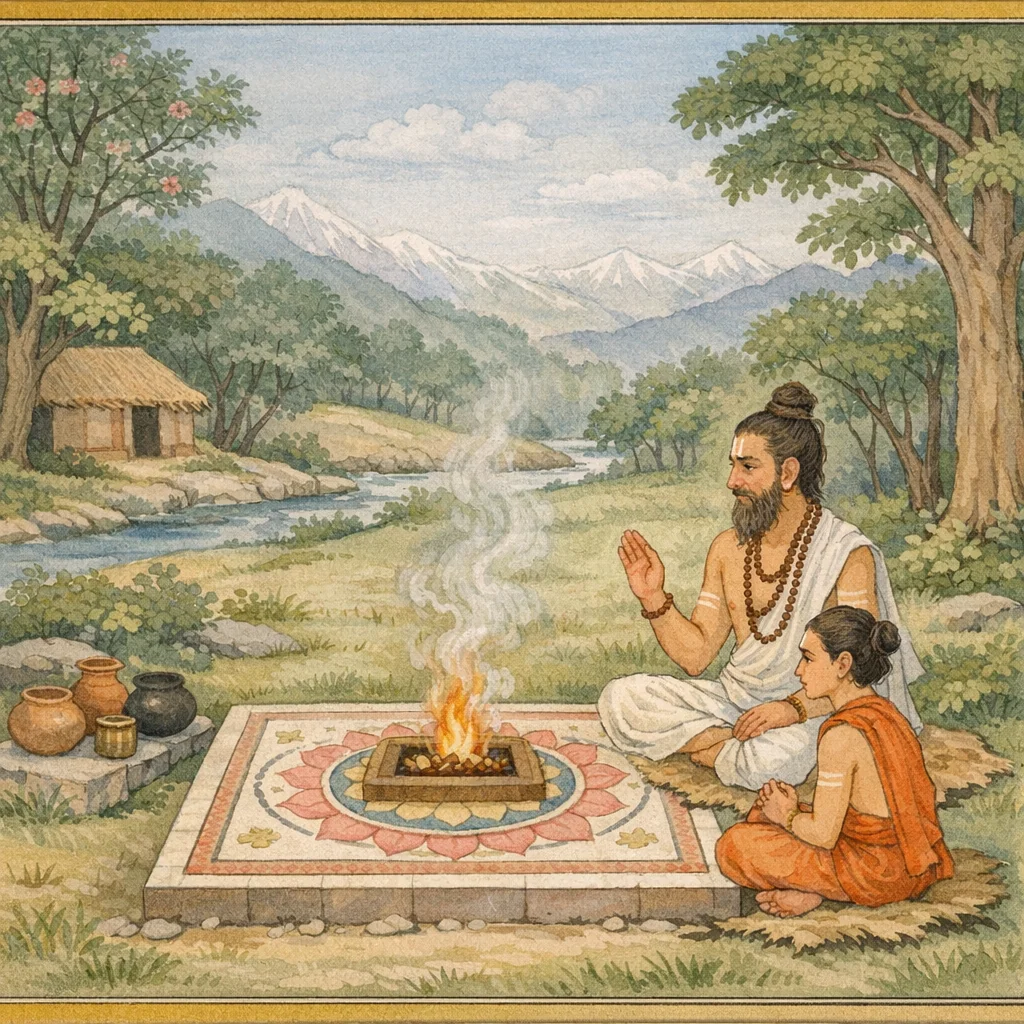
अग्निकार्य-होमविधिः (Agnikārya and Homa Procedure)
Adhyāya 27, taught by Upamanyu, sets out the procedure of agnikārya—how to establish and sanctify the ritual fire and then perform homa as worship of Mahādeva. It first lists permitted settings and receptacles: a kuṇḍa (fire-pit), sthaṇḍila (prepared ground), vedi (altar), or iron vessels or new auspicious clay vessels. After installing the fire according to vidhāna and completing preliminary consecrations (saṃskāra), the practitioner worships Mahādeva and begins the offerings. The chapter then details ritual design: recommended kuṇḍa dimensions (one or two hasta), acceptable shapes (circular or square), and the construction of vedi and maṇḍala, including an eight-petalled lotus (aṣṭadalāmbuja) at the center with relief measured in aṅgulas, and the measure convention (24 aṅgulas = one kara/hasta). It further instructs on one to three mekhalās (encircling bands), stable and pleasing earthen construction, alternative yoni forms, and placement and orientation. Materials and purification are noted—smearing kuṇḍa/vedi with cow-dung and water and preparing the maṇḍala with cow-dung water—while some vessel measures are left unfixed. Overall, it serves as a ritual-architectural blueprint for Śaiva homa centered on Mahādeva.
Shlokas
Verse 1
उपमन्युरुवाच । अथाग्निकार्यं वक्ष्यामि कुण्डे वा स्थंडिले ऽपि वा । वेद्यां वा ह्यायसे पात्रे मृन्मये वा नवे शुभे
Upamanyu said: “Now I shall describe the rite connected with the sacred fire—whether it is performed in a fire-pit, or even on a prepared earthen altar; or upon a vedi, or in an iron vessel, or in a new and auspicious earthen pot.”
Verse 2
आधायाग्निं विधानेन संस्कृत्य च ततः परम् । तत्राराध्य महादेवं होमकर्म समाचरेत्
Having kindled the sacred fire according to the prescribed rule and then duly consecrated it, one should worship Mahādeva there and perform the rite of fire-offering (homa).
Verse 3
कुण्डं द्विहस्तमानं वा हस्तमात्रमथापि वा । वृत्तं वा चतुरस्रं वा कुर्याद्वेदिं च मण्डलम्
One should make a fire-pit (kuṇḍa) measuring either two cubits or even just one cubit. It may be circular or square; and one should also prepare the altar (vedī) and the ritual diagram (maṇḍala).
Verse 4
कुण्डं विस्तारवन्निम्नं तन्मध्ये ऽष्टदलाम्बुजम् । चतुरंगुलमुत्सेधं तस्य द्व्यंगुलमेव वा
The ritual basin (kuṇḍa) should be broad and gently depressed; in its middle there should be an eight-petalled lotus. Its raised portion should be four finger-breadths in height—or, alternatively, only two finger-breadths.
Verse 5
वितस्तिद्विगुणोन्नत्या नाभिमन्तः प्रचक्षते । मध्यं च मध्यमांगुल्या मध्यमोत्तमपर्वणोः
They declare that the region about the navel rises to the height of twice a vitasti (a span). And the “middle” is said to be on the middle finger, at the joint between its middle and upper phalanges.
Verse 6
अंगुलैः कथ्यते सद्भिश्चतुर्विंशतिभिः करः । मेखलानां त्रयं वापि द्वयमेकमथापि वा
The virtuous declare that a “hand” (kara) is measured as twenty-four aṅgulas (finger-breadths). For the sacred girdles (mekhalās), one may wear three, or two, or even one.
Verse 7
यथाशोभं प्रकुर्वीत श्लक्ष्णमिष्टं मृदा स्थिरम् । अश्वत्थपत्रवद्योनिं गजाधारवदेव वा
One should fashion it beautifully—smooth, pleasing, and firm—using well-settled clay; and one should form its base (yoni-pīṭha) either like an aśvattha leaf, or like the pedestal-support of an elephant.
Verse 8
मेखलामध्यतः कुर्यात्पश्चिमे दक्षिणे ऽपि वा । शोभनामग्नितः किंचिन्निम्नामुन्मीलिकां शनैः
From the middle of the mekhalā (the altar’s enclosing line), one should form it—either on the western or on the southern side. From the fire, one should slowly make a beautiful opening, slightly depressed, as an outlet.
Verse 9
अग्रेण कुण्डाभिमुखीं किंचिदुत्सृज्य मेखलाम् । नोत्सेधनियमो वेद्याः सा मार्दी वाथ सैकती
Let the mēkhalā (girdle) be set slightly forward, facing the kuṇḍa (sacred fire-pit), leaving a small space in front. Know that no fixed rule is taught regarding its height or elevation; it may be made of clay or of sand.
Verse 10
मंडलं गोशकृत्तोयैर्मानं पात्रस्य नोदितम् । कुण्डं च मृन्मयं वेदिमालिपेद्गोमयांबुना
With water mixed with cow-dung, one should mark the ritual maṇḍala. The measure of the pātra (vessel) is not separately prescribed here. One should also prepare an earthen kuṇḍa, and smear the vedī (altar) with water mixed with cow-dung.
Verse 11
प्रक्षाल्य तापयेत्पात्रं प्रोक्षयेदन्यदंभसा । स्वसूत्रोक्तप्रकारेण कुण्डादौ विल्लिखेत्ततः
Having washed the pātra (ritual vessel), one should heat it and then sprinkle it with other purifying water. Thereafter, in the manner prescribed in one’s own ritual sūtra, one should mark out the required lines and designs in the kuṇḍa and the related ritual area.
Verse 12
संप्रोक्ष्य कल्पयेद्दर्भैः पुष्पैर्वा वह्निविष्टरम् । अर्चनार्थं च होमार्थं सर्वद्रव्याणि साधयेत्
Having purified the place and materials by sprinkling sanctified water, one should arrange the vahni-viṣṭara (seat of the sacred fire) with darbha grass or with flowers. For arcanā (worship) and for homa (oblations into the fire), one should duly prepare all the required ritual substances.
Verse 13
प्रक्षाल्यक्षालनीयानि प्रोक्षण्या प्रोक्ष्य शोधयेत् । मणिजं काष्ठजं वाथ श्रोत्रियागारसम्भवम्
Whatever is fit to be washed should be washed; and whatever is fit to be purified by sprinkling should be purified by sprinkling with sanctified water. Whether it is made of gems or of wood, or has arisen from the house of a learned Vedic priest, it should be ritually cleansed.
Verse 14
अन्यं वाभ्यर्हितं वह्निं ततः साधारमानयेत् । त्रिः प्रदक्षिणमावृत्य कुण्डादेरुपरि क्रमात्
Or else, one should bring another sacred fire, duly honored, and merge it into the common ritual fire. Having circumambulated three times in the auspicious rightward pradakṣiṇā, one should proceed step by step over the area above the fire-pit (kuṇḍa) and its adjoining ritual ground.
Verse 15
वह्निबीजं समुच्चार्य त्वादधीताग्निमासने । योनिमार्गेण वा तद्वदात्मनः संमुखेन वा
Having clearly uttered the fire-seed mantra (vahni-bīja), one should place it upon the “seat of Agni” within oneself—either by the yoni-path (the generative channel) or likewise before oneself, with the awareness turned inward. Thus the sādhaka kindles the mantra’s purifying fire, cutting the bonds (pāśa) and turning the bound soul (paśu) toward the Lord (Pati), Śiva.
Verse 16
नियोगः प्रदेश सर्वं कुंडं कुर्याद्विचक्षणः । स्वनाभ्यंतःस्थितं वह्निं तद्रंध्राद्विस्फुलिंगवद्
An intelligent practitioner should, in the appointed place, prepare the entire fire-pit (kuṇḍa). Then, contemplating the inner fire stationed within one’s own navel, one should kindle it forth through that aperture, as though it were a spark leaping out.
Verse 17
निर्गम्य पावके बाह्ये लीनं बिंबाकृति स्मरेत् । आज्यसंस्कारपर्यंतमन्वाधानपुरस्सरम्
Having drawn (awareness) outward into the external sacred fire, one should meditate on the subtle, emblem-like form as merged within it—beginning with the anvādhāna rite and continuing up to the ājya-saṃskāra, the consecration of ghee.
Verse 18
स्वसूत्रोक्तक्रमात्कुर्यान्मूलमन्त्रेण मन्त्रवित् । शिवमूर्तिं समभ्यर्च्य ततो दक्षिणपार्श्वतः
Following the procedure enjoined in one’s own ritual sūtra, the knower of mantra should perform the worship using the root-mantra. Having duly worshipped the image of Śiva, he should then proceed to the right side (of the deity/altar) thereafter.
Verse 19
न्यस्य मन्त्रं घृते मुद्रां दर्शयेद्धेनुसंज्ञिताम् । स्रुक्स्रुवौ तैजसौ ग्राह्यौ न कांस्यायससैसकौ
Having first placed (invoked) the mantra into the ghee, one should display the hand-gesture known as the “Dhenumudrā.” For the ladle and spoon, vessels made of shining metal should be used; those made of bell-metal, iron, or lead are not to be used.
Verse 20
यज्ञदारुमयौ वापि स्मार्तौ वा शिल्पसम्मतौ । पर्णे वा ब्रह्मवृक्षादेरच्छिद्रे मध्य उत्थिते
Whether fashioned from sacrificial wood, or prescribed by the Smṛtis, or approved by the canons of sacred craftsmanship; or even set upon an unbroken leaf of the holy Brahma-tree and the like, raised upright at the center—in all such ways the worship of Śiva’s sacred emblem (liṅga) is to be duly arranged.
Verse 21
संसृज्य दर्भैस्तौ वह्नौ संताप्य प्रोक्षयेत्पुनः । पारार्षर्च्यस्वसूत्रोक्तक्रमेण शिवपूर्वकैः
Having arranged the two sacred fires with darbha grass, he should kindle them well and then again sprinkle them with sanctified water. Thereafter, following the sequence taught in his own ritual sūtra, he should worship the lineage of sages (pārārṣa), beginning with Lord Śiva.
Verse 22
जुहुयादष्टभिर्बीजैरग्निसंस्कारसिद्धये । भ्रुंस्तुंब्रुश्रुं क्रमेणैव पुंड्रंद्रमित्यतः परम्
To perfect the consecration of the sacred fire, one should offer oblations with the eight seed-mantras. In proper sequence, uttering “bhruṃ, stuṃ, bru, śruṃ”, and thereafter “puṃḍraṃ, dram” as the subsequent syllables, he should proceed accordingly.
Verse 23
बीजानि सप्त सप्तानां जिह्वानामनुपूर्वशः । त्रिशिखा मध्यमा जिह्वा बहुरूपसमाह्वया
The seven seed-syllables (bīja) of the seven tongues of the sacred fire are to be known in due order. The middle tongue is called Triśikhā, invoked as the one of many forms.
Verse 24
रक्ताग्नेयी नैरृती च कृष्णान्या सुप्रभा मता । अतिरिक्ता मरुज्जिह्वा स्वनामानुगुणप्रभा
Raktāgneyī and Nairṛtī, and another power called Kṛṣṇā, are regarded as Suprabhā. Likewise, Atiriktā and Marujjihvā shine with a radiance that accords with their very names.
Verse 25
स्वबीजानन्तरं वाच्या स्वाहांतञ्च यथाक्रमम् । जिह्वामंत्रैस्तु तैर्हुत्वाज्यं जिह्वास्त्वेकैकश क्रमात्
Then, after uttering each seed-syllable (bīja), one should recite, in proper sequence, the mantra that ends with “svāhā.” With those jihvā-mantras, one should offer ghee into the Fire, invoking the divine tongues of Agni one by one, in due order.
Verse 26
रं वह्नयेति स्वाहेति मध्ये हुत्वाहुतित्रयम् । सर्पिषा वा समिद्भिर्वा परिषेचनमाचरेत्
Having offered the triple oblation into the Fire—uttering “raṁ,” “to Agni (vahnaye),” and “svāhā” in due order—one should then perform parisechana, the rite of sprinkling or encircling the offering, using either ghee or the sacred fuel-sticks (samidh).
Verse 27
दीपान्तं परिषिच्याथ समिद्धोमं समाचरेत् । ताः पालाश्यः परा वापि याज्ञिया द्वादशांगुलाः
Having then sprinkled water around the end of the lamp, one should duly perform the homa, the fire-offering, with kindling set aflame. Those sticks, of Palāśa wood—or alternatively other prescribed sacrificial woods—should be of the ritual measure of twelve finger-breadths.
Verse 28
अवक्रा न स्वयं शुष्कास्सत्वचो निर्व्रणाः समाः । दशांगुला वा विहिताः कनिष्ठांगुलिसंमिताः
They should be neither bent nor naturally dried; their skin should be intact, free from wounds, and uniform. The prescribed measure is ten finger-breadths, reckoned by the breadth of the little finger.
Verse 29
प्रादेशमात्रा वालाभे होतव्याः सकला अपि । दूर्वापत्रसमाकारां चतुरंगुलमायताम्
All of them should be offered in the measure of a span, shaped like the leaf of dūrvā grass, and extending to four finger-breadths in length.
Verse 30
दद्यादाज्याहुतिं पश्चादन्नमक्षप्रमाणतः । लाजांस्तथा सर्षपांश्च यवांश्चैव तिलांस्तथा
Then one should offer oblations of ghee; thereafter, one should offer cooked rice in measures like an akṣa (a fixed small measure), and likewise offer parched grains (lājā), mustard seeds, barley, and sesame—thus completing the prescribed sequence of offerings in Śiva’s rite.
Verse 31
सर्पिषाक्तानि भक्ष्याणि लेह्यचोष्याणि सम्भवे । दशैवाहुतयस्तत्र पञ्च वा त्रितयं च वा
In that rite, edible offerings—foods to be eaten, licked, or sucked—should be prepared mixed with ghee. There, the oblations should be offered ten times, or else five times, or even three times.
Verse 32
होतव्याः शक्तितो दद्यादेकमेवाथ वाहुतिम् । श्रुवेणाज्यं समित्याद्यास्रुचाशेषात्करेण वा
As far as one is able, one should offer the oblations; even a single offering may be given. Ghee may be offered with the ladle, and if no ladle is available, it may be offered using fuel-sticks and the like, with a spoon, or even with the hand.
Verse 33
तत्र दिव्येन होतव्यं तीर्थेनार्षेण वा तथा । द्रव्येणैकेन वा ऽलाभे जुहुयाच्छ्रद्धया पुनः
In that rite, one should perform the oblation with a sacred, consecrated offering, or with sanctified water from a tīrtha, or with a Vedic offering sanctioned by the ṛṣi. And if such materials are unavailable, one should still offer even a single obtainable substance—again, with steadfast faith.
Verse 34
प्रायश्चित्ताय जुहुयान्मंत्रयित्वाहुतित्रयम् । ततो होमविशिष्टेन घृतेनापूर्य वै स्रुचम्
For expiation (prāyaścitta), one should, after sanctifying with mantra, offer three oblations into the sacred fire. Then, filling the sruva (ritual ladle) with ghee specially consecrated through the homa, one should proceed with the rite.
Verse 35
निधाय पुष्पं तस्याग्रे श्रुवेणाधोमुखेन ताम् । सदर्भेन समाच्छाद्य मूलेनांजलिनोत्थितः
Placing a flower before it, he set the śruva (ritual ladle) face-down. Then, covering it with darbha grass, he rose from the very base of the seat/altar, lifting his hands joined in añjali (reverence).
Verse 36
वौषडंतेन जुहुयाद्धारां तु यवसंमिताम् । इत्थं पूर्णाहुतिं कृत्वा परिषिंचेच्च पूर्ववत्
With the mantra ending in “vauṣaṭ”, he should offer into the fire a continuous stream of oblation, measured to the size of a barley-grain. Thus, having performed the pūrṇāhuti (final complete offering), he should sprinkle the sanctified water again, as prescribed earlier.
Verse 37
तत उद्वास्य देवेशं गोपयेत्तु हुताशनम् । तमप्युद्वास्य वा नाभौ यजेत्संधाय नित्यशः
Then, having respectfully dismissed the Lord of the gods (Śiva) from the rite, one should carefully preserve the sacred fire. Or, having dismissed that fire as well, one should perform daily worship by establishing the inner focus at the navel-centre, in steady concentration.
Verse 38
अथवा वह्निमानीय शिवशास्त्रोक्तवर्त्मना । वागीशीगर्भसंभूतं संस्कृत्य विधिवद्यजेत्
Or else, having brought the sacred fire, following the path taught in Śiva’s scriptures, one should duly consecrate that which is born from Vāgīśī’s womb, and then worship it according to the prescribed rite.
Verse 39
अन्वाधानं पुनः कृत्वा परिधीन् परिधाय च । पात्राणि द्वन्द्वरूपेण निक्षिप्येष्ट्वा शिवं ततः
Having again performed the anvādhāna—the rite of kindling and establishing the sacred fire—and having set the enclosing sticks (paridhis) around it, one should place the ritual vessels in paired order; then, according to due procedure, one should worship Lord Śiva.
Verse 40
संशोध्य प्रोक्षणीपात्रं प्रोक्ष्यतानि तदंभसा । प्रणीतापात्रमैशान्यां विन्यस्या पूरितं जलैः
Having purified the sprinkling vessel (prokṣaṇī), one should sprinkle those ritual articles with that very water. Then, placing the praṇītā-vessel in the north-eastern (Īśāna) direction, one should set it there filled with water.
Verse 41
आज्यसंस्कारपर्यंतं कृत्वा संशोध्य स्रक्स्रुवौ । गर्भाधानं पुंसवनं सीमन्तोन्नयनं ततः
Having performed the rites up to the ājya-saṃskāra (the consecration of ghee) and having purified the garland and the ladle, one should then proceed with the sacraments of garbhādhāna (conception), puṃsavana (begetting a worthy child), and sīmantonnayana (the hair-parting rite for the expectant mother).
Verse 42
कृत्वा पृथक्पृथग्घुत्वा जातमग्निं विचिन्तयेत् । त्रिपादं सप्तहस्तं च चतुःशृंगं द्विशीर्षकम्
Having performed the oblations separately and duly, one should meditate upon the newly kindled sacred Fire—three-footed, seven-handed, four-horned, and two-headed.
Verse 43
मधुपिंगं त्रिनयनं सकपर्देन्दुशेखरम् । रक्तं रक्ताम्बरालेपं माल्यभूषणभूषितम्
He is honey-golden in hue, three-eyed, and bears matted locks (jaṭā) crowned with the crescent moon. He appears in a red form, adorned with red garments and red unguents, and embellished with garlands and ornaments.
Verse 44
सर्वलक्षणसंपन्नं सोपवीतं त्रिमेखलम् । शक्तिमन्तं स्रुक्स्रुवौ च दधानं दक्षिणे करे
He was endowed with all auspicious marks, wearing the sacred thread (upavīta) and the threefold girdle. Possessed of spiritual power, he held the srūk ladle and the srūva smaller offering-spoon in his right hand.
Verse 45
तोमरं तालवृंतं च घृतपात्रं तथेतरैः । जातं ध्यात्वैवमाकारं जातकर्म समाचरेत्
Visualizing the newborn in such a form—as if associated with a spear, a palm-stalk, a vessel of ghee, and other auspicious articles—one should then duly perform the birth-rite (jātakarma).
Verse 46
नालापनयनं कृत्वा ततः संशोध्य सूतकम् । शिवाग्निरुचिनामास्य कृत्वाहुतिपुरस्सरम्
After performing the rite of nālāpanayana to remove impurity, and then purifying oneself from the state of ritual defilement (sūtaka), one should establish the sacred fire named “Śivāgniruci” and begin by offering oblations (āhuti) into it.
Verse 47
पित्रोर्विसर्जनं कृत्वा चौलोपनयनादिकम् । अप्तोर्यामावसानान्तं कृत्वा संस्कारमस्य तु
Having duly performed the concluding rites for the parents, and also the sacraments beginning with the tonsure and the sacred-thread initiation, and having completed the rite up to the concluding Aptoryāma, one should then perform his (further) saṃskāra in due order.
Verse 48
आज्यधारादिहोमं च कृत्वा स्विष्टकृतं ततः । रमित्यनेन बीजेन परिषिंचेत्ततः परम्
Having performed the oblation beginning with the ājyadhārā (the offering-stream of ghee) and then the concluding rite called sviṣṭakṛt, one should thereafter sprinkle (the sanctified substance) with the seed-mantra “ram”, as the next step.
Verse 49
ब्रह्मविष्णुशिवेशानां लोकेशानां तथैव च । तदस्त्राणां च परितः कृत्वा पूजां यथाक्रमम्
Then, in due order, one should perform worship—of Brahmā, Viṣṇu, Śiva and Īśāna, of the Lokapālas (guardians of the worlds) as well, and also of their divine weapons—making the offerings all around in a prescribed sequence.
Verse 50
धूपदीपादिसिद्ध्यर्थं वह्निमुद्धृत्य कृत्यवित् । साधयित्वाज्यपूर्वाणि द्रव्याणि पुनरेव च
For the successful preparation of incense, lamps, and related offerings, the ritual expert should kindle the sacred fire; and having duly prepared the materials—beginning with ghee—he should again proceed with the rite.
Verse 51
कल्पयित्वासनं वह्नौ तत्रावाह्य यथापुरा । संपूज्य देवं देवीं च ततः पूर्णांतमाचरेत्
Having arranged a seat within the sacred fire, one should invoke (Śiva) there as done previously. After duly worshipping the Lord and the Goddess together, one should then perform the concluding rite (pūrṇāhuti) to completion.
Verse 52
अथ वा स्वाश्रमोक्तं तु वह्निकर्म शिवार्पणम् । बुद्ध्वा शिवाश्रमी कुर्यान्न च तत्रापरो विधिः
Or else, understanding that the fire-ritual prescribed for one’s own āśrama (stage of life) is to be offered to Śiva, the devotee who abides in Śiva’s discipline should perform it accordingly; in this matter there is no other separate rule.
Verse 53
शिवाग्नेर्भस्मसंग्राह्यमग्निहोत्रोद्भवं तु वा । वैवाहोग्निभवं वापि पक्वं शुचि सुगंधि च
One should collect bhasma (sacred ash) from the fire dedicated to Śiva; or from the ash produced by the Agnihotra; or even from the sacred marriage-fire. It should be well-burnt, pure, and pleasantly fragrant.
Verse 54
कपिलायाः शकृच्छस्तं गृहीतं गगने पतत् । न क्लिन्नं नातिकठिनं न दुर्गन्धं न शोषितम्
A handful of dung from the tawny cow Kapilā was taken; as it fell through the sky, it was neither wet, nor excessively hard, nor foul-smelling, nor dried up—thus revealing its wondrous, untainted nature.
Verse 55
उपर्यधः परित्यज्य गृह्णीयात्पतितं यदि । पिंडीकृत्य शिवाग्न्यादौ तत्क्षिपेन्मूलमंत्रतः
If anything has fallen (and become impure), one should avoid touching it from above or below. Having gathered it, one should roll it into a lump and cast it into the Śiva-fire (the consecrated ritual fire), accompanied by the recitation of the root mantra, thereby restoring ritual purity through Śiva’s mantra and fire.
Verse 56
अपक्वमतिपाक्वं च संत्यज्य भसितं सितम् । आदाय वा समालोड्य भस्माधारे विनिक्षिपेत्
Discarding ash that is under-burnt or over-burnt, one should take the pure white ash. Then, having gathered it and sifted it well, one should place it in a proper vessel meant for sacred ash.
Verse 57
तैजसं दारवं वापि मृन्मयं शैलमेव च । अन्यद्वा शोभनं शुद्धं भस्माधारं प्रकल्पयेत्
One should prepare a receptacle for the sacred ash (bhasma)—made of metal, or wood, or clay, or stone; or else any other clean and beautiful vessel—so that the bhasma may be properly kept for worship.
Verse 58
समे देशे शुभे शुद्धे धनवद्भस्म निक्षिपेत् । न चायुक्तकरे दद्यान्नैवाशुचितले क्षिपेत्
One should place the sacred ash (bhasma) in an even, auspicious, and pure place, treating it as a precious treasure. It should not be given into an unfit hand, nor should it ever be cast upon an impure ground.
Verse 59
न संस्पृशेच्च नीचांगैर्नोपेक्षेत न लंघयेत् । तस्माद्भसितमादाय विनियुंजीत मन्त्रतः
One should not let the sacred ash be touched by impure limbs, nor treat it with neglect, nor transgress its sanctity. Therefore, taking up the bhasma, one should apply and employ it only in accordance with mantra—reverently and ritually.
Verse 60
कालेषूक्तेषु नान्यत्र नायोग्येभ्यः प्रदापयेत् । भस्मसंग्रहणं कुर्याद्देवे ऽनुद्वासिते सति
Only at the prescribed times—and not at any other time—should it be bestowed, and never upon those who are unfit. One should gather the sacred ash (bhasma) only while the deity has not yet been dismissed from the rite.
Verse 61
उद्वासने कृते यस्माच्चण्डभस्म प्रजापते । अग्निकार्ये कृते पश्चाच्छिवशास्त्रोक्तमार्गतः
When the dismissal (udvāsana) has been performed, then—O Prajāpati—after the fire-rite is completed, one should proceed thereafter in the manner taught in the Śiva-śāstra, applying the consecrated ash (bhasma) according to that prescribed path.
Verse 62
स्वसूत्रोक्तप्रकाराद्वा बलिकर्म समाचरेत् । अथ विद्यासनं न्यस्य सुप्रलिप्ते तु मण्डले
Or else, one should perform the offering-rite (balikarma) in the manner prescribed in one’s own ritual sūtra. Then, in a well-smeared and duly prepared maṇḍala, one should place (install) the seat of sacred knowledge (vidyāsana).
Verse 63
विद्याकोशं प्रतिष्ठाप्य यजेत्पुष्पादिभिः क्रमात् । विद्यायाः पुरतः कृत्वा गुरोरपि च मण्डलम्
After duly installing the ‘treasury of knowledge’ (vidyākośa), one should worship it in due order with flowers and the like. Placing it before Vidyā, one should also make a maṇḍala for the Guru and worship accordingly.
Verse 64
तत्रासनवरं कृत्वा पुष्पाद्यै गुरुमर्चयेत् । ततोनुपूजयेत्पूज्यान् भोजयेच्च बुभुक्षितान्
There, having arranged an excellent seat, one should worship the Guru with flowers and other offerings. Thereafter, one should duly honor those worthy of reverence, and also feed those who are hungry.
Verse 65
ततस्स्वयं च भुंजीत शुद्धमन्नं यथासुखम् । निवेदितं च वा देवे तच्छेषं चात्मशुद्धये
Thereafter, one should oneself partake of pure food in ease and without distress. Or one should eat the remainder of what was first offered to the Deity, for that sacred remnant (prasāda) purifies the self.
Verse 66
श्रद्दधानो न लोभेन न चण्डाय समर्पितम् । गन्धमाल्यादि यच्चान्यत्तत्राप्येष समो विधिः
With faith—never out of greed, and never offered to a fierce and impure recipient—whatever other offerings there are, such as fragrances, garlands, and the rest, for those too this same rule of proper worship applies.
Verse 67
न तु तत्र शिवोस्मीति बुद्धिं कुर्याद्विचक्षणः । भुक्त्वाचम्य शिवं ध्यात्वा हृदये मूलमुच्चरेत्
But the discerning person should not, in that context, entertain the thought, “I am Śiva.” After eating and then performing ācamana, meditating on Śiva, one should in the heart recite the root-mantra (mūla-mantra).
Verse 68
कालशेषं नयेद्योग्यैः शिवशास्त्रकथादिभिः । रात्रौ व्यतीते पूर्वांशे कृत्वा पूजां मनोहराम्
One should pass the remaining time in worthy ways—such as recitations and discussions of Śiva’s scriptures. When the earlier part of the night has passed, having performed a beautiful and pleasing worship (of Lord Śiva)…
Verse 69
शिवयोः शयनं त्वेकं कल्पयेदतिशोभनम् । भक्ष्यभोज्यांबरालेपपुष्पमालादिकं तथा
One should arrange a single, exceedingly beautiful bed for Śiva and Devī together, and likewise offer delicacies and cooked foods, garments, fragrant unguents, flower-garlands, and other items—thus honoring the Divine Couple in reverent, loving worship.
Verse 70
मनसा कर्मणा वापि कृत्वा सर्वं मनोहरम् । ततो देवस्य देव्याश्च पादमूले शुचिस्स्वपेत्
Having made everything pleasing and auspicious—whether by mind or by deed—then, remaining pure, one should sleep at the foot of the Lord and the Goddess, in devoted attendance.
Verse 71
गृहस्थो भार्यया सार्धं तदन्ये ऽपि तु केवलाः । प्रत्यूषसमयं बुद्ध्वा मात्रामाद्यामुदीरयेत्
A householder, together with his wife—and the others as well, each individually—having recognized the time of dawn, should utter the first mātrā, the sacred sound “Oṃ,” as the beginning of worship.
Verse 72
प्रणम्य मनसां देवं सांबं सगणमव्ययम् । देशकालोचितं कृत्वा शौचाद्यमपि शक्तितः
Having bowed in the mind to the God of all minds—Śiva, ever with Umā, attended by his gaṇas, and imperishable—one should then, as is fitting to place and time, perform purification and the other preliminary observances, to the best of one’s ability.
Verse 73
शंखादिनिनदैर्दिव्यैर्देवं देवीं च बोधयेत् । ततस्तत्समयोन्निद्रैः पुष्पैरतिसुगंधिभिः
With divine sounds—such as the conch (śaṅkha) and other auspicious instruments—one should awaken the Lord and the Goddess. Then, at the proper time, one should offer them fully blossomed, exceedingly fragrant flowers.
Verse 74
निर्वर्त्य शिवयोः पूजां प्रारभेत पुरोदितम्
Having duly completed the worship of Śiva and Śakti, one should then begin the rite that has been prescribed beforehand.
Frequently Asked Questions
It teaches agnikārya leading into homa: installing the fire with prescribed consecrations, worshipping Mahādeva at the fire, and then performing the offering-ritual with attention to altar design and purity.
The maṇḍala sacralizes space through geometry, while the eight-petalled lotus functions as a symbolic center (nābhi) of ordered worship—mapping cosmic/inner order onto the ritual ground where Śiva is invoked.
Mahādeva is the primary recipient and focus of worship, approached through Agni as the ritual medium; the chapter emphasizes Śiva’s accessibility through correctly established sacrificial space and fire.
Read Shiva Purana in the Vedapath app
Scan the QR code to open this directly in the app, with audio, word-by-word meanings, and more.