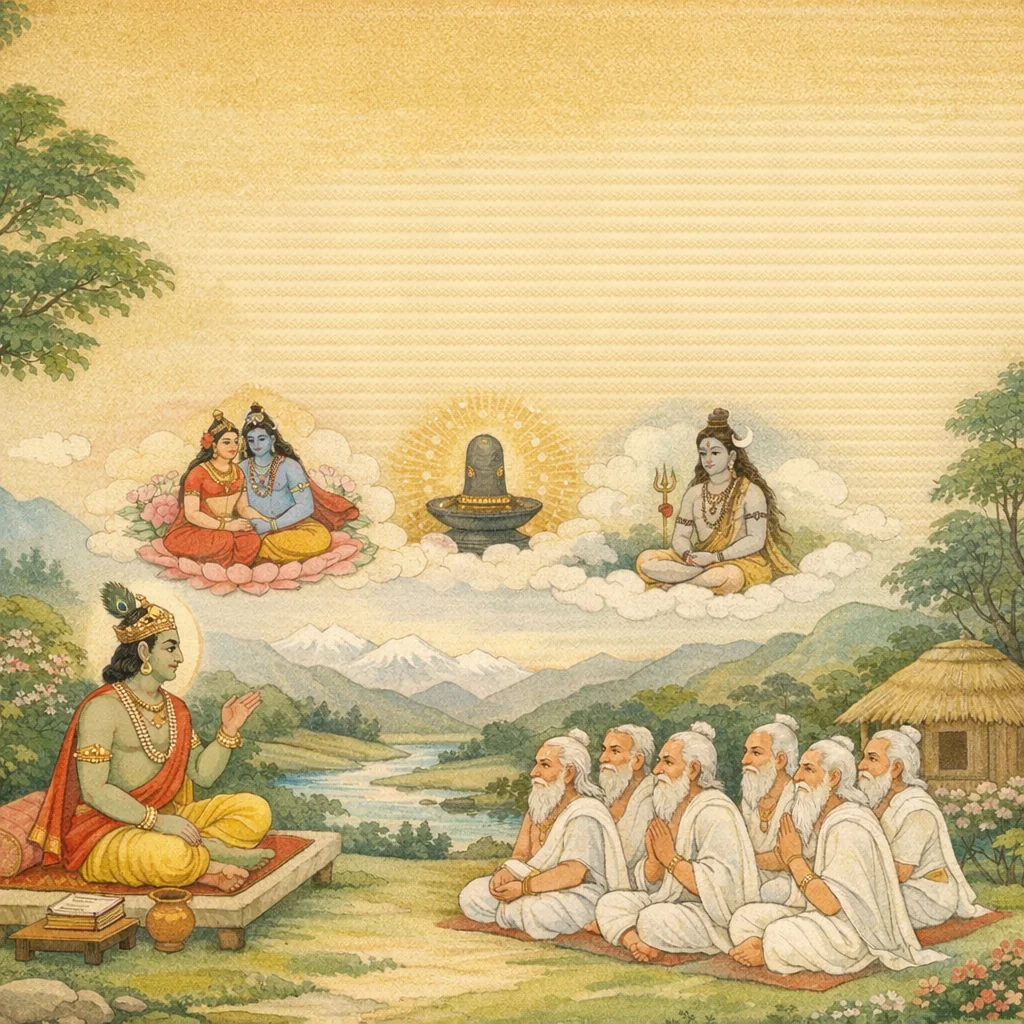
पशु-पाश-पतिविचारः / Inquiry into Paśu, Pāśa, and Pati
Adhyāya 6 proceeds as a question–answer dialogue in which the sages ask Vāyu to clarify the ontological identities of paśu (the bound experiencer) and pāśa (the binding principle), and to indicate their transcendent Lord, pati. Vāyu establishes that creation requires a conscious, intelligent cause (buddhimat-kāraṇa); insentient principles (acetanam)—whether pradhāna, atoms, or other material categories—cannot explain an ordered universe without a knowing agency. The chapter distinguishes agency: though paśu appears to act, its effective power is derivative and functions under the Lord’s preraṇā (impulsion), like the movement of a blind person lacking right cognition. It then presents the soteriological conclusion that there is a supreme pada beyond the empirical for paśu, pāśa, and pati, and that knowing this truth (tattvavidyā/brahmavidyā) leads to yonimukti, freedom from rebirth. Reality is further framed as a triad—bhoktā (enjoyer), bhogya (enjoyed/object), and prerayitā (impeller)—and it is affirmed that beyond this threefold discernment nothing higher remains to be known by the seeker of release.
Shlokas
Verse 1
मुनय ऊचुः । यो ऽयं पशुरिति प्रोक्तो यश्च पाश उदाहृतः । अभ्यां विलक्षणः कश्चित्कोयमस्ति तयोः पतिः
The sages said: “He who is called paśu, the bound soul, and that which is declared to be pāśa, the bond—who is the Reality distinct from both, their Lord, Pati?”
Verse 2
वायुरुवाच । अस्ति कश्चिदपर्यंतरमणीयगुणाश्रयः । पतिर्विश्वस्य निर्माता पशुपाशविमोचनः
Vāyu said: “There exists One, the boundless abode of infinitely delightful excellences. He is Pati, Lord of the universe, its Maker, and the Liberator who frees the paśu from the pāśa.”
Verse 3
अभावे तस्य विश्वस्य सृष्टिरेषा कथं भवेत् । अचेतनत्वादज्ञानादनयोः पशुपाशयोः
If That—the Supreme Lord—were absent, how could this creation of the universe ever come to be? For both the paśu (the bound soul) and the pāśa (the bond) are insentient and ignorant, and therefore cannot originate creation by themselves.
Verse 4
प्रधानपरमाण्वादि यावत्किंचिदचेतनम् । तत्कर्तृकं स्वयं दृष्टं बुद्धिमत्कारणं विना
From Pradhāna (primordial matter) down to the atom and whatever else is insentient, it is never seen to act as an independent producer of effects without an intelligent cause. Therefore the world’s insentient basis cannot be the ultimate maker; it requires the Lord, the conscious Pati.
Verse 5
जगच्च कर्तृसापेक्षं कार्यं सावयवं यतः । तस्मात्कार्यस्य कर्तृत्वं पत्युर्न पशुपाशयोः
Since the world is an effect—dependent on an efficient cause—and is composite, made of parts, therefore the agency (doership) with respect to this effect belongs to the Lord, Pati, alone, not to the bound soul (Paśu) nor to bondage (Pāśa).
Verse 6
पशोरपि च कर्तृत्वं पत्युः प्रेरणपूर्वकम् । अयथाकरणज्ञानमंधस्य गमनं यथा
Even the bound soul as paśu has agency only when preceded by the Lord Pati’s impelling will. Its knowing and acting without true discernment is like the movement of a blind person—going on, yet not seeing the right way.
Verse 7
आत्मानं च पृथङ्मत्वा प्रेरितारं ततः पृथक् । असौ जुष्टस्ततस्तेन ह्यमृतत्वाय कल्पते
When one discriminates the self as distinct, and then recognizes the Impeller—the Lord—as distinct from that self, one becomes accepted by Him; and by His grace, that person becomes fit for immortality (liberation).
Verse 8
पशोः पाशस्य पत्युश्च तत्त्वतो ऽस्ति पदं परम् । ब्रह्मवित्तद्विदित्वैव योनिमुक्तो भविष्यति
In truth there exists a supreme state (pada) concerning the paśu (soul), the pāśa (bondage), and the Pati (Lord). The knower of Brahman—by realizing That alone—becomes free from repeated embodiment, released from the womb of rebirth.
Verse 9
संयुक्तमेतद्द्वितयं क्षरमक्षरमेव च । व्यक्ताव्यक्तं बिभर्तीशो विश्वं विश्वविमोचकः
The Lord bears this paired reality—both the perishable and the imperishable, the manifest and the unmanifest. He upholds the universe and, as the Liberator of the cosmos (viśva-vimocaka), releases it from bondage.
Verse 10
भोक्ता भोग्यं प्रेरयिता मंतव्यं त्रिविधं स्मृतम् । नातः परं विजानद्भिर्वेदितव्यं हि किंचनः
The knower should understand this triad: the experiencer (the bound paśu), the object of experience (the world of enjoyables), and the impelling Lord—the inner Ruler. Beyond this, for those who truly discern, there is nothing further that must be known.
Verse 11
तिलेषु वा यथा तैलं दध्नि वा सर्पिरर्पितम् । यथापः स्रोतसि व्याप्ता यथारण्यां हुताशनः
As oil abides within sesame seeds and ghee is contained within curd; as water pervades a flowing stream and fire spreads through a forest—so the Lord (Śiva), the inner Self, pervades all beings and all worlds, though unseen to the outward gaze.
Verse 12
एवमेव महात्मानमात्मन्यात्मविलक्षणम् । सत्येन तपसा चैव नित्ययुक्तो ऽनुपश्यति
In the same way, the ever-disciplined seeker, through truthfulness and austerity (tapas), steadily beholds the Mahātman—distinct from the individual self—abiding within the self.
Verse 13
य एको जालवानीश ईशानीभिस्स्वशक्तिभिः । सर्वांल्लोकानिमान् कृत्वा एक एव स ईशते १
He is the one Lord, mighty and all-pervading; by His own powers—the Śaktis known as the Īśānīs—He creates all these worlds, and yet, remaining one alone, He rules over them all.
Verse 14
एक एव तदा रुद्रो न द्वितीयो ऽस्ति कश्चन । संसृज्य विश्वभुवनं गोप्ता ते संचुकोच यः
At that time Rudra alone existed—there was no second whatsoever. Having emanated the entire universe and all worlds, He became their protector; and He it is who also withdraws them back at dissolution.
Verse 15
विश्वतश्चक्षुरेवायमुतायं विश्वतोमुखः । तथैव विश्वतोबाहुविश्वतः पादसंयुतः
His eyes are everywhere; indeed, His faces are everywhere. Likewise, His arms are everywhere, and He is endowed with feet on every side—thus the Lord (Pati), all-pervading, abides throughout the universe as its indwelling ruler.
Verse 16
द्यावाभूमी च जनयन् देव एको महेश्वरः । स एव सर्वदेवानां प्रभवश्चोद्भवस्तथा
The one Lord, Mahādeva—Mahāśvara—brings forth heaven and earth. He alone is the source and the arising of all the gods as well.
Verse 17
हिरण्यगर्भं देवानां प्रथमं जनयेदयम् । विश्वस्मादधिको रुद्रो महर्षिरिति हि श्रुतिः
He (Rudra) first brings forth Hiraṇyagarbha (Brahmā), the progenitor of the gods. Indeed, the Śruti declares that Rudra—the Great Sage—stands higher than the entire manifested universe.
Verse 18
वेदाहमेतं पुरुषं महांतममृतं ध्रुवम् । आदित्यवर्णं तमसः परस्तात्संस्थितं प्रभुम्
“I know that Supreme Person—great, deathless, and immutable—the Lord established beyond darkness, radiant like the sun.”
Verse 19
अस्मान्नास्ति परं किंचिदपरं परमात्मनः । नाणीयो ऽस्ति न च ज्यायस्तेन पूर्णमिदं जगत्
Beyond the Supreme Self there is nothing whatsoever; there is neither anything subtler nor anything greater than Him. Therefore this entire universe is pervaded and filled by Him.
Verse 20
सर्वाननशिरोग्रीवः सर्वभूतगुहाशयः । सर्वव्यापी च भगवांस्तस्मात्सर्वगतश्शिवः
He has all faces, all heads, and all necks; He abides in the secret inner cave of every being. The Blessed Lord is all-pervading; therefore Śiva is called “the All-going,” present everywhere.
Verse 21
सर्वतः पाणिपादो ऽयं सर्वतो ऽक्षिशिरोमुखः । सर्वतः श्रुतिमांल्लोके सर्वमावृत्य तिष्ठति
He, the Lord (Pati), has hands and feet everywhere; everywhere are His eyes, heads, and faces. In this world He hears from every side; pervading and enveloping all, He stands as the all-encompassing Lord—immanent in all beings and yet transcendent.
Verse 22
सर्वेन्द्रियगुणाभासस्सर्वेन्द्रियविवर्जितः । सर्वस्य प्रभुरीशानः सर्वस्य शरणं सुहृत्
He appears as the qualities of all the senses, yet He is beyond all the senses. He is the Prabhu, Īśāna, sovereign Lord of all; the refuge of all beings, the ever-benevolent friend (suhṛt).
Verse 23
अचक्षुरपि यः पश्यत्यकर्णो ऽपि शृणोति यः । सर्वं वेत्ति न वेत्तास्य तमाहुः पुरुषं परम्
He who sees even without eyes, who hears even without ears—who knows everything, yet whom none can fully know—Him the sages declare to be the Supreme Person, the transcendent Lord Śiva.
Verse 24
अणोरणीयान्महतो महीयानयमव्ययः । गुहायां निहितश्चापि जंतोरस्य महेश्वरः
This Mahādeva is imperishable—subtler than the subtlest and greater than the greatest. He is also hidden in the cave of the heart of this embodied being, as Maheśvara, its inner Lord.
Verse 25
तमक्रतुं क्रतुप्रायं महिमातिशयान्वितम् । धातुः प्रसादादीशानं वीतशोकः प्रपश्यति
Through the Lord’s grace, Dhātā (Brahmā) beheld Īśāna—the One beyond ritual and yet the very essence of all rites—endowed with unsurpassed majesty; and seeing Him, he became free from sorrow.
Verse 26
वेदाहमेनमजरं पुराणं सर्वगं विभुम् । निरोधं जन्मनो यस्य वदंति ब्रह्मवादिनः
I know Him—the Unborn, the Ancient One, all-pervading and sovereign. The knowers of Brahman declare that for Him there is the cessation of birth, for He is beyond the compulsion of embodied becoming.
Verse 27
एको ऽपि त्रीनिमांल्लोकान् बहुधा शक्तियोगतः । विदधाति विचेत्यंते १ विश्वमादौ महेश्वरः
Though He is One alone, Mahādeva—by the union and deployment of His Power (Śakti)—manifests these three worlds in many ways. Know and reflect: in the beginning, this entire universe is fashioned by Maheśvara.
Verse 28
विश्वधात्रीत्यजाख्या च शैवी चित्रा कृतिः परा । तामजां लोहितां शुक्लां कृष्णामेकां त्वजः प्रजाम्
That supreme, wondrous Śaiva Power is also known as Ajā and as Viśvadhātrī, the Sustainer of the universe. Though unborn, she is spoken of as one—appearing in three hues: red, white, and black—manifesting as the progeny, the worlds and beings.
Verse 29
जनित्रीमनुशेते ऽन्योजुषमाणस्स्वरूपिणीम् । तामेवाजामजो ऽन्यस्तु भक्तभोगा जहाति च
One (the jīva) lies with the Mother—Prakṛti—enjoying her as his very own form; but another, the Unborn Lord, though present with that same Prakṛti, abandons enjoyments, being established in devotion.
Verse 30
द्वौ सुपर्णौ च सयुजौ समानं वृक्षमास्थितौ । एको ऽत्ति पिप्पलं स्वादु परो ऽनश्नन् प्रपश्यति
Two birds, ever united, perch upon the same tree. One eats the sweet fruit of the pippala; the other, not eating, simply witnesses. Thus, in the same body, the bound self (paśu) tastes the fruits of karma, while the supreme Lord (Pati—Śiva), unattached, remains the pure seer.
Verse 31
वृक्षेस्मिन् पुरुषो मग्नो गुह्यमानश्च शोचति । जुष्टमन्यं यदा पश्येदीशं परमकारणम्
Immersed in this tree of worldly existence, the individual soul sinks down; veiled, he grieves. But when he beholds the Lord—other than himself, the ever-present Companion, the Supreme Cause—then his sorrow is dispelled.
Verse 32
तदास्य महिमानं च वीतशोकस्सुखी भवेत् । छंदांसि यज्ञाः ऋतवो यद्भूतं भव्यमेव च
Then one realizes His glory and becomes free from sorrow, abiding in happiness. The Vedic metres, the sacrifices, the seasons, and whatever is—past and future as well—are all contained in Him and sustained by Him.
Verse 33
मायी विश्वं सृजत्यस्मिन्निविष्टो मायया परः । मायां तु प्रकृतिं विद्यान्मायिनं तु महेश्वरम्
The Supreme One, though transcendent, enters this cosmos through His Māyā and, as the wielder of Māyā, brings forth the universe. Know Māyā to be Prakṛti (nature), and know the possessor of Māyā to be Maheśvara, Lord Śiva.
Verse 34
तस्यास्त्ववयवैरेव व्याप्तं सर्वमिदं जगत् । सूक्ष्मातिसूक्ष्ममीशानं कललस्यापि मध्यतः
Indeed, this entire universe is pervaded solely by His own limbs—His powers and aspects. That Īśāna, subtler than the subtlest, abides even in the very midst of a kalala (the tiniest embryonic mass), as the indwelling Lord.
Verse 35
स्रष्टारमपि विश्वस्य वेष्टितारं च तस्य तु । शिवमेवेश्वरं ज्ञात्वा शांतिमत्यंतमृच्छति
Even if one knows the creator of the universe and the One who encompasses it, one attains the supreme peace only by realizing Śiva alone as the Supreme Lord (Pati).
Verse 36
स एव कालो गोप्ता च विश्वस्याधिपतिः प्रभुः । तं विश्वाधिपतिं ज्ञात्वा मृत्युपाशात्प्रमुच्यते
He alone is Time (Kāla), the Protector, and the sovereign Lord of the universe. Knowing that Lord as the Ruler of all, one is released from the noose of death.
Verse 37
घृतात्परं मंडमिव सूक्ष्मं ज्ञात्वा स्थितं प्रभुम् । सर्वभूतेषु गूढं च सर्वपापैः प्रमुच्यते
Knowing the Lord who abides subtler than the finest essence—like the delicate cream beyond clarified butter (ghṛta)—and who is hidden within all beings, one is released from all sins.
Verse 38
एष एव परो देवो विश्वकर्मा महेश्वरः । हृदये संनिविष्टं तं ज्ञात्वैवामृतमश्नुते
He alone is the Supreme God—Maheśvara, Viśvakarmā, the cosmic architect. Knowing Him as the One seated within the heart, one indeed partakes of immortality (mokṣa, liberation).
Verse 39
यदा समस्तं न दिवा न रात्रिर्न सदप्यसत् । केवलश्शिव एवैको यतः प्रज्ञा पुरातनी
When all was not—when there was neither day nor night, neither the manifest (sat) nor even the unmanifest (asat)—then Shiva alone existed as the One, from whom the primordial wisdom arises.
Verse 40
नैनमूर्ध्वं न तिर्यक्च न मध्यं पर्यजिग्रहत् । न तस्य प्रतिमा चास्ति यस्य नाम महद्यशः
Neither above, nor across, nor in the middle could anyone encompass Him. For that Greatly Glorious One—whose very name is renowned—there is no limiting image or fixed likeness.
Verse 41
अजातमिममेवैके बुद्धा जन्मनि भीरवः । रुद्रस्यास्य प्रपद्यंते रक्षार्थं दक्षिणं सुखम्
Some, though awakened in understanding, are fearful of birth; therefore they take refuge in this Rudra—seeking protection—in His auspicious, beneficent right-hand (southern) aspect that grants well-being.
Verse 42
द्वे अक्षरे ब्रह्मपरे त्वनंते समुदाहृते । विद्याविद्ये समाख्याते निहिते यत्र गूढवत्
Two syllables are proclaimed there as the supreme Brahman—endless and without limit. In them, Knowledge and non-knowledge are both designated, hidden within as though in a secret place.
Verse 43
क्षरं त्वविद्या ह्यमृतं विद्येति परिगीयते । ते उभे ईशते यस्तु सो ऽन्यः खलु महेश्वरः
Avidyā (ignorance) is spoken of as the perishable (kṣara), while vidyā (true knowledge) is praised as the imperishable—indeed, as ‘immortal’ (amṛta). But He who rules over both of them is other than these two—verily, that One is Maheśvara (Lord Śiva), the supreme Lord.
Verse 44
एकैकं बहुधा जालं विकुर्वन्नेकवच्च यः । सर्वाधिपत्यं कुरुते सृष्ट्वा सर्वान् प्रतापवान्
He who, though One, diversifies Himself into the manifold net of creation, and yet remains as the One—having brought all beings forth, that mighty Lord exercises sovereignty over all.
Verse 45
दिश ऊर्ध्वमधस्तिर्यक्भासयन् भ्राजते स्वयम् । यो निःस्वभावादप्येको वरेण्यस्त्वधितिष्ठति
He alone shines by his own power, illumining the directions—above, below, and across. Though beyond all attributes and inherent nature, that One, supremely worthy of worship, yet presides over all.
Verse 46
स्वभाववाचकान् सर्वान् वाच्यांश्च परिणामयन् । गुणांश्च भोग्यभोक्तृत्वे तद्विश्वमधितिष्ठति
Transforming all that expresses inherent nature and all that is denoted as its object, and shaping the guṇas into the states of “the enjoyed” and “the enjoyer,” He presides over and sustains the entire universe.
Verse 47
ते वै गुह्योपणिषदि गूढं ब्रह्म परात्परम् । ब्रह्मयोनिं जगत्पूर्वं विदुर्देवा महर्षयः
Indeed, the gods and the great sages came to know—through that secret Upaniṣadic teaching—the Supreme Brahman, hidden from ordinary perception, transcending even the highest; the source of Brahmā and the primordial cause preceding the universe.
Verse 48
भावग्राह्यमनीहाख्यं भावाभावकरं शिवम् । कलासर्गकरं देवं ये विदुस्ते जहुस्तनुम्
Those who truly know Śiva—the Lord grasped only through inner realization, spoken of as desireless, who brings about both manifestation and withdrawal, and who, as the Divine, projects creation through His powers (kalās)—they abandon the body (and attain liberation).
Verse 49
स्वभावमेके मन्यंते कालमेके विमोहिताः । देवस्य महिमा ह्येष येनेदं भ्राम्यते जगत्
Some consider it to be mere nature (svabhāva), and others—deluded—consider it to be time (kāla). Yet this is truly the glory of the Lord (Deva), by which this entire world is set into motion and made to revolve.
Verse 50
येनेदमावृतं नित्यं कालकालात्मना यतः । तेनेरितमिदं कर्म भूतैः सह विवर्तते
That by which this whole universe is ever veiled—since It abides as Time and as the very Self of Time—by that supreme Principle this action is impelled; and, together with all beings, it turns and unfolds through the cycles of becoming.
Verse 51
तत्कर्म भूयशः कृत्वा विनिवृत्य च भूयशः । तत्त्वस्य सह तत्त्वेन योगं चापि समेत्य वै
Having again and again performed that discipline, and again and again withdrawn from outward action, one truly attains yoga—uniting principle with principle—so that the reality of the tattvas is integrated and then transcended on the path toward Śiva, the Lord (Pati).
Verse 52
अष्टाभिश्च त्रिभिश्चैवं द्वाभ्यां चैकेन वा पुनः । कालेनात्मगुणैश्चापि कृत्स्नमेव जगत्स्वयम्
By eight, by three, likewise by two, or again by one; and also through Time and through His own inherent powers, the Lord Himself, of His own will, becomes the entire universe in its fullness.
Verse 53
गुणैरारभ्य कर्माणि स्वभावादीनि योजयेत् । तेषामभावे नाशः स्यात्कृतस्यापि च कर्मणः
One should commence actions in accordance with the guṇas and yoke them to one’s own nature and related dispositions. If those supporting factors are absent, even a deed already done may come to ruin—its fruit is lost.
Verse 54
कर्मक्षये पुनश्चान्यत्ततो याति स तत्त्वतः । स एवादिस्स्वयं योगनिमित्तं भोक्तृभोगयोः
When the store of karma is exhausted, the soul then truly passes on to another state. He—Śiva, the primordial One—is Himself the very cause of yoga, and the ground of both the experiencer and the experienced (enjoyer and object of enjoyment).
Verse 55
परस्त्रिकालादकलस्स एव परमेश्वरः । सर्ववित्त्रिगुणाधीशो ब्रह्मसाक्षात्परात्परः
He alone is the Supreme Lord—beyond the three times, partless and transcendent. He is the all-knowing ruler of the three guṇas, Brahman made manifest, higher than the highest.
Verse 56
तं विश्वरूपमभवं भवमीड्यं प्रजापतिम् । देवदेवं जगत्पूज्यं स्वचित्तस्थमुपास्महे
We worship that Lord Bhava—praiseworthy and unborn—who bears the form of the entire universe, who is Prajāpati, the God of gods, worthy of the worship of the worlds, and who abides within one’s own consciousness.
Verse 57
कालादिभिः परो यस्मात्प्रपञ्चः परिवर्तते । धर्मावहं पापनुदं भोगेशं विश्वधाम च
Because He transcends time and the like, the entire manifested cosmos turns through its cycles only by His power. He bestows dharma, removes sin, is Lord of all enjoyments, and the universal abode—Śiva, the supreme Pati.
Verse 58
तमीश्वराणां परमं महेश्वरं तं देवतानां परमं च दैवतम् । पतिं पतीनां परमं परस्ताद्विदाम देवं भुवनेश्वरेश्वरम्
We know that Deva—Mahādeva—is the Supreme among all rulers, the highest Divinity among the gods, the Lord of all lords, transcendent beyond all; He is the Sovereign even over the rulers of the worlds.
Verse 59
न तस्य विद्येत कार्यं कारणं च न विद्यते । न तत्समो ऽधिकश्चापि क्वचिज्जगति दृश्यते
For Him there is no effect to be produced, nor is there any cause that produces Him. Nowhere in the world is seen anyone equal to Him, nor anyone greater than Him.
Verse 60
परास्य विविधा शक्तिः श्रुतौ स्वाभाविकी श्रुता । ज्ञानं बलं क्रिया चैव याभ्यो विश्वमिदं कृतम्
The scriptures teach that the Supreme Lord possesses manifold powers, innate to Him by His very nature. From these—His power of knowledge, His power of strength, and His power of action—this entire universe is brought forth.
Verse 61
तस्यास्ति पतिः कश्चिन्नैव लिंगं न चेशिता । कारणं कारणानां च स तेषामधिपाधिपः
She (Śakti) has a certain Lord—who is neither marked by any limiting sign (liṅga) nor ruled by any other. He is the Cause of all causes, the sovereign Lord over all lords.
Verse 62
न चास्य जनिता कश्चिन्न च जन्म कुतश्चन । न जन्महेतवस्तद्वन्मलमायादिसंज्ञकाः
No one is His progenitor, and His birth is from nowhere at all. Likewise, for Him there are no causes of birth—such as those termed mala (impurity), māyā, and the like.
Verse 63
स एकस्सर्वभूतेषु गूढो व्याप्तश्च विश्वतः । सर्वभूतांतरात्मा च धर्माध्यक्षस्स कथ्यते
He is the One, hidden within all beings and pervading the universe on every side. As the inner Self of all creatures, He is spoken of as the Overseer of Dharma.
Verse 64
सर्वभूताधिवासश्च साक्षी चेता च निर्गुणः । एको वशी निष्क्रियाणां बहूनां विवशात्मनाम्
He dwells within all beings; He is the Witness and the inner Knower, beyond the guṇas. He alone is the Sovereign Controller of the many embodied souls who, bound and powerless, remain inactive in true freedom.
Verse 65
नित्यानामप्यसौ नित्यश्चेतनानां च चेतनः । एको बहूनां चाकामः कामानीशः प्रयच्छति
He is the Eternal even among all that are called eternal, and the supreme Consciousness among all conscious beings. Though One amid the many and Himself desireless, the Lord bestows upon all the objects of desire and their fruits.
Verse 66
सांख्ययोगाधिगम्यं यत्कारणं जगतां पतिम् । ज्ञात्वा देवं पशुः पाशैस्सर्वैरेव विमुच्यते
When the bound soul (paśu) truly knows that God—Śiva, the Lord of all worlds (Pati)—is the causal ground apprehended through Sāṅkhya and Yoga, it is released from every fetter (pāśa).
Verse 67
विश्वकृद्विश्ववित्स्वात्मयोनिज्ञः कालकृद्गुणी । प्रधानः क्षेत्रज्ञपतिर्गुणेशः पाशमोचकः
He is the Maker of the universe and the Knower of the universe; He knows the source of His own Self. He is the Ordainer of time and the possessor—and master—of the guṇas. He is the Pradhāna (primordial matrix), the Lord of the knower of the field (the individual soul), the Ruler of the guṇas, and the Liberator who cuts the bonds (pāśas).
Verse 68
ब्रह्माणं विदधे पूर्वं वेदांश्चोपादिशत्स्वयम् । यो देवस्तमहं बुद्ध्वा स्वात्मबुद्धिप्रसादतः
That Deity who first brought Brahmā into being and Himself imparted the Vedas—having realized Him through the grace of inward Self-awareness, I have understood that Lord.
Verse 69
मुमुक्षुरस्मात्संसारात्प्रपद्ये शरणं शिवम् । निष्फलं निष्क्रियं शांतं निरवद्यं निरंजनम्
Longing for liberation from this saṃsāra, I take refuge in Śiva—beyond all fruit, beyond action, utterly tranquil, faultless, and stainless.
Verse 70
अमृतस्य परं सेतुं दग्धेंधनमिवानिलम् । यदा चर्मवदाकाशं वेष्टयिष्यंति मानवाः
When human beings try to bind the sky as though it were leather, and grasp the wind like fuel already burnt to ash—only then could one cross beyond the supreme boundary of immortality; by ordinary means, it is impossible.
Verse 71
तदा शिवमविज्ञाय दुःखस्यांतो भविष्यति । तपःप्रभावाद्देवस्य प्रसादाच्च महर्षयः
Then, even without truly knowing Śiva, suffering will indeed come to an end—O great sages—through the power of austerity and through the grace of the Lord.
Verse 72
अत्याश्रमोचितज्ञानं पवित्रं पापनाशनम् । वेदांते परमं गुह्यं पुराकल्पप्रचोदितम्
This is the knowledge most befitting the highest stage of spiritual discipline—pure and a destroyer of sin. It is the supremely secret teaching established in the Vedānta, enjoined since ancient cycles of creation.
Verse 73
ब्रह्मणो वदनाल्लब्धं मयेदं भाग्यगौरवात् । नाप्रशांताय दातव्यमेतज्ज्ञानमनुत्तमम्
By the greatness of my good fortune, I obtained this from the mouth of Brahmā. This unsurpassed knowledge should not be imparted to one who is not tranquil and self-controlled.
Verse 74
न पुत्रायाशुवृत्ताय नाशिष्याय च सर्वथा । यस्य देवे पराभक्तिर्यथा देवे तथा गुरौ
This teaching is never to be imparted to a son of corrupt conduct, nor at all to one who is no true disciple. It is to be given only to that person who has supreme devotion to the Lord—and who, just as toward the Lord, has the same devotion toward the Guru.
Verse 75
तस्यैते कथिताह्यर्थाः प्रकाशंते महात्मनः । अतश्च संक्षेपमिदं शृणुध्वं शिवः परस्तात्प्रकृतेश्च पुंसः
These meanings that have been explained become clear to that great-souled one. Therefore, hear now this concise conclusion: Śiva stands beyond Prakṛti (material nature) and beyond Puruṣa (the individual self).
Verse 76
स सर्गकाले च करोति सर्वं संहारकाले पुनराददाति
At the time of creation, He brings forth everything; and at the time of dissolution, He takes it all back again into Himself.
Frequently Asked Questions
A doctrinal dialogue: the sages question Vāyu about paśu and pāśa and ask who is their lord (pati); Vāyu responds with metaphysical and causal reasoning.
It encodes a Śaiva soteriological model: the self (paśu) is bound by limiting factors (pāśa), and liberation depends on recognizing the Lord (pati) as both the cosmic governor and the remover of bondage.
The chapter highlights acetanam categories such as pradhāna and paramāṇu, and frames the cosmos via kṣara/akṣara and vyakta/avyakta, all upheld and directed by Īśa as the prerayitā.
Read Shiva Purana in the Vedapath app
Scan the QR code to open this directly in the app, with audio, word-by-word meanings, and more.