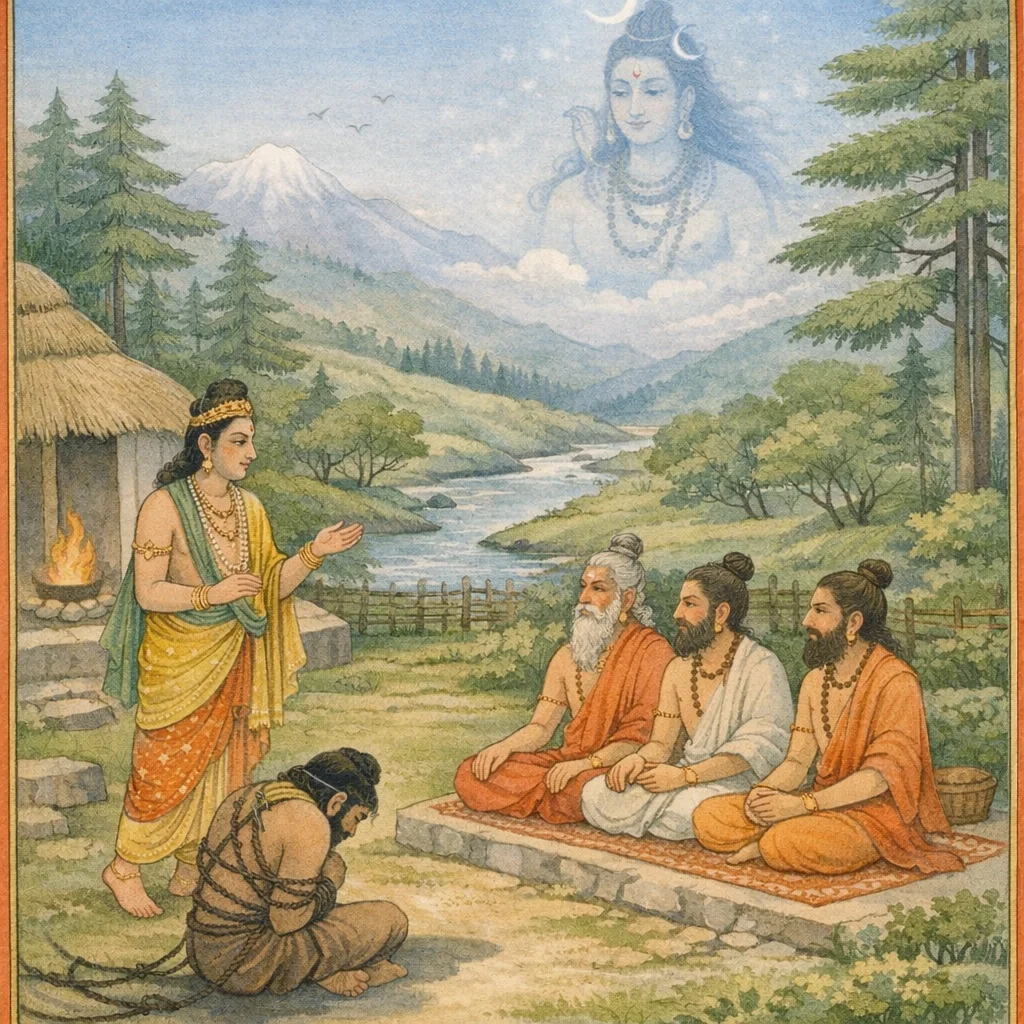
अनुग्रह-स्वातन्त्र्य-प्रमाणविचारः | Inquiry into Pramāṇa, Divine Autonomy, and Grace
Adhyāya 31 opens with Vāyu affirming that the sages’ doubt is legitimate jijñāsā (philosophical inquiry), not nāstikya (denial), and he offers a pramāṇa-based clarification to dispel delusion in the well-disposed. The chapter then argues that Śiva is paripūrṇa (complete) and therefore, strictly speaking, has no “duty” to perform; yet the paśu–pāśa world is called anugrāhya, fit to receive grace. The resolution is given through svabhāva and svātantrya: Śiva’s grace arises from His own nature and sovereign freedom, not from dependence on the recipient or any external command. It distinguishes the Lord’s independence (anapekṣatva) from the dependent condition of the anugrāhya, for whom bhukti and mukti are unattainable without anugraha. It further clarifies that nothing in Śambhu is grounded in ignorance; ignorance belongs to the bound standpoint, and grace is the removal of ajñāna through Śiva’s jñāna/ādeśa. Finally, the chapter points to the niṣkala–sakala polarity: though Śiva is ultimately partless, He is apprehended through a “mūrti-ātman” (Śaiva manifestation) as a practical access for embodied cognition and devotion.
Shlokas
Verse 1
वायुरुवाच । स्थने संशयितं विप्रा भवद्भिर्हेतुचोदितैः । जिज्ञासा हि न नास्तिक्यं साधयेत्साधुबुद्धिषु
Vāyu said: “O brāhmaṇas, urged on by reason, you have doubted in the proper place. For inquiry does not give rise to atheism in minds that are truly virtuous.”
Verse 2
प्रमणमत्र वक्ष्यामि सताम्मोहनिवर्तकम् । असतां त्वन्यथाभावः प्रसादेन विना प्रभोः
Here I shall declare the pramāṇa, the true means of right knowledge that dispels delusion for the virtuous. But for the unvirtuous there is only distortion and contrary understanding—unless illumined by the grace of the Lord.
Verse 3
शिवस्य परिपूर्णस्य परानुग्रहमन्तरा । न किंचिदपि कर्तव्यमिति साधु विनिश्चितम्
It is rightly concluded that for Śiva, who is utterly complete, there is nothing whatsoever that must be done—except the bestowal of supreme grace upon others.
Verse 4
स्वभाव एव पर्याप्तः परानुग्रहकर्मणि । अन्यथा निस्स्वभवेन न किमप्यनुगृह्यते
One’s own inherent nature alone is sufficient for the act of showing grace to others; otherwise, a person who is devoid of that nature cannot truly bestow any benefit at all.
Verse 5
परं सर्वमनुग्राह्यं पशुपाशात्मकं जगत् । परस्यानुग्रहार्थं तु पत्युराज्ञासमन्वयः
This entire world—constituted of bound souls (paśu) and their bonds (pāśa)—is truly an object fit to receive supreme grace. And for the sake of granting that highest grace, there is the ordering will and governance of the Lord (Pati).
Verse 6
पतिराज्ञापकः सर्वमनुगृह्णाति सर्वदा । तदर्थमर्थस्वीकारे परतंत्रः कथं शिवः
The Lord (Pati), the sovereign ordainer, ever bestows grace upon all. If so, how could Śiva be dependent on anyone in accepting offerings or material means for that purpose?
Verse 7
अनुग्राह्यनपेक्षो ऽस्ति न हि कश्चिदनुग्रहः । अतः स्वातन्त्र्यशब्दार्थाननपेक्षत्वलक्षणः
He is independent of any recipient to be favoured—for in truth, no act of grace depends on another. Therefore, the meaning of “sovereign freedom” (svātantrya) is defined as absolute non-dependence.
Verse 8
एतत्पुनरनुग्राह्यं परतंत्रं तदिष्यते । अनुग्रहादृते तस्य भुक्तिमुक्त्योरनन्वयात्
Again, this (individual soul) is said to be dependent—fit to receive grace and subject to another’s will. For without Śiva’s grace, it has no access to either worldly enjoyment or liberation.
Verse 9
मूर्तात्मनो ऽप्यनुग्राह्या शिवाज्ञाननिवर्तनात् । अज्ञानाधिष्ठितं शम्भोर्न किंचिदिह विद्यते
Even embodied beings are fit to receive grace, for Śiva’s true knowledge removes ignorance. For Śambhu (Śiva), nothing whatsoever in this world is founded upon ignorance.
Verse 10
येनोपलभ्यते ऽस्माभिस्सकलेनापि निष्कलः । स मूर्त्यात्मा शिवः शैवमूर्तिरित्युपचर्यते
That formless (niṣkala) Reality which is nevertheless apprehended by us through the manifested (sakala) mode—He is Śiva whose very nature is Form; and in devotional convention He is spoken of as the “Śaiva Form” (śaivamūrti).
Verse 11
न ह्यसौ निष्कलः साक्षाच्छिवः परमकारणम् । साकारेणानुभावेन केनाप्यनुपलक्षितः
Shiva alone—formless and partless in His true nature—is the supreme cause. Yet, through His power manifest in embodied form, He is not recognized by just anyone.
Verse 12
प्रमाणगम्यतामात्रं तत्स्वभावोपपादकम् । न तावतात्रोपेक्षाधीरुपलक्षणमंतरा
Mere knowability through valid means of knowledge is what establishes a thing’s own nature. Yet in this matter, indifference is not justified without proper discernment and the indicative marks by which it is recognized.
Verse 13
आत्मोपमोल्वणं साक्षान्मूर्तिरेव हि काचन । शिवस्य मूर्तिर्मूर्त्यात्मा परस्तस्योपलक्षणम्
Indeed, some manifest form is directly perceivable and comparable to the self. Shiva’s form—whose very essence is form—serves as an indicative mark by which the Supreme (transcendent Shiva) is recognized.
Verse 14
यथा काष्ठेष्वनारूढो न वह्निरुपलभ्यते । एवं शिवो ऽपि मूर्त्यात्मन्यनारूढ इति स्थितिः
Just as fire, though present, is not perceived when it has not arisen in the pieces of wood, so too Śiva is not apprehended when He has not manifested within a formed embodiment—such is the settled principle.
Verse 15
यथाग्निमानयेत्युक्ते ज्वलत्काष्ठादृते स्वयम् । नाग्निरानीयते तद्वत्पूज्यो मूर्त्यात्मना शिवः
Just as, when one is told to “bring fire,” fire cannot be brought by itself apart from a burning piece of wood, so too Śiva—though in truth beyond all attributes—is to be worshipped in His embodied, manifest form (mūrti) for the sake of devotion and realization.
Verse 16
अत एव हि पूजादौ मूर्त्यात्मपरिकल्पनम् । मूर्त्यात्मनि कृतं साक्षाच्छिव एव कृतं यतः
Therefore, at the very outset of worship, one should conceive the Deity as having form and as the very Self. For whatever is offered and done to that embodied Self is, in truth, done directly to Śiva Himself.
Verse 17
लिंगादावपि तत्कृत्यमर्चायां च विशेषतः । तत्तन्मूर्त्यात्मभावेन शिवो ऽस्माभिरुपास्यते
Even in the worship of the Liṅga and other sacred forms—most especially in consecrated images (arcā)—we worship Śiva by entering the inner attitude that He truly abides as the very Self of that particular form.
Verse 18
यथानुगृह्यते सो ऽपि मूर्त्यात्मा पारमेष्ठिना । तथा मूर्त्यात्मनिष्ठेन शिवेन पशवो वयम्
Just as that embodied one is shown grace by Parameṣṭhin (Brahmā), so too are we—mere bound souls (paśus)—shown grace by Śiva, who is firmly established in embodied manifestation (saguṇa form).
Verse 19
लोकानुग्रहणायैव शिवेन परमेष्ठिना । सदाशिवादयस्सर्वे मूर्त्यात्मनो ऽप्यधिष्ठिताः
For the sake of bestowing grace upon the worlds, Shiva—the Supreme Lord—presides over all the manifested divine forms; indeed, beginning with Sadāśiva, all such embodied principles are governed and empowered by Him.
Verse 20
आत्मनामेव भोगाय मोक्षाय च विशेषतः । तत्त्वातत्त्वस्वरूपेषु मूर्त्यात्मसु शिवान्वयः
For the sake of experience (bhoga) and, most especially, for liberation (mokṣa), it is indeed the Self that is spoken of; and in the forms of both tattva and atattva—indeed in embodied and ensouled forms—there is the pervasive connection (anvaya) of Śiva.
Verse 21
भोगः कर्मविपाकात्मा सुखदुःखात्मको मतः । न च कर्म शिवो ऽस्तीति तस्य भोगः किमात्मकः
Experience (bhoga) is held to be the ripened fruit of karma, appearing as pleasure and pain. But since Śiva is not subject to karma at all, what nature could “experience” have for Him?
Verse 22
सर्वं शिवो ऽनुगृह्णाति न निगृह्णाति किंचन । निगृह्णतां तु ये दोषाश्शिवे तेषामसंभवात्
Śiva bestows grace upon all and punishes no one at all. For the faults that belong to those who punish cannot arise in Śiva, since such defects are impossible in Him.
Verse 23
ये पुनर्निग्रहाः केचिद्ब्रह्मादिषु निदर्शिताः । ते ऽपि लोकहितायैव कृताः श्रीकण्ठमूर्तिना
Moreover, whatever acts of restraint or chastisement have been shown even toward Brahmā and the other gods—those too were performed by Śrīkaṇṭha (Lord Śiva) solely for the welfare of the worlds.
Verse 24
ब्रह्माण्डस्याधिपत्यं हि श्रीकण्ठस्य न संशयः । श्रीकण्ठाख्यां शिवो मूर्तिं क्रीडतीमधितिष्ठति
Indeed, there is no doubt that the lordship of the entire cosmos belongs to Śrīkaṇṭha. Śiva abides in His form known as Śrīkaṇṭha, delighting in divine play while sustaining and governing the universe.
Verse 25
सदोषा एव देवाद्या निगृहीता यथोदितम् । ततस्तेपि विपाप्मानः प्रजाश्चापि गतज्वराः
Thus, even the gods and the rest—being still tainted with fault—were restrained, exactly as had been declared. Thereafter, they too became free from sin; and the beings likewise became rid of their feverish affliction.
Verse 26
निग्रहो ऽपि स्वरूपेण विदुषां न जुगुप्सितः । अत एव हि दण्ड्येषु दण्डो राज्ञां प्रशस्यते
Even restraint and correction, by their very nature, are not deemed blameworthy by the wise. Therefore, the punishment that kings administer to those deserving chastisement is indeed praised.
Verse 27
यत्सिद्धिरीश्वरत्वेन कार्यवर्गस्य कृत्स्नशः । न स चेदीशतां कुर्याज्जगतः कथमीश्वरः
If his very accomplishment as ‘Lord’ lies in complete mastery over the entire realm of effects, then if he does not exercise lordship over the world, how could he be called the Lord at all?
Verse 28
ईशेच्छा च विधातृत्वं विधेराज्ञापनं परम् । आज्ञावश्यमिदं कुर्यान्न कुर्यादिति शासनम्
The Lord’s will itself becomes the power of ordaining; for Brahmā, the cosmic ordainer, His command is supreme. Under that command alone one should do this—or should not do this: such is the governing decree.
Verse 29
तच्छासनानुवर्तित्वं साधुभावस्य लक्षणम् । विपरीतसमाधोः स्यान्न सर्वं तत्तु दृश्यते
To follow that right injunction is the mark of a true sādhū-nature. But in one whose contemplation is inverted (misdirected), that is not seen in every respect.
Verse 30
साधु संरक्षणीयं चेद्विनिवर्त्यमसाधु यत् । निवर्तते च सामादेरंते दण्डो हि साधनम्
If the righteous are to be protected, then whatever is unrighteous must be restrained. When it does not turn back through conciliation and the like, punishment in the end is indeed the effective means.
Verse 31
हितार्थलक्षणं चेदं दण्डान्तमनुशासनम् । अतो यद्विपरीतं तदहितं संप्रचक्षते
This teaching—ending, when necessary, in punitive restraint—is characterized as being for one’s true welfare. Therefore, whatever stands contrary to it is declared to be harmful.
Verse 32
हिते सदा निषण्णानामीश्वरस्य निदर्शनम् । स कथं दुष्यते सद्भिरसतामेव निग्रहात्
This is the manifest sign of the Lord for those who are ever established in the welfare of all. How could He ever be tainted in the eyes of the virtuous, when His very act is the restraint of the wicked alone?
Verse 33
अयुक्तकारिणो लोके गर्हणीयाविवेकिता । यदुद्वेजयते लोकन्तदयुक्तं प्रचक्षते
In the world, those who act without propriety are censured as undiscerning. Whatever disturbs and agitates people, that is declared to be improper.
Verse 34
सर्वो ऽपि निग्रहो लोके न च विद्वेषपूर्वकः । न हि द्वेष्टि पिता पुत्रं यो निगृह्याति शिक्षयेत्
In this world, any act of restraint or correction is not (meant) to arise from hatred. A father does not hate his son; rather, he restrains him only in order to discipline and educate him.
Verse 35
माध्यस्थेनापि निग्राह्यान्यो निगृह्णाति मार्गतः । तस्याप्यवश्यं यत्किंचिन्नैर्घृण्यमनुवर्तते
Even when a neutral person restrains one who deserves restraint, doing so in the proper way, some trace of harshness or pitilessness inevitably follows for that person as well.
Verse 36
अन्यथा न हिनस्त्येव सदोषानप्यसौ परान् । हिनस्ति चायमप्यज्ञान्परं माध्यस्थ्यमाचरन्
Otherwise, he would not harm others at all—even those who are at fault. Yet, by adopting an extreme posture of neutrality, he ends up harming even the innocent and the ignorant as well.
Verse 37
तस्माद्दुःखात्मिकां हिंसां कुर्वाणो यः सनिर्घृणः । इति निर्बंधयंत्येके नियमो नेति चापरे
Therefore, one who mercilessly commits violence—whose very nature is to cause suffering—some insist is indeed bound by karmic consequence and discipline; yet others declare, “No, this is not a niyama (a spiritual observance).”
Verse 38
निदानज्ञस्य भिषजो रुग्णो हिंसां प्रयुंजतः । न किंचिदपि नैर्घृण्यं घृणैवात्र प्रयोजिका
When a physician who knows the causes of disease applies painful measures to a patient, there is not the slightest cruelty in it; in this case, compassion alone is the motivating force.
Verse 39
घृणापि न गुणायैव हिंस्रेषु प्रतियोगिषु । तादृशेषु घृणी भ्रान्त्या घृणान्तरितनिर्घृणः
Even compassion is not a virtue when directed toward violent antagonists. Showing pity to such people, out of delusion, one becomes inwardly cruel—his discernment veiled by misplaced compassion.
Verse 40
उपेक्षापीह दोषाह रक्ष्येषु प्रतियोगिषु । शक्तौ सत्यामुपेक्षातो रक्ष्यस्सद्यो विपद्यते
Even here, negligence is a fault with regard to those who ought to be protected and those who contend against them. When one has the power, by neglect the one under protection quickly comes to ruin.
Verse 41
सर्पस्यास्यगतम्पश्यन्यस्तु रक्ष्यमुपेक्षते । दोषाभासान्समुत्प्रेक्ष्य फलतः सो ऽपि निर्घृणः
Even while seeing a serpent close at hand, one who neglects to protect what ought to be protected—imagining only “the semblance of faults”—becomes, by its very fruit and consequence, merciless as well.
Verse 42
तस्माद्घृणा गुणायैव सर्वथेति न संमतम् । संमतं प्राप्तकामित्वं सर्वं त्वन्यदसम्मतम्
Therefore it is not accepted that compassion (ghṛṇā), in every way, is itself a virtue. What is approved is the right fulfillment of intention—rightly attaining one’s aim; all else is not approved.
Verse 43
अग्नावपि समाविष्टं ताम्रं खलु सकालिकम् । इति नाग्निरसौ दुष्येत्ताम्रसंसर्गकारणात्
Even when copper is placed in fire, it indeed becomes coated with soot; yet the fire itself is not tainted by contact with copper. In the same way, the Supreme Lord, Pati, is never defiled by association with the world.
Verse 44
नाग्नेरशुचिसंसर्गादशुचित्वमपेक्षते । अशुचेस्त्वग्निसंयोगाच्छुचित्वमपि जायते
Fire does not become impure by contact with what is impure; rather, the impure thing alone is regarded as impure. But when an impure substance comes into contact with fire, purity is truly produced, for it is purified by fire.
Verse 45
एवं शोध्यात्मसंसर्गान्न ह्यशुद्धः शिवो भवेत् । शिवसंसर्गतस्त्वेष शोध्यात्मैव हि शुध्यति
Thus, by contact with the soul that is to be purified, Śiva never becomes impure. Rather, through contact with Śiva, it is this purifiable soul alone that becomes purified.
Verse 46
अयस्यग्नौ समाविष्टे दाहो ऽग्नेरेव नायसः । मूर्तात्मन्येवमैश्वर्यमीश्वरस्यैव नात्मनाम्
When iron is placed into fire, the burning belongs to the fire alone—not to the iron. In the same way, even when the Lord’s power appears within embodied souls, that sovereignty truly belongs only to Īśvara, not to the individual selves.
Verse 47
न हि काष्ठं ज्वलत्यूर्ध्वमग्निरेव ज्वलत्यसौ । काष्ठस्यांगारता नाग्नेरेवमत्रापि योज्यताम्
It is not the wood that truly burns; it is only the fire that blazes. The wood’s becoming ember is not the fire’s transformation. Apply this same reasoning here as well: the change belongs to the instrument, not to the Lord who empowers it.
Verse 48
अत एव जगत्यस्मिन्काष्ठपाषाणमृत्स्वपि । शिवावेशवशादेव शिवत्वमुपचर्यते
Therefore, in this world, even in wood, stone, and clay, “Shivahood” (śivatva) is ascribed—because of the overpowering indwelling presence of Śiva.
Verse 49
मैत्र्यादयो गुणा गौणास्तस्मात्ते भिन्नवृत्तयः । तैर्गुणैरुपरक्तानां दोषाय च गुणाय च
Virtues such as friendliness and the rest are secondary (gauna) qualities; therefore their modes of operation differ. For those whose minds are colored by such qualities, the very same qualities can become either a fault or a merit.
Verse 50
यत्तु गौणमगौणं च तत्सर्वमनुगृह्णतः । न गुणाय न दोषाय शिवस्य गुणवृत्तयः
Whatever is spoken of as secondary (gauṇa) or primary (agauṇa), Śiva graciously accepts it all. Yet the modes by which Śiva manifests through the qualities are for Him neither merit nor fault, for He remains ever untouched.
Verse 51
न चानुग्रहशब्दार्थं गौणमाहुर्विपश्चितः । संसारमोचनं किं तु शैवमाज्ञामयं हितम्
The wise do not treat the word “anugraha” (grace) as a merely secondary sense. Truly, it is Śiva’s auspicious command—beneficial and liberating—by which one is released from saṃsāra.
Verse 52
हितं तदाज्ञाकरणं यद्धितं तदनुग्रहः । सर्वं हिते नियुञ्जावः सर्वानुग्रहकारकः
Obedience to His command is truly what is beneficial; and whatever is beneficial is, in essence, His grace (anugraha). Therefore let us employ everything for the sake of the highest good—for He is the giver of grace to all.
Verse 53
यस्तूपकारशब्दार्थस्तमप्याहुरनुग्रहम् । तस्यापि हितरूपत्वाच्छिवः सर्वोपकारकः
That which is denoted by the word “help” is also called “grace” (anugraha). And since even that is of the nature of true welfare, Śiva—whose very essence is beneficence—is the universal benefactor of all.
Verse 54
हिते सदा नियुक्तं तु सर्वं चिदचिदात्मकम् । स्वभावप्रतिबन्धं तत्समं न लभते हितम्
All that exists—both conscious beings and unconscious matter—is ever engaged in seeking what is beneficial; yet, obstructed by its own conditioned nature, it does not attain that true Good which is equal and fitting to its real state.
Verse 55
यथा विकासयत्येव रविः पद्मानि भानुभिः । समं न विकसन्त्येव स्वस्वभावानुरोधतः
Just as the sun, by its rays, makes the lotuses bloom, yet they do not all open equally—each according to its own nature—so too do grace and spiritual awakening bear fruit in beings in keeping with their individual disposition and fitness.
Verse 56
स्वभावो ऽपि हि भावानां भाविनो ऽर्थस्य कारणम् । न हि स्वभावो नश्यन्तमर्थं कर्तृषु साधयेत्
Indeed, even the inherent nature (svabhāva) of beings can serve as a cause with respect to an effect yet to arise. Yet svabhāva cannot establish, through individual agents, an effect that is perishing or unstable as something truly accomplished; what is transient cannot be made ultimate reality merely by “nature” and doership.
Verse 57
सुवर्णमेव नांगारं द्रावयत्यग्निसंगमः । एवं पक्वमलानेव मोचयेन्न शिवपरान्
Only gold—never charcoal—melts when it meets fire. So too the Lord, by His purifying power, releases only those devotees of Śiva whose impurities have ripened for removal, not those who are not truly Śiva-oriented.
Verse 58
यद्यथा भवितुं योग्यं तत्तथा न भवेत्स्वयम् । विना भावनया कर्ता स्वतन्त्रस्सन्ततो भवेत्
Even if something is fit to occur in a certain way, it does not become so by itself. Without right bhāvanā (contemplative cultivation), the doer (kartā) does not remain steadily independent; his agency becomes unsettled.
Verse 59
स्वभावविमलो यद्वत्सर्वानुग्राहकश्शिवः । स्वभावमलिनास्तद्वदात्मनो जीवसंज्ञिताः
Just as Śiva is by nature stainless and the universal bestower of grace, so too the selves called “jīvas” are by their own nature tainted; therefore they stand in need of His liberating compassion.
Verse 60
अन्यथा संसरन्त्येते नियमान्न शिवः कथम् । कर्ममायानुबन्धोस्य संसारः कथ्यते बुधैः
Otherwise, how could these beings wander in transmigration according to the ordinances, if Śiva were not the supreme regulator? The wise declare that saṃsāra is the bondage born of one’s connection with karma and māyā.
Verse 61
अनुबन्धो ऽयमस्यैव न शिवस्येति हेतुमान् । स हेतुरात्मनामेव निजो नागन्तुको मलः
This bondage belongs only to the individual soul, not to Śiva—so declare the wise with reason. For the cause of bondage is the soul’s own impurity (mala) alone, intrinsic and not something newly imposed from outside.
Verse 62
आगन्तुकत्वे कस्यापि भाव्यं केनापि हेतुना । यो ऽयं हेतुरसावेकस्त्वविचित्रस्वभावतः
If anything is said to be merely adventitious, arising from outside, it must be accounted for by some cause. Yet that cause—being one and of an unvaried nature—cannot, by itself, explain such adventitiousness.
Verse 63
आत्मतायाः समत्वे ऽपि बद्धा मुक्ताः परे यतः । बद्धेष्वेव पुनः केचिल्लयभोगाधिकारतः
Even though the essential nature of the self is the same, there remains a distinction between the bound and the liberated, because the Supreme—Lord Śiva—ordains it so. And again, even among bound souls, some are entitled to dissolution (laya, absorption) and to enjoyment, according to their due.
Verse 64
ज्ञानैश्वर्यादिवैषम्यं भजन्ते सोत्तराधराः । केचिन्मूर्त्यात्मतां यान्ति केचिदासन्नगोचराः
Beings of higher and lower grades partake of differences in knowledge, lordship, and the like. Some attain embodied, qualified (saguṇa) states, while others become accessible only to near and subtle apprehension.
Verse 65
मूर्त्यात्मसु शिवाः केचिदध्वनां मूर्धसु स्थिताः । मध्ये महेश्वरा रुद्रास्त्वर्वाचीनपदे स्थिताः
Among the embodied principles (mūrti and ātman), some are called Śivas, abiding at the summit of the cosmic paths (adhvans). In the middle are the Maheśvaras; and the Rudras abide in the lower stations.
Verse 66
आसन्ने ऽपि च मायायाः परस्मात्कारणात्त्रयम् । तत्राप्यात्मा स्थितो ऽधस्तादन्तरात्मा च मध्यतः
Though Māyā stands near, from the Supreme Cause a triad arises. Even within that, the individual self abides below, while the Inner Self—the Lord dwelling within—is established in the middle, governing and illumining from within.
Verse 67
परस्तात्परमात्मेति ब्रह्मविष्णुमहेश्वराः । वर्तन्ते वसवः केचित्परमात्मपदाश्रयाः
Abiding in the state of the Supreme Self—beyond all—Brahmā, Viṣṇu, and Maheśvara function in their cosmic roles. Likewise, certain Vasus also operate, taking refuge in the station of the Supreme Self.
Verse 68
अन्तरात्मपदे केचित्केचिदात्मपदे तथा । शान्त्यतीतपदे शैवाः शान्ते माहेश्वरे ततः
Some Śaivas abide in the state of the Inner Self; some likewise in the state of the Self. Others abide in the state beyond peace; and thereafter, in the tranquil, Maheśvara state.
Verse 69
विद्यायान्तु यथा रौद्राः प्रतिष्ठायां तु वैष्णवाः । निवृत्तौ च तथात्मानो ब्रह्मा ब्रह्मांगयोनयः
In the sphere of sacred knowledge (vidyā) the Rudra-principles preside; in the domain of establishment and support (pratiṣṭhā) the Vaiṣṇava powers prevail. In the path of withdrawal and cessation (nivṛtti) the Self-realized ones abide; and in the creative principle stands Brahmā—those born from the limbs of Brahmā.
Verse 70
देवयोन्यष्टकं मुख्यं मानुष्यमथ मध्यमम् । पक्ष्यादयो ऽधमाः पञ्चयोनयस्ताश्चतुर्दश
Among the fourteen classes of birth (yonis), the eight divine wombs are the foremost; the human state is of the middle rank; and the five lower births—beginning with birds—are regarded as inferior.
Verse 71
उत्तराधरभावो ऽपि ज्ञेयस्संसारिणो मलः । यथामभावो मुक्तस्य पूर्वं पश्चात्तु पक्वता
The sense of higher and lower (superiority and inferiority) should also be known as an impurity (mala) for the transmigrating soul. For the liberated one there is, as it were, an absence of such notions; earlier there was immaturity, but afterward there is ripeness (spiritual maturity).
Verse 72
मलो ऽप्यामश्च पक्वश्च भवेत्संसारकारणम् । आमे त्वधरता पुंसां पक्वे तूत्तरता क्रमात्
Even impurity (mala), whether unripe (āma) or ripened (pakva), becomes a cause of worldly bondage. When it is unripe, it leads a person toward lower states; when it is ripened, it leads, in due course, toward higher states.
Verse 73
त्रिमलास्त्वधमा ज्ञेया यथोत्तरमधिष्ठिताः । त्रिमलानधितिष्ठंति द्विमलैकमलाः क्रमात्
Those bound by the three impurities (malas) are to be known as the lowest, according to the ascending order of their entanglement. In due sequence, those with two impurities and those with a single impurity rise beyond, and are no longer ruled by the condition of the threefold impurity.
Verse 74
इत्थमौपाधिको भेदो विश्वस्य परिकल्पितः । एकद्वित्रिमलान्सर्वाञ्छिव एको ऽधितिष्ठति
Thus, the diversity of the universe is imagined as arising from limiting adjuncts (upādhis). Yet Śiva alone presides over all beings—whether bound by one, two, or three impurities (malas).
Verse 75
अशिवात्मकमप्येतच्छिवेनाधिष्ठितं यथा । अरुद्रात्मकमित्येवं रुद्रैर्जगदधिष्ठितम्
Just as this world, though not of the nature of Śiva in itself, is nevertheless pervaded and governed by Śiva, so too—though it is said to be not of the nature of Rudra—the universe is sustained and presided over by the Rudras.
Verse 76
अण्डान्ता हि महाभूमिश्शतरुद्राद्यधिष्ठिता । मायान्तमन्तरिक्षं तु ह्यमरेशादिभिः क्रमात्
Within the cosmic egg, the great Earth is indeed presided over by Śatarudra and the other Rudras. And the intermediate space, up to the sphere of Māyā, is in due order governed by Indra and the other lords of the gods.
Verse 77
अंगुष्ठमात्रपर्यन्तैस्समंतात्संततं ततम् । महामायावसाना द्यौर्वाय्वाद्यैर्भुवनाधिपैः
It was spread out continuously in every direction, extending only up to the measure of a thumb. Beyond the termination of Mahāmāyā lay the celestial region, presided over by the lords of the worlds beginning with Vāyu.
Verse 78
अनाश्रितान्तैरध्वान्तर्वर्तिभिस्समधिष्ठिताः । ते हि साक्षाद्दिविषदस्त्वन्तरिक्षसदस्तथा
They are presided over by those who move within the paths (of the worlds), who are not dependent on any single boundary or fixed station. Indeed, they are directly the gods who dwell in heaven, and likewise those who dwell in the mid-region (the atmosphere).
Verse 79
पृथिवीपद इत्येवं देवा देवव्रतैः स्तुता । एवन्त्रिभिर्मलैरामैः पक्वैरेव पृथक्पृथक्
Thus the gods, devoted to divine observances, praised her as “Pṛthivīpada.” In the same way, through the three kinds of impurities—both in their unripe and ripened states—each soul is bound separately and distinctly.
Verse 80
निदानभूतैस्संसाररोगः पुंसां प्रवर्तते । अस्य रोगस्य भैषज्यं ज्ञानमेव न चापरम्
From the causes that act as its very basis, the disease of worldly bondage (saṃsāra) arises in human beings. For this disease, knowledge alone is the medicine—there is no other remedy.
Verse 81
भिषगाज्ञापकः शम्भुश्शिवः परमकारणम् । अदुःखेना ऽपि शक्तो ऽसौ पशून्मोचयितुं शिवः
Śambhu—Śiva, the Supreme Cause—acts as the physician and the one who prescribes. Even without (the soul undergoing) suffering, that auspicious Lord can release bound beings (paśus) from bondage.
Verse 82
कथं दुःखं करोतीति नात्र कार्या विचारणा । दुःखमेव हि सर्वो ऽपि संसार इति निश्चितम्
There is no need here to deliberate on how it produces suffering; for it is firmly concluded that the entire saṃsāra, the round of worldly existence, is nothing but suffering itself.
Verse 83
कथं दुःखमदुःखं स्यात्स्वभावो ह्यविपर्ययः । न हि रोगी ह्यरोगी स्याद्भिषग्भैषज्यकारणात्
How could what is truly suffering become non-suffering? For one’s intrinsic nature does not reverse. A sick man does not become healthy merely because a physician and medicine exist as causes.
Verse 84
रोगार्तं तु भिषग्रोगाद्भैषजैस्सुखमुद्धरेत् । एवं स्वभावमलिनान्स्वभावाद्दुःखिनः पशून्
Just as a physician, by medicines, lifts the disease-stricken patient out of suffering, so too the Lord raises the bound souls—whose very nature has become tainted and who suffer because of that nature—out of misery by His grace and the means of liberation.
Verse 85
स्वाज्ञौषधविधानेन दुःखान्मोचयते शिवः । न भिषक्कारणं रोगे शिवः संसारकारणम्
By the ordinance of His own medicine—His command and His grace—Śiva releases beings from suffering. He is not like a physician who becomes the cause of the disease; rather, Śiva is the very cause of saṃsāra itself, and therefore He alone can also bring it to cessation.
Verse 86
इत्येतदपि वैषम्यं न दोषायास्य कल्पते । दुःखे स्वभावसंसिद्धे कथन्तत्कारणं शिवः
Thus, even this apparent inequality does not become a fault in Him. When suffering arises from the creature’s own nature (and its bound condition), how could Śiva be its cause?
Verse 87
स्वाभाविको मलः पुंसां स हि संसारयत्यमून् । संसारकारणं यत्तु मलं मायाद्यचेतनम्
The innate impurity (mala) of embodied beings is indeed what drives them through transmigratory existence. That impurity—insentient in nature and beginning with Māyā—is the very cause of saṃsāra.
Verse 88
तत्स्वयं न प्रवर्तेत शिवसान्निध्यमन्तरा । यथा मणिरयस्कांतस्सान्निध्यादुपकारकः
That (power/means) does not operate by itself without the nearness of Śiva—just as a magnet becomes beneficial only when it is in proximity (to iron).
Verse 89
अयसश्चलतस्तद्वच्छिवो ऽप्यस्येति सूरयः । न निवर्तयितुं शक्यं सान्निध्यं सदकारणम्
The wise declare: “Just as iron moves, drawn toward a magnet, so too does this one move toward Śiva.” Such holy proximity to Śiva—arising from a true cause (right spiritual reason and merit)—cannot be turned back or prevented.
Verse 90
अधिष्ठाता ततो नित्यमज्ञातो जगतश्शिवः । न शिवेन विना किंचित्प्रवृत्तमिह विद्यते
Therefore, the ever-present Lord Śiva abides as the unseen Overlord and inner Ruler of the universe. In this world, nothing whatsoever can act or proceed without Śiva.
Verse 91
तत्प्रेरितमिदं सर्वं तथापि न स मुह्यति । शक्तिराज्ञात्मिका तस्य नियन्त्री विश्वतोमुखी
Though all this is set in motion by His prompting, He is not deluded. His Power—whose very nature is command—acts as the universal regulator, facing and governing all directions.
Verse 92
तया ततमिदं शश्वत्तथापि स न दुष्यति । अनिदं प्रथमं सर्वमीशितव्यं स ईश्वरः
By His power this entire universe is pervaded forever; yet He is not tainted by it. He is not a product of anything—He is the First, and all this is to be ruled by Him; He alone is the Lord (Īśvara).
Verse 93
ईशनाच्च तदीयाज्ञा तथापि स न दुष्यति । यो ऽन्यथा मन्यते मोहात्स विनष्यति दुर्मतिः
Because it is given by Īśāna and is His own command, it does not incur fault. But the misguided person who, out of delusion, thinks otherwise—he perishes.
Verse 94
तच्छक्तिवैभवादेव तथापि स न दुष्यति । एतस्मिन्नंतरे व्योम्नः श्रुताः वागरीरिणी
By the sheer majesty of that divine Power, even so he is not tainted. Meanwhile, from the sky there was heard a bodiless voice.
Verse 95
सत्यमोममृतं सौम्यमित्याविरभवत्स्फुटम् । ततो हृष्टतराः सर्वे विनष्टाशेषसंशयाः
Clearly there manifested the utterance: “Truth—Om—Immortality—the gentle, auspicious One.” Thereupon all became exceedingly joyful, for every remaining doubt within them was completely dispelled.
Verse 96
मुनयो विस्मयाविष्टाः प्रेणेमुः पवनं प्रभुम् । तथा विगतसन्देहान्कृत्वापि पवनो मुनीन्
The sages, overcome with wonder, bowed in reverence to Lord Pavana (Vāyu). And Pavana too—having dispelled their doubts—honoured the sages in return.
Verse 97
नैते प्रतिष्ठितज्ञाना इति मत्वैवमब्रवीत् । वायुरुवाच्व । परोक्षमपरोक्षं च द्विविधं ज्ञानमिष्यते
Thinking, “These are not established in true knowledge,” he spoke thus. Vāyu said: Knowledge is held to be of two kinds—indirect (parokṣa) and direct, immediate realization (aparokṣa).
Verse 98
परोक्षमस्थिरं प्राहुरपरोक्षं तु सुस्थिरम् । हेतूपदेशगम्यं यत्तत्परोक्षं प्रचक्षते
They declare indirect (parokṣa) knowledge to be unsteady, whereas direct realization (aparokṣa) is truly firm. That which is reached through reasoning and instruction is therefore called ‘indirect’.
Verse 99
अपरोक्षं पुनः श्रेष्ठादनुष्ठानाद्भविष्यति । नापरोक्षादृते मोक्ष इति कृत्वा विनिश्चयम्
Direct realization (aparokṣa-jñāna) will again arise from the highest spiritual discipline. Having firmly concluded that there is no liberation without such direct realization, one should remain established in that certainty.
Verse 100
श्रेष्ठानुष्ठानसिद्ध्यर्थं प्रयतध्वमतन्द्रिताः
For the successful accomplishment of the highest spiritual observance, strive with earnest effort—remain vigilant and free from negligence.
Frequently Asked Questions
This chapter is primarily doctrinal rather than event-driven; it centers on a philosophical resolution of the sages’ doubt about how Śiva’s grace operates despite His completeness and autonomy.
Anugraha is treated as the decisive condition for bhukti and mukti in the bound state: without grace, the dependent (anugrāhya) cannot attain enjoyment or liberation, because grace functions as the removal of ajñāna.
The niṣkala–sakala relation is emphasized: though Śiva is ultimately niṣkala, He is pragmatically approached as mūrtyātmā (Śaiva mūrti) through which the transcendent is apprehended by embodied beings.
Read Shiva Purana in the Vedapath app
Scan the QR code to open this directly in the app, with audio, word-by-word meanings, and more.