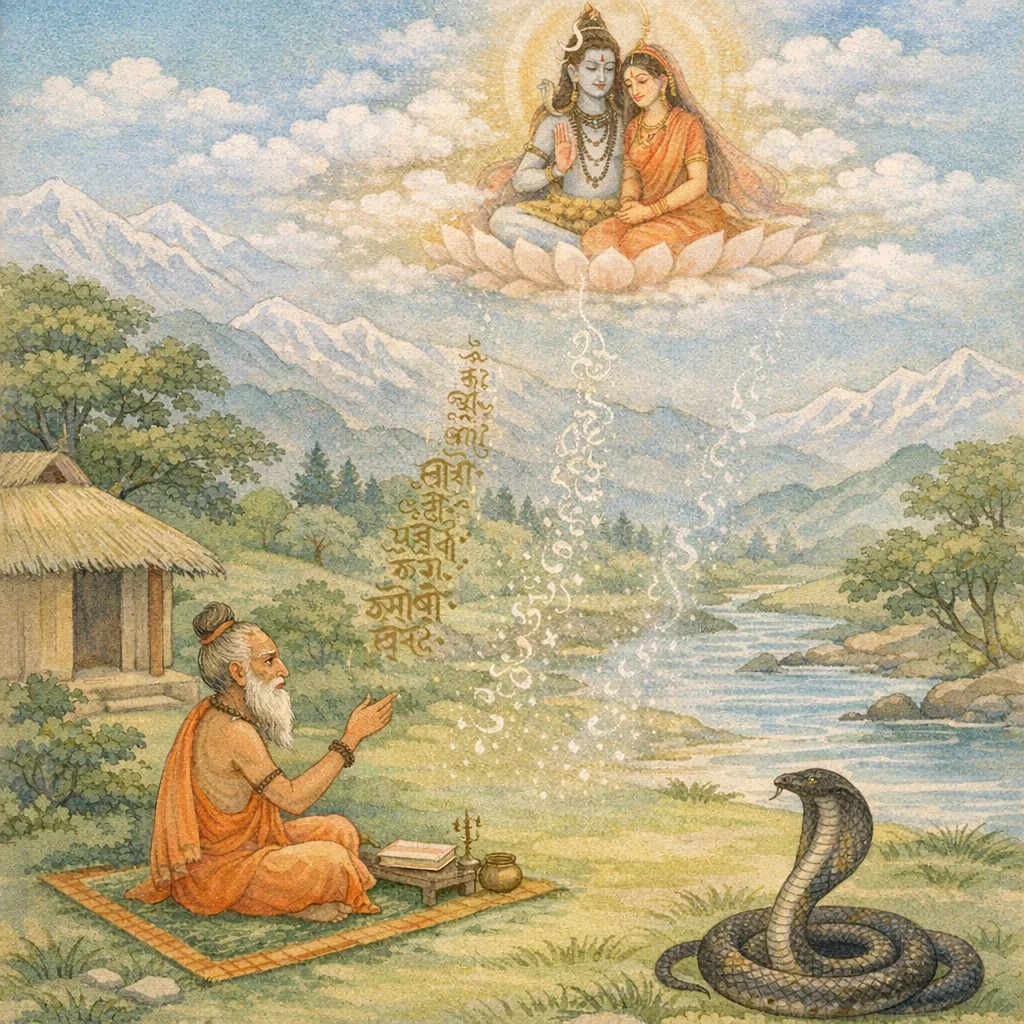
षडध्ववेदनम् (Ṣaḍadhva-vedanam) — The Sixfold Path: Sound, Meaning, and Tattva-Distribution
Adhyāya 29, taught by Vāyu, gives a technical exposition of the intrinsic unity of word/sound (śabda) and meaning (artha) within Śaiva metaphysics. It declares that no meaning exists without a word and that no word is ultimately meaningless; in conventional usage, words serve as universal bearers of meaning. This śabda–artha formation is presented as a transformation of prakṛti and as a “prākṛtī mūrti,” the natural/primordial embodiment of the supreme Śiva together with Śakti. The śabda-vibhūti is then set forth in three grades—sthūla (gross, audible), sūkṣma (subtle, ideational), and parā (transcendent, beyond discursive thought)—culminating in parā-śakti grounded in Śiva-tattva. The teaching further links knowledge-power and will-power, gathers the totality of powers as śakti-tattva, and identifies the root causal matrix as kuṇḍalinī-māyā associated with the śuddhādhvan. From this differentiated basis, the ṣaḍadhvan unfolds into three “sound paths” and three “meaning paths,” and beings’ capacities for dissolution (laya) and enjoyment (bhoga) are said to depend on purity and on the distribution of tattvas, pervaded by kalās beginning with prakṛti’s fivefold transformation.
Shlokas
Verse 1
वायुरुवाच । निवेदयामि जगतो वागर्थात्म्यं कृतं यथा । षडध्ववेदनं सम्यक्समासान्न तु विस्तरात्
Vāyu said: “I shall declare how the universe is constituted as the unity of word and meaning. I will expound, correctly, the knowledge of the sixfold paths (ṣaḍ-adhvan) in a concise summary—rather than at great length.”
Verse 2
नास्ति कश्चिदशब्दार्थो नापि शब्दो निरर्थकः । ततो हि समये शब्दस्सर्वस्सर्वार्थबोधकः
There is no meaning devoid of a word, nor is any word truly without meaning. Therefore, by established convention and proper usage, every word becomes a revealer of the intended sense.
Verse 3
प्रकृतेः परिणामो ऽयं द्विधा शब्दार्थभावना । तामाहुः प्राकृतीं मूर्तिं शिवयोः परमात्मनोः
This manifestation is a transformation of Prakṛti, understood in two ways—as sound and as meaning. The wise declare it to be the natural (prākṛtī) form of the two supreme Selves, Śiva and Śakti.
Verse 4
शब्दात्मिका विभूतिर्या सा त्रिधा कथ्यते बुधैः । स्थूला सूक्ष्मा परा चेति स्थूला या श्रुतिगोचरा
The potency whose very nature is Sound is declared by the wise to be threefold—gross, subtle, and supreme. Of these, the gross form is that which is accessible to hearing, as audible utterance.
Verse 5
सूक्ष्मा चिन्तामयी प्रोक्ता चिंतया रहिता परा । या शक्तिः सा परा शक्तिश्शिवतत्त्वसमाश्रया
She is declared to be subtle and of the nature of awareness (cintā); yet, in her supreme reality, she is beyond all thought-constructs. That very Power is the Supreme Power, abiding in and resting upon the principle of Śiva (Śiva-tattva).
Verse 6
ज्ञानशक्तिसमायोगादिच्छोपोद्बलिका तथा । सर्वशक्तिसमष्ट्यात्मा शक्तितत्त्वसमाख्यया
When the power of knowledge (jñāna-śakti) is conjoined, the power of will (icchā-śakti) is correspondingly strengthened. And because it is the collective essence of all powers, it is designated as the principle called “Śakti-tattva.”
Verse 7
समस्तकार्यजातस्य मूलप्रकृतितां गता । सैव कुण्डलिनी माया शुद्धाध्वपरमा सती
She who has become the root-nature (mūlaprakṛti) of the entire multitude of effects is indeed that very Kuṇḍalinī—Māyā—Satī, supreme in the pure path (śuddhādhvan).
Verse 8
सा विभागस्वरूपैव षडध्वात्मा विजृंभते । तत्र शब्दास्त्रयो ऽध्वानस्त्रयश्चार्थाः समीरिताः
That Reality, whose very nature is differentiation and ordered unfolding, expands as the Self of the six paths (ṣaḍ-adhvā). Therein, three are declared to be the ‘paths’ of sound (śabda), and three are proclaimed to be the ‘paths’ of meaning or objective reality (artha).
Verse 9
सर्वेषामपि वै पुंसां नैजशुद्ध्यनुरूपतः । लयभोगाधिकारास्स्युस्सर्वतत्त्वविभागतः
Indeed, for all beings, according to each one’s own measure of inner purity, the entitlement to dissolution (laya—mergence toward liberation) or to enjoyment (bhoga—experience of worldly fruits) arises, based on the differentiation of all the tattvas (principles of reality).
Verse 10
कलाभिस्तानि तत्त्वानि व्याप्तान्येव यथातथम् । परस्याः प्रकृतेरादौ पञ्चधा परिणामतः
These tattvas are indeed pervaded by the kalās (divine powers) exactly as they are. In the beginning of the Supreme Prakṛti, through transformation, they unfold in a fivefold manner.
Verse 11
कलाश्च ता निवृत्त्याद्याः पर्याप्ता इति निश्चयः । मंत्राध्वा च पदाध्वा च वर्णाध्वा चेति शब्दतः
Those kalās beginning with Nivṛtti are indeed sufficient—this is the settled conclusion. In terms of sacred sound, they are spoken of as the ‘path of mantras’, the ‘path of words/terms’, and the ‘path of phonemes (letters)’.
Verse 12
भुवनाध्वा च तत्त्वाध्वा कलाध्वा चार्थतः क्रमात् । अत्रान्योन्यं च सर्वेषां व्याप्यव्यापकतोच्यते
In due sequence and in their true import are taught the path of the worlds (bhuvanādhvā), the path of the principles (tattvādhvā), and the path of the powers/parts (kalādhvā). Here, among all of these, their mutual relation is described in terms of pervasion and the pervaded—each standing as container and contained according to its level.
Verse 13
मंत्राः सर्वैः पदैर्व्याप्ता वाक्यभावात्पदानि च । वर्णैर्वर्णसमूहं हि पदमाहुर्विपश्चितः
Mantras are pervaded by all their constituent words; and words, in turn, arise from the intention and meaning of the sentence. Indeed, it is through letters that a word becomes a collection of sounds—so declare the wise.
Verse 14
वर्णास्तु भुवनैर्व्याप्तास्तेषां तेषूपलंभनात् । भुवनान्यपि तत्त्वौघैरुत्पत्त्यांतर्बहिष्क्रमात्
The classes of sound and expression (varṇas) pervade the worlds, for they are apprehended within those very worlds. And the worlds, in turn, are pervaded by streams of tattvas (cosmic principles), because at creation these principles proceed outward and inward, manifesting both the inner and outer order of existence.
Verse 15
व्याप्तानि कारणैस्तत्त्वैरारब्धत्वादनेकशः । अंतरादुत्थितानीह भुवनानि तु कानिचित्
Pervaded by the causal principles (tattvas), and set in motion in many ways by their initiating impulse, certain worlds here arise from within and come forth into manifestation.
Verse 16
पौराणिकानि चान्यानि विज्ञेयानि शिवागमे । सांख्ययोगप्रसिद्धानि तत्त्वान्यपि च कानिचित्
In the Śiva-āgama, other Purāṇic teachings too are to be understood; and certain principles (tattvas) well-known in Sāṅkhya and Yoga are also taught there.
Verse 17
शिवशास्त्रप्रसिद्धानि ततोन्यान्यपि कृत्स्नशः । कलाभिस्तानि तत्त्वानि व्याप्तान्येव यथातथम्
All the principles (tattvas) taught in the Śaiva scriptures—and all others as well, in their entirety—are pervaded by His powers (kalās), each in its proper manner and according to its own order.
Verse 18
परस्याः प्रकृतेरादौ पञ्चधा परिणामतः । कलाश्च ता निवृत्त्याद्या व्याप्ताः पञ्च यथोत्तरम्
In the beginning of the Supreme Prakṛti, through transformation, there arises a fivefold manifestation. Those five kalās—beginning with Nivṛtti—pervade the levels of existence in due order, each succeeding one being more extensive than the previous.
Verse 19
व्यापिकातः परा शक्तिरविभक्ता षडध्वनाम् । परप्रकृतिभावस्य तत्सत्त्वाच्छिवतत्त्वतः
Because of His all-pervading nature, the Supreme Power (Śakti) remains undivided throughout the sixfold paths (ṣaḍ-adhvans). And since the state of the higher Prakṛti (Parā Prakṛti) truly exists, it is grounded in the very principle of Śiva (Śiva-tattva).
Verse 20
शक्त्यादि च पृथिव्यन्तं शिवतत्त्वसमुद्भवम् । व्याप्तमेकेन तेनैव मृदा कुंभादिकं यथा
From Śakti onward up to the element Earth, all that has arisen from the principle of Śiva (Śiva-tattva) is pervaded by that One alone—just as clay pervades a pot and other earthen forms.
Verse 21
शैवं तत्परमं धाम यत्प्राप्यं षड्भिरध्वभिः । व्यापिका ऽव्यापिका शक्तिः पञ्चतत्त्वविशोधनात्
That Shaiva Reality is the supreme Abode, attainable through the sixfold paths (adhvans). By the purification of the five tattvas, Śakti is realized as both all-pervading and yet beyond pervasion—transcendent.
Verse 22
निवृत्त्या रुद्रपर्यन्तं स्थितिरण्डस्य शोध्यते । प्रतिष्ठया तदूर्ध्वं तु यावदव्यक्तगोचरम्
By the principle called Nivṛtti, the condition of the cosmic egg (brahmāṇḍa) is purified up to the level of Rudra. And by the principle called Pratiṣṭhā, what lies above that is purified—up to the range of the Unmanifest (Avyakta).
Verse 23
तदूर्ध्वं विद्यया मध्ये यावद्विश्वेश्वरावधि । शान्त्या तदूर्ध्वं मध्वान्ते विशुद्धिः शान्त्यतीतया
Above that, in the middle region up to the level of Viśveśvara, attainment arises through vidyā, true knowledge. Above that again—at the end of the central path—there is śānti, peace; and beyond even peace, through śāntyatītā, there is perfect viśuddhi: the stainless purity oriented to Śiva.
Verse 24
यामाहुः परमं व्योम परप्रकृतियोगतः । एतानि पञ्चतत्त्वानि यैर्व्याप्तमखिलं जगत्
That which they call the Supreme Ether, through its union with the higher Prakṛti—these are the five principles (tattvas) by which the entire universe is pervaded.
Verse 25
तत्रैव सर्वमेवेदं द्रष्टव्यं खलु साधकैः । अध्वव्याप्तिमविज्ञाय शुद्धिं यः कर्तुमिच्छति
Therefore, sādhakas must discern all this precisely in that very context. One who seeks purification without understanding the pervasion of the adhvans—the ordered paths of reality—cannot truly accomplish purity.
Verse 26
स विप्रलम्भकः शुद्धेर्नालम्प्रापयितुं फलम् । वृथा परिश्रमस्तस्य निरयायैव केवलम्
Such a deceiver cannot bring forth the fruit of inner purity. His exertion is in vain, serving only to lead him to hell.
Verse 27
शक्तिपातसमायोगादृते तत्त्वानि तत्त्वतः । तद्व्याप्तिस्तद्विवृद्धिश्च ज्ञातुमेवं न शक्यते
Without conjunction with Śiva’s descent of grace (śaktipāta), the tattvas cannot be known as they truly are; likewise, their pervasion and their progressive unfolding cannot be understood in this manner.
Verse 28
शक्तिराज्ञा परा शैवी चिद्रूपा मरमेश्वरी । शिवो ऽधितिष्ठत्यखिलं यया कारणभूतया
By the sovereign Power—supreme, Śaiva, and of the nature of pure consciousness—the great Goddess, the Supreme Lady, Śiva presides over and sustains the entire universe, for She stands as its causal ground.
Verse 29
नात्मनो नैव मायैषा न विकारो विचारतः । न बंधो नापि मुक्तिश्च बंधमुक्तिविधायिनी
Upon true inquiry, this māyā does not belong to the Self, nor is it a real modification. In reality there is neither bondage nor liberation—though it is spoken of as that which brings about bondage and release.
Verse 30
सर्वैश्वर्यपराकाष्टा शिवस्य व्यभिचारिणी । समानधर्मिणी तस्य तैस्तैर्भावैर्विशेषतः
She is the very summit of all sovereign powers, inseparably aligned with Śiva. Sharing His own nature, she manifests especially through these and those distinct modes of being.
Verse 31
स तयैव गृही सापि तेनैव गृहिणी सदा । तयोरपत्यं यत्कार्यं परप्रकृतिजं जगत्
He is a householder only through Her, and She is ever a housewife only through Him. The universe—born of the Supreme Prakṛti—is their offspring, the effect brought forth by their joint activity.
Verse 32
स कर्ता कारणं सेति तयोर्भेदो व्यवस्थितः । एक एव शिवः साक्षाद्द्विधा ऽसौ समवस्थितः
He is spoken of as the Doer and as the Cause—thus the distinction between the two is conventionally established. Yet Shiva is verily one alone in Himself; that very Lord is presented as twofold (as agent and as causal ground).
Verse 33
स्त्रीपुंसभावेन तयोर्भेद इत्यपि केचन । अपरे तु परा शक्तिः शिवस्य समवायिनी
Some say there is a distinction between the two in terms of feminine and masculine nature. Others declare that She is the Supreme Power—inseparably inherent in Śiva.
Verse 34
प्रभेव भानोश्चिद्रूपा भिन्नैवेति व्यवस्थितः । तस्माच्छिवः परो हेतुस्तस्याज्ञा परमेश्वरी
Just as the radiance of the sun is of the nature of consciousness and yet is regarded as distinct, so it is established. Therefore Śiva alone is the supreme cause; and His command is Parameśvarī, the supreme Sovereign Power.
Verse 35
तयैव प्रेरिता शैवी मूलप्रकृतिरव्यया । महामाया च माया च प्रकृतिस्त्रिगुणेति च
Impelled by Her alone, the Śaiva, imperishable Root-Nature (Mūla-prakṛti) becomes operative; She is also called Mahāmāyā, Māyā, and Prakṛti endowed with the three guṇas.
Verse 36
त्रिविधा कार्यवेधेन सा प्रसूते षडध्वनः । स वागर्थमयश्चाध्वा षड्विधो निखिलं जगत्
By the threefold differentiation of effects, She brings forth the six paths (ṣaḍ-adhvan). That entire sixfold path—consisting of sound (vāk) and meaning (artha)—constitutes the whole universe.
Verse 37
अस्यैव विस्तरं प्राहुः शास्त्रजातमशेषतः
They declare that the entire body of scriptures, without remainder, is nothing but an expanded exposition of this very teaching.
Frequently Asked Questions
The sampled verses indicate primarily a philosophical/technical teaching rather than a discrete mythic episode; the focus is on metaphysical mapping (ṣaḍadhvan) and the ontology of śabda–artha within Śiva–Śakti doctrine.
They model a graded interiorization of language: from audible speech (sthūla), to subtle ideational form (sūkṣma), to transcendent parā beyond discursive thought—culminating in parā-śakti rooted in Śiva-tattva.
The chapter foregrounds ṣaḍadhvan (three śabda-paths and three artha-paths), śakti-tattva as the totality of powers, and kuṇḍalinī-māyā as a root causal matrix linked with śuddhādhvan and tattva-distribution.
Read Shiva Purana in the Vedapath app
Scan the QR code to open this directly in the app, with audio, word-by-word meanings, and more.