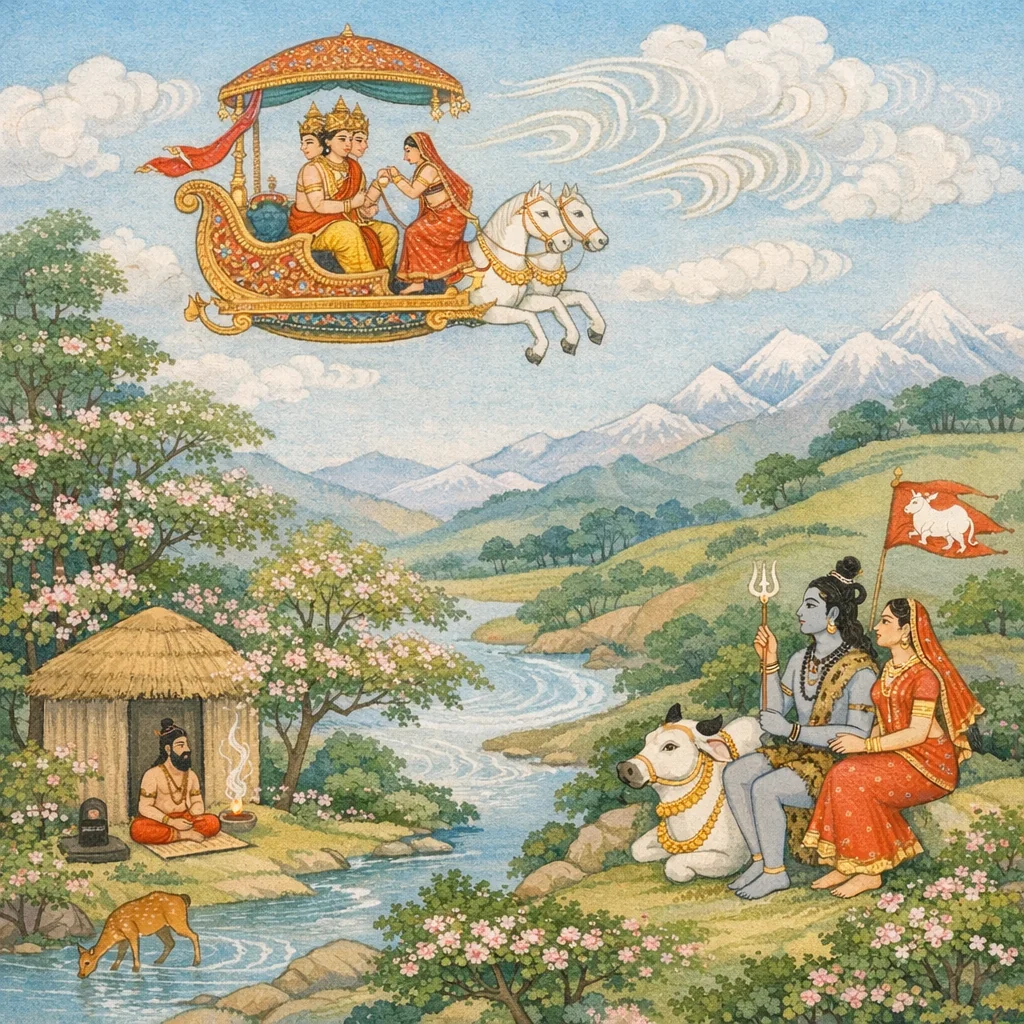
भद्रस्य दिव्यरथारोहणं शङ्खनादश्च — Bhadra’s Divine Chariot-Ascent and the Conch-Blast
Adhyāya 22 portrays a decisive martial theophany: a dazzling celestial chariot (ratha) appears in the sky, bearing the bull-banner (vṛṣa-dhvaja) and adorned with precious weapons and ornaments. Brahmā is revealed as its charioteer, recalling his earlier role in the Tripura conflict and linking the present action to established mythic precedent. Acting under Śiva’s explicit command, Brahmā approaches Hari (Viṣṇu) and instructs the heroic gaṇa-leader Bhadra to mount the chariot. Tryambaka (Śiva) with Ambikā is said to witness Bhadra’s formidable prowess near Rebha’s āśrama, grounding the cosmic event in a specific sacred locale. Bhadra accepts, honors Brahmā, ascends the divine chariot, and his auspicious fortune (lakṣmī) increases, paralleling Rudra’s fortune as the destroyer of cities (puradviṣ). The opening sequence culminates in the blowing of a radiant conch (śaṅkha) whose sound terrifies the gods and kindles their inner “belly-fire” (jaṭharānala), signaling the onset of an intense confrontation and the mobilization of divine forces.
Shlokas
Verse 1
तस्मिन्नवसरे व्योम्नि समाविरभवद्रथः । सहस्रसूर्यसंकाशश्चारुचीरवृषध्वजः
At that very moment, in the sky, a chariot manifested—radiant like a thousand suns—bearing the bull-emblem and adorned with beautiful garments.
Verse 2
अश्वरत्नद्वयोदारो रथचक्रचतुष्टयः । सञ्चितानेकदिव्यास्त्रशस्त्ररत्नपरिष्कृतः
It was furnished with a pair of excellent, jewel-like horses and equipped with four chariot-wheels; it was adorned with many accumulated divine missiles and weapons, exquisitely embellished with precious gems.
Verse 3
तस्यापि रथवर्यस्य स्यात्स एव हि सारथिः । यथा च त्रैपुरे युद्धे पूर्वं शार्वरथे स्थितः
For that excellent chariot as well, He alone indeed should be the charioteer—just as, in the war against Tripura, He formerly took His stand upon the Śārva chariot.
Verse 4
स तं रथवरं ब्रह्मा शासनादेव शूलिनः । हरेस्समीपमानीय कृताञ्जलिरभाषत
Then Brahmā—acting solely by the command of the Trident-bearing Lord (Śiva)—brought that excellent chariot near Hari (Viṣṇu). With palms joined in reverence, he addressed him.
Verse 5
भगवन्भद्र भद्रांग भगवानिन्दुभूषणः । आज्ञापयति वीरस्त्वां रथमारोढुमव्ययः
O blessed one—O auspicious-limbed hero—the revered Lord, the Moon-crested (Śiva), the imperishable One, commands you to mount the chariot.
Verse 6
रेभ्याश्रमसमीपस्थस्त्र्यंबको ऽंबिकया सह । सम्पश्यते महाबाहो दुस्सहं ते पराक्रमम्
Stationed near Rebhyā’s hermitage, the Three-eyed Lord (Śiva), together with Ambikā (Pārvatī), beholds—O mighty-armed one—your irresistible prowess.
Verse 7
तस्य तद्वचनं श्रुत्वा स वीरो गणकुञ्जरः । आरुरोह रथं दिव्यमनुगृह्य पितामहम्
Hearing those words, that heroic Gaṇa—mighty as an elephant among the attendants—mounted the divine chariot, having first received the gracious favor and blessing of Pitāmaha (Brahmā).
Verse 8
तथा रथवरे तस्मिन्स्थिते ब्रह्मणि सारथौ । भद्रस्य ववृधे लक्ष्मी रुद्रस्येव पुरद्विषः
Thus, when Brahmā stood there as charioteer upon that excellent chariot, Bhadra’s fortune and splendor increased—just as ever wax the might and glory of Rudra, the destroyer of the Three Cities.
Verse 9
ततः शंखवरं दीप्तं पूर्णचंद्रसमप्रभम् । प्रदध्मौ वदने कृत्वा भानुकंपो महाबलः
Then the mighty Bhānukampa raised to his lips a splendid conch, radiant as the full moon, and blew it with great force.
Verse 10
तस्य शंखस्य तं नादं भिन्नसारससन्निभम् । श्रुत्वा भयेन देवानां जज्वाल जठरानलः
Hearing that blare of the conch—like the cry of a shattered sāraṣa-crane—the gods were seized by fear, and the inner fire within their bellies flared up.
Verse 11
यक्षविद्याधराहीन्द्रैः सिद्धैर्युद्धदिदृक्षुभिः । क्षणेन निबडीभूताः साकाशविवरा दिशाः
In an instant the quarters grew densely thronged, leaving scarcely any open space in the sky, as Yakṣas, Vidyādharas, serpent-kings, and Siddhas—eager to behold the battle—crowded in.
Verse 12
ततः शार्ङ्गेण चापाङ्कात्स नारायणनीरदः । महता बाणवर्षेण तुतोद गणगोवृषम्
Then Nārāyaṇa—roaring like a rain-cloud—drawing his Śārṅga bow to its very corner, struck the bull-like leader of Śiva’s Gaṇas with a great shower of arrows.
Verse 13
तं दृष्ट्वा विष्णुमायांतं शतधा बाणवर्षिणम् । स चाददे धनुर्जैत्रं भद्रो बाणसहस्रमुक्
Seeing him emerge through Viṣṇu’s māyā, raining arrows a hundredfold, Bhadra too took up his victorious bow—its release like a thousand arrows—ready to meet him in battle.
Verse 14
समादाय च तद्दिव्यं धनुस्समरभैरवम् । शनैर्विस्फारयामास मेरुं धनुरिवेश्वरः
Taking up that divine bow, dreadful in battle, the Lord slowly drew it back, as though making Mount Meru itself serve as the bow.
Verse 15
तस्य विस्फार्यमाणस्य धनुषो ऽभून्महास्वनः । तेन स्वनेन महता पृथिवीं समकंपयत्
As that bow was being drawn, a tremendous roar arose; and by that mighty reverberation the very earth was made to tremble.
Verse 16
ततः शरवरं घोरं दीप्तमाशीविषोपमम् । जग्राह गणपः श्रीमान्स्वयमुग्रपराक्रमः
Then the illustrious Gaṇapa, fierce in valor by his own might, seized a dreadful quiver of arrows, blazing like a venomous serpent.
Verse 17
बाणोद्धारे भुजो ह्यस्य तूणीवदनसंगतः । प्रत्यदृश्यत वल्मीकं विवेक्षुरिव पन्नगः
As he drew forth the arrows, his arm, coming close to the mouth of the quiver, appeared like a serpent lifting its hood from an anthill, as though seeking an opening.
Verse 18
समुद्धृतः करे तस्य तत्क्षणं रुरुचे शरेः । महाभुजंगसंदष्टो यथा बालभुजङ्गमः
When that arrow was lifted into his hand, it flashed at that very instant—like a young serpent that shines and writhes when seized and bitten by a great serpent.
Verse 19
शरेण घनतीव्रेण भद्रो रुद्रपराक्रमः । विव्याध कुपितो गाढं ललाटे विष्णुमव्ययम्
Then Bhadra—mighty with Rudra’s own valor—angered, struck the imperishable Vishnu firmly on the forehead with a dense and intensely powerful arrow.
Verse 20
ललाटे ऽभिहितो विष्णुः पूर्वमेवावमानितः । चुकोप गणपेंद्राय मृगेंद्रायेव गोवृषः
Viṣṇu—already insulted earlier by being spoken of as a mere mark upon the forehead—grew wrathful toward Gaṇeśa, like a mighty bull raging against a lordly lion.
Verse 21
ततस्त्वशनिकल्पेन क्रूरास्येन महेषुणा । विव्याध गणराजस्य भुजे भुजगसन्निभे
Then, with a great arrow like a thunderbolt, shot by the fierce-faced one, he pierced the arm of the Lord of the Gaṇas—an arm resembling a serpent.
Verse 22
सो ऽपि तस्य भुजे भूयः सूर्यायुतसमप्रभम् । विससर्ज शरं वेगाद्वीरभद्रो महाबलः
Then mighty Vīrabhadra too, once again and with great speed, released an arrow at his arm, blazing with the splendor of ten thousand suns.
Verse 23
स च विष्णुः पुनर्भद्रं भद्रो विष्णुं तथा पुनः । स च तं स च तं विप्राश्शरैस्तावनुजघ्नतुः
Then Viṣṇu struck Bhadra again, and Bhadra likewise struck Viṣṇu again. O brāhmaṇas, each in turn repeatedly assailed the other with volleys of arrows.
Verse 24
तयोः परस्परं वेगाच्छरानाशु विमुंचतोः । द्वयोस्समभवद्युद्धं तुमुलं रोमहर्षणम्
As the two rapidly discharged arrows at one another with great force, a fierce duel arose between them—tumultuous and hair-raising in its intensity.
Verse 25
तद्दृष्ट्वा तुमुलं युद्धं तयोरेव परस्परम् । हाहाकारो महानासीदाकाशे खेचरेरितः
Beholding that fierce and tumultuous battle between the two of them, a great cry of alarm arose in the sky, raised by the celestial beings moving through the heavens.
Verse 26
ततस्त्वनलतुंडेन शरेणादित्यवर्चसा । विव्याध सुदृढं भद्रो विष्णोर्महति वक्षसि
Then the noble one pierced Viṣṇu firmly in his broad chest with a fire-tipped arrow blazing with the radiance of the Sun.
Verse 27
स तु तीव्रप्रपातेन शरेण दृढमाहतः । महतीं रुजमासाद्य निपपात विमोहितः
But he, struck hard by an arrow falling with fierce speed, was seized by intense pain and, losing consciousness in delusion, collapsed to the ground.
Verse 28
पुनः क्षणादिवोत्थाय लब्धसंज्ञस्तदा हरिः । सर्वाण्यपि च दिव्यास्त्राण्यथैनं प्रत्यवासृजत्
Then Hari (Viṣṇu), rising again as though after but a moment and regaining full consciousness, loosed against him all the celestial, divine weapons.
Verse 29
स च विष्णुर्धनुर्मुक्तान्सर्वाञ्छर्वचमूपतिः । सहसा वारयामास घोरैः प्रतिशरैः शरान्
Then Viṣṇu—commander of Śarva’s (Śiva’s) host—swiftly checked every arrow loosed from the bow by means of dreadful counter-arrows.
Verse 30
तं बाणं बाणवर्येण भद्रो भद्राह्वयेण तु । अप्राप्तमेव भगवाञ्चिच्छेद शतधा पथि
Then Bhadra, with his foremost arrow called Bhadrāhva, by the Lord’s irresistible power, cut that oncoming arrow into a hundred pieces upon its very course, before it could reach its mark.
Verse 31
अथैकेनेषुणा शार्ङ्गं द्वाभ्यां पक्षौ गरुत्मतः । निमेषादेव चिच्छेद तदद्भुतमिवाभवत्
Then, with a single arrow he severed Śārṅga, and with two more he cut off the wings of Garuḍa. In the very blink of an eye he accomplished it—an act that appeared truly wondrous.
Verse 32
ततो योगबलाद्विष्णुर्देहाद्देवान्सुदारुणान् । शंखचक्रगदाहस्तान् विससर्ज सहस्रशः
Then, by the force of his yogic power, Viṣṇu sent forth from his own body, by the thousand, fierce divine beings, bearing conch, discus, and mace in their hands.
Verse 33
सर्वांस्तान्क्षणमात्रेण त्रैपुरानिव शंकरः । निर्ददाह महाबाहुर्नेत्रसृष्टेन वह्निना
Then Śaṅkara, the mighty-armed Lord, burned them all in a mere instant—just as he once reduced the Tripuras to ashes—by the fire that sprang forth from his eye.
Verse 34
ततः क्रुद्धतरो विष्णुश्चक्रमुद्यम्य सत्वरः । तस्मिन्वीरो समुत्स्रष्टुं तदानीमुद्यतो ऽभवत्
Then Viṣṇu, growing still more enraged, swiftly lifted up his discus. At that very moment, the valiant one became ready to hurl it at him.
Verse 35
तं दृष्ट्वा चक्रमुद्यम्य पुरतः समुपस्थितम् । स्मयन्निव गणेशानो व्यष्टंभयदयत्नतः
Seeing him standing before him with the discus raised, Gaṇeśa—Lord of the Gaṇas—seemed to smile, and without any exertion he checked and held him back.
Verse 36
स्तंभितांगस्तु तच्चक्रं घोरमप्रतिमं क्वचित् । इच्छन्नपि समुत्स्रष्टुं न विष्णुरभवत्क्षमः
But Viṣṇu’s limbs were suddenly immobilized, and that terrible, incomparable discus could not be released. Though he wished to hurl it forth, Viṣṇu was unable—held fast by Śiva’s superior sovereignty.
Verse 37
श्वसन्निवैकमुद्धृत्य बाहुं चक्रसमन्वितम् । अतिष्ठदलसो भूत्वा पाषाण इव निश्चलः
Breathing as if in distress, he raised one arm—the arm furnished with a discus—and then stood there, slack and inert, motionless like a stone.
Verse 38
विशरीरो यथाजीवो विशृङ्गो वा यथा वृषः । विदंष्ट्रश्च यथा सिंहस्तथा विष्णुरवस्थितः
As a living being is powerless without a body, as a bull is ineffective without horns, and as a lion is weakened without fangs—so too is Viṣṇu, without Śiva, rendered ineffectual in his station.
Verse 39
तं दृष्ट्वा दुर्दशापन्नं विष्णुमिंद्रादयः सुराः । समुन्नद्धा गणेन्द्रेण मृगेंद्रेणेव गोवृषाः
Seeing Viṣṇu fallen into a wretched state, Indra and the other gods were fiercely stirred—like bulls roused by the lord of the herd, or like cattle thrown into turmoil by a lion, king of beasts.
Verse 40
प्रगृहीतायुधा यौद्धुंक्रुद्धाः समुपतस्थिरे । तान्दृष्ट्वा समरे भद्रःक्षुद्रानिव हरिर्मृगान्
Weapons in hand, enraged and eager for battle, they advanced toward him. Seeing them on the field, the valiant hero deemed those petty foes as a lion deems deer insignificant.
Verse 41
साक्षाद्रुद्रतनुर्वीरो वरवीरगणावृतः । अट्टहासेन घोरेण व्यष्टं भयदनिंदितः
That heroic one—manifest in the very body-form of Rudra—stood surrounded by a host of excellent warriors. With a dreadful peal of aṭṭahāsa laughter he shattered fear itself, O blameless one.
Verse 42
तथा शतमखस्यापि सवज्रो दक्षिणः करः । सिसृक्षोरेव उद्वज्रश्चित्रीकृत इवाभवत्
Likewise, even Śatamakha (Indra)’s right hand—still holding the vajra—became as though painted and motionless, as if he were about to hurl the thunderbolt yet was restrained.
Verse 43
अन्येषामपि सर्वेषां सरक्ता अपि बाहवः । अलसानामिवारंभास्तादृशाः प्रतियांत्युत
Even the arms of all the others—though smeared with blood—moved only like the languid, half-hearted beginnings of the lazy, returning again and again in the same feeble way.
Verse 44
एवं भगवता तेन व्याहताशेषवैभवात् । अमराः समरे तस्य पुरतः स्थातुमक्षमाः
Thus, by that Blessed Lord, when all their splendor and power had been shattered, the immortals in that battle were unable to stand before Him.
Verse 45
स्तब्धैरवयवैरेव दुद्रुवुर्भयविह्वलाः । स्थितिं च चक्रिरे युद्धे वीरतेजोभयाकुलाः
Their limbs, frozen in shock, ran about in terror. Yet in that very battle they also took their positions—warriors inwardly shaken, torn between martial splendor and fear.
Verse 46
विद्रुतांस्त्रिदशान्वीरान्वीरभद्रो महाभुजः । विव्याध निशितैर्बाणैर्मघो वर्षैरिवाचलान्
Then Vīrabhadra, the mighty-armed hero, pierced those valiant gods as they fled with keen arrows—just as Magha (Indra) strikes the mountains with torrents of rain.
Verse 47
बहवस्तस्य वीरस्य बाहवः परिघोपमाः । शस्त्रैश्चकाशिरे दीप्तैः साग्निज्वाला इवोरगाः
That hero bore many arms, mighty as iron clubs; and with blazing weapons they shone—like serpents wreathed in tongues of fire.
Verse 48
अस्त्रशस्त्राण्यनेकानिसवीरो विसृजन्बभौ । विसृजन्सर्वभूतानि यथादौ विश्वसंभवः
That valiant one shone forth as he hurled countless astras and weapons. As he released them, he appeared like the Source of the universe at the dawn of creation, bringing forth all beings.
Verse 49
यथा रश्मिभिरादित्यः प्रच्छादयति मेदिनीम् । तथा वीरः क्षणादेव शरैः प्राच्छादयद्दिशः
Just as the Sun covers the earth with his rays, so that hero, in a single instant, covered the directions with his arrows.
Verse 50
खमंडले गणेन्द्रस्य शराः कनकभूषिताः । उत्पतंतस्तडिद्रूपैरुपमानपदं ययुः
In the sphere of the sky, the arrows of the Gaṇa-lord, adorned with gold, as they flew forth, took on forms like flashes of lightning, becoming a fitting image for comparison.
Verse 51
महांतस्ते सुरगणान्मंडूकानिवडुंडुभाः । प्राणैर्वियोजयामासुः पपुश्च रुधिरासवम्
Those mighty Ḍuṇḍubhas struck down the hosts of the gods as though they were mere frogs, severing them from their life-breath, and they even drank their blood like an intoxicating draught.
Verse 52
निकृत्तबाहवः केचित्केचिल्लूनवराननाः । पार्श्वे विदारिताः केचिन्निपेतुरमरा भुवि
Some of the gods fell to the earth with their arms cut off; some had their noble faces mutilated; and some, their sides torn open—thus the immortals collapsed upon the ground, struck down in the fury of battle.
Verse 53
विशिखोन्मथितैर्गात्रैर्बहुभिश्छिन्नसन्धिभिः । विवृत्तनयनाः केचिन्निपेतुर्भूतले मृताः
With limbs torn and churned by barbed shafts, and with many joints severed, some—eyes rolled upward—fell upon the earth, dead.
Verse 54
भूमौ केचित्प्रविविशुः पर्वतानां गुहाः परे । अपरे जग्मुराकाशं परे च विविशुर्जलम्
Some entered into the earth; others went into the caves of mountains. Some departed into the sky, and others entered into the waters.
Verse 55
तथा संछिन्नसर्वांगैस्स वीरस्त्रिदशैर्बभौ । परिग्रस्तप्रजावर्गो भगवानिव भैरवः
Thus that hero blazed forth, surrounded by the thirty-three gods whose limbs were shattered—like the Lord Bhairava Himself—while the multitude of beings stood seized and overpowered by dread and awe.
Verse 56
दग्धत्रिपुरसंव्यूहस्त्रिपुरारिर्यथाभवत् । एवं देवबलं सर्वं दीनं बीभत्सदर्शनम्
Just as Tripurāri, the Slayer of Tripura, reduced the entire array of Tripura to ashes, so too the whole host of the gods became utterly dejected—presenting a dreadful, pitiable sight.
Verse 57
गणेश्वरसमुत्पन्नं कृपणं वपुराददे । तदा त्रिदशवीराणामसृक्सलिलवाहिनी
Then there appeared a pitiable form born of Gaṇeśvara; and at that moment, among the heroic gods, a stream flowed forth like water—made of blood.
Verse 58
प्रावर्तत नदी घोरा प्राणिनां भयशंसिनी । रुधिरेण परिक्लिन्ना यज्ञभूमिस्तदा बभौ
Then a dreadful river began to flow, foretelling terror to all living beings; and at that time the sacrificial ground appeared drenched and soaked with blood.
Verse 59
रक्तार्द्रवसना श्यामा हतशुंभेव कैशिकी । तस्मिन्महति संवृत्ते समरे भृशदारुणे
Kaiśikī—dark-hued, her garments drenched in blood—appeared as though she had already slain Śumbha. In that vast battle, now fully underway and exceedingly dreadful, she stood as the fierce power that turns the tide of war.
Verse 60
भयेनेव परित्रस्ता प्रचचाल वसुन्धरा । महोर्मिकलिलावर्तश्चुक्षुभे च महोदधिः
As though seized by fear, the Earth trembled and shook; and the great ocean too surged in turmoil, its vast waves and swirling eddies churning violently.
Verse 61
पेतुश्चोल्का महोत्पाताः शाखाश्च मुमुचुर्द्रुमाः । अप्रसन्ना दिशः सर्वाः पवनश्चाशिवो ववौ
Fiery meteors fell and dreadful portents arose; trees shed their branches. All the directions seemed ill-disposed, and an inauspicious wind blew—signs that the world’s harmony had been disturbed until it returned to the Lord’s order.
Verse 62
अहो विधिविपर्यासस्त्वश्वमेधोयमध्वरः । यजमानस्स्वयं दक्षौ ब्रह्मपुत्रप्रजापतिः
Alas—what a reversal of sacred order this Aśvamedha sacrifice has become! For the sacrificer here is Dakṣa himself, the Prajāpati, the son of Brahmā.
Verse 63
धर्मादयस्सदस्याश्च रक्षिता गरुडध्वजः । भागांश्च प्रतिगृह्णंति साक्षादिंद्रादयः सुराः
Dharma and the other venerable members of the divine assembly were protected by the Lord who bears Garuḍa on his banner (Viṣṇu). And Indra and the other gods directly received their allotted shares of the sacrificial offerings.
Verse 64
तथापि यजमानस्य यज्ञस्य च सहर्त्विजः । सद्य एव शिरश्छेदस्साधु संपद्यते फलम्
Even so, for the sacrificer and for the sacrifice—together with its officiating priests—the proper fruit was obtained immediately: the offender’s head was cut off then and there.
Verse 65
तस्मान्नावेदनिर्दिष्टं न चेश्वरबहिष्कृतम् । नासत्परिगृहीतं च कर्म कुर्यात्कदाचन
Therefore, one should never perform any rite not enjoined by sacred instruction, nor any act rejected by the Lord; and one should never undertake a ritual action adopted by the false and unrighteous.
Verse 66
कृत्वापि सुमहत्पुण्यमिष्ट्वा यज्ञशतैरपि । न तत्फलमवाप्नोति भक्तिहीनो महेश्वरे
Even after performing very great meritorious deeds and offering hundreds of sacrifices, one who is devoid of devotion to Maheshvara does not attain the true fruit of those acts.
Verse 67
कृत्वापि सुमहत्पापं भक्त्या यजति यश्शिवम् । मुच्यते पातकैः सर्वैर्नात्र कार्या विचारणा
Even if a person has committed very great sin, if he worships Lord Śiva with devotion, he is released from all sins—about this there is no need for any further doubt or deliberation.
Verse 68
बहुनात्र किमुक्तेन वृथा दानं वृथा तपः । वृथा यज्ञो वृथा होमः शिवनिन्दारतस्य तु
What need is there to say much here? For one who delights in disparaging Śiva, charity is fruitless, austerity is fruitless; sacrifice is fruitless, and oblations into the fire are fruitless.
Verse 69
ततः सनारायणकास्सरुद्राः सलोकपालास्समरे सुरौघाः । गणेंद्रचापच्युतबाणविद्धाः प्रदुद्रुवुर्गाढरुजाभिभूताः
Then, in that battle, the hosts of gods—together with Nārāyaṇa, the Rudras, and the guardians of the worlds—when struck by the arrows released from Gaṇeśa’s bow, fled away, overwhelmed by intense pain.
Verse 70
चेलुः क्वचित्केचन शीर्णकेशाः सेदुः क्वचित्केचन दीर्घगात्राः । पेतुः क्वचित्केचन भिन्नवक्त्रा नेशुः क्वचित्केचन देववीराः
Some moved about with dishevelled hair; some sat down, their limbs stretched long. Some fell, their faces contorted and broken in expression; and some—those heroic devas—cried out aloud.
Verse 71
केचिच्च तत्र त्रिदशा विपन्ना विस्रस्तवस्त्राभरणास्त्रशस्त्राः । निपेतुरुद्भासितदीनमुद्रा मदं च दर्पं च बलं च हित्वा
Some of the gods there were utterly broken; their garments, ornaments, weapons, and missiles had slipped away. They fell down, their faces and gestures revealing helplessness, having abandoned intoxication, pride, and the sense of strength.
Verse 72
सस्मुत्पथप्रस्थितमप्रधृष्यो विक्षिप्य दक्षाध्वरमक्षतास्त्रैः । बभौ गणेशस्स गणेश्वराणां मध्ये स्थितः सिंह इवर्षभाणाम्
Invincible and unassailable, he struck down and scattered Dakṣa’s sacrifice with unfailing weapons. Then Gaṇeśa shone among the lords of the gaṇas, like a lion standing amid bulls.
Frequently Asked Questions
A divine chariot manifests in the sky; Brahmā (as charioteer under Śiva’s command) directs the hero Bhadra to ascend it, and a powerful conch-blast inaugurates the martial escalation.
The chariot signifies sanctioned divine agency (ājñā + tejas), while the conch-sound functions as śabda-śakti—an energizing, fear-inducing proclamation that transforms narrative action into ritual-symbolic power.
Śiva as Tryambaka with Ambikā is the witnessing sovereign; Brahmā appears as delegated executor; Hari is approached as a major divine counterpart; Bhadra embodies gaṇa-force empowered for a decisive encounter.
Read Shiva Purana in the Vedapath app
Scan the QR code to open this directly in the app, with audio, word-by-word meanings, and more.