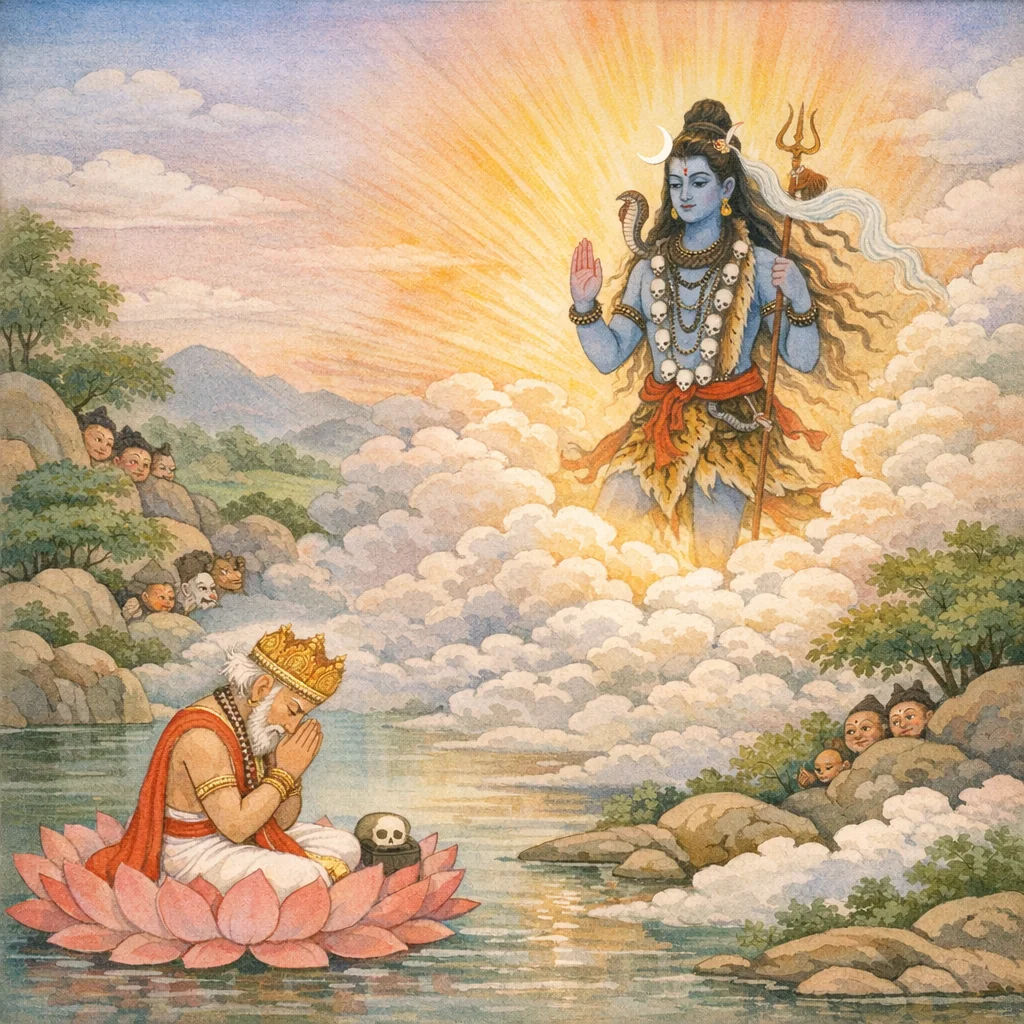
रुद्राविर्भावकारणम् — Causes and Pattern of Rudra’s Manifestation (Pratikalpa)
Vāyu explains the recurring (pratikalpa) cause of Rudra’s manifestation. In each kalpa, after Brahmā creates beings, he grieves when they do not grow or multiply (avṛddhi). To soothe Brahmā’s sorrow and ensure the flourishing of creatures, Rudra—Kālātmā and leader of the Rudra-gaṇas—manifests in successive kalpas by the Supreme Lord’s appointment, appearing as Maheśa Nīlalohita, like a ‘son’ who aids Brahmā while remaining firmly divine. The chapter affirms Rudra’s supreme nature—an immense mass of radiance, without beginning or end, all-pervading—and his accord with the highest power, Śakti: bearing the marks of authority, taking the name and form suited to the divine mandate, able to carry out sacred tasks, and obedient to the higher command (ājñā). It then turns to iconography, portraying him as blazing like a thousand suns, adorned with lunar emblems, serpent ornaments, a sacred girdle, skull and kapāla motifs, and Gaṅgā-associated hair, establishing a contemplative, tradition-bearing image of Nīlalohita/Rudra.
Shlokas
Verse 1
वायुरुवाच । प्रतिकल्पं प्रवक्ष्यामि रुद्राविर्भावकारणम् । यतो विच्छिन्नसंताना ब्रह्मसृष्टिः प्रवर्तते
Vāyu said: “In each recurring cycle of creation I shall explain the cause of Rudra’s manifestation—by which Brahmā’s work of creation proceeds, even when the line of beings is broken and discontinuous.”
Verse 2
कल्पेकल्पे प्रजाः सृष्ट्वा ब्रह्मा ब्रह्मांडसंभवः । अवृद्धिहेतोर्भूतानां मुमोह भृशदुःखितः
In every aeon, Brahmā—born of the cosmic egg—creates the beings; yet when he found no cause by which the creatures would increase and flourish, he became bewildered, overwhelmed by intense sorrow.
Verse 3
तस्य दुःखप्रशांत्यर्थं प्रजानां च विवृद्धये । तत्तत्कल्पेषु कालात्मा रुद्रो रुद्रगणाधिपः
To bring about the cessation of their suffering and to promote the flourishing of beings, Rudra—whose very essence is Time—manifests in each and every cosmic aeon (kalpa) as the Lord of the Rudra-gaṇas.
Verse 4
निर्दिष्टः पममेशेन महेशो नीललोहितः । पुत्रो भूत्वानुगृह्णाति ब्रह्माणं ब्रह्मणोनुजः
Thus, by the command of the Supreme Lord, Maheśa assumed the form called Nīlalohita; and, as though becoming a son, the younger brother of Brahmā graciously aided Brahmā.
Verse 5
स एव भगवानीशस्तेजोराशिरनामयः । अनादिनिधनोधाता भूतसंकोचको विभुः
He alone is the Blessed Lord, Īśa—an immense mass of divine radiance, untouched by any affliction. Beginningless and endless, He is the Sustainer, the all-pervading Master who can withdraw and gather all beings back into Himself.
Verse 6
परमैश्वर्यसंयुक्तः परमेश्वरभावितः । तच्छक्त्याधिष्ठितश्शश्वत्तच्चिह्नैरपि चिह्नितः
Endowed with supreme sovereignty and imbued with the very being of the Supreme Lord, he is ever upheld by His Power (Śakti) and is also marked with the Lord’s own distinguishing signs.
Verse 7
तन्नामनामा तद्रूपस्तत्कार्यकरणक्षमः । तत्तुल्यव्यवहारश्च तदाज्ञापरिपालकः
He bears the same name and the same form, and is competent to carry out that Lord’s tasks. His conduct is in harmony with Him, and he faithfully upholds and executes His command.
Verse 8
सहस्रादित्यसंकाशश्चन्द्रावयवभूषणः । भुजंगहारकेयूरवलयो मुंजमेखलः
He shone with the splendor of a thousand suns, adorned with ornaments formed of the lunar essence. Wearing serpents as a garland, with armlets and bracelets, and girded with a muñja-grass belt, he appeared as the auspicious, manifest (saguṇa) Lord—radiant and yogic—who grants liberation to bound souls.
Verse 9
जलंधरविरिंचेन्द्रकपालशकलोज्ज्वलः । गङ्गातुंगतरंगार्धपिंगलाननमूर्धजः
Mahādeva shines, adorned with fragments of skulls—those of Jalandhara, Virinci (Brahmā), and Indra; and his head and hair are graced by the lofty, surging waves of the Gaṅgā, lending his countenance a tawny-golden hue.
Verse 10
भग्नदंष्ट्रांकुराक्रान्तप्रान्तकान्तधराधरः । सव्यश्रवणपार्श्वांतमंडलीकृतकुण्डलः
His lovely, mountain-like neck bore marks along its edges from the press of broken tusk-tips; and beside his left ear, his earring was curled into a circular coil.
Verse 11
महावृषभनिर्याणो महाजलदनिःस्वनः । महानलसमप्रख्यो महाबलपराक्रमः
He advances with the Great Bull (Nandin) as his mount; his roar resounds like the thunder of mighty clouds. He shines with the splendor of a great fire, and his strength and valor are immeasurable.
Verse 12
एवं घोरमहारूपो ब्रह्मपुत्रीं महेश्वरः । विज्ञानं ब्रह्मणे दत्त्वा सर्गे सहकरोति च
Thus Maheshvara—of awe-inspiring, mighty form—first manifested the Daughter of Brahmā; then, bestowing true spiritual knowledge upon Brahmā, he also cooperates with him in the work of creation.
Verse 13
तस्माद्रुद्रप्रसादेन प्रतिकल्पं प्रजापतेः । प्रवाहरूपतो नित्या प्रजासृष्टिः प्रवर्तते
Therefore, by the grace of Rudra, in every cycle of creation Prajāpati—the Lord of creatures—sets the generation of beings in motion; and that creation flows on perpetually, as an unbroken stream.
Verse 14
कदाचित्प्रार्थितः स्रष्टुं ब्रह्मणा नीललोहितः । स्वात्मना सदृशान् सर्वान् ससर्ज मनसा विभुः
Once, when Brahmā entreated him to undertake creation, Nīlalohita—the all-pervading Lord—brought forth, by the mere will of his mind, all beings resembling his own nature.
Verse 15
कपर्दिनो निरातंकान्नीलग्रीवांस्त्रिलोचनान् । जरामरणनिर्मुक्तान् दीप्तशूलवरायुधान्
They beheld the matted-haired ones—fearless, blue-throated, and three-eyed—free from old age and death, bearing radiant tridents and other excellent weapons.
Verse 16
तैस्तु संच्छादितं सर्वं चतुर्दशविधं जगत् । तान्दृष्टा विविधान्रुद्रान् रुद्रमाह पितामहः
By them, the entire fourteenfold universe was completely pervaded and covered. Seeing those Rudras in many diverse forms, the Grandfather (Brahmā) addressed Rudra (Śiva).
Verse 17
नमस्ते देवदेवेश मास्राक्षीरीदृशीः प्रजाः । अन्याः सृज त्वं भद्रं ते प्रजा मृत्युसमन्विताः
Salutations to You, O Lord of the gods. Do not create beings of this kind. Create other beings instead—may auspiciousness be Yours—beings who are accompanied by death, that is, subject to mortality.
Verse 18
इत्युक्तः प्रहसन्प्राह ब्रह्माणं परमेश्वरः । नास्ति मे तादृशस्सर्गस्सृज त्वमशुभाः प्रजाः
Thus addressed, the Supreme Lord (Śiva), smiling, spoke to Brahmā: “Such a mode of creation does not belong to Me. You create the aśubha prajāḥ—beings of impure disposition.”
Verse 19
ये त्विमे मनसा सृष्टा महात्मानो महाबलाः । चरिष्यंति मया सार्धं सर्व एव हि याज्ञिकाः
All these great-souled and mighty ones—created by me through the mind—shall indeed move and act together with me; for they all, without exception, are fit to perform and uphold the sacrificial rites of yajña.
Verse 20
इत्युक्त्वा विश्वकर्माणं विश्वभूतेश्वरो हरः । सह रुद्रैः प्रजासर्गान्निवृत्तात्मा व्यतिष्ठत
Having thus spoken to Viśvakarmā, Hara—the Lord of all beings in the universe—stood firm along with the Rudras, his mind withdrawn from the further creation of progeny.
Verse 21
ततः प्रभृति देवो ऽसौ न प्रसूते प्रजाः शुभाः । ऊर्ध्वरेताः स्थितः स्थाणुर्यावदाभूतसंप्लवम्
From that time onward, that Deva no longer brought forth auspicious progeny. Steadfast as Sthāṇu, he remained ūrdhvareta—his generative power turned upward and sublimated in yoga—until the dissolution of beings in the cosmic deluge.
Frequently Asked Questions
Brahmā repeatedly creates beings in each kalpa but becomes sorrowful when they do not increase; Rudra (as Maheśa Nīlalohita) manifests to relieve Brahmā’s distress and enable the flourishing of creation.
It frames Rudra as the principle of Time/transformative power—governing contraction, reconfiguration, and the conditions under which creation can properly proceed and multiply.
Rudra as Maheśa Nīlalohita is emphasized, along with attributes of supreme lordship and śakti-based authority, and a detailed iconographic set: solar radiance, lunar adornment, serpent ornaments, kapāla/skull imagery, and Gaṅgā-associated hair.
Read Shiva Purana in the Vedapath app
Scan the QR code to open this directly in the app, with audio, word-by-word meanings, and more.