Sarga 53
शबलाप्रार्थना–वसिष्ठप्रतिज्ञा (The Request for Śabalā and Vasiṣṭha’s Refusal)
बालकाण्ड
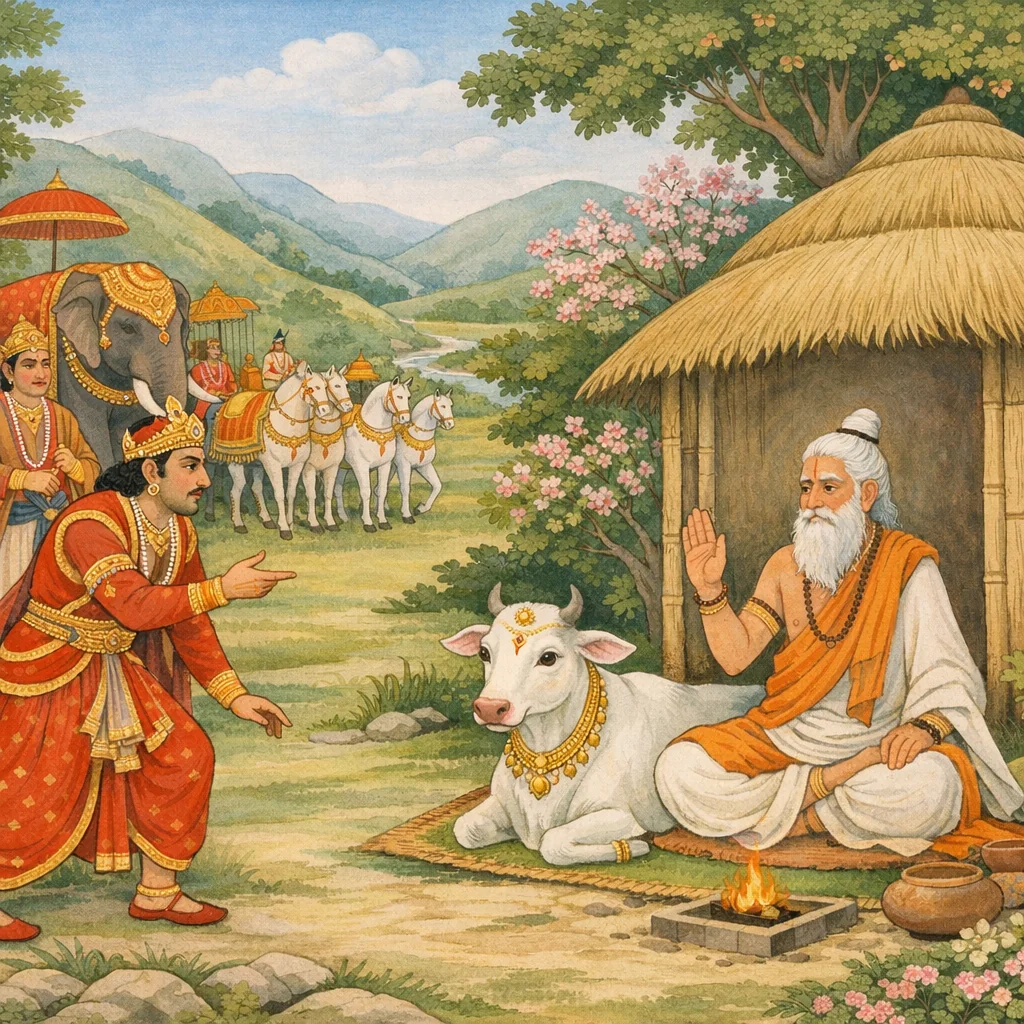
In Sarga 53, after Vasiṣṭha’s hospitality—made possible by Śabalā (Kāmadhenu), the wish-fulfilling cow—Viśvāmitra praises the reception and asserts that a king has claim over “jewels.” He asks for Śabalā and proposes an exchange: first a hundred thousand cows, then ever greater offers—fourteen thousand gold-adorned elephants, eight hundred golden chariots with four white horses, eleven thousand noble horses, and finally a crore of young cows along with unlimited jewels and gold. Vasiṣṭha repeatedly refuses, declaring Śabalā to be his jewel, wealth, and very life, inseparable as fame is from a righteous person. He grounds his refusal in sacrificial dependence: havya and kavya offerings, the upkeep of agnihotra, bali and homa, and even the efficacy of svāhā/vāṣaṭ and branches of learning are said to rely upon Śabalā. The chapter ends with Viśvāmitra’s agitation, revealing an ethical clash between royal acquisition upheld by artha and ascetic-ritual stewardship upheld by dharma.
Shlokas
Verse 1
एवमुक्ता वसिष्ठेन शबला शत्रुसूदन।विदधे कामधुक्कामान्यस्य यस्य यथेप्सितम्।।1.53.1।।
Thus addressed by Vasiṣṭha, Śabalā—the wish-fulfilling cow—bestowed upon each person whatever was desired, exactly as each one wished.
Verse 2
इक्षून्मधूं स्तथा लाजान्मैरेयांश्च वरासनान्।पानानि च महार्हाणि भक्ष्यांश्चोच्चावचां स्तथा।।1.53.2।।
Sugarcane, honey, and parched grain were brought, along with māireya liquor in fine vessels, choice drinks, and foods of many kinds.
Verse 3
उष्णाढ्यस्योदनस्यात्र राशय: पर्वतोपमा:।मृष्टान्नानि च सूपाश्च दधिकुल्यास्तथैव च।।1.53.3।।नानास्वादुरसानां च षाडबानां तथैव च।भाजनानि सुपूर्णानि गौडानि च सहस्रश:।।1.53.4।।
There were heaps of steaming rice like mountains, with delicacies and soups, and even streams of curds flowing—an abundant reception arranged there.
Verse 4
उष्णाढ्यस्योदनस्यात्र राशय: पर्वतोपमा:।मृष्टान्नानि च सूपाश्च दधिकुल्यास्तथैव च।।1.53.3।।नानास्वादुरसानां च षाडबानां तथैव च।भाजनानि सुपूर्णानि गौडानि च सहस्रश:।।1.53.4।।
And there were thousands of vessels filled to the brim with foods of many flavors—indeed with all six tastes—and countless jaggery-sweets as well.
Verse 5
सर्वमासीत्सुसन्तुष्ठं हृष्टपुष्टजनायुतम्।विश्वामित्रबलं राम वसिष्ठेनाभितर्पितम्।।1.53.5।।
O Rāma, Viśvāmitra’s entire host, satisfied by Vasiṣṭha, became thoroughly content—filled with people who were well-fed and joyful.
Verse 6
विश्वामित्रोऽपि राजर्षिर्हृष्ट: पुष्टस्तदाभवत् । सान्त:पुरवरो राजा सब्राह्मणपुरोहित:।।1.53.6।।
Then even King Viśvāmitra, the royal sage, became pleased and well-satisfied—together with his noble women, and accompanied by brahmins and priests.
Verse 7
सामात्यो मन्त्रिसहितस्सभृत्य: पूजितस्तदा।युक्त: परमहर्षेण वसिष्ठमिदमब्रवीत्।।1.53.7।।
Thus honored—along with counselors, ministers, and attendants—he, filled with great delight, spoke these words to Vasiṣṭha.
Verse 8
पूजितोऽहं त्वया ब्रह्मन् पूजार्हेण सुसत्कृत:।श्रूयतामभिधास्यामि वाक्यं वाक्यविशारद।।1.53.8।।
O Brahman, worthy of worship, you have duly honored me with fitting reverence. O master of speech, listen—I shall state my request.
Verse 9
गवां शतसहस्रेण दीयतां शबला मम।रत्नं हि भगवन्नेतद्रत्नहारी च प्रार्थिव:।।1.53.9।।तस्मान्मे शबलां देहि ममैषा धर्मतो द्विज।
Let Śabalā be given to me in exchange for a hundred thousand cows. For, venerable sir, she is a jewel, and a king is a seeker of jewels. Therefore, O twice-born one, give me Śabalā—for by the law of dharma she belongs to me.
Verse 10
एवमुक्तस्तु भगवान्वसिष्ठो मुनिसत्तम:।विश्वामित्रेण धर्मात्मा प्रत्युवाच महीपतिम्।।1.53.10।।
When Viśvāmitra spoke thus, the revered Vasiṣṭha—foremost among sages and steadfast in dharma—replied to the king.
Verse 11
नाहं शतसहस्रेण नापि कोटिशतैर्गवाम्।राजन् दास्यामि शबलां राशिभी रजतस्य च ।।1.53.11।।
O King, I will not give up Śabalā—not for hundreds of thousands of cows, nor even for hundreds of crores of cows, nor for heaps of silver.
Verse 12
न परित्यागमर्हेयं मत्सकाशादरिन्दम ।शाश्वती शबला मह्यं कीर्तिरात्मवतो यथा।।1.53.12।।
O subduer of foes, it is not right that she be separated from my care; for me Śabalā is enduring, as fame is inseparable from a self-controlled and righteous person.
Verse 13
अस्यां हव्यं च कव्यं च प्राणयात्रा तथैव च।आयत्तमग्निहोत्रं च बलिर्होमस्तथैव च।।1.53.13।।
Upon her depend offerings to the gods and to the ancestors, the very means of livelihood, the agnihotra rites, and also the bali and homa offerings.
Verse 14
स्वाहाकारवषट्कारौ विद्याश्च विविधा स्तथा।आयत्तमत्र राजर्षे सर्वमेतन्न संशय:।।1.53.14।।
O royal sage, the ‘svāhā’ and ‘vaṣaṭ’ invocations, and the various disciplines of knowledge as well—indeed all of this depends here upon her; of that there is no doubt.
Verse 15
सर्वस्वमेतत्सत्येन मम तुष्टिकरी सदा।कारणैर्बहुभी राजन्न दास्ये शबलां तव।।1.53.15।।
Truly, she is my very all and always the source of my contentment; therefore, for many reasons, O King, I will not give Śabalā to you.
Verse 16
वसिष्ठेनैवमुक्तस्तु विश्वामित्रोऽब्रवीत्तत:।संरब्धतरमत्यर्थं वाक्यं वाक्यविशारद:।।1.53.16।।
When Vasiṣṭha spoke in this way, Viśvāmitra—skilled in speech—then replied with words of extreme and heightened anger.
Verse 17
हैरण्यकक्ष्याग्रैवेयान् सुवर्णाङ्कुशभूषितान्।ददामि कुञ्जरांस्तेषां सहस्राणि चतुर्दश।।1.53.17।।
I shall bestow upon them fourteen thousand elephants, fitted with golden girths and neck-ornaments, and adorned with goads of gold.
Verse 18
हैरण्यानां रथानां च श्वेताश्वानां चतुर्युजाम्।ददामि ते शतान्यष्टौ किङ्किणीकविभूषितान्।।1.53.18।।
And I shall give you eight hundred golden chariots, ornamented with tinkling bells, each yoked with four white horses.
Verse 19
हयानां देशजातानां कुलजानां महौजसाम्।सहस्रमेकं दश च ददामि तव सुव्रत।।1.53.19।।
O sage of noble vows, I shall give you eleven thousand powerful horses, well-bred and born in excellent lands.
Verse 20
नानावर्णविभक्तानां वयस्स्थानां तथैव च ।ददाम्येकां गवां कोटिं शबला दीयतां मम।।1.53.20।।
I shall give one crore of cows—young and distinguished by many colors. Let Śabalā be given to me.
Verse 21
यावदिच्छसि रत्नं वा हिरण्यं वा द्विजोत्तम।तावद्ददामि तत्सर्वं शबला दीयतां मम।।1.53.21।।
O best of Brahmins, whatever jewels or gold you desire—so much of it, all of it, I will give. Let Śabalā be given to me.
Verse 22
एवमुक्तस्तु भगवान् विश्वामित्रेण धीमता। न दास्यामीति शबलां प्राह राजन् कथञ्चन।।1.53.22।।
Thus addressed by the wise Viśvāmitra, the venerable one replied: “O King, I will not give Śabalā—by any means.”
Verse 23
एतदेव हि मे रत्नमेतदेव हि मे धनम्।एतदेव हि सर्वस्वमेतदेव हि जीवितम्।।1.53.23।।
For this alone is my jewel; this alone is my wealth. This alone is my all—this alone is my very life.
Verse 24
दर्शश्च पूर्णमासश्च यज्ञाश्चैवाप्तदक्षिणा:।एतदेव हि मे राजन् विविधाश्च क्रियास्तथा।।1.53.24।।
O King, it is by her that my Darśa and Pūrṇamāsa rites are accomplished, my sacrifices with fitting gifts, and my many other sacred observances as well.
Verse 25
अदोमूला: क्रियास्सर्वा मम राजन्न संशय:।बहुना किं प्रलापेन न दास्ये कामदोहिनीम्।।1.53.25।।
O King, all my rites are rooted in her—without any doubt. What is the use of so much talk? I will not give away the wish-fulfilling cow.
Frequently Asked Questions
The dilemma is whether sacred, ritual-enabling property (Śabalā/Kāmadhenu) can be claimed or purchased through royal power and wealth. Viśvāmitra frames the cow as a “jewel” subject to kingly right, while Vasiṣṭha asserts an ethical boundary: Śabalā is integral to his ritual life and cannot be alienated by exchange, even for vast material compensation.
The dialogue teaches that dharma is not reducible to price or force: some goods are constitutive of spiritual duty and social order. Vasiṣṭha’s argument makes ritual stewardship a form of responsibility rather than ownership-for-sale, and it critiques artha-driven entitlement when it overrides the integrity of yajña and learned tradition.
The sarga emphasizes cultural institutions rather than a single geography: the āśrama space of Vasiṣṭha, the etiquette of atithi-satkāra (hospitality), and the Vedic sacrificial system (agnihotra, dārśa–pūrṇamāsa, havya/kavya, svāhā/vāṣaṭ). These serve as the chapter’s primary “landmarks” for mapping epic culture.