Sarga 5
अयोध्यानगरवर्णनम् (Description of Ayodhya and the Ikshvaku Royal Setting)
बालकाण्ड
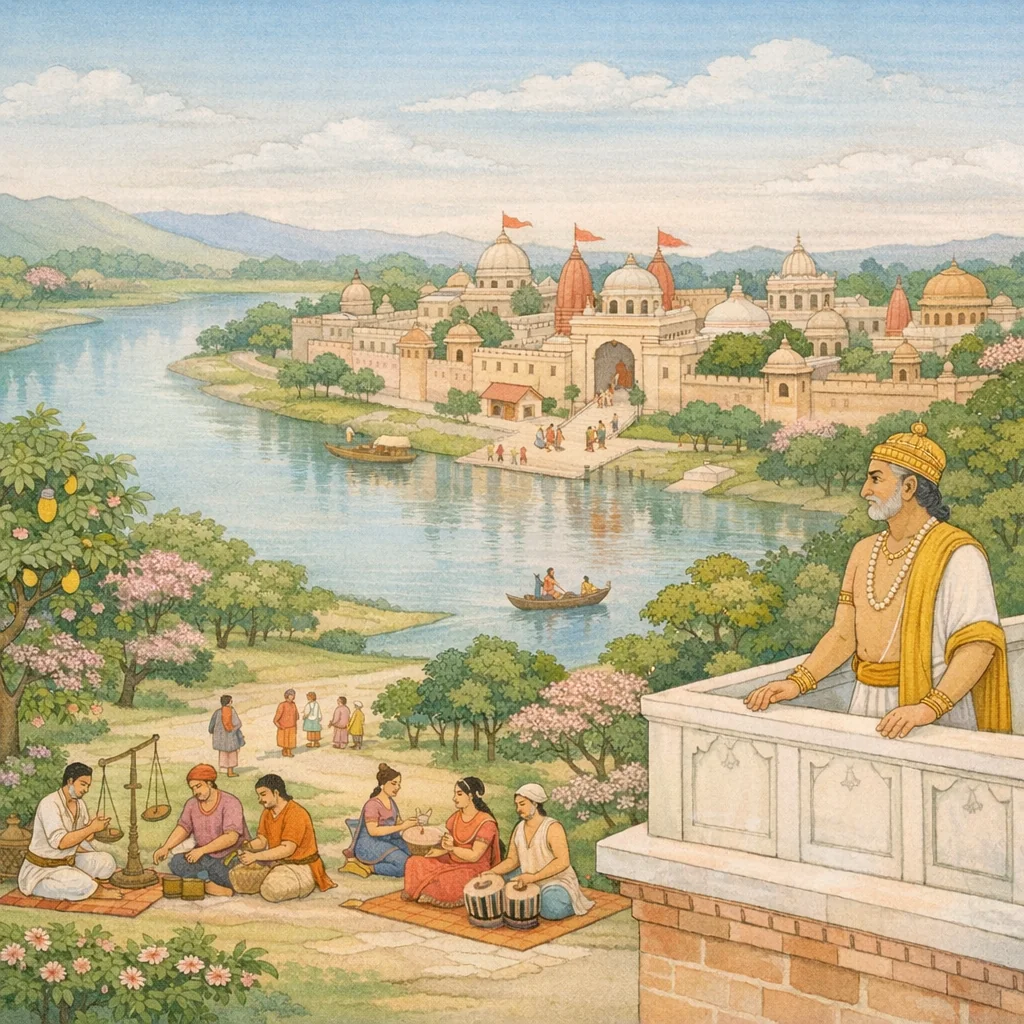
Sarga 5 strengthens the epic’s dynastic and geographic foundation: beginning with Prajāpati/Manu and the ancient line of victorious kings, it links sovereignty to the Ikṣvāku race and to the very rise of the Rāmāyaṇa narrative. Kośala is placed on the banks of the Sarayū, and Ayodhyā—traditionally founded by Manu—is presented as an exemplary capital, measured in yojanas, laid out with broad highways, and marked by civic order, prosperity, and refinement. Its urban poetry catalogs strong defenses (moat and ramparts), gates and markets, artisans and merchants, palaces and gem-adorned mansions, musical soundscapes, gardens and mango groves, and abundant provisions. It also highlights a disciplined martial realm: thousands of mahārathas skilled in archery and forest warfare, alongside a learned, ritual-observant populace—versed in Veda and Vedāṅga, charitable, truthful, and devoted to truth. The chapter culminates by situating King Daśaratha within this ideal civic-moral setting, making Ayodhyā a spatial embodiment of dharmic governance.
Shlokas
Verse 1
.सर्वा पूर्वमियं येषामासीत्कृत्स्ना वसुन्धरा ।प्रजापतिमुपादाय नृपाणां जयशालिनाम् ।।।।
In former times, this entire earth belonged to victorious kings—beginning with Prajāpati (Manu) and his lineage.
Verse 2
येषां स सगरो नाम सागरो येन खानित: ।षष्टि: पुत्रसहस्राणि यं यान्तं पर्यवारयन् ।।।।
Among them was the king named Sagara—by whom the ocean was dug out; and sixty thousand sons would surround him whenever he marched forth.
Verse 3
इक्ष्वाकूणामिदं तेषां राज्ञां वंशे महात्मनाम् ।महदुत्पन्नमाख्यानं रामायणमिति श्रुतम् ।।।।
From the lineage of the great-souled kings of the Ikṣvāku race arose this mighty narrative, renowned in the world as the Rāmāyaṇa.
Verse 4
तदिदं वर्तयिष्यामि सर्वं निखिलमादित: ।धर्मकामार्थसहितं श्रोतव्यमनसूयया ।।।।
Therefore I shall now set forth this entire account from the very beginning—an epic embracing dharma, artha, and kāma—and it should be heard without fault-finding or prejudice.
Verse 5
कोसलो नाम मुदितस्स्फीतो जनपदो महान् ।निविष्टस्सरयूतीरे प्रभूतधनधान्यवान् ।।।।
There was a great realm named Kosala—joyful and flourishing—situated on the banks of the Sarayū, abundant in wealth and grain.
Verse 6
अयोध्या नाम नगरी तत्रासील्लोकविश्रुता ।मनुना मानवेन्द्रेण या पुरी निर्मिता स्वयम् ।।।।
In that land stood the city named Ayodhyā, renowned among people—built by Manu himself, the lord of humankind.
Verse 7
आयता दश च द्वे च योजनानि महापुरी ।श्रीमती त्रीणि विस्तीर्णा सुविभक्तमहापथा ।।।।
That great city was twelve yojanas in length and three yojanas in breadth—splendid, with grand roads laid out in orderly divisions.
Verse 8
राजमार्गेण महता सुविभक्तेन शोभिता ।मुक्तपुष्पावकीर्णेन जलसिक्तेन नित्यश: ।।।।
It shone with its great royal highway—broad and well laid out—strewn with fresh blossoms and ever sprinkled with water.
Verse 9
तां तु राजा दशरथो महाराष्ट्रविवर्धन: ।पुरीमावासयामास दिवं देवपतिर्यथा ।।।।
In that city King Daśaratha—who fostered the prosperity of his great realm—dwelt as the lord of the gods dwells in heaven.
Verse 10
कवाटतोरणवतीं सुविभक्तान्तरापणाम् ।सर्वयन्त्रायुधवतीमुपेतां सर्वशिल्पिभि: ।।।।
It had arched gateways with panelled doors and well-arranged inner markets; it was furnished with every kind of instrument and weapon, sustained by artisans of every craft.
Verse 11
सूतमागधसम्बाधां श्रीमतीमतुलप्रभाम् ।उच्चाट्टालध्वजवतीं शतघ्नीशतसङ्कुलाम् ।।।।
It teemed with bards and keepers of genealogies, was prosperous and of incomparable splendour; it had lofty buildings adorned with flags and was crowded with hundreds of śataghnīs, defensive missiles.
Verse 12
वधूनाटकसङ्घैश्च संयुक्तां सर्वत: पुरीम् ।उद्यानाम्रवणोपेतां महतीं सालमेखलाम् ।।।।
The great city was filled on every side with troupes of female dancers and actors; it abounded in gardens and mango-groves, and was widely girdled as though by a belt of śāla trees.
Verse 13
दुर्गगम्भीरपरिघां दुर्गामन्यैर्दुरासदाम् ।वाजिवारणसम्पूर्णां गोभिरुष्ट्रै: खरैस्तथा ।।।।
It was a fortress with strong defenses and a deep moat, hard for others to approach; it was filled with horses and elephants, and likewise with cattle, camels, and mules.
Verse 14
सामन्तराजसङ्घैश्च बलिकर्मभिरावृताम् ।नानादेशनिवासैश्च वणिग्भिरुपशोभिताम् ।।।।
It was thronged with neighboring tributary kings bearing tribute and offerings, and adorned by merchants dwelling there from many lands.
Verse 15
प्रासादै रत्नविकृतै: पर्वतैरुपशोभिताम् ।कूटागारैश्च सम्पूर्णामिन्द्रस्येवामरावतीम् ।।।।
Like Indra’s Amarāvatī it shone—adorned with mountain-like palaces set with precious gems, and filled with lofty mansions.
Verse 16
चित्रामष्टापदाकारां नरनारीगणैर्युताम् ।सर्वरत्नसमाकीर्णां विमानगृहशोभिताम् ।।।।
Wondrous to behold, laid out like an aṣṭāpada board, filled with throngs of men and women, strewn with every kind of jewel, and beautified by towering multi-storied palaces.
Verse 17
गृहगाढामविच्छिद्रां समभूमौ निवेशिताम् ।शालितण्डुलसम्पूर्णामिक्षुकाण्डरसोदकाम् ।।।।
Densely filled with homes, leaving no space unused, built upon level ground; it abounded in rice and fine grains, and its water was sweet as sugarcane juice.
Verse 18
दुन्दुभीभिर्मृदङ्गैश्च वीणाभि: पणवैस्तथा ।नादितां भृशमत्यर्थं पृथिव्यां तामनुत्तमाम् ।।।।
It resounded loudly and exceedingly with dundubhī kettledrums, mṛdaṅgas, vīṇās, and paṇavas; upon the earth, that city was unsurpassed.
Verse 19
विमानमिव सिद्धानां तपसाधिगतं दिवि ।सुनिवेशितवेश्मान्तां नरोत्तमसमावृताम् ।।।।
Like a heavenly vimāna attained by siddhas through austerity in the skies, it had perfectly ordered rows of dwellings and was inhabited by the noblest of men.
Verse 20
ये च बाणैर्न विध्यन्ति विविक्तमपरापरम् ।शब्दवेध्यं च विततं लघुहस्ता विशारदा: ।।।।सिंहव्याघ्रवराहाणां मत्तानां नर्दतां वने ।हन्तारो निशितैश्शस्त्रैर्बलाद्बाहुबलैरपि ।।।।तादृशानां सहस्रैस्तामभिपूर्णां महारथै: ।पुरीमावासयामास राजा दशरथस्तदा ।।।।
That city was filled with thousands of mahārathas—swift-handed and expert—who would not pierce with arrows one who was solitary and defenseless, and who could strike by tracking sound while pursuing a fleeing foe. In the forest they could slay, with keen weapons and with the sheer strength of their arms, roaring lions, tigers, and boars maddened in rut. In such an Ayodhyā King Daśaratha then dwelt and ruled.
Verse 21
ये च बाणैर्न विध्यन्ति विविक्तमपरापरम् । शब्दवेध्यं च विततं लघुहस्ता विशारदा: ।।1.5.20।। सिंहव्याघ्रवराहाणां मत्तानां नर्दतां वने । हन्तारो निशितैश्शस्त्रैर्बलाद्बाहुबलैरपि ।।1.5.21।। तादृशानां सहस्रैस्तामभिपूर्णां महारथै: । पुरीमावासयामास राजा दशरथस्तदा ।।1.5.22।।
That Ayodhyā was filled with the best of the twice-born—keepers of the sacred fires, virtuous, and accomplished in the Vedas and the six Vedāṅgas—generous in gifts by the thousand, devoted to truth, great-souled, like maharṣis, with unique sages among them.
Verse 22
ये च बाणैर्न विध्यन्ति विविक्तमपरापरम् ।शब्दवेध्यं च विततं लघुहस्ता विशारदा: ।।1.5.20।। सिंहव्याघ्रवराहाणां मत्तानां नर्दतां वने ।हन्तारो निशितैश्शस्त्रैर्बलाद्बाहुबलैरपि ।।1.5.21।। तादृशानां सहस्रैस्तामभिपूर्णां महारथै: ।पुरीमावासयामास राजा दशरथस्तदा ।।1.5.22।।
Thus Ayodhyā was filled with thousands of such great chariot-warriors; and in that city King Daśaratha then made his dwelling.
Verse 23
तामग्निमद्भिर्गुणवद्भिरावृतांद्विजोत्तमैर्वेदषडङ्गपारगै: ।सहस्रदैस्सत्यरतैर्महात्मभिर्महर्षिकल्पै ऋषिभिश्च केवलै: ।।।।
That Ayodhyā was filled with the best of the twice-born—keepers of the sacred fires, virtuous, and accomplished in the Vedas and the six Vedāṅgas—generous in gifts by the thousand, devoted to truth, great-souled, like maharṣis, with unique sages among them.
Verse 24
That city was girded by a deep and formidable moat, hard to cross and thus unassailable to enemies. It teemed with horses, elephants, cows, camels, and donkeys, signifying its military might and prosperity.
Frequently Asked Questions
Rather than a single dilemma, the sarga presents a normative action-model: the construction and maintenance of a capital whose prosperity, security, learning, and restraint embody rājadharma—culminating in Daśaratha’s residence as the rightful ruler within that ordered civic space.
The chapter implies that dharma is institutional and environmental: a righteous city is not only wealth-bearing but also disciplined—fortified yet cultured, militarily capable yet ethically bounded, and sustained by truth, charity, and Vedic learning.
Kośala on the Sarayū and the famed city of Ayodhyā are central; culturally, the passage highlights planned highways and markets, fortified moats, ritual fire practice, Veda–Vedāṅga scholarship, and courtly arts (music, dance, architecture) as markers of a mature civilization.