Sarga 22
बलातिबलोपदेशः — The Instruction of Bala and Atibala
बालकाण्ड
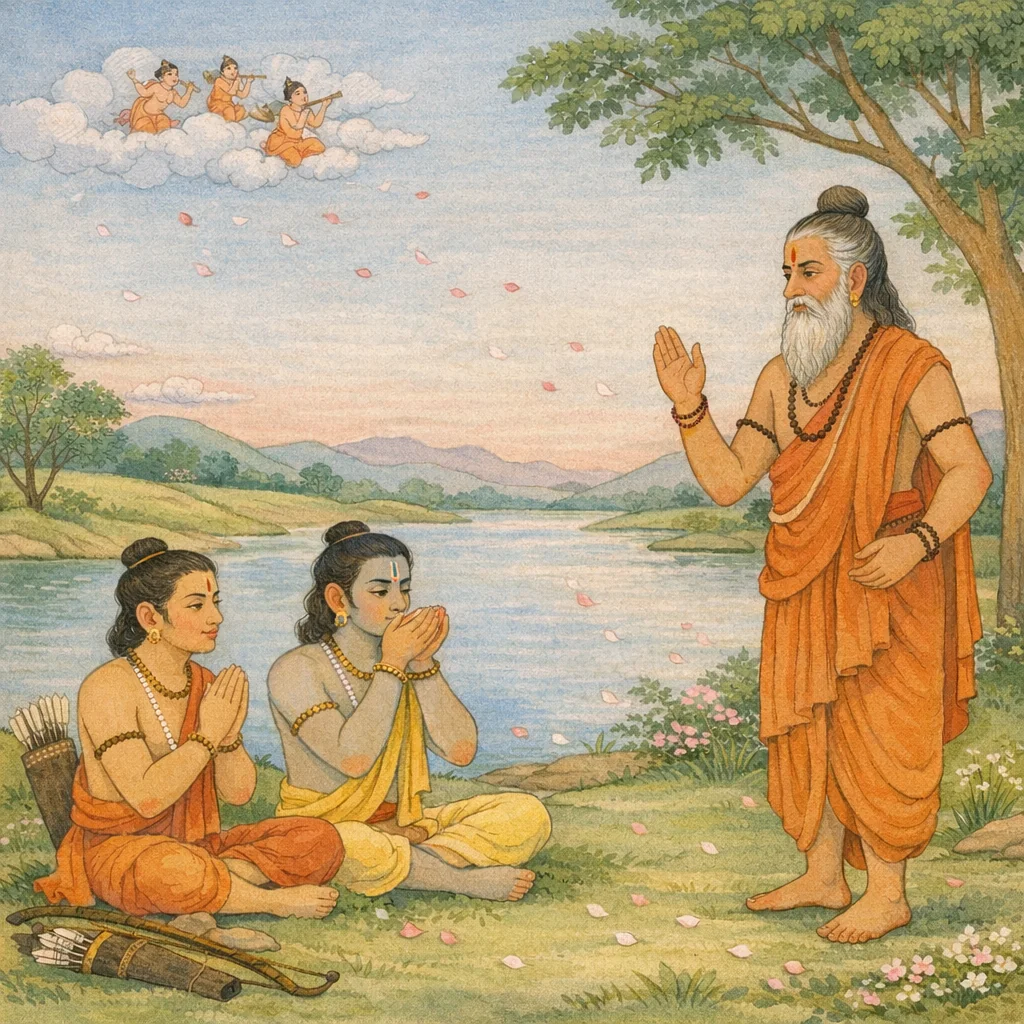
Sarga 22 narrates the formal shift from royal protection to ascetic guardianship and the first explicit bestowal of mantra-knowledge upon Rāma. After Vasiṣṭha’s counsel, Daśaratha summons Rāma with Lakṣmaṇa and, following auspicious svastyayana rites performed by the parents and the royal priest, entrusts the prince to Viśvāmitra. Their departure is marked by cosmic assent—gentle pollen-free winds, a rain of flowers, and celestial sounds of drums and conches—sanctioning the journey. Viśvāmitra leads, while the two brothers follow armed and radiant, praised through lofty similes (serpents with many hoods; Skanda and Viśākha following Śiva), showing disciplined martial readiness under spiritual authority. On the southern bank of the Sarayū, after traveling more than half a yojana, the sage instructs Rāma to take water in an ācamanā-like purificatory gesture and confers the paired vidyās/mantras Bala and Atibala. Their promised fruits are protective and ascetic: freedom from fatigue, fever, and bodily decline; invulnerability to rākṣasas even in sleep or distraction; and the removal of hunger and thirst through recitation. The chapter ends with Rāma purified and endowed with these sciences, his radiance increased like the autumn sun, and the three resting for the night on a grass-bed by the Sarayū, sustained by the preceptor’s gentle words and the dharma of disciple-service.
Shlokas
Verse 1
[Dasaratha sends Rama and Lakshmana with Viswamitra--Viswamitra confers knowledge of bala and atibala to Rama and Lakshmana.] तथा वसिष्ठे ब्रुवति राजा दशरथस्सुतम प्रहृष्टवदनो राममाजुहाव सलक्ष्मणम्।।1.22.1।।
When Vasiṣṭha had spoken thus, King Daśaratha, his face bright with resolve, summoned Rāma together with Lakṣmaṇa.
Verse 2
कृतस्वस्त्ययनं मात्रा पित्रा दशरथेन च।पुरोधसा वसिष्ठेन मङ्गलैरभिमन्त्रितम्।।1.22.2।।स पुत्रं मूर्ध्न्युपाघ्राय राजा दशरथ: प्रियम्।ददौ कुशिकपुत्राय सुप्रीतेनान्तरात्मना।।1.22.3।।
After his mother and his father, King Daśaratha, had performed the auspicious rites of blessing and farewell, and after the family priest Vasiṣṭha had sanctified him with auspicious mantras, King Daśaratha kissed his beloved son upon the crown of his head and, with a heart joyfully consenting, entrusted him to Kuśika’s son, Viśvāmitra.
Verse 3
कृतस्वस्त्ययनं मात्रा पित्रा दशरथेन च।पुरोधसा वसिष्ठेन मङ्गलैरभिमन्त्रितम्।।1.22.2।।स पुत्रं मूर्ध्न्युपाघ्राय राजा दशरथ: प्रियम्।ददौ कुशिकपुत्राय सुप्रीतेनान्तरात्मना।।1.22.3।।
After his mother and his father, King Daśaratha, had performed the auspicious rites of blessing and farewell, and after the family priest Vasiṣṭha had sanctified him with auspicious mantras, King Daśaratha kissed his beloved son upon the crown of his head and, with a heart joyfully consenting, entrusted him to Kuśika’s son, Viśvāmitra.
Verse 4
ततो वायुस्सुखस्पर्शो नीरजस्को ववौ तदा।विश्वामित्रगतं दृष्ट्वा रामं राजीवलोचनम्।।1.22.4।।
Then, seeing lotus-eyed Rāma going with Viśvāmitra, a pleasant breeze blew—clear and free of dust.
Verse 5
पुष्पवृष्टिर्महत्यासीद्देवदुन्दुभिनिस्वनै:।शङ्खदुन्दुभिनिर्घोष: प्रयाते तु महात्मनि।।1.22.5।।
As the great-souled one departed, a heavy shower of flowers fell, while celestial kettledrums resounded and conches and drums roared aloud.
Verse 6
विश्वामित्रो ययावग्रे ततो रामो धनुर्धर:।काकपक्षधरो धन्वी तं च सौमित्रिरन्वगात्।।1.22.6।।
Viśvāmitra went ahead; behind him walked Rāma with bow in hand, and Lakṣmaṇa—Sumitrā’s son, an archer with side-locks—followed as well.
Verse 7
कलापिनौ धनुष्पाणी शोभमानौ दिशो दश ।विश्वामित्रं महात्मानं त्रिशीर्षाविव पन्नगौ।।1.22.7।।अनुजग्मतुरक्षुद्रौ पितामहमिवाश्विनौ।
With quivers and bows in hand, the two shone in the ten directions; like two three-hooded serpents they followed the great-souled Viśvāmitra—mighty and undiminished—like the Aśvins following the Grandsire, Brahmā.
Verse 8
तदा कुशिकपुत्रं तु धनुष्पाणी स्वलङ्कृतौ।।1.22.8।।बद्धगोधाङ्गुलित्राणौ खड्गवन्तौ महाद्युती ।कुमारौ चारुवपुषौ भ्रातरौ रामलक्ष्मणौ ।।1.22.9।।अनुयातौ श्रिया दीप्तौ शोभयेतामनिन्दितौ।स्थाणुं देवमिवाचिन्त्यं कुमाराविव पावकी ।।1.22.10।।
Then the two brothers, Rāma and Lakṣmaṇa, followed Kuśika’s son: bows in hand and finely adorned, their fingers and arms guarded for archery, swords at their sides, radiant and handsome. Blazing with splendor and faultless, they seemed like the two sons of the Fire-god following the incomprehensible Lord Sthāṇu (Śiva).
Verse 9
तदा कुशिकपुत्रं तु धनुष्पाणी स्वलङ्कृतौ।।1.22.8।।बद्धगोधाङ्गुलित्राणौ खड्गवन्तौ महाद्युती ।कुमारौ चारुवपुषौ भ्रातरौ रामलक्ष्मणौ ।।1.22.9।।अनुयातौ श्रिया दीप्तौ शोभयेतामनिन्दितौ।स्थाणुं देवमिवाचिन्त्यं कुमाराविव पावकी ।।1.22.10।।
Then the two brothers, Rāma and Lakṣmaṇa, followed Kuśika’s son: bows in hand and finely adorned, their fingers and arms guarded for archery, swords at their sides, radiant and handsome. Blazing with splendor and faultless, they seemed like the two sons of the Fire-god following the incomprehensible Lord Sthāṇu (Śiva).
Verse 10
तदा कुशिकपुत्रं तु धनुष्पाणी स्वलङ्कृतौ।।1.22.8।।बद्धगोधाङ्गुलित्राणौ खड्गवन्तौ महाद्युती ।कुमारौ चारुवपुषौ भ्रातरौ रामलक्ष्मणौ ।।1.22.9।।अनुयातौ श्रिया दीप्तौ शोभयेतामनिन्दितौ।स्थाणुं देवमिवाचिन्त्यं कुमाराविव पावकी ।।1.22.10।।
Then the two brothers, Rāma and Lakṣmaṇa—bows in hand, richly adorned, their fingers and arms protected with leather-guards, swords at their sides, radiant and handsome—followed the son of Kuśika (Viśvāmitra). Shining with splendor and faultless in bearing, they seemed like the two sons of the Fire-god accompanying the incomprehensible Lord Śiva.
Verse 11
अध्यर्धयोजनं गत्वा सरय्वा दक्षिणे तटे।रामेति मधुरां वाणीं विश्वामित्रोऽभ्यभाषत।।1.22.11।।
Having traveled a little more than half a yojana along the southern bank of the Sarayū, Viśvāmitra addressed Rāma in sweet words, calling him by name.
Verse 12
गृहाण वत्स सलिलं मा भूत्कालस्य पर्यय:।मन्त्रग्रामं गृहाण त्वं बलामतिबलां तथा।।1.22.12।।
“Take this water in your hands, my child—let there be no delay. Receive from me the collection of mantras, and also the mantras called Balā and Atibalā.”
Verse 13
न श्रमो न ज्वरो वा ते न रूपस्य विपर्यय:।न च सुप्तं प्रमत्तं वा धर्षयिष्यन्ति नैऱृता:।।1.22.13।।
For you there shall be neither fatigue nor fever, nor any decline in your appearance; and whether asleep or off-guard, the rākṣasas will not be able to assail you.
Verse 14
न बाह्वोस्सदृशो वीर्ये पृथिव्यामस्ति कश्चन।त्रिषु लोकेषु वै राम न भवेत्सदृशस्तव ।।1.22.14।।
O Rāma, no one on earth is equal to the might of your arms; indeed, even across the three worlds there will be none comparable to you.
Verse 15
न सौभाग्ये न दाक्षिण्ये न ज्ञाने बुद्धिनिश्चये।नोत्तरे प्रतिवक्तव्ये समो लोके तवाऽनघ।।1.22.15।।
O blameless one, in this world none equals you in good fortune, in kindness, in knowledge and firmness of judgment, or in giving a fitting reply when an answer is required.
Verse 16
एतद्विद्याद्वये लब्धे भविता नास्ति ते सम:।बलात्वतिबला चैव सर्वज्ञानस्य मातरौ।।1.22.16।।
Once you have obtained these two branches of knowledge, none will be your equal—neither now nor in the future. For Bala and Atibala are the very mothers of all knowledge.
Verse 17
क्षुत्पिपासे न ते राम भविष्येते नरोत्तम ।बलामतिबलां चैव पठत: पथि राघव।।1.22.17।।
O Rāma, best of men—O Rāghava—if you recite Bala and Atibala while on the road, you will not be troubled by hunger or thirst.
Verse 18
विद्याद्वयमधीयाने यशश्चाप्यतुलं त्वयि।पितामहसुते ह्येते विद्ये तेजस्समन्विते।।1.22.18।।प्रदातुं तव काकुत्स्थ सदृशस्त्वं हि धार्मिक।
If you study these two sacred sciences, unrivalled fame will come to you. These radiant disciplines are said to be the two daughters of the Grandsire, Brahmā. O Kākutstha, you are truly righteous and fully fit to receive them.
Verse 19
कामं बहुगुणास्सर्वे त्वय्येते नात्र संशय:। तपसा सम्भृते चैते बहुरूपे भविष्यत:।।1.22.19।।
Indeed, all these many virtues are found in you—there is no doubt. And when these two sciences are strengthened through austerity (tapas), they will manifest in many forms to serve you.
Verse 20
ततो रामो जलं स्पृष्ट्वा प्रहृष्टवदनश्शुचि:।प्रतिजग्राह ते विद्ये महर्षेर्भावितात्मन:।।1.22.20।।
Then Rāma, touching water and becoming purified, received with a joyful countenance those two sciences from the great sage whose self was spiritually perfected.
Verse 21
विद्यासमुदितो रामश्शुशुभे भूरिविक्रम:।सहस्ररश्मिर्भगवान् शरदीव दिवाकर:।।1.22.21।। गुरुकार्याणि सर्वाणि नियुज्य कुशिकात्मजे।ऊषुस्तां रजनीं तत्र सरय्वां सुसुखं त्रय:।।1.22.22।।
Rāma, mighty in valor and now enriched with knowledge, shone like the thousand-rayed sun in autumn. Having duly carried out every service owed to Kuśika’s son, the three spent that night there on the bank of the Sarayū in great comfort.
Verse 22
विद्यासमुदितो रामश्शुशुभे भूरिविक्रम:।सहस्ररश्मिर्भगवान् शरदीव दिवाकर:।।1.22.21।। गुरुकार्याणि सर्वाणि नियुज्य कुशिकात्मजे।ऊषुस्तां रजनीं तत्र सरय्वां सुसुखं त्रय:।।1.22.22।।
Rāma, mighty in valor and now enriched with knowledge, shone like the thousand-rayed sun in autumn. Having duly carried out every service owed to Kuśika’s son, the three spent that night there on the bank of the Sarayū in great comfort.
Verse 23
दशरथनृपसूनुसत्तमाभ्यां तृणशयनेऽनुचिते सहोषिताभ्याम्। कुशिकसुतवचोऽनुलालिताभ्यां सुखमिव सा विबभौ विभावरी च।।1.22.23।।
That night seemed almost gentle for the two excellent sons of King Daśaratha, though they lay together on an unfamiliar bed of grass—cheered and soothed by the tender words of Kuśika’s son, Viśvāmitra.
Verse 24
Source verse not provided. Please share the Devanāgarī text (or a clear image) for Bāla-kāṇḍa 22.24 (Southern Recension, IIT Kanpur) so I can render an accurate, devotional translation.
Frequently Asked Questions
The pivotal action is Daśaratha’s consent to place his young heir under Viśvāmitra’s ascetic guardianship—an ethics-of-duty decision where royal attachment yields to a higher protective obligation toward sages and social order.
Knowledge is transmitted through ritual purity, timely obedience, and guru-sevā: Bala and Atibala exemplify mantra as disciplined power that preserves bodily steadiness and moral agency, enabling dharmic action without exhaustion, fear, or distraction.
The Sarayū River’s southern bank functions as a liminal training-space where courtly life transitions into forest-ascetic praxis; the svastyayana farewell rite and water-taking gesture mark the cultural protocols of departure and initiation.