Sarga 60
षष्टितमः सर्गः — Kausalyā’s Lament and Sumantra’s Consolation (Sītā’s Fearless Forest-Life)
अयोध्याकाण्ड
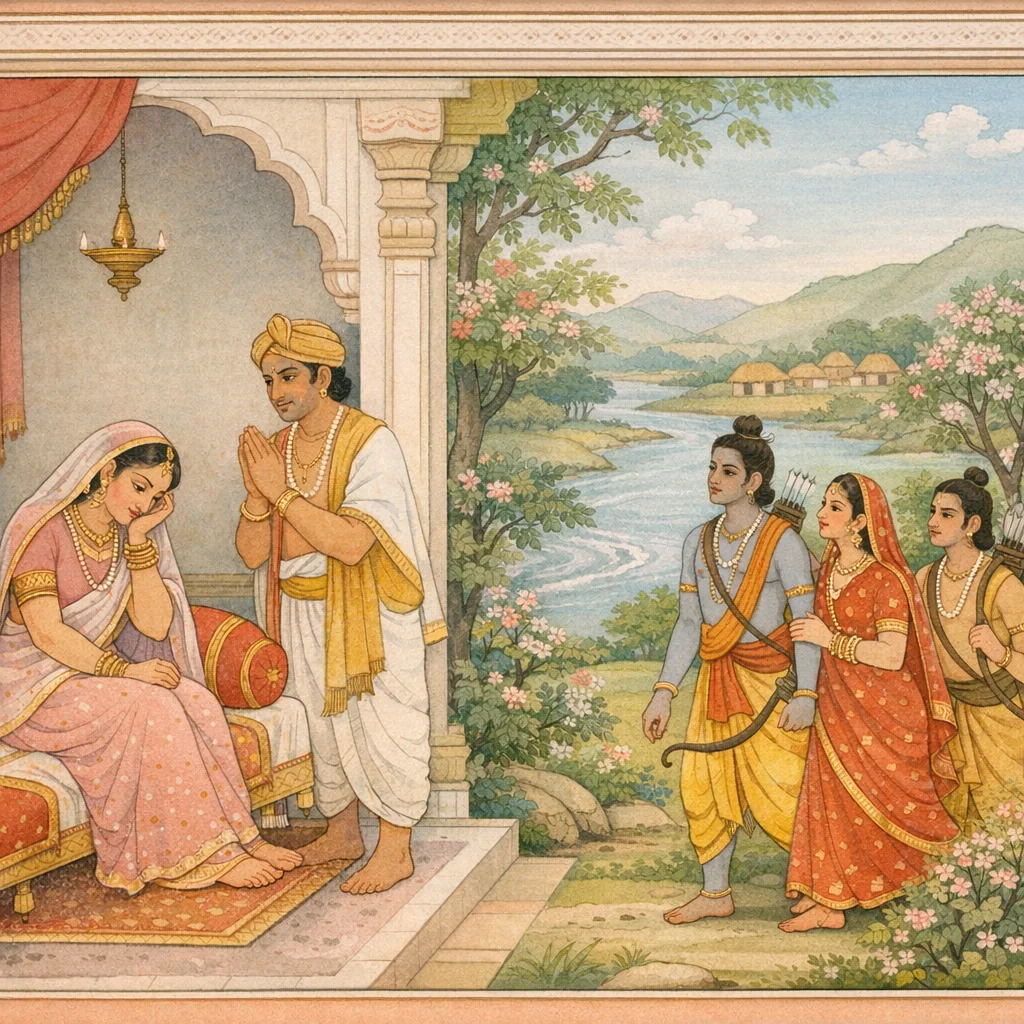
This sarga presents a grief-driven exchange: Queen Kausalyā, trembling and physically unsteady, confronts the charioteer Sumantra and demands to be taken at once to Rāma, Sītā, and Lakṣmaṇa, declaring she cannot live through separation from her son. With folded hands, Sumantra offers measured consolation. He urges her to abandon despair, portrays Rāma’s forest-dwelling as principled endurance in accordance with dharma, and describes Lakṣmaṇa’s attendance as disciplined duty that yields spiritual merit. He then turns to Sītā’s conduct: she appears un-dejected, at ease in the desolate forest as if at home, playfully asking about villages, rivers, and trees, her heart so fixed on Rāma that Ayodhyā without him would feel like wilderness. Sumantra praises her unfading radiance despite travel hardships, her lotus-and-moon-like beauty, her unadorned yet luminous feet, and her fearless movement under Rāma’s protection even amid wild beasts. The chapter closes by affirming the lasting fame of such conduct; yet, despite sound counsel, Kausalyā’s maternal sorrow persists, and she repeatedly cries out for her beloved son.
Shlokas
Verse 1
ततो भूतोपसृष्टेव वेपमाना पुनः पुनः।धरण्यां गतसत्त्वेव कौसल्या सूतमब्रवीत्।।।।
Then Kausalyā—trembling again and again, as though seized by a spirit, and as if bereft of her senses upon the ground—spoke to the charioteer (Sumantra).
Verse 2
नय मां यत्र काकुत्स्थस्सीता यत्र च लक्ष्मणः।तान्विना क्षणमप्यत्र जीवितुं नोत्सहेह्यहम्।।।।
Take me to wherever Rāma of the Kakutsthas is—where Sītā is, and where Lakṣmaṇa is. Without them, I do not wish to live here even for a single moment.
Verse 3
निवर्तय रथं शीघ्रं दण्डकान्नय मामपि।अथ तान्नानुगच्छामि गमिष्यामि यमक्षयम्।।।।
Turn the chariot back at once, and take me too to the Dandaka forest. If I do not follow after them, then I shall go to Yama’s abode—death.
Verse 4
बाष्पवेगोपहतया स वाचा सज्जमानया।इदमाश्वासयन्देवीं सूतः प्राञ्जलिरब्रवीत्।।।।
Then the charioteer, with palms joined, spoke to console the queen; his words faltered, choked by the rush of tears.
Verse 5
त्यज शोकं च मोहं च सम्भ्रमं दुःखजं तथा।व्यवधूय च सन्तापं वने वत्स्यति राघवः।।।।
Give up grief, delusion, and the turmoil born of sorrow; cast off your anguish. Raghava will dwell in the forest, brushing aside hardships.
Verse 6
लक्ष्मणश्चापि रामस्य पादौ परिचरन्वने।आराधयति धर्मज्ञः परलोकं जितेन्द्रियः।।।।
And Lakshmana too—self-controlled and knowing dharma—serves at Rama’s feet in the forest, thereby gaining spiritual merit for the world beyond.
Verse 7
विजनेऽपि वने सीता वासं प्राप्य गृहेष्विव।विस्रम्भं लभतेऽभीता रामे सन्न्यस्तमानसा।।।।
Even in the lonely forest, Sītā—having made her dwelling there as though it were her own home—feels secure and unafraid, for her mind rests wholly upon Rāma.
Verse 8
नास्या दैन्यं कृतं किञ्चित्सुसूक्ष्ममपि लक्ष्यते।उचितेव प्रवासानां वैदेही प्रतिभाति मा।।।।
In her I perceive not even the subtlest trace of dejection; Vaidehī appears to me as though she were already accustomed to life away from home.
Verse 9
नगरोपवनं गत्वा यथा स्मरमते पुरा।तथैव रमते सीता निर्जनेषु वनेष्वपि।।।।
Just as she once delighted in the city’s pleasure-groves, so too Sītā now takes delight even in these lonely forests.
Verse 10
बालेव रमते सीताऽबालचन्द्रनिभानना।रामा रामे ह्यधीनात्मा विजनेऽपि वने सती।।।।
Sītā—lovely, with a face like the young moon—keeps her whole mind dependent on Rāma; and though she is in a lonely forest, she delights in it like a child, ever virtuous.
Verse 11
तद्गतं हृदयं ह्यस्यास्तदधीनं च जीवितम्।अयोध्यापि भवेऽत्तस्या रामहीना तदा वनम्।।।।
For her heart is fixed upon him, and her very life depends upon him; if she were without Rāma, even Ayodhyā would then become a forest to her.
Verse 12
परिपृच्छति वैदेही ग्रामांश्च नगराणि च।गतिं दृष्ट्वा नदीनां च पादपान्विविधानपि।।।।रामं हि लक्ष्मणं वापि पृष्ट्वा जानाति जानकी।अयोध्या क्रोशमात्रे तु विहारमिव संश्रिता।।।।
Vaidehī, seeing villages and towns, the courses of rivers, and trees of many kinds, keeps asking about them; and after asking either Rāma or Lakṣmaṇa, Jānakī comes to know them—dwelling as though in a pleasure-grove only a krośa away from Ayodhyā.
Verse 13
परिपृच्छति वैदेही ग्रामांश्च नगराणि च।गतिं दृष्ट्वा नदीनां च पादपान्विविधानपि।।2.60.12।।रामं हि लक्ष्मणं वापि पृष्ट्वा जानाति जानकी।अयोध्या क्रोशमात्रे तु विहारमिव संश्रिता।।2.60.13।।
Vaidehī, seeing villages and towns, the courses of rivers, and trees of many kinds, keeps asking about them; and after asking either Rāma or Lakṣmaṇa, Jānakī comes to know them—dwelling as though in a pleasure-grove only a krośa away from Ayodhyā.
Verse 14
इदमेव स्मराम्यस्यास्सहसैवोपजल्पितम्।कैकेयी संश्रितं वाक्यं नेदानीं प्रतिभाति मा।।।।
I remember only this much—that she suddenly uttered some words concerning Kaikeyī; but what they were does not now occur to me.
Verse 15
ध्वंसयित्वा तु तद्वाक्यं प्रमादात्पर्युपत्स्थितम्।ह्लादनं वचनं सूतो देव्या मधुरमब्रवीत्।।।।
But, setting aside those words that had slipped out through inadvertence, the charioteer spoke to the queen in gentle, sweet speech, meant to bring her comfort.
Verse 16
अध्वना वातवेगेन सम्भ्रमेणाऽऽतपेन च।न विगच्छति वैदेह्याश्चन्द्रांशु सदृशी प्रभा।।।।
Vaidehī’s radiance, like moonbeams, does not diminish—neither from the road’s fatigue, nor the wind’s swiftness, nor the haste of travel, nor even the sun’s heat.
Verse 17
सदृशं शतपत्रस्य पूर्णचन्द्रोपमप्रभम्।वदनं तद्वदान्याया वैदेह्या न विकम्पते।।।।
Vaidehī’s face, of that gracious lady, shines like the full moon and resembles a hundred-petalled lotus; it neither wavers nor withers.
Verse 18
अलक्तरसरक्ताभावलक्तरसवर्जितौ।अद्यापि चरणौ तस्याः पद्मकोशसमप्रभौ।।।।
Even now her feet—though no longer stained with red lac—still seem as if reddened with lac, shining like lotus buds.
Verse 19
नूपुरोद्घुष्टहेलेव खेलं गच्छति भामिनी।इदानीमपि वैदेही तद्रागान्नयस्त भूषणा।।।।
Even now Vaidehi—having set aside her ornaments out of love for him—walks with gentle grace, as though in playful dalliance, while her anklets softly proclaim each step.
Verse 20
गजं वा वीक्ष्य सिंहं वा व्याघ्रं वा वनमाश्रिता।नाऽहारयति सन्त्रासं बाहू रामस्य संश्रिता।।।।
Dwelling in the forest, even on seeing an elephant, a lion, or a tiger, she feels no fear—having taken refuge in Rāma’s arms.
Verse 21
न शोच्यास्ते न चात्मनश्शोच्यो नापि जनाधिपः।इदं हि चरितं लोके प्रतिष्ठास्यति शाश्वतम्।।।।
They are not to be pitied—nor are you to be pitied, nor even the king; for this conduct will stand established in the world forever.
Verse 22
विधूय शोकं परिहृष्टमानसा महर्षियाते पथि सुव्यवत्स्थिताः।वनेरता वन्यफलाशनाः पितुश्शुभां प्रतिज्ञां परिपालयन्ति ते।।।।
Shaking off grief, with hearts made serene, firmly established on the path laid down by great seers, delighting in the forest and living on wild fruits, they are fulfilling their father’s noble vow.
Verse 23
तथापि सूतेन सुयुक्तवादिना निवार्यमाणा सुतशोककर्शिता।न चैव देवी विरराम कूजितात्प्रियेति पुत्रेति च राघवेति च।।।।
Yet, though restrained by the charioteer who spoke fittingly, the queen—worn down by grief for her son—did not cease her cries: “Beloved!”, “Son!”, and “O Rāghava!”
Frequently Asked Questions
Kausalyā’s impulse is to abandon courtly restraint and immediately pursue exile, even invoking death if prevented. The dilemma is whether maternal attachment may override the established course of dharma and royal order, versus accepting separation while upholding the father’s vow and the prince’s duty.
The sarga presents consolation as dharmic instruction: steadfast duty can coexist with human sorrow, and inner composure is possible when the mind is anchored in righteous purpose. Sītā’s unshaken courage and Lakṣmaṇa’s service exemplify how virtue re-frames hardship into disciplined living.
Ayodhyā (as the emotional reference point), the Daṇḍaka forest (destination of exile), and the liminal landscape of villages, cities, rivers, and trees encountered on the route. Cultural markers include ornaments (anklets), lac-dye, and lotus–moon imagery used to encode ideals of beauty, auspiciousness, and resilience.