Sarga 51
जटायुरावणयुद्धम् (Jatayu’s Combat with Ravana)
आरण्यकाण्ड
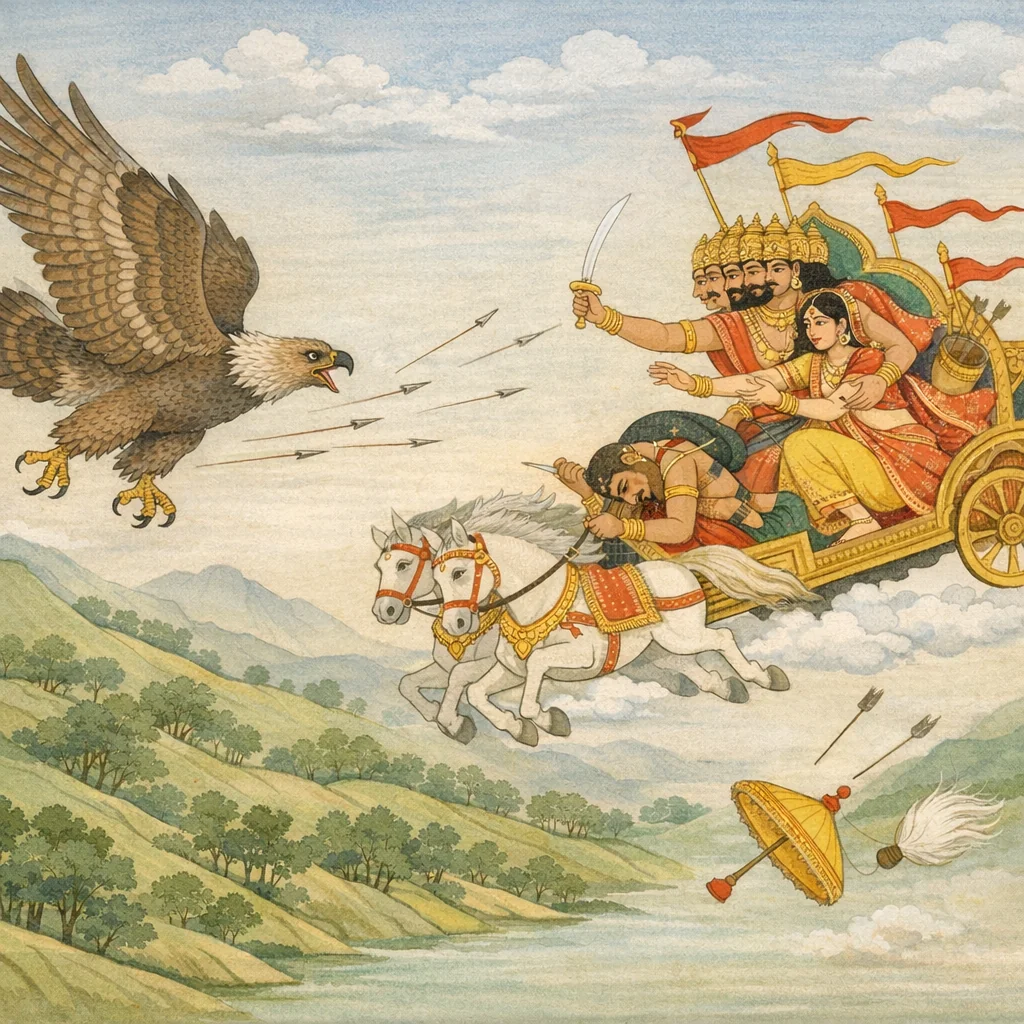
Sarga 51 heightens the abduction episode through a sustained combat tableau between Jaṭāyu, king of birds, and Rāvaṇa, fought across sky and ground. Stung by Jaṭāyu’s righteous rebuke, Rāvaṇa’s “twenty eyes” blaze with anger as he rains arrows; Jaṭāyu repeatedly counters, scattering missiles with his wings, snapping bows with his claws, tearing armor, and wrecking the demon’s chariot—yoked beasts, parasol, fans, and charioteer. Amid the kinetic clash runs a discourse on dharma: Jaṭāyu warns that stealing Rāma’s wife is a thief’s path and a self-chosen “drink of poison,” binding Rāvaṇa to death’s noose. Rāvaṇa briefly falls with Sītā in his lap, and beings praise Jaṭāyu’s valor; yet, seeing the aged bird’s exhaustion, Rāvaṇa regains flight. The climax turns tragic when Rāvaṇa, enraged, draws his sword and severs Jaṭāyu’s wings and feet. Jaṭāyu falls bloodied and near death; Sītā rushes to him and weeps, while Rāvaṇa departs—leaving behind the ethical witness of sacrifice and the proof that will later inform Rāma.
Shlokas
Verse 1
इत्युक्तस्य यथान्यायं रावणस्य जटायुषा।क्रुद्धस्याग्निनिभास्सर्वा रेजुर्विंशतिदृष्टयः।।।।
When Jaṭāyu had spoken thus, rightly and in accord with dharma, Rāvaṇa, inflamed with wrath, made all his twenty eyes blaze like fire.
Verse 2
संरक्तनयनः कोपात्तप्तकाञ्चनकुण्डलः।राक्षसेन्द्रोऽभिदुद्राव पतगेन्द्रममर्षणः।।।।
Enraged, his eyes reddened and his heated golden earrings gleaming, the intolerant lord of the rākṣasas rushed upon Jatāyu, the king of birds.
Verse 3
स सम्प्रहारस्तुमुल स्तयोस्तस्मिन्महावने।बभूव वातोद्धतयोर्मेघयोर्गगने यथा।।।।
In that vast forest, their clash grew tumultuous and thunderous—like two clouds in the sky driven into collision by stormy winds.
Verse 4
तद्बभूवाद्भुतं युद्धं गृध्रराक्षसयोस्तदा।सपक्षयोर्माल्यवतोर्महापर्वतयोरिव।।।।
Then that battle between the vulture and the demon became a marvel to behold—like the clash of two vast winged mountains of the Mālyavān range.
Verse 5
ततो नालीकनाराचैस्तीक्ष्णाग्रैश्च विकर्णिभिः।अभ्यवर्षन्महाघोरैर्गृध्रराजं महाबलः।।।।
Then the mighty Rāvaṇa showered the king of vultures with exceedingly dreadful weapons—sharp-tipped nālīka-spears, nārāca-shafts, and vikarṇī missiles.
Verse 6
स तानि शरजालानि गृध्रः पत्त्ररथेश्वरः।जटायुः प्रतिजग्राह रावणास्त्राणि संयुगे।।।।
But Jaṭāyu—the vulture, lord of winged chariots—stood his ground in battle and bore the net of arrows and weapons hurled by Rāvaṇa.
Verse 7
तस्य तीक्ष्णनखाभ्यां तु चरणाभ्यां महाबलः।चकार बहुधा गात्रे व्रणान्पतगसत्तमः।।।।
Then Jaṭāyu, best of birds and mighty in strength, tore and gashed Rāvaṇa’s body in many places with his feet and sharp claws.
Verse 8
अथ क्रोधाद्धशग्रीवो जग्राह दश मार्गणान्।मृत्युदण्डनिभान्घोरान्छत्रुमर्दनकाङ्क्षया।।।।
Then, in wrath, Daśagrīva seized ten dreadful missiles—like the very staff of Death—yearning to crush his foe.
Verse 9
स तैर्बाणैर्महावीर्यः पूर्णमुक्तैरजिह्मगैः।बिभेद निशितैस्तीक्ष्णैर्गृध्रं घोरैश्शिलीमुखैः।।।।
With those arrows—fully loosed, straight-flying, whetted and razor-sharp—the mighty Rāvaṇa pierced the vulture with dreadful śilīmukha shafts.
Verse 10
स राक्षसरथे पश्यन्जानकीं बाष्पलोचनाम्।अचिन्तयित्वा तान्बाणान्राक्षसं समभिद्रवत्।।।।
Seeing Jānakī upon the rākṣasa’s chariot, her eyes brimming with tears, he heeded not those arrows and rushed again at the demon.
Verse 11
ततोऽस्य सशरं चापं मुक्तामणिविभूषितम्।चरणाभ्यां महातेजा बभञ्ज पतगेश्वरः।।।।
Then the mighty lord of birds shattered with his feet Rāvaṇa’s bow—adorned with pearls and gems—together with its arrow.
Verse 12
ततोऽन्यद्धनुरादाय रावणः क्रोधमूर्छितः।ववर्ष शरवर्षाणि शतशोऽथ सहस्रशः।।।।
Then Rāvaṇa, blinded by rage, seized another bow and poured down a rain of arrows—by the hundreds and by the thousands.
Verse 13
शरैरावारितस्तस्य संयुगे पतगेश्वरः।कुलायमुपसम्प्राप्तः पक्षीव प्रबभौ तदा।।।।
In that clash, hemmed in on all sides by his arrows, the lord of birds shone then like a bird that has reached its nest.
Verse 14
स तानि शरवर्षाणि पक्षाभ्यां च विधूयच।चरणाभ्यां महातेजा बभञ्जास्य महद्धनुः।।।।
He shook off those showers of arrows with his wings, and the mighty one broke Rāvaṇa’s great bow with his feet.
Verse 15
तच्चाग्निसदृशं दीप्तं रावणस्य शरावरम्।पक्षाभ्यां स महावीर्यो व्याधुनोत्पतगेश्वरः।।।।
And that blazing, fire-like armor of Rāvaṇa, the great-heroic lord of birds tore apart with his wings.
Verse 16
काञ्चनोरश्छदान्दिव्यान्पिशाचवदनान्खरान्।तांश्चास्य जवसम्पन्नाञ्जघान समरे बली।।।।
Mighty Jatāyu struck down in battle those splendid, swift asses—ghastly of face like piśācas—armoured with golden breast-plates and yoked to Rāvaṇa’s chariot.
Verse 17
वरं त्रिवेणुसम्पन्नं कामगं पावकार्चिषम्।मणिहेमविचित्राङ्गं बभञ्ज च महारथम्।।।।
He then shattered that excellent great chariot—made with three bamboo-reeds, moving at will through the sky, blazing like fire, and ornamented with gold and gems.
Verse 18
पूर्णचन्द्रप्रतीकाशं छत्रं च व्यजनैस्सह।पातयामास वेगेन ग्राहिभी राक्षसैस्सह।।।।
With great force he brought down the parasol, bright as the full moon, and the fans as well—together with the rākṣasas who held them.
Verse 19
सारथेश्चास्य वेगेन तुण्डेनैव महच्छिरः।पुनर्व्यपाहरच्छ्रीमान्पक्षिराजो महाबलः।।।।
Once more, the glorious and mighty king of birds, with swift force, smashed the charioteer’s great head with his beak.
Verse 20
स भग्नधन्वा विरथो हताश्वो हतसारथिः।अङ्केनादाय वैदेहीं पपात भुवि रावणः।।।।
His bow broken, his chariot ruined, his draught-beasts slain and his charioteer killed, Rāvaṇa fell to the earth—still clutching Vaidehī upon his lap.
Verse 21
दृष्ट्वा निपतितं भूमौ रावणं भग्नवाहनम्।साधुसाध्विति भूतानि गृध्रराजमपूजयन्।।।।
Seeing Rāvaṇa fallen to the ground with his conveyance shattered, all beings acclaimed the vulture-king, praising him again and again: “Well done! Well done!”
Verse 22
परिश्रान्तं तु तं दृष्टवा जरया पक्षियूथपम्।उत्पपात पुनर्हृष्टो मैथिलीं गृह्य रावणः।।।।
But seeing the aged leader of birds worn out with fatigue, Rāvaṇa grew glad; seizing Maithilī, he rose again into the sky.
Verse 23
तं प्रहृष्टं निधायाङ्के गच्छन्तं जनकात्मजाम्।गृध्रराजस्समुत्पत्य समभिद्रुत्य रावणम्।।।।समावार्य महातेजा जटायुरिदमब्रवीत्।
As he went on, delighted, with Janaka’s daughter seated upon his lap, the radiant vulture-king Jatāyu sprang up, rushed after Rāvaṇa, barred his way, and spoke these words.
Verse 24
वज्रसंस्पर्शबाणस्य भार्यां रामस्य रावण।।।।अल्पबुद्धे हरस्येनां वधाय खलु रक्षसाम्।
Rāvaṇa, you fool—by abducting her, the wife of Rāma whose arrows strike like a thunderbolt, you are truly bringing about the destruction of the rākṣasas.
Verse 25
समित्रबन्धुस्सामात्यस्सबलस्सपरिच्छदः।।।।विषपानं पिबस्येतत्पिपासित इवोदकम्।
Along with your friends and kinsmen, your ministers, your forces, and all your attendants, you are drinking this as though it were water to a thirsty man—yet it is poison.
Verse 26
अनुबन्धमजानन्तः कर्मणामविचक्षणाः।।।।शीघ्रमेव विनश्यन्ति यथा त्वं विनशिष्यसि।
The unwise, who do not understand the consequences that follow from their deeds, perish quickly—just as you too will perish.
Verse 27
बद्धस्त्वं कालपाशेन क्व गतस्तस्य मोक्ष्यसे।।।।वधाय बडिशं गृह्य सामिषं जलजो यथा।
You are bound by the noose of Death—where could you go to escape it? Like a fish that seizes a baited hook only to be killed, you have taken what leads to your end.
Verse 28
न हि जातु दुराधर्षौ काकुत्स्थौ तव रावण।।।।धर्षणं चाश्रमस्यास्य क्षमिष्येते तु राघवौ।
For never, O Rāvaṇa, can the two Kakutsthas be overpowered; and the two Rāghavas will not forgive your outrage against this sacred hermitage.
Verse 29
यथा त्वया कृतं कर्म भीरुणा लोकगर्हितम्।।।।तस्कराचरितो मार्गो नैव वीरनिषेवितः।
This deed you have done is the act of a coward, condemned by the world; the path you have taken is the path of thieves, never the path followed by the heroic.
Verse 30
युध्यस्व यदि शूरोऽसि मुहूर्तं तिष्ठरावण।।।।शयिष्यसे हतो भूमौ यथा भ्राता खरस्तथा।
Fight—if you are truly brave, O Rāvaṇa; stand your ground for a moment. Slain, you will lie upon the earth, just as your brother Khara did.
Verse 31
परेतकाले पुरुषो यत्कर्म प्रतिपद्यते।।।।विनाशायात्मनोऽधर्म्यं प्रतिपन्नोऽसि कर्म तत्।
Whatever deed a man takes up when his end is near tends toward ruin; you have undertaken just such an unrighteous act, meant for your own destruction.
Verse 32
पापानुबन्धो वै यस्य कर्मणः कर्मको नु तत्।।।।कुर्वीत लोकाधिपतिस्स्वयंभूर्भगवानपि।
If an act is bound to be followed by sin, who would perform it? Not even the self-born Lord Brahmā, ruler of the worlds, would undertake such a deed.
Verse 33
एवमुक्त्वा शुभं वाक्यं जटायुस्तस्य रक्षसः।।।।निपपात भृशं पृष्ठे दशग्रीवस्य वीर्यवान्।
Having spoken those auspicious, salutary words to that rākṣasa, the valiant Jaṭāyu swooped down again and again upon the back of Daśagrīva (Rāvaṇa).
Verse 34
तं गृहीत्वा नखैस्तीक्ष्णैर्विददार समन्ततः।।।।अधिरूढो गजारोहो यथा स्याद्दुष्टवारणम्।
Then, seizing him with sharp talons, he tore at him on every side; mounting upon Rāvaṇa, he rent him like an elephant-rider subduing a wild, unruly elephant.
Verse 35
विददार नखैरस्य तुण्डं पृष्ठे समर्पयन्।।।।केशांश्चोत्पाटयामास नखपक्षमुखायुधः।
Pressing his beak upon Rāvaṇa’s back, Jaṭāyu tore him with his claws and even ripped out his hair—he whose only weapons were talons, wings, and beak.
Verse 36
स तथा गृध्रराजेन क्लिश्यमानो मुहुर्मुहुः।।।।अमर्षस्फुरितोष्ठस्सन्प्राकम्पत च रावणः।
Thus, tormented again and again by the king of vultures, Rāvaṇa shook with fury, his lips quivering with rage.
Verse 37
स परिष्वज्य च वैदेहीं वामेनाङ्केन रावणः।।।।तलेनाभिजघानाशु जटायुं क्रोधमुर्छीतः।
Rāvaṇa, maddened by rage, clutched Vaidehī with his left arm and quickly struck Jaṭāyu with the palm of his hand.
Verse 38
जटायुस्तमभिक्रम्य तुण्डेनास्य खगाधिपः।।।।वामबाहून्दश तदा व्यपाहरदरिन्दमः।
Then Jaṭāyu—the lord of birds, subduer of foes—closed in upon him and with his beak cut off Rāvaṇa’s ten left arms.
Verse 39
सञ्छिन्नबाहोस्सद्यैव बाहवस्सहसाभवन्।।।।विषज्वालावलीयुक्ता वल्मीकादिव पन्नगाः।
Though his arms were severed, new arms sprang forth at once—suddenly, like serpents rising from an anthill, wreathed in poisonous, flaming heat.
Verse 40
ततः क्रोधाद्दशग्रीवस्सीतामुत्सृज्य रावणः।।।।मुष्टिभ्यां चरणाभ्यां च गृध्रराजमपोथयत्।
Then, out of anger, the ten-necked Rāvaṇa let go of Sītā and assaulted the king of vultures with fists and feet.
Verse 41
ततो मुहूर्तं सङ्ग्रामो बभूवातुल्यवीर्ययोः।।।।राक्षसानां च मुख्यस्य पक्षिणां प्रवरस्य च।
Then, for a brief while, a fierce battle arose between two warriors of unequal might—the foremost among the rākṣasas and the noblest among birds.
Verse 42
तस्य व्यायच्छमानस्य रामस्यार्थे स रावणः।।।।पक्षौ पार्श्वौ च पादौ च खड्गमुद्धृत्य सोऽच्छिनत्।
As Jaṭāyu fought on for Rāma’s sake, Rāvaṇa raised his sword and cut off his two wings—and his sides and feet as well.
Verse 43
स च्छिन्नपक्षस्सहसा रक्षसा रौद्रकर्मणा।।।।निपपात हतो गृद्रो धरण्यामल्पजीवितः।
And the vulture, his wings suddenly severed by that rākṣasa of cruel deeds, fell at once to the earth—wounded, with only a little life remaining.
Verse 44
तं दृष्ट्वा पतितं भूमौ क्षतजार्द्रं जटायुषम्।।।।अभ्यधावत वैदेही स्वबन्धुमिव दुःखिता।
Seeing Jaṭāyu fallen on the ground, drenched with the blood of his wounds, Vaidehī ran to him in grief, as though he were her own kinsman.
Verse 45
तं नीलजीमूतनिकाशकल्पं सुपाण्डुरोरस्कमुदारवीर्यम्।ददर्श लङ्काधिपतिः पृथिव्यां जटायुषं शान्तमिवाग्निदावम्।।।।
The lord of Laṅkā beheld Jaṭāyu lying upon the earth—dark as a blue rain-cloud, broad-chested and noble in valor—like a forest-fire that had been quenched.
Verse 46
ततस्तु तं पत्ररथं महीतले निपातितं रावणवेगमर्दितम्।पुनः परिश्वज्य शशिप्रभानना रुरोद सीता जनकात्मजातदा।।।।
Then Sītā—Janaka’s daughter, moon-faced—embraced once more that winged warrior, cast upon the earth and crushed by Rāvaṇa’s onrush, and she wept.
Frequently Asked Questions
A lone protector (Jaṭāyu) confronts an abductor (Rāvaṇa) to defend Sītā despite age and unequal power, choosing dharmic intervention over self-preservation; the sarga frames abduction as theft-like adharma that demands resistance.
Jaṭāyu’s counsel argues that actions carry binding consequences (anubandha): adharma, even when tactically successful, functions like “drinking poison,” leading inevitably to ruin; moral order is portrayed as causal, not merely conventional.
The combat is staged over the great forest and the sky, using epic similes (storm-driven clouds; winged mountains of the Mālyavān range) and royal insignia (parasol, fans, jeweled bow) to mark status, violence, and the public symbolism of kingship.